
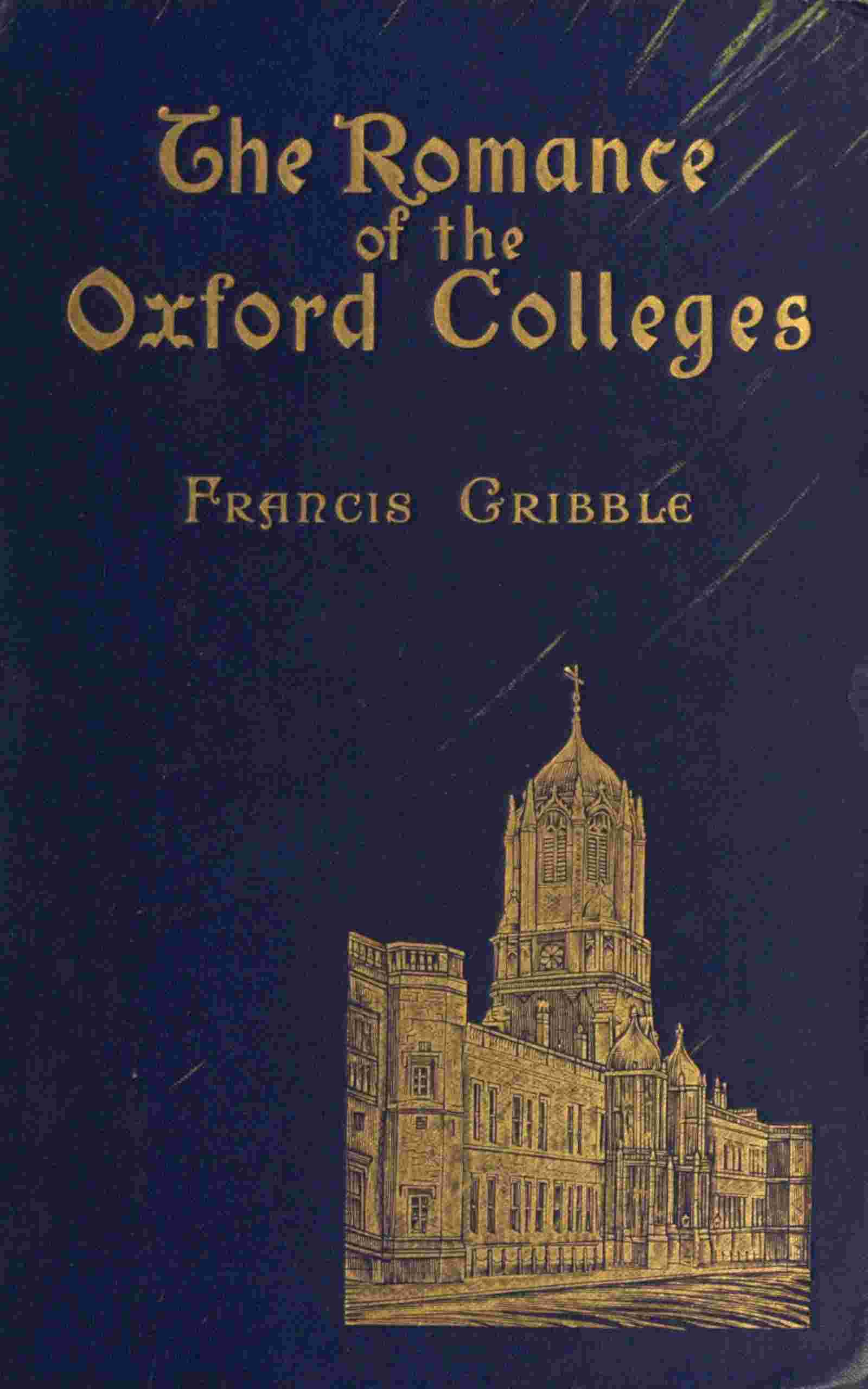
CHRIST CHURCH
Cardinal College—The fall of Wolsey—The foundation of Christ Church—Notable scenes—The degradation of Cranmer—The parliamentary visitation—The eviction of Dean Fell, Mrs. Fell, and all the little Fells—Famous Deans of Christ Church—John Fell—“I do not like thee, Dr. Fell”—Aldrich—Atterbury—Cyril Jackson—Gaisford—Eminent undergraduates—Sir Robert Peel’s practical joke—Gladstone and Martin Farquhar Tupper.
Cardinal Wolsey founded Cardinal College, spent about £8,000 on it—say £100,000 of our modern money—out of the proceeds of the disendowment of the monasteries, and then fell like Lucifer. Henry VIII. first stopped the work, but presently refounded the College, and united it with the new bishopric of Oxford, which was removed to that site from Osney. The Head of the College was also to be the Dean of the Cathedral; and the number of students on the foundation was to be 101. The 101 strokes of Great Tom, which are to be heard every evening of the year at nine o’clock, were originally ordered as a separate reminder to each one of the students that it was time to go to bed. Five minutes after the last stroke, the gates, not of Christ Church only but of every college in Oxford, are closed; though nowadays, as a concession to the modern spirit, porters are in attendance to open them to those who knock.
TOM QUAD AND TOWER, CHRIST CHURCH.
[To face p. 209.
That is as much as space permits to be said concerning the “beginnings.” They were not humble beginnings, like those of most of the other colleges, but splendid and ostentatious. Christ Church started with a flourish of trumpets which has hardly yet ceased sounding in our ears. Henry VIII. himself often dined in its Hall; and it has ever since been the frequent recipient of royal favours. It is impossible to walk in Tom Quad without feeling that this is the college of all others which kings, to whom life is a pageant, would delight to honour. Tom Quad, with its great spaces, its fountain, its wide pavement, has “an air about it” which no other college even simulates. There is an indefinable suggestion, not of study for study’s sake, but rather of leisurely preparation for the leadership of men. The very place, one would say, for the training of statesmen and pro-consuls. It seems incredible that the student who has had the right to pace Tom Quad should go away and fail in life. It does not cease to seem incredible when one learns that it has sometimes happened.
The history of Christ Church, indeed, is more of a pageant—or is fuller of pageants—than the history of any other college. Its full history would fill a book—not a short book, but a long one; but those whose historic sense bids them conjure up the picturesque features of the past will make their first pause at the striking scene of the degradation of Archbishop Cranmer, punished for being a Protestant at a time when the majority were Catholics: a shocking spectacle, though an imposing ceremony, and one anticipating, in all its meanest details of humiliation, that ceremony of the degradation of Captain Dreyfus which, not many years since, stirred the civilised world to horror.
The exact locality of the degradation is uncertain; but it took place, at any rate, somewhere close to the cathedral, and probably in the cloisters. Within the cathedral, Cranmer was set up on the rood-screen and made to listen to the recital of his iniquities. Then he was dragged down again and invested in episcopal robes made, in mockery, of rags and canvas. Then, when he had been declared, in the name of the Blessed Trinity and by the authority of the Church, deposed, degraded, and cut off from all the privileges attached to his episcopal Order, he was marched outside to endure the remainder of his punishment.
“One by one,” writes his biographer, Dean Hook, “all the ornaments and distinctions of office were taken off.... A barber clipped the hair round the Archbishop’s head; and Cranmer was made to kneel before Bonner. Bonner scraped the tips of the Archbishop’s fingers to desecrate the hand which, itself anointed, had administered the unction to others. The threadbare gown of a yeoman bedel was thrown over his shoulders, and a townsman’s greasy cap was forced upon his head. The Archbishop of Canterbury, or, as he was now called, Thomas Cranmer, was handed over to the secular power. In the lowest and most offensive manner the innate vulgarity of Bonner’s mind displayed itself. Turning to Cranmer, he exclaimed: ‘Now you are no longer my Lord,’ and he thought it witty ever afterwards to speak of him as ‘this gentleman here.’”
And so to Bocardo, and thence to the stake of martyrdom—a lamentable illustration of the bitter saying that Cambridge educated Reformers and that Oxford burnt them.
Such might be the first striking scene in a Christ Church pageant. A further scene—a whole series of further scenes, less tragic, indeed, but not less remarkable—may be found at the time of that Civil War to which it has been necessary to make so many references.
The King, as has already been mentioned, lodged at Christ Church, while the Queen’s Court was at Merton. Almost all the Christ Church men save the old and decrepit and the few who, as Wood puts it, “retained their sacred habit as a cloak for their sloth or timidity,” were ready to fight for the King; and they and many other men from other colleges mustered at the Schools and were marched through the High to Christ Church, “where, in the great quadrangle, they were reasonably instructed in the word of command and their postures.” They fought valiantly—twenty of them as officers—but with the result which the world knows; and presently, of course, when the city surrendered, and the Parliament sent its Visitors, there was as much trouble at Christ Church as anywhere.
Dean Samuel Fell, who was also Vice-Chancellor of the University, did his best to be dignified in extremely difficult circumstances. The Earl of Pembroke and Montgomery, who was Chancellor, harangued his Vice-Chancellor in the coarse language of the camp, and told him that he ought to be flogged; but Samuel Fell was not to be intimidated. These Visitors, he said, his juniors in academic standing and position, were too “inconsiderable” persons for the Dean of Christ Church to parley with. He therefore refused to parley with them; and they haled him off to prison, and then proceeded to the Deanery, where Mrs. Fell and the children held the fort.
They knocked, and there was no answer. They tried the door, and found that it was locked and barred. They smashed their way through it with sledge-hammers, entered, and waited for Mrs. Fell to go. But Mrs. Fell did not budge. Mrs. Fell even said that she had no intention of budging. When the Earl of Pembroke and Montgomery argued with her, she argued back with equal vigour; and there was nothing for it but to bid the soldiers act. They strapped Mrs. Fell into a chair, and they strapped all the little Fells on to boards, and they lifted their living, screaming, and protesting loads, and carried them out, and deposited them in the middle of Tom Quad, where they remained until three of the canons came to the rescue, and conducted them to a place of refuge in a neighbouring apothecary’s house. It may be doubted whether Tom Quad has ever witnessed so strange a scene, before or since.
Enough of the picturesque, however. We must next turn to personalities; and, as we find more famous men among Deans of Christ Church than among the Heads of any of the other Houses, we may fitly begin by saying something about some of them in the Mainly about People style. Dr. Samuel Fell’s son John has a fair title to come first. A popular rhyme preserves his memory, and the story of that rhyme must be told.
This second Dr. Fell was one of the first of the deans to take not only himself but his duties seriously. He insisted that Christ Church men should read, and also that they should wear academic dress; he raised the standard of examinations, and was strict in all matters of discipline. As he ruled in the loose days of the Restoration, he inevitably had trouble with some of the livelier spirits; and one of the liveliest of the recalcitrant was Tom Brown, an author and wit of some note in his day, though now forgotten. Tom Brown, having offended, was to be sent down; but, at the last moment, the Dean partially relented. He handed Tom Brown Martial’s epigram beginning “Non amo te, Sabidi,” and promised to allow him to remain in residence if he could extemporise a satisfactory English version of it. Whereupon Tom Brown improvised the familiar quatrain:
Hardly less famous is Aldrich—equally famous, as a logician, as a writer of catches, and as a smoker. His Logic remained the textbook in common use at Oxford for more than two centuries. Concerning his addiction to tobacco a story is told of a bet made that he would be found smoking at ten o’clock in the morning—a bet lost because, at the moment when the clock struck, he was not puffing at his pipe, but refilling it. One of his most popular catches was specially composed for the use of smokers, being so arranged as to give each singer a breathing time in which to keep his pipe alight. Moreover, much as the Dean loved his pipe, he loved his bowl no less; and he was the author of a Latin epigram, enumerating five excuses for the glass:
Aldrich’s successor was Atterbury, who had been a tutor under him; and Atterbury was the most brilliant of the Oxford representatives in the famous “Battle of the Books” concerning the authenticity of the “Epistles of Phalaris.” The ultimate victory in that encounter rested, of course, with Bentley of Trinity, Cambridge, for the Oxford case had not a leg to stand upon; but the Christ Church wits were at least successful in obscuring the issue and throwing dust in the eyes of their contemporaries: a cheap success, no doubt, but better than none at all. It is a pretty story; but the reader who is curious about it must be referred to Macaulay or Jebb, for there remain three other deans with clamorous claims upon our space.
Cyril Jackson is the greatest of them. He had been the tutor of the Regent and his brothers, who had “imbibed” from him, according to his biographer, “that elevation of sentiment, that pride of soul, and that generosity of spirit which teaches them, as it were innately, to look down upon everything which bears the semblance of mean, low, or sordid feeling.” In that eulogy, no doubt, the exaggerations of the courtier are combined with those of the necrologist; but it was not Cyril Jackson’s fault if the lovers of Mrs. Fitzherbert and Mary Ann Clarke failed to imbibe all the virtues which one could wish them to have displayed. He was an excellent tutor and an admirable Dean, who raised the College to a pitch of efficiency never before attained. He joined with Parsons of Balliol and Eveleigh of Oriel in originating honours examinations, and his own men did strikingly well in them. Sir Robert Peel was one of his double-firsts. He was in correspondence with Sir Robert at the beginning of his public career, and advised him to perfect his oratorical style “by the continual reading of Homer.”
His courtly dignity may be said to have laid the foundation of the Christ Church manner—of the manner, at all events, which one associates with the Deans of Christ Church. They, more than the Heads of any other Houses, have aimed at fulfilling the ideal of the “magnificent man” of Aristotle’s “Ethics”—with what success those who have seen the towering figure of Dean Liddell, filling the aisles of the cathedral with the pageant of his presence, are aware. This personal majesty, it is understood, is rather the appanage of the office than the accidental attribute of any individual; and the serene and well-warranted self-sufficiency of Cyril Jackson, imitated, consciously or unconsciously, by his successors, is its source.
Cyril Jackson was so satisfied with his position that he refused all offers of ecclesiastical preferment. Probably he felt that no other office could be more exalted than that which he held and adorned. At all events he declined more than one bishopric, and his reply to one of the offers is historical. “Nolo episcopari. Try my brother Bill; he’ll take it.” But he did not, on the other hand, cling to the office from which he was unwilling to be promoted. He retired from it, at the age of sixty-three, when his reputation was at its highest, and spent his last years quietly in the country. Some Latin elegiacs in which he expressed his preference for the simple life are too delightful not to be quoted:
Dean Hall, who succeeded, may be passed over. Dean Smith, who came next, was known as “Presence of mind Smith.” While an undergraduate, it was said, he had gone boating, and had returned alone. His companion, he explained, had fallen into the river, and had clung to the side of the boat. “Neither of us,” Smith said, “could swim; and if I had not, with great presence of mind, hit him on the head with the boat-hook, both of us would have been drowned.” That story, however, is only repeated, as the journalists say, “with reserve.” Having repeated it, one passes on to Gaisford, whose memory has left more lasting traces.
Gaisford was a protégé of Cyril Jackson, who is said to have said to him: “You will never be a gentleman, but you may succeed with certainty as a scholar.” That he was not, at any rate, a man of the world, may be inferred from his reply to the letter in which Lord Liverpool offered him the Regius Professorship of Greek. “My lord,” he wrote bluntly, “I have received your letter and accede to its contents. Yours, &c.” That he succeeded as a scholar is attested by the fact that when he went to Germany and called on Dindorf, the great Teuton, though he had never been introduced to him, fell on his neck, and kissed him on both cheeks.
Discipline, however, did not flourish in Gaisford’s time, or in that of his immediate predecessors, as it had flourished in the time of the great Cyril. This was the period in which an undergraduate was killed in a “rag”—his back broken across a chair by the too athletic Lord Hillsborough, he who, together with Peard of Brasenose (Garibaldi’s Englishman), cleared the streets of bargees in “town and gown rows.” This was also the period when the Marquis of Waterford and his company painted the door of the Deanery, and the doors of the canons’ residences, red, because of the objection taken to their hunting in pink. It was the period, too, when the flowers were dug up out of the Deanery garden and scattered about the quad—whence the expression “planting Peckwater” as a picturesque synonym for a Christ Church rag. It was the period, finally, when the statue of Mercury, formerly standing in the centre of the fountain in Tom Quad, was dressed in the robes of a Doctor of Divinity. The thing happened in the dead of winter, when the water in the fountain was frozen hard. After the deed had been done, the ice was broken, so that none could get to Mercury without wading through freezing water, five feet deep.
Though these things happened, however, there was a dignity about Gaisford, none the less. It came out when he received a letter beginning: “The Dean of Oriel presents his compliments to the Dean of Christ Church”; on which communication Gaisford’s classical comment was “Alexander the coppersmith sends greeting to Alexander the Great!” It came out again in the sermon in which he exhorted his congregation to the study of the Greek language on the ground that a knowledge of that tongue would enable them “not only to read the oracles of God in the original, but also to look down with contempt upon the vulgar herd.”
Leaving the deans, and turning to the undergraduates, one hardly knows where to begin; for the great names are as thick as bilberries, and belong to every department of activity. One might begin a very miscellaneous list with the names of Hakluyt, John Locke the philosopher, and William Penn, the founder of Pennsylvania—a list which does not become any the less miscellaneous by the addition of the names of John and Charles Wesley, and Canon Liddon. Or one may recall that Christ Church has educated three successive Viceroys of India in Lords Dalhousie, Canning, and Elgin, and three successive Premiers in Gladstone and Lords Salisbury and Rosebery, and various other Prime Ministers, including Lord Liverpool, and George Canning, and Sir Robert Peel.
Peel, it is to be remembered, was the first Christ Church man to take a double first; and he took it with remarkable éclat. The viva voce part of the examination was much more important in those days than in these. Theoretically it still takes place in the presence of spectators; but the benches are usually empty. Then there often were crowded houses to listen to the entertainment; and the examining of Peel was a great occasion, like a first night at an important theatre. There was “standing room only”; and when the examinee distinguished himself there was “loud and prolonged applause,” if not actually an encore and a “call.” One wonders whether there were any who divined the verbosity of the future orator when they heard him render suave in suave mari magno, “It is a source of gratification.”
Yet Peel, prematurely solemn as he was, could sometimes unbend, and once played a practical joke. The victim of it was a timorous freshman, known to be a scholar of poor quality. The unhappy youth received a message to the effect that the Vice-Chancellor, having heard of his ignorance, and desiring to test it, proposed to examine him privately, in his rooms, in the Greek Testament. The supposed Vice-Chancellor, who duly visited him, was Peel in disguise, attended by a scout disguised as an Esquire Bedell. Peel put the freshman through his paces, denounced his blunders in a severe tone of voice, and told him that he would probably be expelled. The freshman, so the story concludes, fled from the College without waiting for the confirmation of this sentence of expulsion, and was never heard of again.
Gladstone, who was to be so ardent a disciple of Peel in many things, imitated him, in the first instance, by taking a double first—he was one of the five first-class men in both the classical and mathematical lists; but his failures are quite as interesting as his successes. He was beaten for a Divinity Prize by Martin Farquhar Tupper, the proverbial philosopher, whose acquaintance he had made as the result of their common habit of attending the Communion Service at the Cathedral. He also competed unsuccessfully for the Ireland; and he has related how one of the examiners explained his defeat to him. “He abused me,” he says, “for my essay, on which he said his own memorandum was ‘desultory beyond belief’; also for throwing dust in the examiners’ eyes, like a man who, when asked who wrote ‘God save the King?’ replied, ‘Thompson wrote “Rule, Britannia.”’”
That, it will be allowed, was characteristic; and there is something not less characteristic in the story which Lord Morley tells of his “Greats” examination:
“The excitement,” Lord Morley writes, “reached its climax when the examiner, after testing his knowledge of some point of theology, said: ‘We will now leave that part of the subject,’ and the candidate, carried away by his interest in the subject, answered: ‘No, sir; if you please, we will not leave it yet.’”
One could tell other stories, of course, if there were room for them; but Gladstone’s life at Oxford was not, except for his success in the schools, either sensational or eventful. His diary shows that he gave, or went to, a wine-party nearly every night; that he was very pleased with himself when he succeeded in making a speech of three-quarters of an hour’s duration at the Union; and that he “haunted sermons,” as the Consistory of Geneva ordered the Prisoner of Chillon to do. That is practically all that there is to be said; but one may conclude by quoting Gladstone’s mature opinion of his University. “Oxford,” he wrote, two generations later, “had rather tended to hide from me the great fact that liberty is a great and precious gift of God, and that human excellence cannot grow up in a nation without it.”
Oxford, it is not to be denied, does sometimes tend thus to confound and obscure the human spirit. That is one of the defects of the qualities of its atmosphere. It not only clings to lost causes—it gets stuck to them, as it were with glue; and it allows reactionary obscurantists like Pusey—to take the first Christ Church instance that occurs—to have too much to say. Gladstone evidently came to feel that, in later life, when he had left the “weeds,” as he called them, of ecclesiasticism behind him. But his deep love for his University was never affected by the discovery. To say of any one, he once declared, that he was “a typically Oxford man” was to pay him the highest possible compliment; and it will readily be believed that that is not a proposition which this work is written to dispute.