
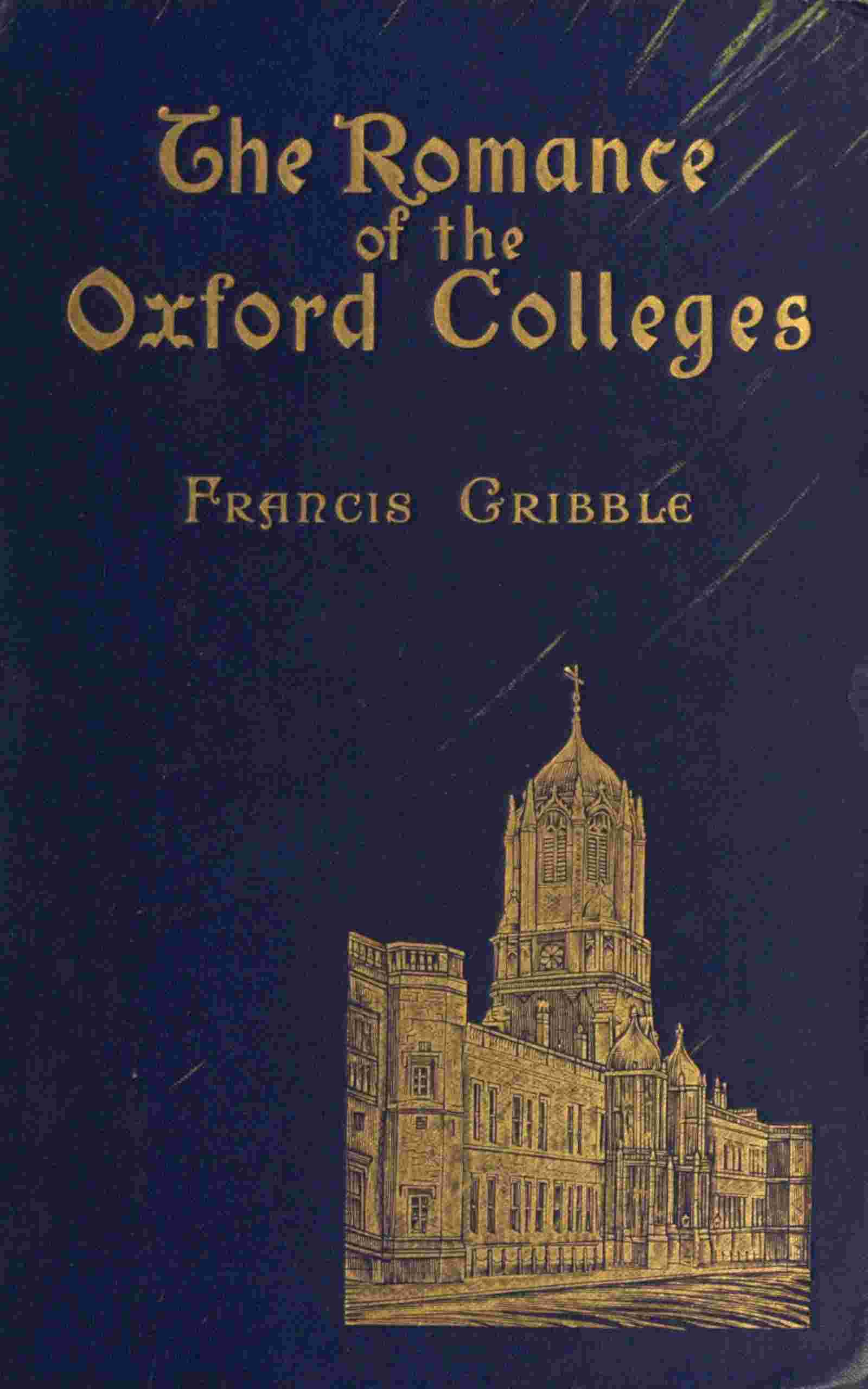
TRINITY COLLEGE
Founded with the spoils of monasteries—The sympathy of Queen Elizabeth—President Kettell—His objection to long hair—His trouble with the Court ladies during the Civil War—Dr. Johnson’s love of the College—The expulsion of Walter Savage Landor—Newman in his evangelical days—The Gentlemen Adventurers—Richard Burton’s revolt against discipline.
Trinity was founded with the spoils of monasteries, in 1554; and the property of the “buzzing monks” was thus put to better uses than ever before. The founder, Sir Thomas Pope, was Princess Elizabeth’s guardian at Hatfield, in Queen Mary’s reign; and he interested the Princess in his educational enterprise. It is on record that our virgin ruler interceded on behalf of two early Fellows of Trinity who had got out of the College by night by climbing over the wall—for what purpose the chronicler does not relate. They had been expelled; but—“at my Lady Elizabeth her Grace’s desire”—they were readmitted on payment of a fine.
TRINITY COLLEGE.
[To face p. 226.
The College, though a small one, and not very richly endowed, has always had a claim to distinction. If one cannot say of it, as one can of some of the other colleges, that, at a given moment, it stood for Oxford, supplying the mind, or the energy, which set the mass in motion, one can, at least, say that it preserved its intellectual activity in times of sloth, and has an exceptionally long list of illustrious names on its books—largely, perhaps, because it has been less hampered than some other colleges by “close scholarships” and provisions for showing preference to “founders’ kin.” It has educated statesmen like the Earl of Chatham and Lord North; such prominent Parliament men as Ludlow and Ireton; poets of varying degrees of merit from Elkanah Settle to Walter Savage Landor; divines, of whom John Henry Newman is the most famous; a number of gentlemen adventurers, of whom more presently; a number of men of letters, among whom Mr. Quiller Couch must on no account be overlooked.
In the case of so small a College maintaining so high a standard, one naturally looks for Presidents of commanding personality; and one finds such a President in Dr. Kettell, who flourished in the reign of Charles I., and whose memory is still preserved by Kettell Hall in the Broad. Dr. Kettell, it is recorded, “had a very venerable person and was an excellent governor”; and the chronicle of his governorship is happily full of those picturesque details which make it interesting to realise what the academic life of the past was like.
In his gown and surplice and hood, he had, says Aubrey, “a terrible, gigantic aspect with his sharp grey eyes”; but the impressiveness of his appearance must have been of a different order when he was seen on horseback, on Sundays, riding out to preach at Garsington, “with his boy Ralph before him, with a leg of mutton and some College bread.” He loved his College, and lived for it, and, where deeds of charity were concerned, let not his right hand know what his left hand did. One of the happy deeds done by his left hand was to thrust money secretly in at the windows of students whom he knew to be poor; and one of his modes of promoting sobriety was to see that the Trinity beer was the best in Oxford, so that no Trinity man should have any excuse for visiting a tavern.
One of the best known of his idiosyncrasies was his objection to long hair; for the wearing of long hair was not, as is sometimes carelessly assumed, first introduced into Oxford by the æsthetes. Whereas they wore their hair long as a mark of the sensibility of their souls, the imitators of the Cavaliers had done so, long before them, in vanity, and for the purpose of proving themselves to be men of fashion. President Kettell was “irreconcilable” to the habit. He went about with a pair of scissors for the purpose of cutting men’s hair when he found it offensively long; and when he happened not to have his scissors with him, he used a knife.
“I remember,” says Aubrey, “he cut Mr. Radford’s hair with the knife that chips the bread on the buttery hatch, and then he sang,
That was at dinner in hall—a curious incident; but times have changed, and many things happened at Oxford in the reign of Charles I. which happen there no longer. Probably, too, when the Court came to Oxford at the beginning of the Civil War, the President’s hostility to long hair relaxed. His principal trouble then was with the Court ladies who attended Divine services in the Trinity chapel, “half-dressed,” to the great scandal of the undergraduates, and walked in the Trinity Grove with their gallants. Some of them, it seems, used to play the lute there—a disconcertingly unacademical proceeding, most disadvantageous to discipline; and the climax was reached when two specially audacious ladies—“my Lady Isabella Thynne and fine Mistress Fenshawe, her great and intimate friend”—carried frivolity to the point of calling on the President.
That, indeed, is a scene worth picturing: on the one hand the “Oxford character,” neither accustomed to the society of ladies nor desirous of it, a man of dignity and authority, though unpolished, very wroth at the intrusion of “minxes” in the paths of academic peace; on the other hand high-spirited and mischievous beauties, to whom great academic names were nothing and great academic potentates were only so many “musty old professors.” Their idea, apparently, was to ogle the President—to make him flirt with them—and, failing that, to overwhelm him with satirical reproaches as a cross-grained old gentleman. And, no doubt, the President was cross-grained, and entirely indisposed to flirt; but he was a match for his visitors none the less.
“Madam,” he said, addressing himself to Mistress Fenshawe, “your husband and father I bred up here, and I knew your grandfather. I know you to be a gentlewoman, and I will not say you are a baggage; but get you gone for a very woman!”
And, so speaking, he drove the giggling intruders from his presence, as summarily as Benjamin Jowett, at a later date, expelled a deputation of the Balliol washerwomen from the Master’s lodge. He makes a characteristic exit speech in that scene, and leaves us free to call up ghosts of other men.
The ghost of Dr. Johnson would readily appear if called. He stayed at Kettell Hall while working at his Dictionary; he said that he would rather live at Trinity than anywhere else at Oxford; his young friends Bennet Langton and Topham Beauclerk were both Trinity men. Dr. Johnson, however, will be waiting for us when we come to speak of Pembroke; so we may put him on one side, and recall the memory of the greatest of the Trinity poets, Walter Savage Landor. He was one of the many Oxford poets who, like Shelley and Swinburne, have left the University without a degree; and his manner of leaving, like Shelley’s, was violent, and the result of variance with the dons.
Landor of Trinity, be it observed, was the contemporary of Southey of Balliol. Like Southey, he distinguished himself by refusing to have his hair powdered, in the conventional style, for dinner; but Southey only knew him by repute, as he told Humphry Davy on the publication of “Gebir.” Landor, Southey then wrote, was “notorious as a mad Jacobin.” He would have sought his acquaintance, he said, for the sake of the Jacobinism, if the concomitant madness had not deterred him; and he concludes, giving chapter and verse for the madness: “He was obliged to leave the University for shooting at one of the Fellows through the window.” But that was not quite true. The story, after the way of stories, had both gained and lost something on its short journey from Trinity to Balliol; and Landor himself has left a record of the rights of it in a letter written shortly after the occurrence.
He was a Rugby man, of the days before Rugby had gone in for “moral seriousness.” He exhibited the roughness of Rugby, together with a spasmodic uncertainty of temper which was all his own; and, though he was an excellent Grecian, he did not imitate the Greeks in mixing water with his wine. In the rooms opposite to his there lived a man named Leeds whom he did not like—a man of whom he writes that “with a figure extremely disgusting, he was more so in his behaviour,” and that “he was continually intruding himself where his company was not wanted.”
One evening it happened that Leeds and Landor were both giving wines; Leeds’s party consisting, according to Landor, of “servitors and other raffs of every description.” The weather was warm, and both parties had their windows open. Neither party, one suspects, was more than relatively sober; and so, feelings running high, the two parties began to express their opinions of each other in a slanging match, until presently Leeds’s party, tired of the wordy war, closed the window, and fastened the shutters. Then Landor, as a final expression of his contempt, discharged a shot-gun at the shutters.
Nobody was hurt—nobody could have been hurt; but Leeds complained and the President sent for Landor; and Landor’s awkward temper was his undoing. Availing himself of the fact that the shot had proceeded, not from the sitting-room, but from the bedroom, he told the President that no gun had been fired from the room in which his company were assembled; and he added that, as no definite person was accused of the offence, he did not feel called upon to reply to this vague charge. The President, however, as it happened, was not the sort of man to be fooled or bluffed.
“Have you got a gun, Mr. Landor?” he asked; and Landor admitted that he had.
“Will you show it to me?”
“Certainly.”
“Has it been fired lately?”
“Yes.”
“In that case, Mr. Landor, and as I have also taken occasion to question your guests——”
So the dialogue ran; and the cross-examination established, if not the legal proof, at least the moral certainty of Landor’s guilt. But he still tried to bluff.
“Mr. President,” he said, “it is against the law of England to require a prisoner to incriminate himself”; but the President retired to consult the Senior Common-room, and returned to pronounce sentence.
“Mr. Landor,” he said, “it is the opinion of the Fellows that you be rusticated for two terms.” And so it happened; and Oxford lost another of her poets—more through the poet’s fault, it must be admitted, than through her own.
The link of poetry, though there is no other, may couple Landor’s name with Newman’s. The most momentous events of Newman’s Oxford career have been spoken of in the Oriel chapter; but he was a Trinity undergraduate, and Trinity’s claim to him must be recognised. “Trinity,” he has written, “has never been unkind to me”; and in 1885 he presented the College library with a set of his works, expressing the hope that the yearly festival of the College might be “as happy a day to you all as in 1818 it was to me.”
Yet there are indications that Newman’s happiness at Trinity was diversified by spiritual distress, and by pained disapproval of the frivolity of others. He had but lately been “converted”; and his conversion made him a wet blanket in merry company. His thoughts, apart from his studies, were not confined to the “snapdragon growing on the walls opposite my freshman’s rooms” of which he afterwards spoke with a poet’s grateful recollection. His Evangelicalism (for he was then an Evangelical) was shocked by the too bibulous propensities of his fellow-men. He could not share in such jollities, like Landor; and at the approach of the College Gaudy, his letters take the tone of a Commination Service:
“To-morrow is our Gaudy. If there be one time of the year in which the glory of our College is humbled, and all appearance of goodness fades away, it is on Trinity Monday. Oh, how the angels must lament over a whole society throwing off the allegiance and service of their Maker, which they have pledged the day before at His table, and showing themselves the sons of Belial!”
Is it really well, one wonders, for a young man to be quite so good as that at quite such an early age? Probably not. The sentences seem to echo the artificial ring of the Evangelicalism of the decadence, which is a displeasing sound; and one turns, not without relief, from Newman to the Gentlemen Adventurers.
It has been mentioned that the first Earl of Chatham was once Pitt of Trinity; and it was under his direction that England conquered the Empire “in a fit of absence of mind”—an Empire which, by the way, Lord North of Trinity went the right way to lose. His name, therefore, though no stories of his Oxford adventures have been preserved, fittingly introduces our list.
The first name on the list is that of Sir Francis Verney, of whom many interesting stories may be read in the “Memoirs of the Verney Family”; he was, in turn, a galley-slave, a common soldier, and a pirate on the Barbary coast, and died miserably in the hospital at Messina in 1615. The second name is that of Calvert, of Trinity, who became Lord Baltimore, and founded the colony of Maryland. The third—to pass over minor names—is that of Richard Burton.
“Readers must be prepared,” says Lady Burton, writing of her husband’s Oxford curriculum, “not to hear the recital of the College course of a goody-goody boy of yesterday”; and though Burton did row in the Trinity torpid, and compete for two scholarships, which he failed to win, his proceedings were, on the whole, irregular. He had lived much abroad, and came to Oxford with ideas somewhat different from those of the ordinary public school boy.
The first thing that happened to him on his arrival was that the College authorities requested him to shave off his moustache. He declined to do so unless they put their request in the shape of a formal written order. Some undergraduates then laughed at his moustache; and he handed them his card, and called them out, though the threatened duel was prevented from taking place. He was next advised to sport his oak, lest he should be ragged; but instead of doing that, he left the door wide open, and thrust the poker in the fire, prepared to give his persecutors a warm reception if they came. The opinion gained ground that he was a desperate character, and he was left unmolested.
His studies were as unconventional as his behaviour—he began to learn Arabic—and so also were his recreations. Those were the days of rowdyism—the days in which, as has just been related, the Marquis of Waterford painted the door of the Dean and Canons of Christ Church red; and Burton thoroughly enjoyed diversions of that order. He once caused himself to be let down with a rope into the garden of the Master of Balliol, pulled up that old gentleman’s choicest flowers, and planted staring marigolds in their place. He also, when the Master of Balliol was watering his flowers, shot at the watering-pot with an air-gun. But, taking one consideration with another, nothing was quite so characteristic of his life at Oxford as his leaving of it.
He had told his father, during the vacation, that he would like to take his name off the books; but his father had insisted on his returning. He returned with the firm resolve of overreaching the parental authority by doing something that would bring about his expulsion; and a race-meeting in the neighbourhood gave him his opportunity.
Undergraduates were not only forbidden to attend that race-meeting; they were ordered to be present without fail at lectures, at the hour at which the races took place. “Tyranny! Unjustifiable interference with the liberty of the subject!” exclaimed Burton and a few other of the wilder spirits; and they ordered tandems to be in waiting for them, behind Worcester, and drove out of Oxford at a spanking pace at the very hour at which the roll was being called.
Of course they were missed; and of course they were sent for, and asked for explanations. The explanations of the others were of a humble character; but Burton’s explanations made matters worse. He blurted out that he saw no harm in attending a race-meeting, and was aware of no reason why undergraduates should be treated like babies in arms; and he not only said that, but went on to moralise.
“Trust begets trust,” he solemnly said, “and they who trust us elevate us”; and it was not to be expected that the dons would put up with that.
Nor did they. They expelled Burton, while contenting themselves with rusticating his companions; and he received the sentence with the same imperturbably high moral tone. He hoped, he said, “that the caution money deposited by his father would be honestly returned to him.” At that there was “movement.” It seemed, for the moment, as if the dons proposed to expel Burton not only from the College, but from the room. He brought his heels together, bowed to them in the courtly Austrian fashion, wished them happiness and prosperity, and withdrew. Then he went down.
But not immediately, and not without a demonstration; and the description of the final scene may be taken from the Life by Mr. Francis Hitchman:
“One of his rusticated friends—Anderson of Oriel,” writes Mr. Hitchman, “had proposed that they should leave with a splurge—‘go up from the land with a soar.’ There was now no need for the furtive tandem behind Worcester College: it was driven boldly up to the College doors. Richard’s bag and baggage were stowed away in it, and, with a cantering leader and a high-trotting horse in the shafts, carefully driven over the beds of the best flowers, they started for the High Street and the Queen’s highway to London, Richard energetically performing upon a yard of tin, waving adieux to his friends, and kissing his hand to the pretty shop-girls.”