
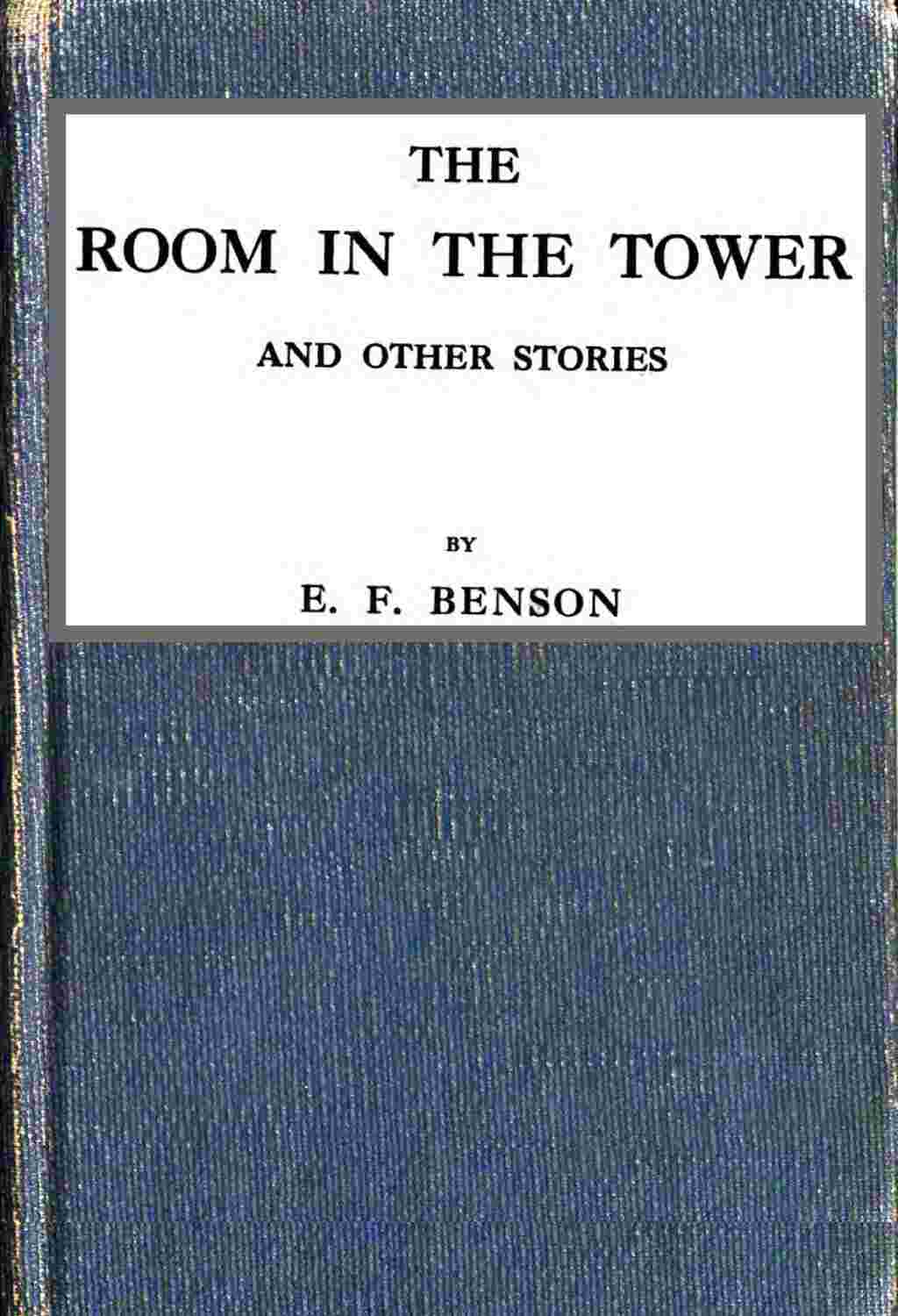
The Project Gutenberg eBook of The room in the tower, and other stories
Title: The room in the tower, and other stories
Author: E. F. Benson
Release date: December 15, 2023 [eBook #72421]
Most recently updated: March 3, 2024
Language: English
Original publication: London: Mills & Boon, 1912
Credits: Chuck Greif, Tim Lindell and the Online Distributed Proofreading Team at https://www.pgdp.net (This book was produced from images made available by the HathiTrust Digital Library.)
THE ROOM IN THE TOWER
AND OTHER STORIES
THE MORNING POST says: “Messrs Mills & Boon seem to have acquired a monopoly in clever first novels.” THE PALL MALL GAZETTE says: “We have come to expect good work from the publishers of ‘In Different Keys’ (Mills & Boon).” THE GLOBE says: “One has almost come to regard Messrs Mills & Boon as the publishers of the unexpected. Alike in fiction and in more serious works, they introduce us to writers of exceptional ability, and to subjects of uncommon interest.” THE NEW YORK HERALD says: “They have long ago acquired the reputation for the production of original books.”
Mills & Boon’s New Novels
Crown 8vo, 6s. each
THE LURE. E. S. Stevens.
THE DAUGHTER OF BRAHMA. I. A. R. Wylie.
THE ROOM IN THE TOWER. E. F. Benson.
A BACHELOR’S COMEDY. J. E. Buckrose.
THE PALACE OF LOGS. Robert Barr.
WHEN GOD LAUGHS. Jack London.
ASHES OF INCENSE. By the Author of “Mastering Flame.”
HIS FIRST OFFENCE. J. Storer Clouston.
THE PRELUDE TO ADVENTURE. Hugh Walpole.
THE BATTLE. Claude Farrere.
STORIES WITHOUT TEARS. Barry Pain.
THE FRONTIER. Maurice Leblanc.
THE MARK. Mrs Philip Champion de Crespigny.
THE GIRL WITH THE BLUE EYES. Lady Troubridge.
SONS OF STATE. Winifred Graham.
ENTER BRIDGET. Thomas Cobb.
THE THORNBUSH NEAR THE DOOR. Sophie Cole.
MEN AND DREAMS. Mary E. Mann.
THE WRITTEN LAW. Frances G. Knowles-Foster.
RUTH OF THE ROWLDRICH. Mrs Stanley Wrench.
THE PRINCE. T. Metcalfe.
THE SILVER MEDALLION. Percy J. Brebner.
THE PRINCE AND BETTY. P. G. Wodehouse.
ALIENS NEAR OF KIN. N. Vernon.
THE
ROOM IN THE TOWER
AND OTHER STORIES
BY
E. F. BENSON
AUTHOR OF
“THE ANGEL OF PAIN,” “SHEAVES”
SECOND EDITION
MILLS & BOON, LIMITED
49 RUPERT STREET
LONDON W.
Published 1912
Copyright in the United States of America, 1912, by E. F. Benson
PREFACE
THESE stories have been written in the hopes of giving some pleasant qualms to their reader, so that, if by chance, anyone may be occupying in their perusal a leisure half-hour before he goes to bed when the night and the house are still, he may perhaps cast an occasional glance into the corners and dark places of the room where he sits, to make sure that nothing unusual lurks in the shadow. For this is the avowed object of ghost-stories and such tales as deal with the dim unseen forces which occasionally and perturbingly make themselves manifest. The author therefore fervently wishes his readers a few uncomfortable moments.
Some of those tales have appeared before in various magazines; the remainder are new. One, the story of “The Man who went too Far,” is the germ of what subsequently developed into a book called “The Angel of Pain.”
E. F. Benson.
CONTENTS
THE ROOM IN THE TOWER
IT is probable that everybody who is at all a constant dreamer has had at least one experience of an event or a sequence of circumstances which have come to his mind in sleep being subsequently realised in the material world. But, in my opinion, so far from this being a strange thing, it would be far odder if this fulfilment did not occasionally happen, since our dreams are, as a rule, concerned with people whom we know and places with which we are familiar, such as might very naturally occur in the awake and day-lit world. True, these dreams are often broken into by some absurd and fantastic incident, which puts them out of court in regard to their subsequent fulfilment, but on the mere calculation of chances, it does not appear in the least unlikely that a dream imagined by anyone who dreams constantly should occasionally come true. Not long ago, for instance, I experienced such a fulfilment of a dream which seems to me in no way remarkable and to have no kind of psychical significance. The manner of it was as follows.
A certain friend of mine, living abroad, is amiable enough to write to me about once in a fortnight. Thus, when fourteen days or thereabouts have elapsed since I last heard from him, my mind, probably, either consciously or subconsciously, is expectant of a letter from him. One night last week I dreamed that as I was going upstairs to dress for dinner I heard, as I often heard, the sound of the postman’s knock on my front door, and diverted my direction downstairs instead. There, among other correspondence, was a letter from him. Thereafter the fantastic entered, for on opening it I found inside the ace of diamonds, and scribbled across it in his well-known handwriting, “I am sending you this for safe custody, as you know it is running an unreasonable risk to keep aces in Italy.” The next evening I was just preparing to go upstairs to dress when I heard the postman’s knock, and did precisely as I had done in my dream. There, among other letters, was one from my friend. Only it did not contain the ace of diamonds. Had it done so, I should have attached more weight to the matter, which, as it stands, seems to me a perfectly ordinary coincidence. No doubt I consciously or subconsciously expected a letter from him, and this suggested to me my dream. Similarly, the fact that my friend had not written to me for a fortnight suggested to him that he should do so. But occasionally it is not so easy to find such an explanation, and for the following story I can find no explanation at all. It came out of the dark, and into the dark it has gone again.
All my life I have been a habitual dreamer: the nights are few, that is to say, when I do not find on awaking in the morning that some mental experience has been mine, and sometimes, all night long, apparently, a series of the most dazzling adventures befall me. Almost without exception these adventures are pleasant, though often merely trivial. It is of an exception that I am going to speak.
It was when I was about sixteen that a certain dream first came to me, and this is how it befell. It opened with my being set down at the door of a big red-brick house, where, I understood, I was going to stay. The servant who opened the door told me that tea was going on in the garden, and led me through a low dark-panelled hall, with a large open fireplace, on to a cheerful green lawn set round with flower beds. There were grouped about the tea-table a small party of people, but they were all strangers to me except one, who was a school-fellow called Jack Stone, clearly the son of the house, and he introduced me to his mother and father and a couple of sisters. I was, I remember, somewhat astonished to find myself here, for the boy in question was scarcely known to me, and I rather disliked what I knew of him: moreover, he had left school nearly a year before. The afternoon was very hot, and an intolerable oppression reigned. On the far side of the lawn ran a red-brick wall, with an iron gate in its centre, outside which stood a walnut tree. We sat in the shadow of the house opposite a row of long windows, inside which I could see a table with cloth laid, glimmering with glass and silver. This garden front of the house was very long, and at one end of it stood a tower of three stories, which looked to me much older than the rest of the building.
Before long, Mrs Stone, who, like the rest of the party, had sat in absolute silence, said to me, “Jack will show you your room: I have given you the room in the tower.”
Quite inexplicably my heart sank at her words. I felt as if I had known that I should have the room in the tower, and that it contained something dreadful and significant. Jack instantly got up, and I understood that I had to follow him. In silence we passed through the hall, and mounted a great oak staircase with many corners, and arrived at a small landing with two doors set in it. He pushed one of these open for me to enter, and without coming in himself, closed it behind me. Then I knew that my conjecture had been right: there was something awful in the room, and with the terror of nightmare growing swiftly and enveloping me, I awoke in a spasm of terror.
Now that dream or variations on it occurred to me intermittently for fifteen years. Most often it came in exactly this form, the arrival, the tea laid out on the lawn, the deadly silence succeeded by that one deadly sentence, the mounting with Jack Stone up to the room in the tower where horror dwelt, and it always came to a close in the nightmare of terror at that which was in the room, though I never saw what it was. At other times I experienced variations on this same theme. Occasionally, for instance, we would be sitting at dinner in the dining-room, into the windows of which I had looked on the first night when the dream of this house visited me, but wherever we were, there was the same silence, the same sense of dreadful oppression and foreboding. And the silence I knew would always be broken by Mrs Stone saying to me, “Jack will show you your room: I have given you the room in the tower.” Upon which (this was invariable) I had to follow him up the oak staircase with many corners, and enter the place that I dreaded more and more each time that I visited it in sleep. Or, again, I would find myself playing cards still in silence in a drawing-room lit with immense chandeliers, that gave a blinding illumination. What the game was I have no idea; what I remember, with a sense of miserable anticipation, was that soon Mrs Stone would get up and say to me, “Jack will show you your room: I have given you the room in the tower.” This drawing-room where we played cards was next to the dining-room, and, as I have said, was always brilliantly illuminated, whereas the rest of the house was full of dusk and shadows. And yet, how often, in spite of those bouquets of lights, have I not pored over the cards that were dealed me, scarcely able for some reason to see them. Their designs, too, were strange: there were no red suits, but all were black, and among them there were certain cards which were black all over. I hated and dreaded those.
As this dream continued to recur, I got to know the greater part of the house. There was a smoking-room beyond the drawing-room, at the end of a passage with a green baize door. It was always very dark there, and as often as I went there I passed somebody whom I could not see in the doorway coming out. Curious developments, too, took place in the characters that peopled the dream as might happen to living persons. Mrs Stone, for instance, who, when I first saw her, had been black haired, became grey, and instead of rising briskly, as she had done at first when she said, “Jack will show you your room: I have given you the room in the tower,” got up very feebly, as if the strength was leaving her limbs. Jack also grew up, and became a rather ill-looking young man, with a brown moustache, while one of the sisters ceased to appear, and I understood she was married.
Then it so happened that I was not visited by this dream for six months or more, and I began to hope, in such inexplicable dread did I hold it, that it had passed away for good. But one night after this interval I again found myself being shown out on to the lawn for tea, and Mrs Stone was not there, while the others were all dressed in black. At once I guessed the reason, and my heart leaped at the thought that perhaps this time I should not have to sleep in the room in the tower, and though we usually all sat in silence, on this occasion the sense of relief made me talk and laugh as I had never yet done. But even then matters were not altogether comfortable, for no one else spoke, but they all looked secretly at each other. And soon the foolish stream of my talk ran dry, and gradually an apprehension worse than anything I had previously known gained on me as the light slowly faded.
Suddenly a voice which I knew well broke the stillness, the voice of Mrs Stone, saying, “Jack will show you your room: I have given you the room in the tower.” It seemed to come from near the gate in the red-brick wall that bounded the lawn, and looking up, I saw that the grass outside was sown thick with gravestones. A curious greyish light shone from them, and I could read the lettering on the grave nearest me, and it was, “In evil memory of Julia Stone.” And as usual Jack got up, and again I followed him through the hall and up the staircase with many corners. On this occasion it was darker than usual, and when I passed into the room in the tower I could only just see the furniture, the position of which was already familiar to me. Also there was a dreadful odour of decay in the room, and I woke screaming.
The dream, with such variations and developments as I have mentioned, went on at intervals for fifteen years. Sometimes I would dream it two or three nights in succession; once, as I have said, there was an intermission of six months, but taking a reasonable average, I should say that I dreamed it quite as often as once in a month. It had, as is plain, something of nightmare about it, since it always ended in the same appalling terror, which so far from getting less, seemed to me to gather fresh fear every time that I experienced it. There was, too, a strange and dreadful consistency about it. The characters in it, as I have mentioned, got regularly older, death and marriage visited this silent family, and I never in the dream, after Mrs Stone had died, set eyes on her again. But it was always her voice that told me that the room in the tower was prepared for me, and whether we had tea out on the lawn, or the scene was laid in one of the rooms overlooking it, I could always see her gravestone standing just outside the iron gate. It was the same, too, with the married daughter; usually she was not present, but once or twice she returned again, in company with a man, whom I took to be her husband. He, too, like the rest of them, was always silent. But, owing to the constant repetition of the dream, I had ceased to attach, in my waking hours, any significance to it. I never met Jack Stone again during all those years, nor did I ever see a house that resembled this dark house of my dream. And then something happened.
I had been in London in this year, up till the end of July, and during the first week in August went down to stay with a friend in a house he had taken for the summer months, in the Ashdown Forest district of Sussex. I left London early, for John Clinton was to meet me at Forest Row Station, and we were going to spend the day golfing, and go to his house in the evening. He had his motor with him, and we set off, about five of the afternoon, after a thoroughly delightful day, for the drive, the distance being some ten miles. As it was still so early we did not have tea at the club house, but waited till we should get home. As we drove, the weather, which up till then had been, though hot, deliciously fresh, seemed to me to alter in quality, and become very stagnant and oppressive, and I felt that indefinable sense of ominous apprehension that I am accustomed to before thunder. John, however, did not share my views, attributing my loss of lightness to the fact that I had lost both my matches. Events proved, however, that I was right, though I do not think that the thunderstorm that broke that night was the sole cause of my depression.
Our way lay through deep high-banked lanes, and before we had gone very far I fell asleep, and was only awakened by the stopping of the motor. And with a sudden thrill, partly of fear but chiefly of curiosity, I found myself standing in the doorway of my house of dream. We went, I half wondering whether or not I was dreaming still, through a low oak-panelled hall, and out on to the lawn, where tea was laid in the shadow of the house. It was set in flower beds, a red-brick wall, with a gate in it, bounded one side, and out beyond that was a space of rough grass with a walnut tree. The façade of the house was very long, and at one end stood a three-storied tower, markedly older than the rest.
Here for the moment all resemblance to the repeated dream ceased. There was no silent and somehow terrible family, but a large assembly of exceedingly cheerful persons, all of whom were known to me. And in spite of the horror with which the dream itself had always filled me, I felt nothing of it now that the scene of it was thus reproduced before me. But I felt the intensest curiosity as to what was going to happen.
Tea pursued its cheerful course, and before long Mrs Clinton got up. And at that moment I think I knew what she was going to say. She spoke to me, and what she said was:
“Jack will show you your room: I have given you the room in the tower.”
At that, for half a second, the horror of the dream took hold of me again. But it quickly passed, and again I felt nothing more than the most intense curiosity. It was not very long before it was amply satisfied.
John turned to me.
“Right up at the top of the house,” he said, “but I think you’ll be comfortable. We’re absolutely full up. Would you like to go and see it now? By Jove, I believe that you are right, and that we are going to have a thunderstorm. How dark it has become.”
I got up and followed him. We passed through the hall, and up the perfectly familiar staircase. Then he opened the door, and I went in. And at that moment sheer unreasoning terror again possessed me. I did not know for certain what I feared: I simply feared. Then like a sudden recollection, when one remembers a name which has long escaped the memory, I knew what I feared. I feared Mrs Stone, whose grave with the sinister inscription, “In evil memory,” I had so often seen in my dream, just beyond the lawn which lay below my window. And then once more the fear passed so completely that I wondered what there was to fear, and I found myself, sober and quiet and sane, in the room in the tower, the name of which I had so often heard in my dream, and the scene of which was so familiar.
I looked round it with a certain sense of proprietorship, and found that nothing had been changed from the dreaming nights in which I knew it so well. Just to the left of the door was the bed, lengthways along the wall, with the head of it in the angle. In a line with it was the fireplace and a small bookcase; opposite the door the outer wall was pierced by two lattice-paned windows, between which stood the dressing-table, while ranged along the fourth wall was the washing-stand and a big cupboard. My luggage had already been unpacked, for the furniture of dressing and undressing lay orderly on the wash-stand and toilet-table, while my dinner clothes were spread out on the coverlet of the bed. And then, with a sudden start of unexplained dismay, I saw that there were two rather conspicuous objects which I had not seen before in my dreams: one a life-sized oil-painting of Mrs Stone, the other a black-and-white sketch of Jack Stone, representing him as he had appeared to me only a week before in the last of the series of these repeated dreams, a rather secret and evil-looking man of about thirty. His picture hung between the windows, looking straight across the room to the other portrait, which hung at the side of the bed. At that I looked next, and as I looked I felt once more the horror of nightmare seize me.
It represented Mrs Stone as I had seen her last in my dreams: old and withered and white haired. But in spite of the evident feebleness of body, a dreadful exuberance and vitality shone through the envelope of flesh, an exuberance wholly malign, a vitality that foamed and frothed with unimaginable evil. Evil beamed from the narrow, leering eyes; it laughed in the demon-like mouth. The whole face was instinct with some secret and appalling mirth; the hands, clasped together on the knee, seemed shaking with suppressed and nameless glee. Then I saw also that it was signed in the left-hand bottom corner, and wondering who the artist could be, I looked more closely, and read the inscription, “Julia Stone by Julia Stone.”
There came a tap at the door, and John Clinton entered.
“Got everything you want?” he asked.
“Rather more than I want,” said I, pointing to the picture.
He laughed.
“Hard-featured old lady,” he said. “By herself, too, I remember. Anyhow she can’t have flattered herself much.”
“But don’t you see?” said I. “It’s scarcely a human face at all. It’s the face of some witch, of some devil.”
He looked at it more closely.
“Yes; it isn’t very pleasant,” he said. “Scarcely a bedside manner, eh? Yes; I can imagine getting the nightmare if I went to sleep with that close by my bed. I’ll have it taken down if you like.”
“I really wish you would,” I said.
He rang the bell, and with the help of a servant we detached the picture and carried it out on to the landing, and put it with its face to the wall.
“By Jove, the old lady is a weight,” said John, mopping his forehead. “I wonder if she had something on her mind.”
The extraordinary weight of the picture had struck me too. I was about to reply, when I caught sight of my own hand. There was blood on it, in considerable quantities, covering the whole palm.
“I’ve cut myself somehow,” said I.
John gave a little startled exclamation.
“Why, I have too,” he said.
Simultaneously the footman took out his handkerchief and wiped his hand with it. I saw that there was blood also on his handkerchief.
John and I went back into the tower room and washed the blood off; but neither on his hand nor on mine was there the slightest trace of a scratch or cut. It seemed to me that, having ascertained this, we both, by a sort of tacit consent, did not allude to it again. Something in my case had dimly occurred to me that I did not wish to think about. It was but a conjecture, but I fancied that I knew the same thing had occurred to him.
The heat and oppression of the air, for the storm we had expected was still undischarged, increased very much after dinner, and for some time most of the party, among whom were John Clinton and myself, sat outside on the path bounding the lawn, where we had had tea. The night was absolutely dark, and no twinkle of star or moon ray could penetrate the pall of cloud that overset the sky. By degrees our assembly thinned, the women went up to bed, men dispersed to the smoking or billiard room, and by eleven o’clock my host and I were the only two left. All the evening I thought that he had something on his mind, and as soon as we were alone he spoke.
“The man who helped us with the picture had blood on his hand, too, did you notice?” he said. “I asked him just now if he had cut himself, and he said he supposed he had, but that he could find no mark of it. Now where did that blood come from?”
By dint of telling myself that I was not going to think about it, I had succeeded in not doing so, and I did not want, especially just at bedtime, to be reminded of it.
“I don’t know,” said I, “and I don’t really care so long as the picture of Mrs Julia Stone is not by my bed.”
He got up.
“But it’s odd,” he said. “Ha! Now you’ll see another odd thing.”
A dog of his, an Irish terrier by breed, had come out of the house as we talked. The door behind us into the hall was open, and a bright oblong of light shone across the lawn to the iron gate which led on to the rough grass outside, where the walnut tree stood. I saw that the dog had all his hackles up, bristling with rage and fright; his lips were curled back from his teeth, as if he was ready to spring at something, and he was growling to himself. He took not the slightest notice of his master or me, but stiffly and tensely walked across the grass to the iron gate. There he stood for a moment, looking through the bars and still growling. Then of a sudden his courage seemed to desert him: he gave one long howl, and scuttled back to the house with a curious crouching sort of movement.
“He does that half-a-dozen times a day,” said John. “He sees something which he both hates and fears.”
I walked to the gate and looked over it. Something was moving on the grass outside, and soon a sound which I could not instantly identify came to my ears. Then I remembered what it was: it was the purring of a cat. I lit a match, and saw the purrer, a big blue Persian, walking round and round in a little circle just outside the gate, stepping high and ecstatically, with tail carried aloft like a banner. Its eyes were bright and shining, and every now and then it put its head down and sniffed at the grass.
I laughed.
“The end of that mystery, I am afraid,” I said. “Here’s a large cat having Walpurgis night all alone.”
“Yes, that’s Darius,” said John. “He spends half the day and all night there. But that’s not the end of the dog mystery, for Toby and he are the best of friends, but the beginning of the cat mystery. What’s the cat doing there? And why is Darius pleased, while Toby is terror-stricken?”
At that moment I remembered the rather horrible detail of my dreams when I saw through the gate, just where the cat was now, the white tombstone with the sinister inscription. But before I could answer the rain began, as suddenly and heavily as if a tap had been turned on, and simultaneously the big cat squeezed through the bars of the gate, and came leaping across the lawn to the house for shelter. Then it sat in the doorway, looking out eagerly into the dark. It spat and struck at John with its paw, as he pushed it in, in order to close the door.
Somehow, with the portrait of Julia Stone in the passage outside, the room in the tower had absolutely no alarm for me, and as I went to bed, feeling very sleepy and heavy, I had nothing more than interest for the curious incident about our bleeding hands, and the conduct of the cat and dog. The last thing I looked at before I put out my light was the square empty space by my bed where the portrait had been. Here the paper was of its original full tint of dark red: over the rest of the walls it had faded. Then I blew out my candle and instantly fell asleep.
My awaking was equally instantaneous, and I sat bolt upright in bed under the impression that some bright light had been flashed in my face, though it was now absolutely pitch dark. I knew exactly where I was, in the room which I had dreaded in dreams, but no horror that I ever felt when asleep approached the fear that now invaded and froze my brain. Immediately after a peal of thunder crackled just above the house, but the probability that it was only a flash of lightning which awoke me gave no reassurance to my galloping heart. Something I knew was in the room with me, and instinctively I put out my right hand, which was nearest the wall, to keep it away. And my hand touched the edge of a picture-frame hanging close to me.
I sprang out of bed, upsetting the small table that stood by it, and I heard my watch, candle, and matches clatter on to the floor. But for the moment there was no need of light, for a blinding flash leaped out of the clouds, and showed me that by my bed again hung the picture of Mrs Stone. And instantly the room went into blackness again. But in that flash I saw another thing also, namely a figure that leaned over the end of my bed, watching me. It was dressed in some close-clinging white garment, spotted and stained with mould, and the face was that of the portrait.
Overhead the thunder cracked and roared, and when it ceased and the deathly stillness succeeded, I heard the rustle of movement coming nearer me, and, more horrible yet, perceived an odour of corruption and decay. And then a hand was laid on the side of my neck, and close beside my ear I heard quick-taken, eager breathing. Yet I knew that this thing, though it could be perceived by touch, by smell, by eye and by ear, was still not of this earth, but something that had passed out of the body and had power to make itself manifest. Then a voice, already familiar to me, spoke.
“I knew you would come to the room in the tower,” it said. “I have been long waiting for you. At last you have come. To-night I shall feast; before long we will feast together.”
And the quick breathing came closer to me; I could feel it on my neck.
At that the terror, which I think had paralyzed me for the moment, gave way to the wild instinct of self-preservation. I hit wildly with both arms, kicking out at the same moment, and heard a little animal-squeal, and something soft dropped with a thud beside me. I took a couple of steps forward, nearly tripping up over whatever it was that lay there, and by the merest good-luck found the handle of the door. In another second I ran out on the landing, and had banged the door behind me. Almost at the same moment I heard a door open somewhere below, and John Clinton, candle in hand, came running upstairs.
“What is it?” he said. “I sleep just below you, and heard a noise as if—Good heavens, there’s blood on your shoulder.”
I stood there, so he told me afterwards, swaying from side to side, white as a sheet, with the mark on my shoulder as if a hand covered with blood had been laid there.
“It’s in there,” I said, pointing. “She, you know. The portrait is in there, too, hanging up on the place we took it from.”
At that he laughed.
“My dear fellow, this is mere nightmare,” he said.
He pushed by me, and opened the door, I standing there simply inert with terror, unable to stop him, unable to move.
“Phew! What an awful smell,” he said.
Then there was silence; he had passed out of my sight behind the open door. Next moment he came out again, as white as myself, and instantly shut it.
“Yes, the portrait’s there,” he said, “and on the floor is a thing—a thing spotted with earth, like what they bury people in. Come away, quick, come away.”
How I got downstairs I hardly know. An awful shuddering and nausea of the spirit rather than of the flesh had seized me, and more than once he had to place my feet upon the steps, while every now and then he cast glances of terror and apprehension up the stairs. But in time we came to his dressing-room on the floor below, and there I told him what I have here described.
The sequel can be made short; indeed, some of my readers have perhaps already guessed what it was, if they remember that inexplicable affair of the churchyard at West Fawley, some eight years ago, where an attempt was made three times to bury the body of a certain woman who had committed suicide. On each occasion the coffin was found in the course of a few days again protruding from the ground. After the third attempt, in order that the thing should not be talked about, the body was buried elsewhere in unconsecrated ground. Where it was buried was just outside the iron gate of the garden belonging to the house where this woman had lived. She had committed suicide in a room at the top of the tower in that house. Her name was Julia Stone.
Subsequently the body was again secretly dug up, and the coffin was found to be full of blood.
THE DUST-CLOUD
THE big French windows were open on to the lawn, and, dinner being over, two or three of the party who were staying for the week at the end of August with the Combe-Martins had strolled out on to the terrace to look at the sea, over which the moon, large and low, was just rising and tracing a path of pale gold from horizon to shore, while others, less lunar of inclination, had gone in search of bridge or billiards. Coffee had come round immediately after dessert, and the end of dinner, according to the delectable custom of the house, was as informal as the end of breakfast. Every one, that is to say, remained or went away, smoked, drank port or abstained, according to his personal tastes. Thus, on this particular evening it so happened that Harry Combe-Martin and I were very soon left alone in the dining-room, because we were talking unmitigated motor “shop,” and the rest of the party (small wonder) were bored with it, and had left us. The shop was home-shop, so to speak, for it was almost entirely concerned with the manifold perfections of the new six-cylinder Napier which my host in a moment of extravagance, which he did not in the least regret, had just purchased; in which, too, he proposed to take me over to lunch at a friend’s house near Hunstanton on the following day. He observed with legitimate pride that an early start would not be necessary as the distance was only eighty miles and there were no police traps.
“Queer things these big motors are,” he said, relapsing into generalities as we rose to go. “Often I can scarcely believe that my new car is merely a machine. It seems to me to possess an independent life of its own. It is really much more like a thoroughbred with a wonderfully fine mouth.”
“And the moods of a thoroughbred?” I asked.
“No; it’s got an excellent temper, I’m glad to say. It doesn’t mind being checked, or even stopped, when it’s going its best. Some of these big cars can’t stand that. They get sulky—I assure you it is literally true—if they are checked too often.”
He paused on his way to ring the bell. “Guy Elphinstone’s car, for instance,” he said: “it was a bad-tempered brute, a violent, vicious beast of a car.”
“What make?” I asked.
“Twenty-five horse-power Amédée. They are a fretful strain of car; too thin, not enough bone—and bone is very good for the nerves. The brute liked running over a chicken or a rabbit, though perhaps it was less the car’s ill-temper than Guy’s, poor chap. Well, he paid for it—he paid to the uttermost farthing. Did you know him?”
“No; but surely I have heard the name. Ah, yes, he ran over a child, did he not?”
“Yes,” said Harry, “and then smashed up against his own park gates.”
“Killed, wasn’t he?”
“Oh yes, killed instantly, and the car just a heap of splinters. There’s an odd story about it, I’m told, in the village: rather in your line.”
“Ghosts?” I asked.
“Yes, the ghost of his motor-car. Seems almost too up-to-date, doesn’t it?”
“And what’s the story?” I demanded.
“Why, just this. His place was outside the village of Bircham, ten miles out from Norwich; and there’s a long straight bit of road there—that’s where he ran over the child—and a couple of hundred yards farther on, a rather awkward turn into the park gates. Well, a month or two ago, soon after the accident, one old gaffer in the village swore he had seen a motor there coming full tilt along the road, but without a sound, and it disappeared at the lodge gates of the park, which were shut. Soon after another said he had heard a motor whirl by him at the same place, followed by a hideous scream, but he saw nothing.”
“The scream is rather horrible,” said I.
“Ah, I see what you mean! I only thought of his syren. Guy had a syren on his exhaust, same as I have. His had a dreadful frightened sort of wail, and always made me feel creepy.”
“And is that all the story?” I asked: “that one old man thought he saw a noiseless motor, and another thought he heard an invisible one?”
Harry flicked the ash off his cigarette into the grate. “Oh dear no!” he said. “Half a dozen of them have seen something or heard something. It is quite a heavily authenticated yarn.”
“Yes, and talked over and edited in the public-house,” I said.
“Well, not a man of them will go there after dark. Also the lodge-keeper gave notice a week or two after the accident. He said he was always hearing a motor stop and hoot outside the lodge, and he was kept running out at all hours of the night to see what it was.”
“And what was it?”
“It wasn’t anything. Simply nothing there. He thought it rather uncanny, anyhow, and threw up a good post. Besides, his wife was always hearing a child scream, and while her man toddled out to the gate she would go and see whether the kids were all right. And the kids themselves——”
“Ah, what of them?” I asked.
“They kept coming to their mother, asking who the little girl was who walked up and down the road and would not speak to them or play with them.”
“It’s a many-sided story,” I said. “All the witnesses seem to have heard and seen different things.”
“Yes, that is just what to my mind makes the yarn so good,” he said. “Personally I don’t take much stock in spooks at all. But given that there are such things as spooks, and given that the death of the child and the death of Guy have caused spooks to play about there, it seems to me a very good point that different people should be aware of different phenomena. One hears the car, another sees it, one hears the child scream, another sees the child. How does that strike you?”
This, I am bound to say, was a new view to me, and the more I thought of it the more reasonable it appeared. For the vast majority of mankind have all those occult senses by which is perceived the spiritual world (which, I hold, is thick and populous around us), sealed up, as it were; in other words, the majority of mankind never hear or see a ghost at all. Is it not, then, very probable that of the remainder—those, in fact, to whom occult experiences have happened or can happen—few should have every sense unsealed, but that some should have the unsealed ear, others the unsealed eye—that some should be clairaudient, others clairvoyant?
“Yes, it strikes me as reasonable,” I said. “Can’t you take me over there?”
“Certainly! If you will stop till Friday I’ll take you over on Thursday. The others all go that day, so that we can get there after dark.”
I shook my head. “I can’t stop till Friday, I’m afraid,” I said. “I must leave on Thursday. But how about to-morrow? Can’t we take it on the way to or from Hunstanton?”
“No; it’s thirty miles out of our way. Besides, to be at Bircham after dark means that we shouldn’t get back here till midnight. And as host to my guests——”
“Ah! things are only heard and seen after dark, are they?” I asked. “That makes it so much less interesting. It is like a séance where all lights are put out.”
“Well, the accident happened at night,” he said. “I don’t know the rules, but that may have some bearing on it, I should think.”
I had one question more in the back of my mind, but I did not like to ask it. At least, I wanted information on this subject without appearing to ask for it.
“Neither do I know the rules of motors,” I said; “and I don’t understand you when you say that Guy Elphinstone’s machine was an irritable, cross-grained brute, that liked running over chickens and rabbits. But I think you subsequently said that the irritability may have been the irritability of its owner. Did he mind being checked?”
“It made him blind-mad if it happened often,” said Harry. “I shall never forget a drive I had with him once: there were hay-carts and perambulators every hundred yards. It was perfectly ghastly; it was like being with a madman. And when we got inside his gate, his dog came running out to meet him. He did not go an inch out of his course: it was worse than that—he went for it, just grinding his teeth with rage. I never drove with him again.”
He stopped a moment, guessing what might be in my mind. “I say, you mustn’t think—you mustn’t think——” he began.
“No, of course not,” said I.
Harry Combe-Martin’s house stood close to the weather-eaten, sandy cliffs of the Suffolk shore, which are being incessantly gnawed away by the hunger of the insatiable sea. Fathoms deep below it, and now many hundred yards out, lies what was once the second port in England; but now of the ancient town of Dunwich, and of its seven great churches, nothing remains but one, and that ruinous and already half destroyed by the falling cliff and the encroachments of the sea. Foot by foot, it too is disappearing, and of the graveyard which surrounded it more than half is gone, so that from the face of the sandy cliff on which it stands there stick out like straws in glass, as Dante says, the bones of those who were once committed there to the kindly and stable earth.
Whether it was the remembrance of this rather grim spectacle as I had seen it that afternoon, or whether Harry’s story had caused some trouble in my brain, or whether it was merely that the keen bracing air of this place, to one who had just come from the sleepy languor of the Norfolk Broads, kept me sleepless, I do not know; but, anyhow, the moment I put out my light that night and got into bed, I felt that all the footlights and gas-jets in the internal theatre of my mind sprang into flame, and that I was very vividly and alertly awake. It was in vain that I counted a hundred forwards and a hundred backwards, that I pictured to myself a flock of visionary sheep coming singly through a gap in an imaginary hedge, and tried to number their monotonous and uniform countenances, that I played noughts and crosses with myself, that I marked out scores of double lawn-tennis courts,—for with each repetition of these supposedly soporific exercises I only became more intensely wakeful. It was not in remote hope of sleep that I continued to repeat these weary performances long after their inefficacy was proved to the hilt, but because I was strangely unwilling in this timeless hour of the night to think about those protruding relics of humanity; also I quite distinctly did not desire to think about that subject with regard to which I had, a few hours ago, promised Harry that I would not make it the subject of reflection. For these reasons I continued during the black hours to practise these narcotic exercises of the mind, knowing well that if I paused on the tedious treadmill my thoughts, like some released spring, would fly back to rather gruesome subjects. I kept my mind, in fact, talking loud to itself, so that it should not hear what other voices were saying.
Then by degrees these absurd mental occupations became impossible; my mind simply refused to occupy itself with them any longer; and next moment I was thinking intently and eagerly, not about the bones protruding from the gnawed section of sand-cliff, but about the subject I had said I would not dwell upon. And like a flash it came upon me why Harry had bidden me not think about it. Surely in order that I should not come to the same conclusion as he had come to.
Now the whole question of “haunt”—haunted spots, haunted houses, and so forth—has always seemed to me to be utterly unsolved, and to be neither proved nor disproved to a satisfactory degree. From the earliest times, certainly from the earliest known Egyptian records, there has been a belief that the scene of a crime is often revisited, sometimes by the spirit of him who has committed it—seeking rest, we must suppose, and finding none; sometimes, and more inexplicably, by the spirit of his victim, crying perhaps, like the blood of Abel, for vengeance. And though the stories of these village gossips in the alehouse about noiseless visions and invisible noises were all as yet unsifted and unreliable, yet I could not help wondering if they (such as they were) pointed to something authentic and to be classed under this head of appearances. But more striking than the yarns of the gaffers seemed to me the questions of the lodge-keeper’s children. How should children have imagined the figure of a child that would not speak to them or play with them? Perhaps it was a real child, a sulky child. Yes—perhaps. But perhaps not. Then after this preliminary skirmish I found myself settling down to the question that I had said I would not think about; in other words, the possible origin of these phenomena interested me more than the phenomena themselves. For what exactly had Guy Elphinstone, that savage driver, done? Had or had not the death of the child been entirely an accident, a thing (given he drove a motor at all) outside his own control? Or had he, irritated beyond endurance at the checks and delays of the day, not pulled up when it was just possible he might have, but had run over the child as he would have run over a rabbit or a hen, or even his own dog? And what, in any case, poor wretched brute, must have been his thoughts in that terrible instant that intervened between the child’s death and his own, when a moment later he smashed into the closed gates of his own lodge? Was remorse his—bitter, despairing contrition? That could hardly have been so; or else surely, knowing only for certain that he had knocked a child down, he would have stopped; he would have done his best, whatever that might be, to repair the irreparable harm. But he had not stopped: he had gone on, it seemed, at full speed, for on the collision the car had been smashed into matchwood and steel shavings. Again, with double force, had this dreadful thing been a complete accident, he would have stopped. So then—most terrible question of all—had he, after making murder, rushed on to what proved to be his own death, filled with some hellish glee at what he had done? Indeed, as in the churchyard on the cliff, bones of the buried stuck starkly out into the night.
The pale tired light of earliest morning had turned the window-blinds into glimmering squares before I slept; and when I woke, the servant who called me was already rattling them briskly up on their rollers, and letting the calm serenity of the August day stream into the room. Through the open windows poured in sunlight and sea-wind, the scent of flowers and the song of birds; and each and all were wonderfully reassuring, banishing the hooded forms that had haunted the night, and I thought of the disquietude of the dark hours as a traveller may think of the billows and tempests of the ocean over which he has safely journeyed, unable, now that they belong to the limbo of the past, to recall his qualms and tossings with any vivid uneasiness. Not without a feeling of relief, too, did I dwell on the knowledge that I was definitely not going to visit this equivocal spot. Our drive to-day, as Harry had said, would not take us within thirty miles of it, and to-morrow I but went to the station and away. Though a thorough-paced seeker after truth might, no doubt, have regretted that the laws of time and space did not permit him to visit Bircham after the sinister dark had fallen, and test whether for him there was visible or audible truth in the tales of the village gossips, I was conscious of no such regret. Bircham and its fables had given me a very bad night, and I was perfectly aware that I did not in the least want to go near it, though yesterday I had quite truthfully said I should like to do so. In this brightness, too, of sun and sea-wind I felt none of the malaise at my waking moments which a sleepless night usually gives me; I felt particularly well, particularly pleased to be alive, and also, as I have said, particularly content not to be going to Bircham. I was quite satisfied to leave my curiosity unsatisfied.
The motor came round about eleven, and we started at once, Harry and Mrs Morrison, a cousin of his, sitting behind in the big back seat, large enough to hold a comfortable three, and I on the left of the driver, in a sort of trance—I am not ashamed to confess it—of expectancy and delight. For this was in the early days of motors, when there was still the sense of romance and adventure round them. I did not want to drive, any more than Harry wanted to; for driving, so I hold, is too absorbing; it takes the attention in too firm a grip: the mania of the true motorist is not consciously enjoyed. For the passion for motors is a taste—I had almost said a gift—as distinct and as keenly individual as the passion for music or mathematics. Those who use motors most (merely as a means of getting rapidly from one place to another) are often entirely without it, while those whom adverse circumstances (over which they have no control) compel to use them least may have it to a supreme degree. To those who have it, analysis of their passion is perhaps superfluous; to those who have it not, explanation is almost unintelligible. Pace, however, and the control of pace, and above all the sensuous consciousness of pace, is at the root of it; and pleasure in pace is common to most people, whether it be in the form of a galloping horse, or the pace of the skate hissing over smooth ice, or the pace of a free-wheel bicycle humming down-hill, or, more impersonally, the pace of the smashed ball at lawn-tennis, the driven ball at golf, or the low boundary hit at cricket. But the sensuous consciousness of pace, as I have said, is needful: one might experience it seated in front of the engine of an express train, though not in a wadded, shut-windowed carriage, where the wind of movement is not felt. Then add to this rapture of the rush through riven air the knowledge that huge relentless force is controlled by a little lever, and directed by a little wheel on which the hands of the driver seem to lie so negligently. A great untamed devil has there his bridle, and he answers to it, as Harry had said, like a horse with a fine mouth. He has hunger and thirst, too, unslakeable, and greedily he laps of his soup of petrol which turns to fire in his mouth: electricity, the force that rends clouds asunder, and causes towers to totter, is the spoon with which he feeds himself; and as he eats he races onward, and the road opens like torn linen in front of him. Yet how obedient, how amenable is he!—for with a touch on his snaffle his speed is redoubled, or melts into thin air, so that before you know you have touched the rein he has exchanged his swallow-flight for a mere saunter through the lanes. But he ever loves to run; and knowing this, you will bid him lift up his voice and tell those who are in his path that he is coming, so that he will not need the touch that checks. Hoarse and jovial is his voice, hooting to the wayfarer; and if his hooting be not heard he has a great guttural falsetto scream that leaps from octave to octave, and echoes from the hedges that are passing in blurred lines of hanging green. And, as you go, the romantic isolation of divers in deep seas is yours; masked and hooded companions may be near you also, in their driving-dress for this plunge through the swift tides of air; but you, like them, are alone and isolated, conscious only of the ripped riband of road, the two great lantern-eyes of the wonderful monster that look through drooped eyelids by day, but gleam with fire by night, the two ear-laps of splash-boards, and the long lean bonnet in front which is the skull and brain-case of that swift, untiring energy that feeds on fire, and whirls its two tons of weight up hill and down dale, as if some new law as everlasting as gravity, and like gravity making it go ever swifter, was its sole control.
For the first hour the essence of these joys, any description of which compared to the real thing is but as a stagnant pond compared to the bright rushing of a mountain stream, was mine. A straight switchback road lay in front of us, and the monster plunged silently down hill, and said below his breath, “Ha-ha—ha-ha—ha-ha,” as, without diminution of speed, he breasted the opposing slope. In my control were his great vocal chords (for in those days hooter and syren were on the driver’s left, and lay convenient, to the hand of him who occupied the box-seat), and it rejoiced me to let him hoot to a pony-cart, three hundred yards ahead, with a hand on his falsetto scream if his ordinary tones of conversation were unheard or disregarded. Then came a road crossing ours at right angles, and the dear monster seemed to say, “Yes, yes,—see how obedient and careful I am. I stroll with my hands in my pockets.” Then again a puppy from a farmhouse staggered warlike into the road, and the monster said, “Poor little chap! get home to your mother, or I’ll talk to you in earnest.” The poor little chap did not take the hint, so the monster slackened speed and just said, “Whoof!” Then it chuckled to itself as the puppy scuttled into the hedge, seriously alarmed; and next moment our self-made wind screeched and whistled round us again.
Napoleon, I believe, said that the power of an army lay in its feet: that is true also of the monster. There was a loud bang, and in thirty seconds we were at a standstill. The monster’s off fore-foot troubled it, and the chauffeur said, “Yes, sir,—burst.”
So the burst boot was taken off and a new one put on, a boot that had never been on foot before. The foot in question was held up on a jack during this operation, and the new boot laced up with a pump. This took exactly twenty-five minutes. Then the monster got his spoon going again, and said, “Let me run: oh, let me run!” And for fifteen miles on a straight and empty road it ran. I timed the miles, but shall not produce their chronology for the benefit of a forsworn constabulary.
But there were no more dithyrambics that morning. We should have reached Hunstanton in time for lunch. Instead, we waited to repair our fourth puncture at 1.45 P.M., twenty-five miles short of our destination. This fourth puncture was caused by a spicule of flint three-quarters of an inch long—sharp, it is true, but weighing perhaps two pennyweights, while we weighed two tons. It seemed an impertinence. So we lunched at a wayside inn, and during lunch the pundits held a consultation, of which the upshot was this:
We had no more boots for our monster, for his off fore-foot had burst once, and punctured once (thus necessitating two socks and one boot). Similarly, but more so, his off hind-foot had burst twice (thus necessitating two boots and two socks). Now, there was no certain shoemaker’s shop at Hunstanton, as far as we knew, but there was a regular universal store at King’s Lynn, which was about equidistant.
And, so said the chauffeur, there was something wrong with the monster’s spoon (ignition), and he didn’t rightly know what, and therefore it seemed the prudent part not to go to Hunstanton (lunch, a thing of the preterite, having been the object), but to the well-supplied King’s Lynn. And we all breathed a pious hope that we might get there.
Whizz: hoot: purr! The last boot held, the spoon went busily to the monster’s mouth, and we just flowed into King’s Lynn. The return journey, so I vaguely gathered, would be made by other roads; but personally, intoxicated with air and movement, I neither asked nor desired to know what those roads would be. This one small but rather salient fact is necessary to record here, that as we waited at King’s Lynn, and as we buzzed homewards afterwards, no thought of Bircham entered my head at all. The subsequent hallucination, if hallucination it was, was not, as far as I know, self-suggested. That we had gone out of our way for the sake of the garage, I knew, and that was all. Harry also told me that he did not know where our road would take us.
The rest that follows is the baldest possible narrative of what actually occurred. But it seems to me, a humble student of the occult, to be curious.
While we waited we had tea in a hotel looking on to a big empty square of houses, and after tea we waited a very long time for our monster to pick us up. Then the telephone from the garage inquired for “the gentleman on the motor,” and since Harry had strolled out to get a local evening paper with news of the last Test Match, I applied ear and mouth to that elusive instrument. What I heard was not encouraging: the ignition had gone very wrong indeed, and “perhaps” in an hour we should be able to start. It was then about half-past six, and we were just seventy-eight miles from Dunwich.
Harry came back soon after this, and I told him what the message from the garage had been. What he said was this: “Then we shan’t get back till long after dinner. We might just as well have camped out to see your ghost.”
As I have already said, no notion of Bircham was in my mind, and I mention this as evidence that, even if it had been, Harry’s remark would have implied that we were not going through Bircham.
The hour lengthened itself into an hour and a half. Then the monster, quite well again, came hooting round the corner, and we got in.
“Whack her up, Jack,” said Harry to the chauffeur. “The roads will be empty. You had better light up at once.”
The monster, with its eyes agleam, was whacked up, and never in my life have I been carried so cautiously and yet so swiftly. Jack never took a risk or the possibility of a risk, but when the road was clear and open he let the monster run just as fast as it was able. Its eyes made day of the road fifty yards ahead, and the romance of night was fairyland round us. Hares started from the roadside, and raced in front of us for a hundred yards, then just wheeled in time to avoid the ear-flaps of the great triumphant brute that carried us. Moths flitted across, struck sometimes by the lenses of its eyes, and the miles peeled over our shoulders. When It occurred we were going top-speed. And this was It—quite unsensational, but to us quite inexplicable unless my midnight imaginings happened to be true.
As I have said, I was in command of the hooter and of the syren. We were flying along on a straight down-grade, as fast as ever we could go, for the engines were working, though the decline was considerable. Then quite suddenly I saw in front of us a thick cloud of dust, and knew instinctively and on the instant, without thought or reasoning, what that must mean. Evidently something going very fast (or else so large a cloud could not have been raised) was in front of us, and going in the same direction as ourselves. Had it been something on the road coming to meet us, we should of course have seen the vehicle first and run into the dust-cloud afterwards. Had it, again, been something of low speed—a horse and dog-cart, for instance—no such dust could have been raised. But, as it was, I knew at once that there was a motor travelling swiftly just ahead of us, also that it was not going as fast as we were, or we should have run into its dust much more gradually. But we went into it as into a suddenly lowered curtain.
Then I shouted to Jack. “Slow down, and put on the brake,” I shrieked. “There’s something just ahead of us.”
As I spoke I wrought a wild concerto on the hooter, and with my right hand groped for the syren, but did not find it. Simultaneously I heard a wild, frightened shriek, just as if I had sounded the syren myself. Jack had felt for it too, and our hands fingered each other. Then we entered the dust-cloud.
We slowed down with extraordinary rapidity, and still peering ahead we went dead-slow through it. I had not put on my goggles after leaving King’s Lynn, and the dust stung and smarted in my eyes. It was not, therefore, a belt of fog, but real road-dust. And at the moment we crept through it I felt Harry’s hands on my shoulder.
“There’s something just ahead,” he said. “Look! don’t you see the tail light?”
As a matter of fact, I did not; and, still going very slow, we came out of that dust-cloud. The broad empty road stretched in front of us; a hedge was on each side, and there was no turning either to right or left. Only, on the right, was a lodge, and gates which were closed. The lodge had no lights in any window.
Then we came to a standstill; the air was dead-calm, not a leaf in the hedgerow trees was moving, not a grain of dust was lifted from the road. But, behind, the dust-cloud still hung in the air, and stopped dead-short at the closed lodge-gates. We had moved very slowly for the last hundred yards: it was difficult to suppose that it was of our making. Then Jack spoke, with a curious crack in his voice.
“It must have been a motor, sir,” he said. “But where is it?”
I had no reply to this, and from behind another voice, Harry’s voice, spoke. For the moment I did not recognise it, for it was strained and faltering.
“Did you open the syren?” he asked. “It didn’t sound like our syren. It sounded like, like——”
“I didn’t open the syren,” said I.
Then we went on again. Soon we came to scattered lights in houses by the wayside.
“What’s this place?” I asked Jack.