
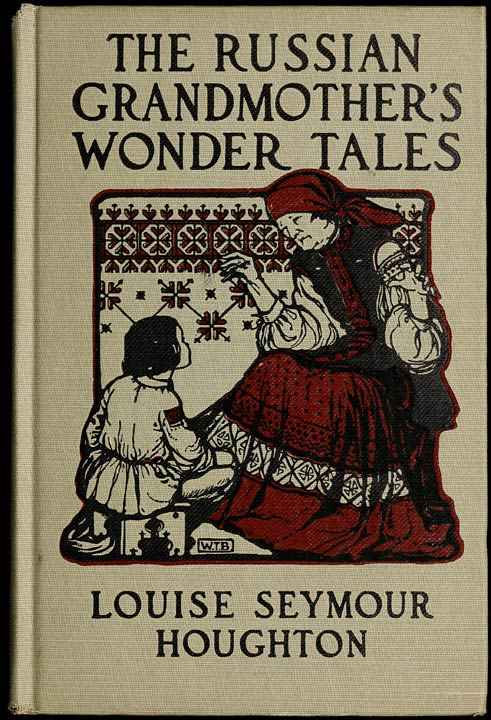
The Project Gutenberg eBook of The Russian Grandmother's Wonder Tales
Title: The Russian Grandmother's Wonder Tales
Author: Louise Seymour Houghton
Friedrich S. Krauss
Illustrator: Wladyslaw T. Benda
Release date: March 25, 2014 [eBook #45214]
Most recently updated: October 24, 2024
Language: English
Credits: Produced by Jeroen Hellingman and the Online Distributed
Proofreading Team at http://www.pgdp.net/ for Project
Gutenberg (This file was produced from images generously
made available by The Internet Archive/American Libraries.)
NEW YORK
Copyright, 1906,
by
CHARLES SCRIBNER’S SONS
Printed in the United States of America
All rights reserved. No part of this book may be reproduced in any form without the permission of Charles Scribner’s Sons
PREFACE
The stories which the Russian grandmother told will be found, with many others, in a German collection of “Tales and Legends of South Slavonia,” put forth in Vienna some twenty years ago by Dr. Friedrich Kraus, an ardent student of folk-lore. I have sketched in a slight background of peasant village life as it still exists in some parts of Southern Russia, because this is the proper setting of these stories; and I have been careful to clothe them as nearly as I might in the simple language in which they are told to-day by many a village fireside in South Slavonia.
I frankly confess to having received from Mr. Joel Chandler Harris the suggestion which I have thus carried out. It was an unerring literary instinct which impelled him to put upon the lips of Uncle Remus and in the environment of a Southern country home of half a century ago the stories which he had found among the colored people of the South. Folk-tales, of whatever character, speak the more directly home to the hearts of children, whatever their own intellectual environment, in proportion as their setting is most nearly that which naturally belongs to them. Just as the highest value of the Homeric poems is their revelation of the heart of man, showing that in all ages and under all conditions heart answers to heart as face answers to face in water, so the folk-tales of all peoples in their native form have a higher function than simply to amuse, a higher than mere literary value; they are the child’s best introduction to the study of human nature.
The children will not be the less interested in the stories which the Russian grandmother told to the little peasant boy if they discover in her wonder-tales some analogies with stories that they already know. The adventures of Master Reinecke and Mrs. Petz, of Isegrim and Lampe, will surely remind them of the Uncle Remus tales; they will find some suggestion of Kamer-es-zaman and the Princess Budoor in the story of “The Beg and the Fox,” a hint of the “City of Brass,” in that of “The Vila in Muhlenberg,” a faint reflection of the “Arabian Nights” story of the Fisherman in the tale of the “Three Eels,” and they will be especially pleased to recognize their old friend—and Sindbad the Sailor’s—the roc, in the bird Kumrikusha. The transformations which are so enchanting a feature of the “Arabian Nights” are here suggested in the story of “Steelpacha,” while the dress of feathers, most universal of folk-fancies, found among every people in the world, and most perfectly developed in the Arabian “Story of Hassan of Bassora,” here appears in the tale of “The Golden Apple-tree and the Nine Pea-hens.”
That these stories originated in that fountain-head of wonder-tales, the East, is very evident. They give more than a few suggestions of biblical story: the servant sent to announce the readiness of the feast (a courtesy of which I was myself the recipient in Syria last winter), the Delilah-like importunities by which the youngest sister lures from Steelpacha the secret of his strength, are perhaps the most striking instances.
Although this preface is not written for the children, yet as there are children who occasionally dip into prefaces, let me call the attention of such to the difference, both in style and point of view, between these stories and those which they have received from the brothers Grimm, from Hans Andersen, and from a host of later writers. All of these drew their material from the same sources as those of the Russian grandmother; but their cultivated minds have worked this material into exquisite literary forms. Not so your own nurses, or even your mothers, who told you wonder-tales before you were old enough to read. Not so the village story-tellers in far-away parts of the world, who, like the Russian grandmother, still hand down to the children the stories they received from parents and grandparents. These sometimes lose the connection; they add little local touches—sweet wine from Zagorjé, going home to Varazdin, and the like—they give to certain incidents the setting with which they are themselves familiar; most artlessly they interweave such results of modern invention and discovery as are familiar to them, with such blank ignorance of physical facts as is shown by bringing in the sun, the moon, the winds, as persons. Many of you know how beautifully George Macdonald did this sort of thing in his story “At the Back of the North Wind,” and you perfectly well perceive the difference between that story and such a tale as, for instance, “So Born, So Die,” in this book. When you are older you will recognize that it is precisely the difference between literature and folk-lore.
That many of these wonder-tales passed through Mohammedan minds on their way to the Russian grandmother, or her great-grandmother, is evident. “The Beg and the Fox” is a striking case in point; it almost seems as if the story ought, like the stories of the “Arabian Nights,” to close with the exclamation, “There is no God but God, the High, the Great!”
The humor of these stories, however, is unmistakably Slavonic. There is a fine pungency—not Oriental, though Oriental humor is very pungent—in certain of the endings, “I have heard a lie, I have told a lie, and God give you joy!” or after a peculiarly impossible story, “Whoever believes it will be blessed!” The underlying pathos of the story of the Basil-plant suggests the exquisite sentiment of Hans Andersen’s “Steadfast Tin Soldier”; but its excessive simplicity, its dropped threads of thought, forbid the idea that it has been worked over by any more sophisticated mind than that of the Russian grandmother.
In this simple-hearted story-teller I have tried to reproduce some lineaments of the peasant mother to whom, he tells us, Dr. Kraus owes his first impulse to folk-lore research. She was one of nine children of a poor pedler, brought up in a village of charcoal burners, deep in a Slavonian forest. She was illiterate, like our Russian grandmother, but like her intelligent and learned in the wonder-lore of her people. Her son pays her a lovely tribute in the preface to the first volume of his collection:
She grew up like a flower in the hedge-row, among the simple peasant folk whose manners and spirit she made entirely her own. The villagers, who had a little education, therefore called her, contemptuously, baba vracana (the little old sorceress), but the illiterate peasants lovingly named her nasá baba Eva (our little mother Eve). But for once the villagers were right, my mother is a sorceress; else, how comes it that I so constantly fall under the spell of her enchantments ... I solemnly declare that if there is a true word in metempsychosis, and it is left to our choice to return to the present state of existence, nothing would so sorely tempt me back, no crown, not even that of learning—as the simple assurance of the All-Father that he would give me again the same dear mother, though I were to go begging with her through the world.
L. S. H.
CONTENTS
| CHAPTER | PAGE | |||||
| I. | The Little Boy and the Grandmother | 1 | ||||
| II. | The Mother’s Fête-Day | 12 | ||||
| III. | Saturday Afternoon | 17 | ||||
| IV. | The Fire of Shavings | 31 | ||||
| V. | Frost-Bitten Toes | 37 | ||||
| VI. | After Supper | 49 | ||||
| VII. | The Snowy Day | 60 | ||||
| VIII. | The Election Meeting | 70 | ||||
| IX. | Cat and Dog | 82 | ||||
| X. | A Pleasant Surprise | 88 | ||||
| XI. | The Patient Little Boy | 97 | ||||
| XII. | The Sheep-Play | 109 | ||||
| XIII. | Getting Ready
|
128 | ||||
| XIV. | Mother’s-Mother | 137 | ||||
| XV. | The Little Boy Homesick | 156 | ||||
| XVI. | The Little Boy Sleepless | 196 | ||||
| XVII. | Home Again
|
203 | ||||
| XVIII. | The Betrothal
|
212 | ||||
| XIX. | In the Fields | 228 | ||||
| XX. | Trinity-Monday
|
242 | ||||
| XXI. | Threshing-Time
|
262 | ||||
| XXII. | The Korowai
|
273 | ||||
| XXIII. | The Wedding
|
283 | ||||
| XXIV. | After the Wedding
|
298 | ||||
ILLUSTRATIONS
- The old woman stole out to the tree, crept under the bed, and there hid herself Frontispiece
- FACING PAGE
- Took his place in the middle of the field, with his mouth wide open 10
- Step into this sack, ... and I will carry you around the field 46
- A shower of golden ducats fell, and lay upon the plates in three great heaps 106
- The third hoop dropped off; the cask fell asunder, and a dragon flew out 172
- Then the youth clambered down and took the Vila home 194
- Drive the sheep slowly, one by one, to the other side 240
- When he beheld the basil-plant he felt an extraordinary love for it 288