
The Project Gutenberg eBook of The Russian story book
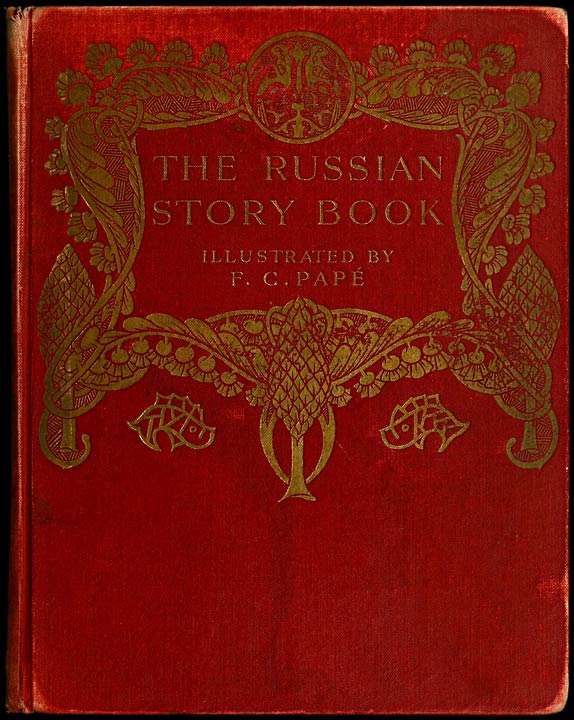
Title: The Russian story book
containing tales from the song-cycles of Kiev and Novgorod and other early sources
Author: Richard Wilson
Illustrator: Frank Cheyne Papé
Release date: March 29, 2015 [eBook #48605]
Most recently updated: October 24, 2024
Language: English
Credits: Produced by Jeroen Hellingman and the Online Distributed
Proofreading Team at http://www.pgdp.net/ for Project
Gutenberg (This file was produced from images generously
made available by The Internet Archive/American Libraries.)
MACMILLAN AND CO., Limited
LONDON · BOMBAY · CALCUTTA MELBOURNE
THE MACMILLAN COMPANY
NEW YORK · BOSTON · CHICAGO DALLAS · SAN FRANCISCO
THE MACMILLAN CO. OF CANADA, Ltd.
TORONTO
Falcon the Hunter (p. 64)
RUSSIAN STORY BOOK
ST. MARTIN’S STREET, LONDON
1916
PREFACE
I have gone right into the heart of “Holy Russia,” to Kiev and Novgorod and the borders of the Caspian, in an endeavour to show by means of some of the early legends the ideals and point of view of the Russian nation while it was in the process of being made. The stories of the song-cycles of Kiev and Novgorod tell of a barbaric, though not a barbarian, world, full of high colour and spirited action, of the knock-down blow followed quickly by the hand of friendship freely extended to pick up the fallen foeman—if indeed he has had the hardihood to survive.
The land of Vladimir and Ilya of Murom the Old Cossáck is a Christian land, with the Christianity of the Greek Church, and it is before all else an Easter land, where the Christian Festival of the Resurrection means infinitely more than it can ever do in countries which are not ice-bound for several winter months. The country is, moreover, an outpost of Christianity towards the East—uninfluenced by Renaissance or Reformation—and must therefore have developed interesting characteristics entirely different from those of Western lands. I think that such characteristics are clearly shown in these stories, but I must leave those of my older readers who are interested in this matter to find them out and to discover the Arthur, Guinevere and Galahad of Russia; for my first concern is to tell a tale which will please healthy-minded boys and girls in their early teens.
This book might have been written by a Russian who thoroughly understands our language, or by an English author who has spent the best part of a lifetime in studying Russia and the Russians, illustrated by a native artist, and decorated by a Russian designer. When such a volume does appear, it will have a great interest for me. Meanwhile, I submit that there is some artistic unity, also, in a volume of Russian stories, written by an Englishman, illustrated by an English artist, and decorated by an English designer, the whole production being for an English child.
One cannot delve far into these folk-lore records without becoming indebted to Miss I. F. Hapgood’s English renderings from the collections of Kirshá Danilóv, P. B. Kirýeevsky, A. T. Gillferding, Rybnikof, P. A. Bezsónof and others, published in New York in 1885; to J. Curtin’s literal translations from the Naródniya Rússyika Shazki of A. N. Afanásieva; to W. R. S. Ralston’s books on Russian folk-song and fable; and to the writings of the Hon. Maurice Baring and Mr. Stephen Graham. To all of these I desire to express my indebtedness for help and guidance, though the responsibility for the telling and interpretation of the tales is entirely my own. If this little collection makes the British child more sympathetic towards Russia and helps it to understand the Russian people to a small degree its purpose will have been achieved.
R. W.