
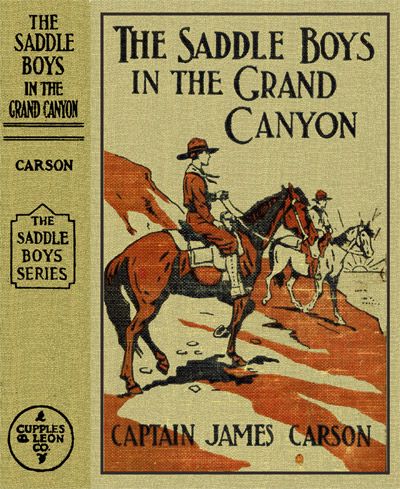
The Project Gutenberg eBook of The Saddle Boys in the Grand Canyon; or, The Hermit of the Cave
Title: The Saddle Boys in the Grand Canyon; or, The Hermit of the Cave
Author: Captain James Carson
Release date: June 15, 2007 [eBook #21841]
Most recently updated: March 10, 2011
Language: English
Credits: E-text prepared by Mark C. Orton, Thomas Strong, Linda McKeown, and the Project Gutenberg Online Distributed Proofreading Team
E-text prepared by Mark C. Orton, Thomas Strong, Linda McKeown,
and the Project Gutenberg Online Distributed Proofreading Team
(http://www.pgdp.net)
The Saddle Boys
in the Grand Canyon
Or
The Hermit of the Cave
BY
CAPTAIN JAMES CARSON
AUTHOR OF "THE SADDLE BOYS OF THE ROCKIES," "THE SADDLE
BOYS ON THE PLAINS," "THE SADDLE BOYS AT
CIRCLE RANCH," ETC.
ILLUSTRATED
new york
CUPPLES & LEON COMPANY
publishers
BOOKS FOR BOYS
BY CAPTAIN JAMES CARSON
THE SADDLE BOYS SERIES
12mo. Cloth. Illustrated.
THE SADDLE BOYS OF THE ROCKIES
Or, Lost On Thunder Mountain
THE SADDLE BOYS IN THE GRAND CANYON
Or, The Hermit of the Cave
THE SADDLE BOYS ON THE PLAINS
Or, After a Treasure of Gold
THE SADDLE BOYS AT CIRCLE RANCH
Or, In At The Grand Round-Up
Cupples & Leon Co Publishers, New York.
Copyrighted 1913, by
Cupples & Leon Company
The Saddle Boys in the Grand Canyon
CONTENTS
| CHAPTER. | PAGE | |
| I. | The Work of the Wolf Pack | 1 |
| II. | Ridding the Range of a Pest | 11 |
| III. | The Floating Bottle | 21 |
| IV. | The Listener Under the Window | 34 |
| V. | Starting for the Grand Canyon | 46 |
| VI. | Buckskin on Guard | 54 |
| VII. | Standing by the Law | 62 |
| VIII. | The Moqui Who Was Caught Napping | 71 |
| IX. | "Talk About Luck!" | 79 |
| X. | The Copper-colored Messenger | 87 |
| XI. | At the Grand Canyon | 98 |
| XII. | How the Little Trap Worked | 105 |
| XIII. | Going Down the Canyon Trail | 116 |
| XIV. | The Home of the Cliff Dwellers | 124 |
| XV. | The Treacherous Guide | 135 |
| XVI. | A Wonderful Discovery | 143 |
| XVII. | The Windows in the Rocky Walls | 151 |
| XVIII. | Finding a Way Up | 158 |
| XIX. | Fortune Still Favors The Brave | 167 |
| XX. | Another Surprise | 175 |
| XXI. | The Little Old Man of Echo Cave | 184 |
| XXII. | Turning the Tables—Conclusion | 195 |
THE SADDLE BOYS IN
THE GRAND CANYON
CHAPTER I
THE WORK OF THE WOLF PACK
"Hold up, Bob!"
"Any signs of the lame yearling, Frank?"
"Well, there seems to be something over yonder to the west; but the sage crops up, and interferes a little with my view."
"Here, take the field glasses and look; while I cinch my saddle girth, which has loosened again."
Frank Haywood adjusted the glasses to his eye. Then, rising in his saddle, he gazed long and earnestly in the direction he had indicated. Meanwhile his companion, also a lad, a native of Kentucky, and answering to the name of Bob Archer, busied himself about the band of his saddle, having leaped to the ground.
Frank was the only son of a rancher and mine owner, Colonel Leonidas Haywood, who was a man of some wealth. Frank had blue eyes, and tawny-colored hair; and, since much of his life had been spent on the plains among the cattle men, he knew considerable about the ways of cowboys and hunters, though always ready to pick up information from veterans of the trail.
Bob had come to the far Southwest as a tenderfoot; but, being quick to learn, he hoped to graduate from that class after a while. Having always been fond of outdoor sports in his Kentucky home, he was, at least, no greenhorn. When he came to the new country where his father was interested with Frank's in mining ventures, Bob had brought his favorite Kentucky horse, a coal-black stallion known as "Domino," and which vied with Frank's native "Buckskin" in good qualities.
These two lads were so much abroad on horseback that they had become known as the "Saddle Boys." They loved nothing better than to ride the plains, mounted on their pet steeds, and go almost everywhere the passing whim tempted them.
Of course, in that wonderland there was always a chance for adventure when one did much wandering; and that Frank and Bob saw their share of excitement can be readily understood. Some of the strange things that happened to them have already been narrated in the first volume of this series, "The Saddle Boys of the Rockies, Or, Lost on Thunder Mountain," and which, in a way, is an introduction to the present story. In the first book the boys cleared up a wonderful mystery concerning a great cavern.
For several minutes Bob was busily engaged with the saddle girth that had been giving him considerable trouble on this gallop.
"There," he remarked, finally, throwing down the flap as though satisfied with his work. "I reckon I've got it fixed now so that it will hold through the day; but I need a new girth, and when we pull up again at Circle Ranch I'll see about getting it. Oh! did you make out anything with the glasses, Frank?"
He sprang into the saddle like one who had spent much of his time on horseback. Domino curvetted and pranced a little, being still full of mettle and spirits; but a very firm hand held him in.
"Take the glass, and see if you can make out what it is," Frank remarked, as if he hardly knew himself, or felt like trusting his eyes.
A minute later Bob lowered the glasses.
"There's something on the ground, and I can catch a glimpse of what looks like a dun-colored hide through the tufts of buffalo grass. The yearling was red, you said, Frank? All right. Then I reckon we'll find her there; but not on her feet."
"Come on!"
As he said these curt words Frank let Buckskin have his head; and, accompanied by his chum, started at a full gallop over the level, in the direction of the spot where the dun-colored object had been sighted.
Shortly afterward they topped a little rise, and pulled up. No need to doubt their eyes now. Just before them lay the mangled remains of the lame yearling, very little being left to tell the story of how the animal had met its fate.
"Wolves!" said Frank, gloomily, as he sat looking down at the torn hide.
"I don't know the signs as well as you, Frank, but I'd say the same from general indications. And they had a royal good feast, too. This makes a round half dozen head your father has lost in the last month, doesn't it?" asked Bob.
"Seven, all told. When Bart Heminway told me he had noticed that one of those fine yearlings seemed lame, I wondered if something wasn't going to happen to it soon. And then, when we missed it from the herd last night, I guessed what had come about. They caught her behind the rest, and pulled her down. The poor thing didn't have a ghost of a show against that pack of savage wolf-dogs."
"I'd like to have just one chance at them, that's all," grumbled Bob, as he let his hand fondle the butt of a modern repeating rifle, which he carried fastened to his saddle.
"This is sure the limit, and it's just got to stop!" declared Frank, grimly.
"Right now?" queried his chum, eagerly.
Two pairs of flashing eyes met, the black ones sending a challenge toward the blue.
"Why not?" said Frank, shutting his jaws hard, "the day is before us still; and we're well primed for the business of hunting that pack to their den. Look at that bunch of rocks a few miles off; that must be where they hang out, Bob! Queer that none of the boys have ever thought of hunting in this quarter for that old she-wolf Sallie, and her brood."
"Then you think she did it, do you?" asked Bob.
"Sure she did. You can see for yourself where her jaws closed on the throat of the poor yearling. Everybody knows her trademark. That sly beast has been the bane of the cattle ranches around here for several years. They got to calling her Sallie in fun; but it's been serious business lately; and many a cowboy'd ride two hundred miles for a chance to knock her over."
"And yet none of the rough riders have even thought to search that rocky pile for her den, you say?" Bob continued.
"Why, you see, the killings have always been in other directions," Frank explained. "Just as shrewd animals often do, up to now Sallie has never pulled down a calf anywhere near her den. I reckon she just knew it might cause a search. But this time she's either grown over-bold, or else the pack started to do the business in spite of her, and she was forced into the game."
"Well, shall we head for that elevation, and see what we can find?" asked Bob, who was inclined to be a little impatient.
"Wait a bit. It would be ten times better if we could only track the greedy pack direct; but that's a hard proposition, here on the open," Frank observed.
"Well, what can we do then?" his chum asked.
"Perhaps put it in the hands of the best trailer in Arizona," and with a laugh Frank pointed off to the left.
The Kentucky boy turned his head in surprise, and then exclaimed:
"Old Hank Coombs, on his pony, as sure as anything! You knew he was coming along all the while, and just kept mum. But I'm sure glad to see the old cowman right now. And it may turn out to be a day of reckoning for that cunning Sallie, and her half grown cubs."
The two lads waved their range hats, and sent out a salute that was readily answered by the advancing cowman. Hank Coombs was indeed a veteran in the cattle line, having been one of the very first to throw a rope, and "mill" stampeding steers in Texas, and farther to the west.
He was an angular old fellow, grim looking in his greasy leather "chaps;" but with a twinkle in his eyes that told of the spirit of fun that had never been quenched by the passage of time.
"Howdy, boys," he called out, as he drew rein alongside the two lads. "What's this here yer lookin' at? Another dead calf? No, I swan if it ain't a yearling as has been pulled down now. Things seem t' be gittin' t' a warm pass when sech doin' air allowed. Huh! an' it looks like Sallie's work, too! That sly ole critter is goin' t' git t' the end of her rope some fine day."
"Why not to-day, Hank?" demanded Frank, briskly.
The veteran grinned, as though he had half anticipated having such a question asked.
"So, that's the way the wind blows, hey?" he remarked, slowly; and then he nodded his small head approvingly. "Jest as you say, Frank, thar's no time like the present t' do things. The hull pack hes been here, I see, an' no matter how cunning old Sallie allers shows herself, a chain's only as strong as th' weakest link. One of her cubs will sure leave tracks we kin foller. All right, boys count on me t' back ye up. I'll go wharever ye say, Frank."
"We'll follow the trail, if there is one," said Frank, instantly; "but the chances are that's where we'll bring up," and he pointed with his quirt in the direction of the rocky uplift that stood like a landmark in the midst of the great level sea of purple sage brush, marking the plain.
After one good look the cowman nodded his head again in the affirmative.
"Reckon as how y'r' right, Frank," he remarked; "but we'll see how the trail heads."
Throwing himself from his saddle he bent down over the remains of the yearling that had been so unfortunate as to become lame, and thus, lagging far behind the rest of the herd, fallen a victim to the wolf pack.
"Easy as fallin' off a log," announced old Hank, immediately. "Jest as I was sayin', thar's nearly allers one clumsy cub as don't hev half sense; an' I kin foller this trail on horseback, 'pears to me."
He ran it out a little way; then, once more mounting, went on ahead, with his keen eyes fastened on the ground.
Bob watched his actions with the greatest of interest. He knew Old Hank was discovering a dozen signs that would be utterly invisible to one who had not had many years of practice in tracking both wild animals and human beings.
Now and then the trailer would draw in his horse, as though desirous of looking more carefully at the ground. Twice he even dropped off and bent low, to make positive his belief.
"I reckon you were right, Frank," remarked Bob, after half an hour of this sort of travel "because, you see, even if the trail did lead away from the rocks at first, it's heading that way now on a straight line."
"Thet was only the cuteness of the ole wolf," said Hank. "She's up t' all the dodges goin'. But that comes a day of reckonin' for all her kind; an' her's orter be showin' up right soon."
When another half hour passed the three riders had reached the border of the strange pile of rocks. And as Frank looked up at the rough heap, with its many crevices and angles, he considered that it certainly must offer an ideal den to any wild beast wishing to hide through the daytime, and prowl forth when darkness and night lay upon the land.
"Here's whar the trail ends at the rocks," said Hank, as he dismounted and threw the bridle over the head of his horse, cowboy fashion, knowing that under ordinary conditions the animal would remain there, just as if hobbled, or staked out.
Both of the saddle boys followed his example, and, holding their rifles ready, prepared to search the rocks for some trace of the wolf den. Wild animals may be very cunning about locating their retreat in a place where it will be hidden from the eye of a casual passer; but, in course of time, they cannot prevent signs from accumulating, calculated to betray its presence to one who is keenly on the watch.
The three searchers had not been moving back and forth among the piles of rocks more than ten minutes when Old Hank was observed to raise his head, smile, and sniff the air with more or less eagerness.
"Must be close by, boys," he said, positively. "I kin git the rank odor that allers hangs 'round the den of wild animals as brings meat home, an' leaves the bones. The air is a-comin' from that quarter, an' chances are we'll find the hole sumwhar over yonder."
"I think I see it," said Frank, eagerly. "Just above that little spur there's a black looking crevice in the rock."
"As dark as my hat," added Hank; "an' I reckon as how that's whar Sallie lives when she's t' home. Now t' invite ourselves int' her leetle parlor, boys!"Contents
CHAPTER II
RIDDING THE RANGE OF A PEST
"Well, what do you think now, Frank?" asked Bob, as they stood in front of that gloomy looking crevice, and observed the marks of many claws upon the discolored rock, where hairy bodies had drawn themselves along countless times.
"I'm wondering," the other replied; "what ails our boys at the ranch never to have suspected that old Sallie had her den, and raised her broods, so close to the Circle Ranch. Why, right now we're not more'n ten miles, as the crow flies, away from home. And for years this terrible she-wolf has lived on the calves and partly grown animals belonging to cattlemen in this neck of the land. It makes me tired to think of it!"
"But Frank, it's a long lane that has no turning," remarked Bob; "and just now we've got to the bend. Sallie has invited her fate once too often. That lame yearling is going to spell her finish, if Old Hank here has his way."
"It sure is," agreed Frank. "And when we get back home with the hide of that old pest fastened to a saddle, the boys will be some sore to think how anyone of the lot might have done the job, if they'd only turned this way."
"But what's Hank going to do?" asked the Kentucky boy, watching the veteran cow-puncher searching on the ground under a stunted pinon tree that chanced to grow where there was a small bit of soil among the rocks.
"I don't know for a dead certainty," replied the other; "but I rather think he's picking up some pieces of wood that might make good torches."
"Whew! then he means that we're to go into the cave, and get our game—is that it, Frank?" demanded the other, unconsciously tightening his grip on his rifle, as he glanced once more toward that yawning crevice, leading to unknown depths, where the wolf pack lurked during the daytime to issue forth when night came around.
"That would be just like the old chap, for he knows nothing of fear," Frank replied; "but of course there's no necessity for both of us to go with him. One might remain here, so as to knock over any stray beast that managed to escape the attention of those who went in."
"All right; where will you take up your stand, Frank?" asked Bob, instantly; at which his chum laughed, as though tickled.
"So you think I'd consent to stay out here tamely, while you two were having a regular circus in there?" he remarked. "That would never suit me. And it's easy to see that you count on a ticket of admission to Sallie's parlor, too. Well, then, we'll all go, and share in the danger, as well as the sport. For to rid the range country of this pest I consider the greatest favor under the sun. But there comes Hank with a bundle of torches under his arm."
"We're off, then!" chuckled Bob.
"Make sure o' yer guns, lads," said the cowman, as he came up; "because, in a case like this, when ye want t' shoot it's apt t' be in a hurry. An' anybody as knows what a fierce critter ole Sallie is, kin tell ye it'll take an ounce of lead, put in the right place, t' down her fur keeps."
"I'm ready," Frank assured the old hunter.
"Then, jest as soon's I kin git this flare goin' we'll push in." Hank announced.
"Will we be able to see the game with such a poor light?" asked Bob, a trifle nervously, as his mind went back to school days, to remember what he had read of that old Revolutionary patriot, Israel Putnam, entering a wolf's den alone, and killing the beast in open fight; truth to tell Bob had never seen a real den in which wild beasts hid from the sun; and imagination doubled its perils in his mind.
"Fust thing ye see'll be some yaller eyes starin' at ye outen the dark," said Hank, obligingly. "Then, when I gives the word, both of ye let go, aimin' direct atween the yaller spots."
"But what if we miss, and the beast attacks us?" Bob went on, wishing to be thoroughly posted before venturing into that hole.
"In case of a mix-up," the veteran went on; "every feller is for hisself; only, recerlect thar mustn't be any shootin' at close quarters. Use yer knives, or else swat her over the head with yer clubbed guns. We're bound t' git Sallie this time, by hook er by crook! Ready, son?"
Both boys declared that they had no reason for delaying matters. Since it had been decided as best to invade the wolf den, the sooner they started, the better.
True, Bob thought that had it been left to him, he would have first tried to smoke out the occupants of the cleft, waiting near by to shoot them down as they rushed out of the depths. But then Hank was directing matters now, and whatever he said must be done.
Besides, Hank had known wolves ever since he first "toted" a gun, now more than fifty-five years ago. Perhaps he understood how difficult it is to smoke out a pack of wolves, that invariably seek a cave with a depth sufficient to get away from all the influences of the smudge.
Without the slightest hesitation Old Hank got down on hands and knees, and began to crawl into the gaping mouth of the crevice.
It did not go straight in, but seemed to twist around more or less. All the while the two boys kept close at the heels of the guide who carried that flaring torch. They watched ahead to detect the first sign of the enemy; and had their ears on the alert with the same idea in view.
Stronger grew the odor that invariably marks the den of carnivorous animals.
"We ought to stir her up soon now, Frank," whispered Bob, on whom the strain was bearing hard, since he was not used to anything of this sort.
"Yes, unless the sly old beast has a back door to her home; how about that, Hank?" asked the cattleman's son.
"Don't reckon as how it's so," came the ready response. "In thet event, we'd feel a breath of fresh air; an' ye knows as how we don't. Stiddy boys, keep yer wits about ye! She's clost by, now!"
"I heard a growl!" admitted Bob.
"And there were whines too, from the half grown cubs," ventured Frank.
"Once we turn this bend just ahead, likely enough we'll be in the mess," Bob remarked.
"Range on both sides of me, boys," directed Hank, halting, so that they could overtake him; because he knew full well that the crisis of this bold invasion of the she-wolf's den was near at hand.
In this fashion, then, the three turned the rocky corner.
"I see the yellow eyes!" whispered Bob, beginning to bring his gun-stock nearer to his shoulder. "Say, there's a whole raft of 'em, Frank!"
"Sure," came the quick reply, close to his ear. "Hank said there was about five of the brood. Hold your fire, Bob. Pick out the mother wolf first."
"That's what I want to do; but how can I make sure?" demanded the Kentucky lad, trying his best to keep his hands from trembling with excitement.
He had sunk down upon one knee. This allowed him to rest his elbow on the knee that was in position, always a favorite attitude with Bob when using a rifle.
"Take the eyes that are above all the rest, and which seem so much larger and fiercer. Are you on, Bob?" continued the other, who was also handling his gun with all the eagerness of a sportsman.
"Yes," came the firm reply.
"Then let her go!"
The last word was drowned in a terrific roar, for when a gun is fired in confined space the din is tremendous. Even as he pulled the trigger Bob knew that luck was against him; for the animal had moved at a time when he could not delay the pressure of his finger.
He heard a second report close beside him. Frank had also fired, realizing what had occurred, and that in all probability the first bullet would only wound the savage beast, without putting an end to her activities.
The torch went sputtering to the floor of the cave, having been knocked from the hand of Hank when the wolf struck him heavily. He could be heard trying to rescue it before it went completely out, all the while letting off a volley of whoops and directions.
Fortunately Frank had kept his wits about him. And his rifle was still gripped firmly in his hands, he having instantly pumped a new cartridge into the chamber after firing. The half grown cubs showed an inclination to follow their mother in her headlong attack on the human invaders of the den; for the numerous gleaming pairs of eyes were undoubtedly advancing when Frank turned his gun loose on them.
The din was simply terrific. Bob was more concerned with the possibility of an attack from the ferocious mother wolf then anything else. He had lost track of her after that first furious rush, and crouching there, was trying the best he knew how to locate the creature again.
Meanwhile Old Hank had succeeded in picking up the torch, which, being held in an upright position, began to shed a fair amount of light once more.
Not seeing anything else at which he could fire, Bob now started in to assist his chum get rid of the ugly whelps that were advancing, growling, snarling, and in various other ways proving how they had inherited the fearless nature of the beast that had nursed them in that den.
Perhaps it was all one-sided, since the animals never had a chance to get in touch with the invaders. Neither of the boys ever felt very proud of the work; but in view of the tremendous amount of damage a pack of hungry wolves can do on a cattle ranch, or in a sheepfold, they had no scruples concerning the matter. Besides, every one along the Arizona border hated a wolf almost as badly as they did a cowardly coyote; for while the former may be bolder than the beast that slinks across the desert looking for carrion, its capacity for mischief is a good many times as great.
"I don't see any more eyes, Frank!" called out Bob, presently, as he tried to penetrate the cloud of powder-smoke that surrounded both of them.
"That's because we got 'em all, I reckon," replied his chum. "How about that, Hank?"
"Cleaned the hull brood out, son," replied the other, chuckling; "an' no mistake about it either."
"But where did the big one go to; has she escaped after all?" asked Bob, with a note of regret in his voice; for he thought the blame would be placed on him, for having made a poor shot when he had such a splendid chance to finish the animal.
"Oh! I wouldn't worry myself about her, Bob," chuckled Frank, who had already made a discovery; and as he spoke he pointed to a spot close by, where, huddled in a heap, lay the heavy body of the fiercest cattle thief known for years along the border.
"She was mortally hurted by the fust shot," said Hank, as they stood over the gaunt animal, and surveyed her proportions with almost a touch of awe; "but seemed like the critter had enough strength left t' make thet leap, as nigh knocked me flat. Then she jest keeled over, an' guv up the ghost. Arter this the young heifers kin stray away from their mother's sides, without bein' dragged off. Thar'll be a vote o' thanks sent ter ye, Bob, from every ranch inside of fifty mile, 'cause of what ye did when ye pulled trigger this day."
Hank, being an experienced worker, did not take very long to secure the pelt of the dead terror of the desert. Then they left the rocks, finding their horses just where they had left them.
All of the animals showed signs of alarm when they scented the skin of the wolf; and Domino in particular pranced and snorted at a great rate since his education had been neglected in this particular. So Hank, having the best trained steed in the bunch, insisted on carrying the pelt with him on their return trip to the ranch.
Ten miles, as the crow flies, and they would be at home; and with comparatively fresh steeds, that should not count for more than an hour's gallop.
Before they had gone three miles, however, Bob called the attention of his chum to a horseman who was galloping toward them. It was a cowboy, and he waved his broad-brimmed hat over his head as he came sweeping forward.
"Is he doing stunts; or does he want us?" asked Bob.
"It's Ted Conway," replied Frank, with a sudden look of anxiety; "one of the steadiest boys at the ranch; and he acts as if something had happened at home!"Contents
CHAPTER III
THE FLOATING BOTTLE
Waving his hat after the extravagant manner of his kind, the cowboy swept constantly nearer the little party. Indeed, it was impossible for them to guess whether Ted Conway bore a message, or was simply delighted to see the son of his employer, and his chum.
Presently he reached the constantly advancing trio, and under the pull of the reins his pony reared upon its hind legs.
"What's wrong, Ted?" asked Frank, immediately.
"Wanted at the ranch, Frank," came the answer. "The boss has sent me out to look you up on the jump. Told me as how you started out on a gallop this way, an' I took chances. Reckon I was some lucky to strike you so easy."
"But what has happened, Ted?" insisted the boy, trying to read the bronzed face of the other, and get a hint as to whether his mission verged on the serious or not.
It was so very unusual for Colonel Haywood to send anyone out to find him, that Frank's suspicions were naturally aroused.
"Well, the Colonel had a little tumble with that game leg of his—same one that the steer fell on, and broke two years back, in the big round-up—" began the cowboy, when Frank interrupted him.
"Then he must have been seriously hurt this time, or he wouldn't send you out for me. Tell me the worst, Ted; you ought to realize that it's better for me to know it all in the start, than by degrees. Is my father dead?"
"No. Last I seen of the Colonel, he was a real live man; only he had his leg done up agin in splints; an' the ole doc. from the Arrowhead Ranch was thar, 'tending to him. No, it ain't on count of his leetle trouble with that leg that made him send me out huntin' for you, Frank."
"What then?" demanded the boy, curtly; but with a sigh of relief, for his father was very dear to him.
"Thar come a messenger to the ranch a while ago, an' somethin' he fetched along with him, 'peared to excite the boss right from the word go," Ted admitted.
"A messenger, Ted?" the boy echoed, wonderingly.
"Never seen him afore, an' think he kim from town," the new arrival went on to say. "Leastwise, he looked like a stray maverick, an' had a b'iled shirt, with a collar that I reckoned sure would choke him. Atween you an' me I tried to get him to chuck the same; but he only grinned, an' allowed he could stand it."
"Oh! a messenger from town, was it?" said Frank, with a relieved look. "Then the chances are it must have been some business connected with a shipment of cattle. Perhaps the railroad has had a bad wreck, and wants to settle for that last bunch we sent away."
But Ted shook his head in the negative.
"'T'wan't no railroad man; that I know," he affirmed, positively. "'Sides, the boss was holdin' of a bottle in his hand, an' seemed to set a heap of store by it."
"A bottle, Ted?" cried Frank, deeply interested.
"That's what," replied the cowboy, energetically. "But jest why he should reckon such a thing wuth shucks I can't tell ye. But he sent me out to bring you back to the ranch house like two-forty. I seen that he was plumb locoed, and some excited by the news, whatever it might be."
Frank looked at his chum in a puzzled way, and shook his head.
"I don't seem able to make head or tail of this business, Bob," he remarked; "but there's only one thing to be done, and that's to romp home on the gallop. So away we go with a rush. Who's after me! Hi! get long, Buckskin! It's a race for a treat of oats as a prize! Here you are, Bob; hit up the pace!"
With the words Frank gave his horse free rein, and went tearing over the level plain, headed as straight for the distant ranch as though he were a bird far up in the clear air, and could see to make a direct line "as the crow flies!"
And after a time, in the distance, they saw the whitewashed outbuildings of Circle Ranch. Frank never viewed the familiar and dearly loved scene with more anxiety than he did now; but so far as he could see there did not appear to be anything out of the ordinary taking place around the ranch house.
"Looks all right, Bob!" exclaimed Frank, as though a great load had been taken from his heart.
The sudden coming of Ted Conway, with that queer message that meant a hurried return, had mystified the boy not a little. But he knew that all would soon be made plain now, since they were nearly home.
Dashing up in front of the house, the two lads jumped to the ground almost before their mounts had come to a halt. The door was open, and Frank led the way in a headlong rush.
As they entered he saw his father seated in his comfortable easy-chair, with that unfortunate leg, that had given him more or less trouble for two years now, propped on another seat, and bound up.
There was a stranger with him, but no sign of the Arrowhead Ranch cowboy doctor; which would indicate that, having done his duty, the roving physician and bone-setter had returned to his regular business, which was roping and branding cattle.
Colonel Haywood was a man in the prime of life. Up to the time that clumsy steer had broken his leg he had been most active; but since then he had not been able to get around on his feet so well, though able to ride fairly comfortably.
"Hello! Frank, my boy!" he exclaimed, as the two came rushing in. "So Ted managed to round you up in great style; did he? Well, I always said Ted was the sharpest fellow on the range when it came to finding things. Where have you been to-day?"
"Doing a little missionary work for the country," replied Frank, smiling. "We came across that lame pet yearling, the dun-colored one you thought so much of; and there was mighty little left of the poor beast but a torn hide, not worth lifting."
"Huh! wolves again!" exclaimed the stock-raiser, with a frown.