
CHAPTER XVIII
THE CLUB TURNS FIRE BRIGADE
It was not a thin haze now, but a blurring gray curtain, half concealing the woods before which it hung. A pungent odor filled the air, which had, too, a curiously irritating, smarting quality, trying and painful to eyes and lungs. The boys, panting from their forced march—the fast walk at which they had descended the hill had quickened to a dog trot and then to a run—pulled up a little uncertainly. They had reached the border of the wooded tract which extended to the lake shore, and in which their camp was situated, and now they knew that the dreaded danger of a forest fire was facing them. Just where it might have started, or how much headway it might have gained, was still to be determined, however; for, though there was smoke a-plenty, no line of leaping flames showed.
Sam ran his eye along the front of the woods. Nowhere was the smoke rolling forth in volumes. It was like the coming of a fog, not yet thick but dimming everything. The breeze was light; so light, indeed, that though he made the test of a wetted finger, he could be sure of little except that the general direction of the air currents was toward the spot where he was rather than toward the lake. So far as it went, this was a hopeful condition. It meant that the spread of the fire would be away from the shore and the tent.
He strained his ears as well as his eyes, hoping to hear the shouts of men fighting the fire, but silence lay upon the woods. Plainly, the alarm had not spread to the summer settlement. The smoke was lying low and drifting away from the lake, and, presumably, had not yet been observed by the men at work about the pavilion.
Sam gave his orders briskly, if a bit breathlessly:
“Spread out—in a line! Don’t get too far apart, though. First fellow that sees anything, yell and yell loud! Now, start in, fellows!”
They obeyed, readily enough, in very open order, as he had directed, and went crashing through the undergrowth.
Sam himself was near the middle of the line. The end man to the left was Tom Orkney, while Herman Boyd had the corresponding place to the right. Sam went straight forward, but the flankers edged out as they advanced, so that they steadily increased the amount of ground covered.
As every one in the party knew, the tract was of the sort to favor a quick spread of a fire. There was a great deal of dry stuff, and the long period of fine weather had made much of it as inflammable as tinder. Besides, the undergrowth was so dense and tangled in places that flames would find abundant opportunity to move along, while the difficulties of coping with them would be increased. Such were the conditions that Sam began to wonder that the whole tract was not in a blaze. The fire must have been going for two or three hours, at least; that it had not made more progress was to be accounted for only by the lack of wind. In the woods, indeed, there was no perceptible breeze, and the air was still and heavy as well as smoke-laden.
Like his mates, Sam plowed ahead, making as much speed as he could. The smoke grew denser, but not very markedly. He was beginning to believe that his own course was not carrying him toward the fire, when a shout, raised by Orkney, was repeated along the line.
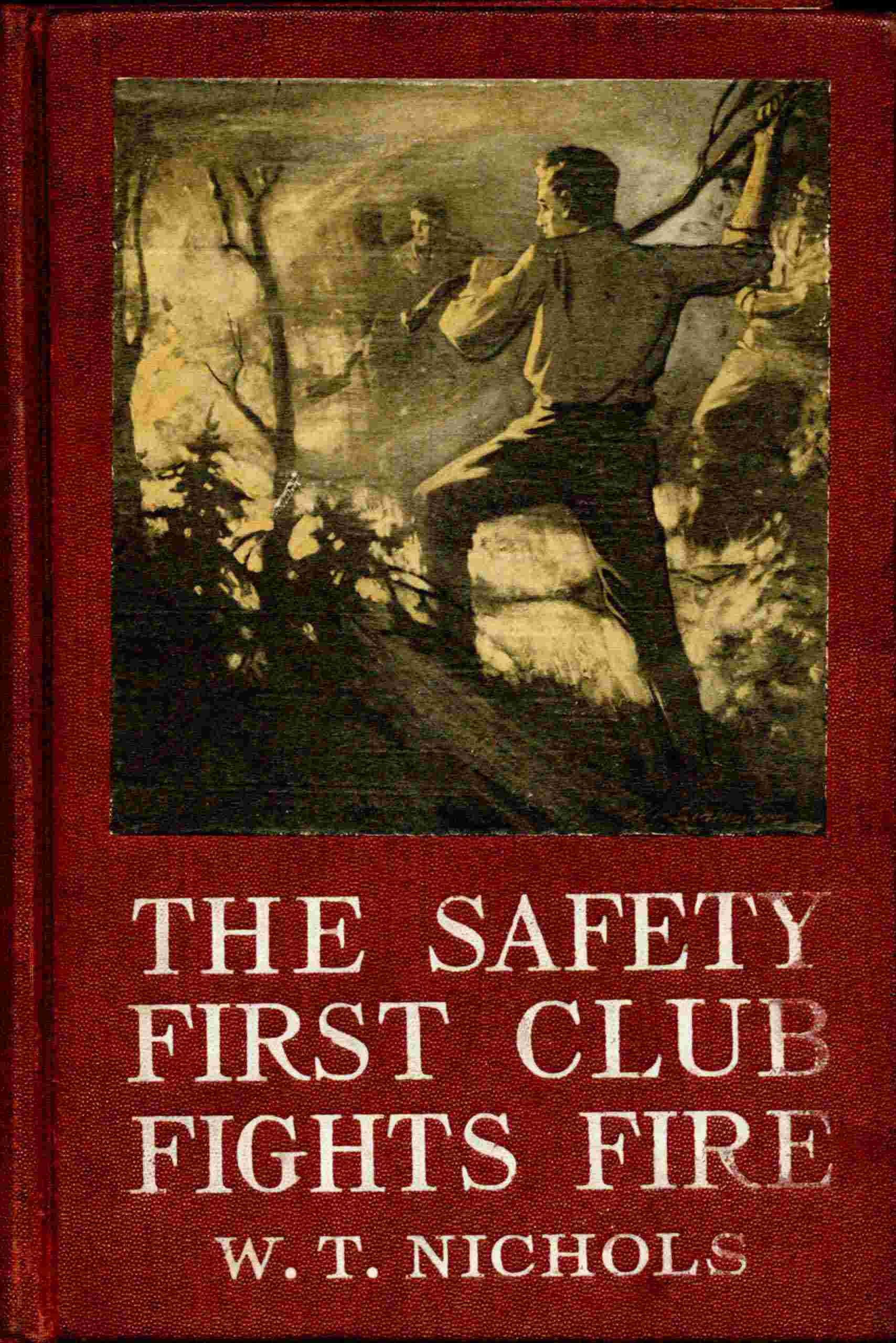
Tom had made the looked-for discovery. Dipping into a hollow, which two months before had been a swamp, he had been met first by a heavy puff of gray fog, so to speak, and through it had caught the yellow glint of flames. At his call the other boys hurried to him. No word of command from Sam or from anybody else was needed to set them at the work which was to be done. Breaking branches from trees, they began to beat the burning brush in the rough and ready fashion which sometimes is extremely effective in dealing with a fire of the sort. It was not light work, nor was it pleasant. It seemed as if the smoke increased even as the flames were checked; and now and again one or another of the club had to drop back for a moment, coughing and choking and gasping for air. A fine, dust-like ash, too, was raised in tiny clouds; more disagreeable than the smoke itself and quite as penetrating of throat and lung; while the heat of the fire was sufficient to blister hands incautiously venturing too near it. Yet, as woods fires go, this did not seem a hard one to deal with. The lack of breeze was in the boys’ favor. They were helped, also, by the “lay of the land.”
As has been said, Orkney had come upon the fire in a swampy hollow. Protracted as the drought had been, it had not sufficed to remove all the moisture by the slow process of evaporation, so that there still remained miry patches, which served as natural brakes on the advance of the flames. A gale, of course, or even a brisk wind, would have disposed of such handicaps quickly enough, but in a comparative calm they made a great difference. To Sam it became evident very quickly that the boys were not only checking the slow drift of the fire, but also were beginning to get it under control. He paused for a moment to watch his companions. Orkney was pounding away lustily. The Shark was exerting less effort, but his arms rose and fell with mathematical regularity. The others were performing, each in his own way, Step with tremendous swings of his long arms, Poke with a swift succession of queer little pats, the Trojan and Herman Boyd busily and steadily. Much encouraged, Sam raised a cheery cry and fell to wielding his broom-like weapon with fresh vigor.
It isn’t to be supposed, though, that with all the favorable conditions, the club quickly finished the business in which it was now engaged. The spread of the fire might be checked, but it still burned stubbornly in the area over which it had extended. There were heaps of rubbish, dead twigs and branches and rotting leaves, which smouldered sullenly long after the flames had died down; there were patches of glowing coals, potential danger spots, should a breeze spring up. The boys worked back and forth, invading the burned-over tract, crossing and recrossing it until they were satisfied that immediate danger was over. Then came a sort of patrol for half an hour or more, with search for points threatening a fresh start for the flames. At last, Sam spoke the word for which the others had waited.
“Out! Guess we can knock off now.”
“Good—and a good job at that!” Poke declared.
“Well, I’m ready to call it half a day and quit,” said Herman. “I’ll ’fess up—I’m tired.”
“Yes; it’s hard work,” Sam observed.
Step thrust a finger almost into Poke’s face, and began to laugh.
“Ho, ho! Say, fellows, look at the boy beauty turned boy coal-heaver!”
Poke ran a grimy hand across a grimy cheek. “Huh! You’re no Spotless Town exhibit yourself,” he retorted. “You look as if your home address was ‘Care of any ash-barrel.’”
“What’s the odds, so long as we’ve put out the fire?” quoth Tom Orkney. “But, I say! Anybody thought of the time? Sun’s down, but not one of us noticed it!”
The boys glanced about them as curiously as if Tom had made some remarkable discovery. They had paid no attention to watches or sunshine, and now dusk was coming on. Poke tightened his belt with a jerk.
“Supper time—and past,” he remarked. “Gee, now that I’m reminded of eating, I could get away with about three square meals at once.”
By common consent the club started in the direction in which the camp lay. They skirted the burned patch, but at the farther border Sam halted. The others pulled up too.
“What’s on your mind, Sam?” asked Step.
Sam wrinkled his brow. “There are a few things I don’t quite figure out. I suppose the fire started on this side; for this is the windward side, if you can say there was breeze enough to make a windward and a leeward. Now, what was there here to set it going?”
“I don’t see anything,” said Step, after a pause devoted to observation.
“Nor I,” chimed in two or three others.
“Probably somebody, going through, was smoking, and got careless with a match or cigarette stub,” suggested Tom.
“Maybe,” said Sam, shortly.
“Well, what likelier explanation have you?”
Sam contented himself with shaking his head and saying, “It’s queer, all the same.”
The fire, in spite of its leisurely progress, had extended over perhaps two acres, nearly all of which would class as swamp land, though in many places it was now as dry as any hill. Still, even where the mire had hardened there were hummocks which made walking difficult, to say nothing of the thick undergrowth on which the flames had fed. Anybody, strolling through the woods, would be more likely to make a detour about the hollow than to tramp across it.
“Oh, in a case like this you can’t find out half the time what caused the trouble,” growled Poke. “Come on! Let’s get to the feed.”
“Hope it isn’t far to camp,” said the Trojan.
“Huh! No need to hope!” snapped the Shark.
“Meaning we’ve lost our way?”
“Meaning camp’s just ahead of us. Where are your eyes, anyway?”
“Cheer up, Shark! Don’t be a grouch,” counseled Poke.
The Shark gave a characteristic shrug. “It ought to grouch anybody to see how you fellows don’t figure out things. Not that you ever will, though! But if only you’d kept your wits working, you’d know the tent can’t be an eighth of a mile from here.”
“Confound it! can’t you be exact?” Poke teased, with a wink at the others. “Talking about things that grouch, what’s worse than a fellow who deals in eighths of a mile, when he ought to say twelve hundred and thirty-four ten-thousandths, plus? You vex me, Shark.”
“You—you——” snorted the Shark; then words failed him, and he set off at a round pace.
The others followed, weariedly but willingly. Camp and supper were pleasing thoughts; and the event proved that about the former, at least, the Shark was right. In a moment or two the canvas of the tent showed like a pale blur on the dark background. The rest quickened their steps; but Sam, pausing, looked back.
After all, the fire had started uncomfortably close to the camp. It was borne in upon him that it was a singularly fortunate circumstance for the club that what little breeze there had been had blown in the opposite direction. If some mischief maker had been at work——
Sam’s expression was grave, as he turned and resumed his way. With all his desire to be fair in his judgments, an ugly suspicion was obtruding itself upon him.