
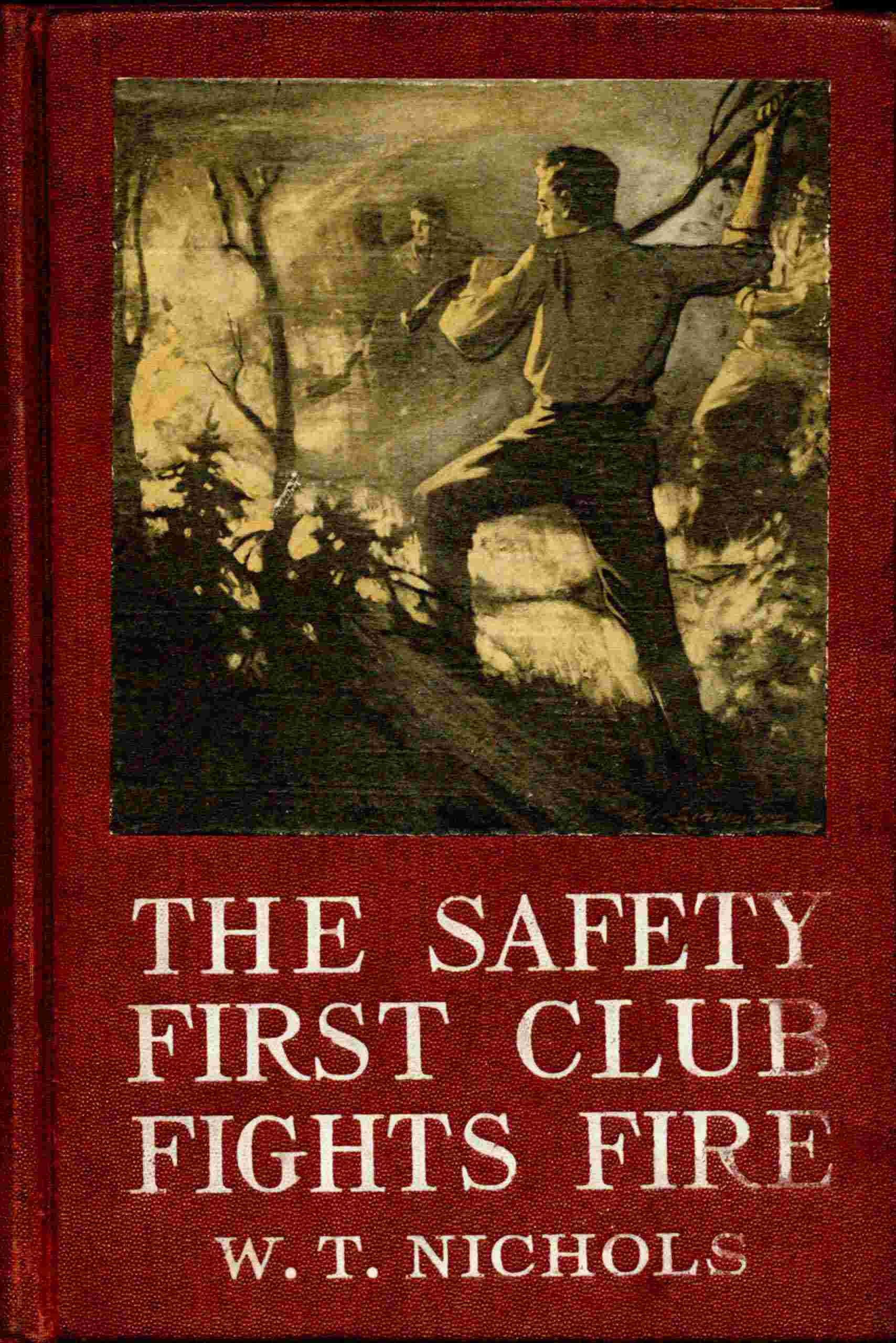
CHAPTER XXIII
AN OLD SCORE SETTLED
Sam, the Shark and Hagle made for the lake shore. This was not so much because of any far-seeing, definite plan, as because this was the line of least resistance, so to speak, and because the lake itself offered escape, should the fire cut them off from flight by land. Hagle displayed utter docility. He had done his utmost to evade capture, but, once in the custody of his pursuers, no lamb could have offered less resistance.
At this point there was still a fairly broad belt of woods which the fire had not penetrated, and Sam, presently, slackened his pace. Coming to a little glade, he pulled up.
“We’re all right now,” he told the others. “We’ve got a breathing spell—chance to rest and get our bearings.”
Jack Hagle sank weakly to the ground. The Shark sat down, and clasped his hands about his knees. Sam turned for inspection of their position. There was smoke in the air; the fire was visible through the trees; but by his calculation they could remain where they were for a time without rashness. Either the big fire was serving as a mighty torch or dawn was coming on; at all events, there was light enough in the glade to permit him to make out its extent and even to mark the expression of his comrades’ faces. The Shark was again his imperturbable self; Hagle was a “wreck,” as Sam himself phrased it.
There was a pause. Sam ended the silence.
“Jack!”
Hagle raised his head, but didn’t answer.
“Jack! What made you beat it—run away from us?”
“I——” Hagle’s voice was faint and tremulous. “I—I don’t know.”
“Rot!” snapped the Shark.
Sam motioned to his friend to hold his peace. “Then you took a lot of needless trouble, Jack. What was your idea, anyway?”
Again Hagle failed to respond.
“Look here,” Sam argued. “You are making a big mistake. If you had any good reason for being in the woods at this time of night, you’d better give it. If you don’t, everybody’ll believe there was a bad reason. And with this big fire—I say, Hagle, I shouldn’t like to be blamed for starting it, even by accident.”
“But it was going, when——” Hagle began impulsively, but stopped abruptly.
“When you came across the pond in a boat?”
“I didn’t say I——” Again Jack broke off in the middle of a sentence.
“But didn’t you?”
The Shark had been chafing on the bit, as it were; and now he spoke forcefully:
“What’s the matter with you, Hagle? Haven’t you got the backbone of a rabbit? Haven’t you any gratitude? Say, did you ever hear that word ‘gratitude’ before? Don’t you know Sam saved you just now just as surely as if he’d carried you out of a burning house and down a ladder? Don’t you know that if it hadn’t been for him, you’d be up to your armpits in that bog by this time, with the fire all around you? If you don’t know it, I know it, and you can take my word it’s true. And to see you acting the way you’re acting—huh! but it’s sickening! Get that, and get it straight, will you?”
Perhaps, after all, this treatment was what the case demanded. Hagle cowered under the attack, but when the Shark paused, he raised his head. There was, of a sudden, an air almost of resolution about him.
“I—I’ll tell you fellows. I know Sam saved me—Sam, and you, Shark.”
“Rats! Leave me out!” growled the youth especially addressed.
“I won’t—I can’t! You helped. And I am grateful—I am! Only—only”—Jack faltered miserably—“only what is there for me to tell?”
“You came over in a boat?” Sam suggested. “We saw one drifting away from shore—it was yours, wasn’t it?”
“I—I suppose so.”
“Why did you come across at night?”
“The fire had started up again. We—I mean, I—I saw the glow. I happened to be awake and looked out of the window. So I dressed, and took the boat, and rowed over, to see—to see how much of a start it was getting. And that—that’s the truth, Sam!”
Neither of his hearers had missed the inadvertent use of the plural pronoun. They exchanged swift glances at the betraying “we.” The Shark would have spoken, but Sam raised a warning hand.
“It’s queer, Jack, that you didn’t give the alarm to the people in the cottages.”
“It seems queer now, but—but it—it didn’t look like much of a fire.”
“Maybe you thought you could put it out?”
Hagle squared his shoulders. “No; I wasn’t thinking of that part of it.”
“Then perhaps you expected to wake us?”
“No; I came across just to—to look at things.”
There was a little pause. Then said Sam, very quietly:
“Jack, taking your word for what you did or didn’t do, I don’t see why you bolted away from us.”
Hagle’s shoulders sagged again. “I—I guess there’s no—no sensible explanation for that.”
“You didn’t try to fight the fire, did you?”
“What’d have been the use? It was too big to tackle.”
“You’ve nothing more to tell us?”
Jack hesitated. “No; I—I guess not,” he said at last.
Sam got upon his feet; the Shark also rose.
“Well,” said the former, “we’ll talk this over later on. Meanwhile, let’s get along to the shore; this spot’ll be too hot to hold us presently. Come on, Hagle!”
There was a rustle of brush at the side of the clearing, and a figure appeared. It came forward confidently. Sam spoke sharply.
“Zorn!” he said.
“Huh! Who else would it be?” growled the Shark.
Jack Hagle had been about to rise, in obedience to Sam’s call, but at sight of the newcomer he seemed to change his intention, and paused midway in the movement, resting on his knees. His glance went swiftly from Zorn to Sam, and then back to Zorn.
The Shark wasted no time in courteous preliminaries.
“What do you want, Zorn?” he asked bluntly.
“None of your business!” the other retorted.
“What are you doing here?”
Zorn did not pay the Shark the compliment of appearing to hear him.
“Hagle, I want you,” he said roughly. “Get up!”
Then a curious thing happened—curious, that is, according to the ideas of every boy in the glade. Jack Hagle did not obey his master’s voice.
“Get up!” roared Zorn. “You’re coming with me, and you’re coming on the jump!”
“Hold on there!” Sam interposed. “Hagle is going to do as he pleases.”
Zorn turned on Sam. “You keep out of this, Parker! Don’t you suppose I see through your scheme to break up my crowd? You want to get Jack off by himself, and pump him dry of all he knows and a lot of things he doesn’t know. And that I won’t stand for!... Hagle, you come with me!”
But Jack, still on his knees, merely began to whimper weakly. Zorn strode toward him; found Sam in the way; attempted to thrust him aside. It was a violent push rather than a blow, but it served just as effectively as a challenge.
Sam struck back, and struck hard. The time for the inevitable physical clash with his enemy had arrived, the battle which must be fought out. The blow caught Zorn on the shoulder. He reeled under its force; regained balance; struck, in turn. Sam’s guard saved him, and in another instant the two were at it, in full earnest, fighting rather than boxing, boring in furiously, more intent on inflicting damage than on avoiding it.
In height, weight and reach they were not badly matched, though such advantage as there was, lay with Zorn. Both had some slight, haphazard training with the gloves, after the customary manner of active schoolboys. Both, too, had inklings of the rules; though, to tell the truth, neither paid much heed to them. Sam, to be sure, would not wittingly strike an adversary below the belt, and it is to be recorded that Zorn made no attempt, apparently, to get in a foul blow; but neither bothered himself about the niceties of procedure. Almost at the outset they came to a clinch, and staggered about the clearing, locked in hostile embrace, and jabbing away desperately. Then Sam, who for all his righteous wrath, was the cooler of the two, broke away, because he felt that close quarters were profiting him not at all; and there was a space, in which the rivals battled almost in full form. And here Sam’s clearer head began to avail him. Zorn was getting the worse of the exchanges. Vaguely he understood this, and charging savagely, succeeded in grappling again with his adversary.
Hagle watched the fight as if spellbound. The Shark looked on, critically, if not without prejudice. He knew that both Sam and Zorn were far from fresh, and speculated not a little at the vigor of the combat. Indeed, in his own coldly mathematical fashion he arrived at a fairly accurate notion of the power of the feud between the two leaders and the strength it gave them in this decisive test. He made no attempt to interfere. It was one to one, which was fair, mathematically and every other way. If Zorn defeated Sam the Shark felt it might be his duty to take up the argument in behalf of the Safety First Club; but Sam was not yet defeated. Nay, he appeared to be getting rather the better of it. So the Shark hastily polished his glasses, assured himself that Hagle continued passively neutral, and gave his undivided attention to the fight. It was a good fight—no; it was more; it was a great fight!
Just as there were no seconds, so there were no rounds, no pauses to regain wind. Both Zorn and Sam were panting heavily. Both were bleeding about the mouth, and a lump was forming under Sam’s left eye. But a change was coming in the tactics of each. Zorn was growing more furious, if that were possible; his generalship was more reckless. Sam, on the other hand, seemed to be slowing, but the mathematician was not misled. Shrewdly enough, he decided that Sam was keeping his head and beginning to follow a definite line of strategy, which involved waiting for the fateful opening Zorn’s offensive was almost sure to afford.
It came at last, when the Shark was beginning to wonder at Sam’s endurance and persistence in the new waiting game. Zorn had struggled to gain the prized and effective under-hold; had failed to secure it; had resorted to a rain of blows with one free arm at Sam’s head; had shifted his plan of attack and tried to wear out his opponent by beating a vicious tattoo on his back. Sam, who had been responding in kind, if not in degree, to these attentions, felt a slackening in the grip of the arm Zorn still had about him. He made a feint of breaking away; followed it with a renewal of his more than bear-like hug of his adversary’s body. He worked an arm down to Zorn’s waist-line; he drove his chin into Zorn’s shoulder. Zorn began to give under this leverage. Sam threw all his force into the assault. Back of it was the determination which springs not only from a belief in the justice of a cause, but also the accumulated score of endured wrongs. To his own surprise he found a curious accession of strength, as if from some unsuspected reservoir. There was a moment in which Zorn was thoroughly outclassed and outmatched, and in that moment he went down, falling heavily and with Sam still gripping him crushingly.
The end of the fight was in sight, but had not yet arrived. Zorn, facing defeat, struggled madly. Sam pressed his hard-won advantage. He knew his adversary’s stubbornness; he did not underrate his grit. Zorn fought till he was beaten, decisively, utterly. And then, with Sam astride his prostrate body and Sam’s fist menacing his head, he sullenly yielded. It was a bare movement of the eye-lids which answered the decisive demand.
“Had enough? Give up?”
Ruefully Zorn gave the sign, which told as much as volumes could tell. Sam sprang to his feet, and stood prepared to renew battle, should the other break parole. But Zorn, in truth, had had enough, and to spare. Slowly and painfully he got upon his feet. He stood, silent for a moment, glancing first at Hagle and then at Sam. Jack rose from his knees. He took a step toward Sam, paused, turned to Zorn.
“Ed, I—I——” he began.
“Go with him, if you want to,” Zorn said dully. “What’s the difference what you do—now? I’m whipped. I’m down and out. Do as you please.”
Jack was trembling. “I—I don’t know——”
“I do then!” said Zorn. “I know when I’m beaten. He—he thrashed me—I can’t get away from that.”
“Well, what you got was a good while coming,” said the Shark testily. “Overdue account, I’d call it.”
“I didn’t think Parker had it in him,” Zorn went on. “I’d been waiting for this chance at him ever since he refused to trade. And this—this has smashed everything. I’m whipped. You three know it to-day. The club will know it to-night, and the whole school and the whole town will hear of it to-morrow.”
“You don’t expect us to keep it a secret, do you?” queried the Shark.
Zorn’s answer had all the surprise of the unexpected. “I don’t want it kept secret; I want it told—just as it is. I mean it! Look here! You’ve got your ideas; I’ve got mine. Maybe they don’t agree all around, but if a fellow can whip me, I won’t try to rob him of the credit. I’m no squealer. I won’t try to take away Parker’s credit.”
“As if that wasn’t just what you’ve been trying to do for a month!” the Shark objected.
“I had a reason.” There was a curious patience in Zorn’s tone. “I was playing my game. Things happened my way—so I could make use of them. I did use ’em.”
Sam’s bewilderment at the marked change in his antagonist was beginning to pass. It could not be said that he yet understood clearly the course Zorn was taking; but he was getting glimmerings of the truth. Defeat in fair fight spelled disaster for Zorn’s plans for school dominance. Zorn recognized this. What was more, he was accepting his reverse with a fair-mindedness, so to speak, for which Sam was hardly prepared. It must be, he reflected, that Zorn had his code, which might not be the code of the Safety First Club, but which he would uphold even at cost to himself; he might not hesitate to do unscrupulous things to achieve a definite result, but if he failed, he would accept responsibility for his methods.
A cloud of smoke drove across the clearing. Sam was reminded of the danger which still threatened them.
“Come on, you fellows!” he said, and moved toward the lake shore.
The Shark followed him at once. Hagle glanced questioningly at Zorn.
“I—I—we ought—ought to clear it up—everything,” he faltered.
Zorn nodded. “I’m willing—if you are,” he said.
“I’ve wanted to—for weeks!” cried Jack.
“Then we’ll do it!” Zorn told him with decision; and strode after Sam and the Shark, Jack Hagle trotting at his heels.