
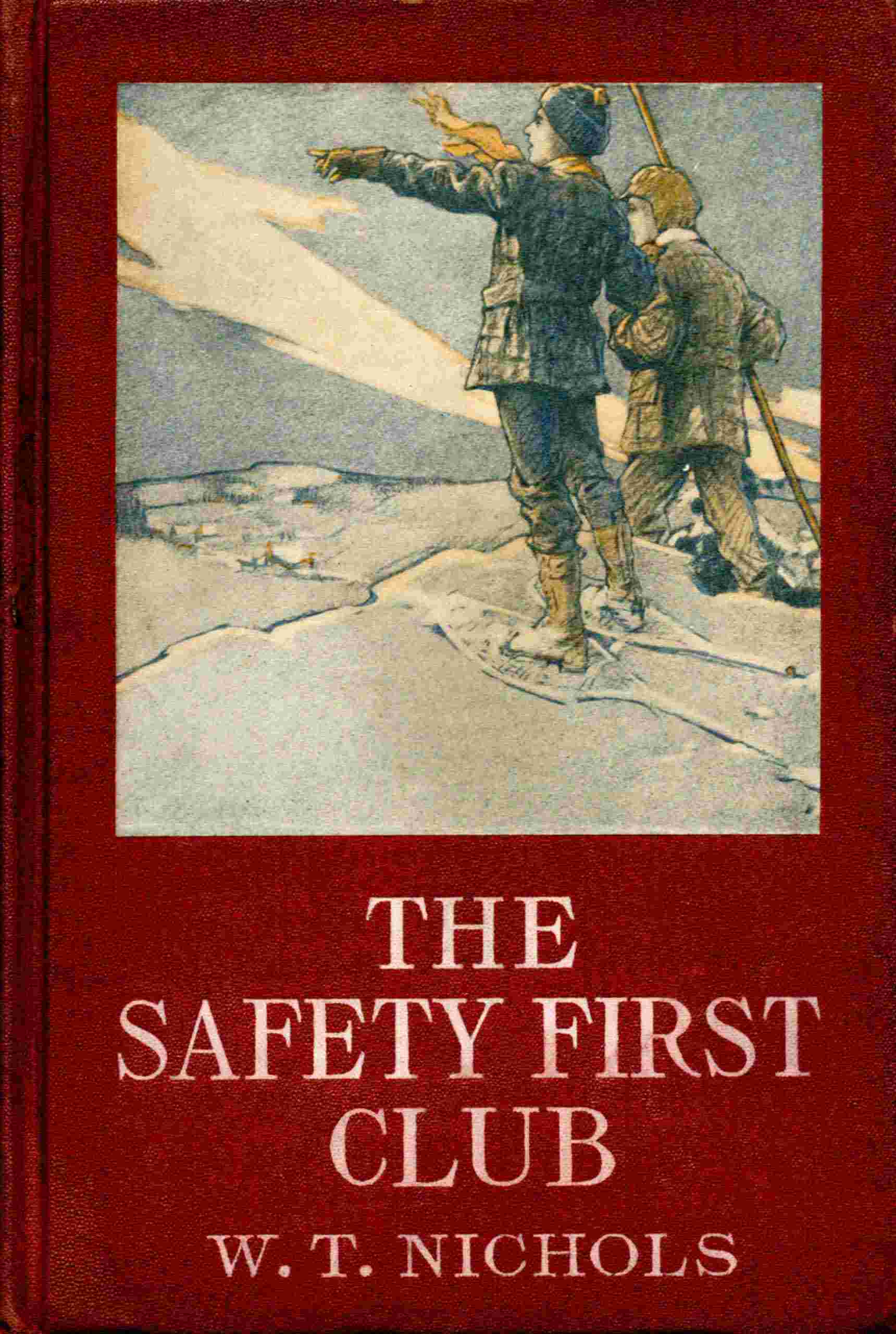
The Safety First Club
CHAPTER I
“HEDGEHOG DAY”
Sam Parker stepped out upon the side porch of his father’s house, closing the door behind him with a slam. There was a frown on his face, which by no means became it; and the corners of his mouth drooped sulkily. He was, as a matter of fact, in a fit of temper, which did not lessen as he surveyed the dull, gray sky, and saw its promise of a dismal day.
“’Nother spoiled Saturday!” he grumbled. “Nowhere to go and nothing to do—oh, thunderation!”
Now, to tell the truth, it may be that the weather had much to do with Sam’s pessimism, just as it often influences persons a great deal older and wiser than this boy of sixteen. Sam, commonly, was good-natured enough. This day, though, things had seemed to go wrong from the very start. He had overslept; one of his shoes had contrived to hide itself under the bureau; his necktie stubbornly had declined to slip into a smooth and even knot; he was late at breakfast, and the oatmeal was cold, and the eggs were as hard as the Fate which he was beginning to suspect was pursuing him. He had attempted criticism, and his father had checked him rather sharply with the reminder that the breakfast hour was 7:30 and not 7:50. His mother had not hastened to his defense; and even Maggie, the cook, frequently his ally and dispenser of consoling doughnuts and cookies, had failed him when he sought sympathy in the kitchen.
“You got up wrong foot foremost,” she told him. “Get along with you now! This is bakin’ day, and I can’t be bothered.”
Sam, thus repulsed, had clumped out of the kitchen; stormed into the hall; snatched up his cap and reefer; stamped across the dining-room, and flung himself out of the house, without visible improvement in his spirits or his condition. If it was dark within, it was gloomy without. He looked up the street and down; nobody was in sight. He buttoned his coat to the neck, and thrust his hands into his pockets: the world, he perceived, was chilly as well as lonely. Then, of a sudden, he grinned, fleetingly and reluctantly, at vagrant memory of the old story of the child that threatened to go out and eat two smooth worms and three fuzzy fellows because nobody loved it. The baby’s troubles were ridiculously like his own, and for a trying second he realized the resemblance. Then he was frowning harder than ever, with mouth drooping still more sulkily.
In sunnier moods Sam Parker was a good-looking boy. Nobody would have called him pretty; he wasn’t of the “pretty” type, being, indeed, rather wholesome and hearty, with plenty of color in his cheeks—and not a few freckles. For a youth who was rapidly adding to his inches, in the process known as getting his growth, he carried himself well; though, as everybody knows, this period in a boy’s life is not that at which grace of figure or movement is most marked. In other words, there were times when Sam did not know what to do with his hands or his feet, and impressed the painful fact upon all beholders, especially because of a certain impulsiveness, which led him now and then into embarrassing ventures.
Standing on the porch and glowering at all he beheld, Sam was not attractive. Hannibal, his bull terrier, trotting from the barn, noted the storm signals his master was flying, and halting at a safe distance, made great pretense of scratching for a flea which did not exist. Sam whistled, and Hannibal grew busier than ever. The boy took an impatient step, and the dog stopped scratching and bolted for the barn.
Sam, striding after him, pulled up abruptly. A thick-set man in cap, and overalls, and boots, and with a carriage rug in one hand and a brush in the other, appeared in the big doorway.
“H’lo, Sam!” was his greeting. “Good day, ain’t it?”
“Good for nothing!” snapped the boy. “Rotten weather!”
The man’s eyes twinkled. They were pleasant eyes, with little fans of fine wrinkles at the corners, and they lighted up his smooth-shaven, weather-beaten face amazingly.
“Huh! Guess you ain’t looked at the calendar lately. This ain’t June; it’s the fust day of December. And I’m tellin’ you this is pretty good weather for December. What if there ain’t no snow? The wheelin’s all right—your daddy took the car out this mornin’.”
Sam nodded. “I know—he went over to Epworth.”
“Why didn’t you go along?”
“What’d be the use?”
Now, this was not strictly ingenuous. Possibly because of his sulks, Sam had not been invited to accompany his father.
“Sure enough! What’d ’a’ been the use?” said the man with an odd grin.
Sam reddened. “Look here! Bet you I could have gone if I’d wanted to, Lon!”
Lon, otherwise Alonzo Gates, hired man and general factotum, made no response to the challenge, but fell to dusting the rug vigorously. Sam, gloomy browed, drew nearer.
“Tell you, Lon, I could have gone. No fun, though—ride’s too cold. That’s the trouble with this weather—no coasting, no skating, no football, nothing!”
“So?” said the man non-committally.
Hobe, the barn cat, sauntered out of the door. Sam kicked at the animal, which took refuge behind a wooden bucket standing just inside the sill, and from this cover snarled defiance. Whereupon Sam kicked again. This time his foot struck something—the bucket. Over it went, and out shot a gallon or two of soapy water. Hobe darted back into the barn. Lon moved aside nimbly, but not nimbly enough. Splash! went the water upon his boots.
“Wal, now, but you have gone and done it!” he ejaculated. “Nice mess to clean up, ain’t it?”
In Sam’s perverse mood the one thing he cared for was to hide the regret he felt.
“Huh! Oughtn’t to have stuff standing round like that. Why didn’t you tell me?”
Lon paused in his labors. “My! but this world’s awful crowded this mornin’, ain’t it?” he remarked. “First there wasn’t room for you ’n’ Hobe; then you jest couldn’t stand for that bucket treadin’ on your toes. Wal, wal!”
Sam snorted wrathfully. What wouldn’t he have given for speech so cuttingly sarcastic that Lon must throw up his hands and beg mercy! But, effective words failing him, he could do no better than offer sounds which were disagreeable rather than intelligible.
Lon chuckled; then grew serious. “See here, Sam!” said he. “I kind o’ guess this is hedgehog day for you, ain’t it?”
“Huh?”
“When you come to think it over,” Lon went on, “a hedgehog’s about the one critter you can’t think of as ever snugglin’ up nice and cozy to anything or anybody. Now, I knew a feller once that had a tame woodchuck that liked to be patted; and I’ve seen the tigers and big cats in circuses purrin’ round their trainers; but I never heard tell of a hedgehog actin’ real sociable and wantin’ to sit in anybody’s lap. And, so far’s I can rec’lect, I never run across a hedgehog that you’d call all-around popular with the neighbors. Whenever one gets close to anybody, he sticks his spines into him. And when a human gets to actin’ like a hedgehog—why that’s when he’s havin’ a hedgehog day—see?”
“Huh!” said Sam again.
Lon gave the rug another flick with the brush.
“By and large, son,” he remarked, “it ain’t good business to have hedgehog days. I know, I know! When you’re feelin’ that way, that’s the way you feel, as the fox said to the bear in the trap. But you ain’t doin’ yourself no good, and you ain’t any perticular help to the rest of the community.”
“Hang the community!”
“Jest what the hedgehog says,” quoth Lon tranquilly. He carried his rug into the barn; brought out another; brushed skilfully for a minute.
“Hunt up some of the boys, Sam,” he advised. “Try lowerin’ your spines, and see if they won’t keep down after a while.”
“Don’t want to.”
“Bad as that, eh?”
Sam disdained to make reply. Lon pursed his lips.
“Sonny, this won’t do. It’s bad medicine. Say, where’ll you be at if you behave like this when you go to St. Mark’s?”
“I’ll get along all right.”
Lon brushed furiously for a little. “I—I dunno’s there’s but—but one way—for some folks to learn things,” he said jerkily. “When you’re there—jest one among two-three hundred boys—it’ll be different, now I tell you! We put up with you; they won’t.”
“Huh! Who’s afraid?”
“I’d be—if I was you.”
“Bah!”
Lon shook his head. “Sam,” he said, “if I thought this was a real in-growin’ attack, I’d be worried a heap wuss than I am. But I’m worried enough as it is. Now, I’ll give you a good tip. If you don’t want to see the other boys, go for a good, long tramp. Walk it off! That’s jest what the real hedgehog can’t do—his legs ain’t long enough.”
“No fun walking—day like this.”
Lon was a patient soul. “Wal, why don’t you go huntin’, then?”
“What for? Rabbits?”
“If you can’t get anything bigger. But you might land a shot at a deer. ’Member what day this is? First of December! Law on deer goes off, and stays off till the fifteenth.”
“Oh!” said Sam. In the new interest he almost forgot, for an instant, that he had a grievance against the universe. But it was only for an instant. “But I wouldn’t have the luck to get a shot at a buck, or a doe, either. The crowd will have started out early, and scared every deer within ten miles of town,” he concluded pessimistically.
“Don’t be too sure of that.”
“’Tis sure!” Sam insisted. “Then what’ll I do for a gun?”
“Got your own, haven’t you?”
“What! Try for a deer with a ‘twenty-two’?”
“Why not? It’s big enough, if it gets to the right spot.”
Sam fell back to his second line of defense. “Well, there’ll be no deer anywhere near town.”
“Who says so?”
“I do!” snapped the boy.
Lon bent toward him, and lowered his voice. “Sam, a feller was tellin’ me last night about a herd that’s been feedin’ in close—right back of old Bill Marlow’s barn—big buck and three-four more. Old orchard in there, you know. And that’s so nigh to town most folks won’t look for ’em there. But there they be—or there they were as late as yesterday, anyhow. And, by gum! if I was you, I’d scout out that way on the chance—that is, if your mother says it’s all right,” he added hastily.
In spite of himself, Sam’s ambition was fired. A shot at a deer! That would be worth while.
“You—you’re certain they were there yesterday?” he asked.
“Bill Marlow told me himself. And you can be sure of one thing—he didn’t tell many other folks. Bill ain’t no gossip.”
Sam nodded. He knew something of Mr. Marlow’s habit of taciturnity. Doubter though he might be, the prospect was brightening. He had heard old hunters tell stories of cases in which deer had been killed almost in the outskirts of the village, while sportsmen ranging farther afield had been rewarded with sight of neither buck nor doe.
“Well, I suppose I might as well have a look,” he said not too graciously.
“Of course you might!”
Sam took a step toward the house. “Of course, with my luck——”
“Oh, you never can tell,” Lon reminded him.
“Still, I might as well be wasting time that way as any other,” said Sam sourly, and quickened his pace.
“Don’t forget to tell your mother!” Lon called after him.
Sam waved a hand in reply, and went on to the house.