
CHAPTER XII.
A MAN OF METTLE.
Years rolled away, but they brought no peace to the mind of John Bonyton.
His was not the mind to bend to the storm, and extract submission from the precepts of Christianity, or that calm philosophy which learns at length to submit to the inevitable.
He brooded upon his loss day and night; he never again entered the roof of his father. Knowing the atrocious plan concocted beneath it, of charging Hope with witchcraft, he could not endure the sight of those whose cruelty he abhorred, and whose hypocrisy was too apparent to be excused.
Finding no sympathy with the colonists, he finally entirely estranged himself from them, and passed his whole time with the Saco Indians. Their simple truth, their loyalty to a friend, no less than their hatred to a foe, harmonized with the broad shades of his own character, and he learned a peace with them which his own people denied him.
Gradually his higher intelligence, his daring courage, his contempt of danger, hardship and death, so won their admiration that he was elected sagamore, or chief. Thus did these primitive people recognize the essential manhood of John Bonyton; thus did they trust him, submit their interests to his keeping, and look up to him as one worthy of all reverence.
Once they besought him to select one of the fairest of their maidens to wife; but when he showed them that the wounds of his heart could never heal, they said no more.
The colonists resented this departure of one of their members from civilized usages, and visited the career of John Bonyton with the utmost acrimony of Puritanical persecution. They looked upon him as wholly given over to Satan, and unentitled to the ordinary claims of human sympathy or human fellowship.
Always a contemner of forms, after his election of sagamore to the tribe, John Bonyton refused any submission to the constituted authority of the colony, which sought in vain to seduce him to the condition of good citizenship. Being called upon to take the oath of allegiance to the colony, he refused, on the ground of his connection with the Saco tribe, whose interests he represented.
The relentless colonists pronounced a decree of outlawry upon the unhappy man, and set a price upon his head.
To these colonial persecutions were superadded those of town and church; so that, but for his faithful friends and allies, the Sacos, the situation of the high-spirited youth would have been miserable in the extreme; but his own indomitable will and fierce assertion of personal independence bore him above hardships and persecutions which would have paralyzed a man of less mettle.
John Bonyton never skulked in by-places to avoid his enemies, but openly confronted them, walking into the town bravely, accoutered in his demi-savage costume, and haughtily bowing to soldier, civilian, or priest, who might be seen with pale lips turning the first corner to avoid the fiery eye of the haughty sagamore.
After the price had been put upon his head, John Bonyton might have been seen making his way at the early twilight of a winter day, to the house of the acting Governor of the colony, Thomas Gorges.
The family were engaged in singing the evening hymn, when a loud rap responded to the last note of the singers. The Governor opened the door in person, for he detected cowardice upon the faces of those nearest the window. John Bonyton stood erect, with rifle in hand, and spoke slowly and distinctly:
“I am John Bonyton, Sagamore of Saco. What will you give me for my head, Governor?”
“How many of your tribe do you carry at your back, John?”
“Not one; I am alone.”
“Then I must say you are a foolhardy man, John, and I warn you to depart. God forbid I should be instrumental in shedding your blood.”
“Hear me, Thomas Gorges. I shall go as I came, and no man will dare lay his hand upon me. Mark me, sir: the shot that lays John Bonyton in the dust will be the signal for the brand, the arrow, and the scalping-knife to fall heavily upon every man, woman and child in this colony. I have warned you.”
He went as he came, alone, and no man dared, as he said, to molest him. These visits he repeated at all times, day or night, till the cross nurse stilled the fretful child by fear of the Sagamore of Saco. So far from being subject to fear for his own life, John Bonyton became a terror to the people of Saco, who never ventured to put any of their edicts against him in execution.
Chief, as he was, of a Pagan tribe, John Bonyton nevertheless felt, or affected to feel, an interest in and need of Christian worship, which he did not fail to gratify when the interests of the tribe permitted him to be absent.
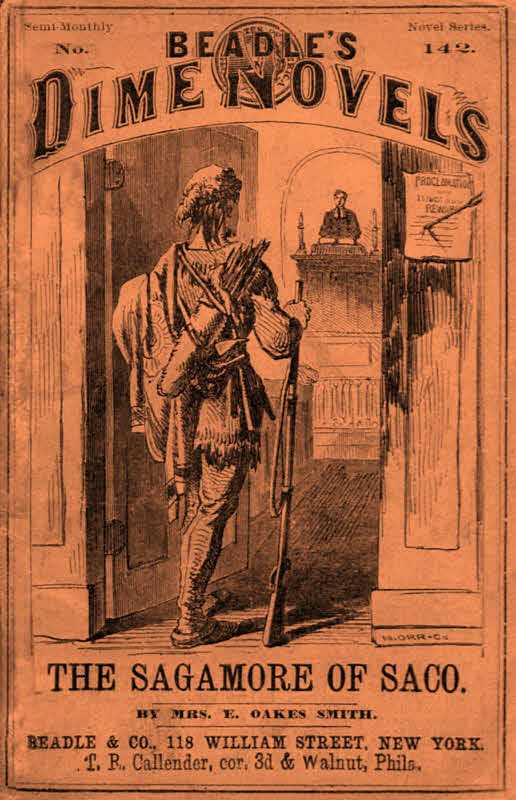
While in the porch of the sacred edifice was pasted up a reward, and an ample one, to whomsoever would bring to the Governor the head of the handsome outlaw, one clear summer morning, the inhabitants being assembled for worship, John Bonyton walked in and read the “Notice” in a clear voice, audible to the people inside, who trembled in their boots. He then stuck a flint-headed arrow through the paper, and walked half-way up the central aisle of the little church.
The minister was at prayer; but being an intrepid man, and accustomed to take a peep now and then through his closed lids, he did so on this occasion, and the prayer, ordinarily an hour in length, was greatly abridged.
There stood John Bonyton, rifle in hand, tall, dark, and defiant.
As the minister said “amen,” the women sunk into their seats, but the men remained standing, for it was the custom in that early age and country for the people to stand in prayer—not to kneel, as the reverent will, nor to sit, as the indolent do.
There was a brief pause, and the minister said:
“John Bonyton, what is your will in this place?”
“To worship God,” was the brief reply.
“Know you not that a price has been set upon your head, and any man has the right to kill you?”
“Yea, I know it.”
There was a clatter of fire-locks, and a stir of heavy feet, for every man carried his musket into the house of God in those days, and worshiped armed to the teeth.
John Bonyton cast a fiery eye over the assemblage, and waved his hand.
“Tell your people to sit down. I shall stand.”
The minister gave the signal, and the congregation became seated.
“Come up here, John Bonyton, and sit by me. God forbid that you should be slain, as was Joab, grasping the horns of the altar.”
“Thomas Jenner, I pray thee proceed with thy ministrations; no man will lay hand upon me. You pray and preach; I will listen to you.”
Whereat the Rev. Mr. Jenner gave the people a sermon, which lasted two hours of that hot, midsummer day, in which he enlarged upon the duty of every man, who had come into this new Canaan to plant here the Ark of the Covenant of God, to hold himself in readiness to drive out the heathen, root and branch, as the Israelites of old were commanded to do, when they crossed the Jordan into the promised land, and failing in which, the Jews brought down upon themselves the judgment of an offended Leader and Judge, even the Most High God.
Fierce looks and angry glances lighted upon the head of John Bonyton, but he moved not hand nor foot, nor turned away his eye from contemplating the face of the minister, all through the long sermon. When it closed, he walked up and stood in front of the communion-table, and looked up at the singers with a pleasant face, although it is recorded that they introduced into their tune more quavers and demi-semi-quavers than of right belonged to it.
The minister, leaning over the pulpit, said:
“John Bonyton, I command thee to go thy way.”
A pleasant smile passed over the handsome face of the sagamore, and he glanced over his shoulder, upward at Mr. Jenner, and replied:
“Bid thy sheep betake themselves to the fold, ewes and lambs, Thomas Jenner, and I will await their exit.”
Whereat the minister pronounced the benediction, and the people, according to their wont, went forth, the men first, and the women following; and it was notable that every woman turned her face and looked fully at the handsome outlaw, and the cheek of every woman was observed to turn, not pale, but to glow with a rosy blush.
Lastly, the minister came slowly down the pulpit-stairs, and walked down the aisle, and then John Bonyton strode forth, and walked, in a slow and stately manner, up the main street of the village, along the river-bank, and up the mountain gorges. No man dared lay hands upon him.
The Sagamore of Saco was no ordinary man, and the men of the times felt it. Tradition is yet rife with legends of his great beauty, his tall, manly physique, like that of the handsome King of Israel, head and shoulders overtopping the rest of the people, while his lonely but unfrequent smile wore the power of fascination.