
CHAPTER XIII.
A LIKING FOR MISERY.
Mistress Bonyton at length found repose where the weary are at rest, and Nancy gave her hand, in due time, to the godly youth, Ephraim Higgins, who, stimulated by his wife, made many ambitious attempts at public prayer and exhortation, but, being deficient in that fervor or ostentation of character essential to “freedom of utterance,” our Ephraim was fain to give over these public aspirations, and content himself with the “amen,” which marked his indorsement of the sayings of others. If the truth must be told, Nancy not unfrequently nudged him to hold his peace even in this, because of the said amen having fallen in the wrong quarter, to the no little mortification of his wife.
Perseverance was a rose so guarded with thorns, that no man had the courage to pluck it, and she may have sometimes caused Nancy some discomfort by alluding to persons and events which might as well have been buried in oblivion. For instance, she was fond of marking an event thus:
“This happened when your Ephraim, the great goose, was spoonying about Hope Vines. Never shall I forget, Nancy, how he used to stand with his finger in his mouth—no, his thumb in his mouth—looking after that girl.”
“What do you think became of Hope?” asked Nancy Higgins, ignoring the spiteful remark of her sister.
“I believe Satan carried her off bodily. I no more believe that she was stolen by the Indians, than I believe that brother Ephe will set the world afire.”
“Never you mind my Ephe; it’s easy to cry sour grapes. When you get your man we shall see—we shall see!”
“There goes John, as true as I live, stalking along just as though the folks warn’t ready to eat him up,” cried Perseverance, making a rush at the door, at which she cried, loudly:
“John! John Bonyton, look here!”
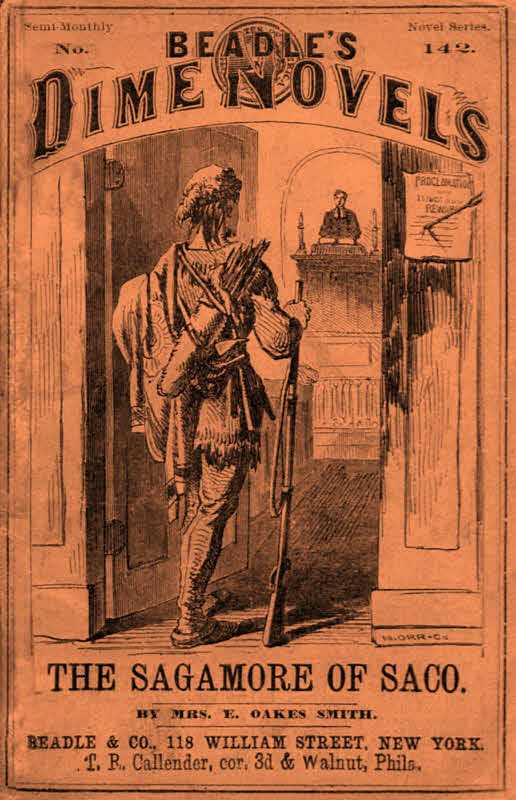
The sagamore turned with a grave slowness, and confronted the speaker in silence. His sister Nancy now joined her, and beckoned him to approach. He lowered the musket which he carried carelessly in the hollow of his arm, showing it to be loaded, and casting the butt upon the ground, it gave out a sharp, significant ring.
“What is your will, wildcats?” he asked.
Unheeding this not very complimentary epithet, Mrs. Higgins entreated him to enter her house.
“Why should I enter your house?”
“Because I am your sister, John, and it shames me to see you living this heathenish life.”
“Then cease to regard me as a brother. Come here, Perseverance.”
In a few minutes the woman was seen moving slowly down the street in company with the tall and taciturn man, who moved toward the rude cemetery, in which were laid the dust to dust of the few of the colony who had passed from the strife of the world into the eternal rest. It was a small inclosure in which the stumps of trees were still visible, and the graves were little more than heaps of sand.
Now and then might be seen a few flowers, and a grave rounded with green turf; but it was a desolate-looking place, serving for nothing but the sad necessities of humanity.
In silence the two proceeded onward, and at length stopped where the sod was heaped with unwonted care over a newly made grave. Perseverance burst into tears:
“She lies here, John.”
The sagamore leaned upon his gun—raising the helmet of plumes from his head, and as he gazed downward, tears flowed from his eyes.
“Did she die in peace, at last?”
“Yea, my brother, she deplored your heathenish—”
He waved his hand.
“What said she?”
“At the last she was very gentle. She said she feared the people would bring down the curse of God upon themselves for some of their doings.”
“Go on,” he said, observing her to hesitate.
“She said, ‘I am ill at ease about John,’ and then she burst into tears, and cried, ‘Oh! John, John, my dearest, best! Oh, that I could see him!—oh, that I could bless him, before I die!’”
At this outburst of genuine feeling from his sister, John Bonyton took her hand in his, and long after did Perseverance remember the groan that escaped his bosom.
“Said she nothing of Hope Vines?”
“Yes, John, she said she repented before God the evil she designed in her heart against her.”
“And you?”
As he asked the question, his stern eyes were upon her face.
“I, John?”
“Yes; have you no repentance?”
“I did nothing.”
“Is it nothing to let loose the tongue against the innocent? Do not tell me that you, Perseverance Bonyton, believed these idle stories, which you helped to promulgate.”
“Wiser than I believed them.”
He turned moodily away to the woods, and Perseverance went her way, momentarily softened, but only to resume her hard and vindictive thoughts, and become one in that aggregate of falsehood and malignity which goes to make up human society.
That night, when the village was buried in sleep, John Bonyton might have been seen for hours, kneeling upon his mother’s grave—he, the strong man, weeping like a child upon its mother’s breast.
Not till the morning was dawning did he turn away, murmuring, “Mother, mother,” as if the repetition of the word brought some ease to his heart.
As he turned away from the grave in the early light, he was surprised to see Ephraim Higgins standing beside him.
“I just come, John, to speak to you. I al’ays liked you, John.”
“I am sure of it. You’ve a true, honest heart, Ephe.”
“I’m glad you think so, John. I al’ays liked you—you know I did.”
“Then you would not take my life, even to please the Governor?” This with a smile.
“No, indeed, John. I wish I could do something for you. I wish you’d come home, and live like a Christian, John—I wish you would.”
And poor, honest Ephraim grasped his hand warmly as he went on:
“I don’t understand things much, John, and sometimes I make your sister Nancy feel ashamed of me, John; but I mean right, I do—and we’ve got a baby—we have, and it’s e’ena’most as purty as Hope Vines.”
“You don’t forget Hope?”
“No, John, no; I didn’t think of her as the women think I did—never, never! She was like a born angel to me—like a cherubim on a tombstone. Somehow I felt as if I could pray to her. My mother said I was bewitched, and you was bewitched, and I believed it. I know better now, John. I’ve thought it out.”
“And you love your old playmate yet, Ephraim, and you know and hear nothing of Hope?”
“No, John, not a word. But, look here—she was doomed, like, from the fust. I used to feel as if I should cry, to look at her eyes.”
“I never saw any thing strange in her—nothing but truth and goodness.”
“All that, John, but not the kind to wring out a dishcloth or sweep a kitchen. Women don’t like them that don’t do jest as all the rest of them duz.”
“That is true. What then?”
“Don’t you remember that Hope would whistle up a quail, with that purty cherry month of hern? Well, the women used to look askance at this, and say—I’ve heard Nancy say it a hundred times—”
“Say what?” asked the sagamore, for Ephraim had a dim perception of saying something not just what should be said and had stopped.
“Well, they used to say,
If women don’t keep the right side of each other, it’s a gone case with ’em, John.”
“You think they would have tortured and killed Hope out of spite, and called it religion?”
“I don’t pretend to be as wise as your sister Nancy, John—la, bless you! I believe the baby’s wiser’n its own father; but I do say they’d a killed her; and it’s better as it is.”
“Who would have had the heart to do it?”
“As to that, any of them. My wife Nancy would a helped, she would. You ought to hear her quote Scriptur’ about witches and wizards, and necromancers, and Moloch, and familiar sperrits. I’ve sot and heard her till every hair in my head stood on end. I think the women are kind of disappointed not to a had a chance at her.”
John Bonyton ground his teeth with fury, and exclaimed:
“They will find a subject in due time, I’ll be bound.”
“That they will. The way they tell about running pins and needles into the flesh of some poor old thing is awful. I think the women, not going to war, let their minds run on these kind of torments instead. Now, Nancy is as kind as the best, but I’ve heard her tell how they’d do. They were in doubt whether they would burn or hang Hope.”
John Bonyton shuddered, and ejaculated between his teeth a compound which we will not repeat; but it was “she-”— something, and a term which many a woman has well deserved.
Ephraim looked aghast at the fierce passion of his friend and droned on again:
“You was al’ays violent and kind o’ unreasonable, John. But it’s nothing here nor there to talk. Howsomever you can fix it, women ain’t over’n above tender. They kinder enjoy sufferin’. See ’em cry. They enjoy it. I’m more tender to our baby than Nancy is.”
It is doubtful if the sagamore heard half of this philosophical tirade of the kind-hearted Ephraim. The sun was now up, and admonished him that if he would escape observation at such a time and place, he must take his departure. Seeing this, Ephraim broke in again:
“Come home with me, John, and eat breakfast—bread and ham and potatoes, John, Christian food, with a grace before meat.”
“I have renounced the colony, as you well know, Ephraim. I can not go with you; but I thank you none the less.”
“Come, now, don’t turn your back upon me, John Bonyton. It goes to my heart to see you go away from kith and kin, and everybody’s hand agin’ you.”
But, before he had ceased to speak, the sagamore grasped his hand, and even, in an unwonted fit of softness, clasped his arms around his one simple, devoted friend, and without a word, was gone.