
CHAPTER THE EIGHTEENTH.
The tears poured forth again, after this appeal, and, shaken by deep sobs, she buried her whole face and breast in my bed; and I, moved by pity and by apprehension, begged her to be of good cheer and to make herself perfectly easy as to both of those issues, for not only would we not betray any secrets to the rabble, but we would also second divine providence, at any peril to ourselves, if any god had indicated to her any cure for her tertian ague. The woman cheered up at this promise, and smothered me with kisses; from tears she passed to laughter, and fell to running her fingers through the long hair that hung down about my ears. “I will declare a truce with you,” she said, “and withdraw my complaint. But had you been unwilling to administer the medicine which I seek, I had a troop in readiness for the morrow, which would have exacted satisfaction for my injury and reparation for my dignity!
To be flouted is disgraceful, but to dictate terms, sublime
Pleased am I to choose what course I will,
Even sages will retort an insult at the proper time.
Victor most is he who does not kill.”
Then she suddenly clapped her hands, and broke into such a peal of
laughter that we were alarmed. The maid, who had been the first to arrive,
did likewise, on one side of us, as also did the little girl who had
entered with the madame herself.
CHAPTER THE NINETEENTH.
The whole place was filled with mocking laughter, and we, who could see no
reason for such a change of front, stared blankly at each other and then
at the women. (Then Quartilla spoke up, finally,) “I gave orders that no
mortal man should be admitted into this inn, this day, so that I could
receive the treatment for my ague without interruption!” Ascyltos was, for
the moment, struck dumb by this admission of Quartilla’s, and I turned
colder than a Gallic winter, and could not utter a word; but the personnel
of the company relieved me from the fear that the worst might be yet to
come, for they were only three young women, too weak to attempt any
violence against us, who were of the male sex, at least, even if we had
nothing else of the man about us, and this was an asset. Then, too, we
were girded higher, and I had so arranged matters that if it came to a
fight, I would engage Quartilla myself, Ascyltos the maid, and Giton the
girl. (While I was turning over this plan in my mind, Quartilla came to
close quarters, to receive the treatment for her ague, but having her
hopes disappointed, she flounced out in a rage and, returning in a little
while, she had us overpowered by some unknown vagabonds, and gave orders
for us to be carried away to a splendid palace.) Then our determination
gave place to astonishment, and death, sure and certain, began to obscure
the eyes of suffering.
CHAPTER THE TWENTIETH.
“Pray; madame,” I groaned, “if you have anything worse in store, bring it
on quickly for we have not committed a crime so heinous as to merit death
by torture.” The maid, whose name was Psyche, quickly spread a blanket
upon the floor (and) sought to secure an erection by fondling my member,
which was already a thousand times colder than death. Ascyltos, well aware
by now of the danger of dipping into the secrets of others, covered his
head with his mantle. (In the meantime,) the maid took two ribbons from
her bosom and bound our feet with one and our hands with the other.
(Finding myself trussed up in this fashion, I remarked, “You will not be
able to cure your mistress’ ague in this manner!” “Granted,” the maid
replied, “but I have other and surer remedies at hand,” she brought me a
vessel full of satyrion, as she said this, and so cheerfully did she
gossip about its virtues that I drank down nearly all of the liquor, and
because Ascyltos had but a moment before rejected her advances, she
sprinkled the dregs upon his back, without his knowing it.) When this
repartee had drawn to a close, Ascyltos exclaimed, “Don’t I deserve a
drink?” Given away by my laughter, the maid clapped her hands and cried,
“I put one by you, young man; did you drink so much all by yourself?”
“What’s that you say?”, Quartilla chimed in. “Did Encolpius drink all the
satyrion there was in the house?” And she laughed delightfully until her
sides shook. Finally not even Giton himself could resist a smile,
especially when the little girl caught him around the neck and showered
innumerable kisses upon him, and he not at all averse to it.
CHAPTER THE TWENTY-FIRST.
We would have cried aloud in our misery but there was no one to give us
any help, and whenever I attempted to shout, “Help! all honest citizens,”
Psyche would prick my cheeks with her hairpin, and the little girl would
intimidate Ascyltos with a brush dipped in satyrion. Then a catamite
appeared, clad in a myrtle-colored frieze robe, and girded round with a
belt. One minute he nearly gored us to death with his writhing buttocks,
and the next, he befouled us so with his stinking kisses that Quartilla,
with her robe tucked high, held up her whalebone wand and ordered him to
give the unhappy wretches quarter. Both of us then took a most solemn oath
that so dread a secret should perish with us. Several wrestling
instructors appeared and refreshed us, worn out as we were, by a massage
with pure oil, and when our fatigue had abated, we again donned our dining
clothes and were escorted to the next room, in which were placed three
couches, and where all the essentials necessary to a splendid banquet were
laid out in all their richness. We took our places, as requested, and
began with a wonderful first course. We were all but submerged in
Falernian wine. When several other courses had followed, and we were
endeavoring to keep awake Quartilla exclaimed, “How dare you think of
going to sleep when you know that the vigil of Priapus is to be kept?”
CHAPTER THE TWENTY-SECOND.
Worn out by all his troubles, Ascyltos commenced to nod, and the maid,
whom he had slighted, and of course insulted, smeared lampblack all over
his face, and painted his lips and shoulders with vermillion, while he
drowsed. Completely exhausted by so many untoward adventures, I, too, was
enjoying the shortest of naps, the whole household, within and without,
was doing the same, some were lying here and there asleep at our feet,
others leaned against the walls, and some even slept head to head upon the
threshold itself; the lamps, failing because of a lack of oil, shed a
feeble and flickering light, when two Syrians, bent upon stealing an
amphora of wine, entered the dining-room. While they were greedily pawing
among the silver, they pulled the amphora in two, upsetting the table with
all the silver plate, and a cup, which had flown pretty high, cut the head
of the maid, who was drowsing upon a couch. She screamed at that, thereby
betraying the thieves and wakening some of the drunkards. The Syrians, who
had come for plunder, seeing that they were about to be detected, were so
quick to throw themselves down besides a couch and commence to snore as if
they had been asleep for a long time, that you would have thought they
belonged there. The butler had gotten up and poured oil in the flickering
lamps by this time, and the boys, having rubbed their eyes open, had
returned to their duty, when in came a female cymbal player and the
crashing brass awoke everybody.
CHAPTER THE TWENTY-THIRD.
The banquet began all over again, and Quartilla challenged us to a drinking-bout, the crash of the cymbals lending ardor to her revel. A catamite appeared, the stalest of all mankind, well worthy of that house. Heaving a sigh, he wrung his hands until the joints cracked, and spouted out the following verses,
"Hither, hither quickly gather, pathic companions boon;
Artfully stretch forth your limbs and on with the dance and play!
Twinkling feet and supple thighs and agile buttocks in tune,
Hands well skilled in raising passions, Delian eunuchs gay!”
When he had finished his poetry, he slobbered a most evil-smelling kiss
upon me, and then, climbing upon my couch, he proceeded with all his might
and main to pull all of my clothing off. I resisted to the limit of my
strength. He manipulated my member for a long time, but all in vain. Gummy
streams poured down his sweating forehead, and there was so much chalk in
the wrinkles of his cheeks that you might have mistaken his face for a
roofless wall, from which the plaster was crumbling in a rain.
CHAPTER THE TWENTY-FOURTH.
Driven to the last extremity, I could no longer keep back the tears.
“Madame,” I burst out, “is this the night-cap which you ordered served to
me?” Clapping her hands softly she cried out, “Oh you witty rogue, you are
a fountain of repartee, but you never knew before that a catamite was
called a k-night-cap, now did you?” Then, fearing my companion would come
off better than I, “Madame,” I said, “I leave it to your sense of
fairness: is Ascyltos to be the only one in this dining-room who keeps
holiday?” “Fair enough,” conceded Quartilla, “let Ascyltos have his
k-night-cap too!” On hearing that, the catamite changed mounts, and,
having bestridden my comrade, nearly drove him to distraction with his
buttocks and his kisses. Giton was standing between us and splitting his
sides with laughter when Quartilla noticed him, and actuated by the
liveliest curiosity, she asked whose boy he was, and upon my answering
that he was my “brother,” “Why has he not kissed me then?” she demanded.
Calling him to her, she pressed a kiss upon his mouth, then putting her
hand beneath his robe, she took hold of his little member, as yet so
undeveloped. “This,” she remarked, “shall serve me very well tomorrow, as
a whet to my appetite, but today I’ll take no common fare after choice
fish!”
CHAPTER THE TWENTY-FIFTH.
She was still talking when Psyche, who was giggling, came to her side and
whispered something in her ear. What it was, I did not catch. “By all
means,” ejaculated Quartilla, “a brilliant idea! Why shouldn’t our pretty
little Pannychis lose her maidenhead when the opportunity is so
favorable?” A little girl, pretty enough, too, was led in at once; she
looked to be not over seven years of age, and she was the same one who had
before accompanied Quartilla to our room. Amidst universal applause, and
in response to the demands of all, they made ready to perform the nuptial
rites. I was completely out of countenance, and insisted that such a
modest boy as Giton was entirely unfitted for such a wanton part, and
moreover, that the child was not of an age at which she could receive that
which a woman must take. “Is that so,” Quartilla scoffed, “is she any
younger than I was, when I submitted to my first man? Juno, my patroness,
curse me if I can remember the time when I ever was a virgin, for I
diverted myself with others of my own age, as a child then as the years
passed, I played with bigger boys, until at last I reached my present age.
I suppose that this explains the origin of the proverb, ‘Who carried the
calf may carry the bull,’ as they say.” As I feared that Giton might run
greater risk if I were absent, I got up to take part in the ceremony.
CHAPTER THE TWENTY-SIXTH.
Psyche had already enveloped the child’s head in the bridal-veil, the
catamite, holding a torch, led the long procession of drunken women which
followed; they were clapping their hands, having previously decked out the
bridal-bed with a suggestive drapery. Quartilla, spurred on by the
wantonness of the others, seized hold of Giton and drew him into the
bridal-chamber. There was no doubt of the boy’s perfect willingness to go,
nor was the girl at all alarmed at the name of marriage. When they were
finally in bed, and the door shut, we seated ourselves outside the door of
the bridal-chamber, and Quartilla applied a curious eye to a chink,
purposely made, watching their childish dalliance with lascivious
attention. She then drew me gently over to her side that I might share the
spectacle with her, and when we both attempted to peep our faces were
pressed against each other; whenever she was not engrossed in the
performance, she screwed up her lips to meet mine, and pecked at me
continually with furtive kisses. [A thunderous hammering was heard at the
door, while all this was going on, and everyone wondered what this
unexpected interruption could mean, when we saw a soldier, one of the
night-watch, enter with a drawn sword in his hand, and surrounded by a
crowd of young rowdies. He glared about him with savage eyes and
blustering mien, and, catching sight of Quartilla, presently, “What’s up
now, you shameless woman,” he bawled; “what do you mean by making game of
me with lying promises, and cheating me out of the night you promised me?
But you won’t get off unpunished! You and that lover of yours are going to
find out that I’m a man!” At the soldier’s orders, his companion bound
Quartilla and myself together, mouth to mouth, breast to breast, and thigh
to thigh; and not without a great deal of laughter. Then the catamite,
also at the soldier’s order, began to beslaver me all over with the fetid
kisses of his stinking mouth, a treatment I could neither fly from, nor in
any other way avoid. Finally, he ravished me, and worked his entire
pleasure upon me. In the meantime, the satyrion which I had drunk only a
little while before spurred every nerve to lust and I began to gore
Quartilla impetuously, and she, burning with the same passion,
reciprocated in the game. The rowdies laughed themselves sick, so moved
were they by that ludicrous scene, for here was I, mounted by the stalest
of catamites, involuntarily and almost unconsciously responding with as
rapid a cadence to him as Quartilla did in her wriggling under me. While
this was going on, Pannychis, unaccustomed at her tender years to the
pastime of Venus, raised an outcry and attracted the attention of the
soldier, by this unexpected howl of consternation, for this slip of a girl
was being ravished, and Giton the victor, had won a not bloodless victory.
Aroused by what he saw, the soldier rushed upon them, seizing Pannychis,
then Giton, then both of them together, in a crushing embrace. The virgin
burst into tears and plead with him to remember her age, but her prayers
availed her nothing, the soldier only being fired the more by her childish
charms.
Pannychis covered her head at last, resolved to endure whatever the Fates
had in store for her. At this instant, an old woman, the very same who had
tricked me on that day when I was hunting for our lodging, came to the aid
of Pannychis, as though she had dropped from the clouds. With loud cries,
she rushed into the house, swearing that a gang of footpads was prowling
about the neighborhood and the people invoked the help of “All honest
men,” in vain, for the members of the night-watch were either asleep or
intent upon some carouse, as they were nowhere to be found. Greatly
terrified at this, the soldier rushed headlong from Quartilla’s house. His
companions followed after him, freeing Pannychis from impending danger and
relieving the rest of us from our fear.] (I was so weary of Quartilla’s
lechery that I began to meditate means of escape. I made my intentions
known to Ascyltos, who, as he wished to rid himself of the importunities
of Psyche, was delighted; had not Giton been shut up in the
bridal-chamber, the plan would have presented no difficulties, but we
wished to take him with us, and out of the way of the viciousness of these
prostitutes. We were anxiously engaged in debating this very point, when
Pannychis fell out of bed, and dragged Giton after her, by her own weight.
He was not hurt, but the girl gave her head a slight bump, and raised such
a clamor that Quartilla, in a terrible fright, rushed headlong into the
room, giving us the opportunity of making off. We did not tarry, but flew
back to our inn where,) throwing ourselves upon the bed, we passed the
remainder of the night without fear. (Sallying forth next day, we came
upon two of our kidnappers, one of whom Ascyltos savagely attacked the
moment he set eyes upon him, and, after having thrashed and seriously
wounded him, he ran to my aid against the other. He defended himself so
stoutly, however, that he wounded us both, slightly, and escaped
unscathed.) The third day had now dawned, the date set for the free dinner
(at Trimalchio’s,) but battered as we were, flight seemed more to our
taste than quiet, so (we hastened to our inn and, as our wounds turned out
to be trifling, we dressed them with vinegar and oil, and went to bed. The
ruffian whom we had done for, was still lying upon the ground and we
feared detection.) Affairs were at this pass, and we were framing
melancholy excuses with which to evade the coming revel, when a slave of
Agamemnon’s burst in upon our trembling conclave and said, “Don’t you know
with whom your engagement is today? The exquisite Trimalchio, who keeps a
clock and a liveried bugler in his dining-room, so that he can tell,
instantly, how much of his life has run out!” Forgetting all our troubles
at that, we dressed hurriedly and ordered Giton, who had very willingly
performed his servile office, to follow us to the bath.
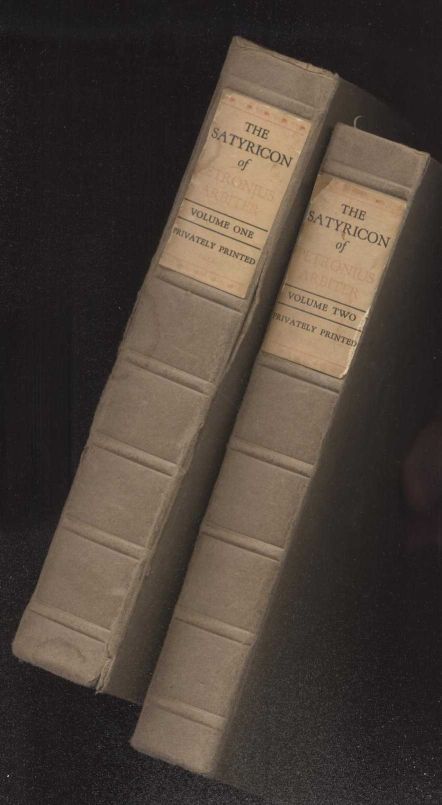
VOLUME II.
THE DINNER OF TRIMALCHIO
CHAPTER THE TWENTY-SEVENTH.
Having put on our clothes, in the meantime, we commenced to stroll around
and soon, the better to amuse ourselves, approached the circle of players;
all of a sudden we caught sight of a bald-headed old fellow, rigged out in
a russet colored tunic, playing ball with some long haired boys. It was
not so much the boys who attracted our attention, although they might well
have merited it, as it was the spectacle afforded by this beslippered
paterfamilias playing with a green ball. If one but touched the ground, he
never stooped for it to put it back in play; for a slave stood by with a
bagful from which the players were supplied. We noted other innovations as
well, for two eunuchs were stationed at opposite sides of the ring, one of
whom held a silver chamber-pot, the other counted the balls; not those
which bounced back and forth from hand to hand, in play, but those which
fell to the ground. While we were marveling at this display of refinement,
Menelaus rushed up, “He is the one with whom you will rest upon your
elbow,” he panted, “what you see now, is only a prelude to the dinner.”
Menelaus had scarcely ceased speaking when Trimalchio snapped his fingers;
the eunuch, hearing the signal, held the chamber-pot for him while he
still continued playing. After relieving his bladder, he called for water
to wash his hands, barely moistened his fingers, and dried them upon a
boy’s head.
CHAPTER THE TWENTY-EIGHTH.
To go into details would take too long. We entered the bath, finally, and after sweating for a minute or two in the warm room, we passed through into the cold water. But short as was the time, Trimalchio had already been sprinkled with perfume and was being rubbed down, not with linen towels, however, but with cloths made from the finest wool. Meanwhile, three masseurs were guzzling Falernian under his eyes, and when they spilled a great deal of it in their brawling, Trimalchio declared they were pouring a libation to his Genius. He was then wrapped in a coarse scarlet wrap-rascal, and placed in a litter. Four runners, whose liveries were decorated with metal plates, preceded him, as also did a wheel-chair in which rode his favorite, a withered, blear eyed slave, even more repulsive looking than his master. A singing boy approached the head of his litter, as he was being carried along, and played upon small pipes the whole way, just as if he were communicating some secret to his master’s ear. Marveling greatly, we followed, and met Agamemnon at the outer door, to the post of which was fastened a small tablet bearing this inscription:
NO SLAVE TO LEAVE THE PREMISES
WITHOUT PERMISSION FROM THE MASTER.
PENALTY ONE HUNDRED LASHES.
In the vestibule stood the porter, clad in green and girded with a
cherry-colored belt, shelling peas into a silver dish. Above the threshold
was suspended a golden cage, from which a black and white magpie greeted
the visitors.
CHAPTER THE TWENTY-NINTH.
I almost fell backwards and broke my legs while staring at all this, for to the left, as we entered, not far from the porter’s alcove, an enormous dog upon a chain was painted upon the wall, and above him this inscription, in capitals:
BEWARE THE DOG.
My companions laughed, but I plucked up my courage and did not hesitate,
but went on and examined the entire wall. There was a scene in a slave
market, the tablets hanging from the slaves’ necks, and Trimalchio
himself, wearing his hair long, holding a caduceus in his hand, entering
Rome, led by the hand of Minerva. Then again the painstaking artist had
depicted him casting up accounts, and still again, being appointed
steward; everything being explained by inscriptions. Where the walls gave
way to the portico, Mercury was shown lifting him up by the chin, to a
tribunal placed on high. Near by stood Fortune with her horn of plenty,
and the three Fates, spinning golden flax. I also took note of a group of
runners, in the portico, taking their exercise under the eye of an
instructor, and in one corner was a large cabinet, in which was a very
small shrine containing silver Lares, a marble Venus, and a golden casket
by no means small, which held, so they told us, the first shavings of
Trimalchio’s beard. I asked the hall-porter what pictures were in the
middle hall. “The Iliad and the Odyssey,” he replied, “and the
gladiatorial games given under Laenas.” There was no time in which to
examine them all.
CHAPTER THE THIRTIETH.
We had now come to the dining-room, at the entrance to which sat a factor, receiving accounts, and, what gave me cause for astonishment, rods and axes were fixed to the door-posts, superimposed, as it were, upon the bronze beak of a ship, whereon was inscribed:
TO GAIUS POMPEIUS TRIMALCHIO
AUGUSTAL, SEVIR
FROM CINNAMUS HIS
STEWARD.
A double lamp, suspended from the ceiling, hung beneath the inscription, and a tablet was fixed to each door-post; one, if my memory serves me, was inscribed,
ON DECEMBER THIRTIETH AND
THIRTY FIRST
OUR
GAIUS DINES OUT
the other bore a painting of the moon in her phases, and the seven
planets, and the days which were lucky and those which were unlucky,
distinguished by distinctive studs. We had had enough of these novelties
and started to enter the dining-room when a slave, detailed to this duty,
cried out, “Right foot first.” Naturally, we were afraid that some of us
might break some rule of conduct and cross the threshold the wrong way;
nevertheless, we started out, stepping off together with the right foot,
when all of a sudden, a slave who had been stripped, threw himself at our
feet, and commenced begging us to save him from punishment, as it was no
serious offense for which he was in jeopardy; the steward’s clothing had
been stolen from him in the baths, and the whole value could scarcely
amount to ten sesterces. So we drew back our right feet and intervened
with the steward, who was counting gold pieces in the hall, begging him to
remit the slave’s punishment. Putting a haughty face on the matter, “It’s
not the loss I mind so much,” he said, “as it is the carelessness of this
worthless rascal. He lost my dinner clothes, given me on my birthday they
were, by a certain client, Tyrian purple too, but it had been washed once
already. But what does it amount to? I make you a present of the
scoundrel!”
CHAPTER THE THIRTY-FIRST.
We felt deeply obligated by his great condescension, and the same slave for whom we had interceded, rushed up to us as we entered the dining-room, and to our astonishment, kissed us thick and fast, voicing his thanks for our kindness. “You’ll know in a minute whom you did a favor for,” he confided, “the master’s wine is the thanks of a grateful butler!” At length we reclined, and slave boys from Alexandria poured water cooled with snow upon our hands, while others following, attended to our feet and removed the hangnails with wonderful dexterity, nor were they silent even during this disagreeable operation, but they all kept singing at their work. I was desirous of finding out whether the whole household could sing, so I ordered a drink; a boy near at hand instantly repeated my order in a singsong voice fully as shrill, and whichever one you accosted did the same. You would not imagine that this was the dining-room of a private gentleman, but rather that it was an exhibition of pantomimes. A very inviting relish was brought on, for by now all the couches were occupied save only that of Trimalchio, for whom, after a new custom, the chief place was reserved.
On the tray stood a donkey made of Corinthian bronze, bearing panniers
containing olives, white in one and black in the other. Two platters
flanked the figure, on the margins of which were engraved Trimalchio’s
name and the weight of the silver in each. Dormice sprinkled with
poppy-seed and honey were served on little bridges soldered fast to the
platter, and hot sausages on a silver gridiron, underneath which were
damson plums and pomegranate seeds.
CHAPTER THE THIRTY-SECOND.
We were in the midst of these delicacies when, to the sound of music,
Trimalchio himself was carried in and bolstered up in a nest of small
cushions, which forced a snicker from the less wary. A shaven poll
protruded from a scarlet mantle, and around his neck, already muffled with
heavy clothing, he had tucked a napkin having a broad purple stripe and a
fringe that hung down all around. On the little finger of his left hand he
wore a massive gilt ring, and on the first joint of the next finger, a
smaller one which seemed to me to be of pure gold, but as a matter of fact
it had iron stars soldered on all around it. And then, for fear all of his
finery would not be displayed, he bared his right arm, adorned with a
golden arm-band and an ivory circlet clasped with a plate of shining
metal.
CHAPTER THE THIRTY-THIRD.
Picking his teeth with a silver quill, “Friends,” said he, “it was not
convenient for me to come into the dining-room just yet, but for fear my
absence should cause you any inconvenience, I gave over my own pleasure:
permit me, however, to finish my game.” A slave followed with a terebinth
table and crystal dice, and I noted one piece of luxury that was
superlative; for instead of black and white pieces, he used gold and
silver coins. He kept up a continual flow of various coarse expressions.
We were still dallying with the relishes when a tray was brought in, on
which was a basket containing a wooden hen with her wings rounded and
spread out as if she were brooding. Two slaves instantly approached, and
to the accompaniment of music, commenced to feel around in the straw. They
pulled out some pea-hen’s eggs, which they distributed among the diners.
Turning his head, Trimalchio saw what was going on. “Friends,” he
remarked. “I ordered pea-hen’s eggs set under the hen, but I’m afraid
they’re addled, by Hercules I am let’s try them anyhow, and see if they’re
still fit to suck.” We picked up our spoons, each of which weighed not
less than half a pound, and punctured the shells, which were made of flour
and dough, and as a matter of fact, I very nearly threw mine away for it
seemed to me that a chick had formed already, but upon hearing an old
experienced guest vow, “There must be something good here,” I broke open
the shell with my hand and discovered a fine fat fig-pecker, imbedded in a
yolk seasoned with pepper.
CHAPTER THE THIRTY-FOURTH.
Having finished his game, Trimalchio was served with a helping of everything and was announcing in a loud voice his willingness to join anyone in a second cup of honied wine, when, to a flourish of music, the relishes were suddenly whisked away by a singing chorus, but a small dish happened to fall to the floor, in the scurry, and a slave picked it up. Seeing this, Trimalchio ordered that the boy be punished by a box on the ear, and made him throw it down again; a janitor followed with his broom and swept the silver dish away among the litter. Next followed two long-haired Ethiopians, carrying small leather bottles, such as are commonly seen in the hands of those who sprinkle sand in the arena, and poured wine upon our hands, for no one offered us water. When complimented upon these elegant extras, the host cried out, “Mars loves a fair fight: and so I ordered each one a separate table: that way these stinking slaves won’t make us so hot with their crowding.” Some glass bottles carefully sealed with gypsum were brought in at that instant; a label bearing this inscription was fastened to the neck of each one:
OPIMIAN FALERNIAN
ONE HUNDRED YEARS OLD.
While we were studying the labels, Trimalchio clapped his hands and cried, “Ah me! To think that wine lives longer than poor little man. Let’s fill ‘em up! There’s life in wine and this is the real Opimian, you can take my word for that. I offered no such vintage yesterday, though my guests were far more respectable.” We were tippling away and extolling all these elegant devices, when a slave brought in a silver skeleton, so contrived that the joints and movable vertebra could be turned in any direction. He threw it down upon the table a time or two, and its mobile articulation caused it to assume grotesque attitudes, whereupon Trimalchio chimed in:
“Poor man is nothing in the scheme of things
And Orcus grips us and to Hades flings
Our bones! This skeleton before us here
Is as important as we ever were!
Let’s live then while we may and life is dear.”
CHAPTER THE THIRTY-FIFTH.
The applause was followed by a course which, by its oddity, drew every
eye, but it did not come up to our expectations. There was a circular tray
around which were displayed the signs of the zodiac, and upon each sign
the caterer had placed the food best in keeping with it. Ram’s vetches on
Aries, a piece of beef on Taurus, kidneys and lamb’s fry on Gemini, a
crown on Cancer, the womb of an unfarrowed sow on Virgo, an African fig on
Leo, on Libra a balance, one pan of which held a tart and the other a
cake, a small seafish on Scorpio, a bull’s eye on Sagittarius, a sea
lobster on Capricornus, a goose on Aquarius and two mullets on Pisces. In
the middle lay a piece of cut sod upon which rested a honeycomb with the
grass arranged around it. An Egyptian slave passed bread around from a
silver oven and in a most discordant voice twisted out a song in the
manner of the mime in the musical farce called Laserpitium. Seeing that we
were rather depressed at the prospect of busying ourselves with such vile
fare, Trimalchio urged us to fall to: “Let us fall to, gentlemen, I beg of
you, this is only the sauce!”
CHAPTER THE THIRTY-SIXTH.
While he was speaking, four dancers ran in to the time of the music, and
removed the upper part of the tray. Beneath, on what seemed to be another
tray, we caught sight of stuffed capons and sows’ bellies, and in the
middle, a hare equipped with wings to resemble Pegasus. At the corners of
the tray we also noted four figures of Marsyas and from their bladders
spouted a highly spiced sauce upon fish which were swimming about as if in
a tide-race. All of us echoed the applause which was started by the
servants, and fell to upon these exquisite delicacies, with a laugh.
“Carver,” cried Trimalchio, no less delighted with the artifice practised
upon us, and the carver appeared immediately. Timing his strokes to the
beat of the music he cut up the meat in such a fashion as to lead you to
think that a gladiator was fighting from a chariot to the accompaniment of
a water-organ. Every now and then Trimalchio would repeat “Carver,
Carver,” in a low voice, until I finally came to the conclusion that some
joke was meant in repeating a word so frequently, so I did not scruple to
question him who reclined above me. As he had often experienced byplay of
this sort he explained, “You see that fellow who is carving the meat,
don’t you? Well, his name is Carver. Whenever Trimalchio says Carver,
carve her, by the same word, he both calls and commands!”
CHAPTER THE THIRTY-SEVENTH.
I could eat no more, so I turned to my whilom informant to learn as much
as I could and sought to draw him out with far-fetched gossip. I inquired
who that woman could be who was scurrying about hither and yon in such a
fashion. “She’s called Fortunata,” he replied. “She’s the wife of
Trimalchio, and she measures her money by the peck. And only a little
while ago, what was she! May your genius pardon me, but you would not have
been willing to take a crust of bread from her hand. Now, without rhyme or
reason, she’s in the seventh heaven and is Trimalchio’s factotum, so much
so that he would believe her if she told him it was dark when it was broad
daylight! As for him, he don’t know how rich he is, but this harlot keeps
an eye on everything and where you least expect to find her, you’re sure
to run into her. She’s temperate, sober, full of good advice, and has many
good qualities, but she has a scolding tongue, a very magpie on a sofa,
those she likes, she likes, but those she dislikes, she dislikes!
Trimalchio himself has estates as broad as the flight of a kite is long,
and piles of money. There’s more silver plate lying in his steward’s
office than other men have in their whole fortunes! And as for slaves,
damn me if I believe a tenth of them knows the master by sight. The truth
is, that these stand-a-gapes are so much in awe of him that any one of
them would step into a fresh dunghill without ever knowing it, at a mere
nod from him!”
CHAPTER THE THIRTY-EIGHTH.
“And don’t you get the idea that he buys anything; everything is produced at home, wool, pitch, pepper, if you asked for hen’s milk you would get it. Because he wanted his wool to rival other things in quality, he bought rams at Tarentum and sent ‘em into his flocks with a slap on the arse. He had bees brought from Attica, so he could produce Attic honey at home, and, as a side issue, so he could improve the native bees by crossing with the Greek. He even wrote to India for mushroom seed one day, and he hasn’t a single mule that wasn’t sired by a wild ass. Do you see all those cushions? Not a single one but what is stuffed with either purple or scarlet wool! He hasn’t anything to worry about! Look out how you criticise those other fellow-freedmen-friends of his, they’re all well heeled. See the fellow reclining at the bottom of the end couch? He’s worth his 800,000 any day, and he rose from nothing. Only a short while ago he had to carry faggots on his own back. I don’t know how true it is, but they say that he snatched off an Incubo’s hat and found a treasure! For my part, I don’t envy any man anything that was given him by a god. He still carries the marks of his box on the ear, and he isn’t wishing himself any bad luck! He posted this notice, only the other day:
CAIUS POMPONIUS DIOGENES HAS
PURCHASED A HOUSE
THIS GARRET FOR RENT AFTER
THE KALENDS OF JULY.
“What do you think of the fellow in the freedman’s place? He has a good front, too, hasn’t he? And he has a right to. He saw his fortune multiplied tenfold, but he lost heavily through speculation at the last. I don’t think he can call his very hair his own, and it is no fault of his either, by Hercules, it isn’t. There’s no better fellow anywhere; his rascally freedmen cheated him out of everything. You know very well how it is; everybody’s business is nobody’s business, and once let business affairs start to go wrong, your friends will stand from under! Look at the fix he’s in, and think what a fine trade he had! He used to be an undertaker. He dined like a king, boars roasted whole in their shaggy hides, bakers’ pastries, birds, cooks and bakers! More wine was spilled under his table than another has in his wine cellar. His life was like a pipe dream, not like an ordinary mortal’s. When his affairs commenced to go wrong, and he was afraid his creditors would guess that he was bankrupt, he advertised an auction and this was his placard:
JULIUS PROCULUS WILL SELL AT
AUCTION HIS SUPERFLUOUS
FURNITURE”
CHAPTER THE THIRTY-NINTH.
Trimalchio broke in upon this entertaining gossip, for the course had been
removed and the guests, happy with wine, had started a general
conversation: lying back upon his couch, “You ought to make this wine go
down pleasantly,” he said, “the fish must have something to swim in. But I
say, you didn’t think I’d be satisfied with any such dinner as you saw on
the top of that tray? ‘Is Ulysses no better known?’ Well, well, we
shouldn’t forget our culture, even at dinner. May the bones of my patron
rest in peace, he wanted me to become a man among men. No one can show me
anything new, and that little tray has proved it. This heaven where the
gods live, turns into as many different signs, and sometimes into the Ram:
therefore, whoever is born under that sign will own many flocks and much
wool, a hard head, a shameless brow, and a sharp horn. A great many
school-teachers and rambunctious butters-in are born under that sign.” We
applauded the wonderful penetration of our astrologer and he ran on, “Then
the whole heaven turns into a bull-calf and the kickers and herdsmen and
those who see to it that their own bellies are full, come into the world.
Teams of horses and oxen are born under the Twins, and well-hung wenchers
and those who bedung both sides of the wall. I was born under the Crab and
therefore stand on many legs and own much property on land and sea, for
the crab is as much at home on one as he is in the other. For that reason,
I put nothing on that sign for fear of weighing down my own destiny.
Bulldozers and gluttons are born under the Lion, and women and fugitives
and chain-gangs are born under the Virgin. Butchers and perfumers are born
under the Balance, and all who think that it is their business to
straighten things out. Poisoners and assassins are born under the
Scorpion. Cross-eyed people who look at the vegetables and sneak away with
the bacon, are born under the Archer. Horny-handed sons of toil are born
under Capricorn. Bartenders and pumpkin-heads are born under the
Water-Carrier. Caterers and rhetoricians are born under the Fishes: and so
the world turns round, just like a mill, and something bad always comes to
the top, and men are either being born or else they’re dying. As to the
sod and the honeycomb in the middle, for I never do anything without a
reason, Mother Earth is in the centre, round as an egg, and all that is
good is found in her, just like it is in a honeycomb.”
CHAPTER THE FORTIETH.
“Bravo!” we yelled, and, with hands uplifted to the ceiling, we swore that
such fellows as Hipparchus and Aratus were not to be compared with him. At
length some slaves came in who spread upon the couches some coverlets upon
which were embroidered nets and hunters stalking their game with
boar-spears, and all the paraphernalia of the chase. We knew not what to
look for next, until a hideous uproar commenced, just outside the
dining-room door, and some Spartan hounds commenced to run around the
table all of a sudden. A tray followed them, upon which was served a wild
boar of immense size, wearing a liberty cap upon its head, and from its
tusks hung two little baskets of woven palm fibre, one of which contained
Syrian dates, the other, Theban. Around it hung little suckling pigs made
from pastry, signifying that this was a brood-sow with her pigs at suck.
It turned out that these were souvenirs intended to be taken home. When it
came to carving the boar, our old friend Carver, who had carved the
capons, did not appear, but in his place a great bearded giant, with bands
around his legs, and wearing a short hunting cape in which a design was
woven. Drawing his hunting- knife, he plunged it fiercely into the boar’s
side, and some thrushes flew out of the gash. fowlers, ready with their
rods, caught them in a moment, as they fluttered around the room and
Trimalchio ordered one to each guest, remarking, “Notice what fine acorns
this forest-bred boar fed on,” and as he spoke, some slaves removed the
little baskets from the tusks and divided the Syrian and Theban dates
equally among the diners.