
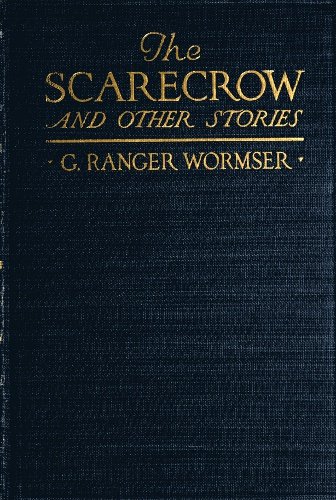
The Project Gutenberg eBook of The Scarecrow, and Other Stories
Title: The Scarecrow, and Other Stories
Author: G. Ranger Wormser
Release date: June 18, 2012 [eBook #40027]
Most recently updated: October 23, 2024
Language: English
Credits: Produced by sp1nd, Mebyon, Mary Meehan and the Online
Distributed Proofreading Team at http://www.pgdp.net (This
file was produced from images generously made available
by The Internet Archive)
THE SCARECROW
AND OTHER STORIES
BY G. RANGER WORMSER
NEW YORK
E. P. DUTTON & COMPANY
681 FIFTH AVENUE
Copyright, 1918,
BY E. P. DUTTON & COMPANY
All Rights Reserved
Printed in the United States of America
CONTENTS
| PAGE | |
| The Scarecrow | 1 |
| Mutter Schwegel | 21 |
| Haunted | 37 |
| Flowers | 61 |
| The Shadow | 81 |
| The Effigy | 105 |
| The Faith | 125 |
| Yellow | 147 |
| China-Ching | 163 |
| The Wood of Living Trees | 187 |
| Before the Dawn | 211 |
| The Stillness | 229 |
THE SCARECROW AND
OTHER STORIES
THE SCARECROW
"Ben—"
The woman stood in the doorway of the ramshackle, tumble-down shanty. Her hands were cupped at her mouth. The wind blew loose, whitish blond wisps of hair around her face and slashed the faded blue dress into the uncorseted bulk of her body.
"Benny—oh, Benny—"
Her call echoed through the still evening.
Her eyes staring straight before her down the slope in front of the house caught sight of something blue and antiquatedly military standing waist deep and rigid in the corn field.
"That ole scarecrow," she muttered to herself, "that there old scarecrow with that there ole uniform onto him, too!"
The sun was going slowly just beyond the farthest hill. The unreal light of the skies' reflected colors held over the yellow, waving tips of the corn field.
"Benny—," she called again. "Oh—Benny!"
And then she saw him coming toward her trudging up the hill.
She waited until he stood in front of her.
"Supper, Ben," she said. "Was you down in the south meadow where you couldn't hear me call?"
"Naw."
He was young and slight. He had thick hair and a thin face. His features were small. There was nothing unusual about them. His eyes were deep-set and long, with the lids that were heavily fringed.
"You heard me calling you?"
"Yes, maw."
He stood there straight and still. His eyelids were lowered.
"Why ain't you come along then? What ails you, Benny, letting me shout and shout that way?"
"Nothing—maw."
"Where was you?"
He hesitated a second before answering her.
"I was to the bottom of the hill."
"And what was you doing down there to the bottom of the hill? What was you doing down there, Benny?"
Her voice had a hushed tenseness to it.
"I was watching, maw."
"Watching, Benny?"
"That's what I was doing."
His tone held a guarded sullenness.
"'Tain't no such a pretty sunset, Benny."
"Warn't watching no sunset."
"Benny—!"
"Well." He spoke quickly. "What d'you want to put it there for? What d'you want to do that for in the first place?"
"There was birds, Benny. You know there was birds."
"That ain't what I mean. What for d'you put on that there uniform?"
"I ain't had nothing else. There warn't nothing but your grand-dad's ole uniform. It's fair in rags, Benny. It's all I had to put on to it."
"Well, you done it yourself."
"Naw, Benny, naw! 'Tain't nothing but an ole uniform with a stick into it. Just to frighten off them birds. 'Tain't nothing else. Honest, 'tain't, Benny."
He looked up at her out of the corners of his eyes.
"It was waving its arms."
"That's the wind."
"Naw, maw. Waving its arms before the wind it come up."
"Sush, Benny! 'Tain't likely. 'Tain't."
"I was watching, maw. I seen it wave and wave. S'pose it should beckon—; s'pose it should beckon to me. I'd be going, then, maw."
"Sush, Benny."
"I'd fair have to go, maw."
"Leave your mammy? Naw, Ben; naw. You couldn't never go off and leave your mammy. Even if you ain't able to bear this here farm you couldn't go off from your mammy. You couldn't! Not—your—maw—Benny!"
She could see his mouth twitch. She saw him catch his lower lip in under his teeth.
"Aw—"
"Say you couldn't leave, Benny; say it!"
"I—I fair hate this here farm!" He mumbled. "Morning and night;—and morning and night. Nothing but chores and earth. And then some more of them chores. And always that there way. So it is! Always! And the stillness! Nothing alive, nothing! Sometimes I ain't able to stand it nohow. Sometimes—!"
"You'll get to like it—; later, mebbe—"
"Naw! naw, maw!"
"You will, Benny. Sure you will."
"I won't never. I ain't able to help fretting. It's all closed up tight inside of me. Eating and eating. It makes me feel sick."
She put out a hand and laid it heavily on his shoulder.
"Likely it's a touch of fever in the blood, Benny."
"Aw—! I ain't got no fever!"
"You'll be feeling better in the morning, Ben."
"I'll be feeling the same, maw. That's just it. Always the same. Nothing but the stillness. Nothing alive. And down there in the corn field—"
"That ain't alive, Benny!"
"Ain't it, maw?"
"Don't say that, Benny. Don't!"
He shook her hand off of him.
"I was watching," he said doggedly. "I seen it wave and wave."
She turned into the house.
"That ole scarecrow!" She muttered to herself. "That there ole scarecrow!"
She led the way into the kitchen. The boy followed at her heels.
A lamp was lighted on the center table. The one window was uncurtained. Through the naked spot of it the evening glow poured shimmeringly into the room.
Inside the doorway they both paused.
"You set down, Benny."
He pulled a chair up to the table.
She took a steaming pot from the stove and emptying it into a plate, placed the dish before him.
He fell to eating silently.
She came and sat opposite him. She watched him cautiously. She did not want him to know that she was watching him. Whenever he glanced up she hurried her eyes away from his face. In the stillness the only live things were those two pair of eyes darting away from each other.
"Benny—!" She could not stand it any longer. "Benny—just—you—just—you—"
He gulped down a mouthful of food.
"Aw, maw—don't you start nothing. Not no more to-night, maw."
She half rose from her chair. For a second she leaned stiffly against the table. Then she slipped back into her seat, her whole body limp and relaxed.
"I ain't going to start nothing, Benny. I ain't even going to talk about this here farm. Honest—I ain't."
"Aw—this—here—farm—!"
"I've gave the best years of my life to it."
She spoke the words defiantly.
"You said that all afore, maw."
"It's true," she murmured. "Terrible true. And I done it for you, Benny. I wanted to be giving you something. It's all I'd got to give you, Benny. There's many a man, Ben, that's glad of his farm. And grateful, too. There's many that makes it pay."
"And what'll I do if it does pay, maw? What'll I do then?"
"I—I—don't know, Benny. It's only just beginning, now."
"But if it does pay, maw? What'll I do? Go away from here?"
"Naw, Benny—. Not—away—. What'd you go away for, when it pays? After all them years I gave to it?"
His spoon clattered noisily to his plate. He pushed his chair back from the table. The legs of it rasped loudly along the uncarpeted floor. He got to his feet.
"Let's go on outside," he said. "There ain't no sense to this here talking—and talking."
She glanced up at him. Her eyes were narrow and hard.
"All right, Benny. I'll clear up. I'll be along in a minute. All right, Benny."
He slouched heavily out of the room.
She sat where she was, the set look pressed on her face. Automatically her hands reached out among the dishes, pulling them toward her.
Outside the boy sank down on the step.
It was getting dark. There were shadows along the ground. Blue shadows. In the graying skies one star shone brilliantly. Beyond the mist-slurred summit of a hill the full moon grew yellow.
In front of him was the slope of wind-moved corn field, and in the center of it the dim, military figure standing waist deep in the corn.
His eyes fixed themselves to it.
"Ole—uniform—with—a—stick—into—it."
He whispered the words very low.
Still—standing there—still. The same wooden attitude of it. His same, cunning watching of it.
There was a wind. He knew it was going over his face. He could feel the cool of the wind across his moistened lips.
He took a deep breath.
Down there in the shivering corn field, standing in the dark, blue shadows, the dim figure had quivered.
An arm moved—swaying to and fro. The other arm began—swaying—swaying. A tremor ran through it. Once it pivoted. The head shook slowly from side to side. The arms rose and fell—and rose again. The head came up and down and rocked a bit to either side.
"I'm here—" he muttered involuntarily. "Here."
The arms were tossing and stretching.
He thought the head faced in his direction.
The wind had died out.
The arms went down and came up and reached.
"Benny—"
The woman seated herself on the step at his side.
"Look!" He mumbled. "Look!"
He pointed his hand at the dim figure shifting restlessly in the quiet, shadow-saturated corn field.
Her eyes followed after his.
"Oh—Benny—"
"Well—" His voice was hoarse. "It's moving, ain't it? You can see it moving for yourself, can't you? You ain't able to say you don't see it, are you?"
"The—wind—" She stammered.
"Where's the wind?"
"Down—there."
"D'you feel a wind? Say, d'you feel a wind?"
"Mebbe—down—there."
"There ain't no wind. Not now—there ain't! And it's moving, ain't it? Say, it's moving, ain't it?"
"It looks like it was dancing. So it does. Like as if it was—making—itself—dance—"
His eyes were still riveted on those arms that came up and down—; up and down—; and reached.
"It'll stop soon—now." He stuttered it more to himself than to her. "Then—it'll be still. I've watched it mighty often. Mebbe it knows I watch it. Mebbe that's why—it—moves—"
"Aw—Benny—"
"Well, you see it, don't you? You thought there was something the matter with me when I come and told you how it waves—and waves. But you seen it waving, ain't you?"
"It's nothing, Ben. Look, Benny. It's stopped!"
The two of them stared down the slope at the dim, military figure standing rigid and waist deep in the corn field.
The woman gave a quick sigh of relief.
For several moments they were silent.
From somewhere in the distance came the harsh, discordant sound of bull frogs croaking. Out in the night a dog bayed at the golden, full moon climbing up over the hills. A bird circled between sky and earth hovering above the corn field. They saw its slow descent, and then for a second they caught the startled whir of its wings, as it flew blindly into the night.
"That ole scarecrow!" She muttered.
"S'pose—" He whispered. "S'pose when it starts its moving like that;—s'pose some day it walks out of that there corn field! Just naturally walks out here to me. What then, if it walks out?"
"Benny—!"
"That's what I'm thinking of all the time. If it takes it into its head to just naturally walk out here. What's going to stop it, if it wants to walk out after me; once it starts moving that way? What?"
"Benny—! It couldn't do that! It couldn't!"
"Mebbe it won't. Mebbe it'll just beckon first. Mebbe it won't come after me. Not if I go when it beckons. I kind of figure it'll beckon when it wants me. I couldn't stand the other. I couldn't wait for it to come out here after me. I kind of feel it'll beckon. When it beckons, I'll be going."
"Benny, there's sickness coming on you."
"'Tain't no sickness."
The woman's hands were clinched together in her lap.
"I wish to Gawd—" She said—"I wish I ain't never seen the day when I put that there thing up in that there corn field. But I ain't thought nothing like this could never happen. I wish to Gawd I ain't never seen the day—"
"'Tain't got nothing to do with you."
His voice was very low.
"It's got everything to do with me. So it has! You said that afore yourself; and you was right. Ain't I put it up? Ain't I looked high and low the house through? Ain't that ole uniform of your grand-dad's been the only rag I could lay my hands on? Was there anything else I could use? Was there?"
"Aw—maw—!"
"Ain't we needed a scarecrow down there? With them birds so awful bad? Pecking away at the corn; and pecking."
"'Tain't your fault, maw."
"There warn't nothing else but that there ole uniform. I wouldn't have took it, otherwise. Poor ole Pa so desperate proud of it as he was. Him fighting for his country in it. Always saying that he was. He couldn't be doing enough for his country. And that there ole uniform meaning so much to him. Like a part of him I used to think it,—and—. You wanting to say something, Ben?"
"Naw—naw—!"
"He wouldn't even let us be burying him in it. 'Put my country's flag next my skin'; he told us. 'When I die keep the ole uniform.' Just like a part of him, he thought it. Wouldn't I have kept it, falling to pieces as it is, if there'd have been anything else to put up there in that there corn field?"
She felt the boy stiffen suddenly.
"And with him a soldier—"
He broke off abruptly.
She sensed what he was about to say.
"Aw, Benny—. That was different. Honest, it was. He warn't the only one in his family. There was two brothers."
The boy got to his feet.
"Why won't you let me go?" He asked it passionately. "Why d'you keep me here? You know I ain't happy! You know all the men've gone from these here parts. You know I ain't happy! Ain't you going to see how much I want to go? Ain't you able to know that I want to fight for my country? The way he did his fighting?"
The boy jerked his head in the direction of the figure standing waist deep in the corn field; standing rigidly and faintly outlined beneath the haunting flood of moonlight.
"Naw, Benny. You can't go. Naw—!"
"Why, maw? Why d'you keep saying that and saying it?"
"I'm all alone, Benny. I've gave all my best years to make the farm pay for you. You got to stay, Benny. You got to stay on here with me. You just plain got—to! You'll be glad some day, Benny. Later—on. You'll be right glad."
She saw him thrust his hands hastily into his trouser pockets.
"Glad?" His voice sounded tired. "I'll be shamed. That's what I'll be. Nothing, d'you hear, nothing—but shamed!"
She started to her feet.
"Benny—" A note of fear shook through the words. "You wouldn't—wouldn't—go?"
He waited a moment before he answered her.
"If you ain't wanting me to go—; I'll stay. Gawd! I guess I plain got to—stay."
"That's a good boy, Benny. You won't never be sorry—nohow—I promise you!—I'll be making it up to you. Honest, I will!—There's lots of ways—I'll—!"
He interrupted her.
"Only, maw—; I won't let it come after me. If it beckons I—got—to—go—!"
She gave a sudden laugh that trailed off uncertainly.
"'Tain't going to beckon, Benny."
"It if beckons, maw—"
"'Tain't going to, Benny. 'Tain't nothing but the wind that moves it. It's just the wind, sure. Mebbe you got a touch of fever. Mebbe you better go on to bed. You'll be all right in the morning. Just you wait and see. You're a good boy, Benny. You'll never go off and leave your maw and the farm. You're a fine lad, Benny."
"If—it—beckons—" He repeated in weary monotone.
"'Tain't, Benny!"
"I'll be going to bed," he said.
"That's it, Benny. Good night."
"Good night, maw."
She stood there listening to his feet thudding up the stairs. She heard him knocking about in the room overhead. A door banged. She stood quite still. There were footsteps moving slowly. A window was thrown open.
She looked up to see him leaning far out over the sill.
Her eyes went down the slope of the moonlight-bathed corn field.
Her right hand curled itself into a fist.
"Ole—scarecrow—!"
She half laughed.
She waited there until she saw the boy draw away from the window. She went into the house and bolted the door behind her. Then she went up the narrow steps.
That night she lay awake for a long time. The heat had grown intense. She found herself tossing from side to side of the small bed.
The window shade had stuck at the top of the window.
The moonlight trickled into the room. She could see the window-framed, star-specked patch of the skies. When she sat up she saw the round, reddish-yellow ball of the moon.
She must have dozed, because she woke with a start. She felt that she had had a fearful, evil dream. The horror of it clung to her.
The room was like an oven.
She thought the walls were coming together and the ceiling pressing down.
Her body was covered with sweat.
She forced herself wide awake. She made herself get out of the bed. She stood for a second uncertain. Then she went to the window.
Not a breath of air stirring.
The moon was high in the sky.
She looked out across the hills.
Down there to the left the acres of potatoes. Potatoes were paying. She counted on a big harvest. To the right the wheat. Only the second year for those five fields. She knew that she had done well with them.
She thought, with a smile running over her lips, back to the time when less than half of the place had been under cultivation. She remembered her dream of getting the whole of her farm in work. She and the boy had made good. She thought of that with savage complacency. It had been a struggle; a bitter, hard fight from the beginning. But she had made good with her farm.
And there down the slope, just in front of the house, the corn field. And in the center of it, standing waist deep in the corn, the antiquated, military figure.
The smile slid from her mouth.
The suffocating heat was terrific.
Not a breath of air.
Suddenly she began to shake from head to foot.
Her eyes wide and staring, were fixed on the moonlight-whitened corn field; her eyes were held to the moonlight-streaked figure standing in the ghostly corn.
Moving—
An arm swayed—swayed to and fro. Backwards and forwards—backwards—The other arm—swaying—A tremor ran through it. Once it pivoted. The head shook slowly from side to side. The arms rose and fell—; and rose again. The head came up and down, and rocked a bit to either side.
"Dancing—" She whispered stupidly. "Dancing—"
She thought she could not breathe.
She had never felt such oppressive heat.
The arms were tossing and stretching.
She could not take her eyes from it.
And then she saw both arms reach out, and slowly, very slowly, she saw the hands of them, beckoning.
In the stillness of the room next to her she thought she heard a crash.
She listened intently, her eyes stuck to those reaching arms, and the hands of them that beckoned and beckoned.
"Benny—" She murmured—"Benny—!"
Silence.
She could not think.
It was his talk that had done this—Benny's talk—He had said something about it—walking out—If it should come—out—! Moving all over like that—If its feet should start—! If they should of a sudden begin to shuffle—; shuffle out of the cornfield—!
But Benny wasn't awake. He—couldn't—see—it. Thank Gawd! If only something—would—hold—it! If—only—it—would—stop—; Gawd!
Nothing stirring out there in the haunting moon-lighted night. Nothing moving. Nothing but the figure standing waist deep in the corn field. And even as she looked, the rigid, military figure grew still. Still, now, but for those slow, beckoning hands.
A tremendous dizziness came over her.
She closed her eyes for a second and then she stumbled back to the bed.
She lay there panting. She pulled the sheets up across her face; her shaking fingers working the tops of them into a hard ball. She stuffed it between her chattering teeth.
Whatever happened, Benny mustn't hear her. She mustn't waken, Benny. Thank Heaven, Benny was asleep. Benny must never know how, out there in the whitened night, the hands of the figure slowly and unceasingly beckoned and beckoned.
The sight of those reaching arms stayed before her. When, hours later, she fell asleep, she still saw the slow-moving, motioning hands.
It was morning when she wakened.
The sun streamed into the room.
She went to the door and opened it.
"Benny—" She called. "Oh, Benny."
There was no answer.
"Benny—" She called again. "Get on up. It's late, Benny!"
The house was quiet.
She half dressed herself and went into his room.
The bed had been slept in. She saw that at a glance. His clothes were not there. Down—in—the—field—because—she'd—forgotten—to—wake—him—.
In a sudden stunning flash she remembered the crash she had heard.
It took her a long while to get to the little closet behind the bed. Before she opened it she knew it would be empty.
The door creaked open.
His one hat and coat were gone.
She had known that.
He had seen those two reaching arms! He had seen those two hands that had slowly, very slowly, beckoned!
She went to the window.
Her eyes staring straight before her, down the slope in front of the house, caught sight of something blue and antiquatedly military standing waist deep and rigid in the corn field.
"You ole scarecrow—!" She whimpered. "Why're you standing there?" She sobbed. "What're you standing still for—now?"
MUTTER SCHWEGEL
He was tremendously disappointed. The house was empty. He had thought it looked uninhabited from the outside. It made him a bit dreary to have his people away like this. That uncertain feeling came over him again. The uncertain feeling never quite left him of late. He was conscious of it most of the time. It formed an intangible background to all his other thought.
He decided he would go down to the lodge presently. He was certain to find Bennet at the lodge. And Bennet's wife; and Bennet's three children. He grinned as he thought of Bennet chasing his children out of his gardens. He could imagine the old gardener's gladness at his homecoming.
Going quickly up the last flight of stairs, he could see that the door of his room stood ajar. He wondered at the yellow glow of light trickling in a long narrow stream out into the dark of the hall.
He went rushing along the corridor.
He pushed the door open.
The same old room. The familiar, faded wall paper. The high, mahogany bed. The hunting print he had so cherished on the wall facing him. The table just as he had left it; the books piled in neat stacks on its polished surface. The lamp standing lighted among the books. The two big arm chairs.
He took a deep breath of surprise.
Some one was seated in the chair facing from him.
He saw the top of a man's head. He had a dim recognition of feet sprawling from under the chair. On either arm of the chair rested a man's hand. There was something he knew about those hands; the prominent knuckles; the long, well made fingers. The heavy, silver signet ring on the smallest finger of the left hand was a ring he had often seen.
He crossed the room.
"Otto—!"
Standing there in front of Kurz, he wondered at the change in him. He looked so much older. There was no trace left of the boyishness which he had always associated with Otto Kurz. There were gray streaks in Kurz's heavy hair; gray at the temples of the wide forehead; gray behind the ears. The mustache and beard were threaded with grayed hairs.
He was astonished to find Otto Kurz in his room.
"Otto—! I had no idea that you would be here—!"
He could not understand the rigid attitude of the man's great body; the set mobility of the man's large hewn features.
He moved a bit so as to stand directly in the line of those fixed staring eyes. He wanted to interrupt the wooden expression of those eyes.
"Otto—It was good of you to come."
Kurz's eyes raised themselves to meet his eyes. He quivered at the look in Kurz's eyes.
"My God!—What is it—?"
The glazed, deadened eyes with the live, dumbed suffering behind them widened.
"Ach—Charlie—!"
"What's happened, Otto?"
"I—do—not—know. I was waiting, Charlie—for—you—to—come."
"Good old Otto!"
He saw Kurz's hand with the heavy, silver signet ring on the smallest finger go up trembling to his beard. It was the old familiar gesture.
"Good?—Did you say good of me, Charlie?"
"Yes, yes!" He insisted eagerly. "Of course it was good of you to come and meet me."
"I—had—to—come."
For he a second he wondered.
"But how did you know?—Who told you?—I only just got here. No one—knew. How could you have known I was coming?"
He heard Kurz sigh; a long sigh that quavered at the end.
"I—? Ach!—how—I—hoped—!"
"That I would come?"
"That you would come, Charlie."
He could not fathom the look in Kurz's eyes. He had never seen a look like that in those eyes. He thought that it was not a human look.
"See here, Otto—What is it?"
Kurz made a little, appealing gesture with his long, trembling hands.
"Later—I—will—try—to—tell—you—"
"Later?"
Kurz nodded his great, shaggy head up and down.
"How did you come in here, Charlie?"
He was surprised at the question.
"How? Why, with my latch key, of course!"
He glanced over at the windows. The blinds were up. He could see the dark pressing against the glass; pressing tightly so that it spread. He started for the window. Kurz's voice stopped him.
"And your family? You have then seen your family, Charlie?"
He smiled.
"No. Not yet. They weren't here when you came in, were they?"
"No—no!—I—have—seen—no—one. I could not bring myself to go before any one. There was an old man. He was going down the hall. I waited till he passed. He must have come to light your lamp."
"Well, old Otto—They're not here. I've hunted all through the house for them. I rather think they must have gone down to Surrey. They've taken the servants with them. After a bit we'll walk over to the lodge and ask Bennet where my people are. That must have been Bennet you saw up here."
"Then you do not know?"
"Know what?"
"About your family?"
"But I just told you, Otto; they must've run down to our place in Surrey. I only came up here to get a look at the old room. I'll go down and ask Bennet presently."
A quick moan escaped through Kurz's set lips.
A sudden thought flashed to him.
"You, Otto—How did you get in here?—With them all away?—With the servants gone?"
He saw the muscles of Kurz's face twitch horribly.
"Ach—! You must not ask, Charlie. A little time, Charlie. There are things I do not myself know. Later—I—will—try—to—tell—you."
"Things you do not know, Otto?"
Kurz's mouth twisted itself into a distorted grin.
"I do not blame you for ridiculing me, Charlie. I always thought I knew everything. Later—; you will see."
"Why not tell me now?"
"No—no—!" Kurz's voice whined frantically. "I do not know if you yourself understand."
"I was only trying to help you, old chap."
"Help—! It is that I want. It is that which brought me here. It is because I must have you help me."
"You've only to say what you want."
"Your help—"
"You know I'll do whatever I can for you."
"Yes—; I hoped that. I counted—on—your—help."
He waited for Kurz to go on. Kurz sat there silent. The long, shaking fingers fumbled at each other.
"Well?"
"Later."
"All right—I don't know what you're driving at."
"Are—you—sure—you—do—not—know—?"
"But—If you don't want to tell me now; why, tell me in your own good time, old fellow."
"Yes. You are not angry? You do not care if I say it later?"
"Of course I don't care."
"Not—care—If—you—knew—; if—it—is—true—; you will care!"
He could not make out what Kurz meant.
"It's mighty nice seeing you," he said after a second's silence. "It's been a long time. Years since I've seen you."
"I came though, Charlie;—I had to come, Charlie."
"I'm jolly well glad you did!"
"You knew I would come."
He drew his brows together in a perplexed frown.
"I knew we would meet sometime."
"Yes. Sometime."
"And the sometime's now. Eh, Otto?"
"Now?" Kurz's big body strained forward. "What—is—it, Charlie—; this—now—?"
The frown stayed over his eyes.
"We were bound to come together again, old Otto. You and I were pretty good pals back there at your university. What a time we two had together! And old Mutter Schwegel! How old Mutter Schwegel fussed over us! How she took care of us! It all seems like yesterday—!"
Kurz got out of his chair.
"Old Mutter Schwegel—;" he muttered.
"Dear old Mutter Schwegel!"
Kurz's eyes stole away from his face.
"Later—I shall tell you of Mutter Schwegel too."
"And the talks we used to have—! The nightlong talks. We settled the affairs of the world nicely in those days. Didn't we, old Otto?"
"The—affairs—of—the—world—"
"And old Mutter Schwegel coming in to put out the light. And then standing there to hear what we had to say of life and of death."
"Of—life—and—of—death."
"And not being able to tear herself away to go to bed. She thought we were wise, Otto. She used to drink in every word we said. And then she'd scold us for staying up all night. Old Mutter Schwegel. I've thought of her often—"
Kurz made a movement toward him.
"And of me, Charlie?—You had thought of me?"
"I say, rather—! Many a time—when they called me back from the university—even after I went out to France—I thought of you."
His mind was muddled a bit. He put it down to the excitement of his coming home. That uncertain feeling came over him again quite strongly. But he had thought of Otto. He remembered he had thought of Otto a lot.
"And what was it you thought of me, Charlie?"
It came back to him that there had been one time when he had thought of Otto particularly. That one time when something tremendous had happened to him. He could not quite think what. He knew he had been glad when he thought of Otto because he had been spared inflicting the thing on him.
He could not get it clear.
He avoided looking at Kurz.
"Why—; why, I wondered what you were doing. All that sort of thing. You know what I mean."
"Yes. I know. I did go into the army, Charlie. It was that sort of thing you meant, Charlie?"
He felt himself start.
"I was afraid you would do that;" he said involuntarily.
"Yes. I, too, was afraid."
Kurz's voice was low.
"You? Afraid?"
"Ach, Charlie!—You know it. The fear it was not for myself!"
He walked over to the window. He stood there looking down at the huge boxwood hedges looming in thick gray bulks up from the smudging reach of the heavily matted shadows.
He turned.
"You funked meeting me—in—war?"
"Ach!—God forbid!—That—I—should—meet—you—in—war—!"
"I too;" he said it quickly. "I too was afraid that I should come upon you. It haunted me—; that fear I might harm you. It stayed with me—; day and night. I shouldn't want to hurt you, Otto. I—I prayed." It came back to him how often he had prayed it. "I always prayed that it might never be you!"
"Yes—; I know."
He went and stood close beside Kurz. He found himself staring at Kurz intently.
"But you're here;—in England. I say, did they make you a prisoner? Could my people get parole for you?"
"No. I do not think they do that here in your country. I do—not—need—parole, Charlie."
"I thought perhaps—"
"No—!"
"But how did you get here, then?"
"Charlie—; Charlie!—ach!—will—you—not—then—wait?"
"Come, come, old Otto. You've got something to tell me. If you don't want to say how you got here, why, all right. Only, you'd best get it off your mind. Whatever it is you'd better come out and say what you came to say."
Kurz slid back into the chair again.
The room was still. Heavy with silence.
"Yes. I'll tell you—if I can. Charlie, it is hard to say."
He tried to help Kurz.
"It's about this war of ours; that's it, isn't it?"
"About the war? Yes—!"
"Then tell me."
He saw Kurz's massive shoulders jerking.
"How—can—I—tell—you—? I do not think you understand. I do not even know if it is what I think it is. I cannot reason it out to myself. The power of reasoning has left me. I had no other knowledge than my reasoning. I do not know. Now, I do not know where I am—or—what—I—am—"
The maddened urge of Kurz's words struck him.
"You're here, old Otto;" he said it reassuringly. "Here with me. In my room. In England. You're with me, Otto!"
"Yes—with—you." And then beneath his breath he whispered: "Where—are—you—?"
He caught the smothered insistence of that last sentence. He smiled, forcing his lips to smile.
"Standing right in front of you, old man. Waiting for you to say what you came to—"
Kurz interrupted him.
"I—had—to come. I felt that I must come. I—came, Charlie. I got myself here, Charlie."
"Quite right, Otto."
"I want you to know first that I thought of you. That I was, as you say you were, afraid I might in some way injure you. I want to tell you that first."
"Good old sentimental Otto!"
"Sentimental?—Ach!—I am not sentimental. But I do not think you can understand how much you were to me back there at the university. I do not think you yourself knew how much you joyed in things. How happy your kind of thought made you."
He laughed.
"I always managed to have a rather corking time of it," he admitted.
"You loved everything so," Kurz went on. "At night when we talked it was you who believed in what you said. It was you who saw so clearly how well all things of life were meant. It was always I who questioned."
"But, I say, old Otto, your mind was so quick; so brilliant. You could pick flaws where I never knew they existed."
"It was you who had so much of faith, Charlie."
"How we did talk;" he said it to himself. "Talk and talk until old Mutter Schwegel, who was so keen for us, grew tired of listening and came and turned out the lamp."
"And how you spoke ever of your beliefs," Kurz's voice was hoarse. "It was so easy for you to know. You never questioned. You believed. It ended there, with your belief. You were so near to what you thought. It was a part of you. I—I stood away from all things and from myself. I would tell you that the mind should reason. I stayed outside with my criticism, while you—ach, Charlie!—How you did know!"
"And how you laughed at me for that!"
"But now, I do not laugh!" Kurz protested with wearied eagerness. "Now I come to you. I ask you if you know those things—now?"
"What things, Otto?"
"The things of life. The things of death."
"I know what I always knew," he said slowly. "I know that life is meant to live fully and understandingly and that death is meant to live on; fully and understandingly."
"And—you—do—understand—now?"
"I understand that always."
"You would not be afraid?"
"Of what?"
"Of—death?"
"No."
He stared out of the window.
The dense, opaque shadows pressing down on the garden. The shadows hanging loose and thick on the high, boxwood hedges. The dark, smooth, night sky.
And suddenly a faint tremor ran through him from head to foot. He pressed his face close to the glass. His hands went up screening a small space for his eyes.
In the still block of shadows, in the black mass of them, he had seen something; something had moved against the quiet clumping shadows.
"I say," he whispered. "There's some one coming up through the garden."
"Yes—yes."
They were silent for a long time.
Once he looked at Kurz huddled in the armchair; his face white and drawn; his eyes staring before him.
He thought he heard footsteps coming softly up the stairs; footsteps that came lightly and hesitated and then came on again.
"Charlie—!" Kurz stammered. "Charlie—!"
He felt that some one was standing in the open doorway.
He turned.
His eyes took in the well known figure. The sweet face with its red cheeks and its framing white hair. The short body. The blue eyes that were fixed on him.
"Mutter Schwegel!" He shouted.
Kurz leaped to his feet.
"What!"
He started for the door.
"Mutter Schwegel, who would have thought of your coming here. It has been a long time. I say!—But I am glad."
"Stop—!" Kurz's voice thundered behind him.
He wheeled to look at Kurz.
Kurz's eyes were riveted on the woman standing in the doorway.
"Aren't you glad to see Mutter Schwegel?" He asked. "When we've been talking of her all night?"
Kurz was muttering to himself.
"Mutter—Schwegel—;" Kurz mumbled. "Mutter Schwegel—! It—is—that—I—wanted—to—tell—you—about—Mutter Schwegel. It—is—as—I—thought. It—is—ach!—it—is—then—that—way—with—us—!"
He felt that the woman was coming into the room.
He turned and looked at her.
"Mutter—Schwegel—is—dead;" Kurz stammered.
He saw that the old woman smiled.
"She—is—dead. Dead—!" Kurz mumbled.
He smiled back at her.
"Dead—;" Kurz's voice droned shaking.
He saw the old woman go to the table.
He and Kurz watched her take the lamp up in her hands. He and Kurz saw her fingers fumbling at the wick. Kurz's quivering face stood out in the lamplight. The old woman was smiling quietly.
They saw her try to put out the light.
The lamp still burned.
"Mutter-Schwegel—is—dead—!" Kurz's voice quavered; and then it screamed. "Dead—," he shrieked; "we—are—all—of—us—dead—!"
That uncertain feeling came over him. And suddenly it went quite from him.
HAUNTED
He lived quite alone in the stone built shanty perched on the highest pinnacle of the great sun bleached chalk cliffs. All about him, as far as the eye could reach, lay the flat, salt marshes with their dank, yellowed grasses. Against the inland horizon three, gaunt, thin-foliaged trees reared themselves from the monotonously even soil. Overhead the cloud splotched blue gray sky, and below him the changing, motion pulled, current swirling depths of the blue green sea. And at all times of the day and the night, the wild whirring of the sea gulls' wings and the uncanny inhuman piercing sound of their shrieking.
He had lived there since that day when the fisherman had pulled him half drowned out of the sea. He could never remember where he had come from, or what had happened. All that he ever knew was that far out by the nets in the early morning they had come upon him and had brought him in to shore. Naturally, the fishermen had questioned him; but his vagueness, his absolute lack of belief that he had ever been anything before they had snatched him from the waters, had frightened them so that since that day they had left him severely alone. Fishing folk have strange, superstitious ideas about certain things. He had borne the full weight of their credulous awe. Perhaps because he, himself, thought as they thought. That he was something come from the sea, and of the sea, and always belonging to the sea.
He had built himself the stone shanty upon the highest pinnacle of those waste grown chalk cliffs; and he had stayed on and on, year in and year out, close there to the sea.
In winter for a livelihood he made baskets from the reeds he had picked in the swamps about him. In the summer he sold the vegetables he grew in the tiny truck garden behind his house. Somehow he managed to eke out a living.
The fishing folk in the small village at the foot of the cliffs saw him come and go along their narrow streets, morose and taciturn. He never spoke to any of them unless he had to. They in their turn avoided him with their habitual superstitious uneasiness. He went to and fro between his shanty and the village store when the need arose. The rest of the time he sat in front of his iron bolted door staring and staring down at the sea.
Daybreak and noon. Evening and night he sat there.
When the sky above was tinged with the first streaking colors of the dawn he watched the ghostly gray expanse of the ocean. When the sun was high in the heavens he looked steadily at the light-flecked spotted swells of the waves. When the shadows began to creep up from the earth he stared at the greater blackness that swam in glistening undulating darkness to him from across the water. And at night his eyes strained through the fitful gloom at the pitchy, turbulent sea.
It was like that in all kinds of weather. The spring tides, with their quick changes from calm to storm, and the slender silver crescent of the new moon hanging just above the horizon. The long summer laziness of the green ocean with its later gigantic flame-red moons and the wide yellow streak of phosphorescent light that streamed in moving ripples to him; the chill, lashing spray in autumn. The foam-covered seething breadth of it in winter when the blackness of the low night skies and the darkness of the high tides were as one menacing roaring turmoil churning itself into white spumed frenzy. It always held him.
He was a man of one idea: The sea. He was a man who drew his life from one source: The sea. It had taken his body and had tried to drown it; the sea had for that short time caught and gripped his soul. The slimy, wet touch of it was seared into him.
It fascinated him; it kept him near it so that he could not have gotten away from it, had he had the courage to want to get away. It kept him there as though he belonged to it; as though it knew he belonged to it; and knew that he knew it. And always and ever the sea haunted him.
The fishing men coming home late at night across the water had grown used to steering their course by the unreal light that trickled out to them from the shanty on the top of the cliffs. And in the dawn when they pushed their smacks off from the long, hard beach to sail out to the nets, they knew that from the high precipices above them the man was watching.
And outwardly they laughed at him; even when in their hearts they feared the thing they thought he was.
They could not understand him. They, who made their living from the sea, could not understand how he could be content to live the way he was living. They could not have known that he would infinitely rather have died than to have taken one thing from out the sea from which he had already filched his soul.
His enslavement by it had made him understand it a lot better than they understood it.
And so he lived the stupid, hypnotized life of one who is held so enchained and cowed that he could not think for himself, or of himself. Until that day when he first met Sally.
It was a sunny day late in the autumn that he stood in front of the weather beaten wooden hut of the village store, his arms filled with baskets. And as he stood there, Sally Walsh came from the store and out into the street.
She had seen the man a hundred times but she had never seen him so close. She stopped short and stared quite frankly at the bigness of him; at the heavily matted hair clinging so damply to his forehead; and at the white face so strange to her beside the sun-burned faces she had always seen. It was when, quite suddenly, he looked at her and she saw the odd blue green sea colored eyes of him, that she started to hurry on.
She had gotten half way down the street when he overtook her.
"D'you want—anything of—me?" He asked it, his blue green eyes going quickly over her slight form, her small face, and resting for a second curiously upon her masses of coiled golden hair.
"I—? why—no."
"You sure?"
"Sure."
She went on her way again and he stood there watching her go; then he turned abruptly and walked slowly back to the store.
It was not so long after that when he met her for the second time.
She was on her knees in the yard in front of her father's house mending the tar-covered fishing nets with quick deft fingers. He stopped at the gate. Feeling the intensity of his blue green eyes upon her, she looked up and saw him.
She got to her feet.
"It's a nice morning."
She spoke to him first.
"Yes"; he said.
"You live up there?" She pointed a bare browned arm up toward the sun bleached chalk cliffs. "By yourself?"
"Yes."
"You ain't got a boat?"
"No."
"They say you don't ever fish. Why don't you, Mister?"
"I—I ain't the one to fish."
"Want to help me with these here nets?"
"I—I can't do—that."
"It ain't hard, Mister."
"I—can't—do—it."
"Come on in; I'll show you how."
He opened the gate and went into the yard and then he stood there just looking down at her.
"I wouldn't touch—no—net—"
Her brows drew together in a puzzled frown.
"You mean you don't like fishing?"
Somehow he did not want her to know.
"I—ain't—the—one—to—take—no—sea-thing—away—from—the—sea."
"Oh;" she said, not understanding.
They were silent a moment.
"You sell baskets?" She asked him.
"D'you want one?"
"Mebbe. Got a medium-sized one?"
"Got a lot."
"Mebbe—I—could—use—one."
"I'd like mighty well to—to give you one, little girl."
"Why, I ain't a little girl, Mister. I—I thought—I'd mebbe—buy—"
He interrupted her.
"You'll not buy one off of me. I'll bring you one—; if you like."
"A medium-sized one."
"I'll bring it to you—; to-morrow."
"Thanks."
"Good-by, little girl."
"Good-by, Mister."
At the end of the street he turned to look back.
She was on her knees working at her mending of the nets again. She looked very small kneeling there on the hard brown earth with the straggling lines of squat weather darkened shanties trailing behind her out onto the edge of the yellow sanded beach, and the clear unbroken blue of the autumn skies above. She glanced up and then she waved her hand at him.
He went slowly along the narrow pathway that wound through the sharp crevices of the chalk cliffs to the back of his own stone built shanty.
That night he stood staring out at the sea. The moon was on the wane. It hung very low in the sky so that the red-gold streak of it seemed to dip into the water. A cold northeast wind lashed over the waves. Dark swollen purplish clouds raced together in an angry mass. The sea itself was black but for the tossing gigantic waves with their dead white crests of spraying foam. The pounding of them on the beach below him vibrated in his ears. The sea-gulls were flying heavily close to the earth; their inhuman, piercing shrieking filling the air.
The little girl had spoken to him.
He turned from the sea then. He went into his shanty. He bolted the great iron bolts of the door and braced himself against it as if he were shutting something out; something that he feared; something that was certain to come after him. He crouched there shivering and shuddering. The pounding of the sea was in his ears. The wind that came from the ocean whistled and wailed shrilly around and around the house. He leaned there; his back to the door; his hands pressing stiff fingered against it; his lips moving, mumbling dumbly. His eyes, the color of the sea, stared blindly before him. The rumbling roar of the rising tide; the thundering boom of it. And in the sudden lull of the wind the hiss of the seething spray.
The sea was angry.
He thought with a kind of paralyzing terror that it was angry with him. It was calling to him. The lashing of the big waves demanded him. The sonorous drumming of it. He had never before denied its call. The persistent thudding of it there at the base of the chalk cliffs. It was insisting that he belonged to it. The inhuman piercing shrieks of the circling sea-gulls mocked him. They knew that he belonged to the sea. How could he even think of that golden haired little girl who had spoken to him—
The sea was angry.
He tore at the iron bolts and flinging the door wide open he rushed out to the edge of the chalk cliffs. And as he stood there the clouds dwindled in a vaporous haze away from the skies. The thin red-gold line of the waning moon grew brighter. The sea lay foam flecked and calm beneath the dark heavens. And at the base of the chalk cliffs the water lapped and lapped with a strange insidious sound.
And the next day he sat there in front of his shanty, his reeds in his hands, his fingers busy with his basket weaving; making big baskets and small baskets; and his eyes, blue green and strained, were fixed on the tranquil blue green of the water below him.
For two days he sat there in front of his iron bolted door that now swung wide open on its rusty hinges.
The third day he stood upon the edge of the precipice.
It was a gray fog drenched day. The mist dripped all about him. The opaque veil of it shut out everything in wet obliteration. He stood quite still knowing that beneath its dank dribbling thickness, the sea churned wildly in its rising tide.
And standing there motionless he heard a voice calling through the quiet denseness of the fog. A voice coming from a distance and muffled by the mist. He started. It was her voice calling to him from the narrow pathway that wound up the chalk cliffs to the back of his shanty.
"Mister—oh, Mister."
He reached his hand out in front of him trying to break the saturating cover of the fog. He went stumbling unseeingly toward the rear of the house.
"Mister—oh, Mister."
The rear of the shanty. His feet sank down into the turned soil of the truck garden. He stood still.
"Here."
"Mister;" the voice of her was nearer. "Where are—you—?"
He could not see in front of him. He felt that she was close.
"Here;—little girl."
He saw the faint outline of her shadow then through the obliterating denseness of the mist.
"Some fog; ain't it, Mister?"
"Stay where—you are. There's the precipice."
"I ain't afraid of no precipice."
"Stay—where—you—are!"
He could hear the dripping of the mist over the window ledges. And then he thought he heard, smothered by the weight of the fog, the pounding of the sea.
"You surprised to see me? But you ain't able to see me. Are you?"
"No."
"You ain't surprised?"
Down there at the base of the chalk cliffs the sea was still; waiting.
"You—shouldn't—have—come."
"Why—you don't mean;—you ain't trying to tell me;—you—don't—want—me—here?"
Great beads of moisture trickled down across his eyes.
"Little girl—; I just said you shouldn't have come. Not up here in this kind of weather."
"Oh, the weather!" She laughed. "I ain't the one to mind the weather, Mister."
Again he reached his hand out in front of him in an effort to rend the suffocating thickness of the fog. His fingers touched her arm and closed over it. From below him came the repeated warning roar of the waves.
"Can you find your way home—by yourself—little girl?"
"I ain't going home, Mister;—not yet. I came up here to get that basket you said you had for me; you know, the medium sized one."
"I'll give it to you—now."
Her hand caught at his hand that lay on her arm. Her fingers fastened themselves around his and held tightly. He had never felt anything like that. The touch of them was cool and fresh, like sea weed that had just drifted in from the sea.
And then from far off across the water came the shrill, piercing shriek of a gull.
He felt her start.
"That's only a sea-gull, little girl."
"I know, Mister. But don't it sound strange; almost as if it were the sea itself; calling for something."
For a second he could not speak.
"Why—;" his voice was hoarse, "Why d'you say that?"
"I don't know. Sometimes I get to feeling mighty queer about that water out there."
"You mean—; why—you ain't afraid of it, little girl, are you?"
"Afraid? There ain't nothing that I'm afraid of, Mister. Why, I'd go anywhere and not be afraid—"
He repeated her words very slowly to himself.
"You'd—go—anywhere—and—not—be—afraid—"
He thought then that the fog was lifting. A sickly, yellowish glow filtered through the heavy grayness. He could see her more distinctly.
"There's only one thing about the sea, Mister, that'd scare me, and that's—"
She broke off abruptly.
"What, little girl?"
"Why, Mister; why, I can't hardly say it. But there's Pa and there's my brother, Will. If anything ever happened—; if the sea ever did anything to Pa or Will, why—I guess, Mister, I'd just die."
"Don't!" He said quickly. "Don't you talk like that."
For a second they were silent.
The sun was breaking through the dwindling thickness of the mist. He could see it lifting in a faint gray line, uncovering the reach of the flat salt marshes with their dank yellowed grasses; a thin silver net of it hung for a second between the sky and the earth, and was gone.