
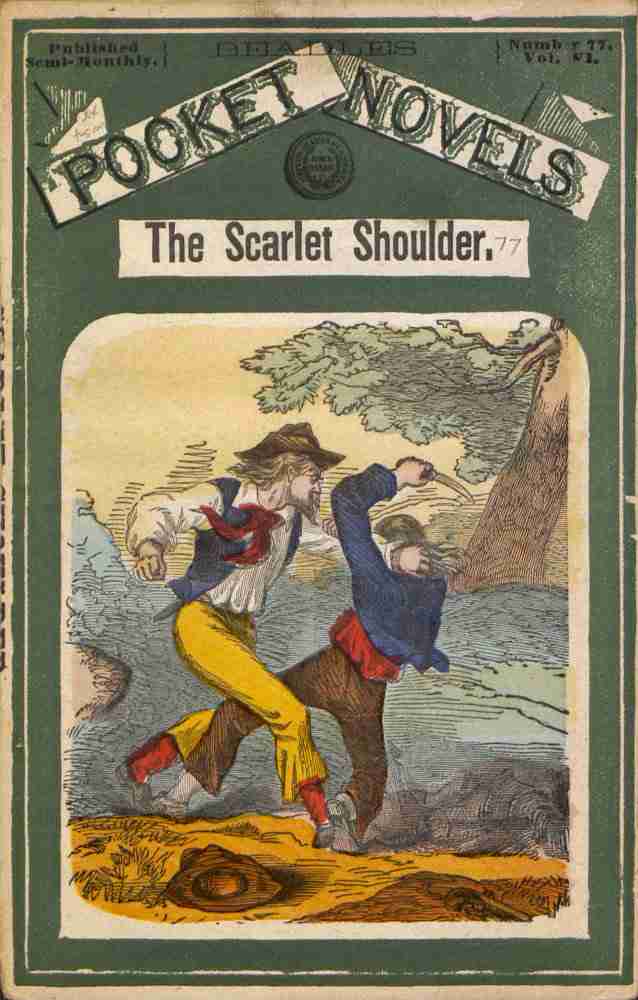
The Project Gutenberg eBook of The Scarlet Shoulders; or, The Miner Rangers
Title: The Scarlet Shoulders; or, The Miner Rangers
Author: Jos. E. Badger
Release date: September 28, 2021 [eBook #66407]
Most recently updated: October 18, 2024
Language: English
Credits: David Edwards, Stephen Hutcheson, and the Online Distributed Proofreading Team at https://www.pgdp.net (Northern Illinois University Digital Library)
THE
SCARLET SHOULDERS;
OR,
THE MINER RANGERS.
BY HARRY HAZARD.
AUTHOR OF THE FOLLOWING POCKET NOVELS:
- 38. The Heart Eater.
- 43. The White Outlaw.
- 54. Arkansas Jack.
- 66. Rattling Dick.
- 71. Delaware Tom.
- 79. Outlaw Jack.
NEW YORK:
BEADLE AND ADAMS, PUBLISHERS,
98 WILLIAM STREET.
Entered according to Act of Congress, in the year 1870, by
FRANK STARR & CO.,
In the office of the Librarian of Congress, at Washington.
CONTENTS
- I The Tragedy 9
- II A Story Told and a Surprise 17
- III Marcos Sayosa, the Young Miner 25
- IV The Miner’s Riot 33
- V The Rescue 39
- VI Carlita 47
- VII Felipe’s Visitor 54
- VIII A Fearful Peril 60
- IX The Jarocho’s Prisoner 69
- X Felipe’s Confession 77
- XI In the Cave and Out of It 86
- XII Explanations 95
THE SCARLET SHOULDERS;
OR,
THE MINER RANGERS.
CHAPTER I.
THE TRAGEDY.
“Indios—Indios bravos!” yelled Manuel Navaja, as he discharged his escopette full at the glowing disk of old Sol; then dropping it, he rushed through the outer gates, sounding the terrible words at every step, his affright being shared by all the peons who heard him, and, leaving their posts, one and all swarmed to the main building.
There is a spell—a fascination like that of a rattlesnake—that none but the dweller in “the land of the sun” can know. Young and old, men, women and children felt it now, and all rushed into the hacienda, only intent upon their own safety. But a clear, stern voice soared above the din, above the shouts of men, the shrieks of women and children; and, aided by his strong arm, that dealt blows upon every hand, he managed to restore order so far that the inner gates were fastened securely, the window shutters closed, and doors barred, and then blockaded with such heavy articles of the furniture as could be moved. The outer gates were left open; no person would venture there, the haciendado being held back by a beautiful woman, who twined her arms around him with strength lent by terror.
Then, with wild yells and whoops, the half nude, paint-bedaubed horde came swarming through the gateway into the patio, or outer courtyard, while others assailed the building in front. The peons within had been hastily armed, and opened a scattering fusilade, but with little damage to the enemy, for in their terror they generally fired at random, as often with both eyes shut as taking aim.
Then the shock came. The doors shook and creaked under the weight hurled against them; the hinges slowly yielded, but the barricade held them in place.
If the majority of the defenders were cowardly, others were there whose courage amply supplied this deficiency. A tall, stalwart man, of a singularly handsome and noble countenance, went from post to post, reproving or encouraging the men in a few quick words, pointing out the best methods of procedure—at times aiming an escopette with a skill that spoke well for his marksmanship. This was the haciendado, Don Christobal Canelo, a man of perhaps thirty years of age.
Close behind him was a lady, who, although her face was as pale as death, betrayed no fear; on the contrary, whenever her husband fired a shot, and the wild yell of mortal agony followed, a smile of pride swept athwart her face, and her eyes flashed with an ardor equal to his own. Then the first fury of the assault was checked, the savages drawing behind the outbuildings, and, turning to note the extent of the damage inflicted upon his little band, Canelo noticed the presence of his wife.
“My God, Luzecita, you here! Where is Felipe?”
“With Josefa in the—”
“But you—this is no place for you, my wife. Think, a bullet might—”
“Pardon, Christobal; where should I be if not by my husband’s side?”
“But not now; there is danger. You should be with your child—our boy,” urged Canelo, affectionately.
“And is there no danger to you?” she added, reproachfully.
“It is my place—my duty to encourage and assist the peons. But think, if you are here, in danger, it will do no good, and only distract me. I could think of nothing else. If you should be—any thing happen to you, what would become of our Felipe? Come, let me take you to him, where you will be safe, at least for the present.”
“And leave you here to be killed?”
“Mi alma, if that is to be my fate, your presence could not avert it, but only make it the more bitter. Your prayers to the blessed Virgin will strengthen our hands and hearts. Come,” and he led her from the hall.
“See, comarados,” exclaimed Tadeo Campos, the capataz, “the red-skinned devils come again. Show yourselves men now, and true Mexicans. Fire!”
He was answered by a volley that did some execution, and then the savages hurled themselves against the shattered door, hewing it with axes, battering it with beams and logs of wood that they had procured from the caballariza (stable), while others pummeled the window screens, or fired at the loop-holes. The patio was filled with smoke, and through it gleamed the oiled bodies of the Indians, as they flitted to and fro.
A large hole was now made in the door, and through it shots were exchanged. But the besieged had the advantage of being in a darkened room, while the enemy were plainly revealed. From without the shots were fired at random, although several took effect; but Campos, with his comrades, taking deliberate aim, made fearful havoc among their assailants.
But this could not last long. One of the shutters began to give way before the force applied to it, and the grills of strong iron bars, called rega, were bending inward, and the ranks of the besieged were really thinned. Then came a loud shout from without, and, with wild yells of exultation, the savages retreated, to the great joy of the peons, for it seemed as if a few minutes more would see the foe effect an entrance.
For a few moments all was silence within the building; even the process of reloading was checked, so eager were they to learn the cause of this strange maneuver. They could hear a faint hum from without, that told them the enemy had not yet abandoned the siege. In vain they peered through the shattered door. The smoke concealed every thing, as it was a still, foggy day, and it settled heavily upon the earth.
Then came a bright flash, a loud roar, and the adobes by the side of the door crumbled, while the shock made the entire house tremble. But one thing could have that effect, and the swarthy faces turned a shade more ashen as the whisper run around of:
“Los canones!”
Where had the cannon come from? there were none belonging to the hacienda. And what were the Indians doing with such a piece? These were questions that all asked, but none could answer.
If their danger had been great before, now it was increased tenfold. A few hours, at least, would end the struggle. The fog and smoke might prevent them from getting range of the doorway for a spell, but not long; and then one or two balls would open a breach for their entrance. Another barricade was formed at the other end of the hall, but that could avail little. The same power would reduce that, and then it would be hilt to hilt, breast to breast.
At this new phase, Canelo sought the chamber where his wife and child were, and hastily explained the cause of the commotion.
“And now, Luzecita, you must not remain here. We can not tell what may happen, and with you and darling Felipe in safety, I can fight with a better will.”
“And you?”
“My place is here. The peons need my influence to encourage and direct them.”
“Where you are, I stay—nay, do not interrupt me,” she hastily exclaimed. “I am your wife, and will live or die with you. The blow that kills you shall reach my heart at the same time.”
“But it can not be; think—”
“I do think—I have thought, and I will stay. What would life be without you?” the woman uttered, as she clasped him around the neck.
“My wife, you must listen, and you will see that what I say is best. Think of our Felipe—what would become of him if these fiends should overpower us? Remember that not we alone would perish—and you know but too well the fate a woman would receive at their hands—but he, our bright, beautiful boy—he, too, would die!”
“Why should he live if we are killed?” faltered the wife.
“Perhaps we may beat them off, then no harm is done. But if the worst is to be, he will have a parent’s hand—a mother’s love to show him how to live. Would you doom him to death, and he so brave and innocent? And then,” as he bent his head and whispered, “think of the one that is to come; would you—”
“My husband, do not ask me; I can not—can not leave you!” and she clung to Canelo hysterically, sobbing as though her heart would break.
“Luzecita,” he cried, assuming a stern voice, while the great tears stood in his eyes, “this is folly. You must go, and soon, or it will be too late. See, if you refuse, I will kill myself before your eyes! And then you will have my death upon your soul, as well as that of your children!” and he held her tightly to his breast as he drew a pistol, and, cocking it, placed the barrel against his temple.
“Christobal—husband, what would you do?” shrieked his wife, struggling wildly to free her arms, so that she could avert the weapon.
“I have said, if you will not flee with Felipe—our son—as I believe in the holy Virgin, I will kill myself!”
“Enough—enough, I will go—my God, I will go!” faintly murmured the lady, as she swooned from grief and terror.
“This is a deeper pain to me, my darling, than death could bring,” he murmured, as he gently placed her upon a sofa, while the scalding tears fell freely from his eyes. “My God, to speak such words to her—my heart’s darling, when perhaps an hour may part us forever. It is hard, ah, so hard; but it was for her sake and our child’s,” and then he hastened from the room, after directing the terrified maid to attend to her mistress.
As he entered the hall, the cannon was fired for the second time, and the six-pound ball crashed through the barricade, shattering the furniture and scattering the splinters in every direction. One of the peons was killed outright, and several others severely wounded. Another shot as well aimed would clear the passage so that an entrance could be effected. Canelo knew that he had no time to spare, if he would save his dear ones.
As he looked for Tadeo Campos, he heard a loud shout and then the sound of a struggle in an adjoining room, or pantry, where there was a door leading out into the garden. Thinking the enemy had effected an entrance, he rushed to the place, just in time to see the capataz master one of the peons, and hurl him to the floor.
“What’s this, Campos? Is not that Pepe Raymon?”
“Si, senor,” panted the capataz, “and a precious scoundrel he is, too. What do you think? He was unbarring the door yonder to let in the savages—the cursed dog!”
“Are you sure, Tadeo?”
“Carrai! yes. He pretended to be badly wounded, but I watched him, and when he sneaked off here, I followed after, and was just in time, as you see. The upper bolt is drawn!”
“Then he must be put beyond chance of doing us any further harm. Take this pistol, and when it is unloaded, come to me. I have work for you to do.”
He had scarcely passed the door, when the report told that the traitor had met his doom, and then Campos overtook his master. In a few, quick words, Canelo told him what he required him to do, and although the capataz looked any thing but pleased at the task, he dared not hint as much.
He was to conduct his mistress and child, with the servant, by a rear exit, from the hacienda, trusting that the besiegers would be all occupied with the cannon and preparing for the assault, in front of the building, and the dense and smoke-laden fog, to effect their escape unseen. It would be risky to attempt securing horses, as the stable was probably occupied by the savages, so they were to hasten on foot to the chapparal, where they could lay concealed until the fate of the building was settled. It was risky, but would not entail as great danger as remaining in the building, when in a few minutes more, at the furthest, a hand-to-hand combat must take place.
Tadeo Campos first reconnoitered the ground, found the way clear, and then, after a few hasty words of parting, the husband, wife, and child separated, never more to meet on this earth alive.
And not a minute too soon, either. Another ball hurtled through the barricade and completed the breach. The haciendado returned to his men, and formed them into a double rank to meet the onset that he knew was coming. Over the heads of the kneeling ones, those in the rear leveled their escopettes, nerved with despair, to meet their fate like men. Many of them were the veriest cowards that lived, but now, under their master’s eye, and knowing that, while there was no chance of fleeing, no quarter was to be expected from their red-skinned foes, they would fight desperately and well.
Then came the rush. There was only a subdued rustling, as of many feet cautiously planted, and then from the dense fog a horde of the painted demons rushed into the breach left by the shattered door. Their own impetuosity came near being fatal to themselves, for, as the crowd became jammed in the doorway, and entangled in the mass of broken furniture, the clear, strong tones of Canelo rung out the order to fire.
The double volley, delivered at such close quarters, was withering in its effects. The savages fell in piles, almost blocking up the entrance, and the others shrunk back from such a deadly reception. The besieged, led by Canelo, sprung forward to meet them, with machetes, pistols, or clubbed guns. Then came an order for the savages to rush over their dead and close hand to hand.
Christobal Canelo started, as if thunderstruck. The order had been given in pure Castilian, and, moreover, he could almost have sworn that he recognized the voice as that of one whom he had befriended, trusted, and loved!
And then where did an Indian—a Comanche upon the war-path—learn to speak that language so perfectly? And to his braves; could they comprehend him? If so, they must be strange savages.
But he had no further time to ponder over the matter. The savages had rallied, and tearing their dead comrades from the breach, they swarmed into the house, led by a tall, sinewy man, who dashed into the midst of his foes. In vain Canelo strove to meet this person, for he knew that if their chief was slain, the assailants would probably retreat. But the savage ever eluded him, ever kept a crowd between him and the haciendado. He wielded a heavy saber that, while it seemed to shed the blows rained at him, like a magic shield, dealt death or gaping wounds at every stroke.
Several savages had singled out Canelo, and were pressing him hard. Two of their number had fallen before his sword, but he was wounded, and the blood flowed freely. It required all his address and activity to keep from being clenched from behind by his enemies; but then, as he clove down the foremost, he dashed to the wall, where he could no longer be surrounded.
The savages were all around with sabers or machetes, and he was fast failing. Still he met them bravely. A saber laid bare his cheek but the man who dealt the wound went down the next moment with his head cloven in twain.
The tall leader of the savages saw this, and, hissing out a fierce oath, drew his pistol, and, retreating to the wall at a space that was free from combatants, deliberately aimed at the brave Canelo. The latter saw nothing of this, as he desperately struggled with his assailants. Then the finger pressed upon the trigger, and there came a flash, a loud report, and the haciendado sunk at the feet of his foes, with the blood slowly oozing from the little discolored hole in the center of his forehead, a dead man.
His death was noted by a peon, and he raised the cry. It was like depriving a ship in a storm of its rudder, the fall of their leader, and with but one or two exceptions, the besieged threw down their weapons and begged for quarter. But the mercy they received was like that rendered famous in the revolutionary war, as “Tarleton quarter.”
One by one they were cut down, even as they kneeled and implored mercy in the Virgin’s name, and in two minutes after the death of Christobal Canelo the only survivors were they who wore the paint and trappings of Comanche warriors; even those who were dying received a finishing stroke.
The leader did not await this. As soon as he had murdered the haciendado, he left the hall, and proceeded at once, and without hesitation, to the room where Canelo had so shortly before changed his wife’s resolve of sharing his fate. He looked through this apartment as though he was seeking some person, and then ran hurriedly into the other rooms, but with the same result. What he sought was not there.
Calling to his men in a tone choked with rage and baffled vengeance, he cried to one, a huge, herculean man:
“Mil diablos, Barajo, the birds have both vanished! But they can’t be gone far, for they were here an hour since. Take you a few men and circle around the place. Scatter, and look well, for if they are lost, what we have done here is all for nothing. Find them and a thousand pesos are yours. Al monte—al monte! Capa de Dios! why do you wait?” raged the disguised Mexican or Spaniard, for surely an Indian tongue never mastered the lingua Espagnol so perfectly.
But at length the men returned from a fruitless search, and then, half wild with rage and disappointment, the leader reluctantly gave the order for marching, and they filed out from the hacienda. The building was left intact, with the exception of what injury had been done by the cannon. The outhouses were undisturbed; the stock, both horses and cloven-footed animals, were abandoned. Truly they were a strange war-party of Comanches in more ways than one.
CHAPTER II.
A STORY TOLD AND A SURPRISE.
“Madre mia, why so sad this bright and beautiful day, when all should be as gay and happy as it is out of doors?” exclaimed a young girl, as she entered the room, and, kneeling at her mother’s feet, lifted the bowed head, holding it between her two dainty palms, and pressed affectionate kisses upon the pale cheeks and lips.
“Ah, child, if you knew what anniversary this sad day is, you would not wonder at my grief,” returned the elder lady, mournfully. “Luisa, child, how old are you?” she added, half vacantly.
“Why, mother, need you ask that?” laughed her daughter. “I am nearly nineteen! Almost an old woman, aren’t I?” and her soft, gleesome laugh again rung out.
“Listen, Luisa; you have never learned the true way in which your father—my husband, died. But you are old enough now, and I think I can bear to tell it all. I have been thinking of the past this morning—of your father and brother, child, who was stolen when you were a babe.”
“Stolen!” exclaimed Luisa, eagerly. “I thought you said he was dead?”
“And so he is—he must be, or I should have found him years ago,” murmured the mother; and then she detailed at length the incidents embodied in our first chapter, so far as she was conversant with them.
“We lay concealed in the chapparal, where the undergrowth was most dense, Felipe and I, together with Tadeo Campos and Josefa. How we managed to reach the place, I know not. My mind was distracted with fear for my husband and my son. And then, as we crouched there, under a thorny mezquiti, we heard the loud shouts and tramping of men, as they searched for us, and we could hear them speaking in Spanish!
“Oh, how my poor heart bounded with joy then, as I thought that my husband had been victorious, and would have cried aloud to them, if brave, prudent Tadeo had not placed his hand upon my mouth, and bade me beware; that he feared they were foes.
“He said that he had suspected the men who had attacked the hacienda were not Indians, although disguised as such, but were Mexicans. Why, he did not say, but bade me remain quiet for my child’s sake, while he would reconnoiter, and learn for certain who the voices belonged to that we had heard. Then he crawled along and was gone but a few moments before he returned. One glance at his face told me the worst, and I swooned away in my great grief.
“It was but too true. The hacienda had been taken, and my husband killed, not by Indians, but by our own countrymen, although who they were or who led them we never learned. Toward midnight we cautiously returned to the house, and there I found your father, dead! shot through the brain!
“It was a horrible sight. The mangled bodies of our brave peons lay in heaps upon the floor, where they had been slain. Not one of them had been spared, or escaped that dreadful massacre, save us four. All were dead!
“The house, as you see, was left standing, the herds were untouched; nothing, save a few articles of plate and the ready money, was taken. Surely a war-party of Indians would never act in this manner, and it further confirmed a belief that the marauders were of our own country. But what was their object? Alas, I fear it was but to murder all, although for what reason I know not.
“We mounted our horses and fled from the spot, after burying your father, and did not rest until we reached the city of Guanajuato, where we arrived nearly dead from fatigue and hunger, and told our tale to the kind friends we met there. I dispatched Tadeo Campos, with a note detailing the sad tragedy, to your uncle Augustin Canelo, who was then at the city of Mexico.
“He was fearfully enraged and grieved at his brother’s murder, and vowed to search the world over but he would have revenge. But we could give him no clue to the assassins. Well, he sent a number of his own peons to the hacienda, and when it was renovated we returned to it. He remained with us at my request, and for a year all went well. He would be absent for weeks at a time on business connected with his silver mines, or searching for some trace of the murderers.
“I thought my cup of sorrow was full, even to overflowing, but I had yet to endure more; another fearful blow awaited me. You, my child, were nearly six months old, when one day our little Felipe, the darling boy, so brave and beautiful, and the image of his father, was torn from me. He had been stolen, but by whom or how, could never be discovered. The Indians were very troublesome then, and I thought that perhaps they had stolen, perhaps murdered my son for the sake of the rich clothes and costly jewels that he wore.
“For long months we searched far and wide for some traces of him, but in vain. The river and arroyos were dragged, the chapparal searched inch by inch, but there were no traces found. In my grief I thought I should die, but it was denied me. And now do you wonder at my sorrow? On this day, nineteen years ago, my husband was murdered; one year later, on the same day, your brother Felipe disappeared—perhaps met the same fate!” and she bowed her head upon her hands, while the hot, scalding tears trickled through her fingers.
The girl at her feet sat in silence, her dark eyes dimmed at the tragical tale she had just listened to. Her sorrow was less than that of her mother, for her brother she could not remember, and the father her eyes had never rested upon, seemed but in a remote degree associated with herself. It was a subject that her mother had ever avoided, and Luisa was too gay and light-hearted to press the topic; so it is not to be wondered at that she did not feel the intense grief that agitated the form of her mother.
No one who could have seen her then would have pronounced her other than beautiful. She was rather under the medium size, but so perfectly proportioned that she appeared taller. Her large, lustrous black eyes were shaded by lashes of the deepest jet, and her finely-arched eyebrows were of the same sable hue. Glossy black tresses were braided like a coronet around her finely-formed head, whence a mass of fine ringlets flowed over a neck and shoulders which would have been considered fair even in our land of blonde beauties, and in her sunny clime were deemed white as the newly-fallen snow. A stranger’s eye would detect and dwell upon the faintly dark shading on her upper lip, that in a youth might have been termed an incipient mustache. But is it a blemish? Her friends thought otherwise. It but added another attraction to her piquant beauty.
Her mother was slightly taller, but the same contour of face and great resemblance, although somewhat impaired by time and sorrow, showed that Senora Luzecita Canelo lived again in her daughter Luisa.
They were aroused by a light tap at the half-opened door, and glanced around.
“Well Josefa, what is it?” said Luisa.
The old nurse entered the room on tiptoe, as if fearful of disturbing the mistress, and whispered, in a low tone:
“It is a stranger, ’na Luisa, on particular business, he says, and—”
“Well, where is Sarguela; he attends to all such, as you know, Josefa,” interrupted the maiden, a little impatiently.
“Don Garcia is with him, but he says he must see the senora; that his business is for her ear alone,” hesitated Josefa.
“Wishes to see me,” asked the lady, looking up. “What and who is he?”
“That he will not tell; but he is a handsome cavallero, and—pardon me, lady, if I say that he is a perfect image of el coronel when I first saw him.”
“Of my husband?” exclaimed the lady, as her face flushed. “And young, say you? Oh, Santissima Virgin, if it should be—ah, no, he is dead long since,” she murmured; then added: “Go, Josefa, and show him here. I will see him.”
In a few moments the old nurse, as she was still called, returned and ushered in the persistent stranger. At first he appeared somewhat abashed and ill at ease, for the ladies had arisen and were facing the door in half eager expectation, and quickly doffing his hat he made a stiff, slightly awkward bow.
“My heart, the picture!” faltered Senora Canelo, pointing to a full-length portrait of her husband, hanging against the wall.
Luisa instantly checked the smile that lurked around her rosy mouth, called forth by the outre demeanor of the stranger, and she too uttered an exclamation as she glanced from the face to the picture.
“I crave your pardon, ladies, if I appear rude, but I have seen so little of society, that for a moment I was dazzled,” he apologized, in a soft, musical tone. “Am I right in thinking I address Senora Canelo?”
“That is my name, senor; and yours?”
“Alas, lady, once I would not have hesitated in replying Felipe Barana; but now, if this packet does not give me a name, I know not that I have one,” replied the youth, in a mournful tone, as he advanced and placed a small parcel, securely tied and sealed, in the trembling hand of the senora.
“Felipe—he said Felipe, and then that face,” murmured she, as she sunk heavily into the chair she had just quitted, and with trembling fingers began to untie the package.
“Be seated, senor,” said Luisa, motioning to a chair, and placing one for herself, so as to partially screen her mother, whom she saw was strangely perturbed.
Senora Canelo tore the wrapper apart, and laying upon an inner package was a note superscribed with her name, in a bold, firm hand that seemed familiar. It was unsealed, and opening its folds, she hurriedly glanced at the contents. Then, with a wild cry, she started to her feet, and advanced a step toward the stranger, but her limbs refused to do their duty, and she sunk to the floor in a swoon.
Luisa bent over her, shrieking for help, and as she loosened the throat of her mother’s dress she caught the words:
“Felipe—my son—thank God!”
Josefa came rushing in, and unceremoniously hustled the stranger out of the room, and set about restoring her mistress.
“Never fear, ’na Luisa, it is only a fainting fit; there’s no cause of alarm. In a few moments it will be over.”
“Are you sure, Josefa, are you sure?” eagerly queried the sobbing girl. “Ay de mi! She looks like dead!”
“No, no; it’s nothing—nothing at all. Why, bless you, child, she’s had thousands of them!” returned the old nurse, exaggerating a little, the better to reassure Luisa. “See, the color comes to her lips, and, praise the Virgin, her eyes open!”
“Oh, mother, mother, I thought you were dead!”
“Where—where is he—Felipe, my son?” and the lady half raised from the lounge, glancing eagerly around the room, then sinking back, she wailed, “Nuestra Madre de los Merced! it was all a dream, a cruel, bitter dream!”
“No, no, it was no dream; he is here—the stranger, I mean, who looks so much like papa’s portrait. And see, here is the letter he gave you!” exclaimed Luisa, placing the note in her mother’s hand.
“Call—but no, I must have been mistaken; he is dead long, long since! My daughter, read what it says, to me; my eyes are blurred, and I can not see.”
Luisa opened the note with intense curiosity, but then looked up in surprise.
“Why, mother, it is from Uncle Augustin!”
“Yes, go on—read, quick!”
“My deeply-wronged sister:” it began, “when you read this, I shall be no more. I am dying, and the padre tells me that, before the sun goes down, I shall be dead. How this occurred, the bearer of this, my dying confession, will tell you. I have deeply wronged you and yours, and stained my soul with a horrible crime; but now make reparation as far as lies in my power. Listen, and, in God’s mercy, do not curse me after I am dead! I hired the men who, disguised as Comanches, attacked the hacienda nineteen years ago, and by my hand, my brother—your husband—died! I was mad, crazy, but I loved you, and thought that, if he was out of the way, in time you would listen to my suit. Then I caused your son, Felipe, to be stolen, and at the time meant to kill him, for I was poor, and he stood between me and wealth. But my heart failed me, and he yet lives, a noble, brave boy, who looks at me with your eyes and his father’s face. I can not tell you all I would of my reasons for the crimes I confess, for my strength is fast failing. But I will send this by YOUR SON, although he knows not who his parents are. I inclose the jewels and a scarf that he wore when he was first abducted, so that you may have no doubt. And now listen to my prayer, the last I shall ever make. I know I have been fearfully guilty, yet I do not think I could rest in my grave if you should curse me as the murderer of your husband. I do not ask for forgiveness, but that you will strive to forget me; as though I had never been born. May the holy Virgin ever smile upon and guard you, and cause the son I return to your heart to be a joy and a blessing. As I hope for mercy hereafter, he is your only son, Felipe.
“Augustin Canelo.”
The mother did not speak while this strange letter was being read, but pressed both hands tightly upon her bosom, as if to still the painful throbbings of her heart, while the breath came in gasps from between her pallid lips. When the last word was pronounced, she essayed in vain to arise; then, as she sunk back, feebly whispered to Luisa, who was scarcely less agitated than herself:
“Go, Luisa; go bring YOUR BROTHER to me!”
The sister needed no further prompting, but sped away like a startled fawn to the room where her brother had been so unceremoniously consigned by Josefa. He was pacing rapidly to and fro, his handsome countenance expressing no small degree of wonder and perplexity.
“Felipe, my brother, don’t you know your little sister, Luisa?” she cried, and throwing her arms around his broad shoulders, stood on tip-toe to press her lips to his.
He was startled, as well he might be, but the tempting lips, pouting out like twin cherries, would have enticed far older and more sedate hearts than his, and clasping her to his breast, he pressed kiss after kiss upon her blushing face, with an ardor that half alarmed her. Truly, it would be pleasant, really pleasant, to be a big brother, if all sisters were like Luisa. But the voice of the mother was heard from within, calling him to hasten, and Luisa said:
“Come, Felipe, brother; come to mother,” and together they entered the room.
Old Josefa stole out from the apartment, and we will follow her example, for the meeting between the long-parted ones was sacred. But an hour afterward the three were seated close together, while before them lay the jewels and scarf that the mother instantly recognized, and they removed any doubt that she could have entertained as to the reality of the youth’s identity.
“Do you recollect nothing whatever of this place, Felipe?” asked his mother.
“I can not just now. Perhaps it will come back to me when I am a little less bewildered. Remember what a surprise I have had; I, who thought I was alone in the world, without even a name,” he replied, as he kissed first one and then the other.
“No; the first I can remember is being in a little village on a mountain’s side, and then it changes to a vast and gloomy cavern, with wild-looking men all around me. I know now that they were Jarochos and a sort of guerilleros, who robbed; but I never knew of their shedding blood, unless in a quarrel between themselves. And as I grew older I became one of them. Do not start, or look so terrified, for you must remember that I knew no better. It was the way I had been taught and I thought all men were like us.
“The man whom I called father—your uncle, Luisa, who went by the name of Don Serapio Barana—was the chief or leader of the band, and he taught me this, and gave me the education I have; him and padre Gayferos. He would often be gone for weeks and months at a time, and then the lieutenant, Lopez Romulo, would be left in command. He was a wicked, cruel man, and I hated him!” Felipe added, while his eyes flashed and a hand crept to the jeweled hilt of the poniard that peeped from his bosom.
“Twice he insulted me so bitterly that, if it had not have been for those around me, I would have slain him like a dog, as he is. Well, one day, perhaps two weeks since, when I returned from a hunt of several days’ duration, I found Don Barana at the point of death. How it happened I only could learn that he had been wounded in an attack upon a conducta de plata” (convoy of silver), “in which the band had been repulsed with severe loss. Then he told me that he was not my father, but that he would send me with a package, and the one who received it would tell me all concerning who and what I was. He made me promise to deliver the packet into no hands but your own, as I valued my future.
“Then padre Gayferos dismissed us all from the room or chamber in the cave, as he wished to receive his last confession. In a few minutes they told me he was dead, and then I took a last farewell of my rough but kind friends. I amused myself on the long journey with picturing what would be my reception—who I would turn out to be; but ah, mi almas, the most romantic air castle did not realize the truth!” he exclaimed, as he caressed his newly-found relatives.
“Oh, my children,” murmured the mother, “this has ever been a fearful, horrible anniversary for me, hitherto, but now it will be divided with joy. On it I lost a dear husband and a son; but the one is an angel in heaven, where he is now smiling down upon us, and the other is here! Oh, my son, my Felipe, we must never more part in this world. For eighteen years I have mourned for you, and—”
“And now, for thrice that long we will rejoice together!” exclaimed Luisa joyously, as she nestled closer against her brother’s arm, looking lovingly up into his handsome face.
CHAPTER III.
MARCOS SAYOSA, THE YOUNG MINER.
The venta of tia Joaquina was widely celebrated among the miners of Los Rayas for the excellence of its liquors, the fine flavor of its cigarettes, and the buxom beauty of el patrona, or “the hostess.” Situated on the outskirts of Guanajuato, it was allowed a little more license then would have been shown it, had it stood in a more respectable portion of the city. Many a night of wild revelry, drinking, carousing, quarreling, and fighting had been passed there by the hotheaded young miners of the surrounding country, without fear of being interrupted by the entrance of the alguazils, to wind up their festivities by a morning visit at the levee of the alcalde.
Many a tragic scene had those old walls witnessed, either within or without, as the miners of Los Rayas, as a general thing, are not over punctilious in regard to the shedding of blood when their veracity or honor is deemed brought in question.
A young man was slowly approaching the venta, and although he kept his hand upon the haft of his cuchillo, it was more from habit than caution, for he was evidently in a deep reverie. But when he reached the door of the posada, he threw off this feeling, and entering the room, was met by the patrona, a large, handsome woman of perhaps forty years.
“Well, ’nor Marcos, you are here at last,” she exclaimed, warmly greeting the miner, who was an especial favorite with her. “The cavalleros have given you up, and, as you can hear, are enjoying themselves hugely,” she added, as a burst of laughter came from beyond a thickly-listed door.
“Yes, tia Joaquina, I was delayed, and even now, if I must confess the truth, I own more than half inclined to give the lads a cold shoulder to-night. I am not in the humor for revelry,” said he, in a low voice, that sounded rich and deep as the tones of a flute.
“P’r Dios, that would never do! There is business to be done to-night. I believe they have heard that on the morrow the Melladios are going to try the strength of your ‘Scarlet Shoulders,’ and see if the defeat you gave them at the last—”
“By the Virgin of Atocha! but that is good news,” exclaimed Marcos, his full, black eyes sparkling with ardor. “We will teach the—”
“H’la, ’na Joaquina!” shouted a voice, as the door was opened and a head thrust through the aperture from within. “Bring some more—mira, comarados, the capitan is making love to Santa Joaquina!” he yelled, as he caught sight of the young miner.
“Treason—treason!” they shouted, as several rushed forth, and, clustering around Marcos, forced him laughingly into the room, where he was greeted with cheers and vivas, that testified to his popularity.
It was a long, low-ceiled room, the rude adobe walls white-washed, but the rough rafters overhead were black with smoke and festooned with cobwebs, the accumulations of years. A rough table ran the entire length of the room, with a narrow passage at either end. Along the sides and secured to the walls were small stands, intended for three persons each, and all equally guiltless of cloth or covering of any kind. Lights were suspended from overhead, and, with candles stuck in niches around the walls, illumined the room sufficiently for the purpose.
A thick, hazy cloud of smoke now filled every crevice, being supplied by the glowing cigarette that each man held, some forty in number. Before them were scattered various utensils that were, or had been, full of liquor. Tin and bone cups, stone jugs and leather bottles, in every possible position that such utensils could possibly assume, covered the table. The patrona was far too careful of her crockery to intrust it in such hands, even though sure of being paid for the damage done. It was too scarce a commodity.