
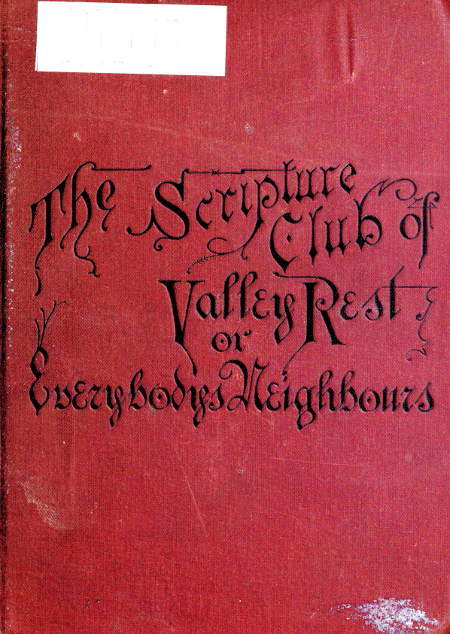
The Project Gutenberg eBook of The Scripture Club of Valley Rest; or, Sketches of Everybody's Neighbours
Title: The Scripture Club of Valley Rest; or, Sketches of Everybody's Neighbours
Author: John Habberton
Release date: April 29, 2017 [eBook #54627]
Most recently updated: October 23, 2024
Language: English
Credits: Produced by David Edwards, Martin Pettit and the Online
Distributed Proofreading Team at http://www.pgdp.net (This
file was produced from images generously made available
by The Internet Archive)
VALUABLE BOOKS
PUBLISHED BY
G. P. PUTNAM'S SONS,
New York.
I. Tent Life in Siberia. Adventures Among the Koraks and other Tribes in Kamchatka and Northern Asia. Fifth Edition. 12mo, cloth extra
2 00
"We strongly recommend this book as one of the most entertaining volumes of travel that have appeared for some years."—London Athenæum.
II. Travels in Portugal. By John Latouche. With Photographic Illustrations. Octavo, cloth extra
3 50
"A delightfully written book, as fair as it is pleasant. * * * Entertaining, fresh, and as full of wit as of valuable information."—London Spectator.
III. The Abode of Snow. A Tour through Chinese Tibet, the Indian Caucasus, and the Upper Valleys of the Himalaya. By Andrew Wilson. Square octavo, cloth extra, with map
2 25
"There is not a page in this volume which will not repay perusal. * * * The author describes all he meets with on his way with inimitable spirit."—London Athenæum.
IV. The Life and Journals of John J. Audubon, the Naturalist. Comprising Narratives of his Expeditions in the American Forests, &c. 12mo, cloth extra, with Portrait
2 25
"It is a grand story of a grand life; more instructive than a sermon; more romantic than a romance."—Harpers' Magazine.
V. Notes on England and Italy. By Mrs. Nathaniel Hawthorne (wife of the Novelist). Third edition. 12mo, cloth
2 00
Illustrated Edition, with 12 Steel Plates. Octavo, cloth extra, gilt edges
5 00
"One of the most delightful books of travel that have come under our notice."—Worcester Spy.
"The grace and tenderness of the author of the 'Scarlet Letter' is discernable in its pages."—London Saturday Review.
VI. Recollections of a Tour Made in Scotland in 1803. By Dorothy Wordsworth (Sister of the Poet). Edited by Principal Shairp, LL.D. 12mo, cloth extra
2 50
"The volume glistens with charming passages, showing how rich in 'Wordsworthian' fancy was this modest sister."—London Athenæum.
VII. Bayard Taylor's Travel. Complete in 10 Vols. Containing works upon Africa; Egypt; Iceland; California and Mexico; Greece and Russia; India, China and Japan; Palestine, Asia Minor, Sicily and Spain; Sweden, Denmark and Lapland; Europe, &c., &c. Per volume
1 50
Or, 11 Volumes, neatly put up in box
16 50
"There is no romance to us quite equal to one of Bayard Taylor's books of travel."—Hartford Republican.
☛ PUTNAM'S NEW CATALOGUE will be forwarded to any address on receipt of stamp.
RECENT PUBLICATIONS
OF
G. P. PUTNAM'S SONS.
DODGE. The Plains of the Great West, and their Inhabitants. A vivid and picturesque description of the Western plains of the American Continent, including accounts of the game, a careful topographical record, notes of emigration, &c., &c., and an exhaustive account of the life and habits of the Indians (both the "reserved" and the "unreserved"), their customs in fighting, hunting, marriage, death, clothing, religious beliefs and rites, &c., &c., with some suggestions for the treatment of the Indian question. By Richard Irving Dodge, Colonel in the U.S. Army. 1 large octavo volume very fully illustrated, $4.00
Colonel Dodge has, during many years, held positions of responsibility on the Western frontier, and has enjoyed exceptional opportunities for obtaining an intimate knowledge of the life and habits of the Indians, and of the features of the great plains in which they live, and the record of his experiences and observations will be found not only most fascinating reading, but a trustworthy and authoritative guide on the subjects of which it treats.
VAN LAUN. The History of French Literature.
By Henri Van Laun, Translator of Taine's "History of English Literature," the Works of Molière, etc., etc.
Vol. I.—FROM ITS ORIGIN TO THE RENAISSANCE.
Vol. II.—FROM THE RENAISSANCE TO LOUIS XIV.
Vol. III.—FROM LOUIS XIV. TO NAPOLEON III. (In preparation.)
8vo, cloth extra, each, $2.50.
We have to deal with a people essentially spirited and intellectual, whose spirit and intellect have been invariably the wonder and admiration, if not the model and mould, of contemporary thought, and whose literary triumphs remain to this day among the most notable landmarks of modern literature. * * * Extract from Author's Preface.
THE BEST READING. A Classified Bibliography for Easy Reference. With Hints on the Selection of Books, the Formation of Libraries, on Courses of Reading, etc. 15th Edition. Entirely re-written and brought down to August, 1876, with the addition of priced lists of the best books in French, German, Spanish and Italian Literature. 8vo, paper, $1.25; cloth, $1.75.
"By far the best work of the kind."—College Courant.
THE SELECT BRITISH ESSAYISTS. A series planned to consist of half a dozen volumes, comprising the Representative Papers of The Spectator, Tatler, Guardian, Rambler, Lounger, Mirror, Looker-On, etc., etc. Edited, with Introduction and Biographical Sketches of the Authors, by John Habberton.
Vol. I.—THE SPECTATOR. By Addison and Steele. Square rómo, beautifully printed, and tastefully bound in cloth extra, $1.25
This series has been planned to preserve, and to present in a form at once attractive and economical, the permanently valuable portions of those standard productions of the Essayists, which, as well for the perfection of their English style, as for the sterling worth of their matter are deservedly perennial.
Vol. 2. SIR ROGER DE COVERLY PAPERS. From The Spectator.
One volume, 16mo, $1.00.
"Mr. Habberton has given us a truly readable and delightful selection from a series of volumes that ought possibly never to go out of fashion, but which by the reason of their length and slightly antiquated form there is danger of our overlooking."—Liberal Christian.
Brother Humbletop Withdraws.
THE
SCRIPTURE CLUB
Of Valley Rest
OR
SKETCHES OF EVERYBODY'S
NEIGHBOURS
By the Author of
"The Barton Experiment," "Helen's Babies," Etc.
NEW YORK
G. P. PUTNAM'S SONS
182 Fifth Avenue.
—
1877
CONTENTS.
| CHAPTER I. | |
| Page | |
| A Liberal Movement | 1 |
| CHAPTER II. | |
| Some Spiritual Differences | 20 |
| CHAPTER III. | |
| Free Speech | 42 |
| CHAPTER IV. | |
| A Solemn Hour Completely Spoiled | 60 |
| CHAPTER V. | |
| Familiar Sounds | 78 |
| CHAPTER VI. | |
| Builder Stott Saves the Faith | 92 |
| CHAPTER VII. | |
| Free Speech Becomes Annoying | 109 |
| CHAPTER VIII. | |
| Aftermath | 126 |
| CHAPTER IX. | |
| The Doctrine of Insurance | 144 |
| CHAPTER X. | |
| A Decisive Battle | 162 |
| CHAPTER XI. | |
| Conclusion | 183 |
Scripture Club.
CHAPTER I. A LIBERAL MOVEMENT.
The success of the Second Church of Valley Rest was too evident to admit of doubt, and there seemed to be no one who begrudged the infant society its prosperity. Most of its members had come to the village from that Western city known to all its inhabitants as being the livest on the planet, and they had brought their business wits with them. At first they worshiped with the members of the First Church, established forty years before, and with an Indian or two still among its members; but it soon became evident to old members and new that no single society could be of sufficient theological elasticity to contain all the worshipers who assembled in the old building. There were differences of opinion, which, though courteously expressed, seemed great enough to claim conscientious convictions for their bases; so with a Godspeed as hearty as their welcome had been, the newer attendants organized a new society. They were strong, both numerically and financially, so within a year they had erected and paid for a costly and not hideous church building, settled a satisfactory pastor, and organized a Sunday-school, three prayer-meetings, and a sewing society. The activity of the new church became infectious, and stimulated the whole community to good works; occasionally one of the other societies would endeavor to return some of the spiritual favors conferred by the Second Church, but so leisurely were the movements of the older organizations that before they could embody a suggestion in an experience the new church would have discerned it afar off and put it into practical operation.
It was in the rapid manner alluded to that the Second Church came finally by a feature which long and gloriously distinguished it. It was 11.50 by the church clock one Sunday morning when Mrs. Buffle, wife of the great steamboat owner, who made his home at Valley Rest, noticed her husbands face suddenly illumine as if he had just imagined a model for the best lake packet that ever existed; it was only 12.10, by the same time-piece, when about thirty of the solid members of the church, remaining after service, gathered in a corner of the otherwise vacant building, and agreed to Mr. Buffle's proposal that there should be organized a Bible class especially for adults.
"When you think of it," explained the projector, "it really seems as if there'd be no end to its usefulness. I call myself as orthodox a man as you can find in any church, anywhere, but there's lots of things in the Bible that I'm not posted on. I suppose it's the same with all of you; each of you may have thought a great deal on some single subject, but you're not up in everything—you haven't sat under preachers who talk about everything."
"There aren't many preachers who dare to preach about everything," remarked young lawyer Scott, who had in marked degree the youthful appetite for the strongest mental food, and the youthful assumption that whatever can be swallowed is bound to be digested.
"Nor that dares to say what he really believes," added Captain Maile, who had that peculiar mind, not unknown in theology and in politics, which loves a doubt far more dearly than it does a demonstration.
"Preachers are like the rest of us," said Mr. Buffle; "they haven't time to study everything, and they have to take a good deal on the say-so of somebody else; a good many things they may be mistaken about, but they'd better have some idea on a subject than none at all; once get a notion into their heads and it'll roll around and make them pay attention to it once in a while. And that's just what we need, I think, and it's what brought this Bible class idea into my mind. Each of us will express our minds on whatever may be the subject of the day's lesson, and we'll learn how many ways there are of looking at it. No one of us may change his mind all at once, but if he gets out of his own rut for an hour in a week, he'll find it a little wider and no less safer when he drops into it again."
"And perhaps he may get it so wide that there'll be room enough in it for three or four, or half-a-dozen Christians to walk in it side by side, without kicking each other, or eyeing each other suspiciously," suggested Brother Radley, whose golden text always was, "It is good for brethren to dwell together in unity."
"That's it!" exclaimed Mr. Buffle, his eyes brightening suddenly. "That's it! But I don't intend to do all the talking, gentlemen. I suggest that such of us as like the idea sign our names to an agreement to meet every Sunday for the purpose specified, and that we immediately afterward proceed to elect a teacher."
"I don't wish to dampen any honest enthusiasm for Biblical research;" said Dr. Humbletop, a genial ex-minister; "but from some remarks which have been made it would seem as if doubt—perhaps honest, but doubt for all that—were to have more to do than faith with the motive of the proposed association. What we need—what I feel to need, at least, and what I believe is the case with all who are here present—is to be rooted and grounded in the faith which we profess. I would move, therefore, that if the class is to be informally organized in the manner proposed by Brother Buffle, that at least the creed of our church be appended to the document to which signatures are to be affixed."
"Mr. Chairman," exclaimed Mr. Alleman (Principal of the Valley Rest Academy, and suspected of certain fashionable heresies), "I object. In our congregation—here in this small gathering, in fact—is a large sprinkling of gentlemen who are not members of the church, and who do not accept our creed, though they enjoy worshiping with us: Brother Humbletop's resolution, if put into effect, would exclude from the proposed teachings the very class of men that we profess to believe are most in need of religious instruction. The churches are so rigid that a thinking man can scarcely gain admission to them without lying, actually or constructively: don't let us, in a class like that proposed, follow the example of the Pharisees, those very flowers of orthodoxy—and 'lay on men's shoulders burdens grievous to be borne.' If our religion is what we claim it is, let us open our gates wide enough to admit every one who is at all interested to study God's ways as made known through the scriptures."
"Don't trouble yourself," said Captain Maile, who was as dyspeptic in body as in mind, but was also a keen observer of human nature; "I don't see but saints need converting as badly as sinners do, and there's enough of them to keep you busy. We sinners can find a gathering place somewhere else—perhaps the sexton will think the furnace-room the proper place for us—and we'll take Christian hospitality and great-heartedness as our first subject for discussion."
"You won't do anything of the kind," exclaimed Squire Woodhouse, one of the old settlers who had joined himself to the Second Church to avoid being tormented about what some of the members of the First Church termed his rationalism. "You're going to meet with us, blow us up all you like, teach us anything you can, and make us better in any way you know how to. God Almighty's kingdom isn't any four-acre lot with a high stone wall and a whole string of warnings to trespassers; his kingdom takes in all out-doors; every man alive is his child, and got a right to come and go in his Father's house, even if he don't sit on the same style of chair or creep under the same kind of bedclothes that his brothers do. If he don't like the meat, or bread, or dessert that somebody else is eating, the table's so full of other good things that he can't go hungry unless he insists upon it. There isn't one of you but's got more religion and brains than any of the twelve apostles ever had; but none of them were ever turned out of the Bible class, though one of them, who was a thief, was man enough to stay away of his own accord, and voluntarily go to judgment."
"Churches wouldn't be near so full if all thieves followed Judas's example," was the ungracious remark with which Captain Maile received this handsome speech; a hearty laugh took the sting out of the captain's insinuation, however. Meanwhile Mr. Buffle had torn a leaf out of a hymn-book, scrawled a form of agreement thereupon, and passed it around for signatures. When the paper reached Dr. Humbletop, that gentleman said:
"Brethren, I sign this paper in the hope that we shall work together for the honor and glory of God; but I distinctly avow and reserve the right to withdraw at any time, should such time come, when my conscience forbids me any longer to attend."
Several others, among them Insurance President Lottson and Mr. Stott, the well-to-do builder, announced the same reservation, but no one entirely declined to sign. Then Mr. Buffle moved the election of a teacher, and the choice fell upon Deacon Bates, a man of unabused conscience, pure life, extreme orthodoxy, and an aimless curiosity (which he mistook for thought) about things Biblical and spiritual. Then Mr. Buffle arose and said:
"Mr. Chairman—Mr. Teacher, I mean—time is money in the church as well as in the world. It's only 12.30; Sunday-school won't be out until 1.30. I move we select a lesson, and go right to work."
The motion was put and carried, and in a second Dr. Humbletop was upon his feet.
"I propose," said he, "that after the offering of a prayer—an essential which seems to have been overlooked by our brethren so zealous in good works—that we proceed to the consideration of the Epistle of Paul to the Romans. Let us sit at the feet of one, the latchet of whose shoes no other theologian was ever worthy to unloose, and let us there seek those truths which shall make us wise unto salvation. Let us make ourselves fully acquainted with God's plan for the redemption of sinful man."
"I move as a substitute," said Mr. Alleman, "that we begin with the Sermon on the Mount, and learn from the Master instead of the servant."
The place was a church and the occasion was the study of the Scriptures. But the attendants were only human and they recognized the conditions necessary to a fight with many indications of satisfaction; faces lightened up, eyes rapidly increased in luster, and lips unconsciously parted in the manner natural to persons who are gradually abandoning themselves to the influence of an impending pleasure. Men sitting to the right, left, and front of the apparent contestants twisted their necks until their eyes commanded the scene; while good old Major Brayme, who was rather deaf, and had got into a corner for his neuralgia's sake, scented the battle afar off and limped around to a front seat.
"The question is on the amendment," said the leader, "unless some brother has still another amendment to offer."
Nobody spoke; as Captain Maile afterward explained, "'twasn't anybody else's fight." Besides, Valley Rest was peopled by the race peculiar to all other portions of this terrestrial ball, and one of the instincts of that race, whether savage or civilized, is that it is far more pleasing to be a spectator than a participant in an altercation.
"Mr. Leader," said Mr. Alleman after a moment of silence, "in support of my amendment I wish to say that no one more enthusiastically admires than I do the remarkable, almost unique, logical ability of the apostle; but the very reason which prompted him to give forth that wonderful letter to the Romans is the one which I offer in opposition to our studying that same epistle. Paul was originally a shrewd man of the world, and his conversion did not deprive him of his common sense and tact. Writing to the church at Rome—a church whose members, judging by the Roman mental constitution, must have been gained through appeals logical rather than emotional—he met them upon their own ground, and taught them and grounded them in belief through those faculties in them which were most easily reached, and which, more than any others, would retain the impressions formed upon them. Of all that Paul taught we profess to be convinced; of what Christ taught we are not so well informed, for the reason that it is Paul, rather than Christ, who is preached from the pulpit. But here we are in a world and a state of society in which, for righteousness' sake, we are less helped by logically drawn dogma than by earnest injunction and pure example. We do believe; what we need is to learn to lead the new life which that belief implies; we need to have asserted, explained, and impressed upon us the simple but comprehensive rules and gracious promises which Jesus enounced during his life. The Sermon on the Mount begins with the Beatitudes; which of us really believes in them as we do in Paul's argument to the Romans? It continues and concludes with a number of moral injunctions, all of which we practically reject, or at least neglect; yet these bear directly on our daily intercourse with our fellow-men, and our daily acts of all sorts. Why, St. Paul himself apparently preached after this same model when he had to talk to men of the world whose intelligence was not confined to a single groove, for we read that when he preached—talked—to Felix, the governor, he reasoned of righteousness, temperance, and the judgment to come. Therefore I move, for the good of those here assembled, and for the glory of God, that this class proceed to the study of the Sermon on the Mount."
There was a perceptible rustle and an active interchange of winks and head-shakings as Mr. Alleman closed; but a dead silence was restored as Dr. Humbletop slowly rose to his feet, cleared his throat, adjusted his newly-polished glasses, and raised his voice.
"My dear friends," said he, "having been an humble but earnest follower of the Lord Jesus Christ for nearly half a century, I need not on this occasion enter into a defense of myself against any possible insinuation of lack of faith. Nor will any one doubt that I apprehend the great value of the Sermon on the Mount; some of you will, perhaps, recall a series of sermons which I preached a few years ago upon the Beatitudes. But Jesus Christ was not merely a moral teacher; his great work was to redeem the world from death by offering himself as a propitiation for their sins, and submitting himself unto death, even the shameful death of the cross. His teachings were great, he spake as man never spake before, but all this is as naught compared with the great work which he finished upon Calvary. It is this that we need to study; it is for this we should love and adore him. 'God so loved the world, that he gave his only-begotten Son, that whosoever believeth in him should not perish, but have eternal life.'"
"I should like to ask Brother Humbletop if personal salvation is the highest motive with which we should study the Bible?" said Mr. Alleman.
It was evident that the question was a poser to the good doctor; the very convexity and luster of his glasses served only to make his eyes stare more aimlessly at nothing for a moment or two. He recovered himself, however, and replied:
"God, in his generosity, and doubtless in view of the needs of sinful humanity, has ordered that the salvation of mankind should have been the principal object of Christs coming upon earth; I am not here to criticise my Maker."
"And you know that no one else is," remarked Mr. Alleman, with not inexcusable acerbity.
"Question!" exclaimed several voices. The leader put the question, and the amendment of Mr. Alleman was adopted by a considerable majority. Again Dr. Humbletop got upon his feet.
"My dear friends," said he, "I regret at this early hour to part from an association from which I had fondly hoped to derive spiritual benefit, but my sense of duty impels me to take such a step; the vote of the class seems to indicate an estimate of Christ to which I should never dare to commit myself—an estimate against which I must always protest. Personally, I hold you all in high esteem; you shall always be remembered by me at the throne of grace, but upon the prime essential of Christian fraternity we seem hopelessly at variance. In one way I doubt not that your deliberations will tend toward good, but that way is not the best way, and I must therefore regret it. I shall consider it my duty to take steps toward the organization of a class upon what I conceive to be a Christian basis, and in that class I shall always be ready to heartily welcome any of you. Salvation through the atonement of Christ is the central truth of the Bible; a body of students who examine the Word from any other standpoint may be perfectly sincere and in earnest, and they may constitute what may without unkind meaning be called a Scripture Club, but they can never claim to be regarded as a Bible class, in the proper acceptation of the term."
The doctor gathered his cloak, hat, and cane, and retired with a graceful but dignified bow; the class rose to its feet in some confusion, and Squire Woodhouse exclaimed:
"Scripture Club, eh? Well, its a good name."
"That's so," said Mr. Alleman; "let's adopt it, and show the blessed old man that names can't change natures."
A general assent was sounded; not so noisy a one, perhaps, as that with which the Dutch patriots of three hundred years ago accepted the designation of "Beggars," cast at them by Spain, and destined to recoil upon those who bestowed it; but the acclamation was nevertheless more earnest and demonstrative than is common in churches, and it was perhaps well that in the midst of it the dismissal of the Sunday-school compelled parents who were members of the "Club" to hurry out in search of their children.
CHAPTER II. SOME SPIRITUAL DIFFERENCES.
The next meeting of the Scripture Club of Valley Rest was impatiently looked forward to by all the club members. Although there were at that time plenty of political theories to quarrel over, two or three fine projects for new lines of lake navigation, and at least a dozen for making of the neighboring city the greatest Western rival to New York, conversation on these subjects was only fitful on the boats which carried the business men of Valley Rest between their homes and the city. Before the second Sunday of the existence of the class, each member had in mind at least one religious topic upon which he wanted full, exhaustive, and decisive discussion; he also in his innermost heart, and sometimes on his lips, had the settled conviction that he was just the man to speak the decisive word, and thus readjust human thought to the newly-discovered requirements of eternal truth.
Nor was excitement on religious topics confined to the members of the club. Not a day of the week passed without bringing to Deacon Bates a new candidate for admission. First came Mr. Hopper, who took enthusiastic delight in whatever was new, whether in religion, politics, medical theories, or popular smoking tobaccos. As Mr. Hopper was a rich man, good Deacon Bates hastily assured him that the class would be delighted to have him as a member, and Mr. Hopper graciously responded by offering to read at the very first meeting a seventeen-page paper, from a very heavy but comparatively new quarterly, on "The True Location of the Holy Sepulchre." Then came Mr. Jodderel, who had once defrayed the entire cost of producing a bulky pamphlet, the motive of which was the probable final settlement of all departed spirits, in renewed bodies, on some one of the terrestrial globes which he believed had been in preparation from the foundation of the world. Mr. Jodderel more than hinted that he would like to see considerable attention given to this topic in the new class, and though good Leader Bates trembled at the thought, having heard the same subject discussed in season and out of season ever since Mr. Jodderel had made the coming peerless city of the West his place of business, he was true to the sentiment which had led to the formation of the class, and therefore gave Mr. Jodderel a hearty fraternal welcome. Then, like Nicodemus, there came by night, and from fear of the orthodox, Brother Prymm, to whom the slightest letter of the law was of more importance than the whole of the spirit thereof. He had made the matter of joining the class a subject of special prayer, he said, and had made up his mind that if it were really the intention of the members to encourage free speech and honestly search for the actual truth regarding the will of God, it was his duty to join the class, and serve his blessed Master to the extent of his poor abilities. Mr. Maddle came next, and Leader Bates' heart gladdened to receive him, for Mr. Maddle was one of the most successful organizers in the State; he had planned and executed at least two remarkably successful campaigns in the local political field, and had reorganized, out of nothing, more than one shapeless business enterprise so admirably that the backers thereof could not learn what they had expended, nor could the creditors discern what they themselves had received. With such a man behind him, Leader Bates rose superior to his own fears of the possible disintegration which the diversity of views of his fellow-members had seemed to make possible. And then, as if providentially sent to give the class the impress and protection of the highest order of mentality, came Dr. Fahrenglohz, Ph.D., Göttingen, who had additional repute as being a good physician and a man who always paid his bills. All these were present at the opening hour of the next meeting, and with them came several people of the class which yields capital listeners, and proves the wondrous capacity of the human mind for absorbing information without ever being moved to lend any of it again to others.
The meeting was opened with prayer. Deacon Bates remarked prefatorily that such would be the proper thing in a class composed of adults, and then he looked around hesitatingly for the proper man to make the first formal committal of the class into the hands of the Lord; but Squire Woodhouse saved him the trouble by springing to his feet and volunteering to Heaven an address so concise that there remained nothing unsaid. Then Bibles were distributed, and opened at the fifth chapter of Matthew's Gospel, and every one looked unspeakably profound, though Mr. Hopper had the presence of mind to place his hand beneath his coat-tails and take hold of the review containing the paper on "The True Location of the Holy Sepulchre," so as to be ready in case occasion offered.
"Let us begin with the beatitudes," said the leader. "'Blessed are the poor in spirit, for theirs is the kingdom of heaven.' By the way, I would suggest that each member speaks in the order of his sitting. Mr. Lottson," continued Deacon Bates, addressing the insurance president, "whom do you suppose Jesus referred to as 'the poor in spirit'?"
"Before answering that question," said Mr. Lottson, "I think attention should be called to a passage in the opening of the chapter. It is said that 'When he was set, his disciples came unto him. And he opened his mouth and taught them, saying,' etc. Now, before we try to understand this beautiful succession of blessings, we should realize whom they were spoken to—to the disciples, who had left all and followed him, and therefore to a set of men to whom he could say things which it would be nonsensical for him to say to the common people and business men around him. The disciples were out of business, and lived on their friends—it was right enough for them to do so under the circumstances, but for this very reason Jesus told them the things which nobody else could understand. This sermon was preached to self-forgetting preachers, not to men who had to make their living and take the world as they found it; and I suppose the first beatitude meant to them just what it said. They were poor in spirit—any man has to be, if he be willing to go around without a cent in his pocket—but to pay them for it he gave them the kingdom of heaven, that is, the church of which Christ is prophet, priest, and king. It's the greatest charge in the world; all business enterprises are nothing in comparison with it; but Jesus showed his divine nature by giving them this, for while they managed it splendidly, it's the only great affair in the world that a lot of poor-spirited men could manage without running it into the ground."
"That depends upon what 'poor in spirit' means," remarked Squire Woodhouse. "President Lottson seems to think it's the same thing as mean-spirited, but if it is, I can tell him that there's more money for that kind of chaps in other businesses. Now I'm a farmer—my principal crop is hay, and when my barn burned down last winter with eleven tons loose and forty odd tons pressed, and I went to the insur——"
"The members will please speak as called upon," said the leader, whose watchful ear imagined it detected a personality in the immediate future of the Squire's address. Squire Woodhouse subsided after a soft whisper to his right-hand neighbor, which caused that gentleman to notice that President Lottson's face was flushing a little, and his lips touching each other more firmly than usual.
"It seems to me," said Mr. Radley, who was next called upon, "that the passage means just what it says. The kingdom of heaven means the place we all hope to get to some day, and the poor in spirit are the people who aren't touchy and don't put on airs Christ was a man of this kind himself, and he knew by experience what he was talking about."
"Then how did he come to call a lot of good church members vipers?" demanded Squire Woodhouse, before the leader could bring him to order.
"Because they were vipers," answered Mr. Radley. "Being poor in spirit—humble—doesn't need to keep anybody from telling the truth. It's your high-spirited chaps that do most of the lying in the world—they do in business circles anyway."
"Next," said Deacon Bates, and Captain Maile lifted up his voice.
"Judging by the notions most people have of the kingdom of heaven," said he, "I don't think anybody but poor-spirited people can ever want to go there."
Next in order came Mr. Jodderel, and, as he afterward told his wife, he breathed a small thank-offering to Heaven for preparing so perfect an occasion for the presentation of his own theological pet.
"I don't wonder," he said, "that my military friend turns up his nose at the home-made heaven of most people, but I want him to understand that it was no such place that the Lord was talking about. What did he mean when he said, 'Come, ye blessed of my Father, and inherit the kingdom prepared for you from the foundation of the world'? What sensible man imagines that the kingdom he spoke of meant any such place as Christians talk about, or even the place where the Lord himself is? It can't be the latter, for that wasn't prepared from the foundation of the world; it existed long before, and didn't need any preparation. If he prepared the kingdom from the foundation of the world, and made the sun, moon, and stars when he founded the world—a fact which I fully and implicitly believe because it is recorded in the inspired Word—the kingdom must be in some other sphere. And if, as astronomers say, and I have no reason to doubt, these spheres are worlds, a great deal like ours, we will have material bodies when we go to them."
"And poor spirits?" queried the insurance president.
"Yes!" exclaimed Mr. Jodderel fearlessly. "We can't go there without first dying here, and I never yet saw a man on his death-bed who thought a high spirit, or what men call a high spirit, had ever done him any good."
President Lottson tried to swallow a sigh which was a little too quick for him; he had once or twice imagined himself on his own death-bed, and had gained thereon some practical intimations which he had made haste to forget when he got back to business. Mr. Prymm, who sat next to Mr. Jodderel, cleared his throat and said:
"I think we owe Mr. Lottson our thanks for calling our attention to an important fact which has escaped general notice. The sermon was undoubtedly preached to the disciples, and should be considered accordingly; a great many mistakes of interpretation are doubtless due to the habit of Christians in taking to themselves every saying of the Lord and his prophets. I confess that the view advanced is so new a one to me that I am unable at present to express any opinion upon it, but I derive already this benefit from it—I learn anew how necessary it is to pay close attention to the letter of the Word."
"Then," said young Mr. Waggett, who sat next Mr. Prymm, and who was principally remarkable for undeviating devotion to Number One, "then the passage has nothing to do with the great affair of the salvation of our own souls."
"Supposing it hasn't," said Squire Woodhouse, in spite of the warning glance of the leader, "Sunday isn't a business day, and if we want to talk about some of our best friends then there's no harm in doing so, nor any time wasted either."
"Brother Scott," said Deacon Bates. The young lawyer, who had been exerting over himself a degree of control that was simply terrible, considering his temptations to interruption, said:
"May it please the class: There are some evident misunderstandings abroad. Mr. Lottson's position is untenable, as the context of the same sermon proves; no examination, according to the rules of evidence, can fail to prove that the sermon was addressed to the whole people. The passage cannot mean literally what it says, as Mr. Radley thinks, because literally it is illogical, and had such been its intention it could never have been accepted by that consistent apologist for the integrity of the Scriptures, the Apostle Paul, whose mind was so marvelously under control of the legal instinct. Captain Maile's assumption as to the general idea of heaven is utterly without support from fact; for poverty of spirit is not the prevailing characteristic of those whose opinions of heaven are verbally made manifest. As for Mr. Jodderel's proposition, it involves the literal accuracy of the Book of Genesis, which many orthodox Christians are unprepared to admit. Mr. Prymm's notion that the sayings of Jesus may be wrongly taken by individuals, as applying to themselves, is not in accordance with logical deductions from other portions of Holy Writ. And how can Mr. Waggett sustain his position that there is any eternal truth that is not necessary to salvation?"
A soft chorus of long-drawn breaths followed the delivery of this speech, and then Squire Woodhouse said:
"Well, now that you've knocked all the rest down, what are you going to do yourself?"
"That," replied Lawyer Scott, evidently pleased by the compliment but puzzled by the question, "cannot be answered as easily as it is asked, and I must beg the gentleman's indulgence until I have time to prepare my case."
Mr. Buffle, founder of the class, was next in order, and admitted that he could not see that Jesus, being a clear-headed man, could ever have meant anything but what he said. He, Mr. Buffle, always said what he meant, no matter whether he was talking to preachers, shippers, or the deck-hands on his own boats; he had found that if a man said exactly what he meant, the stupidest of people could understand him, while smarter people needed no more. He would consider himself a fool if he talked over the head of any one who was listening to him, and of course Jesus couldn't have been foolish. He was very glad, though, to listen to the many different views that had been advanced on the subject; they proved just what he had always believed, that men would learn more about a thing by hearing all sides of it than he could from the smartest talker alive who knew only one side. He liked the liberality of the members of the class; it was what he called liberality, to listen to various views courteously, even if you couldn't accept them all or make them agree.
The question had now reached Dr. Fahrenglohz, and the members, both liberal and narrow, prepared for something terrible. They knew, in general, that he believed nothing that they themselves did; how then could his own ideas be anything but dreadful?
The doctor looked mildly from behind his very convex glasses, and said:
"Jesus was a mystic. From the spiritual plane on which he lived it was impossible for him to descend. He could say only that which he believed. Pure-minded and wholly regardless of ordinary earthly interests, he could not be a utilitarian, in the vulgar acceptation of the word. What thought he, what thinks any philosopher, of how his theories may affect the world? It is his duty to discover the truth, help or hinder whomsoever it may, and to speak it as he understands it, not in such fragments as other people may comprehend it. What did Buddha and Brahma? They spoke, they gave forth that which originated with them."
"And what did it all amount to?" asked Squire Woodhouse. "Business don't amount to a row of pins among their followers, according to the Missionary Herald, and virtue is worse off yet."
The doctor smiled condescendingly. "'He that hath ears to hear, let him hear' as your prophet says. Is virtue and good business always to be found with those who sit under the words of Jesus?"
"N-no," said the Squire, "and that's just what we're driving at. If the words are understood—and followed—men can't help being good and successful."
"And so there is all the more need of careful, prayerful study of the words," remarked Mr. Prymm.
There was general disappointment, among those who had yet to speak, at the lack of any startling heresy in the doctor's utterances. Builder Stott in particular had felt that he might have an opportunity of defending the faith which he so unhesitatingly accepted, at no matter what intellectual difficulties, by abusing some heterodox utterance of the doctor; but the doctors statements had seemed to him to resemble either a sphere—and a hollow one—from which all projectiles would glance harmlessly, or mere thin air, in which there was nothing to aim at. So he could do nothing but assert his own orthodoxy.
"I believe everything that Jesus said was meant just as it was spoken," said he; "whether what we call common sense has got anything to do with it or not, is none of our business. Of course we can't live up to it all—we're born in sin and shapen in iniquity; our hearts are deceitful above all things and desperately wicked—but what we can't do, he did for us, by dying on the cross. We can never act according to his teachings—we'd go to the poor-house or into our coffins as soon as we attempted it. If we could do it, there wouldn't have been any need of an atonement."
"Then the atonement is an excuse for rascality, is it?" asked Captain Maile. The Captain's own house had been erected by Builder Stott, and many had been his complaints of features which had proved not in accordance with the spirit of the contract.
Leader Bates felt extremely uncomfortable; he never had liked personalities, and hated them all the worse when they interfered with that heavenly feeling which was to him the principal object of all religious meetings. He made haste to call upon Mr. Alleman, and that gentleman replied:
"Mr. Leader, there can be no doubt that this passage was spoken to living men, about living interests, and that it not only can be lived up to by the exercise of such qualities as men already have, but that it must be treated and respected as truth if men do not wish the disgrace and penalties of hypocrisy. Of what consequence is it to true righteousness if men will or will not reconcile scriptural injunctions with business desires? Bring business up to truth, not truth down to business, is the earthly application of Christ's teachings."
"That," said Builder Stott, "may be all right in running a first-class academy, but you can't run the building business on any such basis."
The hour for dismission was reached at that instant, with Mr. Hopper still nervously shaking the coat-tail pocket which contained the review with the article on the "True Location of the Holy Sepulchre." Two or three of the members departed, but the greater number stood about and discussed the discussion.
"Well, everybody had a chance to speak his mind," said Mr. President Lottson.
"That's so," said Mr. Buffle, founder of the class, rubbing his hands enthusiastically. "Nobody was afraid of his neighbor's opinions."
"There seemed a general disposition to view the subject from all points," remarked Mr. Prymm.
"Not much regard paid to evidence," said young Lawyer Scott, "but still an evident willingness to open the case fairly."
"There was not a proper interest displayed in the future location of the soul," complained Mr. Jodderel; "still the members acted like good listeners."
"There was a little too much talking back," said Mr. Radley; "men should be more careful about treading on each other's corns. But there was a real, liberal spirit shown throughout, and that's what religious societies need."
"Men shouldn't have corns, if they don't want them trodden on," said Captain Maile. "I won't complain, though—I never saw so little narrowness in so large a religious gathering."
"I take great delight in recalling the conference we have had," said Dr. Fahrenglohz. "I supposed, when I heard of this association, that it would not bear the test of differences of opinions, but I am grateful for the respect shown to me, and pleased at the courtesy displayed toward others."
Squire Woodhouse waited until Mr. Alleman disappeared, and then burst into a small group exclaiming:
"Now, I like Alleman first rate—all of my children go to his academy—but I do wonder whether he could run a farm with those notions of his? I'm glad the class listened respectfully, though—it showed that nobody was afraid that a little liberality would hurt any one."
CHAPTER III. FREE SPEECH.
The members of the Scripture Club did not put off their holy interest with their Sunday garments, as people of the world do with most things religious. When the little steamboat Oakleaf started on her Monday morning trip for the city, the members of the Scripture Club might be identified by their neglect of the morning papers and their tendency to gather in small knots and engage in earnest conversation. In a corner behind the paddle-box, securely screened from wind and sun, sat Mr. Jodderel and Mr. Prymm, the latter adoring with much solemn verbosity the sacred word, and the former piling text upon text to demonstrate the final removal of all the righteous to a new state of material existence in a better ordered planet. In the one rocking-chair of the cabin sat insurance President Lottson, praising to Mr. Hopper, who leaned obsequiously upon the back of the chair and occasionally hopped vivaciously around it, the self-disregard of the disciples, and the evident inability of anyone within sight to follow their example. The prudent Waggett was interviewing Dr. Fahrenglotz, who was going to attend the meeting of a sort of Theosophic Society, composed almost entirely of Germans, and was endeavoring to learn what points there might be in the Doctor's belief which would make a man wiser unto salvation, while Captain Maile stood by, a critical listener, and distributed pitying glances between the two. Well forward, but to the rear of the general crowd, stood Deacon Bates in an attitude which might have seemed conservative were it not manifestly helpless, Mr. Buffle with the smile peculiar to the successful business man, Lawyer Scott, with the air of a man who had so much to say that time could not possibly suffice in which to tell it all, Squire Woodhouse, who was in search of a good market for hay, Principal Alleman, who was in chase of an overdue shipment of text-books, and Mr. Radley, who with indifferent success was filling the self-assigned roll of moderator of the little assemblage.
"Nothing settled by the meeting?" said Mr. Buffle, echoing a despondent suggestion by Deacon Bates. "Of course not. You don't suppose that what theologians have been squabbling over for two thousand years can be settled in a day, do you? We made a beginning and that's a good half of anything. Why, I and every other man that builds boats have been hard at work for years, looking for the best model, and we haven't settled the question yet. We're in earnest about it—we can't help but be, for there's money in it, and while we're waiting we do the next best thing—we use the best ones we know about."
"Don't you think you'd get at the model sooner, if some of you weren't pig-headed about your own, and too fond of abusing each other's?" asked Mr. Radley.
"Certainly," admitted Mr. Buffle, "and that's why I wanted us to get up a Bible-class like the one we have. If everybody will try to see what's good in his neighbors theories and what's bad in his own, his fortune—his religion, I mean—is a sure thing. Fiddling on one string always makes a thin sort of a tune."
"There were a good many small tunes begun yesterday, then," observed Squire Woodhouse.
"Well," said Mr. Buffle, "I thought something of the kind, myself, but a man can't break an old habit to pieces all at once. Things will be different before long, though."
"There is no reason why they shouldn't," said Principal Alleman, "excepting one reason that's stronger than any other. You can't get to the bottom of any of the sayings of Christ, the Prophets or the Apostles without finding that they mean, Do Right. And when you reach that point, what is in the man and not what is in the book comes into play, or, rather, it always should but seldom does."
"I suppose that's so," said Mr. Buffle, soberly.
"In and of ourselves we can do nothing," remarked Deacon Bates.
"It's very odd, then, that we should have been told to do so much," replied Principal Alleman.
"It was to teach us our dependence upon a higher power," said Deacon Bates, with more than his usual energy.
"Are we only to be taught, and never to learn, then?" asked Principal Alleman. "Some of my pupils seem to think so, but those who depend least upon the teacher and act most fully up to what they have been taught are the ones I call my best scholars."
Deacon Bates's lower lip pushed up its neighbor; in the school-room, the Principal's theory might apply, but in religion it was different, or he (Deacon Bates) had always been mistaken, and this possibility was not to be thought of for an instant. Fortunately for his peace of mind, the boat touched her city dock just then, and from that hour until five in the afternoon, when he left his store for the boat, religious theories absented themselves entirely from Deacon Bates's mind.
The last meeting of the class was still the most popular subject of conversation among the members, however, and interest of such a degree could not help be contagious. Other residents of Valley Rest, overhearing some of the chats between the members, expressed a desire to listen to the discussions of the class, and to all was extended a hearty welcome, without regard to race, color, or previous condition of religious servitude, and all were invited to be doers as well as hearers. So at the next session appeared ex-Judge Cottaway, who had written a book and was a vestryman of St. Amos Parish, Broker Whilcher, who worshipped with the Unitarians but found them rather narrow, and Broker Whilcher's bookkeeper, who read Herbert Spencer, and could not tell what he himself believed, even if to escape the penalty of death. Various motives brought men from other churches, including even one from Father McGarry's flock, and all of them were assured that they might say whatever they chose, provided only that they believed it.
"Shall we continue our consideration of last Sunday's lesson?" asked Deacon Bates, after the opening prayer had been offered. "We have some new members, and should therefore have some additional views to consider."
"Let's hear everybody," said Captain Maile. "If we talk as long about this verse as we'll have to talk before we reach any agreement, we'll all die before we can reach the square up-and-down verses that are further along in this same sermon."
"If the class has no objection to offer, we will continue our study of the third verse of the fifth chapter of Matthew, and those who spoke on last Sunday will allow the newer members and others an opportunity to make their views known." As Deacon Bates spoke, his eye rested warningly on Mr. Jodderel.
"I think," said Mr. Jodderel, "that the new members ought to know what ideas have already been presented, so as to throw any new light upon them, if they can. The nature of the kingdom of heaven, now, is the most important question suggested by the lesson, and——"
"It won't be of the slightest consequence to anyone," interrupted Principal Alleman, "unless they first comply with the condition which the verse imposes upon those who want to reach the kingdom."
"I wouldn't be too sure of that," remarked President Lottson, "while Jesus said that the poor in spirit should have the kingdom of heaven, He didn't say that no one else should share it with them. What is written doesn't always express all that is meant."
"It doesn't in insurance policies, anyhow," said Squire Woodhouse, "when my barn burned——"
"Time is precious, my brethren," said Deacon Bates hastily, scenting a personality, "I will therefore ask Judge Cottaway for his opinion of the passage."
"I think," said the Judge, with that impressive cough which is the rightful indulgence of a man who has written a volume on the rules of evidence, "that 'poor in spirit' undoubtedly means unassuming, rightly satisfied with what is their due, mindful of the fact that human nature is so imperfect that whatever a man obtains is probably more than he deserves. They can not be the meek, for special allusion is made to the meek in this same group of specially designated persons. Neither can it refer to people who are usually called poor-spirited persons, to wit, those who are too devoid of what is commonly designated as spirit, for these are properly classified as peace-makers, and have a similar though not identical blessing promised to them."
"The class owes its thanks to the Judge for his clear definition of the term 'poor in spirit," said Mr. Jodderel, "and if he can be equally distinct upon the expression 'kingdom of heaven' he will put an end to a great deal of senseless blundering."
"I know of but one definition," said the Judge, "heaven is the abode of God and the angels, and of those who are finally saved."
"Ah, but where is it? that's the question this class wants answered," said Mr. Jodderel, twisting his body and craning his head forward as he awaited the answer.
"Really," said the Judge, "you must excuse me. I don't know where it is, and I can't see that study as to its locality can throw any light upon the lesson."
This opinion, delivered by an ex-Judge, who had written a book on rules of evidence, would have quieted almost anyone else, and the members' faces expressed a sense of relief as they thought that Mr. Jodderel also would be quieted. But Mr. Jodderel was not one of the faint-hearted, and in his opinion faint-heartedness and quietness were one and the same thing.
"No light upon the lesson?" echoed Mr. Jodderel. "Why, what is the Bible for, if not to inform us of our destiny? What is this world but a place of preparation for another? And how can we prepare ourselves unless we know what our future place and duty is to be?"
"Next!" exclaimed Deacon Bates with more than his usual energy, and Mr. Jodderel sank back into his chair and talked angrily with every feature but his mouth, and with his whole body besides. "Mr. Whilcher has some new ideas to present, no doubt," continued the leader, bracing himself somewhat firmly in his chair, for the Deacon naturally expected an assault from a man of Mr. Whilcher's peculiar views.
"Poverty of spirit seems to me to be old English for modesty," said Mr. Whilcher, "We know very little, comparatively, of the great designs of God, and about as little of the intentions of our fellow-men, so we should be very careful how we question our maker or criticise our neighbors. No human being would appreciate divine perfection if he saw it; no man can give his fellow-men full credit for what they would do, if they were angels, and are sorry because they can't do. I think the passage means that only by that modesty, that self-repression, by which alone a man can accept the inevitable as decreed by God, and forbear that fault-finding which comes fully as easy as breathing, can a man be fitted for the companionship of the loving company which awaits us all in the next world."
"Whereabouts?" asked Mr. Jodderel.
Half-a-dozen members filibustered at once, and Mr. Jodderel was temporarily suppressed, after which Squire Woodhouse remarked:
"Well, now, that sounds first rate—I never knew before that Unitarians had such good religion in them—no harm meant, you know, Whilcher."
"Now let us hear from Mr. Bungfloat," said Deacon Bates.
Mr. Bungfloat, bookkeeper to Mr. Whilcher, hopelessly explored his memory for something from Herbert Spencer that would bear upon the subject, but finding nothing at hand, he quoted some expressions from John Stuart Mills' essay on "Nature," and was hopelessly demoralized when he realized that they did not bear in the remotest manner upon the topic under consideration. Then Deacon Bates announced that the subject was open for general remark and comment. Mr. Jodderel was upon his feet in an instant, though the class has no rule compelling the members to rise while speaking.
"Mr. Leader," said he, "everybody has spoken, but nobody has settled the main question, which is, where is the 'kingdom of heaven?' Everybody knows who the poor in spirit are; any one who didn't know when we began has now a lot of first class opinions to choose from. But where and what is heaven—that is what we want to know."
A subdued but general groan indicated the possibility that Mr. Jodderel was mistaken as to the desires of the class. Meanwhile, young Mr. Banty, who had been to Europe, and listened to much theological debate in cafés and beer-gardens, remarked.
"I'm not a member of this respected body, but I seem to be included in the chairman's invitation. I profess to be a man of the world—I've been around a good deal—and I never could see that the poor in spirit amounted to a row of pins. If they're fit for heaven they ought to be fit for something on this side of that undiscovered locality."
"Discovered millions upon millions of times, bless the Lord," interrupted Squire Woodhouse.
"Well, the discoverers sent no word back, at any rate," said young Mr. Banty, "so there's one view which I think ought to be considered; isn't it possible that Jesus was mistaken?"
Mr. Prymm turned pale and Deacon Bates shivered violently, while a low hum and a general shaking of heads showed the unpopularity of young Mr. Banty's idea.
"The class cannot entertain such a theory for an instant," answered Deacon Bates, as soon as he could recover his breath, "though it encourages the freest expression of opinion."
"Oh!" remarked Mr. Banty, with a derisive smile. The tone in which this interjection was delivered put the class upon its spirit at once.
"Our leader means exactly what he says," said Mr. Jodderel; "any honest expression of opinion is welcome here."
"If such were not the case," said Mr. Prymm, "a rival class would not have been formed."
"And none of us would have learned how many sides there are to a great question," said Mr. Buffle.
"Larger liberty wouldn't be possible," said Builder Stott. "Why, I've just had to shudder once in awhile, but the speakers meant what they said, and I rejoiced that there was somewhere where they could say it."
"I've said everything I've wanted to," remarked Squire Woodhouse.
"That's so," exclaimed insurance President Lottson.
"I havn't seen any man put down," testified Captain Maile, "and I don't yet understand what to make of it."
"Nobody could ask a fairer show," declared Mr. Radley.
"The utmost courtesy has been displayed toward me," said Dr. Fahrenglotz, "although I am conscious my views are somewhat at variance with those of others."
"The nature of proof has not been as clearly understood as it should have been," said young Lawyer Scott; "but no one has lacked opportunity to express his sentiments."
"So far from fault being found with the freedom of speech," said Mr. Alleman, "the sentiment of the class is, I think, that the expression of additional individual impressions would have been cordially welcomed, as they will also hereafter be."
Young Mr. Banty felt himself to be utterly annihilated, and the pillars of the class looked more stable and enduring than ever, and felt greatly relieved when the session ended, and they could congratulate each other on the glorious spirit of liberty which had marked their collective deliberations. And when Squire Woodhouse dashed impetuously from the room, and returned to report that Dr. Humbletop's class consisted of one solitary pupil, several of the members unconsciously indulged in some hearty hand-shaking.