
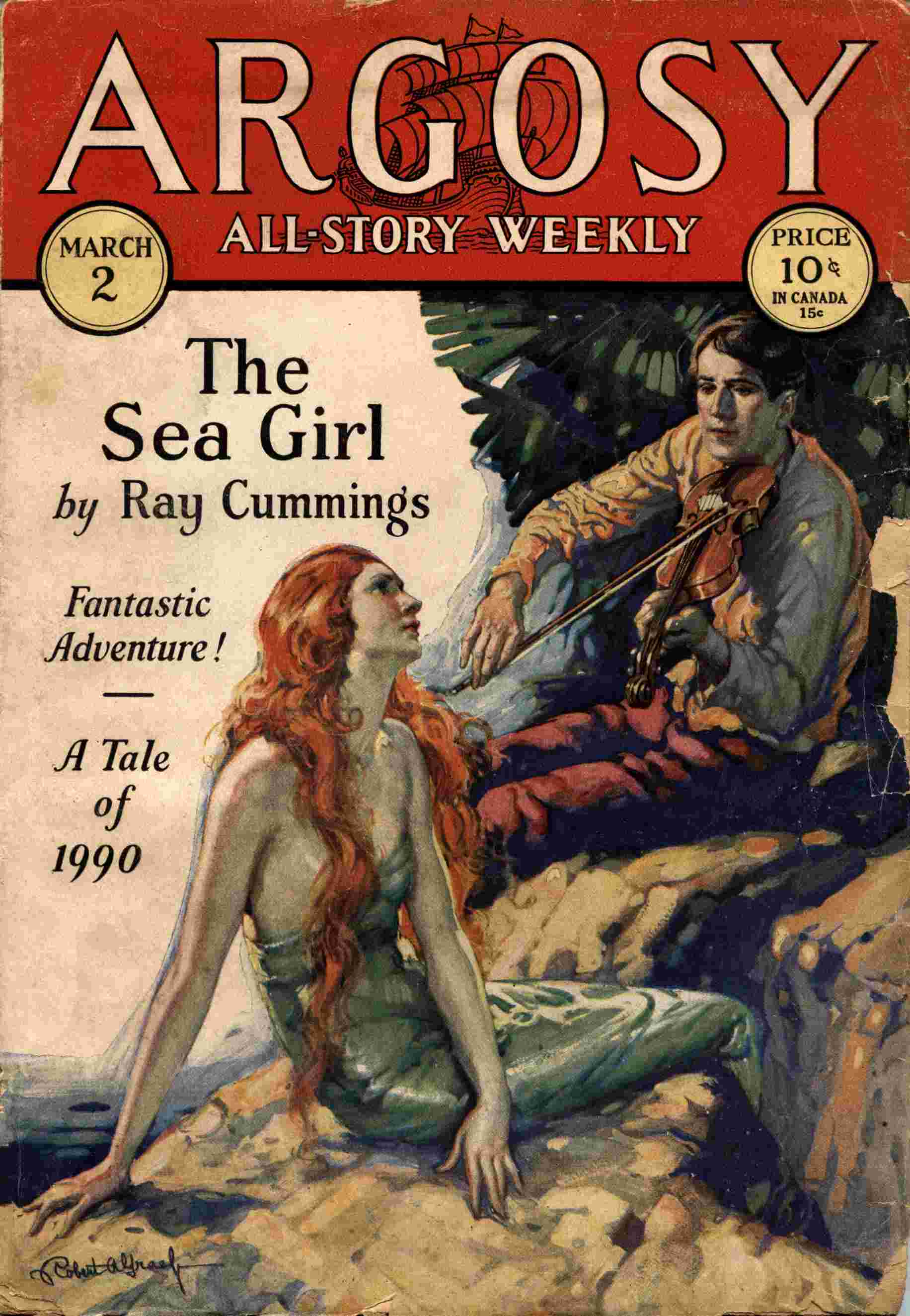
Nereid went in a graceful arc into the sea.
I was stiffened for just an instant. Why, what was this? Arturo moved. He put his foot upon the rail. For a breath, he seemed to hesitate. Was he executing his compact with Nereid? I think so. But perhaps, there at the last as he hesitated, he was fighting with the lure. His foot was on the rail. He plunged. There was a little splash as he struck the water!
I waited. One has not long to wait for a swimmer to come up. I called: “Arturo! Arturo!” I crossed the narrow deck, rushed to the bow—to the stern. I called frantically: “Arturo!”
My running footsteps, my frantic voice brought Dr. Plantet and Polly. She called wildly: “Arturo! Arturo dear—”
We hurried below, and too late now, we plunged the Dolphin.
But there was nothing. Down to our limit of two thousand fathoms there was nothing but the dark, turgid mystery of the sea.
I come now to that curiously inactive year during which, had we not seen what with our own eyes we saw, all the strange events I have so far described might have been the figment of our imagination. The public knew nothing of the details, of course. And even the governments and scientists before whom we laid our report were dubious of our veracity.
But there were solid facts. Ships had been lost. The oceans did recede some twenty fathoms. Solid facts, not to be denied. And a mermaid had been seen. But that, as a matter of science, was a jest; and there was almost nothing left save what we said we saw. And with the going of Arturo, the solid facts seemed to come to an end.
The year passed, and the winter and spring of 1991 slid by. The oceans were down twenty fathoms, but no more. The disturbance of nature seemed at an end. There was earthquake and volcanic activity, but nothing unduly severe—nothing more than many other years of the past had shown.
Twenty fathoms of water were gone, it seemed permanently, from the oceans. The confusion in the world’s affairs which it created was quickly clearing; we humans adjust ourselves so readily to new conditions! Ships soon were again sailing the surface, and none were attacked.
There was no attack upon Maui, or elsewhere. In November, 1990, we took the Dolphin back to Maui. The delay was because Dr. Plantet had been stricken ill. I would not have thought that an emotion, even for a son, could have stricken him. But it did. He denied it was that; but it was.
They had sent armed surface vessels to the Maui area, while Dr. Plantet lay ill. They bombed the depths; they searched with lights; they bombed with hovering planes. There was no response from below.
Then at last, with other scientists, we took the Dolphin cautiously down there. We were a long time finding that exact caldron depression to which Arturo and Nereid had led us. But we found it—and as though to deny us all credibility, nothing was there. This enemy had withdrawn. I recalled that Arturo had said several things which hinted something of the kind.
We fruitlessly searched with a long, deep voyage of the Dolphin. And we thought of Nereid’s island—Arturo’s plane, and Nereid’s globe which had been left there. We found the plane untouched, lying there, mute, pathetic witness to the fact that there ever had been an Arturo. But Nereid’s globe was gone.
We found the little cave with its pool where they swam together, and laughed together, and planned this thing which had taken him from us. A few little trinkets of his were lying there; his violin was there—and a strangely fashioned shell comb which undoubtedly was hers. That was all.
Dr. Plantet seldom mentioned Arturo. But often, with Polly, I pondered the past; and there was much that my idle fancy could conjure. I saw Arturo as a gentle hero, sacrificing himself for his world. I read into the memories of those days the idea that Arturo went away with Nereid because he knew he might be able to check these dire, threatening things. Often I would say to Polly, “It’s a fact that the oceans have stopped falling—and the menace has withdrawn—”
The public so quickly forgets! No one seemed greatly worried now over the mysterious things that had occurred in 1990. No one ever seemed to think that they might occur again. Yet to me, the menace always hung over us.
Arturo had said, “This may only be an experimental attack—the main warfare may be fought on land.” Those wild desert lands which now we were calling the sea. They were so soon to be added to our habitable world, with our enemy infernal lurking in them!
My ship was put back on its regular run in January, 1991. It was, to me, an eerie thing to be traversing again these waters of the Pacific, flowing through them on our prosaic commercial rounds as if nothing strange had ever happened down here. For the first few voyages my nerves were taut; I found myself with sharpened fancy and straining vision watching the passing green depths, as though every moment I might see a globe with Nereid’s face. Or Arturo, in some strange guise, waiting somewhere down here to meet our passing. I sometimes feared that a beam of light which was not light, but something else might leap up from beneath and seize us, as the Dolphin that time had been seized.
The feeling after a few voyages wore off. Nothing happened; I began to tell myself that nothing ever would happen.
I was doing well financially. Our line was prospering. In March, 1991, the directors voluntarily raised my pay. I began to think then of Polly as my wife. I had never spoke definitely of love to her, yet there was between us an understanding—unvoiced, but I am sure that she felt as I did.
Much of my shore leave was spent with Polly and her father. He was planning a long voyage of the Dolphin, to chart the ocean deeps in the interest of science. I wondered if it could be that there was still in his mind some thought of finding a trace of Arturo. I think so; but he disguised it.
He planned to have me navigate the Dolphin. It necessitated my giving up my post; and I hesitated. I wanted to marry Polly; and to be working for her father, dependent upon him for my income, was not wholly to my liking.
The dreams and nightmares which were to have so strange an influence upon my future, began about this time and for five months they troubled me. I had always been, or at least I thought so, a person above the influence of idle dreams. There was nothing morbid about me. Dreams might sway a fanciful lad like Arturo, but not me.
But I was mistaken. These dreams—I had them, fragments of them nearly every time I slept—gradually laid their mark upon me. I did not speak of love to Polly; I avoided decision with Dr. Plantet over the voyage of the Dolphin. I was scarcely aware of it at first, but I became moody, silent, almost morose.
Polly noticed it. Once, with a very gentle tenderness which I was in no mood to appreciate, she tried to question me. I recall that I checked her sharply.
The dreams began unobtrusively. I remember the first one: I awoke with the feeling that I had been somewhere beneath the sea. The memory of a turgid vision of a watery waste, with things floating. The feeling of it oppressed me all day.
There was another. Young Tad Megan, a friend of Arturo’s and mine who had been lost on a surface freighter in one of the disasters of April, 1990, stood in the dream before me. His face was very white; his slowly waving arms seemed floating in water; there was green-black water all around him.
Fragments like these. Recurring dreams, always of water—until, as my morbidness grew, I began to hate my calling that took me under the sea—almost grew to fear it.
There were dreams of music. Sometimes I thought that I had heard Arturo playing. Often, as I awoke, I fancied I had seen his face, smiling at me with a gentle wistfulness. Again, I saw myself, bloated, drifting in a turgid liquid darkness.
It is fearful to be obsessed throughout all one’s waking hours, with the lingering memory of nightmares. I began to fear them—fearing the time when I would have to go to sleep and dream them again. I became nervous; my digestion suffered.
In June, when a grave blunder of mine nearly brought disaster upon us, my superior told me bluntly that my work was unsatisfactory, getting more so all the time. He did not know why, and I did not tell him. But I fought with the dreams—fought to thrust them as nonsense out of my waking thoughts.
I could not—did not dare—propose marriage to Polly. A sense of personal disaster was upon me. I mistrusted everything. My health—I feared I would lose it, and lose my post. And there was another reason why now I began to avoid Polly. A recurring fragment of dream: A dim cathedral vault of green water with chimes ringing through it. A girl, like Nereid, with tawny floating hair and eyes with the sea in them, calling me, luring me—and always I would try to answer, and would wake up, calling my answer to her.
An obsession. I began to feel, even when awake and about my daily duties, the presence of the girl—her eyes upon me, her white arm and hand, flushed with the tint of coral, reaching out to touch me. And against all the reason of my sober waking senses, I knew that in my heart I longed for her. A disloyalty to Polly? I felt it so, and it made me increasingly morbid.
Of such threads was woven the fabric of those last days of Arturo. I know it now. The lure was on me then, as it had been then upon him. But though I did not realize it, there was a strange but solid basis of science to all this. More than mere dreams; more than mere disturbed fancy.
I said nothing to Polly, or to Dr. Plantet, or any one. Like Arturo, I carried it alone. Tad Megan, drowned over a year now, was more and more in my thoughts—as though something were forcing him there. Even more than the alluring girl, the vision of him often came to me as I slept.
I had liked him tremendously. A short stocky fellow with a shock of upstanding red hair. A laughing freckled face usually red with sunburn. A jolly companion, who saw a joke in everything—all of life with its grim struggle to be taken as a joke. And now he was dead, lost in one of those disasters last year which it seemed now would never be explained.
There was a dream in which I saw Tad very clearly. He was laughing; he seemed alive and healthy and laughing, and beckoning me to come and join him. Then water came rushing at us; his face went solemn; it went white and solemn and faded away as I struggled to get to him.
Thus I was, in August ’91, nothing of the Jeff Grant I had been the year before. A moody fellow now, churlish and sullen, almost estranged from Polly and her father. I liked best to be alone. And so the momentous night of August 15 found me, with my shore leave beginning, seeking solitary diversion in New York City. I had been to a theater. I was returning to my hotel along one of the upper pedestrian levels.
Broadway was thronged. It was just about midnight. Down on the street level the vehicles went by in a stream; above them, to the sides, the moving sidewalks swung past with all their seats packed. The green-white trellised vacuums cast their glare upon the busy scene—half a million people hurrying off to their homes, or to eating and dancing places for further midnight diversion.
Gay scenes of shifting, scurrying movement and tumultuous sound. At the crossings the directors roared their orders with electrical voices; loud speakers shouted their advertisements from every point of vantage; huge news-mirrors showed images of the current world-happenings, flashing on and off with advertisements interspersed.
A gay scene; but I was in no mood to join with it. That sense of inward depression, chronic with me now, sat heavily upon my spirit. I walked the crowded upper level alone, following its outer balcony rail. It was a rainy, blustery night. The street-roof overhead was wet with the falling sheets of rain; I could see the water through the glassite, running off in rivulets. At a crossing, where in the side streets there was no roof, the rain beat down in a torrent upon glistening pavements.
The valley of the Hudson was off there, only a few blocks away—frowning Palisades; an empty cañon where last year the stately river had been. The muddy slope down to its center was caking solid now under the sun of these hot summer days. With the tide-water gone, there was only a narrow, swift-flowing fresh-water stream down there at the bottom. The side-slopes were already being built upon.
I stood there for a moment gazing moodily. And suddenly it seemed that Tad Megan was there with me; something of him—standing at my elbow. Plucking at me? I turned swiftly. A man and woman had brushed against me as they passed.
It was eerie, nerve-racking. I tried to shake it off—this something, following me always. Ahead, another half block up Broadway, there was a sudden, tumultuous movement in the crowd. Something unusual. I could see the people rushing along one of the middle levels; voices rose in shouts. The excitement communicated everywhere.
In one of the moving pavement halts a thousand people suddenly leaped off to join the running throng. The stream of vehicles down at the bottom of the street was disorganized; the director down there was frantically roaring, but his orders were lost—the vehicles, fully half of them, were turning into the inclines to come up.
I gripped a hurrying man. “What is it?”
“Announcement. Government—official. To the public, at twelve ten.”
“It’s twelve five now. Where is it to be?”
“Park Circle 80. Government mirror there. Let go of me, you grounder! What’s the matter with you?”
I had been clinging to him; unreasoningly trembling. What, indeed, was the matter with me? I did not know. I tried to steady myself. I smiled. “I’ll go with—”
But the man jerked from me and hurried away. Park Circle 80 was only a few blocks north. The crowd was all converging there. I followed, mingling with it. There must have been ten thousand people thronging that upper circle. They jammed all its tiers; around its outer diameter the vehicles stood parked in rows. I was a few minutes late. The overhead lights had dimmed. A silence had fallen.
The fifty-foot pyramid mirror, with its hexagon sides to face every portion of the circle, was luminous. Moving black letters were on it, for all to read.
Government official, midnight, August 15. Atlantic Coast, average tide at low, off five-sixths fathom—
I stood gaping, reading. Tide bulletins! A series of statements of the low tides of the day at different points along the North American sea coasts.
The crowd grew restless; a director’s broadcasted voice roared: “Silence! It means that the oceans are going down—faster than last year.”
The crowd swayed, shouted, and then grew still; awed, frightened into silence. All over the city, at all the circles, I knew that scenes like this were transpiring.
The menace has come again! Stand by for government orders to the public—
The menace had come again!
CHAPTER IX.
OUT OF THE SEA.
There must have been a dozen near panics in New York that night, and in all the other great cities. Throughout all the rural districts, on every distant farm, the agriculturists were being aroused from sleep by the call of the official newscasters. It may have been a rational policy—I am not one to judge.
I stood there in the throng at Park Circle 80, watching, listening, with pounding heart. It had, this news, so much greater meaning to me! I knew what the menace could be; of all these people, I had actually seen the enemy.
Diagonally across from me, a hundred feet over the circle, close under the roof, was a strip of the huge luminous call board. I chanced to be gazing at the G segment—a column of the Gr names. They flashed past in moving letters: Gran, George; Grad, Francis M.; Grammer, Ruth—people, who might be in the crowd, for whom there was a message. And then, Grant, Geoffry. My name! Some one calling me.
I went to the nearest box. “Geoffry Grant—am I called?”
The girl clicked me into a distant connection; on the tiny mirror I saw the image of Dr. Plantet’s solemn face, with Polly behind him.
“Jeff?”
“Yes.”
“I’ve tried everywhere for you, for an hour. They said at your office you might have gone to New York.”
“Yes.”
“Where are you?”
“New York. Park Circle 80.”
“It’s come again, Jeff. Tide-water fell to-day—they figure now it’s falling more than twice as fast as it ever did before. Good luck, Jeff—”
“Yes, I know, I’ve just been hearing the official report.”
“I’ve been swamped with calls, but I wanted to get hold of you. Oh, they’re not so incredulous of us now! I’ve had twenty of them calling me, to see what I thought ought to be done.”
“Yes.” An inexplicable constraint was on me. I knew I should join with vigor whatever Dr. Plantet might plan. But I felt an outcast; something was pulling at me, away from him; making me silent, cautious of committing myself to anything.
His tense voice went on; his keen eyes showed in the mirror; I knew he was searching my face; behind him I could see Polly, reaching over his shoulder to catch sight of me.
“Jeff, they want me to-morrow or the next day in Washington. Great London will want us also. I suppose the Dolphin will be used. I don’t know why they are convinced just by to-day’s reports, but they are. This is the real menace, Jeff. They all say so, and I feel it myself.”
“Yes,” I repeated lamely.
“The oceans are falling—this time they will keep on, faster; it has come, at last. Jeff, I want you up here—”
“Yes.” It sounded so horribly stupid, my dumb repetition.
“—want you to catch the 2 a.m. mail. Polly and I will meet you at Portland—”
“Yes—no! No, Dr. Plantet!” I felt as though I had suddenly found my wits. I could not go to Maine—I was wanted, needed, elsewhere.
“No—I cannot.”
“Why not? Why, Jeff—” His voice was hurt, puzzled.
How could I explain to him? There seemed nothing to explain. I swept my hand over my cold, wet forehead. I felt like a traitor.
“No, I—I can’t come.”
It seemed as though, pressing around me in the breathless little cubby, were something of Arturo, and Nereid, and the face of young Tad Megan—here—like pressing ghosts, importuning me.
“No, Dr. Plantet—”
“Jeff, see here!” His voice was sharp. “What is this nonsense? What’s the matter with you? Speak out, lad.”
I clicked off the mirror connection so he could not see me. And then, with a sudden impulse that I could not check, I hung up the instrument and staggered out of the cubby. The crowd thronging the circle was in tumultuous movement now, every one struggling to get away. A surge of people and vehicles. I shoved into them, aimless, trembling. I had been a cad with Dr. Plantet. What was the matter with me? I did not know.
I stood for a moment against a direction post, trying to collect my wits. The crowd surged around me. The platforms for the near-by Yonkers District were loading up; the Jersey local flyer lay on its stage off on a side street, where the roof ended; I could see the lights through the rain, people crowding onto it.
Thoughts pressed at my aching head. Thoughts that I could not interpret. Soundless words thumping at my brain—I could almost hear them, but not quite.
Then a realization steadied me. I was not going mad. These pressing ghosts of thoughts—why, I had once heard a lecturer on telepathy describe the thing in some such fashion as this. It steadied me. Was this telepathy? Was something, some one’s thoughts trying to get through to me? I clung to the direction post, trying to fathom my feelings. Arturo? Nereid? Or was it a ghost of Tad Megan, here with me? What was he saying—
A pedestrian director came up to me.
“You all right?”
“Yes, yes, of course.”
He regarded me sharply; his hand drew me from the post. “Alcoholic?”
“No. Of course not!” I laughed.
“What’s your name?”
“Geoffry Grant.” I showed him my signature, pricked officially in the flesh of my arm.
He glanced up at the call board. “There you are—guess they want you at home. Get along now.”
I hurried away, glad to escape him. My name was again on the call board; Dr. Plantet, trying to get me to come back and talk.
I found myself in the rain, on a lower street with only one level. The rain seemed to clear my confusion. And suddenly I heard, soundlessly in my head, the thought:
“Arturo and Tad Megan need you. Come.”
I stood against a dark shop window, with the rain drenching me. I thought intensely: “Where? Come where?” I murmured it, half aloud. “Come where?”
“Arturo needs you. Nereid’s island—you remember? Come alone—come—come—”
I think, in that instant, all my morbidity dropped away. The need for action spurred me. This at least seemed something tangible. Something to do. Normality came to me, I was the old Jeff Grant, not a sniveling, trembling coward, afraid of his own thoughts. And I believe I understood, in part, what had been the matter with me all these months.
I turned back to the glare of Broadway, and called Dr. Plantet.
“I’m sorry I shut off on you, Dr. Plantet. Don’t ask me—I cannot come.”
“But why?”
“I can’t tell you now, I’ll try to let you know soon.”
“But—”
Something said to me: “Keep your own counsel,” but I added: “I’ll trust you, Dr. Plantet. It’s about Arturo.”
I told him briefly I might be able to communicate with Arturo. Oh, I could not blame him for his prompt, vigorous questions! And his command:
“Jeff, you come up here to me, at once—I want to know what you mean by that!”
I could see Polly restraining him.
“No,” I said. “I cannot.”
I shut him off finally. Then I called my office; told them brusquely that if I did not report within a week they could consider my post vacant; to fill it as they wished, and to notify Dr. Plantet what they had done.
And then I boarded a vacuum cylinder in the tube for mid-Long Island, to the field where aëros could be engaged.
“I want a single-seater Wasp.”
The checker looked me over. “For how long?”
I had not thought of that. “Why—for about a week, I guess.”
“Guess? Don’t you know? Where’s your license?”
“You think I’m a grounder? Here you are.”
I showed him my flying license; and my name on my arm, and I wrote my signature to verify it.
“Wait,” he said. “I’ll confirm that.”
He put my signature into the telautograph on his desk; it clicked off into the air. My heart leaped. Had Dr. Plantet sent out a call to apprehend me? Would he dare?
“What’s that for?” I demanded.
“General orders. We’re taking no chances to-night. You may be who you say you are—I’m no expert at signatures.”
The Washington Archives verified me, and the release came back in a moment. I breathed easier.
“Right,” said the checker. “They passed you. Where are you going?”
“None of your business,” I retorted. “Is it?”
He grinned. “Well, I guess it isn’t. Not if you deposit the total value.”
I gave him my draft to cover the cost of the plane. He sent it off to be certified and in a moment had it back. Within half an hour I was in the air, flying west by south. I could do a fair three hundred in this machine.
Noon of the next day found me over the Pacific. I stopped at Guadalupe Island off the coast of Lower California, to refuel and take on my final provisions. And upon sudden impulse I called Polly. The mirror presently showed me her intent little face. I was relieved to see that the room behind her was empty.
“This is Jeff.”
Her face brightened. Dear little Polly! I felt like my old self now—no longer estranged.
“Yes, Jeff.” She did not question; she sat there, regarding me gravely, waiting.
“Where is your father?”
“Gone to Washington, Jeff. Early this morning.”
I had had no news, save the fragments the mechanics were gossiping over, here at the Guadalupe station.
“The tides are lower, Polly?”
“Yes. Two fathoms more—just over-night. It’s come, Jeff.”
I swore her then to secrecy. “I’m at Guadalupe Island, Polly. I’m going well, you can guess where. I can’t talk plainly—too easy for any eavesdropper. Polly, listen, it’s about Arturo, I’ve had—I think I’ve had a message from him—”
“Oh!” Her face went very grave; but her eyes were shining, “Father said last night—”
“Yes, I hinted at it to him. Polly, I’m going—I may not come back.”
“Oh—”
“I mean—not for awhile. This isn’t the sort of thing you can let the government meddle in—they’d send an expedition after me to investigate, you know they would.” I added suddenly: “Polly, I’m sorry about the last few months—I’ve acted badly—I’ve been—it’s hard to explain.”
But she understood. “Like Arturo, Jeff? I knew it.”
“Yes, I imagine like that. Only, it’s Arturo calling me, Polly. Not—not any one like Nereid. Oh, Polly dear, you understand, don’t you? It was—or I thought it was—something like that, but I’m all right now. Polly, see here—I called you for this. Later, some time I may, if I can, send you a message from—from down there. You see? If I do—don’t be frightened. If you get to dreaming—nightmares, anything like that, don’t be frightened. Whatever you think the message says—don’t you attempt to come alone!”
She was very intent. “No, Jeff. What should I do?”
“Tell your father. If you are sure we are calling you—come with him, you see? We may be able to reach you, and not him. Oh, I may be talking nonsense! I don’t know. But if you do get a call from me, or any one, don’t come alone—don’t try it, Polly.”
“No. And you know we’ll be waiting, Jeff.”
“Yes. Do the best you can. There may be bad times ahead of us all. Good luck.”
I was reluctant to cut off. But the operator checked at me for overtime. To be conspicuous was the last thing I wanted.
“Good-by, Polly.”
“Good-by, Jeff. The best of luck—and love to Arturo. Oh, if he is only safe! I’ll be praying for you.” Her fingers touched her lips for the gesture of a kiss. Dear little Polly!
I cut off. In ten minutes more I was away, with six thousand miles of ocean ahead of me to Nereid’s island.
It was mid-morning when I raised the tiny island. It seemed deserted, upstanding with its naked spreading base in the fallen ocean. I landed in the empty bowl which once was the lagoon. All through the hot glaring day I waited. Night came, and the half moon was high overhead. I left my Wasp and sat on a little promontory under the palms, above the naked beach.
The low ocean was rippled with moonlight. A breeze stirred the palms. Upon such a night as this, just about a year before, Arturo had sat here, waiting. I found my heart beating fast. Who would come? Some girl, like Nereid?
And doubts assailed me. Was this all, this message I thought I had received, a trick of my fancy? Why should I think it a rational telepathy? Was I a fool, to be sitting here waiting? For what?
Yet there was upon me a strong feeling which seemed growing into a definite knowledge: Arturo was nearing me. As though physically he were here, standing out of sight behind me—the accents of his familiar voice ringing in my head as though he had just spoken.
My watch showed 1 a.m. I had slept a good part of the previous night, and dozed all day. I was keenly alert, sitting tense, searching the moonlit ocean. I saw at last, a mile or so away, something black bobbing at the surface. And then a tiny beam of light, waving like a signal. I got to my feet. I had pasted a device across my flash, crudely cut from memory of the one Arturo had used. I stood and held it level, shining it out over the water.
The light out there presently was gone; the bobbing thing vanished. But after a time it showed again. Close inshore. A shadow of the rocks was there; I could not see it plainly. It landed. And then I saw figures clambering up the rocks in the moonlight. Three of them—and another stayed back by the round thing from which they had come. Three figures, coming up toward me. Two men, and a girl, white-limbed, with tossing hair.
I stood in a patch of moonlight. There was just an instant when the thought swept me that I was a fool—this was an enemy come to trap me. But I called, quaveringly, “Arturo! Arturo, is that you?”
There was a brief silence. The climbing figures stopped, gazed up and saw me. And a voice called up—a familiar voice. It was Tad Megan—not dead, nothing weird or eerie. A great relief swept me.
Tad’s voice: “There he is—I see him!”
Tad Megan, and Arturo and Nereid. I could recognize them now. The relief of it! If I had not realized what a strain I had been under. But there was nothing uncanny about this. I shouted:
“Here I am!”
They came running up. Nereid, familiar as I remembered her; Arturo, strangely garbed, grown strangely older. Tad wrung my hand.
“No—of course I’m not dead! You, Jeff—by the little gods of the airways, it’s good to see you again.”
CHAPTER X.
INTO THE ABYSS.
It was a round, gleaming metallic globe some thirty feet in diameter. We entered its tiny doorway; a thick, complicated affair, it reminded me of the door to some great round safe in a bank vault. Tad swung it closed. The click and queer whir of it, in spite of these friends around me, struck at me with awe. We were going down into the unknown.
They were very businesslike, Arturo and Tad. And Nereid, with her timorous, flashing smile at me, stood aside and watched them. Ah, never before had I so fully realized Nereid’s beauty! It so queerly stirred me; against all reason of friendship I could not treat her casually. Tad noticed it. He grinned at me, and whispered:
“You get used to it. She’s human—she’s not a ghost, you know.”
They had had little to say to me; the business of getting us embarked and started occupied them.
“We thought you’d never come, Jeff. Nereid has been calling you for months. We need you. You, of every one, we’ve wanted. We only got your answer a short time ago. Nereid had almost given up trying to reach you.”
“So it was Nereid—” I told them of the dreams. Nereid said shyly, “I would not care—I mean, it was not what I desired, to frighten you.”
She spoke slowly, carefully as one who deals with an unfamiliar language. And very softly, with an accent, not to be described and a tone curiously limpid.
Arturo smiled. “We could not help that; we had to get the call through. You’re not very receptive, Jeff.”
“But Arturo was,” said Tad.
They told me then that it was Tad, down there with Nereid, who had made her call to Arturo. There was so much that I would ask, but Arturo cut us short.
“Not now. Later, when we arrive. We’ve been gone too long now, Tad—you know it.”
A different Arturo. He was dressed in short black trunks and a black sleeveless jacket that clung to him like a swimming suit. It shone, with light on it, like a thin woven metal. His black hair was closely clipped. His face was paler now than ever, but it seemed only the pallor of darkness. A leaner, rather longer face than I remembered. And stranger, and older. His jaw was more firmly set; his lips thinner and firmer. And his eyes were different. A flashing, dominant glance. More than that, they seemed larger, as though from living in the dark. And I noticed that here within the globe, the light was very dim, and carefully shaded.
There were similar changes in Tad. His short, stocky figure showed muscular in the brief black suit. His red hair was close-clipped; his freckles gone, with pallor supplanting them. He, too, seemed older; his face in repose, very solemn. But his manner showed he was the same old Tad—irrepressible; like Mercutio, he would make a joke of his own death, I am sure.
We sat on a horizontal platform which hung midway of the globe, spanning its diameter. A similar disk, of necessity smaller, was ten feet over our head like a ceiling. It made a sort of room, with a small metallic post upright in its center—a vertical axis to the globe. A queer, circular room. Seats stood about it; there seemed a buffet, wherein food was stored. And to one side, a table and shelves of instruments. A metal ladder led upward, through the ceiling, to the globe’s upper segment; and a trap door in the floor gave access to a ladder downward.
The whole metallic interior was dim with its shaded lights. I saw that the room was hung upon this central axis. There were windows at intervals in the curving wall of the globe. Through them, with lights whose source I could not determine, a vista of the sea showed plainly. We were pivoted, as though sitting upon the plane of a huge top. But it was not our disk that began spinning. The globe’s mechanisms went into operation with a slow throbbing; the disks of the room held steady, and apparently almost level. But already the central axis was turning; the globe was turning; the windows began passing in steady procession around us.
I asked no questions. Tad and Arturo were busy. I sat, with pounding heart, watching, listening, wondering. Nereid sat near me; I could feel the gaze of her solemn eyes. We had slid from the rocks; we were under the water. Sinking—rolling forward, or downward, I could not tell which.
Arturo stood for a moment before me. “We’ll be throwing on the pressure presently. Hold steady, Jeff; it will be strange at first.”
“Arturo, see here—”
He smiled. “It’s difficult, making sure of our direction. Nereid, you know the way—will you watch with us?”
She nodded, rose, and stood across the disk by the instrument table. Tad was there, and the figure of another man. I had not yet seen him closely. A slim fellow dressed in the brief black suit. His arms and legs gleamed pink-white; he sat now by the instruments, his hands roving them, his gaze intent on a bank of dials illumined with a vague purple sheen.
Arturo called, “Entt! Oh, Entt, can you come here a moment?”
He rose and Tad quickly took his place. He stood before me a delicate-looking, almost girlish fellow. He might have weighed a hundred pounds. A trifle taller than Nereid, slim and straight and smooth pink-white of skin. He stood smiling—a hand shading his wide blue eyes from the light. A handsome fellow; twenty years old perhaps.
“Entt, this is Jeff, our friend.”
He held out his hand. “I am glad.” He spoke like Nereid; he had indeed her strange look.
I shook his hand, and said impulsively, “Are you Nereid’s brother?”
“No—just—her friend.”
His face was smooth as though no razor had ever touched it. His brown hair was clipped close. I liked him at once, this Entt. Gentle, deprecating, but there was a strength to him. The muscles of his arms and shoulders rippled under the satin of his skin.
He turned away. “I must go back, Arturo.”
Arturo said, “He’s been a real friend—there is so much we have to tell you, Jeff. But not now. When we get there.”
Tad was calling, “Arturo, come here!”
“When this pressure comes on, Jeff, hold firm. Just sit tight.”
Arturo left me.
Into the abyss. Strange, fearsome descent! A confusion of impressions. We had left the island. How far we went I could not say. An hour perhaps. The globe turned slowly; the illumined circles of windows with the green water outside them, rotated slowly around me.
And then the descent began. The globe had been throbbing, not only with vibration; with sound. The sound intensified. The globe gradually began whirling faster. I heard Tad say:
“We’re located right, aren’t we, Entt? By the little auk at the pole, I don’t want to go down at the wrong place!”
“There’s the marker we flung out,” said Arturo, and Entt nodded. “See it—off there?”
I could see very little through the whirling windows. They flashed faster. Presently they were all merged in a band of light—a horizontal, circular band like a slot of continuous window. The light had intensified; it showed the water, rushing upward now.
And then the pressure went on. I saw Entt swing the lever; I heard the beat of some new mechanism. It was presently as though within the globe this air I was breathing went under increasing pressure. Yet I knew now it was not exactly that. A changing of the air. A mechanism taking out, absorbing the air of my world, and substituting something else, a new, a different air. The atmosphere of this other realm to which we were going. A greater pressure, undoubtedly, but the change was far more than that. I cannot describe it scientifically. There was no one ever to tell me the technical difference. But I recall now how I felt, there in that globe as we descended.
An oppression. It seemed as though a band were compressing my chest. I could not breathe properly; I began panting. My head soon was roaring, my forehead cold with dank moisture.
There was a queer odor—the odor of wet, clammy earth, a smell like a wet cave far underground. I struggled for breath; a nausea was upon me. Once I thought my senses were fading and called, “Arturo!”
He came running. I was gripping the latticed metal seat. He touched me; appraised me with his gaze. “You’re all right, Jeff. Fearful at first, isn’t it? You’ll be all right after awhile.”
I smiled weakly. “Yes, I—hope so.”
Above the roaring in my ears it seemed that my voice, and Arturo’s, had a different sound. A heavy, muffled sound.
“You’re all right, Jeff, we’ve got it on full now. You’ll feel better presently.”
He left me. I sat gasping, but after a time the nausea passed; my head cleared a trifle; the roaring in my ears began to abate. I found I could still breathe, but it was an effort. The muscles of my diaphragm were tired now with the strain of it. There was a fluid quality to this air, I took it into my lungs and flung it out with a panting, gasping exhalation. It burned me inside, and my skin was burning; tingling, prickling, as though with a thousand tiny needles.
But I grew used to it—or perhaps all the sensations were passing. Another long interval. I got to my feet, with a strange sense of lightness. I moved my arm with a gesture; I could feel the air pressing it. Upon sudden impulse I swung my arm with a swimming stroke; it slewed me around and I nearly fell.
“Jeff! Sit down!” Arturo was regarding me. “Sit down!”
I sat staring at the slot which was the whirling windows. I saw presently a slanting vista of the dim turgid floor of the sea come up, swing over and go level as we settled upon it. I noticed then that the sense of lightness of my body was gone. I felt, on my feet, almost a normal weight; and I knew that most of the lightness was caused by our rapid descent—one feels it, descending in a swiftly-dropping elevator car.
Arturo, Tad and Entt, over at the instrument table, were actively busy. Their low voices reached me, but the interior of the globe was buzzing with sound; and from outside our walls there came the noise of a violent swishing. Here on the dark, soundless floor of the sea, was the sound of tumbling, thrashing water!
I stood swaying, straining to see through the blurred slot of the revolving globe-windows. The dark ocean floor; then I caught a glimpse of what seemed an abyss; a tumbling white area of swirling water; a pit, near at hand where the water was lashed white with a huge circular swirl like a giant whirlpool. We were sucked into it.
Arturo’s voice: “Sit down, Jeff. Hang tight. You fool, don’t stand up like that!”
The globe, took a violent plunge. There was a brief, dizzying interval of chaos. We seemed almost falling free, turning end over end. I clung to my seat. I could see the others clinging, too. A few moments, then we steadied.
We were, as far as I could determine, in the center of a circular whirlpool. The water held level; but now we were descending—our rapid turning motion screwing us downward. Another mile down. Or five miles. I thought it that; and Arturo believed it that far.
He came over, after another interval, and sat beside me. “Strange, Jeff? We’re almost at the bottom. How do you feel?”
“Horrible.”
He laughed briefly. “It will pass. We’ll be at the first of the locks shortly.”
He sat, seeming not anxious to talk. Nor was I, for every breath I drew was still an effort. We were dropping down like an elevator car, the walls of the globe whirling on the upright axis. Tad and Entt were scanning the dials. Entt spoke; Tad reached for a lever.
Our descent seemed slackening. The whirlpool of water was stilled; through the window slot I could see the water, black, with a turgid, inky blackness. There was a perceptible jarring vibration; we settled upon some bottom surface and stood like a top, spinning.
“There,” said Arturo; his voice held relief. “Thank Heavens!”
The light in the water outside abruptly vanished, as Entt switched it off. A blank blackness out there. And then I saw a radiance; far away, it seemed, along a vaulted tunnel in which we lay. A radiance that congealed into a beam of light. It darted at us; gripped us. The globe shivered. My memory leaped back to the Dolphin, caught in the clutch of a similar beam. This one held us; drew us forward into the tunnel. The black tunnel walls went flashing past.
Arturo said: “They’ve got us safely. It’s all right now—”
Oh, I was not the only one who had been perturbed at this descent into the abyss! Arturo was utterly relieved.
“We’ll be in the first lock very soon, Jeff,” he panted.
“How far?” With my labored breathing I was sparing of words.
He said: “Ten miles or so. I don’t know. They’ve got us safely.” He called: “Tad, they waited. Suppose—they had deserted us—”
“Arturo, this rotation—this spinning—”
“Don’t talk yet, Jeff.”
I labored. “I mean the rotation screwed us downward—”
“Yes.”
“Then why doesn’t it—stop now?”
“The exterior pressure. Our rotation absorbs it—like the Dolphin’s water-jacket—give father credit, he struck the principle—it’s well known down here.”
“Arturo—you talk—tell me—I can’t talk to question you—”
He laughed at that. “Do you think—I don’t feel the pressure change? I do. Take it easy, Jeff—you’ll understand in good time. Ah, there’s the lock.”
Our globe stopped. In a dull glow outside I could see us wait an instant, then drift downward through a huge metallic door. It yawned open to receive us; it closed above us as we floated down through it.
We were in a square, cavelike room. Water filled it.
“The first lock,” said Arturo. “They’ll change the water pressure; then we’ll go down into the next one. Ten altogether. We’ll be ten or fifteen minutes in each.”
A new realm beneath us. My thoughts struggled to encompass it all. A mile, ten miles over my head, the ocean floor. Already it seemed so remote. The abyss of our Pacific Ocean. Above its depths, our great atmospheric realm.
Down here a new world, unknown; throughout all the uncounted centuries of the past, unknown save where our legends had glimpsed it. Another realm. A civilization, a science here; things mechanical; the rational thought of rational humans. These locks, gateways, changing pressures were all planned and built by skillful human effort.
So strange a thing!
The lock was dimly lighted. In the silence I could hear the throb of outside pumps, the gurgle of air bubbles, and the hiss of air and water. Against the side wall of the lock room, there was a small, transparent dome. A dull light was in it. The water was excluded. The figure of a man showed in there, bent over a table of instruments, it was the lockkeeper, attending the pumps for our downward passage.
Tad came over. “I say, Arturo, no twenty-hour watchman ever got as hungry as I am. How you feeling, Jeff?”
“Better,” I said, “but terrible.”
“You’ll ease up. We’re rotating slower now. In the fifth lock, we stop.”
I noticed that the globe seemed spinning not quite so fast. Tad insisted: “Can’t we eat, Arturo? Let’s have Nereid fix it up.”
We passed down into the second lock. The spinning of the globe slowed another notch. The second lock was a room like the first. The overhead door swung closed. The pumps outside throbbed. I could see the water changing; a thinner quality, its turgidness leaving it, a limpid aspect coming to it.
Nereid opened a table and set food before us. They all ate save myself; I could no more than taste it—queer looking food which all of them appeared to relish.
We passed down into the third lock; and the fourth and fifth. In each, Entt slowed our rotation. The slot separated into the spinning windows; in the fifth lock they halted. Our globe lay inert, vibrationless at least, I felt immediately less oppressed, but it was largely psychological, for the air we were breathing was unchanged.
“Is this the normal air where we are going?” I demanded.
“Yes,” said Arturo, “it will be always like that. But you’ll get used to it. They’re thinning the water outside—presently we’ll be out into air just like this.” He added, abruptly: “Jeff, it’s a relief to have you here. We are engaged in a desperate thing, Jeff. The welfare of our world up there depends on it—and more than that, Nereid’s people—”
I interrupted: “Day before yesterday, when the public was given the news—” I said it casually, then stopped. Day before yesterday! Was it only that? It seemed so long ago—so far away, so like a vague dream, that bright other world up there which was mine. “When the public was given the news, there was almost a panic—”
“News? What news?” They stared at me.
“Why,” I said, “the news that the oceans are receding again. A real drop this time. We couldn’t mistake it, because—”
My voice trailed away. I gazed in surprise. My words seemed a bombshell. Arturo went visibly whiter; Tad’s jaw dropped. Nereid exchanged a glance of sudden fear with Entt. They all sat confounded.
“Oceans—dropping?”
“Why yes. Off nearly three fathoms. We realized then—”
They sat confounded. They did not know that the menace had come to our world! I had assumed, of course, that they did, that they had sent for me, in some crisis now that the danger had come again.
Arturo gasped. “It has come! Tad, my God, after all we’ve planned! Done it now—why, what she has dared to do—why, it’s irrevocable! We can’t stop it now, Tad!”
A fear, a horror lay upon them all, and I saw that this was something more than the menace of the draining of our oceans, and a war with these people of the abyss. Something, to Nereid and Entt, more personal—more horrifying. And to Tad and Arturo, the defeat of all their plans.
Arturo leaped to his feet. “We’ve got to hasten—where are we?”
“Seventh lock,” said Tad. He had recovered his poise; he gestured vehemently. “Sit down, Arturo—can’t do anything yet.”
Arturo stood at a window. I joined him. “You didn’t know?”
“No! Of course not! We’ve been fighting it! She dared—”
“She?” I gripped him, “Who, Arturo?”
He shook me off, turned on me sharply. “Let me alone! We’ve got to get down to the City of the Mound, I tell you! To Nereid’s father. He probably knows about it now.”
The water in the seventh lock was thin and limpid clear. I could see the attendant in the dome-shaped cubby. He met Arturo’s gaze; he smiled and gestured a greeting. Arturo tried to call him.
“Don’t be a loon!” said Tad sharply. “He can’t hear you. If he did, he couldn’t understand your language. You know that. Wait till we get to the tenth. Then we can get the car and hurry.”
I put my hand on Arturo’s arm. “This is something more than we thought it was before? Our oceans draining. A war—”
He swung on me. “It’s all that, yes. And more—Nereid’s world is to be annihilated, Jeff! A million people, her people, drowned like rats in a trap unless they can escape upward in time! That’s what we’ve been fearing—and it’s come!”
CHAPTER XI.
WHAT THE WHITE GLARE SHOWED.
The ninth lock was filled with a white, swirling mist, air now; water no longer, yet I had not remarked when the change came. I stood with Arturo at the window; the room outside was gray with dank, wet fog. As we rested in the lock, the pumps outside were hissing with the changing air. The fog dissolved; the air seemed clear, with only a dim haze. The door to the lock under us swung slowly open. We were lowered, our weight handled now by mechanical device. We came to rest in the tenth lock. The air became wholly clear, the moisture gone from it.
“Very good,” said Tad. They were preparing to leave. “Shall I open the door, Entt?”
“When we get, what you say—the signal.”
The tenth lock was a room like the others, a square, solid, metallic room, with girders of metal reënforcing its rock walls. It was dully illumined by an indirect light, whose source I could not see. The keeper sat with his instruments in a cubby; there was no dome over him. Figures moved on the lock floor about our globe—figures of men, down under the bulge of our walls; I could not see them clearly. They were clamping some mechanism upon us; the globe was swung aside, into an alcove evidently to store it.
A metallic, railed balcony ran midway of the room. Arturo gestured. I saw standing up there the figure of a woman. A brawny, powerful figure, gray-white of limb, with hair dead black. She stood on the balcony, gesturing down at the workmen, evidently commanding. A tall, gray figure, five feet ten, at the least. I could see her only dimly; a white shield like thin, flexible metal bound her torso; black coils of her long hair crossed her breast.
Our globe was drawn aside; the woman gestured vehemently at us. Entt called. “She said, ready now.”
Tad was moving about the globe. “Come on. We want a fast car, Entt.”
We swung open the globe’s heavy door. There was a gentle inrush of air; it seemed purer, fresher; but it brought an intensified smell of earthly dankness. Our voices in it were heavy, muffled.
I gathered up my few possessions, and we were ready. Entt extinguished the soft lights of the globe. Our round doorway showed with the dull radiance outside; voices in a strange tongue floated in to us; the clanking sounds of mechanisms; the last hiss of rushing air. The woman’s voice sounded sharp, vehemently commanding. With pounding heart I went down the swaying incline which they had put up. I stood on the damp metallic floor.
The realm of the abyss!
Black-garbed figures crowded around us. Entt scattered them. The gray woman on the balcony stood gazing down at us.
Entt led us away.
“See here,” said Arturo, “Entt, you tell her we must have the fastest car. Tell her we’re in a hurry.”
Entt called up. His words echoed dully through the heavy air. The woman answered—a brief, sharp, rasping retort. Her gray-white arm waved us away.
Arturo spurred us with fevered haste. We went through a small, heavy door. Down a ladder, out into an open space.
A sense of great open distance lay around me. It was wholly dark; a pregnant darkness wherein I felt that many strange things might be seen. A heavy, slow-moving breeze, coming from far off, stirred against my hot, tingling cheeks.
I gazed into what seemed an ocean of black space. I tried to focus my straining eyes upon something. Ah, there were stars! But I knew it was incredible. Not stars; points of twinkling light. They gleamed overhead, straight before me, to the sides, and even below—far ahead, but on a lower level than we were walking, so that I stopped suddenly, clutching at Arturo with the feeling that an abyss must yawn at my feet.
“This way, Jeff. Can you see?”
“No.”
“Hold to me. The car is right here.”
Tiny, distant points of light, like stars. I gazed at them across what was immeasurable blank distance.
But near at hand there were things vaguely to be seen. The dull blob of a passing man’s figure. A hundred feet away, perhaps, the vaguest of yellow radiance. Figures there; and a long, gleaming white thing lying in an upraised framework.
Entt headed us toward it. I walked, swaying as though alcoholite had befuddled me. A different gravity here. I felt lighter; yet it was not so much that. A difference. There have since been many learned discussions on this subject; I am not one to attempt it in technical detail. I felt as though all my weight were not pressing upon my feet with a downward pull in normal fashion. There was a side thrust—first one side and then the other as I chanced to be moving.
As though by inertia, my movement tended abnormally to persist. A different application of the gravitational force. And I believe, too, that the quality of this air had its effect. It seemed an atmosphere almost ponderable as I plowed through it. There was a sensible pressing of it upon me; the weight of the breeze was tangibly heavy.
“Here!” cried Arturo. “Get away, you!” He moved with irritable aggression at a man who crowded us, gaping curiously.
A flight into the void, by air! This was an aërocar, waiting here for us. A white structure of thin, flexible metal, some twenty feet long by four feet wide—open and flat like a long toboggan. There were seats on it, two abreast. A low railing, with bulging pontoons glowing dimly yellow. A streamlike thing; its forward end held a V-shaped windshield six feet high. Behind it a group of controls. Like a bowsprit of some ancient sailing vessel, a metallic tube projected out front. It glowed with a greenish phosphorescence.
We climbed on board. None of the attendants came with us; a group of them stood staring, whispering among themselves. Entt spoke to them briefly. The car trembled. The bowsprit tube in advance of us grew more intensely luminous, like a wire electrically heated in the darkness. The air around the tube snapped with a myriad tiny sparks.
Arturo said: “That air out front is dissolving—we’ll move forward into the vacuum.”
The glowing pontoons along our sides hissed with a downward thrust of gas. We lifted. The metallic stage with its staring group of figures dropped away. Entt tilted the luminous tube a trifle upward. We slid forward into the vacuum.
Faster. The wind went rushing past us. We slid out and upward into the blackness of the void, with its tiny points of light twinkling like stars in the distance.
I have flown, off and on, all my life. But this flight in the void of the abyss had an eerie unreality. Unreal, like the magic fancy of a child. Witches on a broomstick, with the rushing night around them, slanting up into the stars. Or a magic strip of carpet, this white thing upon which we crouched. Rushing through the wind; flexible, bending, undulating throughout its length beneath us.
We spoke very little; the noise of the wind tore at our words. I pulled at Arturo’s arm.
“How long—this flight?”
“An hour and a half, perhaps.”
My eyes seemed growing accustomed to the darkness; I strained them into the black space dotted with stars. Not many; occasional groups of them, above us, and as I gazed down over the low rail, I could see them twinkling underneath. The immensity of celestial space, as though we were rushing through it, out among the stars.
The sensation was suddenly dispelled. These were not stars, gigantic, infinitely far away, but points of man-made light, comparatively close. Gazing down, with vision expanding now in the darkness, I made out a vague black surface sliding under us. It lay, not horizontal, but sloping at a sharp angle, and I knew then that we were flying tilted partly sidewise. And while I stared, it swung level as we righted.
A dark surface of land; and the stars were lights down there. I saw them now as different colors, and in groups which might serve as landmarks.
The thin white shape of another aërocar rushed past us overhead.
We were descending now. I had guessed the surface to be some ten thousand feet beneath us. We dropped lower. I could make out a rocky, undulating landscape. Occasional patches of what might have been soil. Shining, narrow ribbons of roads. Areas of vegetation.
We passed over a village. Dull spots of light, merged into a glow. I saw the dark shapes of houses; on a hillside, tiers of them. There was movement down there, in city streets. Off to one side, beyond the settlement, a great flat structure was bathed in a red blast of light. It seemed a factory. A pit in the rocks beside it glowed red.
We swept on. The settlement vanished behind us. I saw a point of light, like a beacon, set on the summit of a rocky cliff. It changed color at intervals. Entt remarked it, with a gesture to Tad. He swung the controls; we went into a sharp, upward climb.
There were points of light always showing in the black void over our heads. As we had descended toward the rocky landscape, the lights overhead had grown very dim. I gazed up at them. They twinkled up there, very faint and dim now. I wondered what they could be. Not aërial beacons, poised over us? As we climbed, they began to brighten.
My imagination struggled to cope with this I was seeing. This silent realm down here—I had the sense of a great celestial spaciousness, but I knew that it was not so. This was within our earth, underground; a great, black void here, like a titanic cave. Yet it must be of finite area; comparatively small. Over my head now—up there where the points of light blazed like stars—must be some great rocky ceiling. And above that, miles above it, no doubt, my imagination saw the floor of our Pacific Ocean!
We ascended in a steep slant. The upper stars brightened. The lights beneath dimmed with distance. Then I saw overhead the outlines of what indeed was a rocky ceiling. It spread horizontally over us; eight or ten thousand feet still up there, at the least. I saw the lights set in this rocky ceiling.
And then I gasped. With sudden, changing viewpoint, I saw what was the truth. There were ribbons of roads on the rocky ceiling. Patches of open space that might have been soil. An open area glowing with light; houses in it—a settlement! It hung up there, the distant, small image of it—a settlement of houses and streets, upside down, perilously clinging to our ceiling!
It was then that my viewpoint changed. I envisaged, very suddenly, that our aëro was flying overturned. This land was beneath us, not above! Hanging head downward, as I have often done in a Wasp, I was staring down at this dark surface over which we were speeding. And as though to verify the fancy, I heard Entt speak, and saw him swing us. The void began slowly turning over. The dim stars came slowly swinging overhead; the rocky ceiling went down and steadied horizontally beneath us. Normality came again.
I grasped it now. This void, this titanic cave, was peopled on all its inner surface. Floor and ceiling, no difference. So strange! And yet was it? My fancy held that just a moment ago, this void had swung completely over. Our whole great earth lying outside it, had turned. This ceiling, which now was beneath us, was not a ceiling, but a floor. But in reality it was only our aëro which had turned.
So strange a thing, this inner surface peopled both top and bottom; up and down. But was it so strange? On the surface of our earth, we in the Americas visualize ourselves always as upright. Our heads are to the stars; our feet to the great earth which always lies bulging under us. And we can fancy China, down there with all its people hanging head downward. Yet we know that in twelve hours, they must be on top, and ourselves hanging down.
Up and down! Meaningless terms when used to try and denote anything of the Absolute! There is, indeed, in all our universe, no term of time or space, or motion that means anything, when taken by itself alone.
The gravity here in this void? The new textbooks explain it in most learned fashion. They talk of different air quality, different pressure down here. The great bulk of our earth, encompassing this inner void to give rise to whole new sets of mathematical formulæ. They say that our scientists had never before encountered an underground area which had its own atmosphere, subject to its own pressures and laws. Let them have their say; I tell only what I saw and felt.
We were dropping suddenly downward in a swift spiral. Arturo touched me. “The City of the Mound. See it there?”
A low, rocky mound-shaped hill lay beneath us, a mile or so off to one side. It was dotted with lights, covered with houses—low, circular houses, seemingly of a gray-black stone. We dropped lower. The mound was perhaps three hundred feet high. The houses were set on its slopes, in tiers. Streets were between them, in orderly array—horizontal streets, like circular bands around the hill; and there were other streets running down the slope. One side was a gentle declivity; the other, a steep, almost precipitous descent. The street there went down a broad, metallic ladder.
Arturo gestured. “Her house is there—the Great Woman. At the top of the mound.”
The wind was lessening as our flight slowed and we settled. I demanded:
“What woman? That one we saw in the tenth lock?”
“Nonsense. She was a subordinate. The Empress—I call her that. Ruler of this realm, I mean; you’ll see her. We had intended to have you—”
He broke off. He was highly nervous—high-pitched, overwrought, I could not mistake it; abstracted, deep in his own thoughts, with little time yet for me. And he was never one to brook questions.
I turned away from him, absorbing myself in the scene of our landing. At the very peak of the mound was the house Arturo had indicated. A squat spreading building of dark frowning ramparts like some ancient moldy fortress. It stood there with a faint sheen of light upon it, grim and forbidding. Around it was an open space—a garden, with paths and low shrubs; beyond that, encircling it, a low palisade like a fence, with the city houses crowding it.
We were still at a high enough altitude for me to get a distant view. The houses covered the mound, and at its foot, thinner down on the level, they spread out into suburbs over the near-by rocky landscape. At the outer city fringes I saw a distant field with things growing.
It was everywhere a squat, solid landscape. The houses, all of one low story, sat squat upon the ground. There were trees, a dark forest over which we passed. The trees spread thick and wide, but low to the ground like shrubs. There was little height to anything.
I had seen no water. But now, on the edge of the city, I made out a dull-white, winding ribbon that I thought might be a river.
We swung down to within a thousand feet of the frowning palace fortress. On its flat roof in a sheen of light I could make out the tiny dark blobs of figures standing in a group by a parapet-wall. From the roof a point of fire suddenly mounted. It came up toward us, mounting slowly. My heart leaped; for an instant I thought it was a missile, sent up to strike and destroy us. But it rose no more than a hundred feet; then it opened into a great ball of white light. For perhaps a minute it hung poised, burning.
Entt gave a cry of fear. He and Nereid sat with hands to their eyes, blinded by the white glare. I felt our aëro wavering; Arturo leaped from my side; he and Tad, themselves shading their eyes, clung to the controls. We wavered, but they held us steady after a moment, circling over the fortress-roof, spiraling slowly down.
On the roof-top, the figures stood with what seemed dark glasses over their eyes. We had dropped still lower; I made them out plainly. Twenty of them at least; most of them tall, gray-limbed women. They stood gazing, not at us, but down at the city, regarding with shaded eyes the scene revealed by the white glare of light they had sent up.