
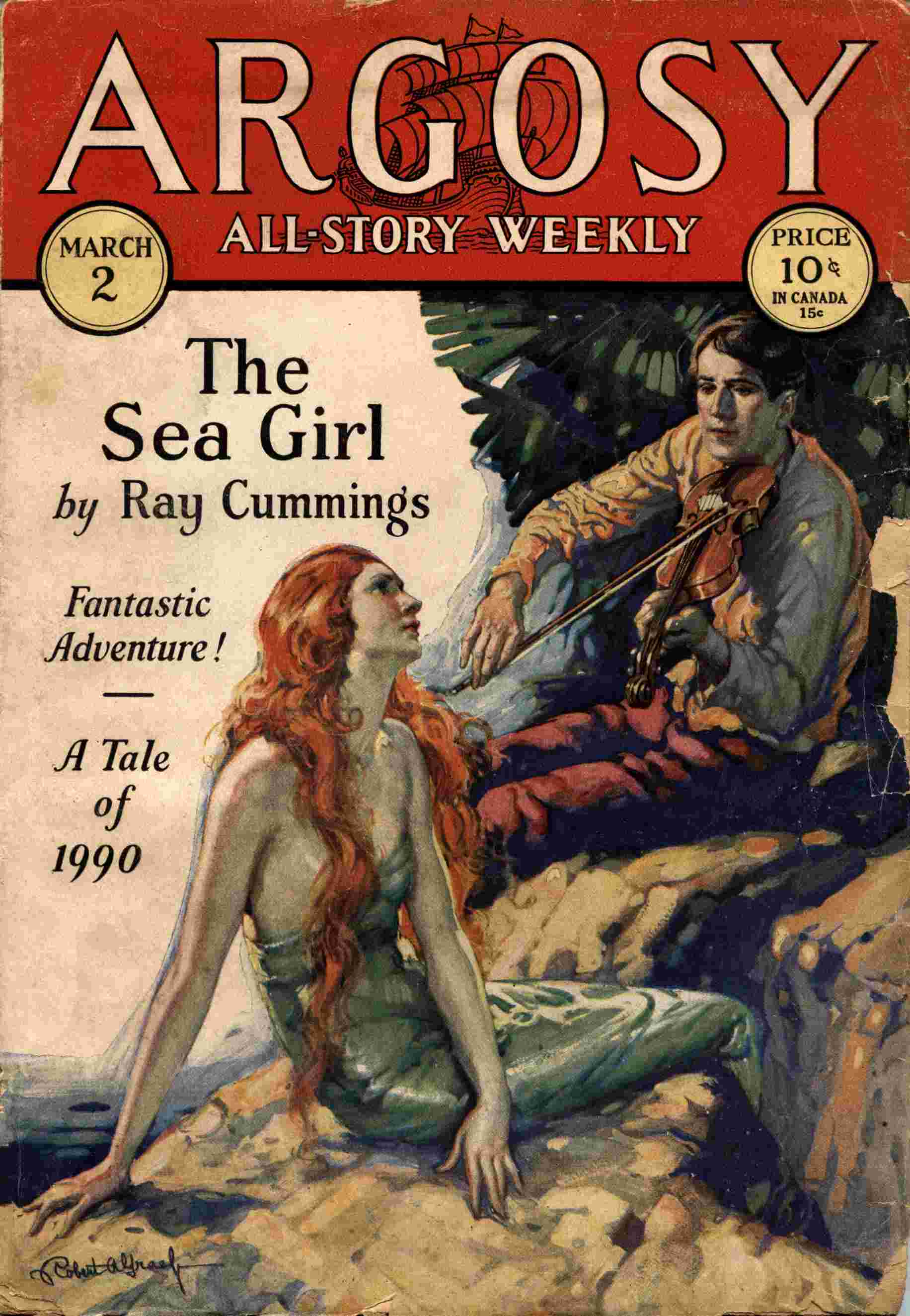
The Project Gutenberg eBook of The sea girl
Title: The sea girl
Author: Ray Cummings
Illustrator: Robert A. Graef
Release date: June 11, 2025 [eBook #76268]
Language: English
Original publication: New York, NY: The Frank A. Munsey Company, 1929
Credits: Greg Weeks, Mary Meehan & the online Distributed Proofreaders Canada team at https://www.pgdpcanada.net
The Sea Girl
By RAY CUMMINGS
Author of “A Brand New World,” “Beyond the Stars,” etc.
Sunken ships and strange ocean changes presage the mightiest and
most unaccountable threat ever made against mankind’s world.
[Transcriber’s Note: This etext was produced from
Argosy All-Story Weekly March 2, 9, 16, 23, 30, April 6, 1929]
“. . . and he lived with her in a Golden Palace at the bottom of the sea . . .”
CHAPTER I.
HUMAN GIRL, OR SIREN?
The first of the mysterious sea disasters occurred in March, 1990. It did not seem important; it was given very little publicity. A small, old-fashioned freight vessel of some thirty thousand tons sank in mid-Pacific with the loss of all on board. The ship, which in its day must have been accounted a luxurious passenger liner, had, years ago, been converted to the freight trade, and its weirdly elaborate superstructure long since dismantled. Bound from San Francisco to the Island ports and Dutch East India with a cargo of manufactured foodstuffs for the eastern island markets, it had sunk unexpectedly, and for no apparent cause, at fifteen N degrees and one hundred and sixty-five degrees E, northwest of the Marshall Group.
As it happened, I was among the first to receive the call of distress. My name is Geoffry Grant. I was twenty-two years old, that spring of 1990. They say that ours is the generation of youthful achievement; even so, I think I had done fairly well, for I was chief officer then, second in command of the largest vessel of the Sub-Pacific Freighters. Our line was newly established to supersede the ancient surface vessels whose passengers were nearly all traveling by air.
We were in fourteen degrees N and one hundred and sixty-five degrees twenty minutes E, on the return voyage, with Honolulu our next port of call, running in the thirty fathom lane, when the distress signal from so near at hand reached us. It was very nearly midnight. The surface was wholly calm; the night darkly overcast with a pallid moon. We had been up at 9 p.m. answering an emergency call from one of the great passenger liners flying west. We had hung at the surface for nearly an hour, waiting for them to come along, and another hour pumping up to them the needed fuel. My superior was disgruntled. It put us late for our connections at the Hawaiians; and with our schedule demanding fifty knots there was little chance of us making it up.
I was sitting off duty, in my cabin that midnight, listening to young Arturo Plantet drooling on his violin. He was our only passenger. A queer character, this boy; wholly different, physically and temperamentally, from myself, and yet between us there existed a real affection. I am a blond, husky six-footer. Arturo, who at this time was just turned eighteen, was shorter, and almost girlishly frail.
I once heard his father, in a moment of exasperation, call him a neurotic. He was not that; he seemed indeed always perfectly healthy, with steady normal nerves. But in this world of youthful practicality, Arturo was miscast. Apparently he cared not at all for achievement. He was a dreamer by temperament, rather than a doer. Of sharpened, poetic sensibilities, he seemed content to live in a world of fancy of his own creating, watching our busy, bustling realities pass him by. A pale, romantic-looking boy, his face beautiful rather than handsome; dark, lustrous, expressive eyes, with heavy girlish lashes; a mouth large, with sensitive girlish lips, and a shock of raven-black, wavy hair.
Yet there was nothing effeminate about Arturo Plantet. His firm chin saved him from that. His voice was soft, yet strongly masculine. I have seen his big eyes fill up with unbidden tears at a jibe from his father; but he was never petulant, and when angered or hurt, a very manly dignity sat upon him.
Nor was he lacking in a manly physical courage. He cared nothing for athletics. He could have been, I am sure, a champion swimmer—he seemed to take to the water naturally, and swam and dived like a little dolphin; but he would not train, nor enter any contests; he disdained them. But I remember that when he was fifteen, his older sister, Polly, was once endangered in the rapids of a Canadian stream. Against all reason Arturo leaped into it and saved her, with a resulting broken leg and arm.
Such was Arturo Plantet, who now sat in my cabin with his interminable violin. He was always very silent; often I wondered what fancies were drifting behind those brooding dark eyes. This ineffectual dreamer!
Yet our busy, practical world of science—so far removed from dreams—was destined soon to be plunged into a turmoil with Arturo playing a leading, if unknown and unappreciated part. Strange commentary! And I think that I am not wholly without a strain of romance myself, for it affects me strongly to look back upon it.
He glanced up at me. “That’s very pretty, Jeff, don’t you think so?”
“What? Oh, yes, I suppose so. Aren’t you going to bed, Arturo? That accursed liner—I don’t know why they can’t guard against things like that—puts us two hours late. We’ll be fully that long making Pearl Harbor. The old man’s furious.”
“Is he? I say, this is a fugue of my own invention, Jeff. Listen how I weave in the two voices.”
I rang up our chief engineer to see what he thought of the chances; it would be too bad, on this our third voyage, to be late. The London office would score us.
“Wait a minute, Arturo, shut that damn thing off—”
And then Randall came running down the passage outside. I caught his words: “The Malaysia’s sinking! We’re nearest to her—”
The old man rang my bell; I was ordered up to the control tower. Randall was telling some one in the passage: “That finishes our schedule, all right; we’ll be all night on this job.”
Arturo followed me. “What’s the Malaysia?”
“Surface vessel,” Randall called after us. “An old roamer. She’s sinking, they don’t know why. Piled to the funnels with cargo; she’ll go down like a stone. They ought to keep those old traps in the rivers—”
“Where is she?”
He told us. Less than a degree and a half away, north by west, well off our course. Already we were swinging, and mounting to the surface.
Arturo stuck to my elbow. He was always unobtrusive. The old man allowed him the run of the ship, partly because he liked the boy, and also because of Dr. Plantet’s influence and the considerable investment he had made when our line was financed.
Arturo was excited and awed. The sea held for him a curious fascination. It did for me also, but in a wholly different way. To me the sea was primarily a world of mechanisms; of mathematical charts, schedules to be maintained; a scientific business to be handled with skillful exactitude.
To Arturo it seemed still to be a world of fairy romance, or a mighty monster in its anger. To his eyes its surface still held scudding ships of ancient fashion; argosies sailing hopefully over the storm-lashed waves toward unknown shining harbors. Or, again, his fancy saw a realm of monsters, hideous, fearsome things of the deeps, coming up to frighten the sturdy mariners of old; or oceanids disporting themselves on the beaches of desert islands; sirens with soft luring voices. Or sea horses, racing the Ægean waves with the car of Poseidon. A fairy world of dreams. To him our throbbing steel mechanisms were the unrealities, the anachronisms.
He was wildly excited now at the shipwreck call. But there was nothing to see; nothing to hear. The one hurried signal that Randall had picked up was the last.
We reached the scene and cruised the surface. A litter of wreckage floating in a wan moonlight on an oily sea. We dived as far as we dared. But even under our brilliant lights there was nothing significant to be seen. The Malaysia had gone on down. We were not far from the Marshall ridge here, but there were still several thousand fathoms down to this floor of the great Pacific basin. The Malaysia had gone, and we could not follow her.
This was the first of the many queer things that happened that spring and summer of 1990. I find them difficult to set down in any logical sequence, for at the time they seemed to have no logic. There were several other unaccountable sea disasters to surface vessels. A whaler, with its attendant searching wasp planes loaded on its landing stage, was cruising south of the Aleutians, coming back to Skagway. It never reached there—never was heard from again. As though in the old days, before any of the aërial or underwater communications were perfected, it merely vanished.
Again, there was another old roamer like the Malaysia. It was at fifteen degrees N, south of the Hawaiians. It sent out one startled call: “Sinking—no reason.” It was gone before help could reach it. And, like the Malaysia, none of its lifeboats were found, no life rafts; none of its safety devices put to any use; no single person found alive or dead upon the scene of its sinking.
There was at first little newspaper or radio comment. The public news organizations were engrossed with the “Yellow Peril” complications. The Yellow War, so recently passed, had its aftermath of bitterness, mingled with the cupidity which was rapidly forcing a renewal of commerce. The “mysterious sea disasters” passed with a cursory comment.
The air lines made more of them. In April, the great Trans-Pacific Aircraft Corporation began a broadcasted inquiry into the dangers of ocean travel. It was propaganda solely; and suddenly several of the world governments shut down upon it.
The subject, quite naturally, was of vital interest to our company. There were two vessels lost in March; two in April; and in May no less than six. All surface ships, slow, old-fashioned freighters, food-laden. And, what interested us most, all were lost in the Pacific, or its fringing seas.
By this time there would normally have been a very great world comment. I wondered why there was not, and did not dream until afterward that by April the whole subject was under strict government censorship, with all publicity forbidden.
By May, the surface lines were gradually withholding their Pacific sailings. Our line was rushed, overloaded with business. There was, with us, considerable official perturbation. I knew it, though we were strictly forbidden aboard ship to mention it. Our directors were frightened, especially when Lloyds and the Amalgamated Marine Underwriters raised our insurance, though as yet no submersible anywhere had met with disaster, or even with any unusual occurrence.
And then, in June, one of our largest vessels, sister ship of the one on which I had my post, left Guam and, apparently, headed into the Nero Deep and stayed there! It brought consternation to us all. I was ashore at the time, visiting Dr. Plantet with Arturo and Polly in their home on the Maine coast. A radio came to me from our New York office; my ship would sail once more, and then be laid up until further notice.
With these events from March to June, there were intermingled throughout the world a hundred others which afterward I was to realize as significant. But they did not seem so at the time.
An unusual volcanic activity was reported almost simultaneously from several different quarters. Etna burst forth with a cloud of steam; harmless; unexplained—a puzzle to the scientists. Fuji, so long dormant, began rumbling, threw Japan into a panic, flung up a cloud of smoke and gas which whitened into steam. The craters of the Hawaiians were everywhere steaming. The geysers of Western America were abnormally powerful in their action; the New Zealand hot springs were suddenly, unnaturally active.
An earthquake occurred under the mid-Atlantic; a wave of tidal proportions inundated the coasts of Africa and the Americas.
Scores of such reports following one upon the heels of the other from widely scattered localities indicated a general, unexplainable disturbance of nature. A wind storm out of season; rainfall in another quarter, unduly severe. Rivers were too high, or abnormally low. And the tides were wrong; countless small news dispatches, even back at the beginning of 1990, mentioned the surprising abnormality of local tides.
None of it was significant of anything; like a puzzle wherein one fits together odd pieces, with the key piece missing. The tides, they said—I quote the words of one popular newscaster of scientific matters: “The tides are all wrong. The moon must have become a lunatic. The astronomers had better look into the matter.”
The tides, if one cared to summarize all the various conflicting reports, were everywhere disturbed; too high a flow; too low an ebb. Everywhere they were growing steadily lower. Harbors and channels were losing depth. Reefs and bars and harbor shoals, which last year were covered at high water, this year were never covered. High tides everywhere were not quite high enough, while low tides, all over the world, were breaking all previous records.
By June there was much comment on this. Most of it, outside of shipping circles, was jocular. What of it? The age of air was upon us; who cared what the water was doing, except possibly the fishermen?
Had there been no censorship, authentic scientific analysis of conditions would very soon have stopped all levity. It did stop, on July 18, when Dr. Plantet prevailed upon the world governments to make the matter fully public.
That last voyage of mine in June was without incident, save one. It was witnessed only by myself and Arturo; one occurrence, most significant of all that had preceded it. Arturo had made half a dozen voyages with me. He loved the sea. He would have none of air travel, nor surface sailing; but the sub-sea seemed to hold a lure for him. Hours at a time he would sit by my elbow at the tower window, gazing forward into the glow of our headlight.
I wondered why Dr. Plantet let him go on this last voyage, which, at best, seemed hazardous. I was not present in their Maine coast home when Arturo parted from his father and Polly; but when he and I left the Continental Air-Liner at San Francisco and boarded my ship, Arturo made one comment:
“Father wants me to stay in the tower with you all I can, Jeff. He is fearfully interested in this thing—how much so, well you’ll know when we get back. He’s worried; so very busy!”
I too had seen a change in Dr. Plantet these last months; a harassed look, a gray, haggard aspect of worry, or perhaps overwork. Though what he, a retired surgeon of forty-five, a student of oceanography as his chosen hobby, would be working at, I could no more than guess.
Arturo knew, perhaps, but beyond that one comment he said nothing of it to me. He was more silent than ever, this voyage. A grim, intent eagerness seemed possessing him. A dark flush was on his usually pale cheeks. A trembling eagerness it was. It showed itself in his smoldering dark eyes; a quiver in his voice, so that any one who did not know, might have thought that fear was upon him.
He sat with me throughout every watch, peering into the white headlight beam. Green depths of water surged at us; a fish occasionally surprised by our light, darted away. So little to see, and nothing out of the ordinary.
Nothing—until that night in Micronesia, west of the Marshalls. We were, I think, about ten degrees N., one hundred and fifty-eight degrees E.—it had been some hours since I had checked our exact position. Arturo and I were at the forward tower bull’s-eye. Nothing to see save green speeding water. And then, abruptly, it flashed at us—a dim, illumined something in the ocean far ahead, flashing forward as we sped seemingly directly at it.
Arturo gripped me. “Jeff!”
The lookout’s voice in the bow-hood sounded simultaneously from the speaker beside us.
“Danger ahead.”
And a duplicate of the engine-room bells, and automatic warnings to the control operators sounded. In the mirror overhead I saw reflected the startled faces of the two men in the control tower; saw them throwing over the wheels.
We turned to port and slanted upward to the surface; so sudden a change that the ship listed perceptibly. An instant only. The whole thing was so swift at our fifty knot speed that in an instant the hovering thing had come—and passed. But we saw it, the vision of it distinctly registered upon our startled minds.
A dim, illumined something far ahead of us, glowing as the bow light picked it up. It grew, in seconds, to something round: a globe twenty feet in diameter perhaps. Metallic? I think so. It glowed darkly luminous and smooth in our light. A globular thing, with projections as though it might have been some monster sea-spider, risen from the deeps, resting up here near the surface with crooked, folded legs.
I recall my instant, fleeting impressions. A thing solid, metallic, mechanical. A lurking thing of a strange, sinister aspect—a thing diabolical. It flashed off sidewise and down as we turned, a darkly shining globe with a great round white spot on it like an eye!
Arturo showed unexpected presence of mind. He reached with one hand for the telescope range-finder; and with the other for a stern searchlight, and trained them both upon the fleeing object now passing under our keel.
“Jeff, look!”
The telescope image showed for an instant in the mirror on a shelf before us as Arturo flung on the current. An enlarged image of a convex window, like glass, transparent with a dim green light behind it. A face was there at the window. Human? I do not know. But it showed in that momentary impression the face of a young girl. Lurid, ghastly with the green glow upon it. Beautiful? Perhaps that. Or weird, unearthly. I recall the intent staring eyes, the parted lips, as though with labored, frightened breathing. A startled face, framed in a tangle of tresses. But it was more than just startled. Those staring green eyes! I met them full, in the mirror.
For an instant he saw the strange face in the mirror.
And the light from them struck at me with a shudder and a lure.
An instant. Then the face, the image in our mirror, was gone. I reached up and snapped off the current. My fingers were trembling.
Arturo murmured, “Oh.”
He was sitting very still, staring blankly as though the vision of that face was still before him.
CHAPTER II.
“COMING UP, FROM UNDER THE SEA!”
The lookouts had seen the globe; even the old man, on his emergency mirrors in his cabin, had caught a brief glimpse of it. He stopped us at the surface. There was nothing up there; a calm, empty moonlit tropic sea, with nothing in sight except the lights of a distant passing liner ten thousand feet or so overhead.
We dived, and cruised around, from fifty fathoms to the surface. But there was nothing to be seen.
I think that none but Arturo and myself had caught the vision of that girl’s face. We did not mention it. Arturo pleaded earnestly:
“Don’t, Jeff. Father would rather you did not, I’m sure. We’ll tell him, let him inform the proper authorities.”
I was determined, in the interests of my superiors, that our director-general should know as soon as I reached New York. But that was no reason for spreading it aboard ship.
It was the only abnormal incident of that last voyage. Naturally it left me wondering, as if here were the key-piece to all these scattered happenings.
A thousand vague conjectures, romantic, fearsome, surged within me. Ships drawn under. Ships, always food-laden. And queerly hovering in my mind was the persisting crazy impression of that girl’s tangled tresses—like seaweed. I found myself waking up one night from a dream. A girl with glowing green eyes, and tangled flowing tresses like seaweed, was singing softly; and the song swept me with a trembling desire.
Arturo was more silent than ever for the rest of the voyage. I tried to discuss the thing with him. He shut me up sharply.
“Father will want to see us. You can talk about it then.”
We were on time picking up the channel lights of our home port. Following close along the bottom, we cruised in between the two beacons of the twenty-fathom depth. The old man was beside me. He gestured toward our beacon chart.
“Those lights, Jeff, are at twenty fathoms, low tide. You and I know it as well as we know our names. But look at them!”
We were passing level with the caisson. Twenty fathoms! This was low tide now, and it did not need the special danger bulletins which had been flashed to us at every port all the way from Java, to warn us that something was wrong. Twenty fathoms? There were barely ten!
Arturo and I transshipped to the continental passenger liner; and again at New York we took the Rekjavik Local Mail, with first stop at Portland. Polly met us at the Portland landing stage.
“I’ve our plane here. Come on.” She kissed Arturo and gave me her hand. “You’re safe! We’ve been rather worried, until we got your landing message.”
Arturo’s sister was a year older than he—at this time, nineteen. As different from Arturo as a sister well could be. She was a practical little person; there was nothing of the ineffectual dreamer about Polly Plantet. They were distant relatives of mine, and I had known Polly since she was ten. We called her then, “Roly Poly”; a chunky little girl, with a round moon-face and long chestnut curls. I recall how she hated the nickname; but, instead of crying, she dashed at us boys, fighting us with flailing little fists.
At nineteen her “moon-face” had lengthened; but it was still solidly practical.
Her figure was not chunky now, but even the most lavish flatterer would never have called her willowy. A solidly wholesome, determined little thing this Polly Plantet. Quiet of demeanor, purposeful, yet withal tempered by a feminine softness. In stature she was something around five feet. Vigorously healthy, she seemed to me the very personification of healthy, normal young womanhood.
Dr. Plantet’s wife had died when Arturo still was in infancy. They had lived then in Martinique, where the children were born. A mixed heritage: Dr. Plantet Anglo-Saxon—his wife Latin, with both French and Spanish mingled in her. Polly was so like her father that one could never mistake them, while Arturo was romantically Latin.
Motherless, Arturo had found in Polly almost a mother. Dr. Plantet was by nature intolerant of human failings, or so at least it always seemed to me. He did not understand his son, and to Polly went, if not his greatest love, certainly all the understanding comradeship of their daily life.
But Polly understood her brother. The essential, womanly softness of the girl’s nature showed at its best with Arturo. Only a year older in age, she was vastly older in maturity. She was at once, to him, a sister and a mother; and a buffer between him and his father.
A little diplomat, Polly knew when to lead, rather than drive. No one could drive Dr. Plantet; nor Arturo either, for that matter—it was almost the only quality which he and his father had in common. Yet they loved each other deeply, of that I am sure.
Polly led us from the Portland landing stage, down the spider incline of moving pedestrian lanes to the lower stage where the private vehicles were stalled. Our luggage had preceded us in the chutes.
“We’ve been worried, Jeff. A hundred times father regretted letting Arturo go.”
“Well, I went,” said Arturo.
“Yes, boy dear—you went. It was foolhardy; Jeff’s directors should never have taken the chance.”
We climbed into the small plane which Polly had brought; the guards shot us off. It was 1 a.m. of the night of July 15-16. A warm, flawless night of brilliant stars, with the last quarter moon not yet risen. We darted up from the clanking Portland terminal like a humming wasp, and headed northeast along the coast.
I went back to Polly’s last remark. “There seemed no danger, Polly; we saw nothing unusual. Except—”
I glanced at Arturo.
“I’ll tell her,” he said. He told her. Simply, unemotionally—with so queer a lack of emotion that it seemed a mask. She made no comment. She, too, seemed abnormally restrained. And upon us all presently descended a silence; to me, an oppression—a sense of fear. Yet it was not exactly that either; rather the feeling of something strange crowding about us, something unknown.
These queer world events; this impending something—unnatural, uncanny—crowding us now, making us silent as though we feared to hear the voicing of our own thoughts. There were millions of people in the world these days who laughed and scoffed and thought it a jest that the tides were wrong, and vessels were disappearing; and who would have said, had we told them we had seen a girl’s face within a globe floating in the ocean depths, that we were drunk, or dreaming that Homer had come to life again with modern trimmings.
But there were others, I am sure, millions of them, who felt uneasy, with panic hovering at hand. Like the presage of a fearsome, unseen storm below the horizon, there was something in the air all over the world. Crowding at us—something very strange, perhaps diabolical.
And it had marked Dr. Plantet. I could see that at once, this night, far more clearly than the previous month, by his harassed, almost haggard look; the surprising and, in him, unnatural, warmth and tenderness of greeting as he put an arm about Arturo’s shoulders and welcomed him home; his solemn, almost grim manner as he listened to what we had seen, there under the water in Micronesia.
He turned to me:
“I’ve something to tell you, Jeff. Arturo and Polly understand a good deal of it, but not all. It is clear now, this thing we’ve got to face. I’ve persuaded the authorities to make it public.
“The world must know—must face it. We cannot be ostriches with our heads buried in the sand. Polly, have Frantzen carry down the luggage and run in the plane; and then bring us out some lunch. We’ll sit out here. It’s too hot inside.”
We sat in a small stone bower on the shore front, with the stars over us, banks of flowers and ferns heaped around us; and, ahead, the open sea. The moon was just rising over the distant ocean horizon—a flattened, spoon-shaped crescent, hugely yellow. It flung a golden path toward us over the lazy, breathing sea. A strip of beach, golden in the moonlight, lay at our feet, with grim frowning rocks and headlands to the sides.
Nature as it used to be! There were no aërials in sight here, no landing stages; nothing of our modernity to remind one of a world mechanical with trees and grass and the moon almost forgotten. Yet even so, at our feet the disturbed world of 1990 obtruded. The strip of beach was naked of water; it sloped out and down to a rocky, slimy shelf, plunged steeply another twenty feet down to where the fallen ocean lapped at it. And in the moonlight the outer rocks and headlands stood queerly high, misshaped of aspect.
To me, with the oppression of spirit upon me, the sight was suddenly ugly—huge darkened teeth upstanding with gums receded to expose the spreading roots!
Dr. Plantet had been talking quietly. Now, indeed, I understood in a measure what he had been through these past weeks. A man, still vigorously young in his forties, though to-night one would have said he was fully fifty or more. He was a vigorous, stocky figure of a man; rather short, exceedingly muscular, with wide shoulders and a deep chest. A solid face, smooth-shaved, with deep-set gray eyes, and sparse brown hair graying at the temples. It was a kindly face. There was much to like in Dr. Plantet if one did not oppose him. But it was a stern face; harsh when stirred to anger.
At forty, wealthy by inheritance, he had given up his career of surgeon at the height of his national fame. He had always loved the sea; in his student twenties he had served as surgeon on one of the last of the old-fashioned passenger ships. Oceanography had always been his hobby; to explore the ocean depths was one of his dreams. Illogical in his intolerance of Arturo? I always thought so; indeed, I had once heard Polly tell him so, in Arturo’s absence. But she could not make him see it.
He told us now what he had been doing these past weeks. Consulting with the scientists of the world governments; analyzing the conflicting world reports.
Ah, so much had happened, kept from all publicity! A huge secret meeting of scientists from all the world governments had been held last week in London. Dr. Plantet had been there. This thing that had been growing upon them all for weeks, now was obvious. The world would have to be told, and preparations made to meet the new conditions—to fight!
Dr. Plantet, essentially the fighter, must have played a leading part in this final discussion, forcing them to his views. It was growing upon me gradually as he talked. The strangeness of it, the strange, weird fear of it.
“Fight—what?” I ventured. I glanced at Arturo, a slim young figure in white, with flowing white sleeves. He sat, chin cupped in his hands, with knees hunched up; in his intent white face, his dark dreaming eyes were gazing off at the rising moon. He seemed not to be thinking of his father’s words, but dreaming dreams of his own.
I repeated, “Fight—what, Dr. Plantet?”
From the house Polly came breathless, bearing the tray of refreshments.
“The newscaster from Melbourne has been on the air—I’ve been listening to him. Father, they keep on making a joke of it! They’ve seen a mermaid on a desert island beach in Micronesia!”
Arturo turned silently. Dr. Plantet said: “Did they give the position? What sort of mermaid? Who reported it?”
“Yes; they gave an island at nine degrees thirty minutes N, one hundred and fifty-seven degrees twenty-five minutes E. I looked it up. There’s an unnamed island there, the tiniest of dots on the chart. Uninhabited—an atoll I imagine, of a few acres.”
Dr. Plantet took some of the food; but I noticed that his hand was unsteady. Arturo gestured the tray away and sat brooding.
Polly was saying: “A mermaid! A passing fishing roamer saw it at dawn a week ago. They didn’t speak of it officially on the air, but yesterday, when they got back to Suva, the sailors told of it. A mermaid, sitting on the coral beach before the dawn, braiding her seaweed hair! They saw her, from miles away with the glasses. The ship had no electric image-finders. But they saw her sitting there. And some of the sailors swear that in the silence of the dawn they could hear her singing, but that’s nonsense. I suppose the master had official instructions to avoid such a thing, so he kept on going and did not land. The sailors, some of them, were frightened. But others wanted to land and capture the mermaid. Can you imagine—superstitious ignorant men in this day and age!”
She was breathlessly excited. A mermaid, on a desert, south sea beach, sitting braiding her seaweed hair, singing to the sailors of a passing ship. The world was laughing at the tale.
Arturo said, very quietly: “You’d better tell us, father, what is going to be done. Jeff doesn’t understand fully yet.”
The tray of food stood neglected. Dr. Plantet lighted a cigarette and sat back apparently relaxed. He spoke quietly, at first precisely, as though carefully choosing his words to my understanding; but there was in his voice a grim sense of power, and his burning eyes clung steadily to my face.
“Jeff, this is no new thing to me. This culmination is, I grant; I had never thought of actually living to see it. But the possibility. Jeff, for years I have been studying what, in popular language, they call ‘our unknown earth.’ What lies within our globe. Beneath the surface of our seas, that we know. But deeper still—beyond, beneath the ocean bottom—then what? Some six miles it is, Jeff, from the summit of Mount Everest to the ocean level. And another six miles to the abyss of the Nero Deep. Twelve miles or so. What is that? Our globe has eight thousand miles of interior. We humans have brought a scant twelve miles within our ken. Twelve miles out of eight thousand. Infinitesimal. It sounds incredible—but it is true. And yet some of us think we know something about our world. We do not—for most of it is as unknown to us as the moon.
“These vast oceans, this hydrosphere of ours, embraces nearly three-quarters of the earth’s surface. You know its mean depth is not much over two miles. We think of these oceans as tremendous—this gigantic layer of water, so enormous of volume. It is not. On an orange it would represent an uneven skin thin as tissue paper. Compared to the wholly unknown interior volume of our earth, that’s all it is—a film-layer of water, like tissue paper on an orange. Insects, crawling on the tissue wrapping—what do they know of the orange?”
He gestured again. “You see what I’m getting at, Jeff? Our oceans are receding. The volume of water in them, compared to the volume of the earth, is very small. It is receding—vanishing. But where could it go? The last geodetic survey, Jeff, was startling. It helped to show enormous errors in several physical facts about the earth which for a century have been accepted as true. Yet, for twenty years now, astronomers and physicists have known that the calculated density of our earth does not check, within the limits of a tremendous probable error, with the earth’s volume, or its mass, or its gravitational force.
“Something is wrong. All the figures, when one set of calculations is checked against another, seem wrong. We know it. And, as I pointed out to them in London last week—with present-day facts to prove it—the Granthin-Morley theories of 1960, scoffed at as they were, hit the truth. If our earth were a wholly solid globe, or nearly so as we have chosen to consider it, with a liquid core of molten rock perhaps—if it were that, with the volume as we know it to be, its total mass would be far greater than our figures show. But the mass we know to be a true figure. The calculated total volume is correct. The gravitational force cannot be questioned. What then is wrong? The density! One-tenth of our globe’s volume, at the very least, must be empty space! A honeycomb perhaps.”
Dr. Plantet sat up abruptly. “Jeff, there is in Holland a fellow named De Boer. He is, I think, the most eminent geologist we have to-day. He stood up last week and told them that our outer core, from the surface of the earth to a depth of a hundred miles, must be honeycombed. And Dr. Jaeger, of the Hawaiian Research Bureau of Vulcanology, supported him. Ah, now you are beginning to understand, Jeff!”
I was, indeed! This thing, so strange! Yet so logical, inevitable, that I could wonder how in all these æons of our earth’s history it had never happened before.
I ventured, “The oceans are receding—”
“Yes. Not a question of tides—no tiny disturbed fluctuations. A general receding. There are nearly ten fathoms gone now—half of it within the last week. Pearl Harbor is nearly empty, since you left it! A narrow channel, nothing more. Did you get a look at New York harbor? And here at our feet—The whole world is wondering, Jeff. But they are keeping it off the air, and out of the newsprints. The people think—most of those who have the intelligence to think at all—that it must be local. These crazy tides!”
He waved away that angle of it with a gesture. “Where is the water going? We do not know, but we can imagine. This tissue paper layer of water is receding doubtless into the vast honeycombed interior of our hundred-mile core. They’ll say, ‘Why, this is very strange. It never happened before, why should it happen now?’”
His voice was edged with sarcasm. “How do we know it never happened before? Our little human knowledge embraces a few thousand years out of the hundreds of millions of our globe’s life history. Indeed, we do know that the ocean level has never stayed the same. Perhaps, over æons of time, the oceans rise and fall—empty and refill like a shallow cove with its tides. And this is only the same thing done suddenly. An earthquake, early this year perhaps, at the bottom of one of our ocean basins, opened a rift to let the water down. Dr. Jaeger thinks it may possibly have been that—the seismographic records show three such disturbances last winter. Whatever it is, the fact is here upon us. The public is going to be told, to-morrow or the next day. The oceans are emptying of water! It may stop any day. Or it may go on—completely to empty them! It may take years—centuries. Or it may continue quickly, more quickly than ever, until all the ocean beds are dry!”
He did not pause; he smiled his ironic smile. “The public will be thrilled! But not when they stop to think about it. The newscasters will picture the great new realm of land. Three times as much land as we already know. Geography suddenly expanded. A rolling desert of lowlands from New York to London! Mountains and valleys down there. Land, sloping down from the heights of New York—over the new desert regions we have called the North Atlantic, up again to the heights which were the British Isles. It will be so thrilling! What wonders may be exposed. Ah, but they won’t be so joyfully thrilled when the reality comes.
“I heard last week a score of meteorologists give an opinion—and not one of them could agree on what it will do to us! What change to our rainfall? Our springs? Our fresh-water supply? Dr. Jaeger stood on the rostrum; and we asked him what might happen. At this present moment the pit of Kilauea, Mauna Loa, Haleakala—all of them out there—are throwing up steam instead of lava and rock. The volcanic disturbance seems greatest in the Pacific—Etna is quiet to-day. We asked Jaeger if that would continue. Or grow worse. Would there be devastating earthquakes? He answered us very simply. The words of a truly great man, Jeff. He said: ‘I do not know.’”
There was a brief silence. Arturo had not moved; he still sat moodily staring over the moonlit, fallen ocean. Polly sat breathless, with parted lips, her eyes upon her father. Her hand touched his knee.
“You do not mention the most serious thing of it all, father.”
The questions had been trembling within me. The ships that disappeared; this thing we had seen in the ocean; this mermaid they said they had seen on a South Sea beach.
Dr. Plantet’s voice took a graver tone. “Ah, that!” He turned from Polly, to me. “Jeff, we humans, as we call ourselves, have been living for a few thousand years out of millions of centuries. We occupy and know only a tiny fraction of our globe. Yet we have the temerity to assume that what we do not see, does not exist. Other beings are here—human of form, like ourselves. They do exist! Doubtless in the last few thousand years since we came—from them perhaps—to inhabit the surface, they have forgotten us. But now they have remembered—discovered us.”
His voice took on a sudden vehemence. “This is theory, speculation—call it what you will. But they couldn’t face me down in London—there is too much evidence. It’s nothing new to me, Jeff; I’ve always been speculating on it. Do you suppose that all the legends of our primitive peoples are founded upon nothing? It is not reasonable. From whence sprang the idea of a world of gods? Supermen. Beautiful women. The oceanids? Sea-nymphs—mermaids—beautiful sea-maidens because that was our human sex instinct to picture them that way. The gods—Titans—the personification of beautiful, virile manhood—that, the picture of them, was a human instinct, too, the outlet of primitive fancies, half fearful, half poetic.
“But from whence came the basis of it? All legends of every one of our ancient peoples—all of them picture unknown beings, here with us upon our earth. Too universal to be a coincidence! Some of us say: ‘Why, those ignorant ancients saw the dugongs, with breasts like women, and called them women of the sea! Or saw seals, and thought them mermaids.’ It may be so—but it hardly explains so universal a similarity of legends.
“For myself, I prefer to think that throughout the ages, this other race, this other civilization, has made occasional contact with ours. Perhaps their own legends tell of a great ethereal world of brightness with strange men like gods. Occasional, inevitable contact. You and Arturo saw what? A mermaid? If you had lived a few thousand years ago you might have built a legend around her—and sung some immortal song in her praise. Ah, Jeff, we have not advanced very far! They saw a mermaid on a beach in Micronesia last week; and if we let them alone—though this is 1990, Jeff—the newscasters would presently blaze out with doggerel verse about her. Where is the difference?”
My head was whirling with it. Not his sarcastic gibes—but this thing, incredible, but proved by every detail of what had already happened. Facts not to be denied. Diversified happenings, so reasonless until the key piece was supplied! Ships drawn under. Ships, always food-laden.
Dr. Plantet was saying: “They’re coming out, Jeff, these people of our vague legends. I conceive possibly—and Jaeger and De Boer agreed with me—that this sudden subterranean outlet of our oceans is not necessarily from a natural disturbance. Perhaps these other humans—they must at least be human, our ancestors perhaps, and I think probably more advanced than ourselves—perhaps they have found the water a barrier and have planned to drain it away.
“There is a clear connection in every fact we have observed, Jeff. They are under the Pacific Ocean undoubtedly. Coming up to steal our ships for the food they contain! They have done that. But what worse will they do? Come up when the water is drained, and attack us? I think so. I think even now they may be coming, with what strange devices to conquer the ocean depths—and to conquer us—we can only guess. Coming up to conquer for their own uses the bright ethereal realm of their legends! I believe that is what is going on down there now! And we must prepare for it. I’ve told our governments so, and they see that it is a fact. The world public will know it by day after to-morrow. The strangest danger that ever has threatened us. No use trying to avoid it. No sense in trying to explain away facts which nothing else can explain. You can’t say ‘This is too strange, it cannot happen.’ That’s childish, because it is happening. The greatest menace in our history is upon us!”
CHAPTER III.
TWO THOUSAND FATHOMS!
I find it difficult to convey a picture of those following days. Upon so large a canvas as our great, diversified world surface, the few futile strokes I can give must leave most of all to the imagination. What fragments came within my limited knowledge I can tell as they recur to me. No one could grasp it as a whole, except those in authority, flanked with their busy scientific staffs, poring over endless reports, charts, summaries of world conditions and the myriad of diversified world happenings—abnormal, startling, fearful some of them; wide-flung events seemingly so unrelated, but each making up its tiny portion of the whole.
We got them there in Dr. Plantet’s home at Sea End hourly from the newscasters. Ten fathoms of water gone from the oceans, harbors dry, rivers tumbling down new waterfalls where once had been the river’s mouth. A hundred local items of emptied water fronts, fishing vessels stranded in the harbor mud, canals being closed everywhere to traffic.
A lurid, dramatic broadcasted advertisement by the Associated Bureau of World Air Commerce: “Schedules changed to meet new conditions. Air lines to the rescue! Stranded island and coast ports to be given air traffic. A thousand new local ships to be commissioned at once.” An ad by the great Dayton builders, requiring additional men for the night shifts.
Hundreds of such things. Newscasters by the hour recited dry statistics of harbor depths, local climate changes, routine weather reports, a learned, somewhat pessimistic summary of the world’s fresh water supplies. A company organized to drill, wholesale, for artesian wells. A panic in the hot spring area of New Zealand. A spouting geyser reported bursting into existence in the Soudan desert. Etna and Vesuvius quiet—the Pacific volcanoes all spouting steam.
The newscaster’s voice came day and night from our receiving grid. The tape clicked beside it, an endless stream of recorded events.
An exodus of people from the Gaspé fishing region; signs of a growing tendency to panic throughout all the South Seas; a Japanese mandate that none must travel from one island to another; an iceberg coming down far below the normal summer limit of drift in the North Pacific; ocean currents disturbed; a prognostication of what the new rainfall might be in various localities.
“Rot!” snorted Dr. Plantet. “They do not know—there is no one who knows anything about it!”
The British Isles were perturbed. There was much learned discussion concerning the Gulf Stream. Without it the cold of an almost Arctic winter would settle upon London. They had always been perturbed over the precious Gulf Stream, these Britishers. I recall reading that three-quarters of a century ago some of them had been bothered by the Yankee railroad from Florida to Key West. And when the additional road causeways were completed there was more British comment, claiming that the Gulf Stream was influenced adversely to effect the mild British winters. Nonsense, of course. But they had real cause now to be worried.
With my company giving me definite leave, I was free these days to remain with the Plantets. Dr. Plantet seemed to want me. He hinted that he would need me for some rôle in this world drama that I might play to advantage. He no more than hinted at it; but I waited, eagerly to welcome it.
We spent most of our time at the air speakers. Polly was excited, tense with it all. Arturo said almost nothing. I was too engrossed at the time to remark him closely. But I recall that queer aspect of brooding; an absorption in his own queer thoughts; a moodiness. He seemed, often, to want solitude.
I would miss him from the instrument room, finding him perhaps sitting on the shore front, where, far out on a slimy, descending slope, the ocean lapped a full seventy feet from where it should have been. A graceful, slim figure of a boy with gentility stamped in every line of him; a romantic little figure, like Raleigh, the boy, Sir Walter, sitting at the ocean’s edge, brooding, dreaming his own dreams with the lure of the sea upon him.
Looking back upon it the comparison strikes me. But at the time I recall I was annoyed with Arturo. He impressed me as rather sullen—a spoiled, sullen boy. Dr. Plantet had one evening said something with an edge to it—some trivial thing, unimportant; and Arturo had flushed with a deep, angry flush—and with quivering lip, had left the house. It was hours before he returned.
We had had numerous world reports that evening of vital interest—especially to any normal young man. But Arturo barely glanced at the printed tape lying in the basket; and wholly without interest sat in a shadowed corner of the room. It hurt Dr. Plantet—himself so actively plunged now into this coming crisis of the world’s history—hurt him that he should sire a son like this.
My picture seems confused. In that quality it approximates the reality, for these days of July, 1990, were indeed a confusion.
Dr. Plantet was away for a day several times. Always, while at home, for hours at a time he was shut up alone in the instrument room, talking to New York or London; consulting. A stream of incoming official calls demanded him. I heard him once when he had left the audible speaker connected—heard him being questioned regarding the progress of his ship; and he had replied that already the successful casting had been made in the Norfolk shops.
I demanded of Polly what that meant.
“He’ll tell you presently, Jeff. You—look here, Jeff, that reminds me.” She put her hands up to my shoulders, holding me to face her. Dear little Polly, so earnest! Her brown eyes were glowing with her earnestness. “Jeff, when father tells you, I want you to persuade him that I am in it, too. You will, won’t you?”
“In what, Polly?”
“He’ll tell you. He, and you of course, and Arturo—but also myself! There are to be four—I heard him say that. And I want to be the fourth.”
I answered her seriously, as I knew she desired. “I can’t promise that, Polly, until I know what it is.”
It was nearly the end of July before Dr. Plantet told me of his plans. During all these July days of confusion there had been no further sign of any human enemy menacing our world. Surface traffic by sea had everywhere been discontinued nor were any submersibles in service. The oceans were abandoned, while a tremendous activity on the part of all aircraft organizations was manifest everywhere.
No sign of an enemy. There had been minor panics among the publics of the Eastern Islands; but the fear there was gradually waning. And in the Western world, comparatively remote from the scene of the threat, the idea of a human enemy whom no one had ever seen, was derided. It was best perhaps. There is nothing more dangerous than panic.
But officially there was no derision. Official activities were more or less secret; rumors of them leaked out, of course, while bulletins distorted the facts to what officialdom considered was for the public good. But through Dr. Plantet’s activities I was made aware of much that was going on. The “Yellow Peril” was lost and forgotten. All the world’s governments were working together. The huge armored aircrafts were being recommissioned. Men were being drilled. The Yellow War, with all its main battles fought in the air, had given a tremendous stimulus to aviation, and all the devices which it had developed for dealing death were being made ready anew.
Underocean warfare was a thing of the distant past. But that, too, was being resuscitated. I heard that they were building armored submersibles. A Brazilian engineer, one Lopez, came suddenly into prominence with his claim for an underwater death-dealing ray.
They brought forth from the United States Navy Yard shops, new models of the ancient ocean bombs, called mines—things that could be electrically exploded. And tiny traveling bomb-ships called torpedoes.
One of these latter was tested off Hatteras. In Dr. Plantet’s instrument room we sat watching the test as it showed on one of his receiving mirrors. It was broadcasted over the world—I suppose fifty million or more people must have been watching it as we were. We had a good view; they had the finder on a small plane which circled back and forth. We saw the small submersible, awash at the surface, shoot out the torpedo. It came up like a child’s toy, and then dived a few feet. It traveled swiftly; we could follow its progress by the tiny aërial projecting up from it, cleaving the surface like the periscope of an old-fashioned sub-marine. It sped straight for its target—a small vessel they had towed out and left drifting. There was a dull, muffled report—we heard it plainly over the audiphone—and a heave of the water. The small ship presently sank.
It seemed rather a futile demonstration. But there were rumors of the Lopez ray—and diving bombs which aircraft could drop from a considerable height.
A multitude of official activities. Dr. Plantet was concerned with many of them—but mostly with this enterprise of his own at Norfolk. He was almost without sleep. Far into the night he would sit over charts, or blue prints—or casting up seemingly endless mathematic formulæ. And several times engineers came from Norfolk to see him, frequently taking him back with them.
On July 29 he chose to tell me what he was doing.
“Come into the library, Jeff.” It was after midnight, and he had just returned from a swift visit to Norfolk. “Come into the library, you and Polly. Where is Arturo?”
The soft, plaintive notes of Arturo’s violin from his bedroom upstairs told us only too surely.
A shadow crossed Dr. Plantet’s tired face; but his muttered contemptuous oath was vigorous enough. He said brusquely:
“Very well—let him alone, Jeff. He probably isn’t interested.”
Polly had joined us. “He is, father—I’ll get him.”
I heard her voice when she got up the incline:
“Arturo! Father is back—it’s successful—they’ve tried the hull under pressure! Boy, dear—”
The door closed upon her; but she came down presently with Arturo. I had not seen him all day.
“Hola, Jeff!” He smiled at me. “Good evening, father.” He kissed his father—I had not seen him do it for a year. “Polly says it is a success—I’m very glad, father, dear.”
I did not miss Dr. Plantet’s gesture as Arturo kissed him; nor mistake it. His powerful hands on Arturo’s slim shoulders seemed involuntarily to tighten; a caress—and it seemed a gesture of possession, as though this son, drifting away in spirit, were suddenly restored to him. A stern, vigorous man, cruel sometimes in his sternness; but I could see at that instant the love that he bore for his son—could see it in his convulsive, clinging gesture, as if he feared that Arturo, who had come to him now, might soon be snatched away.
It may have been a premonition.
“Yes, lad, a success. Come into the library—I’ll tell you all about it.”
We went in. I sat listening to Dr. Plantet. But for a time my gaze and half my thoughts were upon Arturo. He seemed this night abruptly older. He sat with what I fancied were wandering thoughts, striving to listen to his father, striving to nod, to smile, once or twice to question. But his mind was on something else—something eagerly frightening.
I could not miss the tenseness of him, and the new, older aspect of affection with which he regarded his father and Polly. Something within his mind absorbed him—burning eagerness for something frightening.
Polly saw it. She eyed me once significantly; she moved over and sat beside Arturo, with her arm around him. And he leaned down and kissed her.
Strange adventure, which Dr. Plantet now proposed us! Awe-inspiring; to me, adventurous by nature and with the lure of the sea upon me, it nevertheless came as a shock. And a great thrill.
I listened, and presently forgot Arturo, and had no eyes for anything but Dr. Plantet’s tired, intent face; I had no thought for anything but his words. He was brief, abrupt. The oceans were receding, but it might be months before they had fallen appreciably toward their greater hidden depths. Meanwhile, our governments were preparing to fight some unknown, unseen human enemy. No one knew the nature of this menace. If we were to be assailed, where would it be? In the Pacific, doubtless, but the Pacific is a wide-flung area.
“I believe,” said Dr. Plantet, “that if we could locate them, we would find this enemy preparing to attack us. We will be months getting ready. In the meantime, what? Are we to wait without trying to find out what our assailants are doing? The floor of the great Pacific basin—suppose somewhere down there—”
He paused. I stammered suddenly: “You’ve been building a ship—but the deeps? Why, it’s unthinkable!”
“But it is not, Jeff! Oh, the great deeps are beyond us with the water that now lies over them; they are safe from our prying eyes. But I can penetrate two thousand fathoms!”
I think I had never seen him so vehement; a triumph upon him, an excitement almost boyish with this enterprise the product of his genius and intrepidity.
“I’ve been working on it a long time, Jeff—from the very first reports of the abnormal tides. Polly will tell you how I’ve worked. If we can locate this enemy, even determine beyond the shadow of a doubt that there is such an enemy, what a stimulus to our own preparations for defense—the possibility perhaps of our nation making an attack and carrying the warfare down to them!”
Just to-day, he said, they had tested the hull of his tiny ship for that depth. Two thousand fathoms—twelve thousand feet! The craft was a tiny affair indeed! A crew of three or four. A little dolphin, flashing under the sea with a speed up to seventy knots.
“In barely two weeks we’ll be ready, Jeff. Oh, they haven’t stinted me; the government has stood ready with its funds and all its resources. I’ve had materials from a dozen countries rushed here by the fastest wasps we could commandeer. I’ve had the pick of all the technical men developing this new principle. Hydraulics—internal, reciprocating pressure, call it what you will, we haven’t named it yet—and I’m using the new Parodyne atomic engine.
“It’s nearly ready—the cleanest running little thing—Parodyne himself believes we’ll get seventy knots. The Australian Commonwealth Through Mail is planning to stop their flyer at Norfolk and carry us over the Pacific. Set us down where we like to begin our voyage. A diving range of two thousand fathoms, Jeff—we’ve tested it for that, with a fair margin of safety. And I can get another five hundred of littoral region with the Franklin searchlights.”
Two thousand fathoms! The great unknown oceans, with this little dolphin of a ship flashing down into them to such a depth! And I was to be on board! It set a thrill upon me. So might Columbus have felt when from the queen’s fair hand came the money that made his voyage possible. But it must have been a thrill both of eagerness and of fear.
Two thousand fathoms? Why, we could skim the sides of the Tonga and Marshall Ridges; follow the Marianne Trench to where it yawned into the Nero Deep. Two thousand fathoms? What gullies might we explore! What troughs and furrows could we traverse up the steep slopes to the island-bearing rises! Why, what a realm of the unknown to bring so suddenly to our ken!
Dr. Plantet was saying: “You’ll go, Jeff, of course. Ah, now you see why I’ve kept you here—to be my navigator. I could not find one I would sooner trust, for all your youth. If our world is to be assailed, we’ll locate the point of attack—”
And I was chosen for such a voyage as this! I suddenly saw Dr. Plantet to be a name immortal; and the man himself sat here planning his voyage into the great Pacific. And it seemed that something of Balboa and Magellan and Tasman must be here in the room with us now, hovering here—something of them, come here to inspire and to welcome this new maker of the history of the sea.
And I was chosen to be upon such a voyage as this! I think that the humble sailors of those ancient lurching ships were thrilled by the adventure of their enterprise, but thrilled even more by a fear as they fronted the unknown.
CHAPTER IV.
A MARVELOUS DEEP-SEA CRAFT.
The Dolphin was ready. We went down to Norfolk with Dr. Plantet upon his last inspection. At least, Polly and I went; Arturo did not go. He was ill, he said, and indeed he looked it. Flushed of face, with cheeks these last days gone thinner; brooding eyes, with an uneasy, restless gaze that seemed always to avoid us.
Sardonic words came from Dr. Plantet that morning when we left. Arturo did not answer them; he moved away in the library, as if suddenly threatened with childish tears. And Dr. Plantet, wounded to the core of him, I know turned his back upon his son and stalked grimly out.
I recall that as we ascended the incline to the air-stage runway I glanced over to the house. At the library window Arturo’s white face was staring after us.
Was he afraid? He had said he would go with us on the voyage, of course. Polly was going. We needed a cook; some one to care for our physical wants. Who could do that better than Polly? It was characteristic of Dr. Plantet that he should thus be willing to expose her to danger. A stoicism, a subversion of all his instinctive inner feelings of fear—and a warm pride in her that she should want to aid us and her world.
How much more keenly, then, did he feel shame for Arturo! Was the boy a physical coward? Arturo had said he wanted to go, of course. He was to record in detail our findings; cartographer upon this adventure to chart the unknown deeps. He had a skill with mathematical drawings; I could imagine such a task thrilling him.
Polly tried to hide for him his lame enthusiasm. His fear? We never discussed it. And I think now it was very strange that we so little comprehended this boy we all loved.
We stood in the Norfolk shops, where the artificial testing canal came up like a dark thread; stood gazing at the Dolphin as she hung in the cradle over the rectangle of water waiting to receive her. A little dolphin of a ship indeed, hanging there with her ralite hull smooth as burnished copper. A dolphin with trimmed tail and sharply pointed nose. Eighty-two feet of burnished hull, sleek as the body of a seal.
We walked around her; Dr. Plantet showed her points with a creator’s pride. Hardly a projection to mar this sleek exterior. The vertical and horizontal rudders might have been a tail; the lateral planes, flexible, sensitive as the wing-tips of a wasp-flyer, were folded in against the hull, so closely that the cracks of them were barely visible. A workman on board slid them out for us—fins opening out to barely a foot of width, trembling in the air like thin steel sheets.
There were tiny stern ports for the atomic exhausts; the man on board swung them to show us how in themselves they could guide the vessel. There were bull’s-eye windows, like freckled patches on the hull; and under the bow, like a mouth, a tiny port swung open to expose a torpedo tube, the craft’s single weapon, with the staring eyes of the Franklin searchlights above it.
We climbed over the spider-bridge and went on board. A small bull’s-eye turret came sliding up for surface cruising; a tiny door gave into it so that we might crouch through and descend the ladder.
The upper slope of the hull had ingeniously opened to form a small level deck upon which we might sit with the ship awash.
Even for the eighty-two-foot length and a bulge at the middle of some twenty-four-foot diameter, the interior of the Dolphin was surprisingly small. Dr. Plantet explained to me his principle of reciprocating pressures, as he called it.
But I could comprehend, this day, no more than its generalities—a mere glimpse of the fundamentals of what now is so famous; and it was many months before I grasped it in detail.
There was an inner hull, so that the interior space of the vessel was considerably reduced. Within these two ralite hulls, each of them reënforced with every modern device, was an intricate core of tiny passages and cells, with water circulating through them under pressure. A strange yet simple principle of hydraulics—so difficult mathematically to grasp that none before had ever imagined it.
It involved many of the intricate laws of modern hydrodynamics—yet in theory simple as all great things must be.
The outer hull, crowded by the immense pressures of the ocean’s depths, would give inward a trifle, to yield its pressure to the water flowing in the core. And that internal water, so swift of motion, converted the pressure we call latent into what now physicists are calling kinetic. Strange term—kinetic pressure. Strange absorption into harmless gurgling motion of this crushing ocean force which for so long had held the deeps impenetrable!
I stared at Dr. Plantet. “Kinetic pressure?” Yet we have accepted as simple enough the conversion of other energies to be lost in motion. Latent energy, kinetic energy—terms simple indeed.
Dr. Plantet started up the pumps. With my ear near the inner hull I could hear the water circulating. Bubbling, gurgling at first; and then, as its speed increased, humming with a sound almost electrical. And at the windows, which now I knew to be double bull’s-eyes, I could see the water circulating. A thick flat sheet of it flashing past with a queer, oscillating, wavelike swing so swift the eye could scarce remark it.
“These pumps operate automatically, Jeff. A faster flow, as our depth increases.” He moved the switch-lever over to another contact; the humming went up to a higher pitch. “Put your hand on the hull, Jeff.”
The burnished cold surface was gradually warming. He shut off the pumps. He added: “Curiously enough, Jeff, it gives us heat against the cold of the depths.” He smiled. “Rather too much heat, if we use the pumps for more than an hour. But I have a refrigeration coil to help cool it. I think we shall have no trouble, even when running deep for considerable periods of time.”
We were not long on board the Dolphin this morning; there was so much that Dr. Plantet had to do. A center passage like a narrow spider-bridge hung midway of the vessel’s interior.
Beneath it, in the center, the Parodyne engine lay in its terrace of burnished blocks, with coils and dials and intensifying tubes glowing dimly yellow in the gloom as Dr. Plantet started it at its lowest operating force. Almost silent—a vague burring sound as the electrons were tossed fluorescent in its storage globe—a green fountain of burring light, running into the outlets, through the pressure valves of the water-jacket, to plunge at last into the sea beneath our stern. Tiny electronic streams—there were six of them—reconverted by the water’s contact from negligible electric mass into ponderable gas of radiolite, striking the ocean and forcing the Dolphin forward as a rocket is thrust upward by the fire-stream from its tail.
We stood watching the Parodyne for a moment as it worked up its energy from the morsels of pitchblende it was breaking down into freed electrons. An ounce of fuel to run us for a day. So silent, so free-running, one could hardly hear it. A little jewel of a modern engine, so recently developed that there were only three, even of this small size, in existence.
We inspected the several tiny rooms which hung in frames to the sides of the passage, with the ballast and water tanks and pressure chambers beneath them. A tiny galley for Polly. Three rooms with bunks; a narrow space, by courtesy called the diner, with folding table and chairs.
Forward, beyond the end of the passage, the full conical interior was built as an instrument room, with the torpedo tube running under it to nearly amidship, where the torpedoes were stored. The Franklin projectors were here in the bull’s-eye windows, by which, gazing along the light, through the jacket of humming water, we could see into the ocean ahead. I noticed here a score of familiar instruments, and others strange to me. But Dr. Plantet did not stop now to explain them.
We went back to the stern. A similar room, rather larger, held charts and instruments of navigation. A table at which Arturo would work over the log and the diagrams. And here I saw the apparatus for air purification—cylinders of oxylithic powder, moisture coils, tubes for absorbing carbonic acid and all the waste products of our breathing.
We climbed back to the floor of the shop. By to-morrow our little vessel would be fully equipped, provisioned, and ready. The Australian Flyer, westward bound from London to Melbourne, leaving London at 5 p.m. to-morrow evening, would stop and pick us up. The magnetic cranes lowered the Dolphin into the dark rectangle of canal at our feet. She lay awash, quiescent, waiting. Polly, trembling with the thrill of it, christened her with proper ceremony, and the little group of engineers and workmen cheered.
We flew back home to “Sea End.” The servants had been given a holiday, and the house was silent as we entered. I recall a sudden pounding of my heart—the flash of a thought that Arturo might really be ill!