
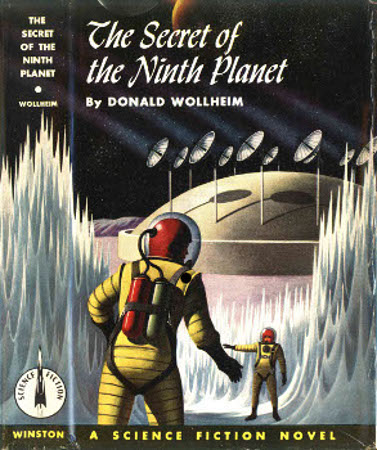
Chapter 15.
Ice Cold on Oberon
Nevertheless, from that point on, a different spirit seemed to animate everyone aboard the Magellan. There was the feeling that they had closed with the enemy and found themselves not wanting. There was the feeling that they possessed powers not inferior to those of their unknown enemies. The thought had been haunting them all along that they were in the position of a backward people facing an advanced invader—something like the problem of the Aztecs when faced with the gunpowder and armor of the conquistadors.
Now they knew that though the Sun-tappers' weapons were different and indeed advanced beyond Earthly technology, they themselves were not without resources equally deadly to the foe.
After the memory of the H-bomb's powers had been finally absorbed, the crew's activities began to indicate that the ship was coming into the crucial phase of its journey. Haines and Boulton were going over the list of military supplies with sharp, calculating eyes and slight grins at the thought of retribution to come. Ferrati was overhauling the rocket planes and land traveling devices, making them shipshape.
Russell Clyde and Burl surveyed the sky, anxious to be the first to spot what they hoped would be the limping body of the battered and fleeing dumbbell ship, a little atingle at the hope of spotting another such ship—feeling now almost like the hunting dog that has finally spotted the fox.
Lockhart himself reflected this mood of growing excitement. He prowled the ship, examining the mighty purring engines, querying Caton, Shea and Detmar as to how it could better its performance, how fast it could be made to shift speed and directions. He studied the orbits and locations of the remaining planets.
"Uranus is not too far off our path to Pluto," he announced one day. "We'll make it in time to wipe out their plant there. But Neptune, whose orbit is between those of Uranus and Pluto, is away off our track, a third of the way around the Sun. We're going to skip it, hit directly for Pluto and their main base—the end of their line. I don't want to give them too much time to make repairs or to get any reinforcements. I think they're limited in numbers—and we ought to slam them while they still are."
There was no dissent at this. And as the days rolled past, the men of the Magellan began to chafe in their repressed desire to finish the matter. At last Uranus came into sight—a large globe, very much like Saturn and Jupiter in that it was of low density and great dimensions. Roughly, sixty-four times the size of Earth, its density was barely above that of water and it probably had no solid surface to speak of. An inhospitable mass of unbreathable gases, at temperatures fantastically lower than the freezing point of water.
As they drew close to the planet, they could see that it also was banded, pale green bands alternating with lighter ones—indicating that some sections of its atmospheric belt moved faster than others. It had five moons which rotated in the opposite direction from those of any other satellite system.
It was on the farthest moon, Oberon, a sphere six hundred miles in diameter, that the Sun-tap station revealed itself. They swung down to observe it and to place their bomb. Not an H-bomb though—they recognized that they had erred in thinking they needed such a powerful explosive.
Oberon was without an atmosphere, a rocky world with streaks of frozen gases, and here and there the sheen of a lake of ice—ice that would never melt—that on this world would be a permanent, hard-as-metal material. There was, nonetheless, something about the surface that seemed to bother Russ.
"Do you notice what seems to be a sort of shifting movement?" he asked Burl. Burl looked, and sure enough, he saw that in places there seemed a flickering of lights.
"Yes," he said, "I see it. What do you suppose it is?"
"I don't know," said Russ, "But I'm going to ask Lockhart to put the ship down and let me take a look."
Lockhart at first demurred, but finally decided that they could afford the brief halt. The Magellan approached the surface, safely distant from the Sun-tap station.
Burl and Russ descended in the two-man rocket plane, while the teardrop-shaped ship hung half a mile above them. They landed on a narrow plain, bordered by low ridges of mountains shining with streaks of frozen hydrogen. A layer of cosmic dust hung over the rocks.
Wearing insulated space suits, they left the rocket plane. It was Burl who made the first discovery. He pointed dramatically at the ground. "Look, Russ. This dust is full of streaks and marks. It hasn't been lying here undisturbed. Something has crossed over it!"
Russ kneeled in order to look more carefully. The layer of dust, the consequences of an airless world exposed without protection to the endless fall of cosmic particles, was indeed not the level, undisturbed surface it should have been. Here and there were light, low depressions, as if something had moved across it—like a small snake crawling on its belly. In one place lay a series of depressions, like the footprints of some light-bodied creature.
"Impossible," muttered Russ. "Life can't exist here."
But they trudged on, across the barren flat to a ridge of rock. Here they found what they had thought to be impossible. Clustered along the side of the ridge, in the faint light of the distant and tiny Sun, was a series of thin, blue stalks, about half a foot in height. On each stalk was a flat scalloped top like a little umbrella. It was sometimes bright blue, and sometimes violet. As they drew nearer, these little stalks began to sway, and turned their tops toward them.
"They look like plants," said Burl. "Plants made of something glassy and plastic."
As Russ studied the strange growths, something moved across the dusty tract behind them. It was long and thin and wiggly, with a ridge of tiny crystalline hairs along its back. It was like a snake perhaps, but one made of some unbelievably delicate glasswork.
It slid among the plants and wrapped itself around one. The growth snapped suddenly, and then was absorbed by the creature.
Russ shook his head in amazement. "This is a great discovery," he said incredulously. "This is life! It's life of a chemical type utterly different from the protoplasm of Earth and Mars and Venus. It's life designed to exist among liquid gases and frozen air—life which can't have anything in common with protoplasm. Apparently it couldn't exist even on Saturn's moons—they were too hot for it!"
Russ was carried away with the possibilities. "This hints at great things, Burl. Out near Pluto, where the system is even colder, there may be other forms of this frigi-plasmic life, if I may coin a word. This means a whole new science!"
They returned to the ship with their astonishing news. The Magellan slowly skimmed over the surface of Oberon. They found whole forests of this glassy frigid vegetation, but not much evidence of any animal life larger than the creature the two explorers had seen.
Over the Sun-tap station—a ringed layout like the others, whose cluster of masts caught the emanations of the distant Sun on the one hand and directed them outward to the still unseen planet Pluto on the other—the ship halted. It drew up fifty miles, pointed its tail and blasted forth a rocket-driven, tactical atomic bomb.
The blast on Oberon was tiny compared to the one which had devastated Iapetus, but it still left a deep indentation in the surface for future space fliers to see.
They left it and the Uranian orbit behind them and headed outward once again. Behind them now lay the worlds of the Sun's family, while far off to one side lay the tiny light of Neptune. Ahead, between them and the vast gulf of interstellar space, lay only the dark, mysterious ninth planet, the enigmatic world named after the lord of the underworld, Pluto.
The Magellan plunged on, in constant acceleration, moving outward to the farthest limit of the solar system. They had traveled almost one billion, eight hundred million miles from the Sun—and yet they still had two billion miles more to go. This was the longest stretch—and during it, they would reach speeds greater than any they had touched before. They shot outward, faster and faster, eating up the infinite emptiness of space, driving the vast stretch that divided Pluto from its neighbors.
The Sun, already small, dwindled steadily. It was still the brightest star in their sky—of all the stars, it alone retained a disclike shape, and the faint flicker of its coronal flames could occasionally be made out—but it no longer dominated the heavens. To find the Sun, they now had to look for it as they would for any other star.
As for Earth, it could not be seen. So close to the tiny Sun it lay that only their sharpest telescopes could bring it out. Even Jupiter showed up only as a thin, tiny crescent near the solar point of light.
"Pluto's a mysterious world," said Burl as he and Russ scanned the heavens for a first glimpse of it. "The accounts in your astronomy books give very little real information on it—but what they give is strange. They say it's the only planet beyond Mars that is a small solid world like the inner ones. It seems to be the same size as Earth—not at all like the big outer worlds. And they say it seems to be the same mass as Earth—a solid world whose surface gravity would be the same as our own planet's."
Russ nodded. "It's an odd one, all right. There's now even some belief that it's not a true planet, but one that was once a satellite of Neptune. Its orbit is peculiar; it apparently may cut into that of Neptune. In fact, everything hints at Pluto not being a true child of our Sun. It may be a world captured from afar—a lonely wanderer cast off from some other star, captured by the Sun after millions of years of drifting lightless through space."
Beyond them, in their vision, lay only the stars of outer space, the void that did not belong to our system. And then, finally, they found Pluto—a tiny point of light shining among the blazing stars. They saw the disc, dimly reflected in the light of the far-away Sun.
Even as they were taking their first long look at the dark planet, the general alarm rang. They had caught up with the fleeing wreck of the Sun-tapper's scout cruiser.
Chapter 16.
In Orbit Around Pluto
There was a mad rush to action stations. Detmar, Ferrati and Oberfield, who had been in their bunks, dashed to their posts while others tried to pass them in both directions. Haines and Burl hastily climbed into their space suits, while Ferrati and Boulton manned the inner defensive controls.
Burl pulled the tight-fitting harness of his insulated space suit over him. The shape of the Sun-tapper ship came into focus on the tiny screen of the air lock viewer. It was approaching them at a frighteningly rapid pace. He could see the broken framework of one of its two globes—the one on which they had scored their hit. The other globe and the connecting passages were strikingly clear. Tiny circles of windows were visible in the passage section, which undoubtedly housed the operators of the vessel. For a fleeting instant he realized that as yet none of the Earthlings had any inkling of what these creatures looked like.
While he knew that the scene was telescopic, the ship was undoubtedly approaching them fast; or rather, they were catching up to it at a perilous pace! Whether the wrecked enemy had slowed down more than they had, as it approached its Plutonian base, or whether some other surprise lay ahead, they had no idea.
Burl felt the jarring impact as Lockhart cut the Magellan's drive. There was an instant of weightlessness, and then their weight reversed as the A-G drive strove to slow down the ship. Within the air lock they were outside the living space of the sphere, suspended beneath the drive chamber. Burl could see the walls of the inner sphere whirl past him, a foot away, as the living quarters rotated to shift with the gravitational change. And at that very moment, while all those inside were temporarily helpless, disaster struck.
Burl had just finished adjusting his airtight helmet, and Haines was already on his way forward to the outer shell port and the rocket guns, when there was a flash of lightning from the crippled enemy spaceship. The foe was still capable of fighting—and it had fired first—alarmingly close.
Within what seemed a split second after Burl's eyes had registered the flash on the little viewplate, the Magellan received the full force of the mighty electronic discharge. To Burl it seemed as if a thunderclap had sounded in his ears, and as if he had been plunged into a bath of white flames. The walls of the passage sparked brilliantly, blinding light filled the air, and Burl's body vibrated as it would to an electric shock.
He reeled wildly, catching at the walls and almost falling. In a few seconds his senses recovered, although his body was still humming from the blow and his ears were ringing. The viewplate had gone black, the lights in the air lock corridor were dark, and when he tried to gain his feet he realized that the ship now had no gravity; it was falling free without power.
Haines was slumped in the end of the corridor, with the port nearly opened. Burl pushed his way over to him and helped the groggy explorer to his feet. There was no sound, and Burl suddenly remembered that he hadn't taken time to switch on his helmet phone. He did so and was relieved to hear Harness voice asking if he was all right.
"I'm okay," Burl called. "Let's get this port open. Maybe we can hit back at least once."
Together, they turned the bolts and pushed the thick outer shell door open. Without the aid of telescopic sights they could see the shape of the Sun-tapper vessel plainly, outlined against the curtain of distant stars. Struggling not to think of what might be going on within the Magellan—their earphones registered nothing except each other—they unlimbered the long tube of the rocket launcher and aimed point-blank at the foe. Haines reached into the ammunition locker vault alongside the passageway and selected the biggest and wickedest of the available shells. He twisted the dial in the warhead and, while Burl held the aim, shoved in the rocket shell. With a press of the button, the missile roared out of the tube, racing in an arc of fire directly toward the faint vision of the other ship.
They watched with bated breath, counting the seconds, hoping not to see another blast of electrical fire. But apparently the foe had exhausted its limited resources, for the thin spidery line of rocket sparks reached out, farther and farther, until it seemed to touch the surface of the golden globe.
There was a great flare in the sky now, an outpouring of fire and hot metal. When it cleared away, the sky was empty.
Haines wearily drew the outer port shut. "Now, let's see if we're goners, too," he said quietly. They sealed the outer shell and made their way along the dark passage.
Even as they were unlocking the toggles of the inner hatch, the corridor lights started to flicker. They would light up dimly, and then flicker out, light up again, flare for an instant, then die down. Someone was alive within the ship.
They got the hatch open. In the central section of the living sphere, the lights were also dim and in a few places they were completely out. They emerged and closed the hatch behind them. Only after Haines had tested the inner atmosphere and found it still pressurized, did they open their helmets and climb stiffly out of the space suits, wincing at bruises they had sustained but had not noticed until then.
The air pressure was all right, but there was a smell of burned rubber and insulation in the air. Now that their helmets were off, they could hear voices somewhere above. They found Oberfield lying unconscious, thrown to the floor by the sudden shift of the ship. They climbed into the control room. Lockhart was floating in the air near the open hatchway leading to the engine room overhead. He was calling out orders to someone who was within.
Russ was working over the navigation desk, a bandage around his head, trying to figure out where they would be and where they were heading, without having access to the still dark viewplates.
Lockhart twisted in the weightless air when he saw them. He seemed both relieved and distressed. "I'm glad you're okay, but I had hoped you'd be able to put in a blow for us."
Burl realized that inside the ship they had no way of knowing that vengeance had been served. Hastily, he explained. His words cheered everyone. Russ and Lockhart shouted joyously. Detmar poked his head down the hatch and called the news back to his two fellows who were struggling to get the A-G generators functioning.
The bolt of energy, whatever it may have been designed to do to a ship of the Sun-tapper build, did not have the totally disastrous effect on the Magellan that it was intended to have. It had knocked out their electrical system temporarily, burned out some of its parts and caused the A-G system to fail, although the atomic piles were impervious to such currents. Oberfield, Ferrati and Shea were badly hurt.
There now followed an anxious period during which more and more of the electrical system began to function as the men labored to rig up emergency wires, and to replace burned out bulbs and lines. There was a general cheer when the viewplates flickered into life again, though not all functioned. They again had access to the sky about them—even though not all sectors were covered.
The humming in the engine room started up, rose and fell uneasily a couple of times, and then they felt a surge of force. Lockhart fell gently to the floor as the ship began to drive ahead, and then in a few minutes the A-G drive was back on, and the Magellan was again under control.
"We took what they had to give, and it wasn't enough," exulted Haines. "Now wait till we reach their main works. We'll show them!"
Lockhart shook his head wearily as he and Russ worked over the controls. "Let's hope we don't have to show them soon. Our ship is running on emergency rigging. Caton says he's going to have to rest the ship and rewire a good part of the system. Meanwhile, we will be able to reach Pluto safely enough."
Pluto was visible in the forward viewplates. They could see lighter and darker patches on it, almost like the markings of continents and oceans, but there was no evidence of an atmosphere, nor had they expected any.
Readings showed that the average surface temperature was about 200° Fahrenheit below zero, even lower in many places. They searched the surface for signs of their foe.
They found what they wanted on the north polar depression, a basin in the oblate sphere of Pluto. There was no ringed station. There rose a vast pile of dark masonry—a mighty structure covering at least a square mile, a fortress building whose roofs bristled with an array of masts and reflectors. And hanging on patrol over this polar basin were two more of the dumbbell ships.
"We're in no position to come to grips with them," said Lockhart. "I'm going to take the Magellan into a low orbit around Pluto's equator. We'll be out of their sight, yet near enough to do some probing and exploring while we're making repairs."
This they proceeded to do, swinging the ship down to within a few hundred miles of the Plutonian surface, setting on a fixed orbit around the equator, exactly as the sputniks of years past had first circled the bulk of the Earth. Staying far enough up to maintain orbit, they were close enough to be below the planet's radiation belt.
Taking stock of the ship's condition showed that they dearly needed this delay. Repairs would not be completed for several days. Practically everyone had been bruised or shaken up; Oberfield had a fractured skull and was in serious condition; Ferrati had broken his leg and pelvis; Shea had a couple of cracked ribs. The men were given emergency medical treatment and confined to quarters.
The Magellan quietly circled Pluto once every hour and a half and the ship tried to resume its normal life. Russ studied the surface beneath them, Haines and Burl at his elbow. Then, after conferring, the three approached Lockhart.
"We want permission to make a landing," Russ said. "If we take the four-man rocket plane we can make the ground safely. We've got to reconnoiter before we can figure out how to put this master Sun-tap station out of business."
Lockhart agreed. "I was planning as much. Now that we're here, we can't delay just because we're injured. Go ahead."
The three got ready quickly. They donned their space suits, loaded the larger rocket plane with equipment, arms, and plenty of extra fuel. Just before they left, Lockhart gave them a word of caution. "Do not attempt to communicate with the Magellan by radio. If Pluto is the Sun-tappers' home world, you may find yourselves surrounded by enemies, and overheard. Don't reveal our existence or position. If you have to talk to us, do not expect a reply unless it's an absolute emergency."
Burl strapped himself into his seat within the rocket plane and glanced through the thick window. Below them was a world the size of Earth—a world which, if it had air and warmth, could most nearly be Earth's twin of all the planets in the system. This rocket plane had touched on the hot surface of Mercury, the first planet, In a little while it would set down on the frigid surface of the last planet. They had come a long way.
Chapter 17.
Stronghold of the Lost Planet
With a jolt that shoved the three men back in their seats, the rocket plane pushed out the cargo hatch, and slid into the dark of space on its own power. Behind them, the metallic surface of the Magellan gleamed briefly, and then swung away on its orbit. Riding the red fire of their rockets, they headed on a long low dive for the mysterious surface below.
Pluto was a vast hemisphere, half lighted in the faint, dim glow of the tiny Sun, half in the total darkness of outer space. Here and there wound a silent, frozen river of glistening white. They passed over a gulf of some frigid sea of liquid gases, from which islands of subzero rock projected, and moved inland over a continent of lifeless grays and blacks. Haines gently drew the ship lower and lower, and at last the rocket plane bumped to the ground.
It rolled a few yards and stopped. The three men crowded to the door, tightened their face plates, and forced open the exit. There was a rush of air as the ship exhausted its atmosphere. Then, one by one, they stepped onto the bleak surface of the Sun's farthest planet.
"I feel peculiar," whispered Burl. "This planet reminds me of something."
"I have the feeling I've been here before," Russ said slowly.
Burl felt an odd chill. "Yes, that's it!"
Haines grumbled. "I know what you mean. I can make a guess. We've never really been the right weight since we left Earth. Even under acceleration there were differences one way or the other. But I feel now exactly as I did on Earth. That's what gives you the odd sensation of return."
The two younger men realized Haines was right. For the first time since they had left their home world, they were on a planet whose gravity was normal to them. It felt good and yet it felt—in these fearful surroundings—disconcerting.
Above them was the familiar black, unyielding sky of outer space. No breath of air moved. Yet somehow the scene resembled Earth. "It's like a black-and-white photo of a Terrestrial landscape," said Burl.
There was a field, some hills, a tiny frozen creek and the dark shapes of rounded mountains in the distance. All without color except for the cold, faint glow of the star that was the Sun.
A thin layer of cosmic dust lay over the surface, such as would be found on any airless world. Russ scooped beneath it and came up with a hard chip.
He squeezed it between his gauntleted fingers. It cracked and broke into powder. He whistled softly. "You know what this feels and looks like?" he said as they came close to the frozen creek on the little hillside. "It feels like dirt—common, Earthly dirt. Like soil. And you know what ... I can already tell you one of Pluto's secrets."
They stopped at the creek. It was a layer of frozen crystalline gases. Haines pushed the alpenstock he was carrying into it and scraped away the gas crystals. "I think I can guess," he said, "and I'll bet there is ice under this gas."
"Pluto was once a warm world with a thick atmosphere," said Russ. "Notice the rounded hills and the worn away peaks of the mountains. Those are old mountains—weather-beaten. This hill is round—weather-beaten. This creek, those rivers of frozen gas—they follow beds that could only be made by real rivers of warm water. The soil that lies beneath this dust—it could only happen on a world that knew night and day, warmth and light, and rain and wind. Pluto was once a living world, a place we'd have called homelike."
Burl shivered a bit. "Out here? So far from the Sun? How and when?"
Russ shrugged. "We'll find that out. But the evidence is unmistakable." They walked on.
There was a low, cracked wall on the other side of the hill, and beyond the wall stood the roofless ruins of a stone house, silent and gray in the airless scene.
They waited with surprise and uncertainty. Haines drew his compressed air pistol, but there was no movement. The scene remained dead and still—the windows of the house were dark.
They advanced on it and flashed a light inside. It was an empty shell. There was no glass within the unusually wide and low window openings, and no door.
"They went in and out the windows," commented Burl, ducking through one of the openings. "And they weren't built like us."
"No," said Russ, "there's no reason to suppose the inhabitants would have been built like human beings."
Inside there was nothing to see, and they left. Beyond, they found a straight depression in the ground filled with flat swirls of cosmic dust. "This looks like a road," said Haines.
They returned to the rocket plane in order to follow the dead roadway more easily. Passing between the low, dark cliffs of rocky mountains, they came to a plain marked by thousands of columns of rock, pieces of crumbling walls, and many straight depressions that must have been streets. It was the remains of a world that had died.
They found, as they traveled northward and made intermittent landings, that there had been many cities. Now all lay in ruins. There had been great roadways, now covered with the debris of outer space. There had been mighty forests, now miles of petrified black stumps. It was a gloomy sight.
In their landings, they had found inscriptions on walls and bas-reliefs carved on mountains. They knew from these what the Plutonians had looked like, and they had a suspicion of what had happened.
The Plutonians had been vaguely like men and vaguely like spiders. They had stood upright on four thin, wide-spread legs and had two short arms. Their bodies were wide and squat, and they seemed to have been mammalian and probably warm-blooded. They breathed air out of flat, thin nostrils and their heads joined their bodies without necks. Two oval eyes were set below a jutting bald brow. They had worn clothes, they had driven vehicles, they had flown planes.
Their vehicles had globe-shaped power plants. Their airplanes had globes where wings should have been. Their cities and their engines—which existed now only on wall pictures that were probably once advertisements—were built along globe-and-rod principles.
"There's no doubt," said Russ, "that the Sun-tapper culture and the Plutonian culture are the same. It's the descendants of the Plutonians that we are fighting."
"But how could they have survived?" Burl asked. "This world was never part of the solar system when it was warm."
"We'll soon know," said Russ. "Tomorrow we're going to see how far we can get into their polar redoubt. Somehow we've got to blow up that last station."
"And I think we three are going to do it," said Haines. "The Magellan will never take the place from the sky. We'll have to do it from the ground."
Now they were reminded of Earth again. For the first time since they had departed from the United States, night fell. They had not been on any other planet long enough for such an experience. But the effect here on Pluto was mild.
Day was like a bright, moonlight night. Night then meant that the dim Sun had set and, in effect, it merely made the landscape slightly darker.
They compared notes late into the night in the rocket plane. By dawn, when again the dim glow shone, they had come to some very definite conclusions about the planet.
A number of the drawings on the walls seemed to have some religious significance. They focused on the phases of a moon. There were symbolic representations of this moon, passing through its phases; presumably Plutonian religious and social practices were related to it.
"But where is this moon?" Burl had asked.
"I think," Russ answered, "that what some astronomers had suspected about Pluto was right. It did not originate in the solar system, but was captured from outer space. Originally it revolved around another sun, some star which was light-years away. How it tore loose from that star we'll probably never know—the star might have simply become too dim, their planet might have been on a shaky orbit, an experiment of theirs might have jarred it loose, many things could have happened.
"Once beyond the gravitational grip of its parent sun, the planet wandered through the darkness of interstellar space until it came within the influence of our own Sun. How long this took would again be a guess. Possibly not more than a few thousand years, I'd say, since somehow a remnant of the population managed to survive. This suggests that they had some warning. Enough time passed for them to build the big structure we noticed at the north pole, probably to store food, build underground greenhouses and make sealed homes for a few families. Inside this giant building the last of the Plutonian people kept going.
"Then came the moment when their planet fell into an orbit around our Sun. I'd guess they emerged to find that the new Sun was too far away ever to heat up Pluto again, or to permit the rebuilding of an atmosphere. So they worked out a new scheme. This was to blow up the Sun into a nova—make it a giant and thereby bring its heat all the way out to Pluto—warming this world again, lighting it again, unfreezing its gases and waters. So they set up the Sun-tap stations."
"That also accounts," added Haines, "for their limited number of spaceships and their need for secret operations."
"Yes," said Burl, "but there are two things that don't fit in. What happened to their moon—surely it would have gone along with Pluto since it revolved around it? And second, why the thirty-year delay between the first Sun-tap stations and the completion and operation of them?"
There was no answer to these questions yet. The three began the morning's expedition.
As they neared the pole, they stayed close to the surface, for, any moment, they expected to see the dumbbell ships that patrolled the sky above it.
At last they set down the rocket plane on the edge of the polar plateau and got out. Not more than a mile away, the black ramparts of the building—a wall running miles across the horizon—rose hundreds of feet into the sky.
Above it, they caught a flicker from the forest of masts and the glint from a dumbbell ship. They moved silently forward, carrying the rocket launcher on their backs and a small load of shells and several hand bombs. These made heavy baggage, but the distance was not far, and the purpose great.
Burl felt like an ant about to creep into a human house. But he reflected that no ant ever had such dangerous intentions. An ant enters a house to steal a crumb of food. But if an ant had intelligence and evil intentions, it could cripple such a house.
Such was the situation for the three of them as they neared the precipitous walls. On arrival, they found that entry would be easier than they expected.
The Plutonian refuge had not been built to offset attack from the surface of the planet itself. It was no thick rampart of unbroken plastic as the walls of the other Sun-tap stations had been. Close up, it proved to have many doorless entryways, ramps running up to higher floors, even wiry monorail scaffolding, probably left behind by the builders.
They entered an opening in the base. Once inside, dim lights set in the ceiling lighted the path before them. They walked down this culvert like rats in a giant sewer until they came to a wall studded with several doors.
The doors were shut, but a tiny globe set on the surface of each one reacted to Burl's charged touch. Two opened upon dark airless passages. The third resisted a moment, and when it did open, there was a whoosh of air which raised a momentary cloud of dust on the stone floor of the culvert. This was obviously the entrance to the inhabited portion of the refuge.
The men closed the door behind them. They were in a small chamber. A door on the other side was opening automatically. "An air lock system," muttered Russ as they went through.
They were now inside the vast building itself. There was air, and, after testing it, they opened their helmets. The air was almost as thick as that of Earth, and they experienced no difficulty in breathing. It was stale and somewhat metallic in flavor, probably because it had been enclosed and used over and over for thousands of years.
They saw no living beings, which seemed strange. "Apparently these people really are at their last gasp," remarked Russ as they passed through an area that had obviously once been a large dormitory. They heard distant humming sounds somewhere in the floors above, but all that was visible on the lower level seemed to be maintenance machinery.
They walked through great storerooms which were piled high with sealed drums. They saw factories lying silent—curious lofts of odd machines powered by globes that were idle. They skirted an unlighted reservoir of water in a circular chamber far in the interior. And here and there in the gloom, they spotted huge ramps leading spirally upward.
Finally they turned their steps up a sloping ramp, mounting one floor and then another, and another. They were tired, but curiously exhilarated. They felt that they were about to strike at the heart of the foe, and that his days were numbered at last.
They emerged on a higher level, lighted more brightly than the others. Here they saw globes that glowed with the same intensity as those in the Sun-tap stations had. They moved carefully now, keeping out of sight, and several times they saw shadows in the distance or heard the thump of something moving.
They worked their way by instinct to what they guessed was the center of operations. They peered, at last, through a low, wide doorway into a large chamber. Here was a mass of mighty globes and rods, some revolving as they circled the metal masts that came through the room from the ceiling above.
"It must be the base of the Sun-tap receiver line," whispered Haines. "This should be a good enough place to set up our time bomb."
They stole over to a cluster of globes and unpacked the powerful little atomic bomb they had carried with them. They carefully put it together, inserted the explosive fuse, and set the timer. "I'm giving it four hours," said Haines. "Time for us to get out of here and radio the Magellan to get into action. That should take care of this station."
They moved carefully out again, scarcely breathing for fear of some Plutonian entering and discovering them. They made their exit safely enough and started to retrace their steps.
Back down through corridors and strange chambers they moved, stopping every little while as something that sounded like footsteps passed over them. "Where," Burl whispered, suddenly troubled, "is the stolen heat and power of the Sun going? It isn't heating up Pluto. Surely they can't simply store it."
"Something we haven't solved," Russ replied hurriedly. "From what I remember of the masts, it looked as if they were relaying it somewhere else again."
"Can't imagine where," said Haines. "Not back into space, surely?"
They fell silent, concentrating all their energies on not losing the way. "Are you sure we came through here?" Burl asked nervously. "I don't remember this at all."
"I don't, either," said Russ. "It looks queer. Are you sure we're on the right path?" He turned to Haines.
The explorer shook his head. "We must have made a wrong turn. I think we've lost our direction."
They hastily conferred, and decided the best thing to do was to make their way to the lowest level and then outward—but suddenly they realized they could not tell which way was outward. There were no windows, and the wall markings and direction signs were unintelligible.
To make matters worse, they heard new noises, and, just as they dodged into a corner, five Plutonians shambled through.
These creatures were as the ancient wall sculptures had depicted them, though a bit smaller than their ancestors. They were pale, almost white in skin color, and their eyes were tiny sparks of red. They wore light harnesses around their bodies, and two of them were carrying tools. They spoke together in clacking bass voices. They shuffled loosely over the ground on their four thin legs. Burl thought of them as ugly caricatures of semi-humans.
When the creatures had passed, the three explorers darted out to where a ramp spiraled to the lower levels. They started down in single file, but it was too late.
Staring directly at them were two Plutonians who had come up from below. The men pushed past, but not before a barking voice had cracked out an order.
The Earthmen started to run down, followed by the scrabbling sounds of their pursuers. The barking calls increased in volume.
From somewhere a booming sound began, repeated over and over. As the men emerged on the floor below, they heard it repeated on every level. "The alarm's out for us," called Haines, making no effort to keep his voice down. "We've got to run for it!"
Laden with the remaining weapons and equipment, the three human beings hurried on, but it soon became clear that four legs were better than two, for the creatures were gaining on them.
They had forgotten they were lost. Now they sought only to get out of sight and hide. They dropped their equipment as they ran, down halls, through tunnels, skittering along sloping ramps, heading for what they hoped would prove to be an exit.
Behind them an increasing crowd of Plutonians had collected, and several times a spark of electronic power crackled and blazed against the wall over their heads. The pursuers were armed.
Burl's lungs began to ache painfully. Close on the heels of his companions he dashed into one room only to find a group of Plutonians coming at him from the other side. His ears were deafened by the barking noises and alarm boomings. He jumped to one side to avoid a Plutonian standing directly in his path, and ran into a narrow tunnel. There was an excited barking as the creatures followed him.
With a sinking heart, he realized that he was now alone. Haines and Russ must have been cut off. He gasped for breath. Running in a tight space suit, carrying his oxygen tanks, was hot and hard work. He did not dare drop the tanks, for his only chance was to escape outside.
He ran wildly on, hoping to reach an outer door. But he seemed now to be in a maze, for nothing was familiar to him. He could no longer remember how many times he had run into groups of Plutonians, nor could he guess how many followed on his heels.
Then he stumbled into a small, round chamber out of which led three tunnels. As he looked around quickly to select his next means of escape, barking Plutonians erupted from each opening. Burl backed up against the wall, knowing that this time he was trapped.
A blaze of sparks broke over his head as a blast banged across the room. The red-eyed, scrabbling figures charged, their chinless mouths opening to emit barking calls of bestial anger. One aimed a rodlike contrivance at him, and there was another flare of light.
The room dissolved around him in a glare of brilliant green. As he slipped helplessly to the floor, he lost consciousness.
Chapter 18.
Sacrifice on the Sacred Moon
"Burl Denning! Can you hear me, Burl Denning?" A thin, tinny voice somewhere was calling him. But the darkness was all around, and Burl felt a great sleepiness and a desire only to sink deeper into the cottony nothing in which he seemed to be cradled.
"Burl Denning! If you can hear me, speak up!" Again the faint, scratchy voice nagged at Burl's mind. He really ought to answer. He tried to open his mouth. Something hard and cold was pressing against his back. He tossed and squirmed.
Once more the voice called, and this time he decided that he must be asleep. He struggled to open his eyes, then finally blinked them wide in an effort to adjust himself to his surroundings.
He was apparently out in the open, and it was night. The sky was dark, not black, but almost so—a deep, blue-black. There was a pale blue saucer hanging in the sky. It blotted out most of the view. Gradually, he became aware of a shiny barrier between him and that sky—he was not out of doors. Something like a glass dome seemed to be overhead.
Burl raised his head. There was no one in sight. He felt dizzy and confused. He lifted a hand to his brow, and felt the cold glass of his space helmet. He was still wearing his space suit then. The voice—it must be in his helmet phone.
"Hello," he ventured weakly. "Who's calling?"
Quickly the faint voice replied, growing stronger. "Burl, are you all right? Where are you?"
Burl looked around. He was sitting on the floor of an isolated enclosure with a transparent dome. There were no walls, just the rounded dome like a fishbowl turned upside down on him. The flooring beneath his feet was plastic.
"I'm all right, I think," said Burl. "Is that you, Russ? Sounds a little like you, but you must be far away."
"Yes, it's me, Russell Clyde," confirmed the voice. "You're coming in weak, too. Where are you?"
Burl described his surroundings. There was a silence for a moment, then Russ's voice again. "I kind of suspected it, but what you say confirms it. We must be on the only planet we haven't visited ... or rather, not on it, but near it. I mean Neptune. I knew from the gravity I wasn't on Pluto any more. Judging from our weight, and your description of the bluish planet in the sky, we must be on Triton, Neptune's bigger moon."
Burl found that his dizziness was disappearing. "I feel light," he commented, as he got to his feet. "Should Neptune look sort of like Uranus, only more bluish in color?" he asked.
"That's it," said Russ. "Neptune is pretty much of a twin for Uranus, only it's denser, a little bit smaller, and perhaps more substantial than the other giant worlds in our system. It should have a second moon, smaller and way out."
Burl walked around the little enclosed space. "I guess I'm a prisoner here," he said. "This dome is on the surface. Most of the area is just a sort of rocky plain with patches of liquid gases, but there are a couple of big buildings nearby. Funny sort of structures—they have fancy tops with symbols on them that look like the phases of the moon."
"I think I'm inside one of those buildings," Russ guessed. "I'm in a big hall with a lot of exhibits in glass cases. And they've got the strangest creatures I've ever seen in them. There are lunar markings here, too—they remind me of the ones we saw on Pluto. You know what I suspect?"
Burl paced around, regaining his senses as he walked. It was obvious that, after he'd been knocked out by the Plutonians, he had been taken by them to this moon of Neptune. For what purpose?
Russ continued to murmur his thoughts, his voice ringing tinnily in Burl's earphones. "I think that Triton was originally Pluto's moon. When Pluto wandered into the solar system, it crossed Neptune's orbit and was held. Its moon came closer to Neptune and was captured completely. But Pluto, having a greater mass, didn't stick. It established an eccentric orbit of its own which took it far out from Neptune for hundreds of years at a stretch and brought it back only rarely. Pluto lost its moon. And that moon was the spiritual home of the Sun-tappers' religion."
Burl glanced across the landscape. There were some funny things growing nearby. They looked a little like thin, glassy trees with big, blue coconuts on top.
"What happened to you and Haines after we got separated?" he asked, still talking through his helmet phone.
"I don't know what happened to Haines," said Russ. "I hope he got away. But they trapped me. I was taken aboard one of their dumbbell ships, and brought here. The trip took days. I guess you were unconscious for all that time. If it's any comfort to you, the Pluto building was destroyed. Our atomic bomb went off. I saw the flare from a window in the ship. I think this moon is the last stronghold of the Sun-tappers, and I think it is our final objective."
The strange crystalline vegetation seemed to be moving closer to Burl. He watched it carefully. It was moving! There were living beings out there!
They glided oddly over the ground, and he saw that their bases were a mass of crystalline fringes, moving feelers which crawled over the surface bearing the upper structures with them. They had thin, trunklike bodies with two long, pencil-like branches that were used as arms. And the coconut objects were heads!
They circled the dome now, and Burl could see that each round blue knob had a central black spot that apparently served as an eye. There was no sign of nostrils or mouth. Burl stared at the creatures in wonder.
The beings were clearly gesturing to him, trying to signal with their odd arms. He waved back, wondering how he could establish communication. As he did so, he described the creatures to Russ.
Russ's voice was excited. "Say! I think I've figured out what sort of place I'm in. This is a museum of galactic life! Each of these glass cases contains a specimen of the highest form of life of its particular world. In one of the cases, opposite me, there's one of the Martian creatures—a big, antlike fellow. He's standing there, looking perfectly alive, but absolutely motionless. Next to him is something else that looks like an intelligent form. It's sort of a man, covered with short red hair. Around its waist it's got a belt, and there are pouches on it, and something like a short sword. It must be a humanoid type from some world out among the stars. Some of the others look like intelligent forms, too, because they are wearing clothing.
"I think that collecting these specimens and setting them up here is part of the religion of the Sun-tappers."
While Russ was talking, Burl thought of a way he might communicate with the stick-men. He wanted to draw a diagram of the solar system on the floor of his enclosure. He gestured futilely with his hand, but there was nothing with which to make a marking. The stick-men outside watched his hand, then one of them reached around to something hanging across its back and withdrew a thin tablet and a wedge of red. Holding the tablet up so that Burl could see, the creature quickly sketched a recognizable map of the Sun and its planets!
Burl realized then that he was dealing with highly intelligent beings—no savages, these, but the products of a high civilization. He indicated the third world as his own. The stick-man drew back as if surprised, then pointed upward.
They came from Neptune!
During the next few hours, a most curious three-way discussion went on—Burl signaling to the Neptunians outside and describing his discoveries to Russ over the phone of his space suit; Russ suggesting answers to some of the more difficult diagrams. It was a curious experience. Gradually, by means of simple drawings and gestures, and even charadelike playlets acted out by the weird vegetable-crystal beings, there emerged the general story of the Neptunians and the invaders from Pluto.
On Neptune there had been a great civilization covering the entire world, a hard surface lying deep beneath its thick methane atmosphere. There were forests and there were animals and intelligent beings. They did not breathe, but absorbed both their food and liquid gas through rootlike feelers on which they stood and moved.
Then one day, about thirty years ago, they had been invaded by creatures that came in dumbbell-shaped spaceships, and which had destroyed their cities, and attempted to conquer the planet. They learned that these ships had come from Triton, the strange new moon that Neptune had acquired about a thousand years earlier, and from the new planet, Pluto, their astronomers had observed at that time.
For thirty years the Neptunians had fought against the invaders. For a while they almost succeeded, but then something new had developed. Their world grew hotter. Great structures had been erected on the poles, the areas first conquered by the Plutonians and still held by them. From these spots, vast amounts of heat surged over the planet and changed it.
Heat meant death and doom to every living frigi-plasmic thing on Neptune. Desperately, they increased their warfare, but the heat sapped their strength, destroying them, until now they knew it was but a matter of time before the Neptunians, beast and vegetable alike, would vanish totally.
"So that's it," breathed Burl. "That's where the Sun-tap energy is going. The Plutonians want Neptune because it's near their old moon, and they have to warm it up to live on it. Of course! And Neptune's too far from the Sun to explode when it novas, it will just get comfortable for the Plutonians!"
The Neptunians continued their strange tale. They had built a crude spaceship and manned it with a suicide battalion of the most desperate warriors of their race. They had journeyed to Triton in hopes of seizing it and destroying the foe from there. The stick-men had attacked and had been beaten back.
Now there were only a few dozen of them left—the last soldiers of their invasion and ignored by the enemy. And here they were, explaining this to Burl whom they recognized as an ally.
Russ's voice suddenly broke into Burl's thoughts, "There's some sort of ceremony beginning here. There's a procession of Plutonians dressed in golden robes marching down the center of the hall, carrying staffs with moon pictures on them.... They're chanting in unison, though it sounds like barking. Can you hear it?"
Burl could. It sounded faintly in his earphones like the noises in a dog pound.
"Now they're circling around. They're opening one of the cases. The glass slides back.... Say! The exhibits aren't dead. I see something moving.... It's a man!"
Russ's voice stopped suddenly. Faintly, Burl could hear the barking and then Russ's terrified voice. "It is a man, Burl. He's dark-skinned and wearing white cotton pants and a homespun shirt. He looks like an Indian, maybe a South American Indian. When they lifted the glass, he just walked out and stood as if he were all mixed up. Then he got scared and started to run."
The voice was silent a moment. "They grabbed him, Burl. They sacrificed him! And now they're coming for me."
"Stop them!" Burl yelled wildly. "Do something!"
"I can't stop them." Russ was resigned. "They're taking me to the empty glass case. I guess I'm elected to be the next exhibit. They're shoving me in!"
Outside Burl's enclosure the stick-men sensed something unusual in his strained attitude. They stared in at him, while he remained tense, listening.
Now Russ's voice came again. "They're going to take off my helmet and throw in the suspended animation gas, Burl. Good-by. I can see them still. Oh ... oh, I feel strange, I feel stiff, faint ... here ... I ... go...."
His voice faded out, thin and weak. Then there was only silence.
Burl threw himself against the restraining transparent wall of his dome prison and hammered on it with his fists. The dome would not give way.
He looked around desperately, determined to escape, wondering what surprise the Plutonians were holding him for—suspecting he would be the next victim. They would be coming for him soon, he knew.
He searched the enclosure for some way of leaving. He looked at the stick-men and wondered if they knew. One of them, the one who seemed to be the leader, gestured to him. His arm pointed to a spot in the floor.
Sure enough, there was a crack there, an outline like a small trap cover. He worked at it with his fingers and, finding a dent, he pushed. A lid came off. Below was a cleared space, a few inches deep, in which were set the levers of a typical Plutonian control board.
Burl wondered if he were still carrying the charge that attuned him to such controls. The shock he had received on Pluto could have blanked it out.
He pushed at the levers with his gloved hands. They did not obey him. Desperately, he removed the glove from one of his hands. It was bitter cold in the little enclosure, but there was some atmosphere. The lever almost froze to his fingers, but he turned it again.
This time it worked. The top of the dome that entrapped him suddenly opened, and the sides slid back. Burl replaced his glove on his hand and dashed outside to the freedom of the frigid surface of Triton.
Then he was among the Neptunian stick-men, and they were actually patting him on the back, waving toward the building, hurrying him on.
They were prepared to die in one last desperate assault on the foe. Could Burl do less?
Chapter 19.
The Museum of Galactic Life
There were a number of structures laid out on the plain under the blue glow of Neptune. Burl saw that only one of them was a true building in the design he had come to know was that of an ancient Plutonian temple except that it was far, far larger than any of the ruined shells he had seen on Pluto.
The other structures turned out to be walls and pillars arranged around the central building, evidently in relation to their religious significance. This main building, ornately decorated, was windowless, and the several closed doors represented metallic and forbidding barriers. It must have covered thirty acres, rising about thirty feet from the ground.
As Burl frantically examined it, the leaders of the Neptunians moved discreetly with him. They gestured at the doors, indicating their own inability to open them. Apparently they thought that Burl might succeed where they had failed.
Burl wasn't sure he could. He supposed there might be controls similar to those that released him from the dome, but he thought first he had better determine a plan of action. Somewhere within, Russ was sealed up—an exhibit among the living dead of many planets.
He managed to convey this thought to the three stick-men. There was an unmistakable nod of assent from one of them, and a twiglike arm indicated that Burl should follow him. They rapidly crossed the area to the outlying fringes of a frigi-plasmic forest.
Here towering crystalline masses pushed up from the dark ground. It seemed to be a weird jumble of broken glass—broken glass ten and fifteen feet high! The Neptunians led Burl into this amazing landscape through a narrow path. He walked behind them, feeling thick and heavy in comparison with their fragile bodies. But, in spite of appearances, they were not fragile, nor were the growths that made up the fantastic Neptune-transplanted vegetation of Triton.
They came to a clearing amid the forest of blue and green and orange crystals, and there were the rest of the Neptunian survivors. Burl counted about forty, rooted in pools of liquid gas, absorbing renewed energy while waiting for commands. As he entered the clearing, most of them lifted their root tentacles and crowded around him. He was as strange a being to them—helmeted and bundled in plastic and rubber and metal—as they seemed to him.
Burl noticed that many of them must have been wounded—there were signs of missing arms or of burned roots, and a few had odd poultices smeared over their round, blue heads.
The Neptunian commander pointed out their store of arms. They had long spears of some glistening translucent substance, a projector which fired darts of the same material, and a number of the Plutonian globe-and-rod instruments—obviously captured from the enemy.
He examined some of the spears and darts, and a suspicion he had held on first seeing them was confirmed. These were made of ice! On Neptune, ice was easily obtained—and hard enough to be worked like metal. Its melting point being far, far above any heat likely outside of a Neptunian laboratory, it was as permanent as iron for their needs!
Burl studied the captured Plutonian hand weapons, and was pleased to have one of the Neptunian soldiers pick up one and demonstrate how it was fired. It had apparently simpler controls than most Plutonian products, for it easily blazed forth a bolt of electronic fire that blasted a tall, crystalline tree to shards.
The Neptunian leader began to gesture again, and conveyed to Burl that they wanted to attack as soon as possible. He gathered that conditions on Triton were not the best for these people—that their ability to hold out was limited and that they desired to make their final assault without delay. They wanted to know now what Burl could contribute.
Burl realized that as far as he was concerned, he was not in any better shape than his allies. His oxygen tanks were slowly but surely emptying. He examined his gauges and was startled to see he had only two more hours before suffocation would set in. The suit was warmed by batteries which would last several days longer, but by that time it would be too late.
Somewhere inside his suit he had a pocket knife, but he could not get at it in the frigid near-airlessness of the outer surface. His holster still hung at his side, but it was empty.
There was nothing to do then but to join the Neptunian assault. He would try to open the door by the electronic charge that still remained in his body. If he did, they could break in and do what they could. If he could not, who knew what would happen?
Burl picked up one of the Plutonian weapons and gestured to the rest to prepare to attack. Immediately, they fell into orderly ranks. They were, indeed, soldiers, Burl thought—the cream of their planet's armies—whatever that meant in Terrestrial terms.
Then, following the lead of the Neptunian captain, they marched out of the forest. As they crossed the open plain, Burl knew that they were probably in sight of the defenders. But he realized quickly that that had been true when he was released and nothing had happened. So perhaps he was wrong. Perhaps the Plutonians were limited—perhaps they had not bothered to keep a watch.
That left only the Plutonian spaceships to worry about. Burl hastily searched the sky and located two glowing spots—four really—undoubtedly two of the double-sphere ships. The Neptunians behind bumped into him, then the whole column came to a halt.
Burl pointed to the ships. The commander waved his arms helplessly. They had been there all along, Burl gathered, and what could he do about it? More gestures. Yes, the ships were dangerous. In fact, they had been the ones that had defeated the main Neptunian attack, blasted them from the sky and destroyed the ship in which the stick-man army had arrived. The Neptunians were going to attack, regardless.
Again, Burl realized the essentially suicidal mood that moved these beings. They were attacking against odds before which they were utterly helpless.
Even as Burl stared at the far-off lights of the Plutonian ships, he noticed them swing away, moving off toward the horizon. As he watched, he thought for an instant that something else had blinked like a star, far in the distance.
Struck by a sudden thought, he activated his helmet radio. "Burl Denning calling the Magellan! He spoke at maximum power into his throat mike. Calling the Magellan! If you can hear me, reply!"
Then, to his joy, a faint, far-away voice answered, "Burl Denning! This is Lockhart. Give us your location."
"Lockhart! There are two Pluto ships approaching you from the direction in which you can hear my voice. Be careful!"
The voice came faintly again, "We see them. We'll take care of them. Haines made it back to the ship. The Pluto base is destroyed. There are only those two ships left. We followed them here as fast as we could. Can you hold out until we draw them out and crack them? We will need a little time."
Burl called, "Don't worry about me. Go to it. Russ may be alive in their building here. Don't bomb it. I'm going to try to get in."
"Okay," called Lockhart's voice, already growing weak as the Magellan and the two pursuing foes drew away.
Burl turned to the Neptunian captain. He drew his hand across the sky to show that the ships had gone, drawn away from their protection of the temple. He pointed at the walls of the building with a "let's go" gesture.
Burl noticed that though the Neptunians were apparently featureless, he could sense a distinct tightening up in their actions. They were tensed, ready for the final battle.
They marched up to the main door of the temple. The captain loosed a bolt of electronic fire at it, but it left no mark.
There was no sound from within. Evidently the Plutonians were either busy about their own business, or did not regard the Neptunians as worth their attention.
In a covered panel right next to the door, Burl found the typical Sun-tap controls. He tried to work them, but they would not function through his gloves.
He hesitated, knowing that removing his glove this time might prove very risky. Then he hastily drew off his left gauntlet and the thin nylon glove that was the inner protection of his suit. He placed his hand on the control. The icy cold bit into it. He twisted, the control worked, and he tore his hand away, replacing the gloves.
The door slid open. Burl ran inside, followed by half a dozen Neptunians. They were in a small antechamber, evidently an air lock.
The Neptunians, leaping with excitement, did not bother to activate the inner door, which would have meant closing the outer door. Instead, they attacked it with heavy ice axes. The strange tools, chilled to a hardness unthinkable on Earth, bit into the fragile plastic.
After a few hard blows, the plastic split, and there was a small explosion as the air within the temple burst through. A gale of escaping gases roared through the little chamber, ripping the rest of the door to shards and hurling the Neptunians right and left. Outside, the flow began to congeal, and a thin snow of liquid air began to fall.
When the blast subsided after several minutes, the Neptunians jumped up, shook off the new gas-snow, and charged through the doorway into the temple itself.
Burl held his Plutonian flashgun at the ready. Inside, they found chaos and disaster. In the great rooms and halls Plutonians writhed on the floors, in the last throes of suffocation and freezing, now that the air had been ripped from their stronghold.
The walls bore brilliant paintings and sharply defined sculptures. Advancing with the ranks of stick-men, Burl caught glimpses of strange scenes on distant planets, of landscapes that must have been Pluto at one time, beneath a double sun that probably was its original parent.
Burl became faintly aware of a distant clanging. Not all the air was gone, he thought; it must be pouring out in slower volume as the pressure diminished. Somewhere an alarm was ringing.
The Neptunians fell behind; he saw now that the floor and walls of the temple were still too hot for them. They began to withdraw, regrouping, blazing away with ice darts and spears at Plutonians who had appeared in hastily-donned space garments.
Burl fired, then plunged on. He had to get to the hall where Russ was imprisoned.
Finally he was out of sight and sound of the Neptunians and their adversaries. Behind him a door swung down. He was nearing the heart of the building now. The remaining Plutonians were sealing it off, rallying for their final defense.
He was now cut off from support. But he still counted on confusion and surprise to aid him. He ran down a long hall to a vast central chamber and arrived a split second before the door slammed shut after him. The museum of galactic life!
It was a huge hall, oval in shape. In its center was a block that might be an altar. Lining the walls on each side, ranging from the great door on the far end to the equally ornate one through which Burl had come, were floor-to-ceiling niches with gently curved, transparent fronts. He could see dark shapes standing motionless within each of these exhibition cases.
There were also about two dozen Plutonians in the hall, most of them grouped around the central altar. They wore gaudy harnesses and carried sharp, swordlike wands.
Two of them started for Burl, and he leveled his weapon and fired. There was a flash of light and one of the creatures dropped senseless. The other turned and scuttled away, uttering barking cries.
Burl glanced hastily around. The rest of the Plutonians—priests or curators or executioners, whatever they were—advanced slowly on Burl. He couldn't get them all, but he'd try. He fired it again.
This time the weapon failed to go off. Its charge was used up. The Plutonians yelped with delight and pressed forward, flourishing their swords.
Burl desperately hurled a globe-and-rod at them, meanwhile looking around for a new weapon, But he saw only the shining glass fronts of the exhibits. In the nearest case was a manlike being, dark purple in color, a thing with a fixed but intelligent stare in its slanted yellow eyes. It had two tall ears, a wide chest, and a curling tail, and was wearing a belt with pouches and a short kilt that only about half covered his two long, hairy legs.
Burl spun on his heel, swooped upon the gleaming swordlike wand that had fallen from the dead Plutonian, and racing back to the exhibit, brought it up with all his might against the transparent surface.
The glassy stuff cracked. Another blow with all the strength of an Earth-muscled body on a light gravity world, and the front shattered open.
There was a puff of a greenish gas. The creature inside suddenly blinked and moved a hand. Then, without waiting, Burl dashed to the next exhibit and swung his metal sword again.
The barking calls of the Plutonians increased in frenzy, and they charged him, screaming. As the second exhibit crashed open, Burl turned to fend off his attackers, swinging his sword. It clashed against the sword of the nearest curator-priest, who slipped and went bowling over against his fellows. Burl reached the third exhibit and smashed it.
He turned to meet a renewed attack, and this time, out of the corner of his eye, he saw that a purple humanoid was in action beside him. The purple one had picked up a Plutonian, apparently with great ease, and was using its body as a bludgeon.
Something furry and green leaped high in the air and came down in the middle of the Plutonians. There was a wild, unearthly screech as it landed, and exhibit number two, from heaven knew what starry world, was in the fray.
Now Burl found himself momentarily unhampered, and rapidly he opened exhibit after exhibit. The battle became wilder and fiercer, as star-being after star-being joined in.
The Plutonians swung away in all directions with their wands. Their barking voices were drowned out by a rising chorus of sounds—roaring, inhuman voices, calling curses in languages of worlds that lay many light-years distant—wild, birdlike calls from a winged being whose intelligent eyes and wide brow belied the ferocity of its beaked and taloned attack. There was a clanking, ringing sound, as a thing of half jointed shining metal, half soft, velvety-white flesh, whirred among the foe, doing damage with a razor-edged arm that shot out from the metallic part of its body.
There was something like a cloud of insects—a mad thing which seemed to be a single hive of tiny winged cells that moved and bit and stood its ground like a single united being.
There was a Martian that had at first stood stupidly, as if unaware of what was going on, and then had gone berserk at the first sight of a Plutonian running past him.
And in the next case was Russ, still space-suited, staring out through the glass. With a joyous crash, Burl smashed the front of the niche.
Russ moved, his eyes opening wide as he saw Burl. He reached down quickly and picked up the helmet which had been taken from his head. As soon as he had it in place, he activated the phones. "Wow!" his voice came in Burl's earphones loud and clear, "Let's go!"