
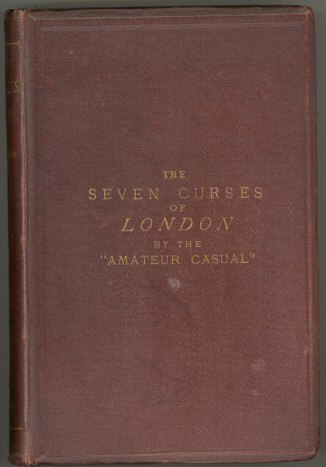
The Project Gutenberg eBook of The seven curses of London
Title: The seven curses of London
Author: James Greenwood
Release date: May 5, 2014 [eBook #45585]
Language: English
Credits: Transcribed from the [1869] edition by David Price
Transcribed from the [1869] edition by David Price, email ccx074@pglaf.org
THE
SEVEN CURSES OF LONDON.
By JAMES
GREENWOOD,
The “Amateur Casual.”
LONDON:
STANLEY RIVERS AND CO.
CONTENTS.
I. Neglected Children. |
|
CHAPTER I. |
|
The Pauper Population.—Pauper Children.—Opinions concerning their proper Treatment.—A Hundred Thousand Children loose in London Streets.—Neglected Babies.—Juvenile “Market Prowlers” |
page 1 |
CHAPTER II. |
|
Who are the Mothers?—The Infant Labour-Market.—Watch London and Blackfriars Bridges.—The Melancholy Types.—The Flashy, Flaunting “Infant.”—Keeping Company.—Marriage.—The Upshot |
p. 13 |
CHAPTER III. |
|
“Baby-Farmers” and Advertising “Child-Adopters.”—“F. X.” of Stepney.—The Author’s Interview with Farmer Oxleek.—The Case of Baby Frederick Wood |
p. 29 |
CHAPTER IV. |
|
The London Errand-Boy.—His Drudgery and Privations.—His Temptations.—The London Boy after Dark.—The Amusements provided for him |
p. 58 |
Curious Problem.—The best Method of Treatment.—The “Child of the Gutter” not to be entirely abolished.—The genuine Alley-bred Arab.—The Poor Lambs of the Ragged Flock.—The Tree of Evil in our midst.—The Breeding Places of Disease and Vice |
p. 76 |
II. Professional Thieves. |
|
CHAPTER VI. |
|
Twenty Thousand Thieves in London.—What it means.—The Language of “Weeds.”—Cleverness of the Pilfering Fraternity.—A Protest against a barbarous Suggestion.—The Prisoner’s great Difficulty.—The Moment of Leaving Prison.—Bad Friends.—What becomes of Good Resolutions and the Chaplain’s Counsel?—The Criminal’s Scepticism of Human Goodness.—Life in “Little Hell.”—The Cow-Cross Mission. |
p. 85 |
CHAPTER VII. |
|
The Three Classes of Thieving Society.—Popular Misapprehensions.—A True Picture of the London Thief.—A Fancy Sketch of the “Under-ground Cellar.”—In Disguise at a Thieves’ Raffle.—The Puzzle of “Black Maria.”—Mr. Mullins’s Speech and his Song |
p. 108 |
CHAPTER VIII. |
|
The Beginning of the Downhill Journey.—Candidates for Newgate Honours.—Black Spots of London.—Life from the Young Robber’s Point of View.—The Seedling Recruits the most difficult to reform.—A doleful Summing-up.—A Phase of the Criminal Question left unnoticed.—Budding Burglars.—Streams which keep at full flood the Black Sea of Crime.—The Promoters of “Gallows Literature.”—Another Shot at a Fortress of the Devil.—“Poison-Literature.”—“Starlight Sall.”—“Panther Bill” |
p. 124 |
CHAPTER IX. |
|
The Registered and the Unregistered Thieves of the London Hunting-ground.—The Certainty of the Crop of Vice.—Omnibus Drivers and Conductors.—The “Watchers.”—The London General Omnibus Company.—The Scandal of their System.—The Shopkeeper Thief.—False Weights and Measures.—Adulteration of Food and Drink.—Our Old Law, “I am as honest as I can afford to be!”—Rudimentary Exercises in the Art of Pillage |
p. 144 |
CHAPTER X. |
|
Lord Romilly’s Suggestion concerning the Education of the Children of Criminals.—Desperate Criminals.—The Alleys of the Borough.—The worst Quarters not, as a rule, the most noisy.—The Evil Example of “Gallows Heroes,” “Dick Turpin,” “Blueskin,” &c.—The Talent for “Gammoning Lady Green.”—A worthy Governor’s Opinion as to the best way of “Breaking” a Bad Boy.—Affection for “Mother.”—The Dark Cell and its Inmate.—An Affecting Interview |
p. 173 |
CHAPTER XI. |
|
Recent Legislation.—Statistics.—Lord Kimberley’s “Habitual Criminals” Bill.—The Present System of License-Holders.—Colonel Henderson’s Report.—Social Enemies of Suspected Men.—The Wrong-headed Policeman and the Mischief he may cause.—Looking out for a Chance.—The last Resource of desperate Honesty.—A Brotherly Appeal.—“Ginger will settle her.”—Ruffians who should be shut up |
p. 183 |
CHAPTER XII. |
|
“Only a Beggar.”—The Fraternity 333 Years ago.—A savage Law.—Origin of the Poor-Laws.—Irish Distinction in the Ranks of Beggary.—King Charles’s Proclamation.—Cumberland Discipline |
p. 211 |
CHAPTER XIII. |
|
The Effect of “The Society for the Suppression of Mendicity.”—State Business earned out by Individual Enterprise.—“The Discharged Prisoners’ Aid Society.”—The quiet Work of these Societies.—Their Mode of Work.—Curious Statistics.—Singular Oscillations.—Diabolical Swindling |
p. 221 |
CHAPTER XIV. |
|
The Variety and Quality of the Imposture.—Superior Accomplishments of the Modern Practitioner.—The Recipe for Success.—The Power of “Cheek.”—“Chanting” and the “Shallow Lay.”—Estimates of their Paying Value.—The Art of touching Women’s Hearts.—The Half-resentful Trick.—The Loudon “Cadger.”—The Height of the “Famine Season.” |
p. 242 |
CHAPTER XV. |
|
The Newspaper Plan and the delicate Process.—Forms of Petition.—Novel Applications of Photography.—Personal Attractions of the Distressed.—Help, or I perish! |
|
CHAPTER XVI. |
|
The Difficulty in handling it.—The Question of its Recognition.—The Argyll Rooms.—Mr. Acton’s Visit there.—The Women and their Patrons.—The Floating Population of Windmill-street.—Cremorne Gardens in the Season |
p. 271 |
CHAPTER XVII. |
|
Statistics of Westminster, Brompton, and Pimlico.—Methods of conducting the nefarious Business.—Aristocratic Dens.—The High Tariff.—The Horrors of the Social Evil.—The Broken Bridge behind the Sinner.—“Dress Lodgers.”—There’s always a “Watcher.”—Soldiers and Sailors.—The “Wrens of the Curragh” |
p. 281 |
CHAPTER XVIII. |
|
The Laws applying to Street-walkers.—The Keepers of the Haymarket Night-houses.—Present Position of the Police-magistrates.—Music-hall Frequenters.—Refreshment-bars.—Midnight Profligacy—“Snuggeries.”—Over-zealous Blockheads. |
p. 304 |
CHAPTER XIX. |
|
Ignoring the Evil.—Punishment fit for the “Deserter” and the Seducer.—The “Know-nothing” and “Do-nothing” Principle.—The Emigration of Women of Bad Character |
p. 324 |
V. The Curse of Drunkenness. |
|
CHAPTER XX. |
|
The crowning Curse.—No form of sin or sorrow in which it does not play a part.—The “Slippery Stone” of Life.—Statistics.—Matters not growing worse.—The Army Returns.—The System of Adulteration |
p. 332 |
The Permissive Liquors Bill.—Its Advocates and their Arguments.—The Drunkenness of the Nation.—Temperance Facts and Anecdotes.—Why the Advocates of Total Abstinence do not make more headway.—Moderate Drinking.—Hard Drinking.—The Mistake about childish Petitioners |
p. 351 |
VI. Betting Gamblers. |
|
CHAPTER XXII. |
|
The Vice of Gambling on the increase among the Working-classes.—Sporting “Specs.”—A “Modus.”—Turf Discoveries.—Welshers.—The Vermin of the Betting-field.—Their Tactics.—The Road to Ruin |
p. 377 |
VII. Waste of Charity. |
|
CHAPTER XXIII. |
|
Parochial Statistics.—The Public hold the Purse-strings.—Cannot the Agencies actually at work be made to yield greater Results?—The need of fair Rating.—The Heart and Core of the Poor-law Difficulty.—My foremost thought when I was a “Casual.”—Who are most liable to slip?—“Crank-work.”—The Utility of Labour-yards.—Scales of Relief.—What comes of breaking-up a Home |
p. 421 |
CHAPTER XXIV. |
|
Emigration.—The various Fields.—Distinguish the Industrious Worker in need of temporary Relief.—Last Words |
p. 455 |
I.—Neglected Children.
CHAPTER I.
STARTLING FACTS.
The Pauper Population.—Pauper Children.—Opinions concerning their proper Treatment.—A Hundred Thousand Children loose in London Streets.—Neglected Babies.—Juvenile “Market Prowlers.”
It is a startling fact that, in England and Wales alone, at the present time, the number of children under the age of sixteen, dependent more or less on the parochial authorities for maintenance, amounts to three hundred and fifty thousand.
It is scarcely less startling to learn that annually more than a hundred thousand criminals emerge at the doors of the various prisons, that, for short time or long time, have been their homes, and with no more substantial advice than “to take care that they don’t make their appearance there again,” are turned adrift once more to face the world, unkind as when they last stole from it. This does not include our immense army of juvenile vagrants. How the information has been arrived at is more than I can tell; but it is an accepted fact that, daily, winter and summer, within the limits of our vast and wealthy city of London, there wander, destitute of proper guardianship, food, clothing, or employment, a hundred thousand boys and girls in fair training for the treadmill and the oakum shed, and finally for Portland and the convict’s mark.
It is these last-mentioned hundred thousand, rather than the four hundred and fifty thousand previously mentioned, that are properly classed under the heading of this first chapter. Practically, the three hundred and fifty thousand little paupers that cumber the poor-rates are without the category of neglected ones. In all probability, at least one-half of that vast number never were victims of neglect, in the true sense of the term. Mr. Bumble derives his foster children from sources innumerable. There are those that are born in the “house,” and who, on some pretext, are abandoned by their unnatural mother. There are the “strays,” discovered by the police on their beats, and consigned, for the present, to the workhouse, and never owned. There is the offspring of the decamping weaver, or shoemaker, who goes on tramp “to better himself;” but, never succeeding, does not regard it as worth while to tramp home again to report his ill-luck. These, and such as these, may truly ascribe their pauperism to neglect on somebody’s part; but by far the greater number are what they are through sheer misfortune. When death snatches father away from the table scarcely big enough to accommodate the little flock that cluster about it—snatches him away in the lusty prime of life, and without warning, or, worse still, flings him on a bed of sickness, the remedies for which devour the few pounds thriftily laid aside for such an emergency, and, after all, are of no avail, what other asylum but the workhouse offers itself to mother and children? How many cases of this kind the parish books could reveal, one can only guess; quite enough, we may be sure, to render unpalatable that excessive amount of caution observed by those in power against “holding out a premium” to pauperism. It is somewhat amazing to hear great authorities talk sometimes. Just lately, Mr. Bartley, reading at the Society of Arts a paper entitled, “The training and education of pauper children,” took occasion to remark:—
“These children cannot be looked upon exactly in the same way as paupers proper, inasmuch as their unfortunate position is entirely due to circumstances over which they could have no control. They are either the offspring of felons, cripples, and idiots, or orphans, bastards, and deserted children, and claim the protection of the law, frequently from their tenderest years, from having been deprived of the care of their natural guardians without fault or crime of their own. Such being their condition, they must either steal or starve in the streets, or the State must take charge of them. It may further be affirmed that, in a strictly commercial point of view, it is more economical to devote a certain amount in education and systematic training than by allowing them to grow up in the example of their parents and workhouse companions, to render their permanent support, either in a prison or a workhouse, a burden on the industrious classes. The State, in fact, acknowledges this, and accordingly a provision is theoretically supplied for all pauper children, not only for their bodily wants, but, to a certain extent, for their mental improvement. At the same time, it is also necessary that the extreme should not be run into, viz., that of treating them so liberally as to hold out a premium to pauperism. In no case should their comfort be better than, nor in fact as good as, an industrious labourer has within his reach.”
Mr. Bartley is a gentleman whose knowledge of the subject he treats of exceeds that of most men; moreover, he is a man who, in his acts and nature, shows himself actuated by a kind heart, governed by a sound head; but, with all deference, it is difficult to agree altogether with the foregoing remarks of his: and they are the better worth noticing, because precisely the same sentiment breathes through almost every modern, new, and improved system of parochial reform. Why should these unfortunate creatures, “their unfortunate position being entirely due to circumstances over which they had no control,” be made less comfortable in their condition than the industrious labourer,—who, by the way, may be an agricultural labourer, with his starvation wages of nine shillings a week and his damp and miserable hovel of two rooms to board and lodge his numerous family? What sort of justice is it to keep constantly before their unoffending eyes the humiliating fact that they have no standing even on the bottom round of the social ladder, and that their proper place is to crouch meekly and uncomplainingly at the foot of it? Even supposing that they, the pauper children, are “either the offspring of felons, cripples, and idiots, or orphans, bastards, and deserted children,” which is assuming to the verge of improbability, still, since it is acknowledged that the state in which we discover them “is due to no fault or crime of their own,” why should we hesitate to make them commonly comfortable? To fail so to do when it is in our power, and when, according to their innocence and helplessness, it is their due, is decidedly at variance with the commonly-understood principles of Christian charity. It will be needless, however, here to pursue the subject of pauper management, since another section of this book has been given to its consideration. Anyhow, our three hundred and fifty thousand pauper children can have no claim to be reckoned among the “neglected.” They are, or should be, a class whose hard necessity has been brought under the notice of the authorities, and by them considered and provided for.
There are other neglected children besides those already enumerated, and who are not included in the tenth part of a million who live in the streets, for the simple reason that they are too young to know the use of their legs. They are “coming on,” however. There is no present fear of the noble annual crop of a hundred thousand diminishing. They are so plentifully propagated that a savage preaching “civilization” might regard it as a mercy that the localities of their infant nurture are such as suit the ravening appetites of cholera and typhus. Otherwise they would breed like rabbits in an undisturbed warren, and presently swarm so abundantly that the highways would be over-run, making it necessary to pass an Act of Parliament, improving on the latest enacted for dogs, against the roaming at large of unmuzzled children of the gutter. Observe the vast number of “city Arabs,” to be encountered in a walk, from Cheapside to the Angel at Islington, say. You cannot mistake them. There are other children who are constantly encountered in the street, male and female, who, though perhaps neither so ragged and dirty as the genuine juvenile vagrants, are even more sickly and hungry looking; but it is as easy to distinguish between the two types—between the home-owning and the homeless, as between the sleek pet dog, and the cur of the street, whose ideas of a “kennel” are limited to that represented by the wayside gutter, from which by good-luck edibles may be extracted. Not only does the youthful ragamuffin cry aloud for remedy in every street and public way of the city, he thrusts his ugly presence on us continuously, and appeals to us in bodily shape. In this respect, the curse of neglected children differs widely from any of the others, beggars alone excepted, perhaps. And even as regards beggars, to see them is not always to believe in them as human creatures helpless in the sad condition in which they are discovered, and worthy of the best help we can afford to bestow on them. It is next to impossible by outward signs merely to discriminate between the impostor and the really unfortunate and destitute. The pallid cheek and the sunken eye, may be a work of art and not of nature, and in the cunning arrangement of rags, so as to make the most of them, the cheat must always have an advantage over the genuine article. Weighing the evidence pro. and con., the object of it creeping even at his snail’s pace may be out of sight before we arrive at what appears to us a righteous verdict, and our scrupulous charity reserved for another, occasion. But no such perplexing doubts and hesitation need trouble us in selecting the boy gutter bred and born from the one who lays claim to a home, even though it may be no more than a feeble pretence, consisting of a family nightly gathering in some dirty sty that serves as a bedroom, and a morning meeting at a board spread with a substitute for a breakfast. In the latter there is an expression of countenance utterly wanting in the former; an undescribable shyness, and an instinctive observance of decency, that has been rain-washed and sun-burnt out of the gipsy of the London highway since the time of his crawling out of the gooseberry sieve, with a wisp of hay in it that served him as a cradle.
And here I can fancy I hear the incredulous reader exclaim, “But that is mere imagery of course; ragamuffin babies never are cradled in gooseberry sieves, with a wisp of hay to lie on.” Let me assure you, dear madam, it is not imagery, but positive fact. The strangest receptacles do duty as baby cradles at times. In another part of our book, it will be shown that a raisin-box may be so adapted, or even an egg-box; the latter with a bit of straw in it as a cradle for an invalid baby with a broken thigh! But as regards the gooseberry sieve, it is a fact that came under the writer’s immediate observation. Accompanied by a friend, he was on a visit of exploration into the little-known regions of Baldwin’s Gardens, in Leather Lane, and entering a cellar there, the family who occupied it were discovered in a state of dreadful commotion. The mother, a tall, bony, ragged shrew, had a baby tucked under one arm, while she was using the other by the aid of a pair of dilapidated nozzleless bellows in inflicting a tremendous beating on a howling young gentleman of about eleven years old. “Tut! tut! what is the matter, Mrs. Donelly? Rest your arm a moment, now, and tell us all about it.” “Matther! shure it’s matther enough to dhrive a poor widdy beyant her sinses!” And then her rage turning to sorrow, she in pathetic terms described how that she left that bad boy Johnny only for a few moments in charge of the “darlint comfortable ashleap in her bashket,” and that he had neglected his duty, and that the baste of a donkey had smelt her out, and “ate her clane out o’ bed.”
I have had so much experience in this way, that one day I may write a book on the Haunts and Homes of the British Baby. It was not long after the incident of the gooseberry sieve, that I discovered in one small room in which a family of six resided, three little children, varying in age from three to eight, perhaps, stark naked. It was noon of a summer’s day, and there they were nude as forest monkeys, and so hideously dirty that every rib-bone in their poor wasted little bodies showed plain, and in colour like mahogany. Soon as I put my head in at the door they scattered, scared as rabbits, to the “bed,” an arrangement of evil-smelling flock and old potato-sacks, and I was informed by the mother that they had not a rag to wear, and had been in their present condition for more than three months.
Let us return, however, to the hordes of small Arabs found wandering about the streets of the city. To the mind of the initiated, instantly recurs the question, “whence do they all come”? They are not imported like those other pests of society, “German band boys or organ grinders;” they must have been babies once upon a time; where did they grow up? In very dreary and retired regions, my dear sir, though for that matter if it should happen that you are perambulating fashionable Regent-street or aristocratic Belgravia, when you put to yourself the perplexing question, you may be nigher to a visible solution of the mystery than you would care to know. Where does the shoeless, ragged, dauntless, and often desperate boy of the gutter breed? Why, not unfrequently as close almost to the mansions of the rich and highly respectable as the sparrows in their chimney stacks. Nothing is more common than to discover a hideous stew of courts and alleys reeking in poverty and wretchedness almost in the shadow of the palatial abodes of the great and wealthy. Such instances might be quoted by the dozen.
It is seldom that these fledglings of the hawk tribe quit their nests or rather their nesting places until they are capable, although on a most limited scale, of doing business on their own account. Occasionally a specimen may be seen in the vicinity of Covent Garden or Farringdon Market, seated on a carriage extemporized out of an old rusty teatray and drawn along by his elder relatives, by means of a string. It may not be safely assumed, however, that the latter are actuated by no other than affectionate and disinterested motives in thus treating their infant charge to a ride. It is much more probable that being left at home in the alley by their mother, who is engaged elsewhere at washing or “charing,” with strict injunctions not to leave baby for so long as a minute, and being goaded to desperation by the thoughts of the plentiful feed of cast-out plums and oranges to be picked up in “Common Garden” at this “dead ripe” season of the year, they have hit on this ingenious expedient by which the maternal mandate may be obeyed to the letter, and their craving for market refuse be at the same time gratified.
By-the-bye, it may here be mentioned as a contribution towards solving the riddle, “How do these hundred thousand street prowlers contrive to exist?” that they draw a considerable amount of their sustenance from the markets. And really it would seem that by some miraculous dispensation of Providence, garbage was for their sake robbed of its poisonous properties, and endowed with virtues such as wholesome food possesses. Did the reader ever see the young market hunters at such a “feed” say in the month of August or September? It is a spectacle to be witnessed only by early risers who can get as far as Covent Garden by the time that the wholesale dealing in the open falls slack—which will be about eight o’clock; and it is not to be believed unless it is seen. They will gather about a muck heap and gobble up plums, a sweltering mass of decay, and oranges and apples that have quite lost their original shape and colour, with the avidity of ducks or pigs. I speak according to my knowledge, for I have seen them at it. I have seen one of these gaunt wolfish little children with his tattered cap full of plums of a sort one of which I would not have permitted a child of mine to eat for all the money in the Mint, and this at a season when the sanitary authorities in their desperate alarm at the spread of cholera had turned bill stickers, and were begging and imploring the people to abstain from this, that, and the other, and especially to beware of fruit unless perfectly sound and ripe. Judging from the earnestness with which this last provision was urged, there must have been cholera enough to have slain a dozen strong men in that little ragamuffin’s cap, and yet he munched on till that frowsy receptacle was emptied, finally licking his fingers with a relish. It was not for me to forcibly dispossess the boy of a prize that made him the envy of his plumless companions, but I spoke to the market beadle about it, asking him if it would not be possible, knowing the propensities of these poor little wretches, so to dispose of the poisonous offal that they could not get at it; but he replied that it was nothing to do with him what they ate so long as they kept their hands from picking and stealing; furthermore he politely intimated that “unless I had nothing better to do” there was no call for me to trouble myself about the “little warmint,” whom nothing would hurt. He confided to me his private belief that they were “made inside something after the orsestretch, and that farriers’ nails wouldn’t come amiss to ’em if they could only get ’em down.” However, and although the evidence was rather in the sagacious market beadle’s favour, I was unconverted from my original opinion, and here take the liberty of urging on any official of Covent Garden or Farringdon Market who may happen to read these pages the policy of adopting my suggestion as to the safe bestowal of fruit offal during the sickly season. That great danger is incurred by allowing it to be consumed as it now is, there cannot be a question. Perhaps it is too much to assume that the poor little beings whom hunger prompts to feed off garbage do so with impunity. It is not improbable that, in many cases, they slink home to die in their holes as poisoned rats do. That they are never missed from the market is no proof of the contrary. Their identification is next to impossible, for they are like each other as apples in a sieve, or peas in one pod. Moreover, to tell their number is out of the question. It is as incomprehensible as is their nature. They swarm as bees do, and arduous indeed would be the task of the individual who undertook to reckon up the small fry of a single alley of the hundreds that abound in Squalor’s regions. They are of as small account in the public estimation as stray street curs, and, like them, it is only where they evince a propensity for barking and biting that their existence is recognised. Should death to-morrow morning make a clean sweep of the unsightly little scavengers who grovel for a meal amongst the market offal heaps, next day would see the said heaps just as industriously surrounded.
CHAPTER II.
RESPECTING THE PARENTAGE OF SOME OF OUR
GUTTER POPULATION.
Who are the Mothers?—The Infant Labour Market.—Watch London and Blackfriars Bridges.—The Melancholy Types.—The Flashy, Flaunting “Infant.”—Keeping Company.—Marriage.—The Upshot.
Instructive and interesting though it may be to inquire into the haunts and habits of these wretched waifs and “rank outsiders” of humanity, of how much importance and of useful purpose is it to dig yet a little deeper and discover who are the parents—the mothers especially—of these babes of the gutter.
Clearly they had no business there at all. A human creature, and more than all, a helpless human creature, endowed with the noblest shape of God’s creation, and with a soul to save or lose, is as much out of place grovelling in filth and contamination as would be a wild cat crouching on the hearth-rug of a nursery. How come they there, then? Although not bred absolutely in the kennel, many merge into life so very near the edge of it, that it is no wonder if even their infantine kickings and sprawlings are enough to topple them over. Some there are, not vast in number, perhaps, but of a character to influence the whole, who are dropped into the gutter from such a height that they may never crawl out of it—they are so sorely crippled. Others, again, find their way to the gutter by means of a process identical with that which serves the conveyance to sinks and hidden sewers of the city’s ordinary refuse and off-scourings. Of this last-mentioned sort, however, it will be necessary to treat at length presently.
I think that it may be taken as granted that gross and deliberate immorality is not mainly responsible for our gutter population. Neither can the poverty of the nation be justly called on to answer for it. On the contrary, unless I am greatly mistaken, the main tributary to the foul stream has its fountain-head in the keen-witted, ready-penny commercial enterprise of the small-capital, business-minded portion of our vast community.
In no respect are we so unlike our forefathers as in our struggles after “mastership” in business, however petty. This may be a sign of commercial progress amongst us, but it is doubtful if it tends very much to the healthful constitution of our humanity. “Work hard and win a fortune,” has become a dry and mouldy maxim, distasteful to modern traders, and has yielded to one that is much smarter, viz., “There is more got by scheming than by hard work.”
By scheming the labour of others, that is; little children—anyone. It is in the infant labour market especially that this new and dashing spirit of commercial enterprise exercises itself chiefly. There are many kinds of labour that require no application of muscular strength; all that is requisite is dexterity and lightness of touch, and these with most children are natural gifts. They are better fitted for the work they are set to than adults would be, while the latter would require as wages shillings where the little ones are content with pence. This, perhaps, would be tolerable if their earnings increased with their years; but such an arrangement does not come within the scheme of the sweaters and slop-factors, Jew and Christian, who grind the bones of little children to make them not only bread, but luxurious living and country houses, and carriages to ride in. When their “hands” cease to be children, these enterprising tradesmen no longer require their services, and they are discharged to make room for a new batch of small toilers, eager to engage themselves on terms that the others have learned to despise, while those last-mentioned unfortunates are cast adrift to win their bread—somehow.
Anyone curious to know the sort of working young female alluded to may be gratified a hundred times over any day of the week, if he will take the trouble to post himself, between the hours of twelve and two, at the foot of London or Blackfriars bridge. There he will see the young girl of the slop-shop and the city “warehouse” hurrying homeward on the chance of finding a meagre makeshift—“something hot”—that may serve as a dinner.
It is a sight well worth the seeking of any philanthropic person interested in the present condition and possible future of the infant labour market. How much or how little of truth there may be in the lament one occasionally hears, that our endurance is failing us, and that we seldom reach the ripe old age attained by our ancestors, we will not here discuss; at least there can be no doubt of this—that we grow old much earlier than did our great grandfathers; and though our “three-score years and ten” may be shortened by fifteen or twenty years, the downhill portion of our existence is at least as protracted as that of the hale men of old who could leap a gate at sixty. This must be so, otherwise the ancient law, defining an infant as “a person under the age of fourteen,” could never have received the sanction of legislators. Make note of these “infants” of the law as they come in knots of two and three, and sometimes in an unbroken “gang,” just as they left the factory, putting their best feet foremost in a match against time; for all that is allowed them is one hour, and within that limited period they have to walk perhaps a couple of miles to and fro, resting only during that brief space in which it is their happy privilege to exercise their organs of mastication.
Good times indeed were those olden ones, if for no other reason than that they knew not such infants as these! Of the same stuff in the main, one and all, but by no means of the same pattern. Haggard, weary-eyed infants, who never could have been babies; little slips of things, whose heads are scarcely above the belt of the burly policeman lounging out his hours of duty on the bridge, but who have a brow on which, in lines indelible, are scored a dreary account of the world’s hard dealings with them. Painfully puckered mouths have these, and an air of such sad, sage experience, that one might fancy, not that these were young people who would one day grow to be old women, but rather that, by some inversion of the natural order of things, they had once been old and were growing young again—that they had seen seventy, at least, but had doubled on the brow of the hill of age, instead of crossing it, and retraced their steps, until they arrived back again at thirteen; the old, old heads planted on the young shoulders revealing the secret.
This, the most melancholy type of the grown-up neglected infant, is, however, by no means the most painful of those that come trooping past in such a mighty hurry. Some are dogged and sullen-looking, and appear as though steeped to numbness in the comfortless doctrine, “What can’t be cured must be endured;” as if they had acquired a certain sort of surly relish for the sours of existence, and partook of them as a matter of course, without even a wry face. These are not of the sort that excite our compassion the most; neither are the ailing and sickly-looking little girls, whose tender constitutions have broken down under pressure of the poison inhaled in the crowded workroom, and long hours, and countless trudgings, early and late, in the rain and mire, with no better covering for their shoulders than a flimsy mantle a shower would wet through and through, and a wretched pair of old boots that squelch on the pavement as they walk. Pitiful as are these forlorn ones to behold, there is, at least, a grim satisfaction in knowing that with them it cannot last. The creature who causes us most alarm is a girl of a very different type.
This is the flashy, flaunting “infant,” barely fourteen, and with scarce four feet of stature, but self-possessed and bold-eyed enough to be a “daughter of the regiment”—of a militia regiment even. She consorts with birds of her own feather. Very little experience enables one to tell at a glance almost how these girls are employed, and it is quite evident that the terrible infant in question and her companions are engaged in the manufacture of artificial flowers. Their teeth are discoloured, and there is a chafed and chilblainish appearance about their nostrils, as though suffering under a malady that were best consoled with a pocket-handkerchief. The symptoms in question, however, are caused by the poison used in their work—arsenite of copper, probably, that deadly mineral being of a “lovely green,” and much in favour amongst artificial florists and their customers. Here they come, unabashed by the throng, as though the highway were their home, and all mankind their brothers; she, the heroine with a bold story to tell, and plenty of laughter and free gesticulation as sauce with it. She is of the sort, and, God help them! they may be counted by hundreds in London alone, in whom keen wit would appear to be developed simultaneously with ability to walk and talk. Properly trained, these are the girls that grow to be clever, capable women—women of spirit and courage and shrewd discernment. The worst of it is that the seed implanted will germinate. Hunger cannot starve it to death, or penurious frosts destroy it. Untrained, it grows apace, overturning and strangling all opposition and asserting its paramount importance.
This is the girl who is the bane and curse of the workroom crowded with juvenile stitchers or pasters, or workers in flowers or beads. Her constant assumption of lightheartedness draws them towards her, her lively stories are a relief from the monotonous drudgery they are engaged on. Old and bold in petty wickedness, and with audacious pretensions to acquaintance with vice of a graver sort, she entertains them with stories of “sprees” and “larks” she and her friends have indulged in. She has been to “plays” and to “dancing rooms,” and to the best of her ability and means she demonstrates the latest fashion in her own attire, and wears her draggletail flinders of lace and ribbon in such an easy and old-fashionable manner, poor little wretch, as to impress one with the conviction that she must have been used to this sort of thing since the time of her shortcoating; which must have been many, many years ago. She has money to spend; not much, but sufficient for the purchase of luxuries, the consumption of which inflict cruel pangs on the hungry-eyed beholders. She is a person whose intimacy is worth cultivating, and they do cultivate it, with what result need not be here described.
At fifteen the London factory-bred girl in her vulgar way has the worldly knowledge of the ordinary female of eighteen or twenty. She has her “young man,” and accompanies him of evenings to “sing-songs” and raffles, and on high days and holidays to Hampton by the shilling van, or to Greenwich by the sixpenny boat. At sixteen she wearies of the frivolities of sweethearting, and the young man being agreeable the pair embark in housekeeping, and “settle down.”
Perhaps they marry, and be it distinctly understood, whatever has been said to the contrary, the estate of matrimony amongst her class is not lightly esteemed. On the contrary, it is a contract in which so much pride is taken that the certificate attesting its due performance is not uncommonly displayed on the wall of the living-room as a choice print or picture might be; with this singular and unaccountable distinction that when a clock is reckoned with the other household furniture, the marriage certificate is almost invariably hung under it. It was Mr. Catlin of the Cow Cross Mission who first drew my attention to this strange observance, and in our many explorations into the horrible courts and alleys in the vicinity of his mission-house he frequently pointed out instances of this strange custom; but even he, who is as learned in the habits and customs of all manner of outcasts of civilisation as any man living, was unable to explain its origin. When questioned on the subject the common answer was, “They say that it’s lucky.”
It is the expense attending the process that makes matrimony the exception and not the rule amongst these people. At least this is their invariable excuse. And here, as bearing directly on the question of “neglected infants,” I may make mention of a practice that certain well-intentioned people are adopting with a view to diminishing the prevalent sin of the unmarried sexes herding in their haunts of poverty, and living together as man and wife.
The said practice appears sound enough on the surface. It consists simply in marrying these erring couples gratis. The missionary or scripture reader of the district who, as a rule, is curiously intimate with the family affairs of his flock, calls privately on those young people whose clock, if they have one, ticks to a barren wall, and makes the tempting offer—banns put up, service performed, beadle and pew opener satisfied, and all free! As will not uncommonly happen, if driven into a corner for an excuse, the want of a jacket or a gown “to make a ’spectable ’pearance in” is pleaded; the negociator makes a note of it, and in all probability the difficulty is provided against, and in due course the marriage is consummated.
This is all very well as far as it goes, but to my way of thinking the scheme is open to many grave objections. In the first place the instinct that incites people to herd like cattle in a lair is scarcely the same as induces them to blend their fortunes and live “for better, for worse” till the end of their life. It requires no great depth of affection on the man’s part to lead him to take up with a woman who, in consideration of board and lodging and masculine protection will create some semblance of a home for him. In his selection of such a woman he is not governed by those grave considerations that undoubtedly present themselves to his mind when he meditates wedding himself irrevocably to a mate. Her history, previous to his taking up with her, may be known to him, and though perhaps not all that he could wish, she is as good to him as she promised to be, and they get along pretty well and don’t quarrel very much.
Now, although not one word can be urged in favour of this iniquitous and shocking arrangement, is it quite certain that a great good is achieved by inducing such a couple to tie themselves together in the sacred bonds of matrimony? It is not a marriage of choice as all marriages should be. If the pair had been bent on church marriage and earnestly desired it, it is absurd to suppose that the few necessary shillings, the price of its performance, would have deterred them. If they held the sacred ceremony of so small account as to regard it as well dispensed with as adopted, it is no very great triumph of the cause of religion and morality that the balance is decided by a gown or a jacket, in addition to the good will of the missionary (who, by-the-bye, is generally the distributor of the alms of the charitable) being thrown into the scale.
To be sure the man is not compelled to yield to the persuasions of those who would make of him a creditable member of society; he is not compelled to it, but he can hardly be regarded as a free agent. If the pair have children already, the woman will be only too anxious to second the solicitation of her friend, and so secure to herself legal protection in addition to that that is already secured to her through her mate’s acquired regard for her. Then it is so difficult to combat the simple question, “Why not?” when all is so generously arranged—even to the providing a real gold ring to be worn in place of the common brass make-believe—and nothing remains but to step round to the parish church, where the minister is waiting, and where in a quarter of an hour, the great, and good, and lasting work may be accomplished. The well-meaning missionary asks, “Why not?” The woman, urged by moral or mercenary motives, echoes the momentous query, and both stand with arms presented, in a manner of speaking, to hear the wavering one’s objection. The wavering one is not generally of the far-seeing sort. In his heart he does not care as much as a shilling which way it is. He does not in the least trouble himself from the religious and moral point of view. When his adviser says, “Just consider how much easier your conscience will be if you do this act of justice to the woman whom you have selected as your helpmate,” he wags his head as though admitting it, but having no conscience about the matter he is not very deeply impressed. Nine times out of ten the summing-up of his deliberation is, “I don’t care; it won’t cost me nothing; let ’em have their way.”
But what, probably, is the upshot of the good missionary’s endeavours and triumph? In a very little time the gilt with which the honest adviser glossed the chain that was to bind the man irrevocably to marriage and morality wears off. The sweat of his brow will not keep it bright; it rusts it. He feels, in his own vulgar though expressive language, that he has been “bustled” into a bad bargain. “It is like this ’ere,” a matrimonial victim of the class once confided to me; “I don’t say as she isn’t as good as ever, but I’m blowed if she’s all that better as I was kidded to believe she would be.”
“But if she is as good as ever, she is good enough.”
“Yes, but you haven’t quite got the bearing of what I mean, sir, and I haint got it in me to put it in the words like you would. Good enough before isn’t good enough now, cos it haint hoptional, don’t you see? No, you don’t. Well, look here. S’pose I borrer a barrer. Well, it’s good enough and a conwenient size for laying out my stock on it. It goes pooty easy, and I pays eighteen pence a week for it and I’m satisfied. Well, I goes on all right and without grumbling, till some chap he ses to me, ‘What call have you got to borrer a barrer when you can have one of your own; you alwis want a barrer, don’t you know, why not make this one your own?’ ‘Cos I can’t spare the money,’ I ses. ‘Oh,’ he ses, ‘I’ll find the money and the barrer’s yourn, if so be as you’ll promise and vow to take up with no other barrer, but stick to this one so long as you both shall live.’ Well, as aforesaid, it’s a tidy, useful barrer, and I agrees. But soon as it’s mine, don’t you know, I ain’t quite so careless about it. I overhauls it, in a manner of speaking, and I’m more keerful in trying the balance of it in hand when the load’s on it. Well, maybe I find out what I never before troubled myself to look for. There’s a screw out here and a bolt wanted there. Here it’s weak, and there it’s ugly. I dwells on it in my mind constant. I’ve never got that there barrer out of my head, and p’raps I make too much of the weak pints of it. I gets to mistrust it. ‘It’s all middling right, just now, old woman—old barrer, I mean,’ I ses to myself, ‘but you’ll be a playing me a trick one day, I’m afraid.’ Well, I go on being afraid, which I shouldn’t be if I was only a borrower.”
“But you should not forget that the barrow, to adopt your own ungallant figure of speech, is not accountable for these dreads and suspicions of yours; it will last you as long and as well as though you had continued a borrower; you will admit that, at least!”
“I don’t know. Last, yes! That’s the beggaring part of it. Ah, well! p’raps it’s all right, but I’m blest if I can stand being haunted like I am now.”
Nothing that I could say would add force to the argument of my costermonger friend, as set forth in his parable of the “barrer.” Applying it to the question under discussion, I do not mean to attribute to the deceptiveness of the barrow or to its premature breaking down, the spilling into the gutter of all the unhappy children there discovered. My main reason for admitting the evidence in question was to endeavour to show that as a pet means of improving the morality of our courts and alleys, and consequently of diminishing the gutter population, the modern idea of arresting fornication and concubinage, by dragging the pair there and then to church, and making them man and wife, is open to serious objections. The state of matrimony is not good for such folk. It was never intended for them. It may be as necessary to healthful life as eating is, but no one would think of taking a man starved, and in the last extremity for lack of wholesome aliment, and setting before him a great dish of solid food. It may be good for him by-and-by, but he must be brought along by degrees, and fitted for it. Undoubtedly a great source of our abandoned gutter children may be found in the shocking herding together of the sexes in the vile “slums” and back places of London, and it is to be sincerely hoped that some wise man will presently devise a speedy preventive.
In a recent report made to the Commissioners of Sewers for London, Dr. Letheby says: “I have been at much pains during the last three months to ascertain the precise conditions of the dwellings, the habits, and the diseases of the poor. In this way 2,208 rooms have been most circumstantially inspected, and the general result is that nearly all of them are filthy or overcrowded or imperfectly drained, or badly ventilated, or out of repair. In 1,989 of these rooms, all in fact that are at present inhabited, there are 5,791 inmates, belonging to 1,576 families; and to say nothing of the too frequent occurrence of what may be regarded as a necessitous overcrowding, where the husband, the wife, and young family of four or five children are cramped into a miserably small and ill-conditioned room, there are numerous instances where adults of both sexes, belonging to different families, are lodged in the same room, regardless of all the common decencies of life, and where from three to five adults, men and women, besides a train or two of children, are accustomed to herd together like brute beasts or savages; and where every human instinct of propriety and decency is smothered. Like my predecessor, I have seen grown persons of both sexes sleeping in common with their parents, brothers and sisters, and cousins, and even the casual acquaintance of a day’s tramp, occupying the same bed of filthy rags or straw; a woman suffering in travail, in the midst of males and females of different families that tenant the same room, where birth and death go hand in hand; where the child but newly born, the patient cast down with fever, and the corpse waiting for interment, have no separation from each other, or from the rest of the inmates. Of the many cases to which I have alluded, there are some which have commanded my attention by reason of their unusual depravity—cases in which from three to four adults of both sexes, with many children, were lodging in the same room, and often sleeping in the same bed. I have note of three or four localities, where forty-eight men, seventy-three women, and fifty-nine children are living in thirty-four rooms. In one room there are two men, three women, and five children, and in another one man, four women, and two children; and when, about a fortnight since, I visited the back room on the ground floor of No. 5, I found it occupied by one man, two women, and two children; and in it was the dead body of a poor girl who had died in childbirth a few days before. The body was stretched out on the bare floor, without shroud or coffin. There it lay in the midst of the living, and we may well ask how it can be otherwise than that the human heart should be dead to all the gentler feelings of our nature, when such sights as these are of common occurrence.
“So close and unwholesome is the atmosphere of some of these rooms, that I have endeavoured to ascertain, by chemical means, whether it does not contain some peculiar product of decomposition that gives to it its foul odour and its rare powers of engendering disease. I find it is not only deficient in the due proportion of oxygen, but it contains three times the usual amount of carbonic acid, besides a quantity of aqueous vapour charged with alkaline matter that stinks abominably. This is doubtless the product of putrefaction, and of the various fœtid and stagnant exhalations that pollute the air of the place. In many of my former reports, and in those of my predecessor, your attention has been drawn to this pestilential source of disease, and to the consequence of heaping human beings into such contracted localities; and I again revert to it because of its great importance, not merely that it perpetuates fever and the allied disorders, but because there stalks side by side with this pestilence a yet deadlier presence, blighting the moral existence of a rising population, rendering their hearts hopeless, their acts ruffianly and incestuous, and scattering, while society averts her eye, the retributive seeds of increase for crime, turbulence and pauperism.”
CHAPTER III.
BABY-FARMING.
“Baby-Farmers” and Advertising “Child Adopters.”—“F. X.” of Stepney.—The Author’s Interview with Farmer Oxleek.—The Case of Baby Frederick Wood.
Although it is not possible, in a book of moderate dimensions, such as this, to treat the question of neglected children with that extended care and completeness it undoubtedly deserves, any attempt at its consideration would be glaringly deficient did it not include some reference to the modern and murderous institution known as “baby farming.”
We may rely on it that we are lamentably ignorant both of the gigantic extent and the pernicious working of this mischief. It is only when some loud-crying abuse of the precious system makes itself heard in our criminal courts, and is echoed in the newspapers, or when some adventurous magazine writer in valiant pursuit of his avocation, directs his inquisitive nose in the direction indicated, that the public at large hear anything either of the farmer or the farmed.
A year or so ago a most atrocious child murder attracted towards this ugly subject the bull’s-eye beams of the press, and for some time it was held up and exhibited in all its nauseating nakedness. It may be safely asserted that during the protracted trial of the child murderess, Mrs. Winser, there was not one horrified father or mother in England who did not in terms of severest indignation express his or her opinion of how abominable it was that such scandalous traffic in baby flesh and blood should, through the law’s inefficiency, be rendered possible. But it was only while we, following the revolting revelations, were subject to a succession of shocks and kept in pain, that we were thus virtuous. It was only while our tender feelings were suffering excruciation from the harrowing story of baby torture that we shook in wrath against the torturer. Considering what our sufferings were (and from the manner of our crying out they must have been truly awful) we recovered with a speed little short of miraculous. Barely was the trial of the murderess concluded and the court cleared, than our fierce indignation subsided from its bubbling and boiling, and quickly settled down to calm and ordinary temperature. Nay it is hardly too much to say that our over-wrought sympathies as regards baby neglect and murder fell so cold and flat that little short of a second edition of Herod’s massacre might be required to raise them again.
This is the unhappy fate that attends nearly all our great social grievances. They are overlooked or shyly glanced at and kicked aside for years and years, when suddenly a stray spark ignites their smouldering heaps, and the eager town cooks a splendid supper of horrors at the gaudy conflagration; but having supped full, there ensues a speedy distaste for flame and smoke, and in his heart every one is chiefly anxious that the fire may burn itself out, or that some kind hand will smother it. “We have had enough of it.” That is the phrase. The only interest we ever had in it, which was nothing better than a selfish and theatrical interest, is exhausted. We enjoyed the bonfire amazingly, but we have no idea of tucking back our coat-sleeves and handling a shovel or a pick to explore the unsavoury depth and origin of the flareup, and dig and dam to guard against a repetition of it. It is sufficient for us that we have endured without flinching the sensational horrors dragged to light; let those who dragged them forth bury them again; or kill them; or be killed by them. We have had enough of them.
Great social grievances are not to be taken by storm. They merely bow their vile heads while the wrathful blast passes, and regain their original position immediately afterwards. So it was with this business of baby-farming, and the tremendous outcry raised at the time when the wretch Winser was brought to trial. There are certain newspapers in whose advertisement columns the baby-farmer advertises for “live stock” constantly, and at the time it was observed with great triumph by certain people that since the vile hag’s detection the advertisements in question had grown singularly few and mild. But the hope that the baby-farmer had retired, regarding his occupation as gone, was altogether delusive. He was merely lying quiet for a spell, quite at his ease, making no doubt that business would stir again presently. Somebody else was doing his advertising, that was all. If he had had any reasonable grounds for supposing that the results of the appalling facts brought to light would be that the Legislature would bestir itself and take prompt and efficacious steps towards abolishing him, it would have been different. But he had too much confidence in the sluggardly law to suppose anything of the kind. He knew that the details of the doings of himself and his fellows would presently sicken those who for a time had evinced a relish for them, and that in a short time they would bid investigators and newspapers say no more—they had had enough of it! When his sagacity was verified, he found his way leisurely back to the advertising columns again.
I have spoken of the baby-farmers as masculine, but that was merely for convenience of metaphor. No doubt that the male sex have a considerable interest in the trade, but the negociators, and ostensibly the proprietors, are women. As I write, one of the said newspapers lies before me. It is a daily paper, and its circulation, an extensive one, is essentially amongst the working classes, especially amongst working girls and women.
The words italicised are worthy particular attention as regards this particular part of my subject. Here is a daily newspaper that is mainly an advertising broadsheet. It is an old-established newspaper, and its advertisement columns may be said fairly to reflect the condition of the female labour market over vast tracts of the London district. Column after column tells of the wants of servants and masters. “Cap-hands,” “feather-hands,” “artificial flower-hands,” “chenille-hands,” hands for the manufacture of “chignons” and “hair-nets” and “bead work,” and all manner of “plaiting” and “quilling” and “gauffering” in ribbon and net and muslin, contributing towards the thousand and one articles that stock the “fancy” trade. There are more newspapers than one that aspire as mediums between employers and employed, but this, before all others, is the newspaper, daily conned by thousands of girls and women in search of work of the kind above mentioned, and it is in this newspaper that the baby-farmer fishes wholesale for customers.
I write “wholesale,” and surely it is nothing else. To the uninitiated in this peculiar branch of the world’s wickedness it would seem that, as an article of negociation, a baby would figure rarer than anything, and in their innocence they might be fairly guided to this conclusion on the evidence of their personal experience of the unflinching love of parents, though never so poor, for their children; yet in a single number of this newspaper published every day of the week and all the year round, be it borne in mind, appear no less than eleven separate advertisements, emanating from individuals solicitous for the care, weekly, monthly, yearly—anyhow, of other people’s children, and that on terms odorous of starvation at the least in every meagre figure.
It is evident at a glance that the advertisers seek for customers and expect none other than from among the sorely pinched and poverty-stricken class that specially patronise the newspaper in question. The complexion, tone, and terms of their villanously cheap suggestions for child adoption are most cunningly shaped to meet the possible requirements of some unfortunate work-girl, who, earning while at liberty never more than seven or eight shillings a week, finds herself hampered with an infant for whom no father is forthcoming. There can scarcely be imagined a more terrible encumbrance than a young baby is to a working girl or woman so circumstanced. Very often she has a home before her disaster announced itself—her first home, that is, with her parents—and in her shame and disgrace she abandons it, determined on hiding away where she is unknown, “keeping herself to herself.” She has no other means of earning a livelihood excepting that she has been used to. She is a “cap-hand,” or an “artificial flower-hand,” and such work is always entirely performed at the warehouse immediately under the employer’s eye. What is she to do? She cannot possibly carry her baby with her to the shop and keep it with her the livelong day. Were she inclined so to do, and could somehow contrive to accomplish the double duty of nurse and flower-weaver, it would not be allowed. If she stays at home in the wretched little room she rents with her infant she and it must go hungry. It is a terrible dilemma for a young woman “all but” good, and honestly willing to accept the grievous penalty she must pay if it may be accomplished by the labour of her hands. Small and puny, however, the poor unwelcome little stranger may be, it is a perfect ogre of rapacity on its unhappy mother’s exertions. Now and then an instance of the self-sacrificing devotion exhibited by those unhappy mothers for their fatherless children creeps into print. There was held in the parish of St. Luke’s, last summer, an inquest on the body of a neglected infant, aged seven months. The woman to whose care she was confided had got drunk, and left the poor little thing exposed to the cold, so that it died. The mother paid the drunken nurse four-and-sixpence a week for the child’s keep, and it was proved in evidence that she (the mother) had been earning at her trade of paper-bag making never more than six-and-threepence per week during the previous five months. That was four-and-sixpence for baby and one-and-ninepence for herself.
I don’t think, however, that the regular baby-farmer is a person habitually given to drink. The successful and lucrative prosecution of her business forbids the indulgence. Decidedly not one of the eleven advertisements before mentioned read like the concoctions of persons whose heads were muddled with beer or gin. Here is the first one:—
NURSE CHILD WANTED, OR TO ADOPT.—The Advertiser, a Widow with a little family of her own, and a moderate allowance from her late husband’s friends, would be glad to accept the charge of a young child. Age no object. If sickly would receive a parent’s care. Terms, Fifteen Shillings a month; or would adopt entirely if under two months for the small sum of Twelve pounds.
Women are shrewder than men at understanding these matters, and the advertisement is addressed to women; but I doubt if a man would be far wrong in setting down the “widow lady with a little family of her own,” as one of those monsters in woman’s clothing who go about seeking for babies to devour. Her “moderate allowance,” so artlessly introduced, is intended to convey to the unhappy mother but half resolved to part with her encumbrance, that possibly the widow’s late husband’s friends settle her butcher’s and baker’s bills, and that under such circumstances the widow would actually be that fifteen shillings a month in pocket, for the small trouble of entering the little stranger with her own interesting little flock. And what a well-bred, cheerful, and kindly-behaved little flock it must be, to have no objection to add to its number a young child aged one month or twelve, sick or well! Fancy such an estimable person as the widow lady appraising her parental care at so low a figure as three-and-ninepence a week—sevenpence farthing a day, including Sundays! But, after all, that is not so cheap as the taking the whole and sole charge of a child, sick or well, mind you, to nourish and clothe, and educate it from the age of two months till twelve years, say! To be sure, the widow lady stipulates that the child she is ready to “adopt” must be under two months, and we all know how precarious is infantine existence, and at what a wonderfully low rate the cheap undertakers bury babies in these days.