
FOREWORD
Leonid Andreyev, who was born in Oryol, in 1871, is the most popular, and next to Tolstoy, the most gifted writer in Russia to-day. Andreyev has written many important stories and dramas, the best known among which are “Red Laughter,” “Life of Man,” “To the Stars,” “The Life of Vasily Fiveisky,” “Eliazar,” “Black Masks,” and “The Story of the Seven Who Were Hanged.”
In “Red Laughter” he depicted the horrors of war as few men had ever before done it. He dipped his pen into the blood of Russia and wrote the tragedy of the Manchurian war.
In his “Life of Man” Andreyev produced a great, imaginative “morality” play which has been ranked by European critics with some of the greatest dramatic masterpieces.
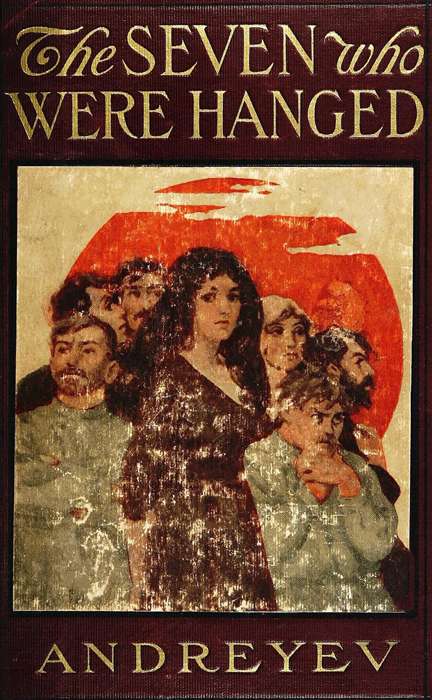
The story of “The Seven Who Were Hanged” is thus far his most important achievement. The keen psychological insight and the masterly simplicity with which Andreyev has penetrated and depicted each of the tragedies of the seven who were hanged place him in the same class as an artist with Russia’s greatest masters of fiction, Dostoyevsky, Turgenev and Tolstoy.
I consider myself fortunate to be able to present to the English-reading public this remarkable work, which has already produced a profound impression in Europe and which, I believe, is destined for a long time to come to play an important part in opening the eyes of the world to the horrors perpetrated in Russia and to the violence and iniquity of the destruction of human life, whatever the error or the crime.
New York.
HERMAN BERNSTEIN.