
The Project Gutenberg eBook of The Shepherd Psalm: A Meditation
Title: The Shepherd Psalm: A Meditation
Author: William Evans
Release date: August 4, 2010 [eBook #33349]
Language: English
Credits: Produced by Juliet Sutherland, Rose Mawhorter and the
Online Distributed Proofreading Team at http://www.pgdp.net
Obvious missing punctuation was added.
p 83. hill-crest was changed to hillcrest
The Shepherd Psalm
A Meditation
By WILLIAM EVANS, Ph.D., D.D.
Bible Teacher and Author of
"The Book of Books," "How to Memorize," "Outline Study of the Bible," "How to Prepare Sermons and Gospel Addresses," "The Book-Method of Bible Study," "Epochs in the Life of Christ," "Through the Bible, Book by Book," etc.
Chicago
THE BIBLE INSTITUTE COLPORTAGE ASS'N
826 North La Salle Street
COPYRIGHT, 1921, BY The Bible Institute Colportage Association of Chicago
Printed in the United States of America
CONTENTS
| Foreword | 5 |
| Introduction | 7 |
| Chapter One: "The Lord is my shepherd; I shall not want" | 17 |
| Chapter Two: "He maketh me to lie down in green pastures; He leadeth me beside still waters" | 26 |
| Chapter Three: "He restoreth my soul; He leadeth me in the paths of righteousness for His name's sake" | 36 |
| Chapter Four: "Yea, though I walk through the valley of the shadow of death, I will fear no evil; for thou art with me; thy rod and thy staff they comfort me" | 58 |
| Chapter Five: "Thou preparest a table before me in the presence of mine enemies; thou anointest my head with oil; my cup runneth over" | 73 |
| Chapter Six: "Surely goodness and mercy shall follow me all the days of my life; and I will dwell in the house of the Lord forever" | 79 |
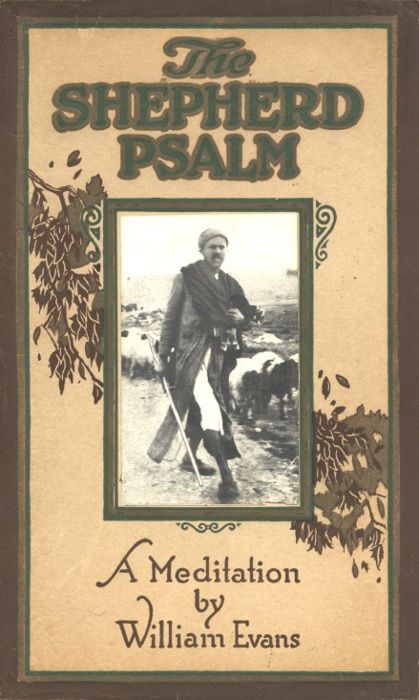
[The illustration on the cover is from an actual photograph by the Author, when he was in Palestine.]
FOREWORD
This production of the Shepherd Psalm is sent forth at the request of many hundreds of kind persons who have listened to the writer preach on it and who desire to see it in print, that it may be a blessing to many who cannot hear it.
It is a well known Psalm. Untold numbers of sermons have been preached on it. Books without number have been printed in attempts to set forth its life, depth, richness, and beauty. Doubtless much more will be written and spoken concerning this charming pastoral symphony—and, after that, much more will remain yet to be said, so full is the inspiration of the divine Word. May God make this Psalm to the reader all that it has been—yea, and more,—to the writer!
INTRODUCTION
The Twenty-third Psalm
The world could afford to spare many a magnificent library better than it could dispense with this little Psalm of six verses. If the verses of this Psalm had tongues and could repeat the tale of their ministry down throughout the generations of the faithful, what marvels of experience they would reveal! Their biographies would be gathered from the four winds of heaven and from the uttermost parts of the sea; from lonely chambers, from suffering sick beds, from the banks of the valley of the shadow of death, from scaffolds and fiery piles; witnessing in sunlight from moors and mountains, beneath the stars and in high places of the field. What hosts of armies of aliens it has put to flight! If by some magic or divine touch, yea, some miraculous power, the saints' experience of this Psalm could shine out between its lines, what an illumination of the text there would be!
Luther was fond of comparing this Psalm to the nightingale, which is small among the birds and of homely plumage, but with what thrilling melody it pours out its beautiful notes! Into how many dungeons filled with gloom and doubt has this little Psalm sung its message of hope and faith! Into how many hearts, bruised and broken by grief, has it brought its hymn of comfort and healing How many darkened prison cells it has lightened and cheered! Into what thousands of sick rooms has it brought its ministry of comfort and support! How many a time, in the hour of pain, has it brought sustaining faith and sung its song of eternal bliss in the valley of the shadow of death! It has charmed more griefs to rest than all the philosophies of the world. And I am persuaded that this little Psalm-bird will continue to sing its song of comfort and cheer to your children, to my children, and to our children's children, and will not cease its psalmody of love until the last weary pilgrim has placed his last climbing footstep upon the threshold of the Father's house to go out no more. Then, I think, this little bird will fold its golden pinions and fall back on the bosom of God, from whence it came.
It has been well said that this Psalm is the most perfect picture of happiness that ever was or ever can be drawn to represent that state of mind for which all alike sigh, and the want of which makes life a failure to most. It represents that heaven which is everywhere, if we could but interpret it, and yet almost nowhere because not many of us do.
How familiar this Psalm is the world over! Go where you will; inquire in every nation, tongue and tribe under heaven where the Bible is known, you will find this Psalm among the first scriptures learned and lisped by the little child at its mother's knee, and the last bit of inspired writ uttered in dying breath by the saintly patriarch.
This Psalm is so universal, says one, because it is so individual; it is so individual because it is so universal. As we read it, we are aware not only of the fact that we are listening to the experience of an Old Testament saint, but also that a voice comes speaking to us through the long centuries past—speaking to us in our own language, recounting our own experience, breathing out our own hopes.
The Davidic authorship of this Psalm has been questioned. We believe firmly that David is the writer; and yet a man feels as he reads the Psalm that it is so personal, so true to his own individual experience, that he could fain claim to have written it himself. It might seem as though the promises and precious things set forth in this Psalm lie beyond our reach; we have nothing to draw with, and the well is deep, but "one of like passions with ourselves has passed that way before and has left a cup to be let down, with His name and story written on the rim, and we may let that cup down into the well and draw a draught of the deep, refreshing water."
Have you ever noticed just where this Psalm is located? It lies between the Twenty-second and the Twenty-fourth Psalms. A very simple statement that—but how deep and wondrous a lesson lies hidden therein!
The Twenty-second Psalm. What is it? It is "The Psalm of the Cross." It begins with the words uttered by Christ on the cross: "My God, my God, why hast thou forsaken me?" It ends with the exclamation of the cross: "He hath done it," or, as it may be translated, "It is finished." The Twenty-second Psalm, then, is the Psalm of Mount Calvary—The Psalm of the Cross.
What is the Twenty-fourth Psalm? It is the Psalm of Mount Zion—a picture of the King entering into His own. How beautifully it reads: "Lift up your heads, O ye gates; and be ye lifted up, ye everlasting doors; and the King of glory shall come in. Who is this King of glory? The LORD of hosts, he is the King of glory." The Twenty-fourth Psalm, then, is the Psalm of the coming Kingdom of Glory.
There you have the two mountains; Mount Calvary and Mount Zion. What is it that lies between two mountains? A valley with its green grass, its quiet waters, its springing flowers, with shepherd and grazing sheep. Here, then, is the lesson we learn from the location of the Psalm: it is given to comfort, help, inspire and encourage God's people during this probationary period of our life, between the Cross and the Crown.
Is not this the reason why the tenses of this Psalm are present tenses? "The Lord is my shepherd"; "He maketh me to lie down"; "He leadeth me." Even the last verse, "I will (not I shall) dwell in the house of the Lord for ever," describes the present attitude of the soul of the Psalmist, who determines by no means to miss participation in the fellowship of the saints in heaven.
We love the Christ of the Cross. We may not yet fully understand that cross; may not yet have found any particular theory of the atonement which completely satisfies our intellect. But we have learned to say that we believe in the atonement and in the vicarious death of our Redeemer. Somehow or other we have come, by faith, to throw our trembling arms around that bleeding body and cry out in the desperate determination of our sin-stricken souls to Him who hangs on that cross to save us by His death. We have come to express our faith in that divine sacrifice in the words of the hymn:
Hangs my helpless soul on Thee.
Let us never forget that we reach the Twenty-third Psalm by the way of the Twenty-second Psalm—the Psalm of the Cross. "The way of the cross leads home." We love the Christ of the Twenty-second Psalm, the Christ of Calvary, the Christ of the Cross.
We also love the Christ of the Throne and the Glory. It may be, that, at times, we have trembled and feared as we have thought of the coming judgment, but when we have remembered that He who sits upon the throne is our Elder Brother, bone of our bone, and flesh of our flesh; that He left His throne in the glory and took on Him the form of a servant, dying the ignominious death of the cross that He might redeem us and save us from the just wrath of God against sin; that some day, He who loved us and gave Himself for us, will say: "Come, ye blessed of my Father, inherit the kingdom prepared for you from the foundation of the world," then we take courage and look forward with joy to the time when, having washed the last sleep from our eyes in the river of Life, we shall gaze with undimmed vision upon Him, whom having not seen, we have yet loved.
We love the Christ of the cross, the Christ of the past, the Christ of Mount Calvary. We love the Christ of the future, the Christ of the throne, the Christ of Mount Zion. But more precious to us, and we say it reverently, than the Christ of the past, or the Christ of the future, is the Christ of the present, He who lives with us now, dwells within us, walks by our side every moment and every hour of the day. We used to sing in our childhood days that beautiful hymn,
When Jesus was here among men,
How He called little children as lambs to His fold,
I should like to have been with Him then.
That His arms had been thrown around me;
And that I might have seen His kind look when he said,
"Let the little ones come unto me."
Many of us feel that we would have given anything to have walked by the side of the Christ in the days of His earthly pilgrimage, and we almost envy those who saw His face in the flesh. Some of us know the thrill of joy that came to our hearts when we trod the sands of Galilee that once were fresh with His footprints, trod the Temple's marble pavements that once echoed with His tread, and sailed the blue waters of Galilee that once were stilled by His wonderful word.
And yet, we should not forget that the enjoyment of the real presence of Christ is just as truly ours today as it was the possession of the disciples in the days of His flesh. As the old hymn so beautifully says,
To bring the Lord Christ down;
In vain we search the lowest deeps,
For Him no depths can drown.
A present help is He;
And faith has still its Olivet,
And love its Galilee.
Is by our beds of pain;
We touch Him in life's throng and press,
And we are whole again.
The name given to our Lord in connection with His birth was Immanuel, which being interpreted is, "God with us." One of the most beautiful doctrines of the Christian faith is the divine immanence, the continued presence of the ever-living Christ with His people; for
Their fronded palms in air;
I only know I cannot drift
Beyond His love and care.
THE SHEPHERD PSALM
CHAPTER ONE
"The Lord is my shepherd; I shall not want."
"The Lord is my shepherd." Have you ever noted how the word "Lord" is printed in the Bible? Sometimes all the letters are large capitals (LORD); or the first letter is a large capital and the other letters smaller capitals (Lord); then, again, the first letter is a large capital and the remaining letters ordinary (Lord). Each method of spelling the divine name indicates a different phase of the character of God. "LORD" refers to Jehovah as the covenant-keeping God, the One who never fails to fulfill all His promises. "Lord" points to our Lord Jesus Christ as the second Person in the Trinity, He who became incarnate. "Lord" signifies also God in Christ, the Jehovah of the Old Testament, God of power, the One who is able to do all things and with whom nothing is impossible, manifesting Himself in Jesus Christ.
What a world of meaning, then, lies wrapped up in the word "Lord" in the first verse of this Psalm! Jehovah who is all-faithful, never failing in His promises, almighty, all-powerful, who is able to supply all of our needs, who created the heavens and the earth, who upholds all things by the word of His power, who spake and it was done, who commanded and it stood fast; the Lord of whom Job said: "I know that thou canst do anything, and no purpose of thine can be hindered"; the "Lord" who never fails in the keeping of His promises, however seemingly impossible of fulfillment, from a natural viewpoint, those promises may be; the "Lord" of whom it is said, "God is not a man that he should lie, nor the Son of man that he should repent." "Hath he said and shall He not do it; hath He promised and shall he not bring it to pass?" the "Lord," the incarnate One, who for our sakes took on Himself our nature with all its sinless infirmities, who was tempted in all points like as we are, yet without sin, and who is thus able to feel our needs and sympathize with us in all our trials and temptations; the "Lord" who, speaking to the multitudes, said, "I am the good shepherd; the good shepherd giveth his life for the sheep"—such a Shepherd, faithful, powerful, sympathetic, is our "Lord." What a wealth of meaning, then, lies in the first clause, "The Lord" (who is LORD, and Lord) such a "Lord" is "my Shepherd."
We can then well say, "I shall not want." With such a Shepherd, how could we want for anything for time or eternity? All that we need for body, mind and soul shall be supplied. The God who provided the table in the wilderness, who fed Elijah by the brook, who struck the rock in the wilderness that the thirst of His people might be quenched, will provide for His children according to His riches in glory.
Reviewing Israel's history in the wilderness it could be recorded, "These forty years Jehovah, thy God, hath been with thee; thou hast lacked nothing." How wonderfully God supplied the needs of His people when they were traveling through that long, weary wilderness! "For the Lord thy God hath blessed thee in all the works of thy hand; he knoweth thy walking through this great wilderness; these forty years the Lord thy God hath been with thee; thou hast lacked nothing" (Deuteronomy 2:7). "Thou gavest also thy good Spirit to instruct them, and withheldest not thy manna from their mouth, and gavest them water for their thirst. Yea, forty years didst thou sustain them in the wilderness, so that they lacked nothing; their clothes waxed not old, and their feet swelled not" (Nehemiah 9:20, 21).
Let us, then, as the children of God, take all the comfort possible out of these words. Let us not go about mourning, grumbling, and borrowing trouble, thereby proclaiming to the world that our great Banker is on the verge of bankruptcy. The "Lord" is our shepherd; we shall not want for nourishment (verse 1), refreshment (verse 2), rest (verse 3), protection (verse 4), guidance (verse 5), home (verse 6). Here is a Bank the child of God can draw on at any time without fear of its being broken. Millions have been supplied and there's room for millions more. No want shall turn me back from following the Shepherd.
How encouraging to recall the words of Jesus uttered to the disciples when they had returned from their itinerary of missionary activity: "When I sent you without purse, and scrip, and shoes, lacked ye any thing? And they said, Nothing" (Luke 22:35).
I shall be well supplied,
Since He is mine and I am His,
What can I want beside?
When the writer was a lad he secured a position for which he was promised so much a week in money and "everything found," by which was meant board, room, and clothing. So this verse may read, "The Lord is my Shepherd," and "everything found."
In a park one day two women were overheard talking. One of them, who by her appearance showed that she was in very straitened circumstances, said to the other, "I am at my wit's end; I know not what to do. My husband has been sick and unable to work for almost a year. What little money we had saved is all spent. We have not a penny with which to buy food or clothing for ourselves or the children. This morning we received notice from the landlord to vacate." And then, in words that were full of suggestive meaning, she added, "If John D. Rockefeller were my father, I would not want, would I?"
Oh, what a world of comfort lies in the thought, "The Lord is my Shepherd," and, therefore, "I shall not want"! I shall want for nothing in time or eternity. Every need of body, mind, and soul shall be supplied. In the great Shepherd lies strength for my weakness, hope for my despair, food for my hunger, satisfaction for my need, wisdom for my ignorance, healing for my wounds, power for my temptation—the complement of all my lack.
More than all in thee I find.
"The Lord is my shepherd." My Shepherd. Religion is a personal thing. Really speaking, your religion consists in your personal relationship to God in Jesus Christ. Not mere profession, but actual possession is what counts. Christianity emphasizes the worth of the individual and his personal relation to God. Sin degrades men into mere numbers.
A photograph was placed on my desk. It had inscribed on it a number, but no name. It was the likeness of a convict. It was a number I went to jail to see; a number I spoke with by the cell door; a number I stood by and saw handcuffed; a number with whom I walked down the steps of the jail; a number with whom I walked up the stairs to the scaffold; a number around whose neck I saw the rope placed; a number I saw drop to his death. Sin degrades personality, but the religion of Christ exalts its adherents to a place in that innumerable company which cannot be numbered, but every one of whom bears upon his forehead the name of his Redeemer and King. Jesus calleth His sheep by name, not by number.
At the close of a sermon in a church in the Highlands of Scotland the preacher, who was supplying the pulpit for a few Sundays, was asked to call upon a shepherd boy who was very sick. Arm in arm with one of the elders of the church the minister crossed the moor, climbed the hillside, and came to the cottage where the boy and his widowed mother lived. After knocking at the door the visitors were admitted by the mother. Her face showed the marks of long vigil. The boy was her only child. The minister and elder went into the room where the sick boy lay on his cot. The minister, looking upon the pale, haggard face of the sick shepherd boy, asked him tenderly, "Laddie, do you know the Twenty-third Psalm?"
Every Scotch boy knows the Twenty-third Psalm, and so the little fellow replied, "Yes, sir, I ken (know) the Psalm well."
"Will you repeat it to me?" said the minister to the boy.
Slowly and tenderly the lad quoted the words, "The Lord is my shepherd, I shall not want," unto the end of the Psalm.
"Do you see," said the minister to the boy, "that in the first clause of the first verse there is just one word for each finger. Hold up your hand, laddie; take the second finger of your right hand, put it on the fourth finger of your left, hold it over your heart and say with me, 'The Lord is my Shepherd.'"
The fourth finger of the left hand! Why that finger? Every woman knows. It is the ring finger. Who placed that ring on your finger? My friend, my lover, my husband; the man who is more to me and different to me than any other and all other men in this world; the man without whom life would not be worth living; my friend, my lover, my husband.
The following Sunday the elder and the minister again crossed the moor and came to the cottage on the hillside. As the mother opened the door to admit them they saw by the expression on her face that a deeper sorrow had fallen on her heart since they last saw her. She took them, silently and solemnly, into a little room, and there, covered with a snow-white sheet, lay the lifeless form of the shepherd laddie, her only child. As the minister took the white sheet and passed it from forehead to chin, from chin to breast, and from breast to waist, he saw, frozen stiff in death, the second finger of the right hand on the fourth of the left hand, which was fastened in death over his heart. The mother exclaimed amid her tears, "He died saying, 'The Lord is my Shepherd.'"
What a world of difference that little word my makes, does it not? As a pastor I have often stood by the open grave that was to receive the body of someone's beloved daughter, the light and joy of some heart. I sought to be deeply sympathetic with those who were suffering bereavement. I tried to mourn with those who mourned, and weep with those who wept, and I think I did, so far as it is possible for a friend to sympathize. But one day I stood by an open grave when my daughter, my child, my own darling girl, my Dorothy, was placed beneath the sod. Ah! then I knew what grief was. Ah, what a world of difference that little word my makes!
It will not profit you much, my friend, to be able to say, "The Lord is a Shepherd"; you must be more personal; you must say, "The Lord is my Shepherd."
A Shepherd both mighty to save and to keep—
Yes, this is the Shepherd, the Shepherd we need,
And He is a Shepherd indeed!
Is this Shepherd, who loves you, yours?
CHAPTER TWO
"He maketh me to lie down in green pastures;
he leadeth me beside still waters."
They tell us that it is a very difficult and well-nigh impossible thing to get a sheep that is hungry to lie down in a pasture, or that is thirsty to drink by turbulent waters. A hungry dog will, but not a hungry sheep. The sheep described in this verse, then, are such as have been fed and satisfied in richest pastures, and whose thirst have been slaked in quiet waters. Doubtless the mind of the Psalmist is going back to such scenes in his own shepherd life when he had led his flock into rich, green pastures, sought out for his sheep some quiet watering-place, or had so manipulated the flow of turbulent waters as to make them flow smoothly.
The writer of this Psalm is seeking to illustrate spiritual truths from his own experience as a shepherd among the hills of Judea. He is spiritualizing his soliloquy. He thinks of the cry of God's people for the satisfaction of the soul's hunger and thirst; he sees the necessity for such feeding and nourishment if there is to be a walk of obedience "in the paths of righteousness."
Spiritualizing this verse, we may say that the "green pastures" and "still waters" refer to the spiritual nourishment which the child of God receives as he waits upon God in the study of His Word and prayer. There can be no spiritual strength sufficient to walk in "paths of righteousness" unless time is taken to "lie down" in the "green pastures" of the divine Word by "the still waters" of prayer. To "lie down" is the first lesson the Great Shepherd would teach His sheep. Not lie down after you are tired, but before. "Lie down" that you may have strength to walk in "the paths of righteousness." One of the hardest commands for the soldier to obey is to wait in the trenches. He would sooner "go over the top."
It is generally recognized as being a very difficult thing to get God's people to thus "lie down." They will do almost anything and everything else but that. They will run, walk, fight, sing, teach, preach, work, in a word do almost anything and everything except seek seasons of quiet and periods of retirement for secret communion with God and quiet soul nurture.
Most of our favorite hymns indicate this attitude. They are militant, working, active hymns: "Work, for the night is coming," "The fight is on," "Onward, Christian soldiers, marching as to war," "Stand up, stand up for Jesus," "Steadily marching on, with His banner waving o'er us," and many another. Where are such hymns as "Alone with Jesus, O the hush, the rapture," "In the secret of His presence how my soul delights to hide," "Take time to be holy"? How few of us are willing to go alone into the woods whither the Master went, clean forspent, clean forspent?
We do not like pauses in our meetings. If there should be a pause we seek at once to fill it in with a verse of Scripture, or someone says, "Let us sing a verse of hymn sixty-six," and so we fill up the pauses with choruses.
From the rush into the hush Jesus calls us. From the turbulent tumult into the quiet secret of His presence. Where there is peace, perfect peace, Jesus calls us.
Of our life's wild restless sea;
Day by day His sweet voice soundeth,
Saying, "Christian, follow me!"
Of the vain world's golden store;
From each idol that would keep us—
Saying, "Christian, love me more!"
Days of toil and hours of ease,
Still He calls in cares and pleasures—
"Christian, love me more than these!"
Saviour, may we hear Thy call;
Give our hearts to Thy obedience,
Serve and love Thee best of all.
Lie down we must. The text says, "He maketh me to lie down." The word "maketh" is the Hebrew causative and indicates forcible, compelling action. Our Great Shepherd knows that amid the activity, the stress, the strain and the restlessness of our lives it is absolutely necessary for us to take periods of quiet and rest, without which it will be impossible for us to continue in the way of righteousness. Have you so much to do that you do not have time to "lie down"? Then the gracious Shepherd will see to it that you have less to do. He would make you lie down. The overworked watchspring snaps. There must be pauses and parentheses in all our lives.
We make much today of active Christianity. We lay emphasis on the activities of Church work. Pragmatism is more than quietism to us. We must "bring things to pass," and "deliver the goods." This is all very well in its place, but we fear that the strength of our activities is not very deeply rooted. We shall be able to bear fruit upward and outward only as the roots of our spiritual life grow downward and deep. The secret springs of our lives must be well cared for.
One day we read in the daily newspaper of some leading man in the community who had fallen and brought discredit on the cause of Christ. This unfaithful one was described as having been "an active member of the church." Yes, that was the trouble. He was too active; he was not passive enough. He had omitted to "lie down" and feed in "green pastures" and drink by the "still waters" of God's Word and by prayer.
A friend tells us that while in the Orient he visited a Syrian shepherd. He observed that every morning the shepherd carried food to the sheepfold. On inquiry he found that he was taking it to a sick sheep. The next morning the friend accompanied the shepherd and saw in the sheepfold a sheep with a broken leg. The friend asked the shepherd how the accident happened. Was it struck by a stone? Did it fall into a hole? Did a dog bite it? How was the limb injured? The shepherd replied, "No, I broke it myself."
In amazement the friend replied, "What, you broke it! Why did you do that?"
The shepherd then told him how wayward this sheep had been, how it had led others astray, and how difficult it had been to come near it. It was necessary that something should be done to preserve the life of this particular member of the flock, and also to prevent it from leading other sheep astray. The shepherd therefore broke its leg and reset it. This breakage necessitated the sheep's lying down for a week or more. During that time it was compelled to take food from the hand of the shepherd. Thus had the compulsion of lying down cured the wandering and wayward disposition of the sheep.
It is said that when a sheep will not follow the shepherd he takes up the lamb in his arms—and then the mother follows.
So it sometimes happens with the children of God. Our Great Shepherd has to lay us aside, put us on our backs, perhaps, for a while in order that we may look up into His face and learn needed lessons. A little girl lay dying. She looked up into the face of her father, who years before had been a very active church worker, but on account of business prosperity had drifted away from Christian moorings, and said, "Papa, if you were as good as you used to be, do you think I would have to die?" God was making this man to "lie down," do you see?
A deacon in a Baptist church told me this story. When first married, he and his wife observed family prayers every day. This worshipful spirit continued for some years after their first child was born; then gradually the father became so engrossed in business that the family altar, Bible reading and prayer were gradually neglected and finally altogether dispensed with. One day, on coming home from the office, the deacon found his nine-year-old girl very ill with a fever. For weeks they watched over her, but finally the angel of death took her home. As the deacon told me this story, the tears filling his eyes, he said, "Then I knew that my daughter had been taken for my sake and that God was making me to 'lie down.' From that day until this, which is over a quarter of a century, the family altar has been maintained in our home."
Mother, in that sweetest of all hours to a mother, the last hour of the day when the child is being put to sleep, when the last thing its eyes rest upon is the face of the mother, does its last vision rest on a mother who has taught it to pray, to love Jesus? It would be infinitely better that the heavenly Father take that little child to be with Himself than that it should go out into the world from a godless, Christless, prayerless home.
Fathers and mothers, are we taking time to "lie down," to be alone with God in prayer and the reading of His Word? Has the family altar in your home been neglected? What are you waiting for? Do you want God to come and lay His hand upon some precious one in your family circle to take to be with Himself? Would you then take time to "lie down"?
It is said that when a sheep is wayward and will not cross the brook, the shepherd finds that by taking the little lamb from it and carrying it across, the mother sheep will at once follow, rushing over the stream. Fathers and mothers, are you waiting for God to do this? Our fathers and mothers used to have the family altar. They took time to read the Bible and pray with their children. What kind of age will the next be if we neglect these religious privileges? It may be that our parents were not the scholars that some of their children are, but I think we may safely say that they were the saints that we never will be until we "lie down" in the green pastures and quiet waters of God's Word and prayer as they did.
Christian workers especially need to learn the lesson of "lying down," We are restless; we fume and worry and fret because we are tired and hungry. We do not take time to "lie down." Strange, is it not, that we will do almost anything but lie down? We will walk, run, climb, sing, preach, teach—do anything but "lie down." Let us not forget that the secret of power lies in being alone with God. Christ drew the multitudes to Him because He withdrew from them at times. The drawing preacher is the withdrawing man. Significant are the words of Jesus to His active disciples: "Come ye yourselves apart into a desert place, and rest a while."
Resting by the waters where He leads His flock,
Resting, while we listen, at His glorious feet,
Resting in His very arms! O rest complete!
These seasons of lying down are periods of renewal of strength for duty, not for indolence or mere ecstasy. By thus feeding in the green pastures and drinking by the still waters, we are strengthened in order that we may walk in the paths of righteousness. We eat and drink for strength, not for drunkenness. One may lie in a bath so long that his strength is exhausted thereby, or he may take a good plunge in the morning which will be a source of exhilaration to him throughout the day. These times of "lying down" may be likened to the plunge. We must not be mere recluses or visionaries. Our "lying down" must fit us for "walking." If our private communion with God does not fit us for Christian activity in our daily avocation, distrust it. We cannot keep the rapture of devotion if we neglect duty of service. Life must not be all contemplation any more than it must not be all activity. We will not need to speak of these times of lying down, nor advertise that we have seasons of quiet communion, of ecstasy and vision; but the result thereof will be clearly apparent in our lives as we walk in the path of righteousness, and in the joyful assurance of soul when we are called upon to pass through the valley of the shadow.
Would that we knew how much depended, both for ourselves and others, on these seasons of retirement for meditation and prayer! What a blessing it would be to us! What a benediction to others!