
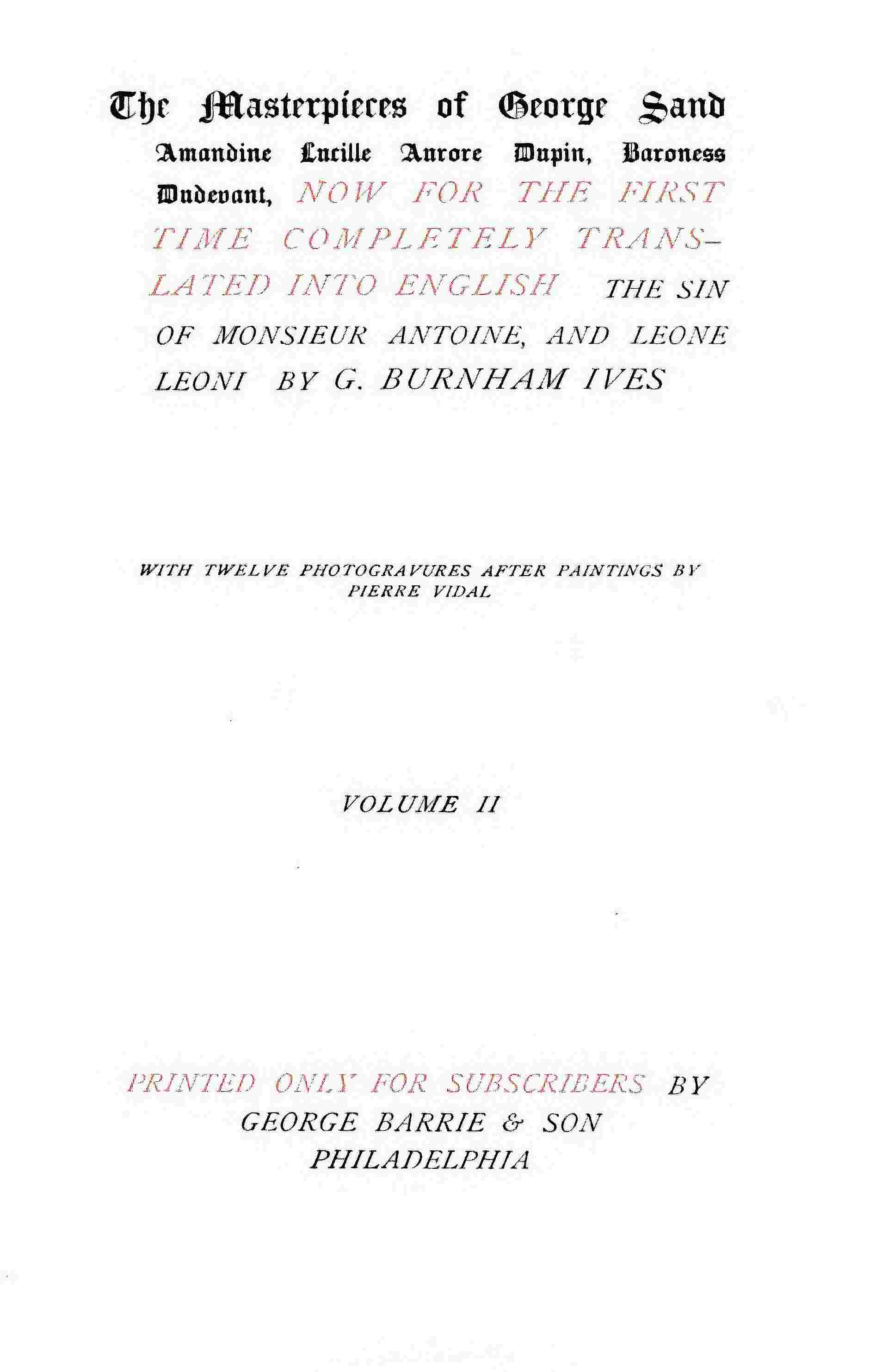
The Project Gutenberg eBook of The Sin of Monsieur Antoine, Volume 2 (of 2) and Leone Leoni
Title: The Sin of Monsieur Antoine, Volume 2 (of 2) and Leone Leoni
Author: George Sand
Illustrator: Pierre Vidal
Translator: George Burnham Ives
Release date: February 21, 2022 [eBook #67461]
Most recently updated: October 18, 2024
Language: English
Original publication: United States: G. Barrie & son, 1900
Credits: Dagny and Laura Natal Rodrigues (Images generously made available by Hathi Trust Digital Library.)
The Masterpieces of George Sand,
Amandine Lucille Aurore Dupin, Baroness
Dudevant, NOW FOR THE FIRST
TIME COMPLETELY TRANSLATED
INTO ENGLISH THE SIN
OF MONSIEUR ANTOINE, AND LEONE
LEONI BY G. BURNHAM IVES
WITH TWELVE PHOTOGRAVURES AFTER PAINTINGS BY
PIERRE VIDAL
VOLUME II
PRINTED ONLY FOR SUBSCRIBERS BY
GEORGE BARRIE & SON
PHILADELPHIA
CONTENTS
CHAPTER
XXIV. MONSIEUR GALUCHET
XXV. THE EXPLOSION
XXVI. THE SNARE
XXVII. SORROWS AND JOYS OF LOVE
XXVIII. CONSOLATION
XXIX. AN ADVENTURE
XXX. THE IMPROMPTU SUPPER
XXXI. UNCERTAINTY
XXXII. A WEDDING PRESENT
XXXIII. THE STORY OF ONE TOLD BY THE OTHER
XXXIV. RESURRECTION
XXXV. ABSOLUTION
XXXVI. RECONCILIATION
LEONE LEONI
INTRODUCTION
CHAPTER I
CHAPTER II
CHAPTER III
CHAPTER IV
CHAPTER V
CHAPTER VI
CHAPTER VII
CHAPTER VIII
CHAPTER IX
CHAPTER X
CHAPTER XI
CHAPTER XII
CHAPTER XIII
CHAPTER XIV
CHAPTER XV
CHAPTER XVI
CHAPTER XVII
CHAPTER XVIII
CHAPTER XIX
CHAPTER XX
CHAPTER XXI
CHAPTER XXII
CHAPTER XXIII
CHAPTER XXIV
LIST OF ILLUSTRATIONS
THE SIN OF MONSIEUR ANTOINE
LEONE LEONI
VOLUME II
EMILE CONFESSES HIS LOVE FOR GILBERTE.
GILBERTE AND JAPPELOUP ACCOMPANY THE MARQUIS.
THE RECONCILIATION.
DON ALEO AND JULIETTE.
LEONI TAKES JULIETTE TO HIS PALACE.
THE MEETING ON THE CANAL.
EMILE CONFESSES HIS LOVE FOR GILBERTE.
"My dear Janille," he cried at last, with impetuous emotion, "and you, noble and generous Antoine, listen to me and learn my secret at last. I love your daughter."
THE SIN OF MONSIEUR ANTOINE
(Continued)
XXIV
MONSIEUR GALUCHET
But, after sleeping twelve hours, Galuchet had only a very confused remembrance of the events of the preceding day, and, when Monsieur Cardonnet sent for him, he retained only a vague feeling of resentment against the carpenter. Moreover, he was little inclined to boast of having cut such an absurd figure at the outset of his diplomatic career, and he attributed his late rising and his sluggish manner to a violent sick-headache. "I did nothing but feel the ground," he replied to his master's questions. "I was feeling so miserable that I could not watch very closely. I can only assure you that they have very vulgar manners in that house, that they live on a footing of equality with peasants, and that the table is very poorly served."
"That is no news to me," said Monsieur Cardonnet; "it is impossible that you can have passed the whole day at Châteaubrun without noticing something more definite. At what hour did my son arrive, at what time did he leave?"
"I can't tell you just what time it was,—their old clock is so far out of the way!"
"That's not an answer. How many hours did he stay there? Come, I don't ask you to be exact to a minute."
"It must have been five or six hours, monsieur; I was horribly bored. Monsieur Emile seemed far from glad to see me; and as for the girl, she's a downright prude. It was fearfully hot on that mountain, and I couldn't say two words without being interrupted by that peasant."
"I can imagine it, for you don't say two words in succession this morning, Galuchet; what peasant do you mean?"
"That carpenter, Jappeloup, a miserable fellow, an animal who presumes to be familiar with everybody, and who speaks of monsieur as Père Cardonnet, as if he were speaking of his equal."
"That doesn't trouble me; but what did my son say to him?"
"Monsieur Emile laughed at his nonsense and Mademoiselle Gilberte thinks he is charming."
"Did you notice any asides between her and my son?"
"No, monsieur, not exactly. The old woman—who is certainly her mother, for she calls her my girl—hardly ever leaves her, and it can't be very easy to pay court to her, especially as she is very high and mighty, and puts on the airs of a princess. That's very becoming in her, on my word, with the dress she wears and not a sou! If they should offer her to me, I wouldn't have her!"
"No matter, Galuchet; you must pay court to her."
"To laugh at her, when the time comes—I agree to that!"
"And also to earn a reward, which you will not get unless you bring me a clearer and more circumstantial report next time; for you are all astray to-day."
Galuchet bent his head over his books and fought all day against the discomfort that follows over-indulgence.
Emile passed the whole week head over ears in hydrostatics; he indulged in no other distraction than to seek out Jean Jappeloup in the evening and chat with him; and, as he always tried to bring the conversation around to Gilberte, the carpenter finally said to him:
"Look you, Monsieur Emile, you never get tired of that subject, that's clear enough. Do you know that Mère Janille thinks you are in love with her child?"
"What an idea!" rejoined the young man, confused by this sudden apostrophe.
"It's a sensible idea enough. Why shouldn't you be in love with her?"
"True, why shouldn't I be in love with her?" echoed Emile, more and more embarrassed. "But can it be that you would speak jestingly of such a possibility, friend Jean?"
"I should say that you were the one, my boy, for you answer me as if we were in jest. Come, why not tell me the truth? out with it or I'll not talk to you any more."
"Jean, if I were really in love with a person for whom I have as much respect as for my own mother, my best friend should know nothing of it."
"I know very well that I am not your best friend, and yet I should like to have you tell me."
"Explain yourself, Jean."
"Explain yourself, rather; I am waiting."
"You will wait a long time; for I have no answer to make to such a question, despite all my esteem and affection for you."
"If that is so, you will have to say adieu forever one of these days to the people at Châteaubrun; for ma mie Janille is not the woman to sleep long when danger is brewing."
"That word offends me; I do not think that I can be accused of bringing danger upon a person whose reputation and dignity are as sacred to me as to her kindred and dearest friends."
"That sounds very well, but it isn't a straight answer to all my questions. Do you want me to tell you something?—early last week I went to Châteaubrun to borrow of Antoine a tool that I needed. I found ma mie Janille there; she was all alone, expecting you. You didn't come and she told me all. And now, my boy, if she didn't frown on you Sunday, and if she allows you to call from time to time to see her girl, you are indebted to me for it."
"How so, my good Jean?"
"Because I have more confidence in you than you have in me. I told ma mie Janille that if you loved Gilberte you would marry her, and that I would answer for you on the salvation of my soul."
"And you were right, Jean," cried Emile, grasping the carpenter's hand; "you never told a greater truth."
"Very good! but the question still remains whether you are in love, and that is what you won't tell me."
"It is what I can tell you alone, since you question me so closely. Yes, Jean, I love her, I love her more than my life, and I mean to marry her."
"I give my consent," replied Jean in a tone of enthusiastic satisfaction, "and so far as I am concerned, I join your hands—One moment! one moment!—provided that Gilberte gives her consent too."
"And if she should ask your advice, my good Jean, who are her friend and second father?"
"I should tell her that she can make no better choice, that you suit me and that I am willing to be your surety."
"Good! now my friend, we only have to obtain the consent of the parents."
"Oh! I'll answer for Antoine, if I take hold of the affair. He has some pride, and he will be afraid that your father may hesitate, but I know what to say to him on that subject."
"What will you say to him, pray?"
"Something that you don't know, something that nobody knows but me. I don't need to speak yet, for the time has not come, and you can't think of marrying for a year or two."
"Jean, confide this secret to me as I confided mine to you. I see but one obstacle to our marriage, my father's obstinacy. I have resolved to overcome it, but I do not conceal from myself that it is very serious."
"Well, as you have been so trustful and frank with old Jean, old Jean will be the same with you. Listen, my boy; before long your father will be ruined and will have no further excuse for putting on airs with the Châteaubrun family."
"If what you say should turn out to be true, I should bless your strange prophecy, notwithstanding my father's inevitable grief and disappointment; for I have many reasons for dreading this great wealth."
"I know it; I know your heart, and I see that you would like to enrich others before enriching yourself. Everything will turn out as you wish, I am sure. I have dreamed of it more than ten times."
"If you have done nothing more than dream, my dear Jean——-"
"Wait, wait. What is that book you always carry under your arm and that you seem to be studying?"
"I have already told you, a scientific treatise on the power and weight of water and the laws of equilibrium."
"I remember—you have told me before; but I tell you that your book lies, or else you have read it wrong; otherwise you would know what I know."
"What is that?"
"That your factory is impossible, and that your father, if he persists in fighting against a stream that snaps its fingers at him, will lose his outlay and will discover his folly too late. That is why I have been so cheerful for some time past. I was depressed and out of temper as long as I thought that your undertaking might succeed; but I had one hope that kept coming to my mind again and again, and I determined to satisfy myself about it. So I walked and worked and used my eyes and studied. Oh! yes, studied, and I didn't read your books and your maps and your figuring; I saw and understood everything. Monsieur Emile, I am only a poor peasant, and your Galuchet would spit on me if he dared; but I can tell you of one thing that you hardly suspect, and that is that your father has no idea of what he is doing, that he has taken bad advice, and that you don't know enough about it to set him right. The coming winter will carry away your works, and every winter will carry off whatever there is, until Monsieur Cardonnet has thrown his last three-franc piece into the water. Remember what I tell you, and don't try to persuade your father. It would be one more reason for him to persist in ruining himself, and we don't need that to induce him to do it; but you will be ruined, my son, and if not altogether here, you will be somewhere else, for I hold your papa's brain in the hollow of my hand. It is a powerful brain, I admit, but it is a madman's brain. He is a man who works himself into a frenzy for his schemes to such an extent that he considers them infallible, and when a man is built that way he never succeeds in anything. I thought at first that he had played his hand out, but now I see that the game is becoming serious, for he is beginning to rebuild all that the last freshet destroyed. He had had too good luck until then; still another reason—good luck makes a man overbearing and presumptuous. That is the history of Napoléon, whom I saw rise and fall, like a carpenter who climbs to the roof of a house without looking to see if the foundations are solid. However good a carpenter he may be—however fine a building he may build—if the wall totters, good-bye to the whole work!"
Jean spoke with such conviction, and his black eyes gleamed so bright beneath his grizzly bushy eyebrows, that Emile could not help being moved. He begged him to give his reasons for talking as he did, and the carpenter refused for a long time. At last, conquered by his persistence, and a little irritated by his doubts, he made an appointment with him for the following Sunday.
"You can go to Châteaubrun Saturday or Monday instead," he said, "and on Sunday we will start at daybreak and go up the stream to certain places that I will point out to you. Take all your books and all your instruments if you choose. If they don't confirm me, it's of little consequence; it will be science that lies. But don't expect to make this trip on horseback or in a carriage; and if you haven't good legs, don't expect to make it at all."
On the following Saturday Emile went to Châteaubrun, beginning, as usual, with Boisguilbault, as he dared not appear too early at Gilberte's.
As he approached the ruins he saw a black speck at the foot of the mountain, and that speck soon became Constant Galuchet, in a black coat, black trousers and gloves, black satin cravat and waistcoat. That was his costume in the country, winter and summer alike; and no matter how great the heat or the fatigue which he was about to undergo, he never left the village except in that ceremonious attire. He would have been afraid of resembling a peasant if, like Emile, he had donned a blouse and broad-brimmed gray hat.
If it be true that the bourgeois costume of our generation is the most depressing, the most inconvenient and the most unbecoming that fashion ever invented, it is equally true that all its inconveniences and deformities are most striking in the open country. In the outskirts of the large cities, one's eyes are less offended, because everything there is arranged, aligned, planked, built and walled in symmetrically, so that all the informality and charm of nature are destroyed. We may sometimes admire the beauty and symmetry of those estates which have been subjected to all the refinements of civilization; but it is very hard to imagine oneself loving such a region. The real country is not there, but in the heart of the fields, neglected and untilled to some extent, where agriculture has no thought of paltry embellishments and strict limits, where estates run together and where boundaries are indicated only by a stone or bush, put in place in full reliance upon rustic good faith. There the roads, intended only for foot passengers, equestrians or heavy carts, present innumerable picturesque irregularities; the hedges, abandoned to their natural vigor, hang in garlands, from leafy arbors, and deck themselves out with the wild climbing plants which are carefully removed in more pretentious regions. Emile remembered that he had walked about within several leagues of Paris without the pleasure of seeing a nettle, and he felt keenly the charm of that rural scenery amid which he now found himself. Poverty did not hide, in shame and degradation, beneath the feet of wealth. On the contrary it made itself manifest, light-hearted and free, on a soil which proudly bore its emblems, wild flowers and vagabond plants, the humble moss and the wood-strawberry, the water-cress on the brink of a stream with no well-defined bed, and the ivy clinging to a rock that had obstructed the path for centuries, without attracting the attention of the police. He loved the branches which overhung the road and were respected by passers-by; the bog-holes in which the frog croaked softly as if to warn the traveller,—a more vigilant sentinel than he who guards a king's palace; the old crumbling walls around the enclosure, which no one thought of rebuilding, the powerful roots which pushed up the ground and dug holes at the foot of the venerable trees; all that lack of art which makes nature ingenuous and which harmonizes so well with the severe type and grave and simple costume of the peasant.
But let that parasitic insect, that monsieur with the black coat, cleanly shaven chin, gloved hands and shambling legs, appear in the midst of that austere and impressive scene, which carries the imagination back to the epoch of primitive poesy, and that king of society becomes simply a ridiculous blotch, an annoying imperfection in the picture. What business have your funereal garments in this bright sunlight, where their creases seem to laugh scornfully as at a victim? Your offensive, misplaced costume inspires more pity than the poor man's rags; we feel that you are out of place in the fresh air and that your livery crushes you.
Never had these reflections presented themselves so vividly to Emile's mind as when Galuchet appeared before him, hat in hand, climbing the hill with a painful exertion which caused his coat-tails to flutter in laughable fashion, and pausing to brush away with his handkerchief the traces of frequent falls. Emile was strongly inclined to laugh at first; and then he asked himself angrily why the parasite was buzzing around the sacred hive. He urged his horse to a gallop, passed Galuchet without seeming to recognize him, arrived first at Châteaubrun, and announced the other's coming to Gilberte as an unavoidable calamity.
"Oh! father," said she, "don't receive that ill-bred, disagreeable man, I entreat you! let us not spoil our Châteaubrun, our home, our pleasant, unceremonious life, by the presence of this stranger, who never can and never will be in sympathy with us."
"What do you expect me to do with him, for heaven's sake?" said Monsieur de Châteaubrun, sorely embarrassed. "I invited him to come whenever he chose; I could not foresee that you, who are usually so long-suffering and generous, would take such a dislike to a poor devil because of his bad manners and his unattractive face. For my part I pity such people; I see that everyone spurns them and that life is a bore to them."
"Don't believe that," said Emile. "On the contrary they are very well satisfied and imagine that everybody likes them."
"In that case, why rob them of a delusion without which they would probably die of grief? I haven't courage to do it, and I don't believe that my dear Gilberte would advise me to have it."
"My too kind-hearted father!" rejoined Gilberte with a sigh; "I wish that I were as kind-hearted, too; indeed, I believe I am, generally speaking; but that conceited, self-satisfied creature, who seems to me to insult me when he looks at me, and who called me by my Christian name the first day he ever spoke to me!—no, I can't endure him, and I feel that he has a bad effect on me, because the sight of him makes me disdainful and sarcastic, contrary to my instincts and my character."
"It is certain that Monsieur Galuchet will become very familiar with mademoiselle," said Emile to Monsieur Antoine, "and that you will be compelled more than once to remind him of the respect he owes her. If it happens that he forces you to turn him out of the house, you will regret having received him with too much confidence. Wouldn't it be better to give him to understand by a somewhat chilly welcome that you have not forgotten the ungentlemanly way he behaved on his first visit?"
"The best way that I can think of to arrange matters," said Monsieur de Châteaubrun, "is for you two to go out in the orchard with Janille; I will take Galuchet out fishing and you will be rid of him."
This suggestion was not particularly agreeable to Emile. When he was under Monsieur de Châteaubrun's eye, he could almost believe that he was tête-à-tête with Gilberte, whereas Janille was an exceedingly active and keen-eyed third. Moreover Gilberte thought that it would be selfish to compel her father to bear alone the burden of such a visitor.—"No," she said, kissing him, "we will stay here to keep you in bad temper; for if we turn our backs on you, you will be so sweet and good-natured that monsieur will believe that he is welcome, once for all. Oh! I know you, father! you wouldn't be able to refrain from telling him so and from keeping him at the table, and then he will drink again! It will be very wise for me to stay here and force him to keep watch on himself."
"Oh! I'll look out for that," said Janille, who had listened thus far without giving her opinion, and who hated Galuchet ever since the day he had haggled over a ten-sou piece for which she asked him after showing him the ruins. "I like to have monsieur drink his wine with his friends and the people he likes; but I don't approve of wasting it on parasites, and I propose to give Monsieur Galuchet's wine a good baptizing. But you don't like water, monsieur, and that will make you cut short your stay at the table."
"Why, Janille, this is downright tyranny," said Monsieur Antoine. "You say you are going to put me on a water diet? do you want me to die, pray?"
"No, monsieur, your skin will be all the brighter for it, and if yonder little fellow makes a wry face at it, so much the worse for him."
Janille kept her word, but Galuchet was too disturbed in mind to notice it. He felt more and more ill at ease in the presence of Emile, whose eyes and smile seemed to be always questioning him sternly, and when he tried to pluck up courage and play the agreeable with Gilberte, he was so coldly received that he knew not what to do. He had determined to be very careful in the matter of the Châteaubrun wine, and he was well pleased when his host, after the first glass, neglected to invite him to take a second. Monsieur Antoine, when he led the way with the first bumper, as his duty as host required, stifled a sigh and glanced at Janille as if to reproach her for the liberality with which she had measured the admixture of water. Charasson, who was in the old woman's confidence, roared with laughter, and was sternly reprimanded by his master, who sentenced him to drink the rest of the harmless beverage with his supper.
When Galuchet was convinced that he was intolerable to Gilberte and Emile, he determined to advance his interests with Monsieur Cardonnet by venturing upon the proposal of marriage. He led Monsieur Antoine aside, and, feeling sure of being refused, offered his heart, his hand and his twenty thousand francs for his daughter. Monsieur Galuchet did not consider that he risked anything by doubling the fictitious capital of his marriage-portion.
This little fortune, in addition to a place which was worth about twelve hundred francs a year, surprised Monsieur Antoine extremely. It was a very good match for Gilberte; indeed, she could aspire to nothing better in the matter of wealth, for it was impossible for the excellent country gentleman to provide her with any dowry whatever, even if he should strip himself entirely. No one on earth was ever more unselfish than that worthy man; he had given proofs enough of it during his life. But he could not, without some bitterness, reflect that his darling daughter, failing to meet a man who would love her for her own sake, would probably be condemned to live single for many years, perhaps forever!
"What an unfortunate thing," he said to himself, "that this fellow isn't more attractive, for he is certainly honest and generous. My daughter takes his fancy, and he doesn't ask how much money she has. Doubtless he knows that she has nothing, and means to give her all he possesses. He is a well-intentioned suitor, whom I must refuse respectfully, pleasantly and with friendly words."
And not knowing how to go about it—not daring to expose Gilberte to the suspicion of being vain of her name or to the resentment of a heart wounded by her manifest aversion—he could think of no better way than to avoid giving a definite answer, and to ask for time to reflect and take counsel. Galuchet also asked leave to come again, not precisely to pay his court to Gilberte, but to learn his fate; and leave was given him to do so, although poor Antoine trembled as he gave it.
He took him to the bank of the stream to fish, although Galuchet had brought nothing for that purpose and was very desirous to remain at the château. However, Antoine walked him along the bank of the Creuse, to show him the best places, and, on the way, he had the weakness and good-nature to ask his pardon for Jean's teasing and mockery. Galuchet took it exceedingly well, and attributed all the blame to himself, saying, however, to put himself in a somewhat better light, that he had been surprised into drinking too much, and that, if he was not capable of carrying much wine, it was because he was habitually very abstemious.
"That's all right," said Antoine. "Janille was afraid that you might be a little intemperate, but what happened to you proves the contrary."
They talked for a considerable time, and, as Galuchet obstinately declined to go, although his host's uneasiness made it plain that he would have preferred not to take him back to the château, they returned thither, and Galuchet at once took Janille aside, to confide his intentions to her, and give Antoine time to inform Gilberte. He reckoned on the displeasure which the news would cause the latter; for on this occasion, not being drunk, he plainly detected Emile's air of annoyance and Gilberte's feelings for the protector she had chosen.
"This time," he said to himself, "Monsieur Cardonnet will not reproach me with having wasted my time. My pretty lovers will be furiously angry with me, and Monsieur Emile will not be able to hold back from picking a quarrel with me."
Galuchet was not a coward; and although he did not deem Emile capable of a duel with fists, he said to himself with much satisfaction that he was strong enough to hold his own against him. As for a genuine duel, that would have been less to his liking, because he had had no experience of duellists' weapons; but he could safely rely upon Monsieur Cardonnet to preserve him from that danger.
While he was talking with Janille, Monsieur de Châteaubrun remained in the orchard with his daughter and Emile, and told them what had taken place between him and Galuchet, albeit with some oratorical precautions. "Oh!" said he, "you call him an impertinent fool, but you will regret your harsh judgment of him; for he is really a very worthy fellow, and I have proof of that. I can tell this before Emile, who is our friend; and if Gilberte would look at the matter without prejudice, she might ask him some questions concerning this young man. Tell me, Emile, on your heart and conscience, is he an honest man?"
"Beyond any question," Emile replied. "My father has employed him for three years and would be very sorry to lose him."
"Is his character good?"
"Although he can hardly be said to have proved it here the other day, I must say that he is very peaceable, and ordinarily quite harmless."
"He isn't in the habit of getting drunk?"
"Not so far as I know."
"Well, then, what have you against him?"
"If he had not taken the fancy to become our guest, I should consider him an accomplished man," said Gilberte.
"Is he so very disagreeable to you?" said Monsieur Antoine, standing still to look her in the face.
"Why, no, father," she replied, surprised by the solemnity of his manner. "Do not take my dislike so seriously. I hate nobody; and if this young man's company is at all agreeable to you, if he has given you good reason to esteem him particularly, God forbid that I should deprive you of any pleasure by a mere caprice! I will make an effort, and perhaps I shall succeed in sharing the good opinion that my excellent father has of him."
"Spoken like a good, sensible girl, and I recognize my Gilberte. Let me tell you then, little one, that you are the last one who should despise this young man's character; and that, even though you do not feel attracted to him, you ought at least to treat him politely and dismiss him kindly. Come, do you understand me?"
"Not the least in the world, father."
"I am afraid that I understand," said Emile, his cheeks flushing scarlet.
"Well," continued Monsieur Antoine, "I will suppose that a young man, quite wealthy compared to us, notices a beautiful, virtuous girl who is very poor, and that, falling in love at first sight, he lays at her feet the most honorable proposals you can imagine—should he be dismissed roughly, turned out of doors with a: 'Monsieur, you are too ugly.'"
Gilberte blushed as hotly as Emile, and, strive as she would to be humble, she felt so insulted by Galuchet's proposals that she could make no reply, while her eyes filled with tears.
"The miserable fellow has lied shamefully to you," cried Emile, "and you can safely turn him away with contempt. He has no fortune, and my father rescued him from absolute destitution. Now, he has only been in his employ three years, and unless he has suddenly received some mysterious legacy——"
"No, Emile, no, he has told no lie; I am not so weak and credulous as you think. I questioned him and I know that the source of his little fortune is pure and unquestionable. Your father has promised him twenty thousand francs, in order to attach him permanently to his service by affection and gratitude, in case he marries in the province."
"But," said Emile in a trembling voice, "my father certainly cannot know that he has presumed to raise his eyes to Mademoiselle de Châteaubrun, for he would not have encouraged him in such a hope."
"On the contrary," rejoined Monsieur Antoine, to whom the affair seemed perfectly natural, "he has confided to your father his liking for Gilberte, and your father authorized him to use his name in support of his offer of marriage."
Gilberte turned deathly pale and looked at Emile, who lowered his eyes, stupefied, humiliated, and wounded to his heart's core.
XXV
THE EXPLOSION
"Well, well, what's the matter?" said Janille, joining them under a rustic arbor near the orchard, where they were sitting, all three; "why is Gilberte so woebegone, and why do you all keep quiet when I come near, as if you were plotting some conspiracy?"
Gilberte threw herself in her nurse's arms and burst into tears.
"Well, well," continued the good little woman, "here's something else! My little girl is unhappy and I don't know what the matter is! Will you speak, Monsieur Antoine?"
"Has that young man gone?" said Monsieur Antoine, looking about him uneasily.
"To be sure he has, for he took leave of me and I went with him as far as the gate," said Janille. "I had some difficulty in getting rid of him. He's a little dull about explaining himself. He would have liked to stay, I saw that well enough; but I gave him to understand that such affairs couldn't be settled so fast, that I must consult with you, and that we would write to him if we wanted to see him again for any reason. But, before I say anything more, what's the matter with my girl? who has hurt her feelings? Ah! but ma mie Janille is here to protect her and comfort her."
"Oh! yes, you will understand me," cried Gilberte, "and you will help me to repel the insult, for I feel insulted and I need you to help me make my father understand it. Why, he almost acts as Monsieur Galuchet's advocate!"
"Ah! so you already know what is going on, do you? In that case it's a family affair. I have something to tell, you, too; but all this will bore Monsieur Emile."
"I understand you, my dear Mademoiselle Janille," the young man replied, "and I know that the proprieties, as ordinarily understood, would require me to withdraw; but I am too deeply interested in what is going on here to consider myself bound by common customs; you can safely speak before me, as I know everything now."
"Very well, monsieur, if you know what is in the wind, and if Monsieur Antoine has thought best to state his views before you,—which, between ourselves, was hardly worth while—I will speak as if you were not here. And in the first place, Gilberte, you mustn't cry; what is it that makes you feel so bad, my girl? Because a poor fool considers himself worthy of you? Oh! bless my soul, it isn't the last time that you will have the pleasure, married or not, of seeing self-sufficient people make themselves ridiculous; for you must laugh at them, my child, and not be angry. This fellow thinks that he does you honor and gives you proof of esteem; receive it as such, and tell him or have somebody else tell him in all seriousness that you thank him, but that you will have none of him. I can't see at all why you are so disturbed; do you happen to think that I am disposed to encourage him? Ah! he might have a hundred thousand francs, or a hundred million, and I shouldn't think he was the man for my girl! The villain, with his big eyes and his air of satisfaction at being in the world—let him look farther! we have no girl here to give him. Oh! ma mie Janille knows what she is talking about, she knows that they don't put the thistle beside the rose in the same bouquet."
"That is well said, dear Janille!" cried Emile, "and you are worthy to be called her mother!"
"What concern is it of yours, pray, monsieur?" retorted Janille, warmed up and exalted by her own eloquence. "What have you to do with our little affairs? Do you know anything wrong about this suitor? If you do, it's of no use to tell us, for we don't need you to help us to get rid of him."
"Stop, Janille, don't scold him," said Gilberte, kissing her old friend. "It does me good to hear it said that that man's proposals are insulting to me, for it humiliates me to think of them. It makes me cold and sick. And yet father doesn't understand it! He considers himself honored by his offer, and will not say anything to keep him out of my sight!"
"Ha! ha!" laughed Janille, "he is the one who is at fault, as usual—the bad man! It is he who makes his daughter cry! Look you, monsieur, do you propose to play the tyrant here, I should like to know? Don't look forward to that, for ma mie Janille isn't dead and has no desire to die."
"That's right," said Monsieur Antoine; "of course I am a despot, an unnatural father! All right! all right! fall to on me if it relieves you. After that, perhaps my daughter will be kind enough to tell me what the matter is, and what I have done that's so criminal."
"Dear father," said Gilberte, throwing herself into his arms, "let us stop this melancholy jesting, and do you make haste to dismiss Monsieur Galuchet forever, so that I can breathe freely again and forget this bad dream."
"Ah! there's the rub," said Monsieur Antoine; "the trouble is to know what I am to write to him, and that is something it will be well to consult about."
"Do you know, mother," said Gilberte to Janille, "he doesn't know what answer to give him? Apparently he wasn't able to say no to him."
"Well, my child, your father didn't do very wrong," replied Janille, "for I listened to your fine suitor's offer without getting excited, and I didn't say yes or no to him. There! there! don't be angry. That's the right way to do, and then consult calmly. You can't say to the fellow: 'I don't like you;' people don't say that sort of thing. You can't say to him either: 'We belong to a good family and your name is Galuchet;' for that would be unkind and mortifying."
"And it wouldn't be any reason," said Gilberte. "What does nobility matter to us now? True nobility is in the heart and not in empty titles. It isn't the name of Galuchet that disgusts me, but the manners and feelings of the man who bears it."
"My daughter is right: name, profession and fortune are nothing," said Monsieur Antoine. "So those are not the means for us to use. Nor can we blame a man for his physical defects. The best thing for us to say is that Gilberte doesn't want to marry."
"Allow me, monsieur, one moment," said Janille. "I don't propose to have you say that; for if this young man should go about repeating it—as he wouldn't fail to do—no one else would come forward, and I am not in favor of my girl turning nun."
"But we must give some reason," said Monsieur Antoine. "Suppose we say that she doesn't want to marry yet, and that we think she's too young."
"Yes, yes, that's it, father! you have hit upon the best reason, and it's the true one. I do not want to marry yet; I am too young."
"That is not true!" cried Janille. "You are old enough, and I believe that before long you will find a good husband whom you like and whom we all like."
"Don't think of that, mother," said Gilberte, warmly. "I will take my oath before God that my father told the truth. I do not want to marry yet, and I want everybody to know it, so that all suitors may keep away. Oh dear! if I am to be surrounded by such importunate creatures, you will take away all the happiness I have in my home, and make my youth sad and gloomy! and you will make me unhappy to no purpose, for I shall not change my resolution, and I will die rather than part from you."
"Who says anything about parting?" rejoined Janille. "The man who loves you won't want to make you unhappy; and, more than that, you don't know what you will think when you love someone. Ah! my dear child! then it will be our turn to weep, perhaps, for it is written that the woman shall leave her father and mother to follow her husband, and He who said that knew a woman's heart."
"Oh! that is a law of obedience, not a law of love," cried Emile. "The man who truly loves Gilberte will truly love her parents and her friends as his own, and will no more desire to separate her from them than he will desire to live apart from them himself."
At that moment Janille encountered the passionate glances of the two lovers seeking each other, and all her prudence returned.
"Pardieu, monsieur," she said dryly, "you interfere in matters that hardly concern you, and it is my opinion that all my ideas would be better left unsaid before you; but since you persist in hearing them, and Monsieur Antoine considers it very wise, I will tell you that I forbid you to repeat or even to believe what my girl just said in a burst of anger against your Galuchet. For all men are not cut on that pattern, thank God! and we don't need to have the world condemn her to remain single, just because she prefers a more agreeable husband. We will find one for her easily enough, never fear; and don't you imagine that, because she isn't rich like you, she will go begging."
"Come, come, Janille!" said Monsieur Antoine, taking Emile's hand, "you are the one who says things that shouldn't be said. It would seem that you wanted to wound our young friend. You shake your head too much. I tell you that he is our best friend next to Jean, who has the right of priority; and I declare that no one, during the twenty years that, on account of my poverty, I have been in a way to appreciate disinterested sentiments, has shown me and inspired in me so much affection as Emile. That is why I say he will never be an embarrassment in our family secrets. By his common-sense, his education and the loftiness of his ideas, he is far ahead of his own age and ours. That is why we could find no better adviser. I look upon him as Gilberte's brother, and I will answer for it that, if a suitable husband for her should present himself, he would enlighten us concerning his character, and would exert himself to bring about a marriage that would make her happy, and to prevent one likely to do the contrary. So your sharp words have no common-sense, Janille. When I took him into my confidence, I knew what I was about; you treat me altogether too much like a child!"
"Ah indeed, monsieur! so you choose to pick a quarrel with me in your turn, do you?" said Janille, with great animation. "Very good! this is the day for truth-telling, and I will speak, since you drive me to the wall. I tell you and I tell Monsieur Emile, to his face, that he is much too young for this rôle of friend of the family, and that this friendship had better cool down a little, or you will feel the inconveniences of it. Why, here's an instance of it this very day, and you will find it out. A young man comes and offers to marry Gilberte: we won't have him—that's all right and fully understood; but what will prevent this discarded suitor from believing and saying—if for no other reason than to be revenged—that it is because of Monsieur Emile and of the family ambition to make a rich marriage, that we will listen to nobody else? I don't say that Monsieur Emile is capable of having such thoughts, I am sure he is not. He knows us well enough to know what sort of people we are. But fools will believe it and the consequence will be that we shall be thought fools. What? we turn Monsieur Galuchet away because our girl is thought to be too young, and Monsieur Cardonnet the younger will come here every week, as if he were the only one excepted from the rule! That can never be, Monsieur Antoine! And it's of no use for you to look at me with your soft eyes, Monsieur Emile, and to kneel by me and take my hands as if you were going to make me a declaration; I love you, yes I admit it, and I shall regret you much; but I shall do my duty all the same, as I am the only one in this house with any head and foresight and decision! Yes, my boy, you must go, too, for ma mie Janille isn't in her dotage yet."
Gilberte had become pale as a lily again and Monsieur Antoine was angry, probably for the first time in his life. He thought Janille unreasonable, and, as he dared not rise in revolt, he pulled Sacripant's ear, who, seeing that he was out of temper, overwhelmed him with caresses and submitted to be tortured by his unconscious hand. Emile was on his knees between Janille and Gilberte; his heart overflowed and he could not keep silent.
"My dear Janille," he cried at last, with impetuous emotion, "and you, noble and generous Antoine, listen to me and learn my secret at last. I love your daughter. I have loved her passionately since the first day that I saw her, and if she deigns to share my feelings, I ask her in marriage, not for Monsieur Galuchet, not for any protégé of my father, not for any of my friends, but for myself, who cannot live away from her, and who will not rise except with her consent and yours."
"Come to my heart!" cried Monsieur Antoine, in a transport of joy and enthusiasm; "for you are a noble fellow and I knew that nothing could be truer and more loyal than your heart."
He pressed the slender youth in his arms as if he would have suffocated him. Janille, deeply moved, put her handkerchief to her eyes; but in an instant she forced back her tears and said:
"This is madness, Monsieur Antoine, genuine madness! Keep watch on yourself and don't let your heart go so fast. Certainly he is a fine fellow, and if we were rich or if he were poor, we could never make a better choice; but we must not forget that what he proposes is impossible, that his family will never consent to it, and that he has been building a romance in his little brain. If I didn't love you so much, Emile, I would scold you for inflaming Monsieur Antoine's imagination so, for it is younger still than yours, and is capable of taking your dreams seriously. Luckily his daughter is more sensible than he and I are. She is not at all disturbed by your soft words. She is grateful to you for them and thanks you for your kind intentions; but she is perfectly well aware that you don't belong to yourself and can't dispense with your father's consent; and that, even if you were old enough to summon him into court to make him consent, she is too well born to care to enter by force a family that spurned her."
"That is true," said Monsieur Antoine, as if waking from a dream; "we are going astray, my poor children; Monsieur Cardonnet will never have anything to do with us, for we have nothing to offer him but a name which he would treat as a chimera, which, indeed, we hold too cheap ourselves, and which throws open no road to fortune. Emile, Emile, let us say no more about it, for it would become a source of regret. Let us be friends, friends forever! be my child's brother, her protector and defender if occasion offers; but let us say nothing about marriage or love, for, in these times we live in, love is a dream and marriage a business affair."
"You do not know me," cried Emile, "if you think that I accept or will ever accept the laws of society and the scheming of self-interest! I will not deceive you; I would answer for my mother if she were free, but my father will not be favorably disposed to this marriage. And yet my father loves me, and when he has tested the force and endurance of my will he will realize that his own will cannot carry the day in this matter. There is one means that he can try to compel me to submit. He can deprive me for a time of the enjoyments of his wealth. But in that case how joyfully I will work in order to deserve Gilberte's hand, to raise myself to her level, to deserve the esteem which is not accorded to lazy men, but which they merit who have passed through honorable tests, as you have, Monsieur Antoine. My father will yield some day, I have no doubt; I can take my oath to it before God and before you, because I feel within me all the strength of an invincible love. And when he has come to appreciate the power of a passion like mine, he, who is so sovereignly wise and intelligent and who loves me more than all the world, certainly more than ambition and wealth, will open his arms and his heart unreservedly to my bride. For I know my father well enough to know that when he yields to the power of destiny, he does it without a backward look to the past, without base rancor, without cowardly regret. Therefore believe in my love, O my friends, and rely as I do on God's help. There is nothing humiliating to you in the prejudices I shall have to combat, and the love of my mother, who lives only for me and in me, will make up to Gilberte in secret for my father's temporary prejudice. Oh! do not doubt it, do not doubt it, I implore you! Faith can do anything, and if you help me in this fight, I shall be the luckiest mortal who ever fought for the holiest of all causes, for a noble love, and for a woman worthy of my whole life's devotion!"
"Ta! ta! ta!" exclaimed Janille, bewildered by his eloquence; "here he is talking like a book and trying to excite my girl's brain. Will you be kind enough to keep quiet, golden tongue? we do not want to listen to you, and we refuse to believe you. I forbid you, Monsieur Antoine! You don't realize all the misfortunes this may bring on us, and the least would be to prevent Gilberte's making a possible, reasonable marriage."
Poor Antoine no longer knew which way to turn. When Emile spoke, he glowed with the memory of his youthful years, and remembered that he too had loved; nothing seemed to be nobler and holier than to defend the cause of love and to encourage such a noble enterprise. But when Janille threw water on the fire, he recognized his mentor's wisdom and prudence. Thus, sometimes he took part with her against Emile, sometimes with Emile against her.
"We have had enough of this," said Janille, vexed because she saw no apparent end to their irresolution; "all this ought not to be discussed before my child. What would be the result if she were a weak or frivolous creature? Luckily she does not bite at your fairy tales, and as she cares very little for your money she will have too keen a sense of dignity to wait until you're at liberty to dispose of your heart. She will dispose of hers as she thinks best, and while she continues to give you her esteem and friendship, she will beg you not to compromise her by your visits. Come, Gilberte, say a sensible, brave word to put an end to all this foolish talk!"
Thus far Gilberte had said nothing. Deeply moved as she was, she gazed pensively in turn at her father, Janille, and, most frequently of all, at Emile, whose ardor and tone of conviction stirred her to the depths of her soul. Suddenly she rose and knelt before her father and her governess, whose hands she affectionately kissed.
"It is too late to call upon me for cold prudence, and to remind me of the exigencies of self-interest," she said; "I love Emile, I love him as dearly as he loves me, and before it had occurred to me that I could ever belong to him, I had sworn in my heart never to belong to another. Receive my confession, my father and mother before God! For two months I have not been frank with you, and for two weeks I have been hiding from you a secret that weighs upon my conscience, and that will be the last, as it is the first in my whole life. I have given my heart to Emile, I have promised to be his wife on the day that my parents and his consent. Until then, I have promised to love him bravely and calmly; I promise it now anew, and I call upon God and you to witness my promise. I have promised, and I promise again, that if his father's will is inflexible, we will love each other as brother and sister, although it will be impossible for me ever to love another, and that I will never give way to any impulse of madness and despair. Have confidence in me. See—I am strong, and I am happier than ever, since I have placed Emile between you two and with you two in my heart. Do not fear complaints or melancholy or low spirits or sickness from me. Ten years hence I shall be just as you see me to-day, finding all-powerful consolation in your love, and in my own a courage proof against every trial."
"God's mercy!" cried Janille in desperation, "we are all accursed. We only lacked this. This girl of mine actually loves him and has told him so, and tells him so again before us! Oh! it was a wretched day for us that this young man entered our house!"
Antoine, utterly overwhelmed, could do nothing but burst into tears, pressing his daughter to his heart. But Emile, inspired by Gilberte's courage, found so much to say, that he succeeded in taking possession of that mind, incapable as it was of defending itself. Even Janille herself was shaken, and they ended by adopting the plan which the lovers themselves had formed at Crozant, namely, to wait—a plan which did not decide much to Janille's satisfaction—and not to meet too often—which, at all events, reassured her to some slight extent as to the danger from without.
They left the orchard, and a few moments later Galuchet also left it, but stealthily, and, without being seen, plunged into the bushes to make his way, under cover, to the Gargilesse road.
Emile remained to dinner, for neither Antoine nor Janille had the courage to shorten a visit which was not to be repeated until the following week.
The worthy country gentleman's affectionate and ingenuous heart was unable to resist the caresses and loving speeches of the two children, and when Janille's back was turned, he allowed himself to be prevailed upon to share their hopes and to bless their love. Janille tried to hold out against them, and her depression was genuine and profound; but no one can arrange a plan of seduction so cunningly as two lovers who desire to win over a friend to their cause. They were both so kind, so attentive, so affectionate, so ingenious in their cajoling flatteries, and above all, so beautiful, with their eyes and foreheads illumined by the glow of enthusiasm, that a tiger could not have resisted. Janille wept, at first with vexation, then with grief, then with affection: and when the evening came and they went and sat by the stream, in the soft moonlight, those four, united by invincible affection, formed but a single group, with arms intertwined and hearts beating in unison.
Gilberte especially was radiant, her heart was lighter and purer than the fragrance which exhaled from the plants when the stars rise, and ascends to them. Intoxicated with bliss as Emile was, he could not entirely forget the difficulty of the duties he had to perform in order to reconcile the religion of his love with filial respect. But Gilberte believed that they could wait forever, and that, so long as she loved, the miracle would occur of itself and no one would be obliged to act. When Emile, having ventured to kiss her hand under the eyes of her parents, had taken his leave, Janille said to her, with a sigh:
"Well, now you will be in the dumps for a week! I shall see you with your eyes all red, as they often were before that infernal trip to Crozant! There will be no more peace or happiness here!"
"If I am sad, darling mother," said Gilberte, "I give you leave to prevent his coming again; and if my eyes are red, I will tear them out so that I can't see him. But what will you say if I am more cheerful and happier than ever? Don't you feel how calm my heart is? See, put your hand there, while we can still hear his horse's footsteps as he rides away! Am I excited? Light the lamp and examine me closely. Am I not still Gilberte, your daughter, who breathes only for you and my father, and who can never be bored and listless for an instant with you? Ah! when I suffered, when I cried, was when I had a secret from you, and when I was dying to be able to tell it to you. Now that I can speak and think aloud, I breathe again and I feel nothing but the joy of living for you and with you. And didn't you see this evening how happy we all were to be able to love one another without fear or shame? Do you think that it will ever be different, and that Emile and I would be happy together if you were not with us always and every minute?"
"Alas!" thought Janille with a sigh, "we are only at the very beginning of this fine arrangement!"
XXVI
THE SNARE
Emile determined to delay no longer to speak seriously to his father, and to make, not a formal and too hasty avowal of his love, but a sort of preliminary discourse which would lead little by little to more decisive explanations. But the carpenter had made an appointment with him for the following morning, and he thought, justly enough, that if that man proved what he had asserted, he would have an excellent pretext for broaching the subject, and for demonstrating to Monsieur Cardonnet the uncertainty and vanity of his plans for making a fortune.
Not that Emile placed blind faith in Jean Jappeloup's competence to form an opinion in such matters; but he knew that the observation of a natural logician may materially assist scientific investigation, and he set out before dawn to join his companion at a certain point where they had agreed to meet. He had informed Monsieur Cardonnet the night before of his purpose to examine the course of the stream that ran the factory, but without telling him whom he had chosen for his guide.
It was a difficult but interesting excursion, and on his return Emile requested a private interview with his father. He found him with a tranquil air of triumph, which seemed to him not to be of very good augury. However, as he deemed it his duty to inform him of what he had seen, he entered upon the subject without hesitation.
"You urge me, father," he began, "to espouse your projects and to take hold of them with the same ardor that you yourself display. I have done my best, for some time past, to place at your service all the application of which my brain is capable; I owe it therefore to the confidence you have placed in me to tell you that we are building on sand, and that, instead of doubling your fortune, you are rapidly throwing it into a bottomless pit."
"What do you mean, Emile?" replied Monsieur Cardonnet with a smile; "this is a very alarming exordium, and I supposed that science would have led you to the same result that practice shows—namely, that nothing is impossible to enlightened determination. It seems that you have deduced from your meditations a contrary solution. Let us see! you have made a long trip and doubtless a very thorough examination? I too explored last year the stream which it is our business to subdue, and I am certain of success; what do you say to that, boy?"
"I say that you will fail, father, because it will require an outlay beyond the means of a private individual, and which is not likely to be retrieved by proportionate profit."
With that, Emile, with much lucidity, entered upon explanations which we will spare the reader, but which tended to prove that the course of the Gargilesse presented natural obstacles impossible to overcome without an outlay ten times as great as Monsieur Cardonnet anticipated. It would be necessary for him to become the owner of a considerable part of the bed of the stream, in order to divert its course in one place, widen it in another, and in another, blast out ledges that interfered with the regularity of its flow; and finally, if he could not do away with the accumulation and sudden and violent overflow of the water in the upper reservoirs, he would have to build dikes around the factory a hundred times more extensive than those already begun, which dikes would then throw the water back in such quantities as to ruin the surrounding land; and, in order to do that, he would have to buy half of the commune or wield an oppressive power, impossible to obtain in France. The works already constructed by Monsieur Cardonnet were a serious detriment to the millers thereabout. The water, being arrested in its course for his use, made their mills walk backward, as they said in the province, producing a contrary current against their wheels, which stopped them entirely at certain hours. Not without compensating them in another way and at great expense, had he succeeded hitherto in pacifying these small manufacturers, pending the time when he would ruin them or ruin himself; for the compensation offered could be temporary only and was to cease with the completion of his works. He had bought at a high price, from one, his services for six months as a carter, from others, the use of their horses to draw his barges. He had soothed a goodly number with illusory promises, and the simple-minded people, dazzled by a temporary profit, had closed their eyes to the future, as always happens with those whose present circumstances are straitened.
Emile passed hurriedly over these details, which were of a nature to irritate Monsieur Cardonnet rather than to convince him; and he strove to arouse his apprehensions, especially as he was thoroughly convinced, and certain that he had exaggerated nothing.
Monsieur Cardonnet listened to the lad with much attention, and, when he had finished, said to him, passing his hand over his head with a fatherly, caressing touch, but with a calm smile of conscious power:
"I am well pleased with you, Emile. I see that you are busy; that you are working in earnest; and that you are no longer wasting your time running about from château to château. You have been talking very clearly, like a conscientious young lawyer who has studied his case carefully. I thank you for the excellent direction your ideas are taking; and do you know what affords me the most pleasure? that you apply yourself to your work as I had hoped that you would as a result of hard study. Here you are already eager for success; you feel its potent excitement. You are passing through the inevitable stages of alarm, doubt, and even momentary discouragement which accompany the development of every important plan in the genius of the manufacturer. Yes, Emile, that is what I call conceiving and giving birth. This mystery of the will is not begotten without pain; it is with the man's brain as with the woman's womb. But set your mind at rest now, my boy. The danger that you fancy that you have discovered exists only upon a superficial examination of things, and you cannot grasp the whole subject in a simple walk. I passed a week exploring this stream before I laid the first stone on its banks, and I took counsel of a man more experienced than you. See, here is a plan of the whole locality, with the levels, measurements and depths of water. Let us look it over together."
Emile examined the plan with care and discovered several actual mistakes. They had considered it impossible that the water should reach a certain elevation even in extraordinary freshets, and that certain barriers could hold it in check beyond a certain number of hours. They had figured on contingencies, and the commonest experience, the testimony of any witness of what had happened theretofore, would have sufficed to destroy the theory, if they had been willing to listen to that evidence. But that was something that Cardonnet's proud and distrustful nature could not do. He had placed himself at the mercy of the elements, with his eyes closed, like Napoléon in the Russian campaign, and in his superb obstinacy he would willingly have undertaken, like Xerxes, to whip the rebellious Neptune into submission. His adviser, although a very clever man, had thought of nothing but encouraging his ambition, or had allowed himself to be swayed and influenced by that ardent will.
"Father," said Emile, "this is not simply a matter of hydrographic calculations, and you will allow me to say that your absolute confidence in the work of a specialist has led you astray. You laughed at me when, at the beginning of my general studies, I said to you that all branches of human knowledge seemed to me to be interrelated, and that one must needs know almost everything to be infallible on any given point; in a word, that no special work could dispense with synthesis, and that before learning the mechanism of a watch it would be well to learn the mechanism of creation. You laughed at me—you laugh at me still—and you took me away from the stars to send me back to mills. Very well; if, with your hydrographer, you had consulted a geologist, a botanist and a physicist, they would have demonstrated to you something that I feel safe in asserting after one view of the locality, subject to the confirmation of more competent judges than myself. It is: that, taking into consideration the slope of the ridge of the mountain over which your stream flows, taking into consideration the direction of the winds that accompany it, taking into consideration the plateaus from which it takes its source and their relative elevation, which attracts all the clouds, where indeed all the storms take rise—floods of water must constantly pour down into this ravine and sweep away unavailing obstacles; unless, as I have said, it be controlled by works which you cannot undertake to erect, because the necessary expense exceeds the resources of any single capitalist. That is what the physicist would have told you on the authority of atmospheric laws: he would have appealed to the incessant effects of the lightning upon the rocks which attract it; the geologist would have appealed to the nature of the soil, whether loamy, chalky or granitic, which retains, absorbs and discharges the water in turn.
"And the botanist," said Monsieur Cardonnet, smiling, "do you forget him?"
"He," replied Emile, with an answering smile, "would have noticed on the steep, barren cliff, where the geologist could not have detected with absolute assurance the former passage of the water, a few blades of grass which would not have enlightened his fellow-scientists. 'This little plant,' he would have said to them, 'did not grow there all alone; it is not the kind of spot that it loves, and you see what a melancholy look it has, awaiting the time when the flood that brought it here shall carry it away again or bring some of its friends for company.'"
"Bravo! Emile, nothing could be more ingenious."
"And nothing more certain, father."
"Where did you learn all this, pray? Are you hydrographer, mechanician, astronomer, geologist, physicist and botanist all at once?"
"No, father; you compelled me to pick up on the wing the elements of those sciences, which have a common foundation; but there are some privileged natures in which observation and logic take the place of learning."
"You are not modest."
"I am not speaking of myself, father, but of a peasant, a true genius, who doesn't know how to read, who doesn't know the names of the fluids, gases, minerals or plants, but who understands causes and effects, whose keen eye and infallible memory detect differences and characteristics; of a man, in short, who, while speaking the language of a child, showed me all these things and made them clear to me."
"Who is this unknown genius whom you met on your walk, I pray to know?"
"A man whom you do not like, father, whom you take for a madman, and whose name I hardly dare mention to you."
"Ah! I understand! it is your friend Jappeloup the carpenter, Monsieur de Boisguilbault's vagabond, the village sorcerer, who cures sprains with words and puts out fires by cutting a cross on a beam with his axe."
Monsieur Cardonnet, who had thus far listened to his son with interest, albeit without being persuaded, laughed scornfully, and was thenceforth inclined to treat the subject with sarcasm and contempt.
"And this is the way madmen come together and agree!" he said. "Really, my poor Emile, nature made you an unfortunate gift when she gave you a large supply of intellect and imagination, for she withheld the guiding spirits, coolness and common-sense. Here you are astray, and because a miracle-working peasant has posed before you as the hero of a romance, you devote all your petty knowledge and your ingenious reasoning powers to attempt to confirm his wonderful decisions! You have put all the sciences at work, and astronomy, geology, hydrography, physics and even poor little botany, which hardly expected the honor, come in a body to sign the patent of infallibility awarded to Master Jappeloup. Write poetry, Emile, write novels! you are good for nothing else, I am very much afraid."