
WeRead Powered by ReaderPub
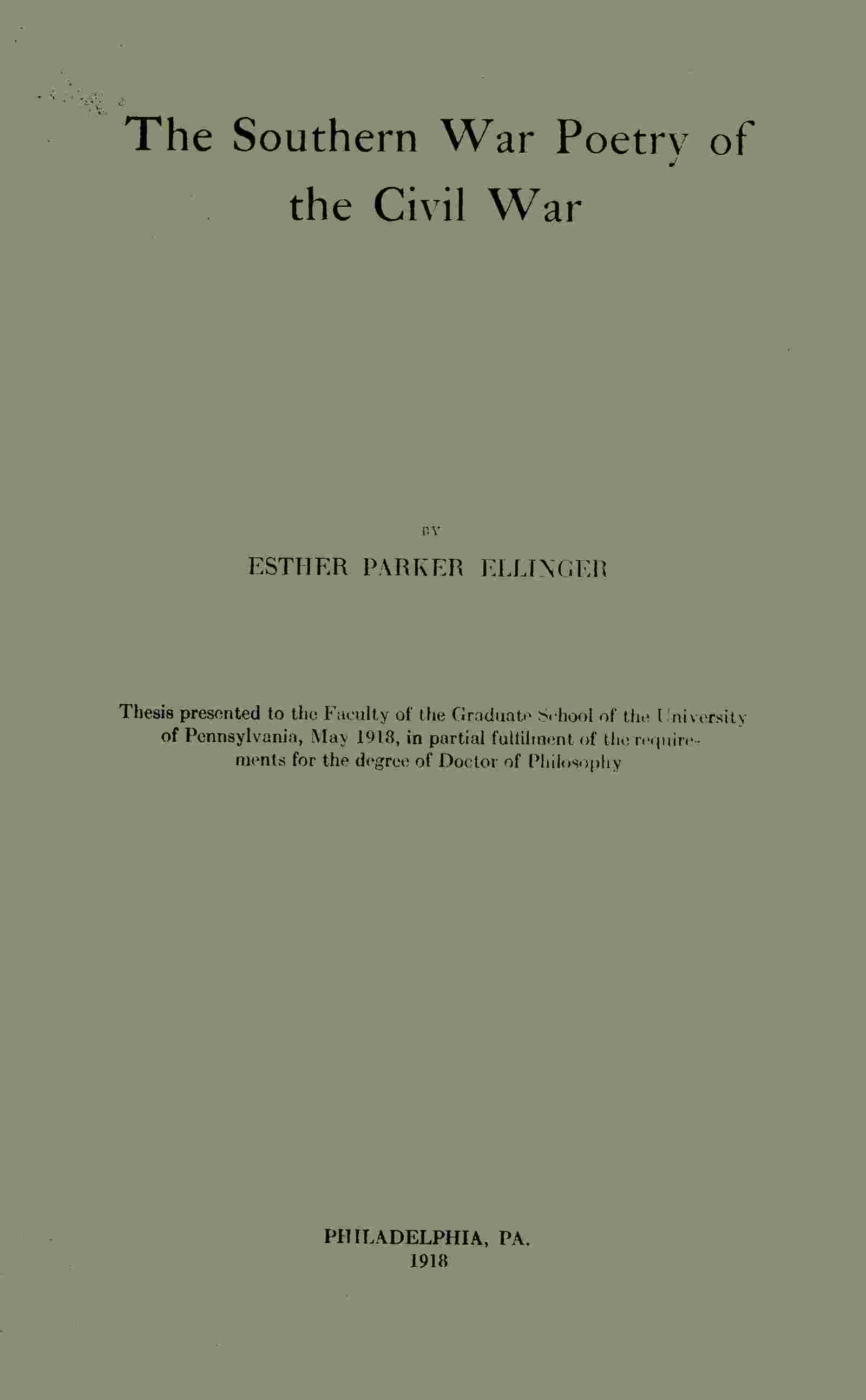
The Southern war poetry of the Civil War cover

The Southern war poetry of the Civil War

Chapter 10: INDEX OF SOUTHERN WAR POEMS OF THE CIVIL WAR
Open in WeRead

Explore more books like this:

About This Book

A doctoral study surveys and analyzes verse composed in the Confederate states during the American Civil War, arguing that such poetry functioned as the emotional literature of its people and exerted significant cultural influence. It traces the historical development and varieties of wartime verse, assesses quality and circulation, and examines reasons for its later marginalization and limited postwar circulation. The work gathers and catalogs poems from newspapers, broadsides, and collections, supplies bibliographies and anthology listings, offers critical commentary on recurring themes and modes, and includes an index to facilitate further research.

INDEX OF SOUTHERN WAR POEMS OF THE CIVIL WAR

[Note:—Round brackets at the end of the title indicate the volume or one of the volumes in which the poem may be found. Wherever the poem appears in several anthologies, that anthology easiest of access to the general reader, has been selected. Square brackets are used for the interpolation of explanatory matter.
The first two lines of each poem are given to serve as a check since identical poems may appear under corrupted captions, or various titles.]

Abe’s Cogitations: (Randolph.)

“We ought to whip them rebel chaps,
I think so, more and more”—

Abraham Lincoln: The Mohammed of the Modern Hegira. New Orleans, March 5, 1861. (P. & P. B. from the New Orleans Crescent.)

At midnight in the Keystone State
Old Abe was dreaming of the hour—

Acceptation: By Mrs. M. J. Preston. (E. V. M.)

“We do accept thee, heavenly Peace!
Albeit thou comest in a guise”—

Acrostic [Davis]: February 22, 1862. (R. N. S. from the Charleston Courier.)

“Jehovah, mighty arbiter in earth below,
Ere morning stars together sang, in heaven supreme,”—

Acrostic [B. F. Butler]: Baltimore, March 14, 1863. (R. B. B. 11½.)

“Brutal by nature—a coward and knave,
Famed for no action, noble or brave”—

Acrostic in Memory of O. Jennings Wise: By Miriam. (S. L. M. Ed. Table, September, ’63.)

“Over his cold brow
Just touched by Time’s soft silver tracery,”—

Acrostic on Magruder: By G. B. Milner, Harrisburg, Texas. (Alsb.)

“Much hast thou suffered, bright Isle of the Wave!
Ah! can anyone succor: can anyone save?”—

Addition to the Bonnie Blue Flag: A Tribute to True Kentuckians. (W. L.)

“And we will add another cheer for our Kentucky State,
Her sons in the most glorious war have proved both brave and great;”—

Address: Delivered at the opening of the New Theatre at Richmond: A Prize Poem, by Henry Timrod. (W. G. S. from Southern Illustrated News.)

“A fairy ring
Drawn in the crimson of a battle plain”—

Address to the Exchanged Prisoners: On the 31st of July, 1862, all the prisoners of war in Fort Warren, (about 250 soldiers of the Confederate army) embarked for Fortress Monroe, to be exchanged. They left in Fort Warren, 14 gentlemen, who were imprisoned under the designation of “political prisoners.” These were all Marylanders by birth, all but one (Mr. Winder) were residents of that state when arrested. On their behalf the following lines were addressed to their departing friends: By T. S. Wallis, Fort Warren, July 31, 1862: S. L. M., July and August, 1862. (E. V. M.)

“The anchors are weighed, and the gates of yon prison
Fall wide, as your ship gives her prow to the foam,”—

Address to the Women of the Southern Troops: Air—“Bruce’s Address:” By Mrs. J. T. H. Cross. (R. R.)

“Southern men, unsheathe the sword,
Inland and along the board;”—

After the Battle: By Miss Agnes Leonard. (W. G. S. from the Chicago Journal of Commerce, June, 1863.)

“All day long the sun had wandered,
Through the slowly creeping hours”—

After the Battle of Bull Run: July 21, [1861.] (W. L.)

“Sadly and low,
Hear how the fitful breezes blow!”—

Afraid of a Dead Baby: By Kentucky. (S. O. S.)

“Keep here, my little baby: rest alone!
Not in thy father’s tomb can’st thou be laid:”—

Alabama: (Randolph).

“Over vale and over mountain,
Pealing forth in triumphal song,”—

The Alabama: Respectfully dedicated to the Gallant Captain Semmes, His Officers and Crew and to the Officers and Seamen of the C. S. Navy: by E. King, author of Naval Songs of the South. Richmond, Va., George Dunn & Co. (R. B. M., 1864.)

“The wind blow off yon rocky shore
Boys! Set your sails all free”—

The Alabama Cottage: A Homely Scene. (R. B. B.)

“The Alabamian sat by the chimney side—
His face was wrinkled and worn.”—

Albert Sidney Johnston: (Im.)

“Honor to him who only drew
In Freedom’s cause his battle blade,”—

Albert Sidney Johnston: By A. G. (E. V. M., ’69.)

“I heard afar, the cannon’s roar,
Its lightning flashed from shore to shore,”—

Albert Sidney Johnston: Killed at Battle of Shiloh, April, 1862. By Fleming James. (E. V. M.)

“’Mid dim and solemn forests, in the dawning chill and gray
Over dank, unrustling leaves, or through the stiff and sodden clay”—

Albert Sidney Johnston: Dirge by Colonel A. W. Terrell. (Alsb.)

“Hush the notes of exultation for a battle dearly won!
Low the chief’s proud form is lying—Texas weeps another son!”—

All Is Gone: By Fadette. (W. G. S. from the Memphis Appeal.)

“Sister hark! Atween the trees cometh naught but summer breeze?
All is gone”—

All Over Now: (Im.)

“All over now! The trumpet blast,
The hurried tramping to and fro,”—

All Quiet Along the Potomac Tonight: By Mrs. Randolph Harrison. (C. S. B.)

“All quiet along the Potomac tonight,
No sound save the rush of the river”—

All Spice: Or Spice for All: By Cola, Le Diable Boiteux. Baltimore, March 7, 1862: Baltimore, April 1, 1862. (R. B. B.)

“The people endure all
The Hydropaths cure all”—

All’s Noise Along the Appomattox: Battle of the Crater, A. D., 1863. (C. C.)

“All’s noise along the Appomattox tonight,
For Grant, with his Whiteworth’s and Parrots”—

All’s Well: By Mrs. Margaret J. Preston of Va. (Amaranth, from The Land We Love.)

“‘All’s well!’ How the musical sound
Is pleasantly smiting the ear,”—

All’s Well: Come to the Rescue. (R. B. B.)

“One night of late I chanced to stray
Being in the pleasant sweet month of May dream.”—

Allons Enfants: The Southern Marseillaise: Air “Marseillaise.” By A. E. Blackmar, New Orleans, 1861. (C. S. B.)

[“This may be called the rallying song of the Confederacy. Composed early in 1861, it was sung throughout the South while the soldiers were hurried to Virginia with this, the grandest of martial airs, as a benediction.”]

“Sons of the South, awake to glory,
A thousand voices bid you rise”—

The American Star: Air “Humors of Glen.” Published by Louis Bonsai, Baltimore and Frederic Streets, Baltimore. (R. B. B. p. 7)

“Come, striking the bold anthem, the war dogs are howling,
Already they eagerly snuff up their prey”—

The Angel of the Church: By W. Gilmore Simms. January, 1864. (W. G. S.)

“Aye, strike with sacrilegious aim
The temple of the living God;”—

The Angel of the Hospital: By S. C. Mercer. (R. N. S. from the Louisville Journal.)

“’Twas nightfall in the hospital. The day
As though its eyes were dimmed with bloody rain”—

Another Flag: A Second Thought: [By C. B. Northrup.] (Outcast.)

“Whole we preserve the stars and stripes and blue
Of freedom’s ancient flag, it will not do”—

Another Yankee Doodle: (R. R.)

“Yankee Doodle has a mind
To whip the Southern traitors.”—

An Answer to the Poem Entitled “How They Act in Baltimore:” By Redgauntlet. (Md. Hist. B.)

“When our ladies on the street
Yankee soldiers chance to meet,”—

An Appeal: By Kentucky. (S. O. S.)

“Haste, Kentuckians! wait no longer;
Rally, and you will be stronger.”—

An Appeal for Jefferson Davis To His Excellency, Andrew Johnson, President of the United States: By a Lady of Virginia. (E. V. M.)

“Unheralded, unknown, I come to thee,
Who holdest in thy hands the scales of power;”—

An Appeal for Maryland: By B. Baltimore, January 20, 1862. (R. B. B. 84.)

“Of all the gems that gild the wreath
Of freedom, the blue sky underneath,”—

Appeal to Maryland: From a Dying Soldier at Manassas: by a Lady of Maryland. (S. L. M., Oct., 1861.)

“Oh Mother! my Maryland! will you awake?
Hear you not from Manassas the thunder of guns?”—

Appeal to the South: (R. B. B.)

“Southrons! since we boast that name;
Southrons! since your blood we claim”—

An Appeal to the South: By A Daughter of Dixie H. Baltimore, Jan. 24, 1862; also Norfolk, Va., Jan. 24, 1862. (R. B. B. 2 & 41.)

“Hark! o’er the Southern hills I hear
The cannons and the rifles sound;”—

(The) Approaching Battle Hour: By Kentucky. Richmond, Virginia, June, 1862. (S. O. S.)

“Ah! hovers over them
The gaunt war-demon fell;”—

April 26th: In the ceremonies at Memphis, Tennessee, 26th April, “In Memory of the Confederate Dead,” Dr. Ford one of the speakers improvised the following appropriate lines: (E. V. M.)

“In rank and file, in sad array
As though their watch still keeping,”—

April Twenty-Sixth: By Annie Chambers Ketchum. Memphis, Tenn. (E. V. M.)

“Dreams of a stately land,
Where rose and lotus open to the sun”—

Are We Free? By James R. Brewer. Annapolis, Oct. 22, 1861. (E. V. M.)

“Are we free? Go ask the question
In the cells of Lafayette,”—

Are You Ready? (Bohemian from the Macon Telegraph.)

“Sons and brothers—near and far,
Have you heard the tones of war?”—

Arise! Ye Sons of Freeborn Sires! By A. E. Morris, Company C, 20th Infantry. (Alsb.)

“Arise! ye sons of freeborn sires, arise! your country save!
Kindle again the wonted fires that animate the brave:”—

Arlington: By Margaret J. Preston. (E. V. M.)

“You stand upon the chasm’s brink
That yawns so deadly deep,”—

Arm for The Southern Land: By General Mirabeau B. Lamar. (S. B. P.)

“Arm for the Southern land,
All fear of death disdaining;”—

The Army and Its Flag of Stars and Stripes: [By C. B. Northrup] (Outcast.)

“In Liberty’s great war”—

Arouse, Kentuckians! By Kentucky. (S. O. S.)

“Arouse, Kentuckians, or my heart will break!
What though by thousands brethren may forsake”—

Ashby: By John R. Thompson of Virginia. Richmond, June 13, 1862: S. L. M., Editor’s Table, May, 1862. (S. S.)

“To the brave all homage render!
Weep, ye skies of June!”—

The Ashbys: By D. B. Lucas, of Va. (E. V. M. ’69.)

“And lo! there galloped through the gates of war
Two brothers, riding side by side, with spurs,”—

Ashby’s Avengers: Air “Annie Lyle.” (Cav.)

“Down where the Southern army
Near Virginia’s side,”—

Ashby’s Death: Air: “Annie Laurie.” (Cav.)

“A wail sweeps o’er the Valley,
Virginia’s deep with woe.”—

Ashes of Glory: By A. J. Requier. (W. G. S.)

“Fold up the gorgeous silken sun,
By bleeding martyrs blest,”—

At Fort Pillow: By James R. Randall. (W. G. S. from the Wilmington Journal, April 25, 1864.)

“You shudder as you think upon
The carnage of the grim report”—

At Galveston, Texas: By H. L. Flash. (Alsb.)

“We parted, love, some months ago, in pleasant summer weather;
You blamed the fates that you and I could not remain together;”—

Attention! By B. Baltimore, Oct. 16, 1861. (R. B. B. 7.)

“Hearken, friends and foes now hearken
See Abe Lincoln’s prospects darken;”—

Audax Omnia Perpeti, etc. By B. (R. B. B. 4.)

“Come pretty muse, give me your help,
Keen make my pen as the teamster’s lash”—

Auld Lang Syne: A supposed song of Morgan’s Cavalry on entering a Kentucky town. By Kentucky. (S. O. S.)

“Shall auld acquaintance be forgot,
And not now be brought to mind?”—

Autumn Thoughts, 1862: By Miss Mary A. Grason. (E. V. M. ’69.)

“Our Autumn comes with tender glow;
A golden haze is on the hills,”—

The Autumn Rain: By Susan Archer Talley. Richmond, Va. (E. V. M.)

“Softly, mournfully, slowly,
Droppeth the rain from the eaves”—

The Avatar of Hell: Sonnet, by “Pax.” (W. G. S. from the Charleston Mercury.)

“Six thousand years of commune, God with man,
Two thousand years of Christ, yet from such roots”—

Awake! Arise! By G. W. Archer, M. D. (W. G. S.)

“Sons of the South, awake, arise!
A million foes sweep down amain,”—

Awake in Dixie: By H. T. S., Winchester, Va., February 24, 1862. Air, “Dixie’s Land.” (R. B. B. 7.)

“Hear ye not the sound of battle,
Sabres’ clash and muskets’ rattle:”—

Away with the Dastards Who Whine of Defeat: By Paul H. Hayne of S. C. Charleston, May 10, 1862. (E. V. M.)

“Away with the dastards who whine of defeat
And hint that the day of destruction draws near,”—

Away with the Stripes: By Kentucky. (S. O. S.)

“Ho! away with the stripes, the despots’ fit flag!
The stars and the stripes are the bully’s great “brag”:”—

A Ballad for the Young South: By Joseph Brennan. S. L. M., Feb., 1861, from the New Orleans Crescent. (S. S.)

“Men of the South! Our foes are up
In fierce and grim array;”—

The Ballad of the Right: By J. W. Overall. (S. S. from the New Orleans True Delta.)

“In other days our fathers’ love was loyal, full and free,
For those they left behind them in the Island of the Sea;”—

A Ballad of the War: By George Herbert Sass, of Charleston, S. C. (W. G. S., originally published in Southern Field and Fireside.)

“Watchmen, what of the night?
Through the city’s darkening street”—

Baltimore: (West. Res.)

“Hail, queen of cities, birthplace of the just,
Oh how cast down! by Northern vandals crushed,”—

Baltimore: By C. (Mr. Samuel’s Scrapbook: Ridgway Library.)

“Hail, queen of cities, birthplace of the just,
Oh how cast down! By Northern vandals crushed,”—

Baltimore Girls: Air, “Dearest Mae.” (West Res.)

“O the girls of dear old Baltimore,
So beautiful and fair,”—

The Band in the Pines: Heard after Pelham died: by John Esten Cooke. (W. G. S.)

“Oh, band in the pine-wood, cease!
Cease with your splendid call:”—

Banks’ Skedaddle: (Alsb.)

“You know the Federal General Banks,
Who came through Louisiana with his forty thousand Yanks;”—

Banner Song: Written and Expressly Dedicated to the Armstrong Guards. By Wm. H. Holcombe, M. D. (S. L. M., July 1861.)

“See our banner floating high
Stars in freedom’s shining sky;”—

The Banner-Song: By James B. Marshall. (R. R.)

“Up, up with the banner, the foe is before us,
His bayonets bristle, his sword is unsheathed,”—

The Barefooted Boys: (S. S.)

“By the sword of St. Michael
The old dragon through!”—

The Bars and Stars: Air, “Star Spangled Banner:” by A. W. Haynes. (Randolph.)

“Oh, the tocsin of war still resounds o’er the land,
And legions of braves are now rushing to battle,”—

Le Bataille des Mouchoirs: The Greatest Battle of the War: fought Feb. 20, 1863. By a young lady of 17, Eugenie. (S. L. M., Oct., ’63.)

“Of all the battles, modern or old,
By poet sung or historian told,”—

The Battle at Bethel: Air, “Dixie.” (Bohemian from the Richmond Whig.)

“Send out the news from West to South and spread it through the land,
Our noble boys have met the foe at Bethel,”—

The Battle at Bull Run: By Ruth. Louisville, Ky., July 24, 1861. (R. R.)

“Forward, my brave columns, forward!
No other word was spoken;”—

Battle at Bull’s Run: (R. B. B. 7.)

“Oh be easy, don’t you tease me,
While I sing a bit of fun,”—

Battle Before Richmond: By G. B. S., 1862. (W. L.)

“Slowly the great sun rose o’er Richmond’s hills,
Calmly the noble river waved along,”—

Battle Call, Nec temere, nec timide: Dedicated to her countrymen, the Cavaliers of the South, by Annie Chambers Ketchum. Dunrobin Cottage, May, 1861. (R. R.)

“Gentlemen of the South!
Gird on your flashing swords!”—

The Battle Call: By Mrs. E. V. McCord Vernon, Richmond, Va., Feb. 20, 1862. (C. C.)

“Rise Southerner! the day of your glory,
The hour of your destiny’s near”—

Battle Call to Kentucky, 1862: By Walker Meriweather Bell. (Amaranth.)

“Arouse thee, Kentucky! the graves of thy sires
Are pressed by the foot of the foe.”—

Battle Cry of Freedom: By Wm. H. Barnes. (Lee.)

“Our flag is proudly floating on the land and on the main,
Shout, shout the battle cry of freedom.”—

The Battle Cry of the South: By James R. Randall. (W. G. S.)

“Brothers, the thunder-cloud is black,
And the wail of the South wings forth;”—

Battle Eve: By Susan Archer Talley. S. L. M., Aug., 1861. (S. S.)

“I see the broad red setting sun
Sink slowly down the sky;”—

The Battle Field of Manassas: By M. F. Bigney. (R. R.)

“Fill, fill the trump of fame
With the name,—
Manassas,”—

Battle Hymn: (W. G. S. from the Charleston Mercury).

“Lord of Hosts, that beholds us in battle, defending
The homes of our sires ’gainst the hosts of the foe”—

Battle Hymn: Columns Steady: By Wm. Gilmore Simms. (Bohemian.)

“Columns steady! make ye ready—with the steel and rifle ready!
Wait the signal! wait the moment—soul and steel and weapon steady!”—

Battle Hymn of the Virginia Soldier: (R. B. B. 8.)

“Father of earth and heaven, I call thy name!
Round me the smoke and shout of battle roll;”—

Battle Ode to Virginia: (R. R.)

“Old Virginia! virgin crowned
Daughter of the royal Bess,”—

Battle of Belmont: (Wash’n.)

“I sing of the Battle of Belmont, ’twas near Columbus town
The Yankees in great numbers from Cairo did come down.”—

Battle of Belmont: By J. Augustine Signaigo. (W. G. S. from the Memphis Appeal, Dec. 21, 1861.)

“Now glory to our Southern cause, and praises be to God
That He hath met the Southron’s foe and scourged him with His rod:”—

Battle of Bethel: (Randolph.)

“Saw ye not the ruddy sunlight;
Glancing o’er the hill-tops far,”—

The Battle of Bethel Church: (C. C. from the New Orleans Delta, 10 June, 1861.)

“As hurtles the tempest
Proclaiming the storm,”—

Battle of Big Bethel: (West Res.)

“Though Butler be a hero,
Who ne’er has powder smelt,”—

The Battle of Buena Vista: Inscribed to Jefferson Davis: by a Mississippian. (E. V. M. from the Louisville Courier, April 1866.)

“It was upon the battle field
Where lay the dead and dying”—

The Battle of Charleston Harbor: April 7th, 1863: by Paul H. Hayne. (W. C. S.)

“Two hours or more, beyond the prime of a blithe April day,
The Northman’s mailed ‘Invincibles’ steamed up air Charleston Bay;”—

Battle of Galveston: Air, “The Harp that Once Through Tara’s Halls:” by Mrs. E. L. Caplen, of Galveston. (Alsb.)

“’Twas on that dark and fearful morn
That anxious hearts beat high!”—

The Battle of Great Bethel: Fought on Sunday, June 9, 1861. Dedicated to Magruder and his command: by “C.,” an American patriot not 14 years old. (Mr. Samuel’s Scrapbook, Ridgway Library.)

“Brave Virginians! on this day
Drive the Northern horde away!”—

Battle of Hampton Roads: By Ossian D. Gorman. (W. G. S. from the Macon Daily Telegraph.)

“Ne’er had a scene of beauty smiled
On placid waters ’neath the sun.”—

The Battle of Hampton Roads: By Tenella, [Mrs. Clarke of N. C.] (E. V. M.)

“Now, once again, let Southern hearts unite in thankful praise,
To the mighty God of battle, mysterious in his ways;”—

Battle of Manassas: July 21, 1861. (W. L.)

“The bridal of the earth and sky! the blessed Sabbath-morn,
Brightens into the perfect day from its soft rosy dawn;”—

The Battle of Manassas: Dedicated to General Beauregard, C. S. A.: by Mrs. Clarke, wife of Colonel Clarke, 14th Regiment, N. C. (E. V. M.)

“‘Now glory to the Lord of Hosts!’ oh! bless and praise His name,
That He hath battled in our cause, and brought our foes to shame.”—

Battle of Manassas (July 21, 1861): By Cornelia J. M. Jordan. (Corinth.)

“Clear rises now, the glorious sun,
No cloud bedims the sky,”—

The Battle of Manassas: By Susan Archer Talley: Richmond, Aug. 3, 1861. S. L. M., Sept., 1861. (R. B. B. 61.)

“Now proudly lift, of sunny South,
Your glad triumphal strains,”—

The Battle of Richmond. (Psalm xliv. 3-4): By George Herbert Sass, Charleston, S. C. (W. G. S.)