
PART II.
THE SQUARE JAWS.
CHAPTER I.
THE WELDING OF FRENCH AND BRITISH.
Not all things can be welded together. There are metals which are wholly unsympathetic, and even for those which are not we require the services of the plumber and his solder.
It is the glory and the good fortune of the British and French Armies that, from the first day of the war, they have shown themselves fitted—and eager—to become one; and that they have discovered, to this end (and continue daily to employ them), plumbers of the first class and lead in abundance.
Let us understand one another. To say "joining," "soldering," is not to say "fusion," and the theory of united action upon a united front does not necessarily imply that out of two friends a single individual is wrought. A poilu might say that it is possible to be very good comrades without sleeping in the same bed.
For Germany such fusion would have been a danger, and she has always avoided it. Although she has carried her partnership with her allies to the length of making them her slaves, she has been very careful to allow nothing like a mingling of breeds in the forces which are at her disposal. The German Army has, for instance, resisted every temptation to admit into its ranks any of its Austrian friends. For it believes that it is possible to be too friendly.
Germany has confined herself, where this is in question, to giving her weakened allies no more help than can be obtained from her officers, commissioned and non-commissioned, or from the specialised activities of her artillery and engineers. Beyond this she has but one thought—at any cost to insure unity of action between her forces and those of her allies.
From this it follows that to bring about a real fusion of two or more allied armies upon one front is a tactical achievement of the first importance. Such a fusion—the essential condition of all united effort that is to possess a real value—becomes, from its very nature, the principal object of the enemy's attack. The history of this war shows, if one may say so, nothing but a series of attempts, upon one side or the other, to prevent or destroy the cohesion of the opposing forces. (Mons; the first and second Battles of Ypres; the Russian-Rumanian Armies and the Army of the East; the junction of the Italians near Vallona with the Army of Salonika, etc.) But it is not enough that this fusion should exist. It is also vital—as we shall presently see in the case of the Franco-British forces—that it should be both elastic and solid.
Since it is agreed that in war-time each month counts as a year, we may say that it is now two months since the French and British Armies celebrated their silver wedding. Age has weakened neither the strength nor the love of the partners to this marriage. We can say confidently that, since the day when "the contemptible little Army of General French" first shook hands with our pioupious, the friendship has never been interrupted. For all his passionate desire to accomplish the destruction of the bond which the two countries have willingly exchanged for their individual liberty, the enemy's efforts have been fruitless.
Even during the gloomy days of the retreat from Mons and Charleroi the union of the two Armies remained unimpaired. While one of them, overwhelmed by numbers, found itself compelled to retire, the other, without any proper understanding of the reason, and with no thought for anything but the maintenance of the connection, complied at once with the manœuvre, though not without exacting a heavy toll from its enemies.
A few days later the victory of the Marne was to reward these mutual sacrifices for the common cause.
A cloud had passed. Others followed. Again and again the enemy, furious at the perfect understanding which existed between his opponents and dreading what the consequences of it might be to himself, determined to make an end of it. The two battles of Ypres were the fruit of this resolution, to shatter the unity of the French and British Armies.
For one moment they believed that they had succeeded.
This was on the 24th April, 1915, when, by the use of asphyxiating gas, till then unknown to us, they had driven in one corner of the Ypres salient. We know that it was the gallantry of the Canadians that saved the day and closed the opening breach.
Since then the chain has never been weakened. Nay, in the North it has never been so much as stretched.
This, however, has not been the case with the connection between the British Army and the main body of the Armies of France. The continual addition of new units to the British forces was bound to cause frequent changes, here, in the geographical distribution of the adjoining troops. Can France ever forget the day when she learned that silently, without a hitch, and under the very noses of the Germans, the British front had suddenly been extended from Loos to the Somme? A mother who meets, after years, the son whom she has last seen as a child, must feel a surprise not unlike that with which France discovered that the Armies of her Allies had become so large. Who knows but that we may soon be again delighted in the same way? I say "delighted," not "surprised," for our Allies have taught us to forget to be astonished by anything they may do.
And so, every time that the British front is extended, this elasticity of the fusion of the Armies is to be observed.
It is clear that these rearrangements can in no way affect its solidity, since it is this very fusion which has made possible not only the terrific offensive of the 1st July last, but also its uninterrupted prosecution.
Only a very happy combination of circumstances could have brought about this miracle—for it is one—which to explain is to show that it must last as long as the war shall go on.
First of all, it is due to the perfect understanding which exists between the General Staffs of the two Allied Armies. It is, indeed, an achievement to set men of different races, if of equal courage, side by side. But this is not enough. Much more need is there of a unity of command which shall see that the best use is made of all this determination, brought together from sources so widely sundered, so that the utmost measure of mutual support and cohesion may result from the efforts of units which, though they work alongside of one another, are strangers. Now it is this very thing which is evident in the combined operations of the British and French Armies, at all times and particularly since the opening of the offensive in Picardy. The Commander-in-Chief, Sir Douglas Haig, and General Foch—whom one may perhaps describe as the keystone of the combination—have shown themselves, in this connection, to be as good psychologists as they are tacticians.
The troops of neither nation—and this should be made very clear—have in any case experienced the smallest embarrassment in following out the commands of their leaders. Whenever either English or French have been able to give one another any kind of support, they have done it faithfully and readily. The "fusion" is not a thing of maps; it is not to be found in this place or that; it is a spiritual verity.
Living side by side, dying under one another's eyes, English and French are acquiring a mutual respect and confidence which cannot fail to strengthen their fighting power.
"After all the proofs of their resolution and intrepidity," wrote Field-Marshal French in a report, of June, 1915, upon the gas attacks, "which our valiant Allies have given throughout the campaign, it is quite unnecessary for me to dwell upon this incident, and I will only express my firm conviction that if there are any troops on earth who could have held their trenches in the face of an attack as treacherous as it was unforeseen, it is the French divisions that would have done it."
Which is the more admirable—the General who speaks of his Allies in such generous terms, or the soldiers who inspired such words?
CHAPTER II.
HOW THE AUSTRALIAN CONTINGENT VOTED IN FRANCE IN FACE OF THE ENEMY.
8th December, 1916.
What Frenchman has not met, at least once, in Paris or some other of our large towns, one of these stout lads who wear the uniform and carry the equipment of the British soldier, but are to be distinguished from him by that khaki-coloured, broad-brimmed felt hat, which the Boers have immortalised?
Of a height generally above that of the average Frenchman, with broad shoulders, an alert glance, a free and easy air; a skin that is often tanned; a horseman from boyhood, slow to tire, reckless in battles and of a hot temper—such is the Australian soldier, one of the world's foremost fighting men.
His courage, which the enemy regards with a peculiar distaste, has earned him heavy fighting everywhere throughout the war. Let us recall, shortly, some of his chief performances.
The first division sent by Australia to the assistance of the Mother Country towards the end of 1914 was employed on the defences of Egypt and the Suez Canal. These sterling horsemen did splendid work in this field of operations, and for four months lived in the desert, exposed to continual attack.
Next, the Australian troops, augmented by certain units of New Zealanders, disembarked on the Gallipoli Peninsula at the left of their English comrades. Hardly were they on shore before they began a series of battles which never stopped for a week. They held, at very great cost, the bit of ground which had been taken from the Turks, and during four months two divisions of them lived, Heaven knows how, on a space of less than a third of an acre.
Then came the Evacuation of Gallipoli. The Australians returned to Egypt, there to rest between December, 1915, and the 1st of April, 1916, on which day they made their appearance on the Western front.
Since that time the Australians have fought on French soil.
They have to thank their splendid reputation that they are always to be found wherever the most glory is to be won. It was they who took Pozières, during the Somme offensive, and the farm at Mouquet, and measured their strength, throughout those epic days, against that of the Prussian Guard.
Such is the Army which, quite recently, has held its Elections under the very guns of the Germans.
For this Army, whose valour is already almost legendary, is also among the most democratic Armies of the world. No one is more jealous of his independence than the Australian. If he loves and admires his comrades-in-arms, the French poilus, it is, no doubt, because, having long misunderstood them, after the fashion of strangers towards all things French, he cannot to-day find words enough to do justice to their military qualities and their unselfish courage. But it is also, and, above all, because his heart goes out naturally to the French people under arms, to this democracy which in so many ways resembles his own country, Australia the Free. Like the French soldier, the Australian loves his fun; like him, he is light-hearted, always singing. And each of them glories in the knowledge that beneath his soldier's uniform is a citizen and an elector of a noble country.
These reflections will help us to understand why the Australian Government has been led to hold a referendum of its Expeditionary Force in France.
As you know, the people of Australia were concerned with the business of deciding for or against the introduction of compulsory military service into their country. Mr. Hughes, the Premier of New South Wales, who did France the honour to visit it at the beginning of this year, was the originator of this referendum. The result, for reasons which I will presently mention, was a majority against conscription for Australia.
To enable the Australian contingent to vote was the simplest thing in the world. Voting booths were prepared at Contay, a small village between the Ancre and the Somme, close to the firing-line. As fast as the sections left the trenches to go back into billets, each officer, non-commissioned officer and man was given two voting papers. On one the word "Yes" was printed; on the other, "No." The voting lasted a month—the time between reliefs—at the end of which period about 100,000 papers had been collected in the ballot-boxes at Contay. It is strange that the majority of the Australian contingent voted against compulsory service for Australia.
Why?
Let no one imagine that it was because these heroes have become opponents of the war; nor is it even because they think that their country has done enough.
They have voted against compulsory service, first of all, for a reason of a general nature, which applies to the whole of this body of Australian electors—namely, because the Australians have a horror of all moral compulsion and a burning love of liberty. These soldiers have also been influenced by another objection: they fear lest to introduce a professional Army into Australia may be to infect their nation with a spirit of militarism which is not at all to their taste.
And the proof that the negative result of the referendum has in no way weakened the determination of Australia to pursue the war to a victorious end and in complete accord with the Mother Country, is that, on the one hand, the Australian contingent persists, after, as before, recording its vote, in splendidly performing its duty at the front; and that, on the other hand, Australia continues to send to the battlefields of Europe thousands of fresh volunteers.
Hurrah for Liberty! Down with the Boches! In this motto the quality of the Australian troops is perfectly expressed. This quality one meets with again in the war song, the species of Marseillaise, which the Australians sing to-day when they are on the march in France.
Here are its words in full:
AUSTRALIA WILL BE THERE.
1st Verse.
That was cruising all around,
Sinking British shipping
Where'er it could be found,
Till one bright Sunday morning
The Sydney came in sight—
The Emden said good night.
Chorus.
Rally round the banner of your King.
On land or sea,
Wherever you be,
Keep your eye on Germany.
For England, home and beauty,
Have no cause to fear.
Should old acquaintance be forgot?
No, No—No, No, No.
Australia will be there,
Australia will be there.
2nd Verse.
And French in our cavalry fine,
You bet those German bandsmen
Are in for a lively time.
And there's Winston Churchill
To guide our Navy grand;
With this fine lot we'll make it hot
For the poor old Fatherland.
Chorus.
3rd Verse.
When England was at war;
Australian Light Horsemen, my boys,
Were always to the fore.
Archie Norris and Billy Cook
Have now all kissed the Book.
Chorus.
CHAPTER III.
BOELCKE'S LAND OF PROMISE.
On the 28th of October, six Halberstadters and Aviatiks attacked two English aviators in the neighbourhood of Pozières. During the fight six fresh enemy machines came to the assistance of their friends. At the end of five minutes of furious fighting two German machines collided. Pieces of the machines fell, and one of them descended toward the East. The fight lasted 15 minutes, at the end of which time all the enemy machines were driven off.
It is probable that it was during this fight that Captain Boelcke was killed. It was, in fact, at this date that the German wireless stated that Boelcke had been killed owing to a collision in the air.
In a letter which he wrote to a friend a few days before his tragic and still unaccountable death, Boelcke, the best-known and most successful of the German aviators, said:
"The Somme front is a positive land of promise. The sky is filled with English airmen."
Boelcke expressed, under the guise of a kind of sporting self-congratulation, the astonishment of his fellows at the way in which the British flying service had developed.
A large number of documents found upon German prisoners give evidence of a no less striking kind upon the same point.
"Our air service," says one of them, "practically ceased to exist during the Battle of the Somme. At times the sky seemed black with enemy machines."
Another says:
"We are so inferior to our opponents in our air service that when hostile machines fly over our own lines we have no recourse but to hide ourselves in the earth. Now and then a few of our machines attempt to go up, but it is only a drop in the bucket."
Finally, for one must not pursue this subject too far, a General Order has been issued to the German Army to the effect that when troops are marching they must halt and take cover whenever a British machine is known to be in their vicinity; for the English are in the habit of flying sufficiently low over the invaded territory to use their machine-guns against moving troops and convoys.
To this evidence from enemy sources I may perhaps add my own. I assert, then, as definitely as it is possible to do it, that one of my most agreeable surprises, during my visit to the British front, was the discovery of the great numbers and unceasing activity of the British aeroplanes. Whether I was in the firing-line or behind it, my attention was being constantly drawn to the movements of the British air service.
On the 15th of September the total number of hours during which flying was carried on upon the British front was 1,300. Reckoning that each aviator flies, on an average, for two hours, it is possible to form an idea of the number of machines which were in the air on that day.
During the last Battle of the Ancre the British planes of every kind, for bombing, fighting and directing the gunfire, seemed always to be over the German lines; and on one fairly still day I was able to count as many as 30 of them in the air at once, and this on a comparatively narrow sector.
Behind the lines I went to see numerous aviation camps, instruction camps, depôts of munitions, etc. They were like so many beehives, models of organisation, order and method. The pilots, the observers, the mechanics, everyone, seen at close quarters, gave me an impression of a very unusual power and intelligence, and inspired me with the same confidence with which their own mastery of the air has so long filled them, ever since, indeed, they wrested it from the enemy.
Perhaps it may not be labour lost if, in order to get a right understanding of the present very satisfactory and praiseworthy position, we review shortly the history of British military aviation since the beginning of the war.
England had not wished for war, nor had she prepared for it, and while aviation seemed to her a marvellous achievement of the human brain, she was far from thinking that she was bound to make use of it in order to injure mankind. This is why her military air service, like her whole Army, was in no more than an embryonic condition when she found herself faced with the grim reality of this war.
Far more than the exigencies of the campaign on the continent, it was the repeated raids of the Zeppelins over England which caused her to devote herself to the development of her aviation.
The undertaking bristled with difficulties. We should be wrong, were we in France, to suppose that we are the only people the story of whose aviation has been marked by crises. Our Allies, though their practical nature is proverbial among us, were forced to experiment and grope their way for a long time before they could arrive at a solution of the many knotty problems of aerial defence.
A complete lack of any central authority, a division or responsibility between the various staffs, nobody to decide as to how machines should be employed or how built, waste of every kind—the English have experienced all these troubles. But how admirably they have surmounted them! The proof is that now the only resource of the Germans is a servile imitation.
This spirit of imitation among the Germans has shown itself most markedly in these last weeks, during the process of the Battle of the Ancre. The Germans set out by collecting a large number of aeroplanes on a very narrow front. Then they began to show some signs of taking the initiative with a daring to which we were little accustomed.
Did they really hope to wrest the mastery of the air from the English? I do not know. In any case their attempt began badly; for when, 40 in number, they met 30 of the British machines, they could discover no better way of saving themselves than by flight, after a quarter of their number had been put out of action.
It was about this time that General von Groener, a man of energy and resolution, called upon the German aeroplane factories to increase their output; and that Mr. Lloyd George in England, while giving publicity to this new effort of Germany, exhorted his fellow-countrymen not to allow themselves to be overtaken by their enemy.
Boelcke may rest in peace. His land of promise can only grow greater and breed birds more rapidly.
After this, what need one say more of the technical skill and the often heroic courage of the British aviator?
The French and British airmen form, indeed, one great family of heroes, and our men have, in King George's Army, cousins who are as like them as brothers.
At this point I will do no more than offer for your consideration a document and a story.
The document is a letter, sent from Germany to his friends by an English aviator, Lieutenant Tudor-Hart, on the 25th of this July. I should blame myself were I to alter one word of it.
"I was," he writes, "with Captain Webb at between 12,000 and 15,000 feet above the German lines, when we saw eight German machines coming towards us from the South-west. They were higher than we were, and we went towards them to attack them. Two of them passed about 300 yards above our heads. I opened fire on one and they replied together.
"I signed to Webb to turn so that I might fire at the other machine, behind us; but he made a spurt forward with the machine. I looked round to see what had happened, but Webb pointed to his stomach and fell forward upon the controls. I fancy he must have died almost immediately. His last thought had been to save the machine.
"It at once began to swing in the direction of the German lines, and I was compelled to return to my machine-gun, in order to fire on a plane which was getting too close. The other machines never stopped firing at us. My only hope was to make for our lines, but I could not manage to push Webb out of the pilot's seat, and I was obliged to manœuvre above the hood.
"I had to fire so often that it became impossible for me to guide the machine. At last, constantly under fire, I planed down towards a field near by and tried to land. I saw a number of men with rifles, and I thought that I might be killed before being able to set the machine on fire.
"One wing having struck the earth, the machine was smashed, and I was thrown out. I got off with one side paralysed, one ankle and one rib broken. I was very well treated, and the German flying men behaved towards me like sportsmen and gentlemen."
It is in this way that the paladins of this war both conduct and express themselves.
And now for the story.
There was once in England a rich man who interested himself in Art and Politics. His name was Lord Lucas. Life had always smiled upon him, and he had returned her smile. Had he wished it, he might have spent his life in slippered ease and lived from day to day without a care.
Choosing, rather, to become a soldier, he joined the Expeditionary Forces during the South African War. He was wounded and lost a leg, but this in no way deterred him from being of service to his country.
When the European War broke out, Lord Lucas was the Minister for Agriculture in the Asquith Cabinet.
He felt shame to be engaged in such a vapid business as Politics now appeared, and he resigned. Next we find him volunteering for the British air service. In spite of his artificial leg, he went through his training, was hurt, got cured, and returned to his work and never rested until he had flown over the German lines. One day Lord Lucas, millionaire, artist, ex-Cabinet Minister, and, above all, soldier, failed to return to his squadron. The Boches alone know whether he is dead or a prisoner.
The man who told me the story of this splendid life was the best friend of Lord Lucas, and he was worthy to be it. I asked this soldier, a peer himself and himself wounded, if in England, as in France, commissions in the air service were much sought after. In reply, he pointed to two great birds, and said: "We admire them, Monsieur, as you do, and, like you, we envy them."
CHAPTER IV.
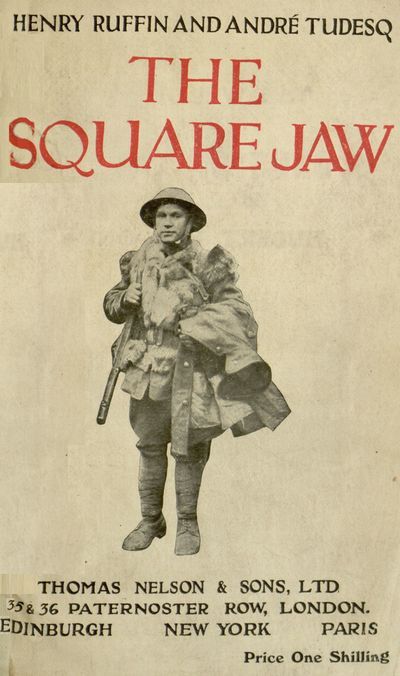
THE SQUARE JAW.[A]
[A] Of the two articles which follow, the first ("The Square Jaw") was written on the 9th of December, during the crisis caused by the successive resignations of Mr. Lloyd George and Mr. Asquith.
The second ("The Moral of the British Armies") was written on the 19th of the same month, the day after Germany made her official offer of peace.
The British soldier does not concern himself with Politics. It is not in his character to do so; moreover, any such conduct is against the rules of his profession. And so, since discipline "is the first weapon of Armies," the British soldier respects it above everything else.
The Englishman has a passion and a profound respect for method. Method requires that Politics should be the business of Ministers and Politicians, and that war should be carried on by soldiers. Method, says the Englishman, demands that everyone should stick to his own work and his own place. Without this, anarchy must ensue. Now there cannot well be anything less anarchical than the British Army.
It is their order and discipline which most powerfully and most quickly impress the Frenchman who is permitted to live for a time among the Armies of England. These qualities, let me hasten to add, are also the least superficial, and thus afford the surest test of the value of these Armies.
Observe that it is not by collecting together a body of indifferent natures, passive temperaments and personalities more or less irresponsible, that this order and discipline have been infused into the British Army. The level of capacity of this Army is, moreover, by no means a low one; for it is one of the most intelligent Armies in Europe or in the whole world. The common soldier is not of one class, to the exclusion of all others. He does not represent one section only of British opinion. His corporate mind is therefore in no way a limited one.
As a volunteer, he thronged into England, at the beginning of the war, from every quarter of the globe, and by this voluntary act at once proclaimed his intelligence. To-day, as a conscript, he represents, more than ever before, the completeness of his country's will.
As for the officers, who differ from our own in their essentially aristocratic character, in them we see the direct expression of all those qualities of brain and heart which distinguish the leading elements of British society.
And so, if this army does not concern itself with Politics, if it is thoroughly disciplined, if it contents itself with "making war," it is because it prefers to do these things.
It is, moreover, excellently informed of everything which happens outside itself, whether in England or elsewhere, and in this respect differs considerably from the German Army which lies beyond its trenches. A Boche prisoner, recently taken, owned that neither the newspapers of his country nor any letters ever reached the German troops in the front lines. As each day comes, its history is told to our enemies by word of mouth only; that is to say, after the fashion which best suits their rulers.
Among the English there is very little heard or said about peace, or about the objects for which they are fighting; but they read, and they read continually. The soldier follows the course of events as well in his letters as in his newspaper.
And in what does his knowledge consist? What does he know?
He knows that the Army to which he belongs owes much to that French Army which he admires so deeply, and by whose side he is proud to fight for the interests which their natures share. He knows that to the British Army is secured, from now onwards, one of the chief factors of invincible and victorious strength—numbers. He knows approximately the number of his effectives, and he would gladly, by crying it aloud, shake the confidence of the enemy and confirm that of his friends.
He knows also that the second factor of his strength—material—while it is already considerable and probably equal to that which his opponents possess—does not represent a quarter of what the coming year will produce. He knows, from having done it again and again since July, that not only can he resist the enemy, but defeat him; and he awaits confidently the hour of triumph.
Hence his firm, his unshakable determination to obtain victory on his own terms; hence, also, it follows that no thought or hope of a premature peace ever disturbs his mind.
And if no one else remained to fight, he would go on, for—he says it himself, and one cannot but believe him—he has "a square jaw."
It is important, in the present condition of affairs, that the French public should make no mistake as to the opinions of the British soldier concerning the war and its sure conclusion.
About this no one can be under any delusion. Everywhere on the British front there is but one opinion—that the war must be carried through to the end; that is to say, till the inevitable victory of the Allies has come to pass; and that it would be a crime against the Homeland, the Allies and those comrades who have fallen, to listen to proposals for a peace which would be consistent with neither the intentions nor the interests of England and her Allies.
During my visit of two months I have seen the larger part of the British front from the Somme to the Yser. Everywhere I have met with the same spirit of determination. This state of mind may be explained in various ways; the perfect confidence which the British Army feels in its Commander-in-Chief, Sir Douglas Haig, "the lucky," as the soldiers call him; the regular growth in the numbers of the effectives, which, though I may not disclose these figures, exceed the estimates of them usually made in France; the tremendous development of material and in the output of munitions; the magnificent successes gained on the Somme and the Ancre, which have given rise to the certainty of being able to defeat an enemy formerly said to be invincible; etc., etc.
Without doubt, the war goes slowly. Tommy admits it, but he begs you to observe—and justly—that on every occasion when his infantry has come to grips with the Germans it has invariably beaten them.
"Besides," he thinks, "perhaps it is not absolutely essential, in order to win the war and place England and her Allies in a position to dictate their own terms, that our Armies should hurl themselves forward in one final and costly advance over the shattered lines of the Germans." The British soldier is fond of comparing the Western battle front to an immense boxing ring, of which the complex systems of barbed wire which stretch from the North Sea to Belfort form the ropes. The war, on the West, has been fought within these limits since the Marne. It is possible that it will see no change of position up to the end.
But, as in a boxing match, it is not necessary, in order to win, to drive one's opponent over the ropes and out of the ring; in the same way it may happen that the German Army is "knocked out" in the positions where it is fighting to-day.
That, at least, is the opinion of the British soldier.
It is, indeed, no more than a paraphrase of that dictum, pronounced not long ago by General Nogi, and as true of the ring as it is of war: "Complete victory is to him who can last a quarter of an hour longer than the other fellow."
Tommy has no intention—no more than has his friend the poilu—of playing the part of "the other fellow."
CHAPTER V.
THE RELIEF.
The scene is an old trench of the French first line. It is midday. It is raining. It goes on raining. It has always rained. The sector is fairly quiet, and has been for an hour or so. Tommy sees a chance to write a letter.
Here in his dug-out—a miserable shelter which oozes water everywhere—squatted on the straw that becomes filth the moment it is thrown down, he is telling his friends in Scotland all his small sorrows and hopes; he is wishing them "A Happy New Year."
Suddenly his pen falters; the writer considers, stops writing, and, addressing the second-lieutenant as he goes by: "Beg pardon, sir," he asks, "may I say that they have moved out?"
"Certainly not," says the lieutenant, apparently horrified by such a question. "It is absolutely forbidden to say anything about this business. Do you understand, all of you?"
"But—but," someone ventures to say, "everyone in England knows about it already. The papers ..." and they show the lieutenant some newspapers which have come that morning. The officer takes them, glances at them, smiles, and says: "Oh, these journalists!"
On the front page of the paper a striking photograph is exhibited, showing an incident of the taking over by the British of the French front. Underneath is the following description:
"Tommy takes over the French trenches. French soldiers looking on at the arrival of British troops who are relieving them. This important operation took place at the front, at Christmas-time, silently, secretly and with complete success. The enemy, who was in many places no more than a few yards distant, never had any suspicion of this change, which has greatly extended the British lines and eased the strain which our gallant Allies have endured upon the Western front.
"This military manœuvre affords the best reply to the manœuvres of Germany in the direction of peace."
And so Tommy continues his letter in some such fashion as this:
"Now that the thing is done, I may tell you that we have left the sector of —— in order to come down farther South, where we have relieved the French. It has been a fine chance to see our brave Allies at work, and I am tremendously proud to have taken their place in the lines.
"The thing has been done very well, although it wanted a lot of care and was very dangerous. You can imagine that if the Boches had had any notion of what we were at, they would not have failed to do their level best to stop us or make it difficult for us; for it must make them very savage to see our 'contemptible little Army' always extending its flanks, without wearing thin anywhere, and so setting free first-rate troops for the French to use elsewhere.
"We came among the Frenchmen on Christmas Day.
"The roads were all as busy as on the day before the offensive on the Ancre in front of Beaumont-Hamel. We never stopped meeting French troops and wagons, which were going back towards the railway.
"We exchanged civilities with the poilus which neither they nor we understood the least bit. But I may tell you that it was pretty clear to me that they were not sorry to be giving up their places to us.
"On the 25th of December, after supper, we left our last camp and marched through the night for many hours, till we came to this French trench where I am writing to you now.
"The poilus were at their posts. It'll be a long time before I forget that sight.
"Although they were far dirtier and more tired than were we, the French, as they themselves say, 'had the smile.' If we had been allowed to make any noise, we should have cheered them. But we were only 38 yards from the Boche line.
"The officers and the non-commissioned officers gave the orders in whispers. They had interpreters to help them.
"As for me, I was at once told off to do sentry in the place of a great French chap, with a beard, who was a good 15 years older than I.
"As I understood a bit of French, I was able to make out most of what he said to me.
"'Good evening, my lad,' says he. 'You're a good fellow to come and let me out of this. Shake hands, won't you?'—I didn't understand everything; French is so difficult—and he added: 'And now, young 'un, open your eyes and keep them skinned.'
"Then he gave me a great deal of very sound advice, showing me in which directions I must keep a good look-out, and telling me to have a care of a blackguardly German machine-gun which never has done sweeping their parapet.
"When he had finished with this he took his rifle out of the loophole, and I put mine there in its place. And that's how the big relief was carried out on Christmas night."
At this point Tommy was forced to interrupt his long letter, for the Germans had at last got news of the relief and were attacking the sector. In vain.
Next day Tommy finished thus:
"My poilu was right. This corner can hardly be called a quiet one, and Fritz is a bad boy, there's no doubt about it. Thanks for your Christmas parcel. The pudding was A1. Good-bye.
"Tommy."
PART III.
THE ARMIES OF THE NORTH.
Flat calm on both sides of the Ancre; calm—or something like it—on the Somme. Let us take advantage of this apparent truce to get into rather closer touch with the British Army.
By this eight-day tour (though it has seemed, while we have been making it, a kind of intermezzo between two acts of the offensive) we had intended, particularly, to demonstrate to ourselves, by our study of the events and those who have enacted them, the dauntless determination with which our Allies, not satisfied to defend the heroic heritage which these battlefields of 1915 have bequeathed to them, now prepare for the future.
In telling these experiences, one has to play the Censor over oneself. And so we may say nothing of the most important things of all. Everywhere throughout this countryside mighty Armies, in the most perfect secrecy, are doing their business, scattering, with prodigal hand, the seed of future victory. And the harvest will surely be gathered. And if, at this time of heart-breaking uncertainty, our journey enables us to do no more than declare that great things are assuredly preparing, this alone will make it worth our having undertaken it.
We did not set out, we three, with our permits from the General Headquarters, to make a sentimental pilgrimage over the battlefields that lie between Lorette and the trenches of French Flanders. No; it was a reconnaissance that we made—into the Future. These sketches of the British Armies are, thus, no more than a study of latent forces.
CHAPTER I.
THE PREPARATION OF THE CANADIANS.
We spent the first two days among the Canadians. Let me recall a few of their performances. They sustained, in front of Ypres, the first great gas attack launched by the Germans. During the offensive in Picardy, being sent into the front line on the 15th of September or thereabouts, they stormed Courcelette and Martinpuich, and consolidated their forward positions on one side towards Grandcourt, on the other towards Le Sars. The rest of them kept the enemy contained.
To sum them up—an Army full of robust qualities, an Army of young athletes, inured by their own home-life to the physical hardships of the trenches, regardless alike of cold, fog and mud. An Army, too, of formidable size, since to-day its numbers are greater than those of the whole British Expeditionary Force of 1914.
We saw them in their lines—in camp. Our guides were certain young officers from Quebec, who spoke an archaic, melodious French, that was most pleasant to hear. Their names also sounded oddly in our ears; more than one of them recalled the old sailor names of Cherbourg, Saint Malo and Lorient. They told us what joy they found in fighting for their two Homelands—England and France.
While we were crossing a wood near A——, one of them told me, gravely: "I have been here since our good God made the little apples to grow, but I have known neither regret nor weariness. Rather has this life in France this springhead of my race, made me know myself each day more truly."
These men and their leaders, indeed, do neither their training nor their fighting from any other motive than duty. Their fighting has a kind of mystical quality, the passion of a young people, which makes them, behind their battle lines, a family of brothers, and, when they engage, an army of warriors who will lay down their lives for one another.
A few miles from the enemy, behind a redoubt, where thousands of French graves lie scattered, one of their divisions occupied some huts which our engineers had built. Almost everywhere the notices were written in French. In one immense system there were trenches of a hundred shapes all jumbled together. We saw, here, a demonstration of a surprise attack against a machine-gun emplacement on a redoubt of the German pattern. This manœuvre was no more than an illustration of theory. The captain who had charge of it had, during the previous night, himself led an attack against the Germans. From it he had returned with three things—a slight wound, two prisoners and the Military Cross.
Elsewhere, at the edge of a mine-crater, we listened to a lieutenant grounding his men in the art of trench-digging. A trench should be made irregularly, in accordance with the natural variations of the soil. All of which the lieutenant summed up thus: "To do this job well you must do it badly."
A company of Canadian gunners were practising with a trench-digging machine, invented in England, which had done well on the Somme. Suddenly one of them, to his horror, perceived that a shell which stood among a hundred others was smoking. By some unaccountable means its fuse had caught fire, the match was burning, and in a few seconds, perhaps in one, the shell would burst. Were it to do so, the whole of this store of ammunition must go aloft, with the gunners and us and all.
And so this gallant little Canadian who has seen the danger, gives the alarm, and while we flatten ourselves into the mud, picks up the shell in his plucky hands and throws it with all his strength out in front of the battery, where it bursts—and no one a penny the worse.
We could have fallen, for very joy, upon the neck of the gallant lad who had just saved all our lives. It would have been so silly to be killed in such a fashion, miles away from the enemy!
Farther on they were learning to handle a new trench-mortar. We were privileged to observe a little barrage fire. It made a noble shindy in the fog and a magnificent disturbance of the soil. These guns have been only recently introduced, but they are installing great numbers of them along the whole British front with a view to the winter campaign, for they have been an immense success. The Germans, in this field, at least, of experimental operations, have acquired this information at considerable cost to themselves.
In the same way we followed the open-air training of the machine-gun men. More or less every man has to go through it, so that if necessary he may be able to do this work. It is the picked gunners, who have shown what they can do in actual fighting, who teach the beginners the use of this terrible weapon, and it is with a most entertaining air of "the old soldier" that they give their instruction.
We saw the periscope rifles at work, the bomb-throwing and grenade-throwing rifles and other strange and terrible weapons of which one may not tell. What a rare museum we will be able to make up after the war! The collections of arms from the Middle Ages will sink into insignificance beside it. It would appear that for inventing ways of killing his fellows, the imagination of Man knows no bounds.
We came upon some sturdy Canadians, their hats stuck in their belts. A stout band of leather was round their heads. Slung across his shoulders one carried two heavy boxes loaded with shells; another, without any effort, carried one of his comrades. These exercises were explained to us in this way. "It is the method of the Red Indians that the Canadians have cleverly adapted to the purposes of supplying their trenches or carrying their wounded. With it, one has no need to be a Hercules." With this system, strength yields to skill. They showed us a man who can in this way walk easily with a piano on his back. "It would come in handy for shifting a broken-down tank!" said our guide with a grin.
Here we are at the Canadian Headquarters, an 18th-century château whose walls are hung with early Flemish masters.
"France sends us welcome guests."
The man who gives us this genial reception is none other than General Byng, Commander-in-Chief of the Canadian detachment in France. He is a handsome fellow, slender, solidly built. In him an immense strength is found united to an exquisite courtesy.
Hardly have we become his guests before he is showing his confidence in us by permitting us to share in his secrets.
He has brought us in front of a huge map representing the field of his operations. On it he shows us, with a most worthy pride, the dispositions of all his divisions, brigades and battalions.
While we are chatting, an officer of the Intelligence comes in. He has an unfortunate piece of news for the general, and so for us—the fall of Bucharest.
"At dawn this morning," he says, "the Boches began cheering in their trenches. Then they pushed up above their parapets placards which told us that the Rumanian capital had been taken. Also, one of our listening-posts got a German wireless put purposely into English, which said: 'Bucharest is taken. Hurrah!'"
For a serious moment or two we are silent.
Then someone ventures: "That's a nuisance!"
Another silence. The square jaws set a little more firmly. Then: "Carry on!" says our host.
CHAPTER II.
ARRAS, THE WOUNDED TOWN.
While I was in the British lines I visited Arras.
Everyone knows that since February of this year this ancient town has been included in that part of the front which is held by our Allies.
Soldier or traveller, whoever enters the ruins of Arras, is subject to the strictest regulations, which have been imposed for the sake of the security of individuals and the preservation of the general order. The steel helmet is obligatory, as is the gas mask.
Numerous notices instruct us "not to move about except upon the footpaths and hugging the walls. It is absolutely forbidden to use the middle of the roadway." A useful precaution in a town whose outskirts are held by the Germans.
The town is divided into districts. On notice-boards are posted various directions such as, "Rendezvous Place No. 1." For there is no longer any Grande Place or Petit Place or any other spots whose names are known to the people of Arras—only Place 1, 2, 3, and so on.
I have noted, in this connection, the following, as a novel example of organisation and forethought:
"To civilians. You are not required to concern yourselves with military matters. If you talk about such things, you may come under suspicion."
A civilian warned is a civilian armed.
Such was Arras when I saw it in November, 1914, after the first bombardment, and so it was, or nearly so, when I saw it yesterday. And it was the same sorrow that I felt as I passed along those empty streets, where not one house is to be seen that has not received its wound, more or less mortal. The dismal impression may have been strengthened by yesterday's wretched weather.