
As in London or Paris, the police direct the traffic at the cross-ways and the corners of the lanes. The streets have been re-christened of late. One reads: "Oxford Street," "Cannon Street." We are here in the heart of the war zone. And in this strange country our little old French towns rub their eyes in wonder to find themselves, heretofore so insignificant, now in the very moment of their utter destruction, wakened to share the dignity of capitals.
Still more miles of mud. We leave the road and, with the heavy gait of sewer-men, move through the fields.
Far ahead, on the winding ridges, we see great white marks, like the letter "Y." They are the German trenches, dug in the solid chalk at the beginning of the offensive. It is as if someone had made chalk drawings on those slopes to amuse the aeroplanes. In front, following their lines, are walls of sand-bags, so high and so deep that they appear to be a citadel: the English trenches. It is a stiff climb. We hop from puddle to puddle like sparrows. Everywhere the earth is in heaps. Holes filled with water—shell-holes, you understand—have turned the whole place into a chessboard of sunken squares. Here, there and everywhere, sole lords of this "No Man's Land," stand the shells of the two-hundred-and-tens or the two-hundred-and-forties, like terminal gods, red painted. But the real surprise still awaits us.
Here may I ask you to recall to your most particular remembrance the landscapes of the Moon as Wells and Jules Verne have pictured them for us. Or if chance has offered you the privilege of leaning over the lip of Etna or Vesuvius, summon now your best recollections of the experience. We are on the threshold of a chaos for whose description the tongue of man is poorly equipped.
A plateau, according to the geographers, is a dome, flattened or rounded, in the direction of Heaven; these plateaux, as war constructs them, are gulfs that lead down towards hell. Over hundreds of yards between the opposing trenches surges a sea of vast funnels. One stands amazed before them as before those abysses which open at one's feet among the Alps. Here the destructive genius of man has nothing to learn from the dreadful wrath of Nature.
It is raining. Bogs, where the grass is already sprouting between the yellow pools, lie in the low places, like those cold lakes that fill the tall craters of Auvergne. Here yawns an opening, propped with beams, and three-quarters covered with the continually sliding earth. A sap. There again stands a notice, posted too late: "Poison!—Danger!"
Wreckage of every kind—rusty tins, heaps of cases bursting with rotten bags of powder and saltpetre, litter these strange craters. And what an amazing efflorescence of old iron, grenades and bits of shell!
In this Land of Mines we find a symbol of the savage splendour of this war. All these carefully prepared horrors, all these apocalyptic monstrosities, for the conquest of an acre or two! One can understand why King George came here, as a wooden tablet records, to the edge of this fabulous, petrified tide race, to salute the victorious courage of the Empire's soldiers.
Beast-like around us roar the guns. Lightnings flicker through the haze. A line of skeleton trees jags the horizon—Delville Wood. To the West vague clouds of smoke from camp fires, vague heaps of bricks. This is all that we can call Mametz and Montauban. A sausage balloon rises jerkily—over there, towards Maricourt. One cannot speak these names with a steady voice. They are the foretaste of Freedom. And it is here, in the Land of Mines, that the foundations of Victory have been laid.
CHAPTER V.
THE MENACE OF THE GOLDEN VIRGIN.
I have now to tell of the reconquered ground, and I own that the description, which I cannot claim to have invented, more nearly than any other suggests the reality. Indeed, there are not in the French language, nor can there be in any other, for the imagination cannot conceive such things, any words that can give a just idea of so much wretchedness and desolation.
So I have thought a score of times, while, during these last days, I have been making my way over the plateau which lies between the Ancre and the Somme, a quite narrow section of the battle front. What would be my difficulty had I to describe the land that the French have retaken!
We had set out on our pilgrimage from Albert.
"Albert! That's an old story—ancient history. Tell us about something else," say those who look for new sensations.
Not so. We may not yet forget Albert, that ruined outpost of Picardy, for her sufferings are not ended. Within the last few days the Boches bombarded her from an immense distance. They only succeeded in knocking over ruins, since all is ruin at Albert, but "if one can't get thrushes one eats blackbirds," eh, friend Fritz?
"Well, Mother So-and-So," said an old fellow to an old dame the other morning in a street in Amiens, "when do you think the folks will get back into Albert?"
"Indeed, Father Such-and-Such, you know that as well as I do. When the Golden Virgin falls."
For a superstition runs in this country that the war will be near its end when the Golden Virgin, who hangs suspended—by what miracle?—between Heaven and Earth, from the top of the belfry of Albert, shall fall to break in pieces upon the ground. But the trouble is that the Virgin "holds on."
From Albert to Fricourt, going via Bécordel-Bécourt, the road is hardly 1-1/2 miles long. By this way one skirts in an almost straight line the South-western slopes of the plateau. A few steps beyond the German line that was taken on the 1st July, and we are in Fricourt.
You will look a long time in the guide-books that were held in esteem before the war ere you will find the smallest mention of Fricourt. Fricourt, Mametz, Montauban, Contalmaison and a dozen other villages that now can never be forgotten, did not exist for the tourist. He got on most happily without them.
Well, to-day all these villages can be found on their own soil no more than in those guide-books. That, Fricourt! This grey blotch in front of the wood of the same name! That, the Public Square, that rectangle of tree-trunks!
That? Yes, that is very surely Fricourt. All the villages are like that.
Let us get on and you shall see for yourself. A short climb, but a stiff one, and we are in Mametz.
You look about you and you see nothing at all. Believe me, I am not joking. The number of mounds and wooden crosses of every size that border the edges of the road tell us plainly enough at what a cost to both sides these ruined hamlets were captured.
Another fight with the mud and we are in Montauban de Picardie. Montauban looks over all this plateau that lies between the Ancre and the Somme. In clear weather one can see everywhere around, and towards the North-west the houses of Bapaume are visible. To-day the clouds are too low and the rain too heavy for us to try to see anything at all.
One can, moreover, look at nothing but the earth, for it is here that the story of recent events is most clearly to be read.
The first thing that one finds on entering Montauban is the little cemetery on the left. To enter the village it was necessary first to cross this cemetery; and to cross it, they had to "make jam" of it. Will you be so good as to consider what a cemetery is like when it has been made into jam? Grave-stones torn up and smashed, crosses thrown down, Christs crucified again, iron railings twisted grotesquely, vaults burst open, corpses.... Out of such a chaos, who shall ever retrieve the dear graves of his dead?
And see these gaping holes where once were houses, these cellars laid bare, the bellows of the blacksmith, bits of the trough where baker Moulin kneaded his bread, splintered pieces of the chemist's bottles, the whole stock of the draper's at the corner—ribbons, thread and remnants—a fragment from the porch of the town hall, and on it the word "Égalité."
Equality in suffering, one would say.
But perhaps we may find some sign of peace beyond the village in the little wood of Bernafay, which in other days offered a calm retreat to the weary and a shelter to lovers.
No! The wood of Bernafay is a wood no longer, and so it is with all the pretty woods of this neighbourhood, Trônes, Belville and Foureaux. How is one to describe this ghastly picture of roots, clayey soil freshly ploughed up, shattered trunks of every size, and dismal stumps, among which, none the less, the birds persist in their vain search for food and cover?
These trees will bud again; Nature will clothe herself once more in green; even the earth that lies about us will yield new fruits. But the villages? What magical power shall call them back to life, unless it be the marvellous vitality of France—France, who refuses to die?
CHAPTER VI
"RONNY."
This is not a Christmas story.
His real name was P——, but his name must not be mentioned on account of the family who mourns for him in a corner of the County of Surrey. We will simply call him "Ronny," as his school friends, and, later on, his brothers-in-arms, used to call him.
"Ronny" was barely eighteen years old when war broke out. He was full of spirit, and already had a knowledge of soldiering, so he volunteered immediately, and soon got his commission.
His appearance was incredibly young. Fine features. A well-bred nose and a child's eyes. When he first appeared in mess he was bombarded with amiable chaff, all of which he took in good part and replied with witty retaliation. He could exchange a joke without malice, like the good sportsman that he was.
Above all, "Ronny" was fond of his job. He threw his whole soul into the work of glory, which he accomplished with ease and grace, for he had rare gifts of leadership. You should have seen him on the barrack square with his men, this wisp of a boy. "Company, properly at ease everywhere." The moment he spoke, discipline and obedience reigned. The fact is, "Ronny" was "some" boy.
His Colonel thought him too good a soldier to leave behind when the battalion was ordered abroad, even though he loved him as his son. Then followed two long, weary years of fighting, which only served to draw these two (master and pupil) closer together.
On 3rd September, 1916, during the Somme offensive, the battalion was in action on the Ancre, and did gloriously. The day was won, but at roll-call there was no "Ronny." At first he was said to be dead, then wounded, but no trace of him could be found, either among the dead or in the hospitals. So Captain P——, 20 years old, appeared in the official lists as "Missing."
One day the Colonel received a letter from "Ronny's" parents. They had seen his name in the lists. "What does this mean? They said 'Missing.' Can we still hope?"
Between men of the same county and lineage, whose heart and blood have but one pulse, there is no need to dissemble. "Your son was as my own," said the Colonel. "Our sorrow is the same."
So they mourned for "Ronny."
On 19th November two men, the Colonel and myself, visited, with heavy hearts, the field of the Ancre (a further edition of the same fight), still teeming with the heat of battle. The dead lay scattered around, some horribly mutilated, some struck down in the very act of fighting, with gestures of defiance to the enemy and their weapons—even to Heaven itself. Alas, for the vanity of all human ambitions!
As for me—you remember, dear Colonel—I was distraught and beside myself, and could only murmur, "Poor devils! Poor devils!" You were calmer, more familiar (is it possible?) with these horrors. Yet your sad eyes were a proof to me that even soldiers do feel.
I remember, as we turned to leave the field of death and honour, you looked back, and I noticed that just in front of you, right in your path, was a human head, already fleshless—a skull.
I seized you by the arm. "Stop!" I cried. Too late! Your heavy boots—— The thing crushed like a broken egg-shell. I heard you say, "God, if it were him!" "Who? What? Him?" I said. You didn't answer. You were on your knees. The decaying cloth of the collar yielded to your searching hands. The disc? Yes, there it was! ... I hear you now! I shall never forget your cry: "Ronny, my Ronny!"
CHAPTER VII.
PIPING OUT THE DAY.
14th November.
It is just before sunset—the most impressive moment of the day in these British lines. Now, wherever the British soldiers meet their bands, the following picture may be seen.
We were returning from the trenches, a few evenings ago, at about four o'clock. The sky was cloudy; the ground heavy. As the night fell, a cold, penetrating fog enveloped the whole countryside. We were walking thoughtfully along, our minds busy with those impressions of the war which had greeted us, without pause, since morning. We said little, for we were very ready for our beds.
Suddenly, as we were entering the village, the sound of music reached our ears. It was the bagpipes. Music in this poor village, at this time of day, and in such weather! Here's a bit of luck! Hurry up, there! We hurry up; nay, we run. At last we reach the scene of action, where a most pleasant sight awaits us.
In front is the principal street of the village, with its double row of whitewashed houses. At the distance of a few hundred yards the fog swallows it up. That is the town hall, hardly bigger than the biggest of the houses, there where you see the Journal Officiel posted, and Abel Faivre's picture, "On les aura!"
The band is halted in the very middle of the road, facing the East. In front, twelve pipers; behind, eight bugles and side drums; between them, the big drum. The men wore the kilt flapping above their bare knees, the khaki tunic closely belted at the waist, the plaid on their shoulders, and the plumed tam-o'-shanter. They are magnificent men, with deeply-bronzed faces; and they are as grave as sphinxes.
At a word from the bandmaster the four bugles leave the ranks, and two by two, with measured steps, fall in at the head of the procession. Slowly and in perfect time they put their instruments to their lips and sound a retreat, or something of the kind. The air is very much the same as the "lights out" of our own infantry regiments. The bugles having gone back to their places with a repetition of their ceremonial, it is the pipers' turn. The twelve Scotsmen blow like one. What are they playing?
The unaccustomed ear of a Frenchman is puzzled to put a name to such music. Is it a dance? Is it a lament?
The song of the pipes swells out louder, and now the bugles and drums are to give it their support. But before touching their drums, the drummers, with the derision of automata, bring their heels together, throw out their chests, and then, raising their elbows face high, cross the drumsticks behind their necks.
Only then may they begin to play.
The Scotsman who handles the big drum hits it first on one side and then on the other, and each time whirls his free drumstick like a windmill. He is not perhaps a musical virtuoso, but there can be no question about his ability as a juggler.
And now the bandsmen, who have stood, hitherto, motionless in the middle of the village, bestir themselves, and, marking time to their own music, move forwards with a slow and majestic step.
The sadness of the music, the gravity of the Scotsmen, the falling night, the homeliness of the place, and a certain indefinable flavour as of some pagan rite, stir one's heart strangely.
Meanwhile, the village street has become filled with soldiers.
Various detachments, just back from their work, fall in along the sides of the roadway. The men, with their steel helmets and leather coats, their breasts exposed to the wind, look like the legionaries of Rome. Nothing is lacking to this picture but the incense and the altar and the victims.
The short, sharp words of command and the clink of weapons mingle with the wailing of the pipes, while at their cottage doors the lonely wives of French soldiers look on calmly at all this bustle in their street. A little fair-headed girl beats time to the music with her left hand.
The night has been saluted by the armies of Britain.
The night may now come.
CHAPTER VIII.
Y GULLY.
Between Beaumont-Hamel and Beaucourt, near the bend which the Ancre makes where it turns to meet the Somme, there is a deep gully, about three hundred yards across, which the Tommies have christened—probably they were a trifle short of words that day—with the last letter but one of the alphabet. It is called Y Gully.
Up to the very last fight on the Ancre the German lines ran in front of this gully, to the West. The enemy made use of this most valuable hollow to conceal there his reserves of men and ammunition. Its western cliffs could easily afford cover to a full brigade of infantry—and, indeed, they did so. At the bottom of the ravine runs a railway, in peace time of the ordinary gauge. The Germans, however, had found occasion to substitute for it a Décauville, and this was used, under the protection of the little valley, by the three German lines which defended the summit against the British troops. The position seemed to be one of tremendous strength.
One could almost detest Nature, so often and so terribly does she seem to make herself the confederate of our most formidable enemies. But mankind, in the person of our British Allies, has revenged itself upon her for this undesirable amiability, and out of a pretty winding valley, over whose blossoming soil the feet of lovers were wont to stray, has created this blasted gorge, this Gorge of Death, this Valley of Jehoshaphat, where one expects at every turn to meet with some mourning Jeremiah.
The Tommies who have opened the road for us to this abode of misery had to overcome the greatest difficulties. I have already described this battlefield at the very moment of the offensive, while it was still covered by its dead. I could not find, on this my second visit, a trace of those poor bodies which the grave-diggers had just finished hiding out of sight. The Tommies who fell in this fight were collected into vast common graves, which kindly hands have marked out with frames of pebbles. As for the German bodies, they were buried in their own trenches—to fill them up was all that was necessary—or in the shell craters where the machine-gun had dropped them. And so in this ravine Death is on every side, and the ground has, in many places, taken the shapes of the bodies that lie beneath it.
The eyes of all the "poilus"—the real ones, the men of Douaumont, and Vaux, and the ravine of La Caillette, and many another of these lunar landscapes—have rested upon similar scenes, which remind one a little of those undistinguished districts in the suburbs of Paris where the dustmen come to shoot their rubbish.
The earth, which one might take to have been brought here in ten thousand carts, is nothing, so far as the eye can carry, but little dusty craters, so thickly scattered that their overlapping sides break into one another.
They are of every size, according to the calibre of the shells which have made them. Inside these innumerable volcanoes are scattered, pell-mell among the hardly-covered bodies, all the small possessions of the soldier, with shells that have not burst, bombs, books, letters, bandages, blood....
Such is the Gully in all its tragic beauty, with its heaped-up soil, its road destroyed, its few trees in splinters, its scattered graves, its scent of death, its heavy silence, its sides pitted with shell-holes and smashed dug-outs, its dead horses and their carrion flesh.
On the right, the Ancre, swollen by the rain, flows, indifferent and peaceful, beside its slaughtered poplars; and on the left bank the houses of bombarded Gueudecourt, the ruins of Thiepval, and all the mourning landscape that surrounds us, seem to advise us not to let our eyes linger upon the ravine, and to tell us that all Nature is worthy of our pity and that the earth has become indeed the great valley of tears of which the psalmist sings.
CHAPTER IX.
CHRISTMAS NIGHT IN "NO MAN'S LAND."
The setting is not a Biblical one. If, indeed, this cursed spot can possibly recall the Book of Books, we must search the chapter of immortal horrors in the Book of Revelation.
No vegetation will grow there within the next ten years; no ghost of a tree or shadow of a house; the moon reveals the troubled earth whose chalky mud is as a festering sore.
There is universal destruction, as though a huge tidal-wave, overrunning the plain and the valley, had been struck by God's anger and checked in the full force of its rolling waters. The evening of the last day could bring no greater melancholy. Three horrors rule this strip of land—Fright, Death and Frost. A bitter cold night with a starry sky—such was Christmas in "No Man's Land."
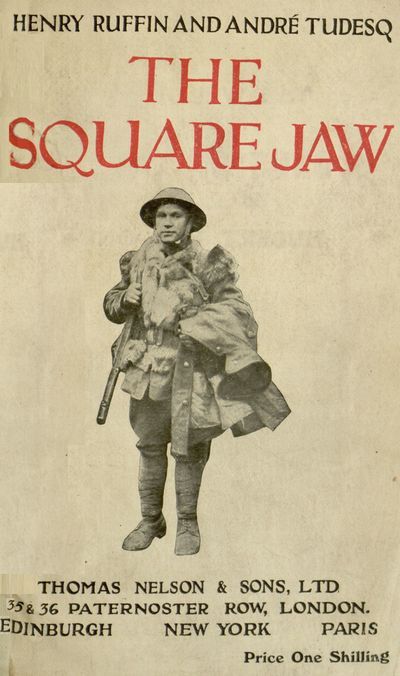
And what of "man"? Here we have a Scotsman from the mountains, gaunt, dour, wiry, with lynx-like eyes, the lusty chest of a woodman and the soul of a hermit. Like hundreds of thousands and tens of hundreds of thousands of his brother-soldiers, he had held the line in front of Ypres, Loos and Arras. Like the soldiers of England, Ireland and Wales, he had known the mist of Flanders, the marshes of the mine country, the mossy peat of Artois. Like his fellows, he is weary. With his grey-steel helmet, the leathern, fleece-lined waistcoat and the leggings of buffalo-hide which show up the muscles of his legs, you might think he was a centurion of the Roman Empire. Like all the others, his name is Tommy.
This Christmas Night Tommy has a care. The "bonnie Highland lassie" whom he was courting in the good old days, when Highlanders had not yet earned the ferocious nick-name of the "square-jawed," had written to him that morning asking for a souvenir. A souvenir!
Those of you who have not seen Tommy, notwithstanding the certainty of punishment, bartering his regimental badges or buttons in exchange for a kiss from some village beauty, can hardly understand this superstitious worship of "a souvenir." That word sums up all the dangers, hardships and glories of war, and is considered the surest of love tokens. But for soldiers of His Majesty's Guards the real souvenir is the one snatched from the enemy in mortal combat. The day after the Battle of the Ancre—that is, the day after the attack and victory—I saw little groups of men scattered over the battlefield indifferent to hostile barrages and machine-gun fire. These men, crawling from shell-hole to shell-hole, looked only on the ground. They were souvenir hunting.
Now for our story. Tommy is in a listening post—a crump-hole between the two trenches surrounded with barbed wire. The Germans are 30 yards in front and the British 10 yards behind him. He hears the enemy's observers behind their loopholes stamping their feet to keep them warm. Small clouds shade the moon. A heavy silence pervades the frozen earth. This Highlander is alone in "No Man's Land."
Is he thinking of the Christmas turkey, brown and crackling in its juice, which has been carefully fattened at the farm at home; of the plum-pudding, aflame with brandy, done to a turn by his bonnie lassie? Is he thinking of the dying embers and the midnight kiss, stolen or given—who knows? No; Tommy is simply thinking of "souvenirs."
Twice already, but in vain, he has searched his crump-hole. He can't find the smallest relic. Creeping under the knife rests, and separating with care the ring of wire which the British call "trench concertina wire," he drags himself on his stomach through the wire system. These iron blackberries catch hold of him and prick him. He likens himself to one of those great trench rats on a poaching foray.
Suddenly his hand falls upon a human form. The body is cold—a corpse! He remembers, a week ago, an evening patrol was caught by our artillery fire, and this is one of them. "No Man's Land" in this sector is not particularly healthy, and grave-diggers are dispensed with. This dried-up corpse was so much part of the landscape that Tommy had not noticed it. He now looks at it with a friendly eye. "Poor old Boche! Poor old lump of souvenirs!" Tommy is a simple fellow. He goes straight for what he wants. He first thought he would take the identity-disc. That would be a fine souvenir; but the corpse has no arms, so he gives up that idea. "D——d artillery that spoils even corpses!" he grumbles, and then feels for the legs. Perhaps the old Boche keeps a knife in his right legging. "Damn again! There is no right leg—nor left either!" If only a sharp breeze were to lift the clouds from the moon, the wide-open eyes of the observers would discover in "No Man's Land" a great lusty Highlander, white as a sheet or as the whitest of white Pierrots.
Suddenly our Highlander is seized with a mixture of horror and rage, added to which there is a feeling of weird pride. The living and the dead have made a ghastly Christmas bet.
Tommy hovers over this wreck of a man. He seizes the Boche's head—of course, the helmet, badges and bandolier have disappeared.
The corpse, as though from the depths of the other world, gives a horrid laugh. Tommy forces his fingers into the grinning mouth, but the jaws shut with a spring—like a mousetrap. False teeth! Tommy, exasperated, seizes the grim trophy.
The bonnie lassie will receive shortly a gold brooch inscribed with her name and Tommy's. She will wear it proudly at church. She will make her friends jealous without anyone ever suspecting the real history of the souvenir. Perhaps it is as well!
Now this is not a Christmas story, but a real fact, which happened on the evening of "Everyman's" Christmas among the outposts before Grandcourt.
Printed in Great Britain by Hayman, Christy and Lilly, Ltd.,
113-117, Farringdon Road, London, E.C.
Transcriber's Notes:
Retained inconsistent hyphenation of sandbags vs. sand-bags.
Illustrations may be clicked to view larger versions.