
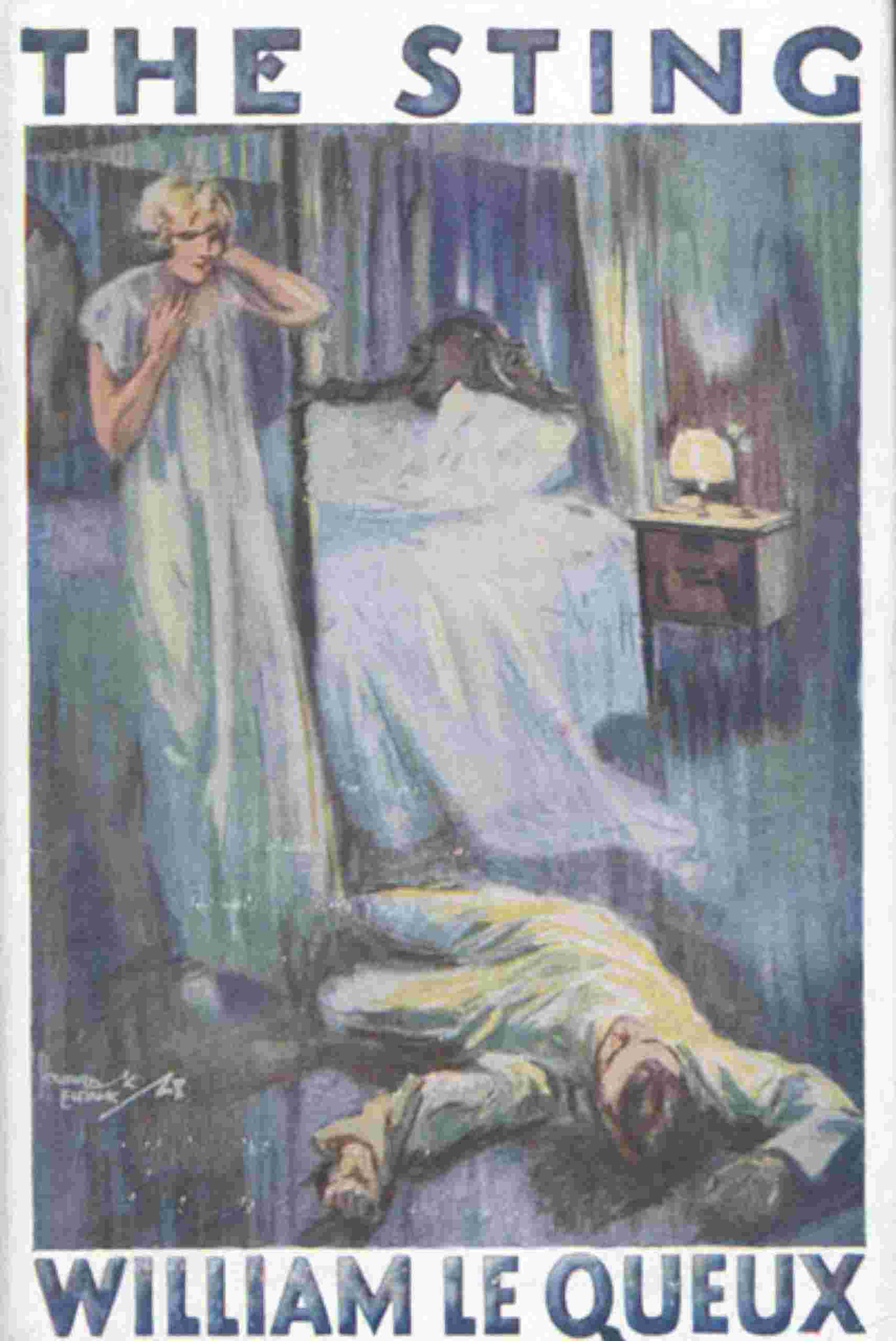
Very little conversation took place during the meal; and, when it was over, Mr. Benson took Sir Courtney to the library, where for the first time they fully discussed the coming case.
Sir Courtney opened a bag and took from it all the papers relating to the case.
“You know, Mr. Benson,” he said, “there is one feature of this case that is puzzling, unique. That is that during the whole period of the police court proceedings, and since then, the defense has remained practically where it was when it started.
“I am not blaming you or anyone else for that. I know you have employed the best detectives, and yet we have no real alternative lines to suggest in reply to the prosecution challenge. We rely—and it seems to me we must rely entirely—on the poison business as being inconsistent with the footman’s story of a quarrel—a quarrel which the prosecution say ended in a murder. I must confess——”
“Just put those papers to one side and listen to me.” Mr. Benson had been carefully considering how far to take Sir Courtney into his confidence all the day; now, he made his decision.
When he interrupted the K.C. “The story I have to tell is rather long,” he said. “We had better have a drink.”
The K.C. wonderingly acquiesced, and Mr. Benson poured out whisky and soda.
“You say that we’ve been standing still,” he laughed grimly. “I tell you we’ve been moving so fast that I, for one, am quite giddy with movement. The trouble is that we’ve been moving under the ground—literally, as a matter of fact, and unfortunately our movements are not such as to be possibly interpreted into the sort of thing you require to-morrow. Now listen to me, and I’ll make that sparse hair of yours, stand on end.”
The great K.C. smiled a little at the old man’s quaintness of expression, but he knew that no offense was intended; and, indeed, he knew that as far as that was concerned Mr. Benson in Norfolk was a bigger figure than Sir Courtney Caldecott in the Law Courts. He sat and listened carefully to the old man’s tale. As the strange narrative proceeded, his cigar went out; but he never noticed it. His eyes opened wide with astonishment. Sometimes he looked at the old lawyer as if he feared the old man was talking from a disordered brain. But the light in Mr. Benson’s eyes—strong, compelling, and clear—and his lucidity of his manner, discounted that theory, at once.
When at last the whole story was told, the K.C. sat back in his chair and stared at Mr. Benson in silence. Mr. Benson stared back. The K.C. moved at last, looked at his cigar, and lit it.
Mr. Benson noticed that his hand trembled as he held the match.
“Well,” asked Sir Courtney Caldecott, “what are we going to do?”
CHAPTER XX.
GREAT ARGUMENT ABOUT IT
“Well, one thing is clear,” said Mr. Benson, “and that is—that it is simply impossible to table this in court.”
He spoke decisively, and the K.C., watching the determined face of the wonderful old man opposite him, there and then abandoned an idea to spring the whole story on a startled court. One of the characteristics of Sir Courtney Caldecott was a capacity to realize facts, accept them, and take them into consideration in his plans. He never relied on good fortune, to help him here, or luck, there. He made his own good fortune, he was in the habit of boasting; and luck he despised.
Now he saw that it would be impossible to use directly the amazing story which he had just heard; nevertheless, he determined to find out if it were the whole story.
“There is one important omission you have made in relating the most amazing story I have ever heard,” he said, “and that is the name of the actual murderer—or murderess.”
“I do not know,” said Mr. Benson. “All my information I have passed on to you, without reserving even a detail.”
“I suppose you have formed theories—you have your suspicions?” The K.C. looked into the eyes of the old lawyer. And, as he asked his question, he thought what a difficult subject Mr. Benson would be to cross-examine. But it did not appear that Mr. Benson was hiding anything.
He raised his eyebrows, knocked the ash off his cigar, and replied quite frankly.
“Certainly I have theories and suspicions strong enough to act upon if these were no ulterior considerations. I am quite convinced that the Dr. Laidlaw, I spoke of, is the murderer. All the evidence points to that.”
“What about the strange woman that none of you seems to know anything about?” asked the K.C.
“That I can tell you no more about than I have,” replied the lawyer. “Indeed, if it had not been that our young friend, Dr. Wilfred Barlow, says he saw her, together with his fiancee, I should have doubted that part of Laidlaw’s confession.”
“Forgive me if I speak perfectly frankly, without consideration of anybody’s feelings.” The K.C. frowned, paused a second, then proceeded. “What hold do you think Laidlaw has over Lady Evenden?”
“Oh, I think it is simply what the psychologist, Mr. Rushton Tring, says—the effect of a strong mind over a weak one. I am inclined to think that Laidlaw’s story in relation to that is substantially true. I think he treated her after the death of her first husband; and, by his methods, and those of his Viennese colleague, undoubtedly effected a cure. That, I am given to understand, would cause her to respond to his suggestions—in short, her will would be enslaved by his. It is a curious theory, but I am instructed by Mr. Rushton Tring, a man whose probity I cannot doubt.”
Mr. Benson looked across at the K.C., who nodded agreement. Then he continued. “I am assured by Tring that, strange as it is, those facts are true. She requires, actually requires, in her present mental condition, the services of Laidlaw, until they can be gradually replaced by some other, and more creditable, master of his craft, or science, or whatever you like to call it.”
“If you say that Tring backs that theory, then I am inclined to agree, at any rate, to its possibility. But, look here, Mr. Benson, here is the crux.”
The K.C. leaned forward, and his face wrinkled into lines which strangely contorted it. “As I see it, my friend, this is the crux. Laidlaw has told his story. That is checked by the story my client had heard from his brother John, who in turn had heard it from his messmate. All this is true, and entitles Laidlaw to a certain amount of credence. But what shall we say of our unfortunate and bereaved client; I refer to Lady Evenden? Don’t you see she has absolutely refused to disclose a thing. Even the Loch Lomond story, she will not tell fully to you, and she absolutely refuses to say what happened that night. Laidlaw, give him his due, does make some sort of a statement. That about another man being there I frankly disbelieve off hand, for the simple reason that Laidlaw says he was knocked unconscious; and yet, the watchers downstairs in that crypt place did not so much as see him.”
“Do you infer that——”
“I infer nothing,” quickly interrupted Sir Courtney Caldecott. “Please, please, my dear Mr. Benson, do take this in an impersonal sense. I would be the last person to——”
“I do hate people interrupting me,” said Mr. Benson testily. “When you interrupted me, I was about to ask if you inferred that the possibility existed that Lady Evenden was the murderess? Do let me finish.” The K.C. had held up a deprecating hand, although he watched Mr. Benson with keen interest. “I personally have toyed with the idea as a possibility, but I am convinced the theory does not rest on any substantial fact. I know the trouble constituted by the obstinate silence of Dr. Barlow and his sweetheart, who certainly know something that would help us. I know the trouble occasioned by Lady Evenden’s own silence; but then, I account for that by her subjection to Laidlaw’s will. Obviously, he wants to make her believe all sorts of things with a view to blackmail. He may have made her believe that she killed her first husband.”
“I suppose you see the possibility of her having committed this crime under the influence and control of Laidlaw?” The K.C. spoke dispassionately, but his eyes were burning.
“Yes,” replied Mr. Benson. “I have even considered that, and there I am confronted by a complete absence of motive.”
“What about the will?” Sir Courtney Caldecott asked, lighting a fresh cigar.
“Oh, the will provides very satisfactorily for Lady Evenden,” replied the lawyer. “It is true that it was the intention of the late Sir Michael to make a more substantial provision for Frank, which was frustrated by his unexpectedly sudden death. But then, my dear chap, I had talked to John, and John was one of the most open-hearted and generous fellows in the world. There was no reason to doubt that he would have acted as his father would have expected him.”
“What about the remainder?” the K.C. inquired.
“Ah, that is rather involved,” said Mr. Benson. “We arranged some years ago that, in the event of the late Sir Michael out-living John—the war was on, you must remember—Lady Evenden and her heirs would succeed. Sir Michael had a great political pull, and letters patent were issued.”
“You see where this is leading us, don’t you?” asked Sir Courtney Caldecott. “According to this, if Sir Michael out-lived John, then Lady Evenden, and subsequently Frank, as the male heir, inherit. Very well, then, supposing Laidlaw had this control over Lady Evenden. Would there not be more funds for him if he got John out of the way? Had not John already manifested his detestation of the little doctor, and ordered him off the premises?”
“You are acting upon the assumption that Laidlaw knew all this?” the lawyer asked.
“Certainly,” replied Sir Courtney.
“I don’t think he could,” said Mr. Benson slowly. “I don’t believe that Lady Evenden herself knew exactly how she stood as far as money was concerned. I think she knew of the special remainder in her favor; but, she also thought that in any case she would be very well provided for, and that Frank would be, also. The temporary will, which unfortunately is the last will, and must be sent forward for probate, was only to meet the emergency of the baronet’s possible ruin, which seemed imminent some months ago. That all straightened itself out; and unfortunately the making of a new will was neglected.”
“Nevertheless,” argued the K.C., “she might have known, and in any case Laidlaw knew that John stood between him and control.”
“Two things remain still to be accounted for before, in my view, the theory that Lady Evenden murdered her stepson can be said to hold water,” said Mr. Benson decisively. “One is, supposing she had been acting under Laidlaw’s control, why should she not have murdered Frank, as well? He certainly would have been as great a thorn in the side of the doctor, as Jack.
“Then the other, and in my view the conclusive, argument is this: if Laidlaw wanted Jack out of the way, why the devil didn’t he murder him, himself? He was clever, he had a wonderful poison—I am proceeding on the theory now that he supplied that curious poison found in poor John’s brain. Why should he bother about having her do it for him? He could have done it quite simply; he had the run of the secret passages. There is always danger of a woman talking. And, no one would know better than Laidlaw that the control he exercised over Lady Evenden would relax with his absence, and might be substituted by some other, as, in fact, we are trying to do now, with Mr. Rushton Tring.”
“Sense,” said Sir Courtney Caldecott; “good, sound common sense, I quite agree, up to a point. But, my dear chap, logic does not necessarily govern the mind of a murderer. After all, murder is a terrible thing—even the most cold-blooded would hesitate to murder. It might be, it might possibly be, that he thought there would be difficulty in establishing the fact, in evidence, of his control over the unhappy woman, and that a buffer would stand between him and the consequences of his murder.”
“Nonsense,” said Mr. Benson. “Laidlaw is so diabolically cold-blooded that I predict that, if he is ever cremated, his coffin will come out of the furnace hanging with icicles. That man would stop at nothing, and as for intrusting his work, or his secrets, to a woman—pshaw! Dismiss it from your mind, my good chap!”
“I say,” said Sir Courtney Caldecott, “would it be possible for us to see the secret passages to-night?”
“Of course,” replied Mr. Benson. “I’ve still got Joe Litt and his friend sitting downstairs in the little crypt vestry, in case our friend turns up unexpectedly. Shall we go down now?”
The K.C. signified his consent, and the two men went to their rooms to get overcoats. Mr. Benson led his distinguished friend along the route which had lately become so familiar to him, along the front of the Priory, through the secret entry, and into the crypt. He was just lighting a candle when a stick struck the wall, close by his head.
“Hey, what the devil’s this?” shouted the indignant old man, while Sir Courtney Caldecott positively jumped in apprehension. The match revealed a determined-looking yokel about to wield the stick again, while behind him was Joe Litt, an old fowling-piece in his hand. Instantly, Joe apologized and began to upbraid his assistant, but the old lawyer would not have it. He chuckled at the incident, and blamed himself for not having a prearranged signal in case of his coming. The eminent K.C. examined the crypt, with interest. He was shown the ruined altar and the ancient candlesticks, the chest of vestments and several very wonderful old missals, all dating from pre-Reformation days.
Then, accompanied by Joe Litt, they went up the staircase into the Prior’s Room. Very carefully did Sir Courtney Caldecott examine every inch of that much-examined chamber, but nothing new was found. Joe Litt stood by the wardrobe which gave entry to the secret staircase to the crypt, while Mr. Benson and Sir Courtney talked, in the middle of the room. The curtains were closely drawn over the windows. No one from outside could possibly tell that the place was lit.
Sir Courtney and Mr. Benson concluded their inspection, and the lawyer, having put the light out, was following the K.C., who in turn was following closely in the wake of Joe Litt, when there was a sudden explosion. A shot was fired which, in the confined passage, sounded like the discharge of a cannon.
Sir Courtney was so shocked that his feet flew from under him, and he slipped down, on the narrow stairs, in a most undignified manner. As he slipped, he inadvertently kicked the feet of Joe Litt from under him so that that worthy came down also, and, with him, their only candle.
Mr. Benson rushed on, and fell over the two, in front. It was nearly a minute before they picked themselves up and proceeded, as quickly as they could, to the crypt, where a strange sight met their eyes. The secret door at the end, through which the lawyer and Sir Courtney had come earlier that evening, was wide open, and the night breeze was blowing in. A candle was guttering on the floor; and, beside it, at full length, lay the yokel, who had been left to guard the crypt.
Quickly, the three men went over and examined him. His forehead was bleeding, and the gun was lying beside him.
Joe Litt lighted the other candle, and Mr. Benson stooped over the stricken man, while Sir Courtney Caldecott knelt by his other side. It was apparent that the man was not suffering from a gunshot wound. His forehead had been bruised, and partly cut, by some jagged thing.
They gave him some water, and presently he opened his eyes.
“Shot ’im, I did,” he declared, and went off into unconsciousness again. Mr. Benson examined the gun. It was double-barrelled, and one barrel had been fired.
“Laidlaw’s been,” announced Mr. Benson, “and Bill Harris here has shot him. Stay where you are, Joe. Come on, Sir Courtney.”
Mr. Benson was off, like a schoolboy. He ran up the secret staircase and stood on the lawn looking about him when the K.C., panting heavily, joined him.
“Can’t see him anywhere, can you?” asked the old man, and the K.C. looked excitedly around. There was not a sound. Presently a form moved towards them, and both men looked towards it. The man continued to approach, while Mr. Benson fingered the gun which he still held. On closer approach, however, it proved to be the form of Wilfred Barlow, who had heard the shot and thought, at first, it was fired by a poacher. To him it sounded far away; but, he had decided to come out when he had found the library windows open.
In a few words, Mr. Benson made him conversant with the situation. They looked about, but there was no sign of Laidlaw; and, after a few minutes of fruitless searching, the three went downstairs and rejoined Joe Litt. Wilfred minutely examined the wounded man and bandaged his head carefully, with a linen handkerchief.
Soon he was able to tell them what had happened. It appeared that some time after Mr. Benson, accompanied by the K.C. and Joe Litt, had gone upstairs into the Prior’s Room, Bill Harris had heard a sound, as if some one were seeking entrance to the crypt, from the lawn. After his experience earlier in the evening, when he had nearly hit Mr. Benson, he determined to be more careful; so, before he moved, he waited until the intruder had come right to the door and had struck a light. It was then, gun in hand, that he had rushed across the crypt. By the light of the candle, which the intruder had placed upon the floor, Bill could see the features of Dr. Laidlaw, while he thought he glimpsed another figure behind him.
The doctor had beaten a hasty retreat; and, as he fled up the staircase, Bill pulled the trigger of his gun. He said he knew that he had hit him, because the doctor had given a yelp of pain. Then some one had hit Bill with something hard, and that was all he remembered.
Mr. Benson was forced to curse his own stupidity in leaving only one man downstairs, if even for merely a few minutes. However, nothing could be done now. Bill was made quite comfortable with cushions, since he refused to go to bed, and insisted on finishing his watch out, with Joe.
Wilfred accompanied Mr. Benson and the K.C. to the library, where they spent a further hour, talking over the weird happenings of the night.
“Bless my soul!” declared the old lawyer a little later, starting up, “do you fellows realize it’s one o’clock? We have a lot to do to-morrow.”
“It’s to-day, my dear chap, it’s to-day,” said Sir Courtney Caldecott gravely. “This is the opening day of the trial.”
CHAPTER XXI.
THE TRIAL
Tuesday morning dawned grey and cold for Frank Gough. Long before the light began to shine, through the uncurtained windows of the prison infirmary ward, he was awake. Often during the night had he seen the night warder, in charge, make his round of the half-dozen beds, to see that the patients were all right, stepping with silent steps, and looking, Frank thought, like a sinister figure from Dante’s inferno, ceaselessly watching that no victims escaped.
Frank, as is costumary in the case of men awaiting trial for murder, had been kept in the hospital, where he could be under constant observation, thus enabling the prison authorities to achieve the dual purpose of making certain that he did not attempt his life, and at the same time to enable the medical officer to give the court a perfect report of his state of mind.
At six-thirty, the day officer came on duty.
“Come on, the hospital wallahs!” he admonished them. “Show a leg, and let me take down what you want for breakfast.”
The rest of the prisoners laughed, except Frank. The officer was of the old brigade of prison officers and a good sort. His humor was crude and sometimes cruel; but, no sting was intended.
Having made his round, and got his men up, he came to Frank’s bed.
“Well, ole man,” he asked, “ ’Ow d’ye feel?”
“All right, thanks,” replied Frank with a slight smile.
“Don’t you worry?” said the warder. “You’ve got every chance of a walkover; I’ve got a bet of two bob that you’ll beat the hangman to a frazzle.”
The reference to the executioner made Frank wince. But, as he looked at the honest face of the old warder before him, he had to smile.
Breakfast was served. Frank drank a cup of tea and ate a small piece of bread. But, though he was offered bacon, he could not touch it. He bathed before he dressed, for there was a fairly well-appointed bathroom opening off the ward; and, though the majority of the patients fought shy of it, they had to endure its ritual, once a week.
Frank was given clean towels and allowed to have a bath every morning; he appreciated that kindness on the part of his warder.
At eight o’clock, he was taken along the corridor to the main reception hall of the prison; and there, standing in a row, were a dozen curiously-mixed types ready to proceed to Norwich, to take their trial at the assizes. Frank was known to them all, and as he joined the group they stared open-eyed at the star prisoner—the man “for the rope,” as one of them put it. While they stood there, the Governor of the prison approached, asked each man his name, his offense, and checked it by the record. Then each man was given his money, his property, and all with which he came into the prison.
Next came the doctor, a stethoscope hanging about his neck.
“Open your shirts!” shouted a warder, and all the party opened their shirt fronts.
Frank began to undo his tie.
“Not you!” said the medical officer, who had already examined Frank in the hospital.
For a second the doctor listened to each man’s heart; then, with a curt nod, he walked off. The men were fit for trial. Two warders approached now, with a handful of what looked like heavy steel bangles, hinged in the center. These were fitted on the wrists of the prisoners, and a chain was run through a loop in each bracelet, the end being locked with a key by the principal warder.
Frank was not attached to this train, but was now moved off to the gate of the prison. There a prison van and a motor car were waiting for the journey to the railway station. Frank was placed in the car, two warders with him, while another sat in the front, by the driver.
He was to travel by road at his own expense. The “body ticket” was handed to the keeper of the doors, and the journey to the assizes was begun.
A warder opposite him took out a flask and a cigarette case. “Have a pull at that—it’ll keep the cold out,” he said, handing the flask to Frank, who gratefully accepted the hospitality.
Meanwhile, in the old cathedral town, excitement was running high, and, long before the doors of the Assize court opened, a queue was formed for admittance. By the time the court opened there was barely standing-room.
Mr. Benson and Sir Courtney Caldecott, K.C., accompanied by a small army of juniors and clerks, occupied the defending counsel’s seats, while for the Crown, Mr. Assidell, K.C., and Mr. Graff Edwards, with their instructing solicitors, took their seats, opposite.
At half-past ten a fanfare of trumpets announced the approach of the judges, in state. Outside the court could be heard the hoofs of horses as the four horses in the state-coach dexterously were wheeled round, to bring the doors of the carriage opposite the judge’s entrance.
The crowd in the court rose respectfully, and stood silent, as the judges, accompanied by the high sheriff and other county dignitaries, entered. The senior judge, Mr. Justice Titterton, made a curt bow and sat down. By his side was Mr. Justice Hemingway. The commission was duly read and the grand jury charged; then Mr. Justice Hemingway left to take actions in the Civil Court, while Mr. Justice Titterton remained to preside over the Crown Court.
For an hour, Mr. Benson was in suspense as to whether or not the grand jury would find a true bill in Frank’s case, although Mr. Justice Titterton’s direction had seemed to him to incline in the direction of affirming the necessity for a trial. The grand jury presented the court with a true bill, and the clerk of arraigns swore a jury.
Mr. Justice Titterton watched the young man whose entry into the dock had caused such a sensation in court. His whimsical, humorous eyes blinked at him, behind his spectacles, as Frank pleaded “not guilty” in response to the charge.
Mr. Benson had met the judge on many occasions, and liked him. Indeed, in the confused state of the defense, it was the one thing that he had to congratulate himself on, that Mr. Justice Titterton would hear the action. The judge was not only scrupulously fair; but, he was, also, an exceptionally human type of man.
Mr. Benson carefully scanned the jury. He knew three of its members, the remainder were strangers to him. But his survey was interrupted. Mr. Assidell was on his feet.
The learned K.C. for the prosecution sketched the facts of the murder so far as they were known. He made great play with the fact, as testified by the footman, Thomason, of the quarrel between the stepbrothers, and the fact that Frank’s story of a reconciliation was unbacked by anyone.
The poison that was found in the dead man’s brain, he suggested, well might have been put there by the murderer, in an endeavor to drag a red herring across the trail. But, in any case, he maintained, the prosecution were not called on to say who put the poison there. They were called on to say who caused the death of the late Sir John Evenden.
Doctors would be called who would state that the blow itself was sufficient to cause death. He asked the jury to believe that a quarrel ensued between the two brothers—a very serious quarrel—a quarrel, he would show them, of vital interest to one of them—the man now standing in the dock.
This quarrel was not a fantastic story of the prosecution’s imagination, but emanated from the prisoner at the bar, himself.
The great man spoke eloquently for an hour; then, he sat down and called his witnesses.
The first man to be called was the valet, Roberto, and he repeated his evidence of finding the body of Sir John dead on the floor of the Prior’s Room. He was carefully examined by Mr. Assidell as to the position in which the body was lying. He agreed that it looked as though some one had knocked down the baronet, who had rolled over on the floor.
Sir Courtney Caldecott cross-examined. He checked every statement; then he asked unexpectedly:
“Are you the only valet in the Priory?”
The man replied affirmatively.
“Then why didn’t you go to valet Mr. Frank Gough?”
“I did,” replied Roberto, “I offered my services night and morning.”
“Why didn’t you valet him on the night before you found the dead body of Sir John Evenden?”
“I did, sir,” replied the valet.
“What time?”
“I just forget, sir. I think it was before dinner.” Roberto put his hand to his head, in his effort to remember.
“Come on, man,” said Sir Courtney. “Get your wits working. You only had two men to valet, and it would be the last occasion on which you valeted Mr. Frank; for, he was arrested the next day. Come along, now.”
“Oh, I remember,” said the valet. “I went to his room, but he was engaged. I was just going to open the door, but there were people talking. I heard Mr. Jack’s voice and I heard Mr. Frank’s. Then, when I went the next time, he had gone to bed. I looked in the room, but he was asleep.”
The whole court listened quite apathetically to this statement, but the actors in the drama were tense with excitement. Mr. Justice Titterton gave a quick look of surprise at the valet, took a pencil, and made a note in his book. He pursed his lips as he looked at Sir Courtney and Mr. Assidell. The latter also stared at the valet, and immediately made a note.
“Bravo!” said Mr. Benson in what was supposed to be a whisper to the silk-gowned leader in front of him. Sir Courtney grinned very faintly as he whispered “Sh-sh” under his breath.
“What were they talking about, Roberto?” asked Sir Courtney in honeyed tones.
“I don’t know,” replied the valet. “I never listen to conversations.”
“Quite right,” said the K.C. “You never listen to conversations. It was a conversation, then? An ordinary one?”
“Yes, sir.”
“A friendly conversation?”
“Yes, sir, I think so, sir. I heard them wishing each other a health—giving a toast, sir.”
“Now then,” said Sir Courtney. “I only want you to tell us one thing more, Roberto. What time was this?”
“I can’t remember, sir. It would be pretty late—perhaps ten o’clock. I know it was very late when I went the second time, but, as I said, Mr. Frank was in bed, sir,” said the valet.
“I want you to fix the time a bit better than that,” said Sir Courtney Caldecott. “Now, try to test your memory, Roberto. Think, now. It couldn’t have been early, you say. It couldn’t, for instance, have been before ten——”
“My lord, this is perfectly intolerable,” said Mr. Assidell, K.C. “My learned friend is asking leading question after leading question. I simply must protest.”
“But surely not necessarily so vehemently, Mr. Assidell,” said the judge with his blandest smile. “Sir Courtney has not put leading question after leading question. He has put one, his last one. He put it in such a sly way, if I may use the term, that it had slipped out before I saw it coming. He repeated with perfect truth what the valet had said—that it was not early. His words were—I’ve got them down here—‘It would be pretty late—perhaps ten o’clock,’ and Sir Courtney——”
“I most humbly beg your lordship’s pardon,” said Sir Courtney. “I thought the valet had said, ‘It would be pretty late—after ten o’clock.’ Otherwise I should not have dreamt of putting my question in the form I did.”
“All right,” said the judge with a twinkle in his eye. “I’ll accept that. I only hope this ear trouble is not likely to lead you into any more similar errors.”
“I’ll put my question in another form,” said Sir Courtney. “Now, Roberto. You have said that you think it was about ten o’clock. You mean that?”
“Yes, sir,” said Roberto.
“Now be very, very careful about this. Might it have been later?” Sir Courtney’s face all wrinkled up again in his characteristic manner. The valet thought for a moment, then replied:
“I think it was about then, sir. I cannot remember the exact time.”
“Was it before ten?”
“I don’t know, sir. I think it was about ten, sir,” said the valet, now thoroughly distressed. Sir Courtney determined to get this point before he sat down.
“Is there nothing that will remind you. What time did you usually go to valet Mr. Frank at night? Not early, surely?”
“No, sir. It was because I did not see him downstairs in the library that I thought he had gone to bed, and then I went to the room where I heard him talking to Mr. Jack.”
“Then it would be at a reasonable time for going to bed?”
“Yes, sir,” said Roberto.
“Very well—late, about ten o’clock. That’s the nearest you can get, eh?” asked Sir Courtney in conclusion.
“Yes, sir,” said the valet, and Sir Courtney sat down.
Instantly the Crown leader was on his feet.
“How is it,” he asked, “that we have never heard of this visit of yours to Mr. Frank’s room until this morning?”
“Because I was never asked,” said Roberto, wonderingly.
“You were examined at the police court, and you were asked to say all you knew to the police. Why did you not tell them that?” Mr. Assidell bullied in his most terrifying manner. Roberto trembled, and his hand shook as he held the side of the witness-box.
“I never was asked,” he repeated. “I never knew it had anything to do with the murder.”
“You deliberately suppressed this evidence until now, and then you suddenly give the court a most valuable piece of information at the last minute. Are you sure that you are telling the truth?”
Roberto looked on the point of collapse.
“I am very sorry, sir,” he said. “I didn’t know it had anything to do with the case. They only asked me about finding the body, and if he was well the last time I saw him, and I told them the truth.”
“When did you tell the police you last saw Sir John. I mean, when they asked you when you had seen him last—what did you reply?”
“I forget, sir, but I told the truth,” said Roberto. “I think I said that I had seen him the previous evening.”
“Had you?”
“Yes, sir.”
“What time?”
“About dinner time, sir.”
“Now you say that you heard him later than that?”
Roberto could merely repeat the statement he had made. He said he had not attached importance to his visit to Frank’s room, and all the storming and bullying of Mr. Assidell could not shake him. In the end Mr. Justice Titterton put an end to his sufferings.
“You have no right to impute dishonesty of motive to this man, Mr. Assidell,” he said coldly. “He performed a routine duty to which he attached no importance. That may be stupidity on his part; it may be stupidity on the part of the police in not extracting the information. It may be stupidity on the part of the defense for not getting it before—if they did not get it before” (this with a sly look in the direction of Sir Courtney and Mr. Benson). “But at present, at any rate, it is not necessarily dishonesty on the part of the valet.”
Turning to the valet, his lordship said:
“You may step down.”
“Call Thomason, the footman!” said Mr. Assidell.
CHAPTER XXII.
THE VERDICT
The loutish footman, Thomason, then entered the witness box. Led by Mr. Assidell, K.C., he repeated his evidence of the quarrel he had heard between the two stepbrothers. At first he was very nervous about mentioning this matter again, for he had suffered much from the butler and the other servants because of his first statements to the police about the quarrel—the statements upon which Frank Gough had been arrested.
The most important part of his evidence, according to Mr. Assidell, as manifested in his questioning, was the time of the quarrel. Here Thomason was shaken. Whereas, before, he had said the time was nine o’clock or thereabouts, now he said it might have been ten o’clock, or even later. On the other hand, it might have been before nine. The Crown prosecutor, satisfied, apparently, to have shaken the witness’s testimony on the question of time, sat down, and Sir Courtney rose.
By dint of skilful questioning he succeeded in establishing the fact that the butler would certainly know the limit of the time possible for Thomason to have heard the quarrel, because part of the plate which he had brought back from the small pantry adjoining the Prior’s Room had to be wrapped in green baize and handed over to the butler to lock away.
Thomason departed, and was succeeded by other servants, and then the doctors gave their evidence. The great Government analyst, Sir Werner Scatterhyde, testified to examining the organs of the dead baronet, and referred to the poison he had found in the brain. He admitted that the blow which the dead man had received was sufficient to cause death, but he confessed that, for his part, he was inclined to the belief that death was caused by the poison.
“Would it have been possible for the poison to have been injected after death?” asked Mr. Assidell, and the specialist replied, after momentary hesitation, that it might, but such a thing in his view was improbable. Sir Courtney Caldecott made a note of the momentary hesitation.
“In conclusion,” said Mr. Assidell, “you fully agree that the injuries to the head were in themselves sufficient to have caused death?”
“Well, yes,” replied the specialist. “They are really more likely to have induced violent concussion, with perhaps ultimate death, but they might have caused death.”
“Sir Werner Scatterhyde,” began Sir Courtney, “Let me ask you this. When the deadly poison, of whose fell properties you have so interestingly told us, was introduced into the brain, how long would life be possible after that?”
“Twenty seconds,” said the specialist.
“Quite so—twenty seconds,” repeated Sir Courtney with a glance at the jury. “Now tell us, Sir Werner—we have heard a lot about the injection of this poison being performed after death—would it have been long after death?”
“No, certainly not,” replied the analyst. “No later than at the very moment of death. It had received certain circulation which would cease after death.”
“Then it must have been before death?” asked Sir Courtney.
“Well, it would have been possible at the very moment of death. I mean that, if the person who struck the blow immediately injected the poison, that would account for the exact position.”
“What about the blow taking place after death?” Sir Courtney asked.
“Well, yes,” said the specialist. “That is certainly possible. But, again by the look of the head at the time, I judged that the blow was simultaneous with death.”
“Then you think the two processes were simultaneous? That very little time, if any, separated the blow from the injection of the poison?” asked the K.C., and the specialist replied that that was so.
Other doctors were examined, and all testified to the adequacy of the blow to cause death. Then the defense opened with a brilliant speech by Sir Courtney Caldecott. He pointed out the extreme weakness of the prosecution’s case, and outlined his answer—if the jury thought it necessary for him to answer. There was a stir in the jury box, which the judge quickly saw and quelled before any member of the jury could express an opinion.
“I certainly think there is a case to answer, Sir Courtney,” he said. Sir Courtney gracefully accepted the ruling, and immediately called:
“Mr. Frank Gough.”
Frank was led by warders round to the witness box. Wilfred Barlow, sitting in the well of the court, felt a great pity for Frank as he saw him stand there to face his ordeal. He remembered his hatred of Frank because of the persecution of Jill. But, he felt now that he wished he had not thought quite so hardly of him.
With perfect simplicity Frank told his story of the quarrel and the reconciliation. He was definite, very sure of the order in which the two things took place. They could not have been reversed, he said, because from the very moment he entered his brother’s room there was an awkwardness of manner about Jack, who was suffering under the painful exposure of Lady Evenden’s past, coupled with the visit that day of Laidlaw, who had been admitted to his mother.
There was nothing pleasant about the first interview. There was nothing unpleasant about the second. In the second, the clouds of mistrust and irritation had all been blown away, leaving a clear sky. Jack had come to make friends, and he had welcomed his stepbrother. The reconciliation was very real and complete.
Under cross-examination, Frank unconsciously created a great impression, when Mr. Assidell was pressing him as to enmity between the brothers, by replying with simple dignity and in convincing sincerity.
“But I loved my brother,” he said, and even the judge gave one of his almost imperceptible nods. Frank bore his cross-examination well. He only showed a little impatience when he was pressed into the whole story of his mother’s ordeal at the death of her first husband.
Sir Courtney Caldecott was afraid Frank was going to do irretrievable harm by losing his temper, and he decided to intervene.
“I must protest, respectfully, my lord, against this subject being discussed. It is absolutely irrelevant.”
“I am not quite sure,” replied Mr. Justice Titterton. “If it is said that this story was the cause of a quarrel which led to Sir John’s death, then it becomes very germane and relevant, and I shall certainly rule it so.”
“But, with great respect, it is not so,” replied Sir Courtney. “There was an interview of a most cordial nature afterwards——”
“Yes, quite so,” replied the judge. “But, it remains for you to prove that. The prosecution say that a certain story was told which caused a quarrel which, in turn, caused a man’s death. They must prove that. But, they are entitled to demonstrate the potency of the story which caused the quarrel.”
Sir Courtney subsided. He knew perfectly well that his objection was hopeless, and had merely intervened to give Frank a breathing space. Mr. Assidell, K.C., pegged away at the story of the tragedy at Loch Lomond, and Frank gave the answers as well as he could. He had been too young at the time even to remember his father. His mother had not told him anything about it. Dr. Laidlaw he did not know from Adam, and John and he had agreed jointly to go to their mother on the day following their interview and assure her of their joint moral support, in every way.
This also created a good impression.
“Are you going to call Lady Evenden?” asked the judge.
“Well, if your lordship thought it necessary,” began Sir Courtney, “we would consult her physicians. She is most anxious to give evidence.”
He whispered a word to Mr. Benson. “With your lordship’s permission I will call Dr. Barlow,” he said. Wilfred started in surprise. Was Mr. Benson up to some unexpected trick to force his hand?
When he entered the box, however, and was sworn, Sir Courtney examined him as to the state of Lady Evenden’s health. He looked at Mr. Benson, who was gazing at him with eyes full of meaning, and suddenly he grasped the situation and played up to what was expected.
“Lady Evenden is suffering from extreme nervous prostration,” he declared, “and is in my opinion quite unfit to appear in this court.”
“Have you had a second opinion on that?” asked Sir Courtney.
“Yes,” replied Wilfred. “Mr. Rushton Tring, the mental specialist of Harley Street, is at present in residence at the Priory, and absolutely forbids her ladyship to undergo any strain.”
The judge bowed his acknowledgements, and Sir Courtney went on.
“I wish to interpose this at this stage,” he said. “My learned friend has thought fit to expatiate upon the tragic circumstances in which Lady Evenden lost her first husband. I objected to that matter at the time, but your lordship saw fit to overrule me. I consider that I am entitled in the interest of a bereaved lady whose fair name has been wantonly attacked by my learned friend——” Mr. Assidell, purple of face, was on his feet in a second, complaining volubly against this perverted interpretation on the part of his colleague. Sir Courtney insisted upon continuing, but the judge held up his hand.
“I gathered you thought you were entitled to something, Sir Courtney?” he asked mildly, his eyes twinkling behind his glasses.
“With your lordship’s gracious permission,” said Sir Courtney, “I consider I am entitled to place on record the fact that the death of the first husband of Lady Evenden was duly inquired into at the time by a Scottish Court of Inquiry, the competent court. Medical men also gave evidence. Lady Evenden was exonerated from the slightest suspicion of any culpability, whatever. The unfortunate man died whilst a raving lunatic. It was impossible for his wife to remain in the same room with him. In these remote country districts scandal soon spreads, and frequently arises out of nothing. In this case I presume it was because Lady Evenden, very properly loathing the associations of the place, never went back.”
“I was going to take it upon myself, Sir Courtney, to say pretty much what you have said. I quite endorse your words,” said the judge.
“May I say that I also am profoundly conscious of the truth of what my learned friend says,” said Mr. Assidell, K.C. “Never for a moment did I desire to attack the character or reputation of Lady Evenden—merely to establish, in the course of my duty, the cause of the quarrel.”
The storm over, the trial proceeded. Counsel made their speeches and the day ended with all finished, except the judge’s summing up. That night Mr. Benson and Sir Courtney were in hopeful vein. Lady Evenden was greatly excited. She seemed several times to be on the verge of saying something of importance, when she met Mr. Tring and Mr. Benson in the hall, after the trial. Finally she said that, whatever happened, they must call her on the telephone, if at the last moment there was danger of Frank suffering. In that event she would come to the court.
Mr. Benson sincerely hoped the necessity would not arise.
The next day the court was crowded, and its approaches were blocked thicker than ever. The judge began his summing up at once. He had three notebooks full of notes, and he ran through them with wonderful lucidity and system.
The prosecution, he said, had established their theory of a quarrel—established it on the evidence of Thomason, the footman, and the prisoner himself. The defense had established, on the evidence of the valet, that the prisoner was telling the truth when he spoke of a second interview. Undoubtedly there were two interviews. Which was first? The butler’s evidence was important in the degree that it proved that Frank Gough left the dining room to go to the Prior’s Room. That would point to the interview in the Prior’s Room being first. Also the butler said he locked away the silver which was collected from the Prior’s Room by Thomason between half-past nine and ten.
Again, in the earlier part of the brothers’ conversation, there was nothing to drink toasts about and to cause laughter. The valet had heard them pledge each other in a drink. Men rarely do that except on a special occasion—men living together, he meant. That occasion might well be the making up, between two brothers who, on all testimony, had loved each other, of a very serious quarrel, which reflected nothing but honor on both of them. He submitted that there were grave doubts as to whether the quarrel was remotely connected with the death of the late baronet at all. The poison theory remained a complete mystery. He finally told them that where doubt lay, that doubt belonged to the prisoner, and he was certain that in this case they would find certain doubts.
The jury retired, and Mr. Benson gathered up his papers preparatory to telephoning to Lady Evenden. Sir Courtney was rising to go with him. They had chatted where they were for three minutes, when suddenly there was a slight stirring, and the jury were back. The judge was hastily called, and he came in straightening his stole as he walked.
Frank Gough stepped into the dock. The jury did not need to declare their verdict—it was written on their faces.
Nevertheless, when the foreman declared, “Not guilty,” there were resounding cheers in the court.
“It is not necessary, Frank Gough,” said Mr. Justice Titterton, “for me to tell you that you leave this court with your good name unsullied. You are discharged, but in your discharge I want most whole-heartedly to associate myself with the jury’s verdict. I regret extremely that it has been your misfortune to suffer, in the interests of justice, what you must have undergone in the last few weeks.”
The ovation which Frank received outside was overpowering. It was arranged that Sir Courtney Caldecott should accompany Mr. Benson and him back to the Priory. But more than an hour had to elapse before they could steer clear of Norwich.
The meeting between Frank and his mother was pathetic. She wept on his shoulder, and was so overcome that she had to retire at once to her room.
Dinner was served in state in the large dining room. At the table were Sir Courtney Caldecott, Mr. Tring, Mr. Benson, and Frank, who did the honors. After the meal, they went to the library, where the whole case was put before Frank, who listened in bewilderment. When he heard of Wilfred, he said:
“Where is he now?” Mr. Benson replied that he had not seen him since the court rose.
“I should like to see him,” said Frank. “Is Jill still here? I mean Miss Kilby?”
“Yes, yes,” replied Mr. Benson, “but first things first, my boy. What are we going to do?”
It was finally decided that the specialist should remain in the house, and do what he could with Lady Evenden to break completely the ascendancy of Dr. Laidlaw. Frank was most emphatic about the necessity for that.
The inquiry into the mystery of John’s death should go forward, and, for the next few days, that Mr. Benson should continue to live at the Priory.
Very late they went to bed, Frank seeming a little dazed by luxury and comfort after the nerve-racking experience in the prison infirmary.
The next morning he rose early, crossed the lawn, and went through the shrubbery for a walk. Returning by the paddock, he saw a figure that quickened his heartbeat. It was Jill, looking sweetly pretty in a tweed coat and skirt. She was bareheaded, and the morning sun caused a bewitching sheen to appear upon her hair.
Frank made for her immediately.
“Jill,” he called. She turned and saw him. The color rose to her cheeks. Instantly she remembered the experiences of old, the persistent pursuit of her, the unscrupulous way in which he had tried to compromise her. And, then suddenly, there flashed upon her the vision of this young, vitally live, fine specimen of manhood, with all his keen desires and great capacity for enjoyment, shut up behind prison bars under the very shadow of the scaffold. The vision stirred what was maternal in her. She felt a desire to protect him. With the color still in her cheeks, but with the look of anger in her eyes changed now to dangerous pity and sympathy, she put out her hand.
“I am so glad to see you,” she said softly.
Frank, where Jill was concerned, was like the Bourbons; he refused to learn anything and he forgot nothing—nor did he want to. He only cared that he loved this girl and wanted her. He took the outstretched hand and, with a quick movement, drew her towards him, putting the other arm around her shoulders and imprinting kiss after kiss upon her violently unwilling lips.
“Don’t, don’t,” she called. “Oh, don’t! I never thought—— Oh, please don’t!” What would have happened it would be difficult to say if there had not been an interruption.
“I wish you two would get into the woods to do your love-making. This sort of performance in the open may be up to date, but to me it is positively revolting.” They both jumped back to see Mr. Benson standing there. Jill glanced at him, and then at Frank; then she fled towards the house, her cheeks flaming with color, a flying incarnation of indignation and outrage. Frank looked crestfallen as Mr. Benson put a hand on his shoulder.
“Come with me, young fellow,” he said. “I’m going to talk to you very seriously.”
CHAPTER XXIII.
A SURPRISE FOR ALL
“Now, my boy,” said Mr. Benson, “this has got to stop. I don’t want you to jump up in the air about it.” Frank had flushed angrily. “There are as good fish in the sea as ever were caught, but it is perfectly apparent to me that this is not your particular fish. You have quite enough to do without acting the young squire with reluctant and, indeed, resentful women. Come along, I want to talk to you of matters much more important.”
Without giving the somewhat sullen Frank an opportunity of discussing Jill further, the solicitor took him to the library, where, for over an hour, he discussed affairs of the estate with him.
Whether because of the lawyer’s warning or not, it certainly was true that for several days Frank rarely saw Jill at all. He was kept busy going through matters that required his attention with Mr. Benson; then, three days afterwards, Lady Evenden sprang a surprise on them.
She expressed her desire to get away from the Priory at once, and asked how soon the packing could be done, so that they could move to the Villa des Muguets, Cannes. The Cannes villa was a beautiful little Riviera estate purchased only two years before Sir Michael died.
Mr. Rushton Tring and Mr. Benson both thought it would be an excellent change for Lady Evenden and strongly advised it. The result was that affairs were left in the hands of Mr. Benson, while Frank, Lady Evenden, and Jill, accompanied by a maid, and Roberto, the valet, left for the south of France.
Lady Evenden seemed to take on a new lease of life when she got to the Riviera. For a few days she was comparatively quiet, and remained about the grounds of the villa. And the deep gloom which had been characteristic of her since the death of her husband seemed to be lifting. After the first week she brightened up considerably and went daily for long drives with Jill. Later on, she began to do a little modest entertaining, inviting such visitors to Cannes as were friends of some long standing.
The society of the rich widow of a baronet, who carried her title and estates in her own right, was very assiduously sought by all types of the floating Riviera population, from the poor all-year residents, who tried to keep up in the south a better appearance on depleted funds than they could in England, to the inevitable Riviera adventurers and adventuresses.
Frank’s position during this time was a very curious one. To do him justice he seriously had intended to fight his way forward in the legal profession; but, his recent ordeal at Norwich had given his desires in that direction a temporary setback. He developed a rather morbid disposition. He told himself that there was only one thing in life worth having, and that was Jill Kilby—whom he could not attain.
He had given the old lawyer some sort of promise to leave her alone; and, partly for that reason, and probably because he saw in the caution of her manner in his presence what the result of further advances would be, he let her alone.
To do Frank justice he was not, in the ordinary sense of the word, a young rake. The large sums of money which now came his way did not by any means send him to the devil. He went sometimes to the casino and gambled a little. Sometimes he won and sometimes he lost. But it was a mere bagatelle either way, compared with the resources he had—and he never contracted the gambling fever. One day, from a distance, Jill, who was sitting with his mother in the casino, saw a pretty woman of perhaps thirty, and looking more like twenty, make great efforts to engage Frank in conversation. Frank presently saw the woman, looked at her a second, then, slightly raising his hat, he was about to pass on, when she ran up to him and touched him on the arm, laughing into his face as she asked him something.
Frank appeared to hesitate; then, with a slight and rather bored smile, he accompanied her to a waiting car.
“Whatever else he does, he doesn’t exactly ‘chase’ girls,” thought Jill to herself; and, although she rather feared Frank, and certainly had no regard for him herself, she felt that she would like to have boxed the pretty intruder’s ears.
That afternoon Jill was sent into the town to do some errands for Lady Evenden, and when she returned she heard voices in the drawing-room. She was about to enter when Lady Evenden, with rather flushed cheeks, came to the door and said:
“Thank you so much, Jill, I’m engaged just now. Run off and amuse yourself. I’ll see you at dinner.” She closed the door, but not before Jill saw the little figure of Dr. Laidlaw!
That night Jill wrote fully to Wilfred and told him all that had happened that day. And Wilfred in turn saw Mr. Benson. The two, by this time, were firm friends. The old lawyer had been more than true to his half-promise, and had got Wilfred a partnership, with an old friend, in Norwich.
While Mr. Benson was disagreeably surprised to learn of Laidlaw’s new appearance on the scene, he felt he could do nothing. He wrote to Mr. Tring, and advised Wilfred to get Jill to observe every movement and report it.
The weeks lengthened into months, and still the widow remained at Cannes. But, as the weeks went by, the parties at the villa began to differ in quality and quantity. Frank took little or no interest in them. He was amply supplied with funds by his mother, and he never invited people, nor did he indulge in society. He fished and he played golf, and he seemed to enjoy that better than the gay round of the casino life.
However, when his mother particularly desired his appearance, he always came to her dinners and receptions. On one such evening the principal guest was Prince Louis de Zanbetti—an Italian, reputed to be very wealthy—and his beautiful fair-haired princess, Elsa. There were others there, also. But Frank did not like the look of some of them.
There was an American, for instance, called Hortal. There were two Englishmen named Majoribanks and Everfield respectively, and they prefixed their names with Major and Colonel. Not that he cared twopence, but, merely to confirm his suspicions, Frank asked them an apparently innocent question or two about their regiments and Army careers, then, when dinner was over, before he joined them in the smoking room of the villa, he looked them up in the Army List. There were no such entries.
That night a very high game of cards was played, and the prince won over a thousand pounds from Frank. Very rarely did Frank gamble. The game certainly had no fascination for him. But, on this particular occasion, the stakes were so subtly raised, the chances so carefully arranged, as he thought afterwards, that he fell a victim. The next day he paid, determined never to be caught like that again.
Frank brooded a little over his loss, and went to Lady Evenden to inquire where she had met her friends. She said they were friends of a very old friend of hers.
“Who?” Frank persisted.
“Oh, a very old friend,” she replied evasively and with some apparent discomfort. Frank pressed, but could not get any further. Ultimately Lady Evenden became irritable. Neither took any notice of Jill when she entered the room. Jill at first thought she would retire as Frank and his mother were having rather high words; then she decided she would stay in case her mistress required her.
“Well, look here,” said Frank. “I don’t know who the old friend of yours is, but let me tell you that your old friend’s friends are card-sharpers and adventurers! Yes, they are”—as Lady Evenden raised horrified eyebrows in protest. “I lost over a thousand pounds last night, and I tell you frankly I don’t want to see them here again.”
“Do I ever keep you short of money?” she asked. “Surely, Frank, you don’t need to accuse everyone because you have had a little bad luck,” she smiled. “I’ll make you out another check, poor dear, but you really must be more guarded in your remarks about our friends. So unkind, too. My dear, I would make you, as conceited as a peacock if I told you what the beautiful little princess said about you.” Lady Evenden smiled archly.
“Look here, mother,” said Frank, “I don’t know who the devil is responsible for introducing that lot, but they’re not coming here again, that’s all. I don’t want to pain you unduly, but let me tell you this. Neither the Majoribanks man nor the evergreen Everfield, or whatever he calls himself, appear in the Army List at all, while the record—I have taken the trouble to get it—of our prince is bluer than the Mediterranean. He has been shot out of three clubs and shot into two prisons. As for the ‘beautiful little princess,’ perhaps it will surprise you to know that she told me last night that she was my affinity, that she was badly treated by the prince, that it would be nice for us to elope, and finally borrowed a hundred to settle a ‘dress-maker’s bill.’ ”
Lady Evenden listened in horror.
“You cannot mean it!” she said. “Doctor—I mean—— Oh, Frank, leave me please! I am very sorry. I will write you a check.”
“My dear mother, I don’t want, or need, your check,” said Frank. “But I do wish you would give me your confidence. Yet—understand this—if you bring any similar gang round here again, I leave.”
He walked out of the room, and Jill admired him for the first time in her life. That evening Lady Evenden retired early, and Jill did a thing she would never have believed herself capable of doing. She went to his smoking room and deliberately sought Frank. He was sitting staring moodily into the fire, smoking a cigar. He looked up in genuine surprise at Jill’s entry.
“Hello, Jill,” he said. “Wonders will never cease!” He smiled whimsically. She flushed slightly, and immediately began her story. In consequence of what she had heard in the drawing-room, she said she felt sure that Dr. Laidlaw was responsible for the introduction of undesirables to Lady Evenden. Frank listened to her carefully, and, when she had finished, he said, after a moment’s thought:
“Yes, that’s what it is. They were sent here to catch me. The little doctor knows perfectly well he has no chance to get anything out of me directly, and so he has set the indirect trap. I wonder what the hold is which he has got upon my mother.”
They discussed the affair at length, for over an hour, and they agreed to work together. Frank told Jill he would write all the facts to Mr. Benson, and take his advice; then Jill rose to go. Frank accompanied her to the door. As she passed him, he put a hand on her shoulder and was within an ace of putting the other one round her waist.
“Now, stop that,” said Jill sharply, and in some confusion Frank mumbled an apology.
“It’s no good, you know,” said Jill sensibly. “We’re neither of us children, and we might as well talk sensibly. You’re getting heaps better, but I do wish you would try to cut out this love-making business.”
“I shall never cut it out where you are concerned, Jill,” Frank said gravely. “I promise I won’t be a nuisance to you. Really, I mean that, but I do love you, Jill, and I can’t help telling you so.”
“I am very sorry if you really do,” said Jill, “but I can’t quite believe it is as bad as you think. Anyway, I don’t love you, and I certainly love somebody else. Listen”—she laughed a little wickedly. “What about the little girl with whom I saw you drive off from the casino?”
He stood there, trying to remember. When he recalled the incident she had gone.
The long Riviera summer waned into autumn, and another winter approached, and still Lady Evenden remained at Cannes. The anniversary of Sir Michael’s death and the tragedy of John came round, and were marked by a special memorial service in the little English chapel on the hill.
November came, and, though the days were sunny in the middle of the day, the deadly mistral blew down at sunset, taking its usual toll of the invalid population.
Then one day a telegram came. Lady Evenden examined it carefully, read it over and over again, stared at it with unseeing eyes, then fainted. Jill went over to her assistance at once. When she had attended to Lady Evenden, she crumpled up the telegram, and, as soon as opportunity afforded read it:
“The doctor died last night and the woman got away.”
Those were the words which had had such a terrible effect upon Lady Evenden. Jill showed Frank the telegram at once, and he asked his mother what it meant. She said it referred to the death of her friend and advisor, Dr. Laidlaw. She could not understand the reference to the woman, and she declined to discuss the subject further.
A week later a slim lady, young and beautifully dressed in black, called at the villa. She asked to see Lady Evenden. But, as she was resting, the butler suggested that she should see Mr. Frank, and she was shown into the drawing-room where Jill was.
Frank came a moment afterwards.
“Saints and sinners!” he declared. “You here? What are you doing here?”
“I have called to see Lady Evenden,” the girl replied.
“Well, tell me how you are, Brenda?” Frank said, then, turning to Jill, he went on, “This is Miss Brenda Trenchard, Miss Kilby, your predecessor in office.”
“Frank is not quite right in my introduction, Miss Kilby. I am Lady Evenden, and Sir John Evenden is in the car outside with his nurse.” The girl smiled a little sadly. There was nothing triumphant in her astounding declaration—rather a wistfulness, and Jill saw at once that she had suffered.
The effect of her words, however, was tremendous. Jill could not speak for a moment, and Frank also lost his tongue.
“What the devil are you talking about, Brenda?” he asked at last in hoarse tones.
“There is no need to be rude,” the girl said, frowning. “I have suffered rather a lot lately. May I please see—er—Lady Evenden?”
“I don’t mean to be rude,” said Frank. “But you completely take my breath away. Rouse mother, Jill.”
When Jill had left the room, he asked:
“Do you mean to say that you actually married Jack after all?” She nodded.
“Tell me all about it,” begged Frank. “When did you marry him, Brenda? What’s this about a baby? Where have you been all the time, Brenda? Tell me everything.” Then, with the apparent inconsequence which was a very definite charm in Frank’s character, he said with almost schoolboy eagerness: “Let me see your baby, Brenda, before mother comes down.”
Brenda Trenchard smiled and seemed about to lead the way, when Lady Evenden appeared, accompanied by Jill.
“Brenda, what is this mischievous and absurd story about your having married Jack?” Lady Evenden asked with flashing eyes. Brenda was taken aback; then her face hardened.
“I came here to try to save you a lot of terrible trouble, Lady Evenden,” she said. “But since you adopt this——”
“You came here to make a lot of trouble, you wicked girl,” interrupted Lady Evenden.
“Stop a minute, for heaven’s sake,” said Frank. “I think you must be off your head, mother. Brenda says she is married, or, rather, was married to John. She will have proof of that, and it is positively disgraceful to treat her like this. I won’t tolerate it.”
“She was never married to John,” said Lady Evenden.
“Do you dare stand there and say that?” asked Brenda. “You who saw me standing by the side of my dead husband?”
“Like any common paramour, like——” began Lady Evenden.
“Stop this instant, mother,” thundered Frank. “Where in the name of heaven do you get your evil tongue? How dare you? Tell me at once, tell me, what is this about Brenda standing by the side of—of Jack? What is it?”
“I shall not stay here,” declared Brenda. “I will go to London and take the necessary steps.” She turned, and Frank followed her.
“Please allow me to do something, Brenda,” he begged, but she waved him impatiently to one side.
“Not any of you—not one,” she said bitterly as she entered her car and drove off, after slamming the door. Frank, bitterly aggrieved, re-entered the villa.