
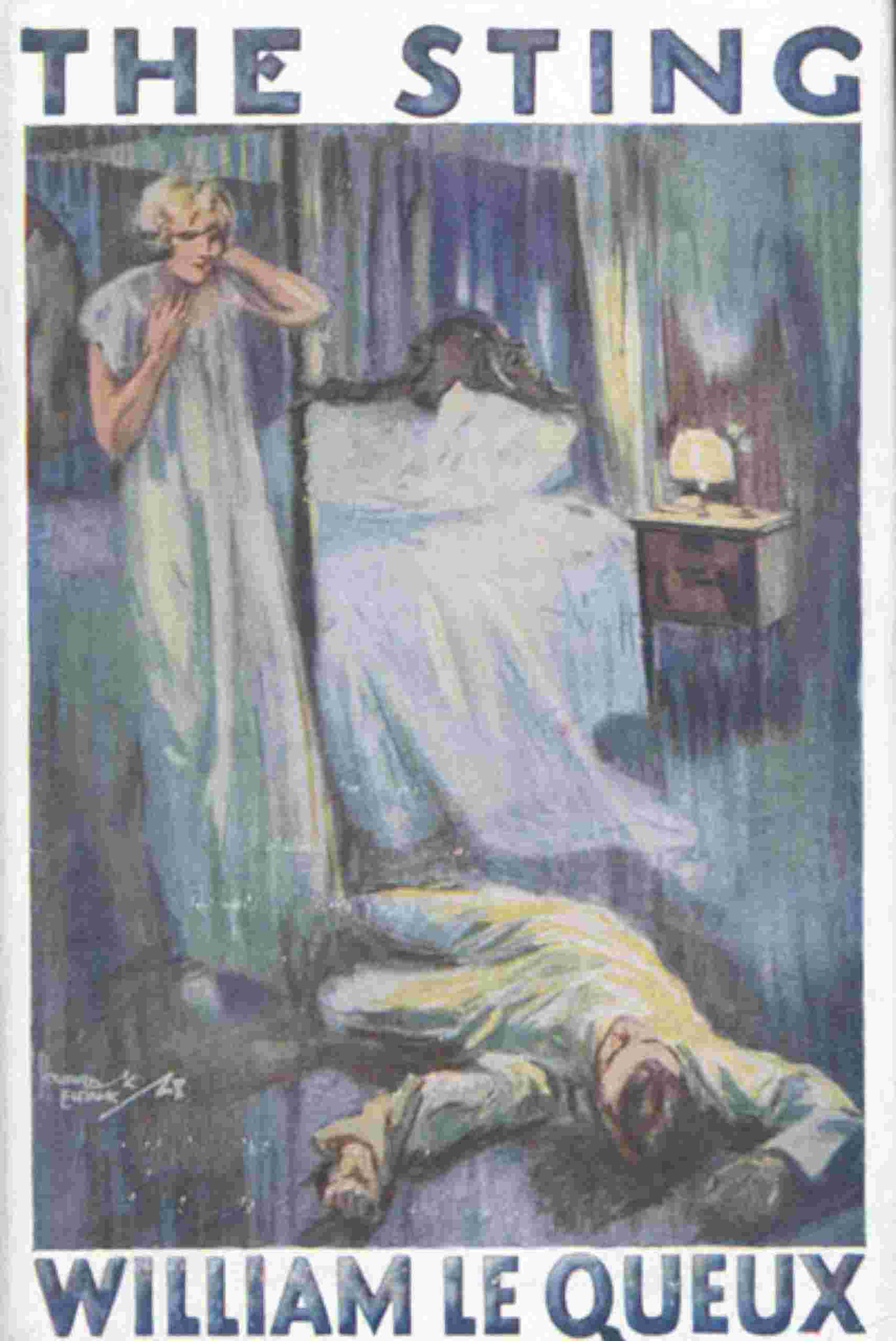
“What does this mean?” he asked his mother. But she had gone into hysterics, and had to be put to bed. The next day she would reveal nothing. She seemed absolutely apathetic about the whole affair, but Frank determined to take immediate measures. He sent a long cable to Mr. Benson, and ordered Jill to get the packing done at once. Lady Evenden made no demur, but fell in with all the arrangements. Two days later they were back at the Priory. Mr. Benson came across at once, and held a long discussion with Frank.
The next day letters of claim were received by Mr. Benson, in his capacity of solicitor to the estate, on behalf of Sir John Evenden, a minor, suing through his mother, Lady Evenden, née Trenchard.
Mr. Benson traveled with Frank to London and sought an interview with Brenda. They interviewed her with her solicitors, saw the certificate of marriage, and the testamentary evidence of where she and Jack had lived together for several days before his murder.
Mr. Benson examined the evidence very carefully, and, more carefully still, examined Brenda. Then, to the astonishment of the London lawyers, the old man gave his instant decision.
“Upon the assumption that this evidence is true, I shall not fight.”
“Then I take it you will prepare a statement of affairs?” asked the solicitor acting for Brenda.
“Certainly, sir,” said Mr. Benson, standing upright. No one ever knew what the next words cost him, but he uttered them with a sphinx-like expression. “And then I shall hand over the estate of Evenden Priory to the London firm of Nettlefall & Diamond—isn’t it?”
There was a hard smile on the old man’s face, and, as Frank helped him on with his fur coat and handed him his old-fashioned silk hat, he felt the old man’s arm tremble.
“What does this mean exactly?” asked Brenda. “It doesn’t mean that you will refuse to act for me, does it?”
“My dear lady, you have your own people here, and at their instructions on your behalf I shall certainly have to surrender the estate to their charge.”
“Oh, but I don’t want that,” said Brenda. “I have known you for so long, and I know what Sir Michael thought of you, and what Jack did. I couldn’t bear to think of your handing the estate to strangers.”
“This is all very irregular, you know,” said Mr. Diamond, looking very irritated.
“Of course it is, of course it is,” said Mr. Benson with a chuckle, as he left Brenda looking pathetically after him. Yet, before he left her, the cunning old man had slipped his hotel room number—a tiny disk—into her hand with a significant pressure.
She understood what he meant, and later that evening telephoned Mr. Benson and arranged to come round and see him. She came. And Frank, Mr. Benson, and she remained closeted in a private room for two hours while she told her story. It was an amazing one, and several times Mr. Benson gasped in horror. She told of her accidental meeting with Jack after a lapse of years, of their marriage in secret, of a three days’ honeymoon at her flat, and of his journey down to Evenden Priory to break the news to his parents. Then she spoke of the tragic wire telling her of Sir Michael’s death, and her telegram to Jack to say that she was coming down by a late train. She came, very late—it was after midnight, and Jack met her at the station. She carried only a handbag; and when they got to the Priory it was in darkness, so Jack took her straight to his room, intending to announce her arrival and position the next day.
Jack and she had retired to bed. She had been very tired, was just dozing when she heard a heavy fall. Startled, she had looked up, and saw that Jack had left her side and was lying groaning on the ground. Horrified, she had jumped out of bed and rushed to his aid. He had struck the side of a great brass-bound chest as he fell, and this had injured terribly one side of his head, for, even as she raised his head he had died. Overcome with horror, she rose to call assistance, when suddenly, as if from nowhere, Lady Evenden had appeared, and with her a man she knew later to be Dr. Laidlaw.
Lady Evenden had asked her the reason of her presence, and had not expressed surprise to see Jack lying on the floor. Laidlaw had taken Lady Evenden to one side; and, while the distraught bride sought to do something for her dead groom, Lady Evenden and Laidlaw had made a decision.
Laidlaw came over to her and bade her dress at once. He hinted at a frightful disgrace—that Jack was only in a coma, and that he would put matters right. Half-distraught, she obeyed his order to leave. Outside, in the drive, a car was waiting. She stepped into it, and then she remembered no more than that a soft cloth was put over her face.
When she woke up she was in a large raftered bedroom with a woman in attendance on her. She tried to find out where she was, but never could. Weeks went by, then months, and she was kept a prisoner. Sometimes Laidlaw would come to see her, and sometimes another man—a short man—would be with him. She went sometimes to walk along a lonely moor from which she could see distant patches of the sea, but whenever a stranger appeared in sight, she was taken back.
Locked in her room at night, and with windows shuttered and locked, she had no opportunity to escape. Sometimes she became hysterical, and then the woman would inject something into her arm, which sent her into a trance-like condition from which she would emerge in terrible depression. When she had discovered that she was to become a mother, she sought to live for the sake of the child; and, ultimately, when it was born, a strange woman came to attend her with Dr. Laidlaw. The woman was never allowed alone with her.
Then Laidlaw had come home very ill, and later had died. In the confusion Brenda had made her escape, had gone to a farm on the moor—she had found it was on the Solway Moss, miles away from anywhere—and had made her way to friends in London with her three-months’-old baby.
Frank and Mr. Benson were astounded at the story, which rang true in every detail. And, immediately after Brenda had gone to her rooms, promising to communicate the next day, the lawyer and Frank sought Mr. Rushton Tring, who agreed to accompany them to the Priory.
On their arrival, they found Wilfred and Jill in the hall awaiting them. They said that Lady Evenden had been in a most hysterical condition all the preceding night, but that she was sleeping now.
Mr. Tring decided to postpone his interview until the next day, saying that the sleep would do his patient good. Late that night, Wilfred heard a tapping on his door—the pre-arranged signal from Jill that Lady Evenden was waking. He called Mr. Benson and Mr. Tring; then Mr. Benson called Frank. Silently the party made its way in the wake of Jill, who led them to the Prior’s Room.
As if dazed and acting under some control from outside her own consciousness, Lady Evenden took a pillow from the great bed. The little group standing at the half-open door watched. She took a small pair of scissors and cut the end of the pillow. Presently she drew out a tiny cylindrical object.
“Put that down—at once.” The command came from Mr. Rushton Tring, who sprang forward. But he was too late—with a startled scream Lady Evenden pressed the cylinder to her brow just as the specialist seized her hand. In another second she had collapsed groaning upon the floor. Mr. Benson and Wilfred ran forward, while Frank cried out in his horror.
“You needn’t bother, Dr. Barlow,” said the specialist, “she is quite dead.”
It was indeed so. Lady Evenden’s troubles were over. The servants were not awakened, and silently the party carried the body of the dead lady back to her room; they then foregathered in the library.
“The secret is out now,” declared Mr. Tring. “I have inquired very carefully, since Sir John’s murder, into the properties of this drug. It is little known—a muscarin alkaloid, deadly in the extreme. It is only necessary for the tiniest portion to penetrate the brain, and this cylinder is fitted with a hypodermic needle of curious design and uncommon strength.” He held up the cylinder. “Now, she had obtained from Laidlaw this poison—why, we shall never know. The most probable solution is that, at the time of her husband’s death, she had a brain storm which swept over her. She was terribly unbalanced, you know, never normal, and she was left with the obsession that Laidlaw could not move, or, perhaps for reasons best known to himself, did not try to move. Also that Sir John had told his father a story about the death of her first husband—a story which had given him so great a shock that he had died.
“Her object was revenge. Probably Laidlaw’s object was to get Sir John out of the way so as to enrich Lady Evenden and ultimately himself.”
They decided that no scandal would be necessary; so, the next morning Lady Evenden was found dead in her sleep. And, when the startling news of the little heir was announced, the county was given to understand that Lady Evenden had been abroad in enfeebled health, since the tragedy of the previous year.
Jill, who shortly afterwards married Wilfred, became an inseparable companion of Brenda’s; and Frank, who was provided with a substantial settlement, set off on a world tour.
Mr. Benson remained the “Dictator” of Evenden Priory, as indeed he was of two counties.
A year went by, and the tragic events of the years before were rapidly fading under the mellowing influence of time, and Frank returned. He stayed for a few days at a house party at the Priory. Brenda thought he looked stronger and finer after his tour, and took a great interest in his stories of adventure in foreign lands.
When he went away, and she shook hands with him through the carriage window, Jill, who stood beside her, thought there was a curiously soft light in Brenda’s eyes as she said:
“Au revoir, Frank—don’t be away so long this time.”
“If you’ve got any sense you won’t, my boy,” put in old Mr. Benson, still as young, and still as old, as ever.
Frank had only time to say:
“I’ll see you soon, Brenda.” And then the train moved off.
“Well, I’ve seen queerer things than that happen,” muttered Mr. Benson as he strolled down the platform with Lady Evenden on his right arm, and the wife of his friend, Dr. Barlow, on his left.
THE END
TRANSCRIBER’S NOTES
Archaic (resistence, throughly) and inconsistent (e.g. handbag/hand bag/hand-bag, prearranged/pre-arranged, etc.) spellings have been preserved.
Alterations to the text:
Punctuation: fix some quotation mark pairings/nestings.
[Chapter I]
Change “How did Sir Michael Everden repair the family fortunes?” to Evenden.
“threatening thunder-clouds obscuring the sun for a few mintues” to minutes.
[Chapter II]
“for many vaulable early histories and theological works” to valuable.
[Chapter V]
(“I don’t know who that man is, but he’s nasty little fellow,”) add a after he’s.
[Chapter VI]
“All this was carefeully taken down by the police inspector” to carefully.
[Chapter VIII]
“Wilfred was inchned to resent the reference to Jill” to inclined.
[Chapter IX]
“coming to him as it did from outside the famly, was a shock to him” to family.
[Chapter X]
“But Br. Benson soon put an end to his expostulations” to Mr.
“Why can’t you do as as you’re told? What have you to say?” delete one as.
“came here tonight with the express purpose and full intention” to to-night.
[Chapter XI]
“your little friend, the companion—hence your knowlege” to knowledge.
[Chapter XII]
“Well, if the pore old gentleman breaks his skull open” to poor.
[Chapter XIII]
“followed by a shufflng of feet, then the rasping sound” to shuffling.
[Chapter XIV]
(“Cursing and theratening and all sorts of things.”) to threatening.
[Chapter XV]
(“Well, what have to say?” Mr. Benson seated himself) add you after have.
(“Do you want me tell you all that?”) add to after me.
[Chapter XVI]
“which he handed to the great pychologist” to psychologist.
[Chapter XVII]
“I have come down to staighten one or two matters out” to straighten.
“Only two or two things can be stated with assurance” to one.
[Chapter XX]
“he determined to find out it if were the whole story” to if it.
(“Laidlaw’s been,” anounced Mr. Benson, “and Bill Harris) to announced.
[Chapter XXII]
“Lady Evenden was exonerated from the slightest suspision” to suspicion.
[End of text]