
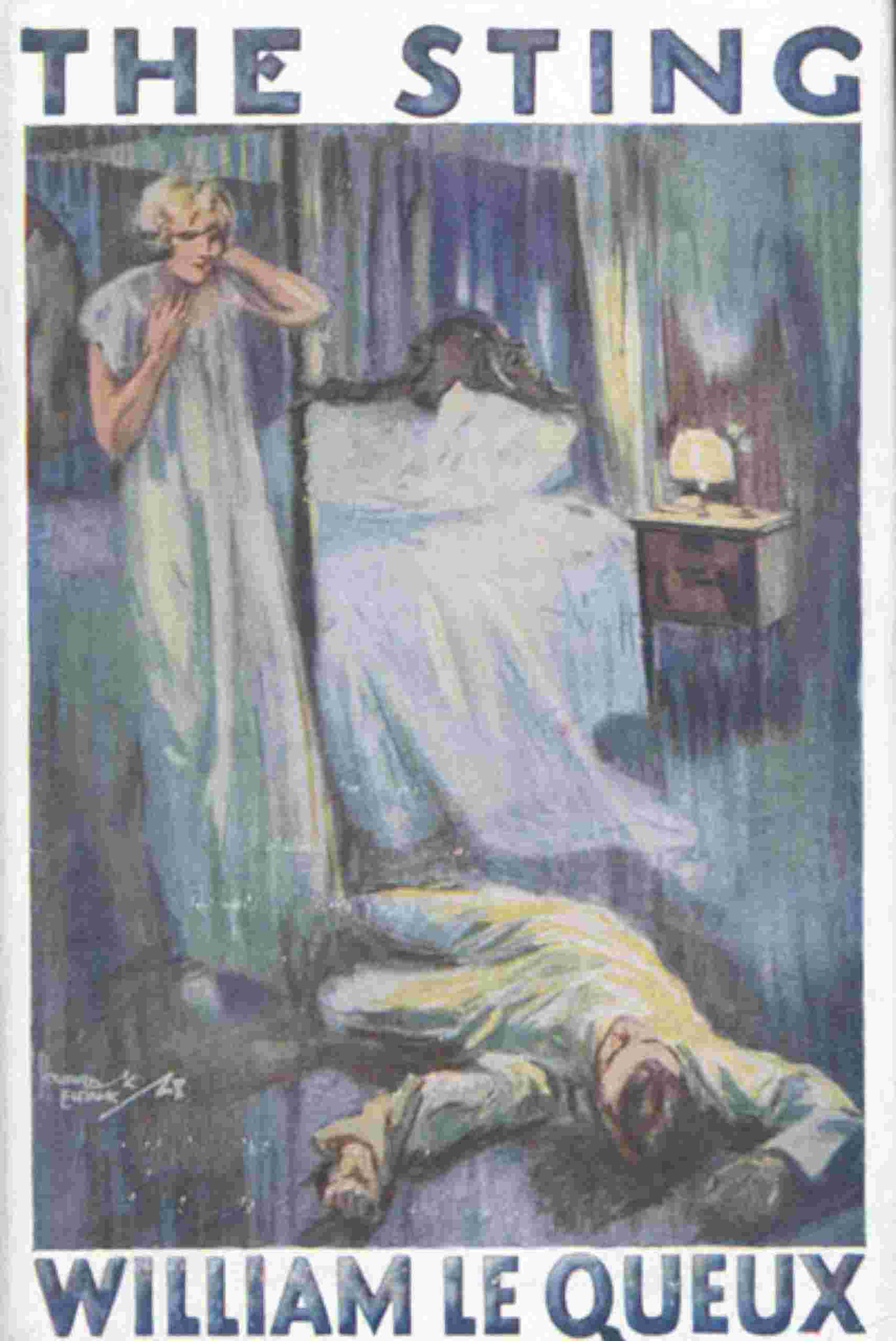
CHAPTER IV.
THE HAND OF DEATH
Jack carried his stepmother over to a couch, laid her gently down, then crossed the room for some water from the carafe that stood on a side table. Soon, the color began to show again in Lady Evenden’s face; and, to Jack’s manifest relief, she opened her eyes.
At first she smiled, bewildered. Then memory seemed to return to her; for, a pained look, followed by a hard expression that Jack had never seen before, settled on her face.
“Don’t try to get up, mum,” Jack begged. “I can’t say how sorry I am for this——”
She interrupted him with a little imperious movement of her arm.
“You were saying that your friend told you there were circumstances in the death of my first husband that reflected upon me, I think. What precisely do you charge me with, Jack?”
“Oh, mum, dear! I make no charge at all. How can you think that I would?” Jack replied hurriedly. “The thing is that when this rotten story was told to me I felt that there must be some explanation of it, and it was only right that you should have the chance to give the proper story. Then, don’t you see, I know what to reply?”
“Jack”—Lady Evenden spoke slowly, and her eyes searched her stepson’s face keenly—“how did you come to be discussing my affairs? What possible interest could my early life have for you? Is there anything since you have known me that would justify you picking about in the dead past? In what have I failed? You were only a little boy of eight, Jack, when I came into your life, and I always loved you——”
“Stop, stop!” Jack seized his stepmother’s hand, leaned forward, and gently kissed her. “You make me feel an awful brute. I don’t presume to criticize you at all. But, when I heard this story it became my duty to tell it to you. Can’t you see that? Obviously, it would have been the same if you had been my own mother—you have been equal to that to me.”
“You have not told me how this arose.” Lady Evenden spoke quietly. In her eyes a wistful look had appeared as she gazed at the troubled countenance of her stepson.
“Basil Towers, my messmate, saw your photo and——” Jack began, when she interrupted him.
“Ah, yes! The Towers of Ardlui. What did he say exactly, Jack?”
Jack related to her exactly what the gunnery lieutenant had said. She listened intently and shuddered slightly when he came to the part where the paralyzed man was found in the lake. Then, for a moment or two after Jack had finished she sat silent, her hand shading her eyes. At last she spoke.
“Jack, my life with John Gough, Frank’s father, was a terrible one. It is a memory that I would bury—a nightmare and worse. On the last night—that awful night young Towers told you about—I never slept. I spent the whole night in packing up my things. Ill or not ill, I intended to leave my husband the next day. I had come to the limit of human endurance. Jack, you don’t know—you can’t realize—what a fiend that man was. Look”—with a rapid movement she unloosened her dress and bared one shoulder, revealing a permanent scar. Jack shuddered. “That is a pleasant little memory of John Gough,” she continued bitterly; “John Gough and a red-hot poker.” She refastened her dress, her breath came quickly, as if the fear of the terrible days came back to her for a moment; then she resumed.
“I don’t pretend to know what was the condition of my late husband on the night the doctor and Mr. Towers saw him. All I know is that in the morning—he had gone. He was found in the lake. That is all I know. Of course I left the district—the district that had nothing but miserable and humiliating memories for me. My one desire was to forget.”
“But, my dear,” Jack asked, “was no one left to attend to the man in his room if he was paralyzed like that?”
“It was the first seizure he had had, Jack,” she replied. “Drink and uncontrolled passion had left him often before foaming at the mouth, and gibbering. I saw him put to bed, and I warned the maids to listen carefully to his bell, and to be sure and go together—not one—it was not safe, with that man. Then I locked my door, and packed, as I told you.”
“It is very terrible, mum,” Jack said. “And I am very sorry for raising such a tragic chapter in your life. There is only one thing I want to ask you. Of course I believe what you say. But, does father know all about this?”
Lady Evenden stiffened; there was almost defiance in her eyes as she spoke.
“No, he does not.”
Jack felt like one who has had a blow in the face. Lady Evenden merely looked at him, unflinchingly, challengingly. He gulped—then spoke.
“Mum—why not? Don’t you think he should?”
“Yes—he ought to have known, at the time. In fact I meant to tell him. I began to tell him that there was something in my earlier married life that was very terrible that I wanted him to know; but, your father saw my distress, and said that if it was anything of a painful nature he did not want to hear it. His trust in me was absolute. I have never abused your father’s trust, Jack.”
“Still, mum, I’m not unduly criticizing you—but, don’t you think he ought to know now? He would believe you just as I do. It would be terrible if he got to know of it accidentally as I did,” Jack persisted.
“It is too late.” Lady Evenden shook her head sadly.
“Why?” Jack asked.
“I had not meant to cloud your home-coming with this, Jack dear, but you must know now what I intended to break more gently. Your father’s heart is in a terrible condition. A shock like this would kill him.” Lady Evenden leaned back in her corner of the couch, and her beautiful eyes filled with tears. Jack was aghast.
“Since when has this been so, mum?” he asked kindly.
She proceeded to tell him of the frequent heart attacks of Sir Michael, culminating in his visit to Professor Gaspari at Lausanne.
Time had passed without either noticing it, and now the first gong was sounding for dinner. Lady Evenden rose; so did Jack.
“Oh, I say,” he said as they walked to the door. “There is some more news to-day that I must tell you. You remember Brenda Trenchard——”
“Jack, Jack,” Lady Evenden interrupted him impatiently. “How can you follow up two subjects like the things we have been discussing with a reference to my flirtatious little companion of three years ago? Listen, Jack—we have only a moment. Will you give me your word to preserve my secret from your father?”
“Yes, of course, I will. But I must tell you about Brenda——”
“Some other time, Jack. Believe me, I’m asking you to do the right thing where your father is concerned, and I know I can rely upon you. You’re a dear boy, Jack; kiss me.” Jack felt as though she wanted him to kiss her to testify his faith in her still, and he put his arm round her shoulders and kissed her very tenderly.
She gave him a smile, then quickly made her way to the butler’s pantry to speak to Evans, the butler, about some last-moment arrangements before she dressed.
Jack proceeded slowly up the east staircase to the Prior’s Room to dress. His mind clung to the interview he just had had with his stepmother. He felt an overwhelming sympathy for her. He trusted her and believed her version of the circumstances in which the brutal John Gough had died. Nevertheless, why, he asked himself, had she never told his father? His meditations were cut short by a tap on the door, which he had locked. He went over and opened it, and was immediately confronted with Frank Gough.
“Hello, my dear old wig-and-gown merchant,” Jack greeted him in undisguised pleasure, putting out both hands, which were immediately taken and held by his stepbrother.
“Well, I’m jolly glad to see you, old admiral,” Frank replied laughing. “I thought I’d run in on you and have a chat before we go down.”
“I’m jolly glad to see you,” Jack said cordially. “Help yourself to cigarettes, and there’s a syphon there. But wait! Look at this.” Jack took a large wickered jar from a trunk. “I’ve brought you this, a jar of eleven o.p. Navy rum.”
“Splendid fellow!” Frank took the jar. “I shall love a little of this at the end of a long day’s shooting or hunting. I say—got a corkscrew, we’ll just sample it now, shall we?”
“In the senior service, my lad, we are trained to carry every article of prime importance,” Jack announced as he flung his stepbrother a corkscrew. While Jack completed his dressing, Frank withdrew the cork from the rum jar, and poured two small glasses of the pungent spirit. The brothers were toasting each other when there came a second tap on the door.
“What is it?” Jack called, and the door opened revealing Roberto, Sir Michael’s valet, who had come to see if he could be of assistance to Jack, having dressed Sir Michael. Jack refused his services, and the two brothers continued their talk.
“I say, Jack,” Frank presently said, “I want your advice, old man, seriously. You know Jill Kilby?”
Jack nodded and smiled.
“No, no!—this is serious,” Frank averred. “Well, I’ve been keen for a long time—and it isn’t a bit of good. She won’t have anything to do with me. I’ve tried everything I can. I’ve acted the cave man and the sheik business, you know——”
“What does the cave man and the sheik business consist of, Frankie?” Jack asked, laughing.
“Well—you know——” Frank replied, “for instance, on the way through France, I managed to get across to her compartment on the train, and I made furious love to her until a guard came and I had to get out.”
“The devil you did!” Jack gazed at him, first in horror, and then he forced a laugh. “I am afraid I could never get to that point,” he said, “though a certain lady of my acquaintance tells with some complacent satisfaction that her husband kidnaped her aboard a destroyer that he commanded, and utterly refused to allow her to land until she promised to marry him. They’ve been married for twenty-six years now, and got one lieutenant, one sub, one middie, and one fleet-surgeon’s wife; so, I suppose it sometimes works out all right.” Both the brothers laughed. Then Frank spoke again, seriously.
“For some reason or other the confounded girl seems to hate me, Jack,” he said, frowning and taking a fresh cigarette. “She’s got a lover, too—got him staying down in the village inn, here. I have seen them together in the drive after dinner. Couldn’t help hearing them speak. They referred to me; and this man—Dr. Barlow, they call him—spoke of me as a cad!”
Jack could not refrain from laughing heartily.
“Listeners, you know, old chap, never hear any good about themselves. But, seriously, if the girl doesn’t want you—why worry? Have another dip in the lucky bag. There goes the bell; come on, we’ll have a chat later.”
The brothers left the room and descended the great winding stairs, traversed the main corridor of the first floor, finally reaching the hall together, where Jack immediately was pounced on by a score of old friends and acquaintances. At dinner, he found himself next to Jill Kilby, and, as he glanced down at her, he could not forbear a misgiving when he thought of the story Frank had told him.
She was pretty, Jack thought, but compared to Brenda—his Brenda—— As he thought of Brenda, a happy glow pervaded everything. What would they all say when they knew that he and Brenda had made things up? He glanced across the table. What would his father think? Sir Michael was in the midst of an animated conversation with Muriel Daneley, the pretty American heiress married to the middle-aged Earl of Daneley, who sat farther down the table.
“I’ve been hearing some rather dreadful things about you,” said Jack, smiling down at the little companion on his left.
Jill started, and involuntarily glanced furtively down the table to where Frank was sitting, his eyes fixed on her.
“What do you mean, Mr. Evenden?” she asked.
“Well, I’m told that a certain very great friend of mine is positively in the throes, because of you. Eating his heart out, and every other thing he can eat out—because you spurn him! You must be a cruel little lady!”
Jill glanced up and flushed a little. But as she saw the honest, humorous eyes of her bantering neighbor, she did not express the annoyance she felt.
“I am so glad the weather is holding for the shooting,” she said. “The men all say they have never had a better season.”
“Self-possessed little monkey,” Jack mused to himself; then aloud he said: “I’m very glad to hear that. You see, my time is essentially limited. Most of these chaps can stay on if a bad patch of weather comes, but with me it is—now or never. My leave finishes in just over a week’s time—and there’s no appeal.”
“Yes, I quite understand—that’s why I’m so glad——”
“Jack, I’ve particularly wanted to ask you one or two questions of a rather important nature.” Jack turned contritely to the lady on his right; then he groaned. Lady Nina Cockett was the wife of the old rector. He knew her of old—but there was no help for it. “I’ve been troubled for some time, Jack,” she said, “by what I am afraid I must call the insidious permeation of Anglo-Catholic views and practices in the chaplaincies of the Crown forces. Now I wonder if you can tell me. Does your chaplain take the eastward, or the northward, position at the altar?”
“I really don’t know,” Jack replied. “I suppose it depends on what course the ship’s on.”
“Jack, my dear,” the dominant voice of Lady Nina came in retort, “I know the tendency of the day is for young people to treat serious matters lightly, but I do trust that you render to your pastor that fitting respect that you have been taught to show.”
“Oh, yes, of course.” Jack tried to break away so as to resume his conversation with Jill, but the dragon had him, and the rest of the meal was occupied by Lady Nina’s questions and statements. Jack was sorrier than ever for the dear old rector, who bore his cross with such exemplary patience. But all things end—and presently the port was served and the ladies departed. For the usual three quarters of an hour the men sat on, smoking their cigars and sipping their port.
“To-morrow I want a long chat with you about a number of things, Jack, old man,” said Sir Michael as he and Jack walked from the dining room towards the drawing-room. “Yes,” Jack replied. “You look very well to-night, dad. Do you feel fit?”
“Yes—and no,” replied the baronet slowly. “But that, and a number of other things, I’ll go into with you to-morrow morning. I think I’ll retire early to-night. I’ve rather overdone it to-day. I feel the strain a little, but a good night’s rest will put me right, without doubt.”
“What time will suit you, dad?” Jack asked.
“Oh, we’ll take an early walk round together before breakfast—You’re used to early rising, I know. Come to the gun room at seven-thirty,” replied the baronet.
“That’s fine,” Jack answered. “I used always to look forward to our rambles round the woods in the mornings, dad, as you know.”
“So did I, my boy, and so I do still,” responded Sir Michael. “Now run off and join the ladies, or play bridge, or billiards, or what not. If you should see your mother tell her I’ve retired early—just a little tired, that’s all.”
“Righto, dad.” Jack bade his father “good-night”; then he made for the billiard room. There, he played two games of billiards, looked about for Frank, but failed to find him, went to the drawing-room to see if Jill Kilby was there, but left hurriedly as Lady Nina Cockett caught his eye and began to clear her throat preparatory to another onslaught. Perhaps Frank would stop up to the Prior’s Room to have a chat with him, Jack thought, making his way there. But Frank did not come; so, presently, he undressed and prepared for bed.
Jill Kilby had taken advantage of the fact that there was some good chamber music in the drawing-room which held everyone’s attention, to slip out to meet Wilfred Barlow. She told him all the news of the last three days, and of Jack’s arrival and his jest at dinner; then she returned to find her mistress in great distress.
Lady Evenden had asked repeatedly for Jill in the last hour; and, despite her distress, was somewhat annoyed that she should be absent without letting her know. It appeared that Sir Michael had been suffering from an acute pain in his chest, and the local doctor had been sent for. He arrived almost simultaneously with Jill, and, knowing the case thoroughly, declared that it was something that might be expected after a tiring day—certainly nothing alarming. He gave a soothing draught and left, reassuring Lady Evenden about her husband.
Sir Michael lay down again to rest. Downstairs the dancing went on, the cards were well patronized, and the billiard room was occupied by a merry young crew of both sexes. Harmless little flirtations developed in the conservatories, until, at length, the last guest was in bed.
It was three o’clock in the morning when Roberto, the valet sleeping in the box room opening off Sir Michael’s bedroom, heard strange groans issuing from his master’s room. He rushed in—to find Sir Michael in fearful agony, his hands clutching his breast.
The valet rushed to the bedside, raised his master’s head; even as he did so, Sir Michael gave a low groan—and all was over.
CHAPTER V.
DR. LAIDLAW TAKES A HAND
As soon as he found that his master was dead, the valet, Roberto, immediately raised the alarm, and Lady Evenden was quickly upon the scene. Her grief was terrible. For some time she could not realize that the dreaded end had come so suddenly—so almost nefariously. Jill Kilby was sent for by the butler, and she tried to get her mistress to leave the death chamber; but Lady Evenden would remain there, half-kneeling, half-lying, by her husband’s bed, her arms thrown round the neck of the man who could never respond again to her caresses.
Frank and Jack were both sent for, and they came almost together. Horrified and bewildered, they stood for some time helplessly gazing at the tragic tableau formed by the living and the dead.
Jack, at last, getting a grip of himself, sent for the local doctor, who came speedily and pronounced life extinct. Sir Michael, he said, had suffered another seizure. This time the heart had been unable to resist the strain, and death had followed. He was surprised—he had not thought from his examination of Sir Michael, earlier in the evening, that the contingency was remotely possible.
Lady Evenden, after great persuasion, was induced to go to her room, and the doctor gave her a draught to insure a certain amount of sleep. Jill stayed by her side, in her room, while Jack and Frank jointly worked out the immediate arrangements to be made. Neither of them returned to bed. They were occupied sending messages to the lawyers and relatives throughout the remaining hours of the night.
In the morning, the guests were quietly informed of the tragic event, and of the impossibility of Lady Evenden’s receiving them in person. With expressions of deep sympathy, they all left the house which, so suddenly, had changed from a bright home of gladness to a place of unutterable gloom.
During the forenoon, Mr. Christopher Benson of the firm of Benson, Waugh & Musgrave, solicitors, arrived, and, after going to the room in which his distinguished client lay, and remaining there in respectful silence for some time, he sought an interview with Jack, in the library.
Mr. Benson was an old gentleman who had served the late baronet’s father in a legal capacity, and had known Jack since babyhood. He was a small man, standing about five feet four. Seventy-six years of age, he looked about sixty—ruddy of countenance, and dressed in a fashion of thirty years ago. He affected small white side-whiskers, which he brushed back to his ears. His hair, plentiful at the sides, was very thin on top. He wore tremendously high Gladstonian collars, which had the effect of framing his face completely between whisker and neck. But the most remarkable features, of Mr. Christopher Benson, were his eyes and his ears.
His ears were unusually large, and his eyes—surmounting a certain pouchiness in the cheeks—were disconcertingly bright and alert. He was immaculately dressed in his old-world style, wearing a grey morning coat and vest with perfectly creased, striped trousers, patent shoes, and a huge stock tie—black to-day in respect to the Evenden family.
He stood before the great fireplace in the library as Jack entered, his hands behind him, the flames from the fire throwing flickering shadows over his venerable face—for the windows were darkened.
As Jack entered, he switched on several lights.
“Good morning, Sir John,” the old man greeted him, and Jack started. The title sounded exceedingly strange; it was the first time it had been addressed to him.
“This is a sad morning for all of us, my boy,” went on the old man. “Yet what a mercy you are home I was afraid you might have to be sent for to your ship.”
“I arrived last night, as a matter of fact,” Jack replied. “How are you, Mr. Benson?” He shook hands cordially with the old man.
“I am very well, thank you, my boy,” Benson said. “I don’t need to ask you how you are. How is Lady Evenden taking this?”
“Terribly,” Jack replied with a shiver. “I have just left her room. It is awful to behold her grief! She does not cry, you know, but just sits in the window mumbling to herself occasionally, and sometimes she seems to be talking to—to him.” Tears welled up in Jack’s eyes at the memory. The old man patted his shoulder.
“H’m! H’m!” he growled. “I’ll have to see her before I go. These strong, capable women, like your stepmother, are the ones to watch in a crisis like this, my boy. They wrap themselves up in some single person and, when anything happens, they simply crumple up. You must be very careful of her, Jack. She’s a good woman.”
“Oh, I know! I know!” Jack agreed.
“Now, my boy”—the old man coughed slightly—“it is most disagreeable to think of matters of business at a time when one’s whole soul is steeped in emotion. Yet, there are certain things that must be attended to at once, and I must—I am sorry—but I must ask you to accompany me through a certain number of papers——”
“Oh, I say, Mr. Benson,” Jack broke in, protestingly, “can’t it wait? Is it really necessary to discuss anything like that yet?”
“Yes, it is,” almost snapped the old man. Then he proceeded more kindly. “You must remember that you were born a privileged person. Great privileges carry with them great responsibilities, and certain crosses, as it were, that are not always the lot of those in humbler circumstances.”
“Quite, sir.” Jack saw the old lawyer in a new light. There was tremendous personality in the little man. And, as he stood there, his fine old face set, and his clear, sharp eyes flashing, he looked an embodiment of duty, bequeathed from an older and sterner generation, for the guidance of a generation to come.
“There are certain papers for you to sign that I have prepared for such a contingency as the present,” he said, unfolding a bundle of papers tied with pink tape, and adjusting a pair of heavy old-fashioned eyeglasses to his nose. “We will just run through them.”
A quarter of an hour was so occupied, then the old man folded his papers, removed his glasses, lay back in his chair; and, with the tips of his fingers just touching from time to time, addressed Jack.
“Now there is one other point I must mention to you this morning,” he said. “There is a will, of course, which will be read after the funeral—But, did your father take you into his confidence at all about his affairs?”
“No,” Jack replied. “As a matter of fact, only last night he told me he wished to consult me about a number of things this morning, and I arranged to meet him in the gun room at seven-thirty.”
“H’m! I see.” The old man crossed his legs, glanced with his sharp eyes towards the door, then leaned forward, and, speaking more quietly, said: “The will with which we shall have to proceed to probate, the only existing will, my boy, is an absolute travesty of your late father’s wishes. The reason why he wanted to consult you this morning was to secure your co-operation and agreement in making such provision for your stepbrother and your stepmother as was just and reasonable.”
“But you don’t mean to say that he didn’t provide for us all, do you?” Jack asked in bewilderment.
“He intended to,” Mr. Benson replied. “I’ll tell you what happened. Some time ago—only a few weeks ago—your father was absolutely in the throes of financial difficulty. Things looked as black as thunder in the Russian oil markets, from which, of course, his great wealth was derived. Now he had a positive horror of this estate slipping out of the family again. I don’t blame him for that; but, when he thought he might possibly come very near to ruin, he determined that every available penny left, should be concentrated in the estate, so that the heir would not be forced to mortgage or sell. The former process invariably ends in the latter, in my long experience.
“Now, in the event of his death, there would have been sufficient to carry on with, but only just sufficient, and he relied upon you to look after your stepmother by way of pension, to what extent the estate could afford. Are you following me?”
Jack nodded.
“Well now”—the old man looked around—“get me a little whisky, will you?” Jack could scarcely repress a smile. He apologized for his lack of thought, rang, and ordered the refreshment. When it was served, and the door closed behind the retreating servant, Mr. Benson, after taking a sip, continued: “Since then the situation has entirely changed. Your father and his associates won their way through, and your father died worth probably half a million, after these iniquitous death duties are paid. Now it is for you, in honor, to meet your father’s wishes and provide an adequate sum for your stepbrother and stepmother. Do you understand?”
“Certainly, Mr. Benson. You know perfectly well I will do whatever you think right in that regard.”
“Well, that’s all I want to say now, my boy. I keep on calling you ‘my boy’ and ‘Jack.’ I must get into the habit of calling you ‘Sir John.’ That is one of the penalties of age, my boy, a vain hankering after the things that were—and garrulity.”
The old man rose, finished his whisky, then turned to Jack.
“Now take me to Lady Evenden,” he ordered.
“Well—I don’t really know whether you can do any good, Mr. Benson——” Jack began doubtfully.
But the old man cut in brusquely. “Tut, tut! Take me to Lady Evenden—and leave the rest to me.”
Jack, without more ado, led the way up the great staircase to his stepmother’s room, softly opened the door, and called Jill. Mr. Benson pushed past him and crossed the room to where Margaret Evenden sat, a tragic figure indeed, in the wide window overlooking the park. Her eyes, roaming incessantly, were searching every bit of the landscape within view. It was all holy ground to her. Not an inch but her beloved husband and she had trodden in the happy years that were ended now.
Jack withdrew, and Jill Kilby, looking a little doubtfully at the lawyer as he crossed the room, advanced and touched his coat sleeve.
“Her ladyship is not herself——” Jill began.
“I knew her ladyship before you were born, girl. Leave the room,” ordered the old lawyer sternly. Jill hesitated. “Leave the room, will you?” Mr. Benson’s eyes flashed, completely intimidating. Jill flushed and left the room. Mr. Benson then approached Margaret Evenden, who had not shown the slightest interest in the duel of wills that had just taken place within three yards of her. A very different Mr. Benson it was who touched her on the shoulder.
“Lady Evenden, my poor child!” whispered the old man. “This won’t do, you know.” She looked up, and the old lawyer took her hand.
“Who told him?” Margaret Evenden whispered “John did.”
Mr. Benson looked closely at her. There was a tremor in his voice as he asked:
“Lady Evenden, my dear child, do you know me?”
She stared vacantly at him for several moments, then replied:
“Of course—you’re Mr. Benson, but nothing matters now. I kept my secret safely all these years, and then somebody told him—and he died.”
“Will you please listen to one who has sought to serve you ever since he met you, my dear?” Mr. Benson asked, and his magnetic eyes held hers.
She replied in spite of herself. “Yes—I know I can trust you. I think I can trust you. But it doesn’t matter now, anyhow.”
“You can trust me, my child, and, what’s more, you must obey me. Now listen to me. Your dear husband died because his heart was in a terrible condition, and he had been overstraining it lately. He loved you, and he expected you to remain the strong helper of the weak in this district that you have ever been. The charities that he and you inaugurated still need your presiding genius. You have work still to do.”
She was silent. He paused a moment, then proceeded.
“I am no priest, my dear, only a rather cynical old lawyer; but an overwhelming majority of civilized people firmly believe that death is not the end of existence. Now on that basis, my dear child, does it not behoove you, at this time, so to act that your dear husband will be proud of your victory over evil circumstance, when you are once more reunited?”
“I shall not fail him,” she replied. “Only he would not have left me if some one had not told him.”
“Never mind that,” counseled the old man. “Remember what I say. I will see you to-morrow. Good-day, my dear Lady Evenden.”
She bade him “good-day,” and with frowning brows Mr. Benson left the room. At the door he found Jill talking to Jack Evenden. He ignored the girl, drew Jack aside, and spoke directly and firmly.
“Listen to me, Jack. Your stepmother is on the verge of a complete mental breakdown. I know the signs. When the great crises of life come, these strong, capable women are bowled right over. They feel too deeply, my boy; they feel too deeply. Now listen to me and take my advice. Anything might happen with that unfortunate lady. You must get—and get at once—a strong, capable, experienced woman into the house, as a nurse or companion. That flibbertigibbet of a flapper that presumed to teach me my business is utterly useless—worse than useless. Now get one at once, will you?”
“Yes, certainly, if you say I must,” replied Jack, looking frightened. “Do you mean there is danger of her sanity——”
“Yes, I do,” interrupted Mr. Benson. “She’s got all sorts of ridiculous delusions now. Who’ll you get?”
“I’ll send for Lady Porter, she——”
“Capital,” agreed the lawyer. “The very woman. Send at once, and in the meantime have the housekeeper somewhere about your stepmother. Don’t leave her in the care of that flapper.”
Jack agreed, though in his heart he felt that the old man exaggerated the state of his stepmother, as he did Jill’s incompetence. Nevertheless, he knew in what esteem his father had held the old man, and he knew that Mr. Benson was considered the greatest lawyer in four counties. Besides, he personally liked the old man as well as respected him. He determined therefore to send for Lady Porter, his father’s cousin from Lincoln, immediately. He accompanied Mr. Benson to the hall, where a little man was waiting. The butler approached him.
“This gentleman says he must see Lady Evenden, sir,” he announced.
“Well, he can’t whoever he is”—Mr. Benson spoke before Jack could reply.
“No—it is impossible for anyone to see Lady Evenden, at present.” Jack agreed, with a glance at the little man.
“I beg your pardon, gentlemen,” said the little man coming forward, “but I am a very old friend of Lady Evenden, and at this moment it is very important that I should see her—even imperative.”
“What is your name?” asked Jack.
“Laidlaw—Dr. Laidlaw,” replied the little man with a quick glance at the lawyer, who was observing him keenly.
“Well, then, you must write, Dr. Laidlaw,” said Mr. Benson. “You certainly cannot see her. She is not fit to receive anybody.”
“I am sure if she knew——” commenced Dr. Laidlaw.
“You cannot see her. You cannot see her!” thundered Mr. Benson. “Can you not take an order, man?”
“It is very important——” Again the doctor was interrupted.
“Will you please go, sir?” The lawyer looked like a judge and an executioner in one.
Dr. Laidlaw, coloring, and with an evil glint in his eye, left without another word.
“I don’t know who that man is, but he’s a nasty little fellow,” observed Mr. Benson to Jack, and Jack agreed that the doctor’s appearance was certainly not prepossessing. The lawyer took his leave and Jack returned to the library.
Late that afternoon, when Jack paid a call at his stepmother’s room, he was astonished to meet Dr. Laidlaw leaving it, just as he was about to enter. He halted a moment to question him. But, Laidlaw rushed past him and was on the staircase before Jack could think of anything to say.
“Lady Evenden is trying to sleep, and wishes you to excuse her,” Jill announced, as Jack was about to enter the room.
“Well, I think I’d better see her for a moment,” Jack hesitated.
“Forgive me,” Jill said. “You can, of course, if you like, Mr. Evenden—but she seems so upset just now that I think, if I might presume to advise, I should suggest you let her have a rest for an hour or so.”
“All right,” Jack rather reluctantly agreed. “But just one moment, Miss Kilby. Who admitted that little man who has just gone?”
“Oh, his name is Dr. Laidlaw,” Jill said. “Her ladyship saw him in the grounds somewhere, and sent word down that she would receive him, so I informed the butler, and he came.”
“I see—all right,” Jack said after a pause. Then, as he moved away, he said to himself, “I wonder who the little fellow is? He seemed sure of his welcome—and he apparently was welcome. Laidlaw? Laidlaw? Where have I heard the name—— Great heavens! the name of the doctor who attended her first husband at Loch Lomond! What on earth does this mean?”
Deep in meditation, Jack walked to the smoking room, then to the library, afterwards making a round of the likeliest places to find his stepbrother. Failing, he returned to the library, rang for the butler, and told him to send Mr. Frank to him in the Prior’s Room, if he should come in.
But Frank did not come in, and later in the evening Jack dined alone in the great dining room. Afterwards, obsessed by loneliness, he retired to the Prior’s Room, leaving instructions again with the butler to send Frank along if he should return before midnight.
Roberto, the valet, went to attend his new master at seven-thirty the following morning, but got no reply when he knocked. He decided therefore to wait until eight o’clock.
At eight, he was equally unsuccessful; so, he turned the handle of the door, which was not locked, and entered. The next thing that happened was that the household was startled by a piercing cry as Roberto, completely unstrung, ran along the corridors shouting:
“Master Jack, Master Jack is dead—murdered.”
CHAPTER VI.
ARRESTED!
If the death of Sir Michael, unexpected as it was, had given the household of Evenden Priory a shock, this new calamity was overwhelming. Roberto’s wild shrieks were only too justified. The butler and a footman visited the Prior’s Room immediately, and there, lying on the floor in his pyjamas, his body twisted and contorted, was the young master of Evenden. Jack had enjoyed his baronetcy for something under twenty-four hours.
The police and the doctor were immediately sent for. The latter pronounced Jack dead, and added that death had probably taken place eight hours previously.
When the superintendent of the local police arrived, accompanied by an inspector, Frank Gough received them in the library. Frank stated all he knew. He said that on the previous evening he had been rather late returning from a visit to Norwich, where he had ordered some black clothes from his tailor. On the way back, his car had given trouble, and it had been necessary to have it repaired. The delay made him late for dinner, which he subsequently ate alone.
He then had received a message from the butler to the effect that his brother had retired, and that he would expect him to come up to the Prior’s Room. He did so, and had found the dead man strangely perturbed. Jack had been very nice, but it had been necessary for him to make a certain disclosure, the nature of which Frank had resented very much.
While Frank was still worried and shocked—because, he said, the disclosure was certainly shocking—his dead brother had gone on to explain that, as the apportionment of money for both Frank and his mother was entirely in his hands, it left him in a very difficult position. Frank then lost his temper, and accused Jack of deliberately raking up a cock-and-bull story to avoid his manifest duty, financially, to his stepmother and stepbrother.
High words had followed. The brothers had almost come to blows. Then Frank had said that as soon as the funeral of his stepfather was over he would leave the place forever. After that he left the room, going direct to his own bedroom. Half an hour later, he stated, Jack had come to his room to apologize. He understood, he had said, how Frank must have felt, and very quietly told him more details of the story. The two brothers had at last arrived at a common policy of silence in regard to the matter; and, before he left, Jack had told Frank that it was his intention to carry out religiously his father’s wishes with regard to money—and that with a generous interpretation.
Both had apologized to each other for the previous high words and unkind aspersions. Then, after shaking hands, Jack went back to the Prior’s Room.
All this was carefully taken down by the police inspector. The superintendent darted a keen glance at Frank from time to time; but, not until the statement was completed did he speak. Then he asked a number of questions. But Frank remained unshaken.
The superintendent then asked Frank to remain with him while he interrogated the servants.
The butler’s story was a complete confirmation of the early part of Frank’s story. The late young baronet, he said, had dined alone and then he had retired, after expressing a wish that his stepbrother should be asked to visit him in his room. He had delivered the message to Mr. Frank whom he later saw depart in the direction of the Prior’s Room. He knew nothing more until he had the report of Roberto in the morning that Mr. Jack was dead.
The housekeeper, two footmen, and Roberto were then examined. Roberto merely repeated his first statement. At eight o’clock he had found his master dead—that was all he knew.
The housekeeper knew absolutely nothing, and said so. Just before she left, however, she startled her hearers by declaring:
“Of course I know how he died, all the same.”
“What do you mean, Mrs. Turnbull?” asked the superintendent.
“Last night was the eve of St. Michael and All Angels,” declared the old lady, “and there never has been, in the history of the Priory, a case of a single person who has been allowed to remain the night through in the Prior’s Room on that awful night. Some have tried—but they have escaped in time—terrified.”
“What is this?” asked the bewildered superintendent.
Frank told him the ancient tradition of the haunted room and the supposed visit of the dour figure of the last of the priors, John Paseley, on the anniversary of his murder, in defense of his priory. The inspector, who was a good catholic, surreptitiously crossed himself.
“Is there any record of any authentic experiences?” asked the superintendent.
“Yes,” Frank replied. “There is an old book in the locked strong room, there. Shall I get it?”
“Yes,” replied the superintendent. “I would like to see it.”
Then the question of keys arose. Jack had had the key to that room. After a moment’s reflection, the superintendent said:
“Never mind, I will finish the inquiry first; then I will look. Perhaps I had better take the keys, for the moment.”
The next to be examined was the senior footman—he knew nothing and was quickly dispatched. He was followed by a young under-footman called Thomason—country-bred and raw. He entered the room with gaping mouth, his goggle-eyes fixed on Frank, and quickly had his hearers alert.
“I dunno whether I ought to say what I gotta say, sir,” he began helpfully. The superintendent immediately fixed on him a keen glance. “Tell us all you know,” he ordered. “Everything, mind you.”
“Well, sir,” began Thomason, “about nine o’clock I had occasion to go to the small pantry adjoining the Prior’s Room, and I heard awful quarreling, sir.”
“Did you recognize the voices?”
“Yes, sir,” replied Thomason.
“Who were they?” demanded the superintendent. Thomason turned a frightened glance in the direction of Frank.
“I can’t help telling, sir, can I?” he faltered, looking the picture of rustic stupidity.
“Get on, you fool, get on—tell the truth,” ordered Frank.
“Well, the voices was Mr. Jack and Mr. Frank,” Thomason declared, gasping in his horror.
“Could you hear what they were saying?” the superintendent next asked.
“Not exactly,” replied the footman. “There was something about greediness—and something about her ladyship—and something about Mr. Frank leaving the place forever.”
“But they were quarreling—fiercely?”
“Oh yes, sir—something scandalous!” replied Thomason solemnly.
“You stayed there for some time, I take it?” asked the superintendent.
“Yes, sir.”
“Cocking your ear?” The interruption came from old Evans the butler who, with rising disgust, had watched the exhibition his footman was making of himself.
“Be quiet, Mr. Evans,” ordered the superintendent. “This man may be an important witness.”
“He’ll never be an important footman if I have anything to do with it,” heatedly replied the butler. “The very idea—a servant trained by me——”
“Mr. Evans, I must ask you to leave the room!” The superintendent stood up and pointed to the door. With a venomous look at his ungainly assistant, old Evans left the room, but it said much for his authority at the Priory that Thomason stood and shivered like a whipped baboon after he had gone.
Nothing more was got out of Thomason—indeed, he tried to withdraw something of what he already had said, until the superintendent frightened him severely by telling him the terrible things that happen to people who mislead the police.
While the inquiry was in progress, Mr. Benson arrived. Frank had sent for him earlier. The former was thunderstruck by the news. The first thing he asked was whether Lady Evenden knew about it?
Frank did not know—he had been fully engaged all the time since the discovery.
The old lawyer asked Frank to accompany him. The superintendent seemed on the point of demurring. But, Mr. Benson was accustomed to rule even superintendents of police; and, he and Frank went together to Lady Evenden’s room.
The news had been broken to her by the housekeeper and Jill Kilby. She was terribly distressed. But, singularly enough, Mr. Benson thought her in much better mental condition than she had been on the previous day. Jill Kilby stated that, earlier in the morning, Lady Evenden had broken down and had cried bitterly and passionately, for the first time since her husband’s death.
She said very little now. She took her son’s hand and gripped it. Then she turned to Mr. Benson, gripping his hand tightly, as though it were some pillar of rock in a moving sea of trouble.
“There must be a curse fallen upon the house,” she cried. “Oh, Mr. Benson, don’t let anything else terrible happen to us, will you?”
The old man answered as reassuringly as he could, and then he and Frank left the room to return to the library.
The superintendent and inspector had completed their interrogation of the servants, and were poring over the great tome which told of the recurring phenomena of the Prior’s Room.
“How did you get hold of that?” asked Mr. Benson.
“Mr. Frank Gough told me it was in the strong room, and I had the keys that were found in the pockets of the murdered man,” answered the superintendent.
“My dear Dodgson!” Mr. Benson’s eyebrows lifted and his forehead wrinkled. “Since when has it been customary for police officers to take keys from the pockets of deceased people without consulting lawyers, or anybody else? What are you thinking about?”
“I am searching in this book to see if I can find any possible clue to the murder. It has been stated that no one has remained throughout a whole night in that room—called the Prior’s Room—on a certain day—that is, the eve of Michaelmas.”
“By Jove, that is certainly remarkable—and it is true, too, I can tell you that,” said Mr. Benson thoughtfully.
“I want to see you a minute privately, in any case,” the superintendent proceeded. Mr. Benson nodded, and they left the room together. He led Superintendent Dodgson to a small morning room; then the superintendent coughed a little and spoke.
“You are, of course, acting for the family?” Mr. Benson nodded. “Well, roughly,” continued the superintendent, “this is the position at present. The following statements taken—will you read them? This is Mr. Gough’s, and this is the last one—by the footman Thomason.” There was silence for ten minutes while Mr. Benson digested the contents. The longer he read, the more he frowned. Without a word, he folded the papers, handed them back to the superintendent, removed his eyeglasses, and fixed the other with the piercing eyes that had intimidated many a county bench. Then he spoke.
“Well?”
The superintendent was undoubtedly embarrassed—his position was delicate. He coughed again, once or twice.
“I feel like calling Scotland Yard,” he began. Mr. Benson nodded approval. “But in the meantime—I say in the meantime—I don’t see how I can avoid arresting Mr. Gough.”
Mr. Benson never flinched. Not by so much as the flicker of an eyelid did he betray the slightest emotion. In silence for quite a minute he continued to stare at the superintendent; then, shaking his head a little, he said very quietly:
“At present that would seem inevitable, Dodgson, but I wouldn’t do it, if I were you. He certainly didn’t do it—I have not the slightest doubt upon that point—And equally, I have no doubt but what, as the inquiry proceeds, evidence will be forthcoming to substantiate the story he tells. It is not the duty of the law as I see it—and as I’m sure you do—to place a young man, newly shouldering great rank, in a position that will cast a certain stigma upon him for life? Frank Gough as you know, is now the heir. Reversion to him was long since arranged. Will you arrange with him to remain here and be at your call?”
“I would like to, Mr. Benson.” The superintendent was visibly troubled. “But I’ve thought it over, and I cannot see how I possibly can do anything but arrest him. My position in the event of his going away, or committing suicide, would be untenable. Don’t you see, sir,” he went on, “that even what you’ve just said, from a strictly impartial point of view, increases, prima facie, the case against him. Take the facts: there has been a quarrel; the elder brother has the power, and means to use it, of depriving the other of any inheritance. Further than that, there is some talk of scandal in connection with the mother. The removal of the first leaves the way open for the inheritance of the second, and that completely, as well as quieting the alleged scandal. In the face of that, what can I do?”
“Well, there are all sorts of things you can do—that is your trouble. One of the first things I would do, if I were you, would be to get your pathological people down to conduct a post-mortem on the body. I suppose you don’t mind my having a chat with Mr. Gough privately, do you?”
“Not in the least, Mr. Benson,” agreed the superintendent, rising.
“And there’s just one other thing—I’m in charge now. Do you mind turning over those keys to me?” The little man held out his hand, and, after a second’s hesitation, Superintendent Dodgson placed the bunch of keys into it. Then he left the room, having agreed to send Frank to the lawyer.
Frank entered the room. The lawyer drew up a chair for him close to his own, and said:
“Frank, my boy, we’re in for a very unpleasant few days, from what I can see of things. Now, in whatever you have to undergo, I conjure you to be strong—never let yourself go. You are about to be tested in very fierce fires indeed, my lad, but remember you are not fighting alone. All the time the best brains that I can buy, and all that I can do, will be done. Victory is a foregone conclusion, boy—get that on your mind. We don’t need to even dream of defeat. But, in the meantime be strong.”
“What—what——” Frank stammered, for the earnestness of the lawyer was an indication of the terrible nature of the experience in store for him.
“When we shall have finished our chat,” said Mr. Benson gravely, “the superintendent of police will arrest you for the murder of your stepbrother.” Frank turned very pale. “Now, remember what I have told you—they will not win, but much depends upon your calmness, and the complete manner in which you take me into your confidence.”
“But—this is awful——” stammered Frank.
“Of course it is,” agreed the lawyer. “Now pull yourself together, and tell me, absolutely word for word, what your late brother said to you when you joined him in the Prior’s Room last night.”
Frank, after some difficulty in starting, told Mr. Benson as nearly as he could remember, word for word, what had occurred on the evening before. He repeated the whole story that had been told to Jack by Gunnery Lieutenant Towers, and he told of its connection with the visit of Dr. Laidlaw. The old man raised his eyebrows when he heard that. Then Frank told him how the quarrel was occasioned, how that, feeling pretty sick about the terrible tale of his own father’s death, his mind was still dwelling on it when Jack, having finished that subject, was talking about the terms of his father’s will. In the bitterness of his heart Frank accused him of coupling the two things together, and if making the one an excuse for the other.
Jack had been furious to have such meanness attributed to him. Frank had been equally furious to have this awful story told him of his father’s death—which would seem to shatter the ideal his mother stood for, to him.
Then he told of how Jack had come to his room later, unable to sleep without putting the unfortunate misunderstanding right, and how the interview had ended in perfect amity—with deep sympathy expressed on both sides, each for the position of the other.
When the interview was over, and Mr. Benson had asked him many questions, the old lawyer rang the bell, and upon a servant appearing, ordered brandy and soda. He insisted on Frank taking a stiff glass; then he accompanied him to the hall, where the superintendent was waiting.
“Have you prepared Mr. Frank Gough, Mr. Benson?” he asked.
“I have informed Sir Frank Evenden, Dodgson, and he is quite at your service. See to it that you treat him in every way——”
“You can leave that to me, sir,” interrupted the superintendent. “Sir Frank, I regret this most painful duty; but, until such evidence appears as will clear you, it is my duty to arrest and detain you for the wilful murder of the late Sir John Evenden.”
“I understand your position, superintendent,” Frank replied calmly. “I am, of course, innocent of any knowledge of the causes of my brother’s death. I place myself entirely at your disposal.”
The old lawyer nodded his approval, and a minute later he was standing on the steps of Evenden Priory, the autumn breeze ruffling his white locks—for he stood bareheaded—while a retreating motor car carried the heir to Evenden Priory, to answer a murder charge.
“Two dead baronets in the Priory, and another facing death at the hands of the law,” muttered the old man. “Surely, John Paseley, you are celebrating this Michaelmas in high and solemn order.”
CHAPTER VII.
THE HIDDEN DOOR
To Jill was given the task of informing Lady Evenden that Frank had been arrested—charged with the murder of his stepbrother. For some moments Lady Evenden was too utterly bewildered to grasp what Jill was saying—too utterly overwhelmed to realize this new calamity—Then, as the full meaning dawned on her, her conscious brain at last rebelled—declined any longer to hold the gathering stream of troubles, and she fainted. Her condition became extremely serious; for, when after a dangerously long interval of unconsciousness, she partially recovered, she rambled in her conversation, and spoke of her husband, of Jack, and of Frank as if they were all still well and about her.
Lady Porter, the cousin of the dead baronet, arrived later in the day, and she was welcomed by Mr. Benson, who remained in the house. Lady Porter was a stout woman of fifty, comely, and normally very jolly. She was extremely capable, and what she lacked in brain power she made up for in amiability and in tact and in sound common sense.
Mr. Benson told her all that had happened, and she listened carefully, expressing horror and surprise, but still retaining a cool demeanor. She went to take charge of Lady Evenden; and, in the meantime, until the stricken lady was well enough to do so, to run the house.
All day long Mr. Christopher Benson sat in the library, writing letters, calling up people on the telephone, sending telegrams, and interviewing such callers as he agreed to see. Late in the afternoon Dr. Laidlaw called, and Mr. Benson, at once, sent for him.
Dr. Laidlaw entered the room, and Mr. Benson indicated a chair.
“I wished to see Lady Evenden,” Laidlaw said.
“That is quite impossible. At the moment she is dangerously ill,” replied Benson. “Nevertheless, I should like a chat with you.”
“I think if I could see Lady Evenden a moment I might be able to—er—make her a little easier in mind,” said the doctor.
“How?” Mr. Benson’s keen eyes were fixed on Laidlaw.
“Well, you can hardly expect me to tell you that, sir,” Laidlaw protested. “I am an old friend of Lady Evenden.”
“Dr. Laidlaw, tell me now, without further quibbling, what it is that you want with Lady Evenden.” The lawyer never removed his gaze from the rat-faced little man opposite. He noticed that the sharp eyes glanced up for a moment, as if to read what was in the mind of his interrogator, then they fell again to the carpet; for, Dr. Laidlaw did not look people quite straight in the face.
“I am an old friend of Lady Evenden,” he repeated, “and I wanted to see her—to comfort her in her present distressing troubles.”
“Will you tell me at once, Dr. Laidlaw, what brings you here this afternoon? Or shall I ring up the police forthwith?” Mr. Benson leaned a little nearer to the doctor, who paled visibly, glanced at the door, as if measuring a possible means of quick retreat. Then, he gazed again at the lawyer and, with a certain degree of insolence, replied:
“The police?”—his little voice became stronger—“the police? You lawyers are always talking of sending for the police. Why the devil should you talk of sending for the police when a man, a perfectly respectable professional man, calls to condole with a lady whose friendship he has enjoyed for many years?”
A harder look came into the old lawyer’s eye. He crossed the room to a telephone, called a number; then, in answer to some one at the other end, he said:
“Put me through at once to Superintendent Dodgson. This is Mr. Christopher Benson speaking—I am speaking from Evenden Priory.”
Dr. Laidlaw, terror on his face, ran across the room, through the door, and along the corridor like a hare; whereupon, Mr. Benson merely asked the superintendent if Frank was all right and as comfortable as possible. He was assured that every arrangement that could be made for his comfort had been made. He was temporarily in Norwich police station. On the following day, he would appear before a magistrate at Norwich, when a formal remand would be asked for. Then he would be sent to Nottingham Jail for a week, or perhaps ten days, until the next hearing.
When he left the telephone, Mr. Benson looked out of the window. There was no sign of Dr. Laidlaw.
“If I could find the exact nature of the power of that little scoundrel, I think it would be very helpful in this present crisis,” he murmured to himself. For some time he remained in thought. Then he determined upon a course of action. He went to the private safe of the late Sir Michael Evenden, and carefully examined the titles of bundles of papers and letters there contained. Bundle after bundle Mr. Benson glanced at and carefully set to one side. He nearly had completed his examination when he came upon a bundle tied neatly with green tape. On the cover was the title: “Laidlaw.”
Mr. Benson took the bundle, replaced all the other papers, and sat down in a chair to investigate thoroughly the papers he held in his hand. An hour and a half slipped by before the lawyer again fastened the papers up. But, he did not return them to the safe. He placed them, instead, in a small brief bag which contained his own documents, and he carefully locked it.
As was expected, Frank’s appearance before the magistrates at Norwich the following day was purely formal; nevertheless, the news had gone round, and all approaches to the court were blocked by crowds.
Chief Inspector Huntley arrived from Scotland Yard on the day of the first police-court proceedings, and he had an interview with Mr. Benson. He preserved an open mind on the murder, preferring to await the report of Sir Werner Scatterhyde, the eminent Home Office analyst.
The report was forthcoming on the day previous to the double funeral of Sir Michael and Sir John.
The position in which the body had been found had led the police, up to the present, to believe that death was caused by a violent blow on the right side of the head, a blow which had been delivered with force sufficient to break the neck of the dead man, and yet with some padded instrument which had not broken the scalp bones. There was the dark discoloration of a fearful bruise—probably arising at the moment before death.
The fact that the dead man was wearing his pyjamas pointed to the theory that he had got out of bed—for the bed had been occupied—and that, while standing on the floor, he had been struck from the side.
But now that the analyst’s report came to hand, a completely new question arose. Traces were found in the brain of a curious and little-known, but absolutely deadly, muscarin alkaloid.
This new discovery complicated the issue, to a tremendous degree. No longer was the story of a fight, following a quarrel, in itself sufficient. The neck was certainly broken—but had that caused death, or had the poison?
The police authorities informed Mr. Benson of their discoveries; and, while the new element was more mysterious still, he felt that, at any rate, it increased Frank’s chances of clearing himself.
Sir Courtney Caldecott, K.C., was retained to defend Frank. And he came down to the Priory during the week between the first and the second police court proceedings.
The double funeral, of Sir Michael and Sir John, was attended by thousands from miles around, and even from neighboring counties.
Lady Evenden, whose condition continued to give rise to great anxiety, insisted on attending. Occasionally, she appeared quite herself; then she had lapses, when she appeared to be wandering in her mind. On the day of the funeral she seemed considerably better. Before the departure of the cortège, she spent some minutes alone by the open coffin of her husband. After that, though her face was deadly white, and her step uncertain, she took Mr. Benson’s arm and later entered the first coach, behind the farm wagon, which carried the two coffins.
Six great shire horses drew the funeral wagon—each from a separate farm on the estate, and each led by the farmer. Through the bareheaded thousands, the mournful procession wended its way to the little churchyard of Evenden, where it was met by the old rector. No near relations except the Porters attended. Sir Michael had only another cousin besides Lady Porter, and he was in Australia.
The solemn church service over, the vicar led the way to the open vault in the tiny side-chapel, and there Lady Evenden stood, watching the bearers, carefully and reverently, carry down to its last resting place the massive ebony casket which contained the remains of him who had meant everything to her.
John’s coffin followed, and all the piles of wreaths were placed upon them. Then, as the last solemn sentences fell from the lips of the rector, and the bishop of the diocese had given his benediction, Lady Evenden’s feet slipped from under her. Stout arms were immediately forthcoming, however, to help the old lawyer to get her back to her carriage.
She revived, a little, on the way home. Mr. Benson watched her carefully, but did not speak. He thought it better to let her gradually find her way back to the ordinary things of life. Suddenly she startled him by addressing him.
“Mr. Benson, do you think they will hang my son?”
“My dear lady, my poor child,” protested Mr. Benson. “What are you thinking about? Certainly not. Certainly not. He will be acquitted.”
“You really think so?” The large eyes were perfectly sane now.
“Yes I do—I more than think so. I have an infallible instinct in these matters, my dear lady. I am nearly eighty years of age, and have six junior partners, and I’ve never been wrong, yet. Now, remember that, Lady Evenden—he’s safe.”
“Mr. Benson, I don’t know what I should have done without you.” She gratefully pressed his wrinkled old hand. And, Mr. Benson felt that, as far as she was concerned, the tide at last had turned, that now her condition, which had caused him so much anxiety, was more normal. There were things—important things—he wished most particularly to ask her, before Frank’s trial; but, he decided that the time was not yet opportune.
On returning to the Priory, Lady Evenden went direct to her room, where she was attended by Lady Porter and Jill, while Mr. Benson returned to his everlasting papers, and his telephoning, in the library.
In the circumstances no guests were received after the funeral, and the great house remained strangely silent and solemn, as if the shadow of death still hung very close over it, though the rooms were no longer darkened.
Late that evening, as Mr. Benson sat in the library, he was visited by Lady Porter. He looked up in some surprise.
“Margaret is sleeping,” she announced. “I think she is much better, don’t you, Mr. Benson?”
“Yes I do,” he replied.
“I say, Mr. Benson,” Lady Porter began after some hesitation, “I am the last person in the world to indulge in stupid scandal-mongering”—Mr. Benson nodded his head in agreement—“but there are two things I think I ought to mention to you. One is that, in her sleep, Margaret is forever rambling about some secret that has been betrayed—or something. I put it down at first as mere delirium. I do now, for that matter. But, it is curious how the ramblings should be always the same, isn’t it?”
“Yes,” the lawyer agreed. “I suppose it is. Does she say what the nature of the secret is?”
“Never,” was the reply. “All the time it is a sort of constant lamenting of the fact that some one betrayed a secret—to her husband, one gathers—and that the knowledge of that secret caused his death.”
“I should certainly say nothing about it if I were you,” Mr. Benson counseled, “and I would see to it that the girl doesn’t either.”
“I certainly agree,” said Lady Porter, “and that brings me to the other thing. I like that girl, Jill, well enough, but there is one thing that I feel it is my duty to tell you. She slips out at nights to meet some man in the drive.”
“The hussy!” said Mr. Benson with a slight smile.
“No, no! It isn’t that,” said Lady Porter with a little deprecating smile; “I don’t live in the year dot. But don’t you see, Mr. Benson, when a girl fills the responsible position of companion to a woman in the condition, and in the circumstances, of Margaret, one expects a rather vigorous degree of absolute reliability. If she has a fiancé, why can’t she have him call openly, or go to see him openly?”
“What is there exactly that has disturbed you, Lady Porter? I gather there must be something more than the mere fact that you suspect she goes out to meet a man?” Mr. Benson asked seriously.
“Well, at about nine o’clock, she invariably excuses herself to go to her room. Last night I happened to see her just afterwards, crossing the lawn. There is a nearly full moon now, and, when she came to the tower, where the Prior’s Room is situated, she was joined by a man, and they stood together there—they must have stood there in the shadow of the wall; for, although I watched, I never saw them go. The curious part about it is that Jill returned along the corridor without my seeing her either cross the lawn or leave that wall.”
“Are you sure of that? I mean did they disappear under the tower—the Prior’s Tower?” Mr. Benson’s eyes positively sparkled with excitement.
“Yes,” replied Lady Porter. “Well—I don’t say disappeared. I said I lost sight of them there. They must have been standing under the shadow of the wall.”
“But you say that, although you watched the spot, you did not see them emerge from the shadow, and that Jill returned without your seeing her come back by the way she went?” he asked.
“Yes, that is true,” Lady Porter agreed.
“Where is she now?” The lawyer rose.