
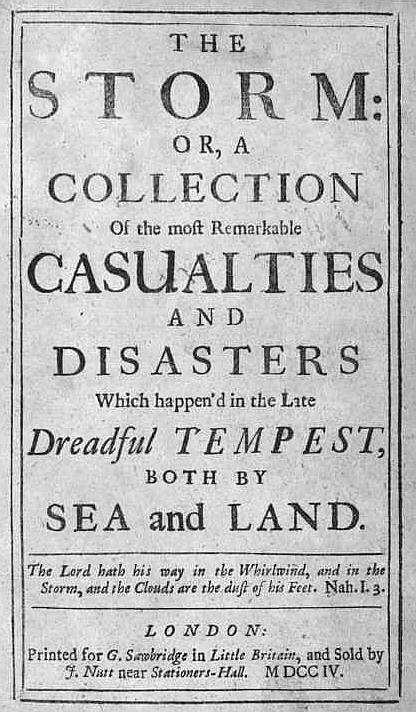
This sort of Weather held all Sabbath-Day and Monday, till on Tuesday Afternoon it encreased again; and all Tuesday Night it blew with such Fury, that many Families were afraid to go to Bed: And had not the former terrible Night harden'd the People to all things less than it self, this Night would have pass'd for a Storm fit to have been noted in our Almanacks. Several Stacks of Chimneys that stood out the great Storm, were blown down in this; several Ships which escap'd in the great Storm, perish'd this Night; and several People who had repair'd their Houses, had them untiled again. Not but that I may allow those Chimneys that fell now might have been disabled before.
At this Rate it held blowing till Wednesday about One a Clock in the Afternoon, which was that Day Seven-night on which it began; so that it might be called one continued Storm from Wednesday Noon to Wednesday Noon: in all which time, there was not one Interval of Time in which a Sailor would not have acknowledged it blew a Storm; and in that time two such terrible Nights as I have describ'd.
And this I particularly noted as to Time, Wednesday, Nov. the 24th was a calm fine Day as at that time of Year shall be seen; till above Four a Clock, when it began to be Cloudy, and the Wind rose of a sudden, and in half an Hours Time it blew a Storm. Wednesday, Dec. the 2d. it was very tempestuous all the Morning; at One a Clock the Wind abated, the Sky clear'd, and by Four a Clock there was not a Breath of Wind.
Thus ended the Greatest and the Longest Storm that ever the World saw. The Effects of this terrible Providence are the Subject of the ensuing Chapter; and I close this with a Pastoral Poem sent us among the Accounts of the Storm from a very ingenious Author, and desir'd to be publish'd in this Account.
A PASTORAL, Occasion'd by the Late Violent Storm
Damon, Melibæus.
DAM.
Walking alone by pleasant Isis sideWhere the two Streams their wanton course divide,
And gently forward in soft Murmurs glide;
Pensive and sad I Melibæus meet,
And thus the melancholy Shepherd greet.
Kind Swain, what Cloud dares overcast your brow,
Bright as the Skies o're happy Nile till now!
Does Chloe prove unkind, or some new Fair?
MEL.
No Damon, mine's a publick, nobler, Care;Such in which you and all the World must share. 10
One Friend may mollifie another's Grief,
But publick Loss admits of no relief.
DAM.
I guess your Cause: O you that use to singOf Beauty's Charms and the Delights of Spring;
Now change your Note, and let your Lute rehearse
The dismal Tale in melancholy Verse.
MEL.
Prepare then, lovely Swain; prepare to hear,The worst Report that ever reach'd your Ear.
My Bower you know, hard by yon shady Grove,
A fit Recess for Damon's pensive Love: 20
As there dissolv'd I in sweet Slumbers lay,
Tir'd with the Toils of the precedent Day,
The blust'ring Winds disturb my kind Repose,
Till frightned with the threatning Blasts, I rose.
But O, what havock did the Day disclose!
Those charming Willows which on Cherwel's banks
Flourish'd, and thriv'd, and grew in evener ranks
Than those which follow'd the Divine Command
Of Orpheus Lyre, or sweet Amphion's Hand,
By hundreds fall, while hardly twenty stand. 30
The stately Oaks which reach'd the azure Sky,
And kiss'd the very Clouds, now prostrate lie.
Long a huge Pine did with the Winds contend;
This way, and that, his reeling Trunk they bend,
Till forc'd at last to yield, with hideous Sound
He falls, and all the Country feels the Wound.
Nor was the God of Winds content with these;
Such humble Victims can't his Wrath appease:
The Rivers swell, not like the happy Nile,
To fatten, dew, and fructifie our Isle:40
But like the Deluge, by great Jove design'd
To drown the Universe, and scourge Mankind.
In vain the frighted Cattel climb so high,
In vain for Refuge to the Hills they fly;
The Waters know no Limits but the Sky.
So now the bleating Flock exchange in vain,
For barren Clifts, their dewy fertil Plain:
In vain, their fatal Destiny to shun,
From Severn's Banks to higher Grounds they run.
Nor has the Navy better Quarter found; 50
There we've receiv'd our worst, our deepest Wound.
The Billows swell, and haughty Neptune raves,
The Winds insulting o're th' impetuous Waves.
Thetis incens'd, rises with angry Frown,
And once more threatens all the World to drown,
And owns no Power, but England's and her own.
Yet the Æolian God dares vent his Rage;
And ev'n the Sovereign of the Seas engage.
What tho' the mighty Charles of Spain's on board,
The Winds obey none but their blust'ring Lord.60
Some Ships were stranded, some by Surges rent,
Down with their Cargo to the bottom went.
Th' absorbent Ocean could desire no more;
So well regal'd he never was before.
The hungry Fish could hardly wait the day,
When the Sun's beams should chase the Storm away,
But quickly seize with greedy Jaws their Prey.
DAM.
So the great Trojan, by the Hand of Fate,And haughty Power of angry Juno's Hate,
While with like aim he cross'd the Seas, was tost,70
From Shore to Shore, from foreign Coast to Coast:
Yet safe at last his mighty Point he gain'd;
In charming promis'd Peace and Splendor reign'd.
MEL.
So may Great Charles, whom equal Glories move,Like the great Dardan Prince successful prove:
Like him, with Honour may he mount the Throne,
And long enjoy a brighter destin'd Crown.
CHAPTER IV
Of the Extent of this Storm, and from what Parts it was suppos'd to come; with some Circumstances as to the Time of it
As all our Histories are full of the Relations of Tempests and Storms which have happened in various Parts of the World, I hope it may not be improper that some of them have been thus observ'd with their remarkable Effects.
But as I have all along insisted, that no Storm since the Universal Deluge was like this, either in its Violence or its Duration, so I must also confirm it as to the particular of its prodigious Extent.
All the Storms and Tempests we have heard of in the World, have been Gusts or Squauls of Wind that have been carried on in their proper Channels, and have spent their Force in a shorter space.
We feel nothing here of the Hurricanes of Barbadoes, the North-Wests of New England and Virginia, the terrible Gusts of the Levant, or the frequent Tempests of the North Cape. When Sir Francis Wheeler's Squadron perish'd at Gibralter, when the City of Straelsond was almost ruin'd by a Storm, England felt it not, nor was the Air here disturb'd with the Motion. Even at home we have had Storms of violent Wind in one part of England which have not been felt in another. And if what I have been told has any truth in it, in St. George's Channel there has frequently blown a Storm at Sea right up and down the Channel, which has been felt on neither Coast, tho it is not above 20 Leagues from the English to the Irish Shore.
Sir William Temple gives us the Particulars of two terrible Storms in Holland while he was there; in one of which the great Cathedral Church at Utrecht was utterly destroy'd: and after that there was a Storm so violent in Holland, that 46 Vessels were cast away at the Texel, and almost all the Men drowned: and yet we felt none of these Storms here.
And for this very reason I have reserv'd an Abridgment of these former Cases to this place; which as they are recited by Sir William Temple, I shall put them down in his own Words, being not capable to mend them, and not vain enough to pretend to it.
'I stay'd only a Night at Antwerp, which pass'd with so great Thunders and Lightnings, that I promis'd my self a very fair Day after it, to go back to Rotterdam in the States Yacht, that still attended me. The Morning prov'd so; but towards Evening the Sky grew foul, and the Sea men presag'd ill Weather, and so resolved to lie at Anchor before Bergen ap Zoom, the Wind being cross and little. When the Night was fallen as black as ever I saw, it soon began to clear up, with the most violent Flashes of Lightning as well as Cracks of Thunder, that I believe have ever been heard in our Age and Climate. This continued all Night; and we felt such a fierce Heat from every great Flash of Lightning, that the Captain apprehended it would fire his Ship. But about 8 the next Morning the Wind changed, and came up with so strong a Gale, that we came to Rotterdam in about 4 Hours, and there found all Mouths full of the Mischiefs and Accidents that the last Night's Tempest had occasioned both among the Boats and the Houses, by the Thunder, Lightning, Hail, or Whirlwinds. But the Day after came Stories to the Hague from all Parts, of such violent Effects as were almost incredible: At Amsterdam they were deplorable, many Trees torn up by the Roots, Ships sunk in the Harbour, and Boats in the Channels; Houses beaten down, and several People were snatch'd from the Ground as they walk'd the Streets, and thrown into the Canals. But all was silenc'd by the Relations from Utrecht, where the Great and Ancient Cathedral was torn in pieces by the Violences of this Storm; and the vast Pillars of Stone that supported it, were wreathed like a twisted Club, having been so strongly compos'd and cimented, as rather to suffer such a Change of Figure than break in pieces, as other Parts of the Fabrick did; hardly any Church in the Town escap'd the Violence of this Storm; and very few Houses without the Marks of it; Nor were the Effects of it less astonishing by the Relations from France and Brussels, where the Damages were infinite, as well from Whirlwinds, Thunder, Lightning, as from Hail-stones of prodigious Bigness. This was in the Year 1674.
'In November, 1675, happen'd a Storm at North-West, with a Spring-tide, so violent, as gave apprehensions of some loss irrecoverable to the Province of Holland, and by several breaches in the great Diques near Enchusen, and others between Amsterdam and Harlem, made way for such Inundations as had not been seen before by any man then alive, and fill'd the Country with many relations of most deplorable Events. But the incredible Diligence and unanimous Endeavours of the People upon such occasions, gave a stop to the Fury of that Element, and made way for recovering next Year all the Lands, though not the People, Cattel, and Houses that had been lost.'
Thus far Sir William Temple.
I am also credibly inform'd that the greatest Storm that ever we had in England before, and which was as universal here as this, did no Damage in Holland or France, comparable to this Tempest: I mean the great Wind in 1661. An Abstract of which, as it was printed in Mirabilis Annis, an unknown, but unquestion'd Author, take as follows, in his own Words.
A dreadful Storm of Wind, accompanied with Thunder, Lightning, Hail and Rain; together with the sad Effects of it in many Parts of the Nation.
Upon the 18th of February, 1661, being Tuesday, very early in the Morning, there began a very great and dreadful Storm of Wind (accompanied with Thunder, Lightning, Hail, and Rain, which in many Places were as salt as Brine) which continued with a strange and unusual Violence till almost Night: the sad Effects whereof throughout the Nation are so many, that a very great Volume is not sufficient to contain the Narrative of them. And indeed some of them are so stupendious and amazing, that the Report of them, though from never so authentick Hands, will scarce gain Credit among any but those that have an affectionate Sense of the unlimited Power of the Almighty, knowing and believing that there is nothing too hard for Him to do.
Some few of which wonderful Effects we shall give a brief Account of, as we have received them from Persons of most unquestionable Credit in the several Parts of the Nation.
In the City of London, and in Covent Garden and other Parts about London and Westminster, five or six Persons were killed outright by the Fall of Houses and Chimneys; especially one Mr. Luke Blith an Attorney, that lived at or near Stamford in the County of Lincoln, was killed that Day by the fall of a Riding-House not far from Pickadilla: and there are some very remarkable Circumstances in this Man's Case, which do make his Death to appear at least like a most eminent Judgment and severe Stroak of the Lord's Hand upon him.
From other Parts likewise we have received certain Information, that divers Persons were killed by the Effects of this great Wind.
At Chiltenham in Gloucestershire, a Maid was killed by the Fall of a Tree, in or near the Church-Yard.
An honest Yeoman likewise of Scaldwel in Northamptonshire, being upon a Ladder to save his Hovel, was blown off, and fell upon a Plough, died outright, and never spoke Word more.
Also at Tewksbury in Gloucestershire, a Man was blown from an House, and broken to Pieces.
At Elsbury likewise in the same County, a Woman was killed by the Fall of Tiles or Bricks from an House.
And not far from the same Place, a Girl was killed by the Fall of a Tree.
Near Northampton, a Man was killed by the Fall of a great Barn.
Near Colchester, a Young-man was killed by the Fall of a Wind-mill.
Not far from Ipswich in Suffolk, a Man was killed by the Fall of a Barn.
And about two Miles from the said Town of Ipswich, a Man was killed by the Fall of a Tree.
At Langton, or near to it, in the County of Leicester, one Mr. Roberts had a Wind-mill blown down, in which were three Men; and by the Fall of it, one of them was killed outright, a second had his Back broken, and the other had his Arm or Leg struck off; and both of them (according to our best Information) are since dead.
Several other Instances there are of the like Nature; but it would be too tedious to mention them: Let these therefore suffice to stir us up to Repentance, lest we likewise perish.
There are also many Effects of this Storm which are of another Nature, whereof we shall give this following brief Account.
The Wind hath very much prejudiced many Churches in several Parts of the Nation.
At Tewksbury in Gloucestershire, it blew down a very fair Window belonging to the Church there, both the Glass, and the Stone-work also; the Doors likewise of that Church were blown open, much of the Lead torn up, and some Part of a fair Pinnacle thrown down.
Also at Red-Marly and Newin, not far from Tewksbury, their Churches are extreamly broken and shatter'd, if not a considerable part of them blown down. The like was done to most, if not all the Publick Meeting-places at Gloucester City. And it is reported, that some Hundreds of Pounds will not suffice to repair the Damage done to the Cathedral at Worcester, especially in that Part that is over the Quire.
The like Fate happen'd to many more of them, as Hereford, and Leighton Beau-desart in Bedfordshire, and Eaton-Soken in the same County; where they had newly erected a very fair Cross of Stone, which the Wind blew down: and, as some of the Inhabitants did observe, that was the first Damage which that Town sustained by the Storm, though afterwards in other respects also they were in the same Condition with their Neighbours. The Steeples also, and other Parts of the Churches of Shenley, Waddon, and Woolston in the County of Bucks, have been very much rent and torn by the Wind. The Spire of Finchinfield Steeple in the County of Essex, was blown down, and it brake through the Body of the Church, and spoil'd many of the Pews; some Hundreds of Pounds will not repair that Loss. But that which is most remarkable of this kind, is, the Fall of that most famous Spire, or Pinnacle of the Tower-Church in Ipswich: it was blown down upon the Body of the Church, and fell reversed, the sharp End of the Shaft striking through the Leads on the South-side of the Church, carried much of the Timber-work down before it into the Alley just behind the Pulpit, and took off one Side of the Sounding-board over the Pulpit: it shattered many Pews: The Weather-Cock, and the Iron upon which it stood, broke off as it fell; but the narrowest Part of the Wood-work, upon which the Fane stood, fell into the Alley, broke quite through a Grave-stone, and ran shoring under two Coffins that had been placed there one on another; that Part of the Spire which was pluck'd up was about three Yards deep in the Earth, and it is believed some Part of it is yet behind in the Ground: some Hundreds of Pounds will not make good the Detriment done to the Church by the Fall of this Pinnacle.
Very great Prejudice has been done to private Houses; many of them blown down, and others extreamly shattered and torn. It is thought that five thousand Pounds will not make good the Repairs at Audley-End House, which belongs to the Earl of Suffolk. A good Part also of the Crown-Office in the Temple is blown down. The Instances of this kind are so many and so obvious, that it would needlesly take up too much time to give the Reader an Account of the Collection of them; only there has been such a wonderful Destruction of Barns, that (looking so much like a Judgment from the Lord, who the last Year took away our Corn, and this our Barns) we cannot but give a short Account of some Part of that Intelligence which hath come to our Hands of that Nature.
A Gentleman, of good Account, in Ipswich, affirms, that in a few Miles riding that Day, there was eleven Barns and Out-houses blown down in the Road within his View; and within a very few Miles of Ipswich round about, above thirty Barns, and many of them with Corn in them, were blown down. At Southold not far from the Place before mentioned, many new Houses and Barns (built since a late Fire that happened there) are blown down; as also a Salt-house is destroyed there: and a thousand Pounds, as it is believed, will not make up that particular Loss.
From Tewksbury it is certified, that an incredible Number of Barns have been blown down in the small Towns and Villages thereabouts. At Twyning, at least eleven Barns are blown down. In Ashchurch Parish seven or eight. At Lee, five. At Norton, a very great Number, three whereof belonging to one Man. The great Abby-Barn also at Tewksbury is blown down.
It is credibly reported, that within a very few Miles Circumference in Worcestershire, about an hundred and forty Barns are blown down. At Finchinfield in Essex, which is but an ordinary Village, about sixteen Barns were blown down. Also at a Town called Wilchamsted in the County of Bedford (a very small Village) fifteen Barns at least are blown down. But especially the Parsonage Barns went to wrack in many Places throughout the Land: In a few Miles Compass in Bedfordshire, and so in Northamptonshire, and other Places, eight, ten, and twelve are blown down; and at Yielding Parsonage in the County of Bedford (out of which was thrust by Oppression and Violence the late Incumbent) all the Barns belonging to it are down. The Instances also of this kind are innumerable, which we shall therefore forbear to make further mention of.
We have also a large Account of the blowing down of a very great and considerable Number of Fruit-Trees, and other Trees in several Parts; we shall only pick out two or three Passages which are the most remarkable. In the Counties of Gloucester, Hereford, and Worcester, several Persons have lost whole Orchards of Fruit-Trees; and many particular Mens Loss hath amounted to the Value of forty or fifty Pounds at the least, meerly by Destruction of their Fruit-Trees: and so in other Parts of England proportionably the like Damage hath been sustained in this Respect. And as for other Trees, there has been a great Destruction made of them in many Places, by this Storm. Several were blown down at Hampton-Court. And three thousand brave Oaks at least, but in one principal Part of the Forest of Dean, belonging to his Majesty. In a little Grove at Ipswich, belonging to the Lord of Hereford (which together with the Spire of the Steeple before-mentioned, were the most considerable Ornaments of that Town) are blown down at least two hundred goodly Trees, one of which was an Ash, which had ten Load of Wood upon it: there are now few Trees left there.
In Bramton Bryan Park in the County of Hereford, belonging to Sir Edward Harly, one of the late Knights of the Bath, above thirteen hundred Trees are blown down; and above six hundred in Hopton Park not far from it: and thus it is proportionably in most Places where this Storm was felt. And the Truth is, the Damage which the People of this Nation have sustained upon all Accounts by this Storm, is not easily to be valued: some sober and discreet People, who have endeavoured to compute the Loss of the several Counties one with another, by the Destruction of Houses and Barns, the blowing away of Hovels and Ricks of Corn, the falling of Trees, &c. do believe it can come to little less than two Millions of Money.
There are yet behind many Particulars of a distinct Nature from those that have been spoken of; some whereof are very wonderful, and call for a very serious Observation of them.
In the Cities of London and Westminster, especially on the Bridge and near Wallingford-house, several Persons were blown down one on the Top of another.
In Hertfordshire, a Man was taken up, carried a Pole in Length, and blown over a very high Hedge; and the like in other Places.
The Water in the River of Thames, and other Places, was in a very strange manner blown up into the Air: Yea, in the new Pond in James's Park, the Fish, to the Number of at least two Hundred, where blown out and lay by the Bank-side, whereof many were Eye-witnesses.
At Moreclack in Surry, the Birds, as they attempted to fly, were beaten down to the Ground by the Violence of the Wind.
At Epping in the County of Essex, a very great Oak was blown down, which of it self was raised again, and doth grow firmly at this Day.
At Taunton, a great Tree was blown down, the upper Part whereof rested upon a Brick or Stone-wall, and after a little time, by the force of the Wind, the lower part of the Tree was blown quite over the Wall.
In the City of Hereford, several persons were, by the Violence of the Wind, borne up from the Ground; one Man (as it is credibly reported) at least six Yards.
The great Fane at Whitehall was blown down; and one of the four which were upon the white Tower, and two more of them strangely bent; which are to be seen at this Day, to the Admiration of all that behold them.
The several Triumphant Arches in the City of London were much shattered and torn; That in Leaden-hall-Street lost the King's Arms, and many other rare Pieces that were affixed to it; That in Cheapside, which represented the Church, suffered very much by the Fury of the Storm; and a great Part of that in Fleet Street (which represented Plenty) was blown down: but, blessed be God, none as we hear of were either killed or hurt by the Fall of it.
The Wind was so strong, that it blew down several Carts loaded with Hay in the Road between Barnet and London; and in other Roads leading to the City of London.
Norwich Coach, with four or six Horses, was not able to come towards London, but stayed by the way till the Storm was somewhat abated.
It is also credibly reported, That all, or some of the Heads which were set up upon Westminster-Hall, were that Day blown down.
There was a very dreadful Lightning which did at first accompany the Storm, and by it some of his Majesty's Houshold conceive that the Fire which happened at Whitehall that Morning, was kindled; as also that at Greenwich, by which (as we are informed) seven or eight Houses were burnt down.
Thus far the Author of Mirabilis Annis.
'Tis very observable, that this Storm blew from the same Quarter as the last, and that they had less of it Northward than here; in which they were much alike.
Now as these Storms were perhaps very furious in some Places, yet they neither came up to the Violence of this, nor any way to be compar'd for the Extent, and when ruinous in one County, were hardly heard of in the next.
But this terrible Night shook all Europe; and how much farther it extended, he only knows who has his way in the Whirlwind, and in the Storm, and the Clouds are the Dust of his Feet.
As this Storm was first felt from the West, some have conjectur'd that the first Generation or rather Collection of Materials, was from the Continent of America, possibly from that part of Florida and Virginia where, if we respect natural Causes, the Confluence of Vapours rais'd by the Sun from the vast and unknown Lakes and Inland Seas of Water, which as some relate are incredibly large as well as numerous, might afford sufficient Matter for the Exhalation; and where time adding to the Preparation, God, who has generally confin'd his Providence to the Chain of natural Causes, might muster together those Troops of Combustion till they made a sufficient Army duly proportion'd to the Expedition design'd.
I am the rather inclin'd to this Opinion, because we are told, they felt upon that Coast an unusual Tempest a few Days before the fatal 27th of November.
I confess, I have never studied the Motion of the Clouds so nicely, as to calculate how long time this Army of Terror might take up in its furious March; possibly the Velocity of its Motion might not be so great at its first setting out as it was afterward, as a Horse that is to run a Race does not immediately put himself into the height of his Speed: and tho' it may be true, that by the length of the way the force of the Wind spends it self, and so by degrees ceases as the Vapour finds more room for Dilation; besides, yet we may suppose a Conjunction of some confederate Matter which might fall in with it by the way, or which meeting it at its Arrival here, might join Forces in executing the Commission receiv'd from above, all natural Causes being allow'd a Subserviency to the Direction of the great supream Cause; yet where the vast Collection of Matter had its first Motion, as it did not all take Motion in one and the same moment, so when all the Parts had felt the Influence, as they advanc'd and press'd those before them, the Violence must increase in proportion: and thus we may conceive that the Motion might not have arriv'd at its Meridian Violence till it reach'd our Island; and even then it blew some Days with more than common fury, yet much less than that last Night of its force; and even that Night the Violence was not at its extremity till about an hour before Sun-rise, and then it continued declining, tho' it blew a full Storm for four Days after it.
Thus Providence, by whose special Direction the Quantity and Conduct of this Judgment was manag'd, seem'd to proportion things so, as that by the course of things the proportion of Matter being suited to Distance of Place, the Motion shou'd arrive at its full Force just at the Place where its Execution was to begin.
As then our Island was the first, this way, to receive the Impressions of the violent Motion, it had the terriblest Effects here; and continuing its steady Course, we find it carried a true Line clear over the Continent of Europe, travers'd England, France, Germany, the Baltick Sea, and passing the Northern Continent of Sweedland, Finland, Muscovy, and part of Tartary, must at last lose it self in the vast Northern Ocean, where Man never came, and Ship never sail'd; and its Violence cou'd have no effect, but upon the vast Mountains of Ice and the huge Drifts of Snow, in which Abyss of Moisture and Cold it is very probable the Force of it was check'd, and the World restor'd to Calmness and Quiet: and in this Circle of Fury it might find its End not far off from where it had its Beginning, the Fierceness of the Motion perhaps not arriving to a Period, till having pass'd the Pole, it reached again the Northern Parts of America.
The Effects of this impetuous Course, are the proper Subjects of this Book; and what they might be before our Island felt its Fury, who can tell? Those unhappy Wretches who had the misfortune to meet it in its first Approach, can tell us little, having been hurried by its irresistible Force directly into Eternity: how many they are, we cannot pretend to give an Account; we are told of about seventeen Ships, which having been out at Sea are never heard of: which is the common way of Discourse of Ships founder'd in the Ocean: and indeed all we can say of them is, the fearful Exit they have made among the Mountains of Waters, can only be duly reflected on by those who have seen those Wonders of God in the Deep.
Yet I cannot omit here to observe, That this Loss was in all probability much less than it would otherwise have been; because the Winds having blown with very great Fury, at the same Point, for near fourteen Days before the Violence grew to its more uncommon height, all those Ships which were newly gone to Sea were forc'd back, of which some were driven into Plymouth and Falmouth who had been above a hundred and fifty Leagues at Sea; others, which had been farther, took Sanctuary in Ireland.
On the other hand, All those Ships which were homeward bound, and were within 500 Leagues of the English Shore, had been hurried so furiously on afore it (as the Seamen say) that they had reach'd their Port before the Extremity of the Storm came on; so that the Sea was as it were swept clean of all Shipping, those which were coming home were blown home before their time; those that had attempted to put to Sea, were driven back again in spight of all their Skill and Courage: for the Wind had blown so very hard, directly into the Channel, that there was no possibility of their keeping the Sea whose Course was not right afore the Wind.
On the other hand, these two Circumstances had fill'd all our Ports with unusual Fleets of Ships, either just come home or outward-bound, and consequently the Loss among them was very terrible; and the Havock it made among them, tho' it was not so much as every body expected, was such as no Age or Circumstance can ever parallel, and we hope will never feel again.
Nay, so high the Winds blew even before that we call the Storm, that had not that intolerable Tempest follow'd so soon after, we should have counted those Winds extraordinary high: and any one may judge of the Truth of this from these few Particulars; That the Russia Fleet, compos'd of near a hundred Sail, which happen'd to be then upon the Coast, was absolutely dispers'd and scatter'd, some got into Newcastle, some into Hull, and some into Yarmouth Roads; two founder'd in the Sea; one or two more run a-shore, and were lost; and the Reserve Frigat, their Convoy, founder'd in Yarmouth Roads, all her Men being lost, and no Boat from the Shore durst go off to relieve her, tho' it was in the Day-time, but all her Men perished.
In the same previous Storms the—Man of War was lost off of Harwich; but by the help of smaller Vessels most of her Men were sav'd.
And so high the Winds blew for near a Fortnight, that no Ship stirr'd out of Harbour; and all the Vessels, great or small, that were out at Sea, made for some Port or other for shelter.
In this juncture of time it happen'd, that together with the Russia Fleet, a great Fleet of Laden Colliers, near 400 Sail, were just put out of the River Tine: and these being generally deep and unweildy Ships, met with hard measure, tho' not so fatal to them as was expected: such of them as could run in for Humber, where a great many were lost afterwards, as I shall relate in its course; some got shelter under the high Lands of Cromer and the Northern Shores of the County of Norfolk, and the greater number reach'd into Yarmouth Roads.
So that when the Great Storm came, our Ports round the Sea-Coast of England were exceeding full of Ships of all sorts: a brief account whereof take as follows.
At Grimsby, Hull, and the other Roads of the Humber, lay about 80 Sail, great and small, of which about 50 were Colliers, and part of the Russia Fleet as aforesaid.
In Yarmouth Roads there rode at least 400 Sail, being most of them Laden Colliers, Russia Men, and Coasters from Lynn and Hull.
In the River of Thames, at the Nore, lay about 12 Sail of the Queen's hir'd Ships and Store-ships, and only two Men of War.
Sir Cloudsly Shovel was just arriv'd from the Mediterranean with the Royal Navy: Part of them lay at St. Hellens, part in the Downs, and with 12 of the biggest Ships he was coming round the Foreland to bring them into Chatham; and when the Great Storm began was at an Anchor at the Gunfleet, from whence the Association was driven off from Sea as far as the Coast of Norway: What became of the rest, I refer to a Chapter by it self.
At Gravesend there rode five East India Men, and about 30 Sail of other Merchant-men, all outward bound.
In the Downs 160 Sail of Merchant Ships outward bound, besides that part of the Fleet which came in with Sir Cloudsly Shovel, which consisted of about 18 Men of War, with Tenders and Victuallers.
At Portsmouth and Cowes there lay three Fleets; first, a Fleet of Transports and Tenders, who with Admiral Dilks brought the Forces from Ireland that were to accompany the King of Spain to Lisbon; secondly, a great Fleet of Victuallers, Tenders, Store-ships, and Transports, which lay ready for the same Voyage, together with about 40 Merchant-ships, who lay for the benefit of their Convoy; and the third Article was, the Remainder of the Grand Fleet which came in with Sir Cloudsly Shovel; in all almost 300 Sail, great and small.
In Plymouth Sound, Falmouth and Milford Havens, were particularly several small Fleets of Merchant-ships, driven in for Shelter and Harbour from the Storm, most homeward bound from the Islands and Colonies of America.
The Virginia Fleet, Barbadoes Fleet, and some East India Men, lay scatter'd in all our Ports, and in Kinsale in Ireland there lay near 80 Sail, homeward bound and richly laden.
At Bristol about 20 Sail of home-bound West India Men, not yet unladen.
In Holland, the Fleet of Transports for Lisbon waited for the King of Spain, and several English Men of War lay at Helvoet Sluice; the Dutch Fleet from the Texel lay off of Cadsandt, with their Forces on Board, under the Admiral Callenberge. Both these Fleets made 180 Sail.
I think I may very safely affirm, That hardly in the Memory of the oldest Man living, was a juncture of Time when an Accident of this nature could have happen'd, that so much Shipping, laden out and home, ever was in Port at one time.
No Man will wonder that the Damages to this Nation were so great, if they consider these unhappy Circumstances: it shou'd rather be wonder'd at, that we have no more Disasters to account to Posterity, but that the Navigation of this Country came off so well.
And therefore some People have excus'd the Extravagancies of the Paris Gazetteer, who affirm'd in Print, that there was 30000 Sea-men lost in the several Ports of England, and 300 Sail of Ships; which they say was a probable Conjecture; and that considering the multitude of Shipping, the Openness of the Roads in the Downs, Yarmouth, and the Nore, and the prodigious Fury of the Wind, any Man would have guess'd the same as he.
'Tis certain, It is a thing wonderful to consider, that especially in the Downs and Yarmouth Roads any thing shou'd be safe: all Men that know how wild a Road the first is, and what Crowds of Ships there lay in the last; how almost every thing quitted the Road, and neither Anchor nor Cable would hold; must wonder what Shift or what Course the Mariners could direct themselves to for Safety.
Some which had not a Mast standing, nor an Anchor or Cable left them, went out to Sea wherever the Winds drove them; and lying like a Trough in the Water, wallow'd about till the Winds abated; and after were driven, some into one Port, some into another, as Providence guided them.
In short, Horror and Confusion seiz'd upon all, whether on Shore or at Sea: No Pen can describe it, no Tongue can express it, no Thought conceive it, unless some of those who were in the Extremity of it; and who, being touch'd with a due sense of the sparing Mercy of their Maker, retain the deep Impressions of his Goodness upon their Minds, tho' the Danger be past: and of those I doubt the Number is but few.
OF THE EFFECTS OF THE STORM
The particular dreadful Effects of this Tempest, are the Subject of the ensuing Part of this History: And tho' the Reader is not to expect that all the Particulars can be put into this Account, and perhaps many very remarkable Passages may never come to our Knowledge; yet as we have endeavour'd to furnish our selves with the most authentick Accounts we could from all Parts of the Nation, and a great many worthy Gentlemen have contributed their Assistance in various, and some very exact Relations and curious Remarks; so we pretend, not to be meanly furnish'd for this Work.
Some Gentlemen, whose Accounts are but of common and trivial Damages, we hope will not take it ill from the Author, if they are not inserted at large; for that we are willing to put in nothing here common with other Accidents of like nature; or which may not be worthy of a History and a Historian to record them; nothing but, what may serve to assist in convincing Posterity that this was the most violent Tempest the World ever saw.
From hence 'twill follow, that those Towns who only had their Houses until'd, their Barns and Hovels levell'd with the Ground, and the like, will find very little notice taken of them in this Account; because if these were to be the Subject of a History, I presume it must be equally voluminous with Fox, Grimston, Holinshead or Stow.
Nor shall I often trouble the Reader with the Multitude or Magnitude of Trees blown down, whole Parks ruin'd, fine Walks defac'd, and Orchards laid flat, and the like: and tho' I had, my self, the Curiosity to count the Number of Trees, in a Circuit I rode, over most part of Kent, in which being tired with the Number, I left off reckoning after I had gone on to 17000; and tho' I have great reason to believe I did not observe one half of the Quantity; yet in some Parts of England, as in Devonshire especially, and the Counties of Worcester, Gloucester, and Hereford, which are full of very large Orchards of Fruit-Trees, they had much more mischief.
In the Pursuit of this Work, I shall divide it into the following Chapters or Sections, that I may put it into as good Order as possible.
| 1. | Of the Damage | in the City of London, &c. |
| 2. | in the Counties. | |
| 3. | } On the Water { | in the Royal Navy. |
| 4. | to Shipping in general. | |
| 5. | by Earthquake. | |
| 6. | by High Tides. | |
| 7. | Remarkable Providences and Deliverances. | |
| 8. | Hardned and blasphemous Contemners both of the Storm and its Effects. | |
| 9. | Some Calculations of Damage sustain'd. | |
| 10. | The Conclusion. | |
We had design'd a Chapter for the Damages abroad, and have been at no small Charge to procure the Particulars from foreign Parts; which are now doing in a very authentick manner: but as the World has been long expecting this Work, and several Gentlemen who were not a little contributing to the Information of the Author, being unwilling to stay any longer for the Account, it was resolved to put it into the Press without any farther Delay: and if the foreign Accounts can be obtain'd in time, they shall be a Supplement to the Work; if not, some other Method shall be found out to make them publick.
I. Of the Damages in the City of London, and Parts adjacent
Indeed the City was a strange Spectacle, the Morning after the Storm, as soon as the People could put their Heads out of Doors: though I believe, every Body expected the Destruction was bad enough; yet I question very much, if any Body believed the Hundredth Part of what they saw.
The Streets lay so covered with Tiles and Slates, from the Tops of the Houses, especially in the Out-parts, that the Quantity is incredible: and the Houses were so universally stript, that all the Tiles in Fifty Miles round would be able to repair but a small Part of it.
Something may be guest at on this Head, from the sudden Rise of the Price of Tiles; which rise from 21 s. per Thousand to 6 l. for plain Tiles; and from 50 s. per Thousand for Pantiles, to 10 l. and Bricklayers Labour to 5 s. per Day: And tho' after the first Hurry the Prices fell again, it was not that the Quantity was supply'd; but because,
1st, The Charge was so extravagant, that an universal Neglect of themselves, appear'd both in Landlord and Tenant; an incredible Number of Houses remain'd all the Winter uncovered, and expos'd to all the Inconveniences of Wet and Cold; and are so even at the Writing of this Chapter.
2. Those People who found it absolutely necessary to cover their Houses, but were unwilling to go to the extravagant Price of Tiles; chang'd their Covering to that of Wood, as a present Expedient, till the Season for making of Tiles should come on; and the first Hurry being over, the Prices abate: and 'tis on this Score, that we see, to this Day, whole Ranks of Buildings, as in Christ Church Hospital, the Temple, Asks-Hospital, Old-street, Hogsden-Squares, and infinite other Places, covered entirely with Deal Boards; and are like to continue so, perhaps a Year or two longer, for Want of Tiles.
These two Reasons reduc'd the Tile-Merchants to sell at a more moderate Price: But 'tis not an irrational Suggestion, that all the Tiles which shall be made this whole Summer, will not repair the Damage in the covering of Houses within the Circumference of the City, and Ten Miles round.
The next Article in our Street Damage was, the Fall of Chimneys; and as the Chimneys in the City Buildings are built in large Stacks, the Houses being so high, the Fall of them had the more Power, by their own Weight, to demolish the Houses they fell upon.
'Tis not possible to give a distinct Account of the Number, or particular Stacks of Chimneys, which fell in this fatal Night; but the Reader may guess by this Particular, that in Cambray-House, commonly so called, a great House near Islington, belonging to the Family of the Comptons, Earls of Northampton, but now let out into Tenements; the Collector of these Remarks counted Eleven or Thirteen Stacks of Chimneys, either wholly thrown in, or the greatest Parts of them at least, what was expos'd to the Wind, blown off. I have heard Persons, who pretended to observe the Desolation of that terrible Night very nicely; and who, by what they had seen and enquired into, thought themselves capable of making some Calculations, affirm, They could give an Account of above Two Thousand Stacks of Chimneys blown down in and about London; besides Gable Ends of Houses, some whole Roofs, and Sixteen or Twenty whole Houses in the Out-Parts.
Under the Disaster of this Article, it seems most proper to place the Loss of the Peoples Lives, who fell in this Calamity; since most of those, who had the Misfortune to be killed, were buried, or beaten to Pieces with the Rubbish of the several Stacks of Chimneys that fell.
Of these, our Weekly Bills of Mortality gave us an Account of Twenty One; besides such as were drown'd in the River, and never found: and besides above Two Hundred People very much wounded and maim'd.
One Woman was kill'd by the Fall of a Chimney in or near the Palace of St. James's, and a Stack of Chimneys falling in the new unfinish'd Building there, and carried away a Piece of the Coin of the House.
Nine Souldiers were hurt, with the Fall of the Roof of the Guard-house at Whitehall, but none of them died.
A Distiller in Duke-Street, with his Wife, and Maid-servant, were all buried in the Rubbish of a Stack of Chimneys, which forced all the Floors, and broke down to the Bottom of the House; the Wife was taken out alive, though very much bruised, but her Husband and the Maid lost their Lives.
One Mr. Dyer, a Plaisterer in Fetter-Lane, finding the Danger he was in by the shaking of the House, jumpt out of Bed to save himself; and had, in all Probability, Time enough to have got out of the House, but staying to strike a Light, a Stack of Chimneys fell in upon him, kill'd him, and wounded his Wife.
Two Boys at one Mr. Purefoy's, in Cross-Street Hatton-Garden, were both kill'd, and buried in the Rubbish of a Stack of Chimneys; and a third very much wounded.
A Woman in Jewin-Street, and Two Persons more near Aldersgate-Street, were kill'd; the first, as it is reported, by venturing to run out of the House into the Street; and the other Two by the Fall of a House.
In Threadneedle-Street, one Mr. Simpson, a Scrivener being in Bed and fast a-sleep, heard nothing of the Storm; but the rest of the Family being more sensible of Danger, some of them went up, and wak'd him; and telling him their own Apprehensions, press'd him to rise; but he too fatally sleepy, and consequently unconcern'd at the Danger, told them, he did not apprehend any Thing; and so, notwithstanding all their Persuasions, could not be prevailed with to rise: they had not been gone many Minutes out of his Chamber, before the Chimneys fell in, broke through the Roof over him, and kill'd him in his Bed.
A Carpenter in White-Cross-Street was kill'd almost in the same Manner, by a Stack of Chimneys of the Swan Tavern, which fell into his House; it was reported, That his Wife earnestly desir'd him not to go to Bed; and had prevail'd upon him to sit up till near two a Clock, but then finding himself very heavy, he would go to Bed against all his Wife's Intreaties; after which she wak'd him, and desir'd him to rise, which he refus'd, being something angry for being disturb'd; and going to sleep again, was kill'd in his Bed: and his Wife, who would not go to Bed, escap'd.
In this Manner, our Weekly Bills gave us an Account of Twenty One Persons kill'd in the City of London, and Parts adjacent.
Some of our printed Accounts give us larger and plainer Accounts of the Loss of Lives, than I will venture to affirm for Truth; as of several Houses near Moor-Fields levell'd with the Ground: Fourteen People drowned in a Wherry going to Gravesend, and Five in a Wherry from Chelsey. Not that it is not very probable to be true; but as I resolve not to hand any thing to Posterity, but what comes very well attested, I omit such Relations as I have not extraordinary Assurance as to the Fact.
The Fall of Brick-Walls, by the Fury of this Tempest, in and about London, would make a little Book of it self; and as this affects the Out-Parts chiefly, where the Gardens and Yards are wall'd in, so few such have escap'd; at St. James's a considerable part of the Garden Wall; at Greenwich Park there are several pieces of the Wall down for an Hundred Rods in a Place; and some much more, at Battersey, Chelsey, Putney, at Clapham, at Deptford, at Hackney, Islington, Hogsden, Wood's Close by St. John's Street, and on every side the City, the Walls of the Gardens have generally felt the Shock, and lie flat on the Ground twenty, thirty Rod of walling in a Place.
The publick Edifices of the City come next under our Consideration; and these have had their Share in the Fury of this terrible Night.
A part of her Majesty's Palace, as is before observ'd, with a Stack of Chimneys in the Centre of the new Buildings, then not quite finished, fell with such a terrible Noise as very much alarm'd the whole Houshold.
The Roof of the Guard-house at Whitehall, as is also observ'd before, was quite blown off; and the great Vane, or Weather-Cock at Whitehall blown down.
The Lead, on the Tops of the Churches and other Buildings, was in many Places roll'd up like a Roll of Parchment, and blown in some Places clear off from the Buildings; as at Westminster Abby, St. Andrews Holbourn, Christ-Church Hospital, and abundance of other Places.
Two of the new built Turrets, on the Top of St. Mary Aldermary Church, were blown off, whereof One fell upon the Roof of the Church; of Eight Pinnacles on the Top of St. Albans Woodstreet, Five of them were blown down; Part of One of the Spires of St. Mary Overies blown off; Four Pinnacles on the Steeple of St. Michael Crooked Lane blown quite off: The Vanes and Spindles of the Weather-Cocks, in many places, bent quite down; as on St. Michael Cornhil, St. Sepulchres, the Tower, and divers other Places.
It was very remarkable, that the Bridge over the Thames received but little Damage, and not in Proportion to what in common Reason might be expected; since the Buildings there stand high, and are not sheltered, as they are in the Streets, one by another.
If I may be allow'd to give this Philosophical Account of it, I hope it may not be absurd; that the Indraft of the Arches underneath the Houses giving Vent to the Air, it past there with a more than common Current; and consequently relieved the Buildings, by diverting the Force of the Storm: I ask Pardon of the ingenious Reader for this Opinion, if it be not regular, and only present it to the World for Want of a better; if those better furnished that Way will supply us with a truer Account, I shall withdraw mine, and submit to theirs. The Fact however is certain, that the Houses on the Bridge did not suffer in Proportion to the other Places; though all must allow, they do not seem to be stronger built, than other Streets of the same sort.
Another Observation I cannot but make; to which, as I have Hundreds of Instances, so I have many more Witnesses to the Truth of Fact, and the uncommon Experiment has made it the more observ'd.
The Wind blew, during the whole Storm, between the Points of S.W. and N.W., not that I mean it blew at all these Points, but I take a Latitude of Eight Points to avoid Exceptions, and to confirm my Argument; since what I am insisting upon, could not be a natural Cause from the Winds blowing in any of those particular Points.
If a Building stood North and South, it must be a Consequence that the East-side Slope of the Roof must be the Lee-side, lie out of the Wind, be weather'd by the Ridge, and consequently receive no Damage in a direct Line.
But against this rational way of arguing, we are convinced by Demonstration and Experiment, after which Argument must be silent. It was not in one Place or Two, but in many Places; that where a Building stood ranging North and South, the Sides or Slopes of the Roof to the East and the West, the East-side of the Roof would be stript and untiled by the Violence of the Wind; and the West Side, which lay open to the Wind, be sound and untouch'd.
This, I conceive, must happen either where the Building had some open Part, as Windows or Doors to receive the Wind in the Inside, which being pusht forward by the succeeding Particles of the Air, must force its Way forward, and so lift off the Tiling on the Leeward side of the Building; or it must happen from the Position of such Building near some other higher Place or Building, where the Wind being repuls'd, must be forc'd back again in Eddies; and consequently taking the Tiles from the lower Side of the Roof, rip them up with the more Ease.
However it was, it appear'd in many Places, the Windward Side of the Roof would be whole, and the Leeward Side, or the Side from the Wind, be untiled; in other Places, a high Building next the Wind has been not much hurt, and a lower Building on the Leeward Side of the high One clean ript, and hardly a Tile left upon it: this is plain in the Building of Christ Church Hospital in London, where the Building on the West and South Side of the Cloyster was at least Twenty Five Foot higher than the East Side, and yet the Roof of the lower Side on the East was quite untiled by the Storm; and remains at the Writing of This covered with Deal Boards above an Hundred Foot in Length.
The blowing down of Trees may come in for another Article in this Part; of which, in Proportion to the Quantity, here was as much as in any Part of England: Some printed Accounts tell us of Seventy Trees in Moorfields blown down, which may be true; but that some of them were Three Yards about, as is affirmed by the Authors, I cannot allow: above a Hundred Elms in St. James's Park, some whereof were of such Growth, as they tell us they were planted by Cardinal Woolsey; whether that Part of it be true or not, is little to the Matter, but only to imply that they were very great Trees: about Baums, commonly call'd Whitmore house, there were above Two Hundred Trees blown down, and some of them of extraordinary Size broken off in the middle.
And 'twas observ'd, that in the Morning after the Storm was abated, it blew so hard, the Women, who usually go for Milk to the Cow-keepers in the Villages round the City, were not able to go along with their Pails on their Heads; and One, that was more hardy than the rest, was blown away by the Fury of the Storm, and forced into a Pond, but by strugling hard got out, and avoided being drowned; and some that ventured out with Milk the Evening after, had their Pails and Milk blown off from their Heads.
'Tis impossible to enumerate the Particulars of the Damage suffered, and of the Accidents which happened under these several Heads, in and about the City of London: The Houses looked like Skeletons, and an universal Air of Horror seem'd to sit on the Countenances of the People; all Business seem'd to be laid aside for the Time, and People were generally intent upon getting Help to repair their Habitations.
It pleased God so to direct things, that there fell no Rain in any considerable Quantity, except what fell the same Night or the ensuing Day, for near Three Weeks after the Storm, though it was a Time of the Year that is generally dripping. Had a wet Rainy Season followed the Storm, the Damage which would have been suffered in and about this City to Houshold Goods, Furniture and Merchandise, would have been incredible, and might have equall'd all the the rest of the Calamity: but the Weather prov'd fair and temperate for near a Month after the Storm, which gave People a great deal of Leisure in providing themselves Shelter, and fortifying their Houses against the Accidents of Weather by Deal Boards, old Tiles, Pieces of Sail-Cloth, Tarpaulin, and the like.
II. Of the Damages in the Country
As the Author of this was an Eye-witness and Sharer of the Particulars in the former Chapter; so, to furnish the Reader with Accounts as authentick, and which he has as much cause to depend upon as if he had seen them, he has the several Particulars following from like Eye-witnesses; and that in such a manner, as I think their Testimony is not to be question'd, most of the Gentlemen being of Piety and Reputation.
And as a Publication was made to desire all Persons who were willing to contribute to the forwarding this Work, and to transmit the Memory of so signal a Judgment to Posterity, that they would be pleas'd to send up such authentick Accounts of the Mischiefs, Damages, and Disasters in their respective Counties that the World might rely on; it cannot, without a great breach of Charity, be suppos'd that Men mov'd by such Principles, without any private Interest or Advantage, would forge any thing to impose upon the World, and abuse Mankind in Ages to come.
Interest, Parties, Strife, Faction, and particular Malice, with all the scurvy Circumstances attending such things, may prompt Men to strain a Tale beyond its real Extent; but, that Men shou'd invent a Story to amuse Posterity, in a case where they have no manner of Motive, where the only Design is to preserve the Remembrance of Divine Vengeance, and put our Children in mind of God's Judgments upon their sinful Fathers, this would be telling a Lye for God's sake, and doing Evil for the sake of it self, which is a step beyond the Devil.
Besides, as most of our Relators have not only given us their Names, and sign'd the Accounts they have sent, but have also given us Leave to hand their Names down to Posterity with the Record of the Relation they give, we would hope no Man will be so uncharitable to believe that Men would be forward to set their Names to a voluntary Untruth, and have themselves recorded to Posterity for having, without Motion, Hope, Reward, or any other reason, impos'd a Falsity upon the World, and dishonour'd our Relation with the useless Banter of an Untruth.
We cannot therefore but think, that as the Author believes himself sufficiently back'd by the Authority of the Vouchers he presents, so after what has been here premis'd, no Man will have any room to suspect us of Forgery.
The ensuing Relation therefore, as to Damages in the Country, shall consist chiefly of Letters from the respective Places where such things have happen'd; only that as all our Letters are not concise enough to be printed as they are, where it is otherwise the Letter is digested into a Relation only; in which the Reader is assur'd we have always kept close to the matter of fact.
And first, I shall present such Accounts as are entire, and related by Men of Letters, principally by the Clergy; which shall be given you in their own Words.
The first is from Stowmarket in Suffolk, where, by the Violence of the Storm, the finest Spire in that County, and but new built, viz. within thirty Years, was overthrown, and fell upon the Church. The Letter is sign'd by the reverend Minister of the Place, and vouched by two of the principal Inhabitants, as follows.
SIR,
Having seen an Advertisement of a Design to perpetuate the Remembrance of the late dreadful Storm, by publishing a Collection of all the remarkable Accidents occasion'd by it, and supposing the Damage done to our Church to be none of the least, we were willing to contribute something to your Design, by sending you an Account thereof as follows.
We had formerly a Spire of Timber covered with Lead, of the height of 77 Foot; which being in danger of falling, was taken down: and in the Year 1674, with the Addition of 10 Loads of new Timber, 21 thousand and 8 hundred weight of Lead, a new one was erected, 100 Foot high from the Steeple, with a Gallery at the height of 40 Foot all open, wherein hung a Clock-Bell of between 2 and 3 hundred Weight. The Spire stood but 8 Yards above the Roof of the Church; and yet by the extreme Violence of the Storm, a little before 6 in the Morning the Spire was thrown down; and carrying with it all the Battlements on the East side, it fell upon the Church at the distance of 28 Foot; for so much is the distance between the Steeple and the first Breach, which is on the North-side of the middle Roof, of the length of 17 Foot, where it brake down 9 Spars clean, each 23 Foot long, and severally supported with very strong Braces. The Spire inclining to the North, fell cross the middle Wall, and broke off at the Gallery, the lower part falling in at the aforesaid Breach, and the upper upon the North Isle, which is 24 Foot wide, with a flat Roof lately built, all new and very strong: It carried all before it from side to side, making a Breach 37 Foot long, breaking in sunder two large Beams that went a-cross, which were 12 Inches broad and 15 deep, besides several other smaller. Besides these two Breaches, there is a great deal of Damage done by the Fall of great Stones upon other parts of the Roof, as well as by the Wind's riving up the Lead, and a third part of the Pews broken all in pieces, every thing falling into the Church, except the Weather-cock, which was found in the Church-yard, at a considerable distance, in the great Path that goes cross by the East End of the Church. It will cost above 400 l. to make all good as it was before. There were 3 single Chimneys blown down, and a Stack of 4 more together, all about the same time; and some others so shaken, that they were forc'd to be pull'd down; but, we thank God, no body hurt, tho' one Bed was broken in pieces that was very oft lain in: no body lay in it that Night. Most Houses suffered something in their Tiling, and generally all round the Country, there is incredible Damage done to Churches, Houses, and Barns.
Samuel Farr, Vicar.
John Gaudy.
William Garrard.
From Oxfordshire we have an Account very authentick, and yet unaccountably strange: but the reverend Author of the Story being a Gentleman whose Credit we cannot dispute, in acknowledgment to his Civility, and for the Advantage of our true Design, we give his Letter also verbatim.
Meeting with an Advertisement of yours in the Gazette of Monday last, I very much approved of the Design, thinking it might be a great Motive towards making People, when they hear the Fate of others, return Thanks to Almighty God for his Providence in preserving them. I accordingly was resolved to send you all I knew. The Place where I have for some time lived is Besselsleigh, in Barkshire, about four Miles S.W. of Oxon. The Wind began with us much about One of the Clock in the Morning, and did not do much harm, only in untiling Houses, blowing down a Chimney or two, without any Person hurt, and a few Trees: but what was the only thing that was strange, and to be observed, was a very tall Elm, which was found the next Morning standing, but perfectly twisted round; the Root a little loosen'd, but not torn up. But what happened the Afternoon preceding, is abundantly more surprizing, and is indeed the Intent of this Letter.
On Friday the 26th of November, in the Afternoon, about Four of the Clock, a Country Fellow came running to me in a great Fright, and very earnestly entreated me to go and see a Pillar, as he call'd it, in the Air, in a Field hard by. I went with the Fellow; and when I came, found it to be a Spout marching directly with the Wind: and I can think of nothing I can compare it to better than the Trunk of an Elephant, which it resembled, only much bigger. It was extended to a great Length, and swept the Ground as it went, leaving a Mark behind. It crossed a Field; and what was very strange (and which I should scarce have been induced to believe had I not my self seen it, besides several Country-men who were astonish'd at it) meeting with an Oak that stood towards the middle of the Field snapped the Body of it asunder. Afterwards crossing a Road, it sucked up the Water that was in the Cart-ruts: then coming to an old Barn, it tumbled it down, and the Thatch that was on the Top was carried about by the Wind, which was then very high, in great confusion. After this I followed it no farther, and therefore saw no more of it. But a Parishoner of mine going from hence to Hinksey, in a Field about a quarter of a Mile off of this Place, was on the sudden knock'd down, and lay upon the Place till some People came by and brought him home; and he is not yet quite recovered. Having examined him, by all I can collect both from the Time, and Place, and Manner of his being knock'd down, I must conclude it was done by the Spout, which, if its Force had not been much abated, had certainly kill'd him: and indeed I attribute his Illness more to the Fright, than the sudden Force with which he was struck down.
I will not now enter into a Dissertation on the Cause of Spouts, but by what I can understand they are caused by nothing but the Circumgyration of the Clouds, made by two contrary Winds meeting in a Point, and condensing the Cloud till it falls in the Shape we see it; which by the twisting Motion sucks up Water, and doth much Mischief to Ships at Sea, where they happen oftner than at Land. Whichever of the two Winds prevails, as in the above-mentioned was the S.W. at last dissolves and dissipates the Cloud, and then the Spout disappears.
This is all I have to communicate to you, wishing you all imaginable Success in your Collection. Whether you insert this Account, I leave wholly to your own Discretion; but can assure you, that to most of these things, tho' very surprizing, I was my self an Eye-witness. I am,
SIR,
Your humble Servant,
Joseph Ralton.Dec. 12. 1703.
The judicious Reader will observe here, that this strange Spout, or Cloud, or what else it may be call'd, was seen the Evening before the great Storm: from whence is confirm'd what I have said before of the violent Agitation of the Air for some time before the Tempest.
A short, but very regular Account, from Northampton, the Reader may take in the following Letter; the Person being of undoubted Credit and Reputation in the Town, and the Particulars very well worth remark.
SIR,
Having seen in the Gazette an Intimation, that there would be a Memorial drawn up of the late terrible Wind, and the Effects of it, and that the Composer desired Informations from credible Persons, the better to enable him to do the same, I thought good to intimate what happen'd in this Town, and its Neighbourhood. 1. The Weather-cock of All-Saints Church being placed on a mighty Spindle of Iron, was bowed together, and made useless. Many Sheets of Lead on that Church, as also on St. Giles's and St. Sepulchres, rowled up like a Scroll. Three Windmills belonging to the Town blown down, to the Amazement of all Beholders; the mighty upright Post below the Floor of the Mills being snapt in two like a Reed. Two entire Stacks of Chimneys in a House uninhabited fell on two several Roofs, and made a most amazing Ruin in the Chambers, Floors, and even to the lower Windows and Wainscot, splitting and tearing it as if a Blow by Gun-powder had happen'd. The Floods at this instant about the South Bridge, from a violent S.W. Wind, rose to a great and amazing height; the Wind coming over or a-thwart large open Meadows, did exceeding damage in that part of the Town, by blowing down some whole Houses, carrying whole Roofs at once into the Streets, and very many lesser Buildings of Tanners, Fell-mongers, Dyers, Glue-makers, &c. yet, through the Goodness of God, no Person killed or maimed: the mighty Doors of the Sessions-house, barr'd and lock'd, forced open, whereby the Wind entring, made a miserable Havock of the large and lofty Windows: a Pinnacle on the Guild-hall, with the Fane, was also blown down. To speak of Houses shatter'd, Corn-ricks and Hovels blown from their Standings, would be endless. In Sir Thomas Samwell's Park a very great headed Elm was blown over the Park-Wall into the Road, and yet never touched the Wall, being carried some Yards. I have confined my self to this Town. If the Composer finds any thing agreeable to his Design, he may use it or dismiss it at his Discretion. Such Works of Providence are worth recording. I am
Your loving Friend,
Ben. Bullivant.Northampton,
Dec. 12. 1703.