
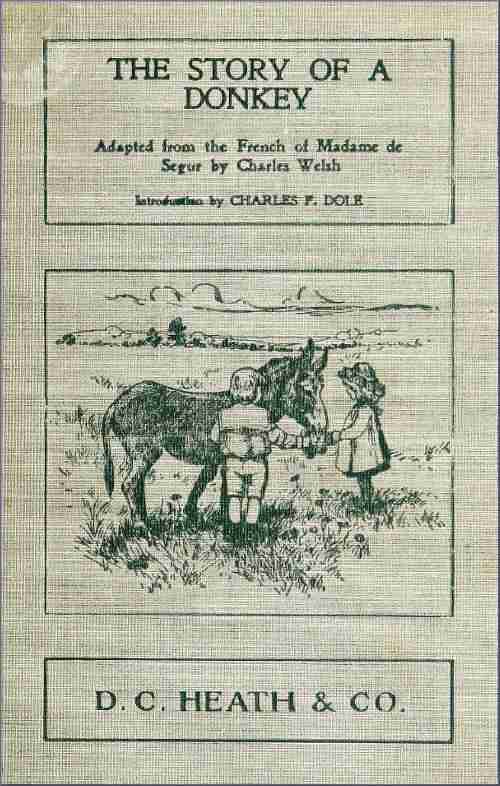
The Project Gutenberg eBook of The Story of a Donkey
Title: The Story of a Donkey
Author: comtesse de Sophie Ségur
Editor: Charles F. Dole
Illustrator: E. H. Saunders
Translator: Charles Welsh
Release date: August 4, 2017 [eBook #55256]
Most recently updated: October 23, 2024
Language: English
Credits: Produced by Turgut Dincer and the Online Distributed
Proofreading Team at http://www.pgdp.net (This file was
produced from images generously made available by The
Internet Archive)
THE
STORY OF A DONKEY
ABRIDGED FROM THE FRENCH OF
MADAME LA COMTESSE DE SÉGUR
By CHARLES WELSH
EDITED BY
CHARLES F. DOLE
ILLUSTRATED BY E. H. SAUNDERS
BOSTON, U.S.A.
D. C. HEATH & CO., PUBLISHERS
1904
Copyright, 1901,
By D. C. Heath & Co.
Dedication.
TO MY PRESENT LITTLE MASTER, HARRY.
My Dear Little Master,
You have been kind to me, but you have spoken contemptuously of donkeys in general. I want you to know better what sort of animals donkeys really are, and so I have written for you this story of my life. You will see, my dear little Master, that we donkeys have been, and still are, often badly treated by human beings. We are often very nice indeed; but I must also confess that in my youth I sometimes behaved very badly, and you will see how I was punished for it, and how unhappy I was, and how at last I repented, and how at last my repentance changed me and gained for me the forgiveness of my friends and masters. So, when you have read my history, you won’t say any more “as stupid as a donkey,” or “as obstinate as a donkey,” but “as sensible as a donkey,” “as clever as a donkey,” or “as gentle as a donkey.”
Hee-haw! my dear little Master, hee-haw! I hope you will never be as I was when I was young.
I remain,
Your obedient servant,
NEDDY.
PREFACE.
I do not recollect my childhood; I was probably as unhappy as the rest of the little donkeys are; and no doubt as pretty and as graceful. Certainly I was full of wit and intelligence, for, old as I am now, I have more of both than most donkeys possess.
I have often outwitted some of my poor masters, who, being only men, could not be expected to have the intelligence of a donkey,—and I will begin my Memoirs with the story of a trick I once played in the days of my youth.
INTRODUCTION.
The author of this book was the daughter of that Count Rostopchine who was governor of Moscow when it was burned in 1812, and Napoleon was obliged in consequence to make his disastrous retreat from that city. Born in 1799, Sophie de Rostopchine married, in 1821, the Count de Ségur, a son of one of the oldest and proudest families of France. She was a very accomplished and lovable person, and, as her writings attest, she was thoroughly in sympathy with the ways and feelings of children.
She did not begin to publish her stories until she was fifty-seven years of age, but between that date and the time of her death in 1874, she wrote and brought out a great many books for children.
The “Memoirs of a Donkey,” published in 1860, is one of the most popular, wholesome, and entertaining of her books. It is longer in the original than the version here given, as it contains a great number of scenes that could interest only the boys and girls of France; and there are many incidents in which the donkey scarcely figures. We have, therefore, given in this book the story of Neddy, the donkey. His adventures are interesting and amusing enough by themselves, and as there has been nothing quite like them originally written in English, we have included this retelling of the story in our Home and School Classics.
LIST OF ILLUSTRATIONS.
“I ate up several cabbages” | Frontispiece |
“I jumped clean over the hedge” | 5 |
“I galloped along” | 11 |
“We were placed along the wall” | 16 |
“I galloped to the other end of the meadow” | 24 |
“I drank up a bowl of cream” | 27 |
“The boys shouted” | 29 |
“I was ahead of all” | 33 |
“I followed him all the way” | 37 |
“Jack and Janie took the greatest care of me” | 42 |
“The gentlemen and boys formed a broad line across the field” | 45 |
“A sad procession” | 49 |
“Muffles took the bunch of flowers” | 54 |
“In order to clear a path” | 58 |
“Along the edge of the ditch” | 61 |
“I took the hat in my teeth” | 67 |
AND TEN SMALLER ONES IN THE TEXT.
The Story of a Donkey.
CHAPTER I.
Men, poor things, can’t be expected to be as wise as donkeys, and therefore you probably do not know that there was a market in our country-town every Tuesday. At this market vegetables were sold, and butter, and eggs, and cheese, and fruit, and many other nice things.
Tuesday was a miserable day for the poor donkeys, and especially for me. I belonged to a farmer’s wife, and she was very severe and ill-tempered. Just think! every week she used to load up my back with all the eggs her hens laid, all the butter and cheese she made from the milk of her cows, all the vegetables and fruit that were ready for market out of her garden. Then she would get on the top of all this and beat me with a hard, knotty stick because my poor thin legs didn’t carry her to market with all that load as fast as she liked. I trotted, I almost galloped, but that farmer’s wife whipped me all the same. I used to get very angry at such cruelty and injustice. I tried to kick her off, but I was loaded down too heavily, and so I could only wobble about from side to side; but I did have the satisfaction of knowing that she was well jolted. Then she would growl, “Ah, you wretched animal! see if I don’t teach you to wobble!” and she would beat me again till I could scarcely keep on my legs.
One day we reached the market-town in this way, and the baskets with which my poor back had been nearly crushed were taken off and set down upon the ground. My mistress hitched me to a post, and went away to get her dinner. I was dying of hunger and thirst, but nobody thought of offering me a single blade of grass or a drop of water. While the farmer’s wife was away, I managed to get my head close to the basket of vegetables, and made a dinner of the cabbages and lettuces. I never tasted anything so good.
I had just finished the last cabbage and the last lettuce in that basket when my mistress came back. She cried out when she saw the empty basket, and I looked at her with such an impudent and self-satisfied air, that she at once guessed that I was the culprit. I won’t repeat to you the mean things she said to me. When she was angry she used language which was enough to make me blush, donkey as I am. So after heaping me with abuse, of which I took no notice, she seized her stick and began to beat me so severely, that at last I lost patience and launched out three kicks. The first kick broke her nose and two teeth, the second sprained her wrist, and the third knocked her flat.
A score of people at once set upon me and knocked me about. They picked up my mistress and carried her away, leaving me fastened to the post, by the side of which were spread out the things I had brought to be sold in the market. I remained there a long while, and finding that no one paid any more attention to me, I ate a second basketful of excellent vegetables, and then with my teeth I gnawed through the cord that tied me up, and quietly took the road home.
The people I passed on the way were astonished to see me all alone.
“Look,” said one, “see that ass with the broken nose! He has run away.”
“Then he has run away from prison,” said the other, and they all began to laugh.
“He doesn’t carry a heavy load upon his back,” said a third.
“Certainly he has done some mischief,” a fourth one said.
“Catch him and we will put the little one upon his back,” said a woman.
“He will carry you as well as the little boy,” answered her husband.
I, wishing to give a good opinion of my kindness and good will, came gently towards the country woman and stopped near her to let her mount upon my back.
“He doesn’t seem a bad sort!” said the man, helping his wife to the saddle.
I smiled with pity on hearing this remark. Bad! as if a donkey kindly treated were ever bad! We become angry, disobedient, and obstinate only to revenge ourselves for the blows and injuries we receive. When we are well treated we are good,—much better, in fact, than many other animals.
I took the young woman and her little child of two years back to their home; they stroked me, were very much pleased with me, and would willingly have kept me.
But it was, I thought, not honest to stay with them. My masters had bought me and I belonged to them. I had already broken my mistress’s nose, teeth, and wrist, and had kicked her in the stomach. I was sufficiently revenged.
Seeing that the mother was going to give in to her little boy (who I noticed was a spoiled child), I jumped to one side, and before the mother could catch my bridle again, I ran away at a gallop and came back to my home.
Mary, my mistress’s little girl, saw me come back.
“Hallo, here’s Neddy,” she said; “how early he is! Jim, come and take off his pack-saddle.”
“That wretched donkey!” growled Jim; “always something to be done for him! Why is he alone? I suspect he has run away from mother.”
My saddle and bridle were taken off, and I galloped away to the meadow. Suddenly I heard shrieks. I looked over the hedge, and saw some men carrying my mistress home. Then I heard Jim say:—
“I say, father, I’m going to take the cart-whip, and I shall tie that donkey to a tree, and then whip him till he can’t stand.”
“All right, my lad,” said my master, “but mind and don’t kill him, for he cost money. I’ll sell him next fair-day.”
I shuddered when I heard this. There wasn’t a moment to be lost. This time I did not care whether they lost their money or not. I made a run and jumped clean over the hedge. Then I ran till I was out of sight and hearing in the depths of a beautiful large forest, where there was plenty of soft grass to eat, and plenty of sparkling brooks to drink from.
CHAPTER II.
Next day after, I thought over my good fortune. “Here I am saved,” thought I; “they never will find me, and in a couple of days, when I am quite rested, I will go farther on.”
Just then I heard the far-off barking of a dog; then of a second one; and several minutes afterwards the yelling of a whole pack. Restless and frightened, I got up and went towards a little brook that I had noticed in the morning. I had hardly ventured into the water, when I heard Jules saying to the dogs, “Go on, go on, dogs, search him out, find this miserable donkey, and bring him back to me.”
I nearly fell down with fright, but I quickly remembered that if I walked in the water the dogs could not follow my scent. So I began to run in the brook which was fortunately bordered on both sides with thick bushes.
I went on for a long time without stopping. The barking of the dogs as well as the voice of Jules became fainter, until at last I heard nothing more.
Breathless and exhausted I rested a minute to drink. I ate a few leaves off the bushes. My legs were stiff with cold, but I did not dare to get out of the water lest the dogs might come upon my scent again. When I had rested a little, I set off again, always following the brook until I got out of the forest. I then found myself in a meadow where over fifty cattle were grazing. I lay down in the sun in a corner of the field. The cattle paid no attention to me, so that I could rest at my ease.
Towards evening two men came into the meadow. “Brother,” said the taller of the two, “shall we take the cattle in to-night? They say there are wolves in the woods.”
“Wolves! Who told you that nonsense?”
“People say that the donkey from the farm has been taken away and eaten in the forest.”
“Bah! don’t believe it; the people of that farm are so wicked that they have killed their donkey with bad treatment.”
“Then why do they say that the wolves have eaten him?”
“So that people won’t know that they have killed him.”
“We had better take in our cattle, all the same.”
“Do as you wish, brother; it is all one to me.”
I was in such fear of being seen that I lay in my corner and did not stir; fortunately the grass was long and hid me; the cattle were not on the side where I was. The men drove them towards the gate, and then to the farm where their masters lived.
I was not afraid of wolves, because the donkey of whom they spoke was myself, and because I had not seen the tail of a wolf in the forest where I passed the night. So I slept beautifully and was finishing my breakfast when the cattle came back to the meadow, guarded by two large dogs.
I was looking at them, when one of the dogs saw me, and, barking fiercely, ran towards me, his companion following. What should I do? how could I escape them?
I flew towards the hedges surrounding the meadow, through which ran the brook I had followed. I was fortunate enough to jump over it, and I heard the voice of one of the men I had seen yesterday, calling off his dogs.
I went on my way at my ease, and walked as far as another forest, the name of which I don’t know. I must have gone more than ten miles. I was saved; nobody knew me; and I could show myself without fear of being taken back to my former masters.
But it began to grow cold, for winter was coming on, and I thought it high time to look out for a comfortable home. I trotted on right through the forest, and out at the other side, and after some days’ travelling, I arrived at a village that I had never seen or heard of before. Here I felt I should be safe.
Just outside the village there stood a little cottage in a garden quite by itself. It was very clean and neat. An old woman was sitting by the door doing some needlework. I thought she looked both kind and sad; so I went up to her, and put my head on her shoulder.
The good woman gave a shriek, and jumped up quickly.
I did not move, but lifted my face towards hers with a gentle and pleading look.
“Poor thing!” she said at last; “you don’t look like a bad creature. If you don’t belong to any one, you shall take the place of my poor Greycoat, who died the other day of old age, and I shall still be able to earn my living by taking my vegetables to market to sell. But,” she added, with a sigh, “you’ve got a master somewhere, I’ll be bound.”
“Granny, whom are you talking to?” said a pleasant voice from the house, and a nice little boy came out of the door. He was six or seven years old, poorly but very neatly dressed. He looked at me, half admiring, half afraid.
“Granny, may I stroke him?” he said.
“Of course you may, George, my dear; but take care he doesn’t bite you.”
The little boy stretched up his hand, but he was so short that he had to stand on tiptoe before he could reach my back. I didn’t move, for fear of frightening him; I only turned my head round, and licked his hand.
“Oh, granny, granny! just see! what a dear donkey! he licked my hand!”
“It’s very strange,” said George’s grandmother, “that he should be here all by himself. Go to the village, my dear, and ask whether anybody has lost a donkey. Perhaps his master is very anxious about him.”
George set off at a run, and I trotted after him. When he saw me come up, and then stand still by a mound on the roadside, he climbed up on my back, and said, “Gee up!”
I galloped along, and George was enchanted. When we got to the village inn, George cried, “Whoa back!” and I stopped immediately.
“What do you want, laddie?” said the innkeeper.
“Please, sir, do you know whose donkey this is?”
The innkeeper came out, and looked me all over. “No, my boy, he isn’t mine, and he doesn’t belong to any one I know. Go and ask farther on.”
So George went through the village asking the same question, but nobody had ever seen me before. At last we went back to the good old woman, who was still sitting with her work at the cottage door.
“So you can’t find his master, my dear? Very well, then, we may keep him till he is claimed. He mustn’t stay out all night. Take him to Greycoat’s shed, and give him some hay and a pail of water.”
The next morning George came to fetch me out of the shed, and gave me some breakfast. Then he put on the halter, and took me round to the cottage door. The old woman put a light pack-saddle on my back and mounted. Then George brought her a basket of vegetables, which she took on her knee, and we set off to market. Nobody in this market-town had ever seen or heard of me, and I came back joyfully to my new home.
I lived there for four years, and was very happy. I did my work well and never did anybody any harm. I loved my good old mistress and my little master. They never beat me or overworked me, and they gave me the best food they could. We donkeys are not dainty. The outside leaves of vegetables and plants that cows and horses won’t eat, and hay and potato-peel and carrots and turnips, are all we need.
CHAPTER III.
On some days, however, I was not so happy, for my mistress, now and then, hired me out to the children in the neighborhood. She was not well off, and on the days when she had nothing for me to do she was glad to earn something in this way.
And the people who hired me were not always good to me, as the following story will show:—
There were six donkeys in a row in the courtyard; I was the strongest and one of the most beautiful. Three little girls brought us oats in a bucket; as I ate I listened to the children talking.
Charles.—Come along, let us choose our donkeys. I’ll begin by taking this one (pointing me out with his finger).
“Yes, you always take what you think is the best,” said the six children all at once. “We must draw lots.”
Charles.—How can we draw lots, Caroline? Can we put the donkeys in a bag and draw them out like marbles?
Anthony.—Ha! ha! ha! The idea of donkeys in a bag! As if one could not number them 1, 2, 3, 4, 5, 6. Put the numbers in a bag and draw them out as they come.
“That is so, that is so,” cried the five others. “Ernest, make the number slips while we write them on the backs of the donkeys.”
“These children are stupid,” said I to myself; “if they had the sense of a donkey, instead of giving themselves the trouble of writing the numbers on our backs, they would simply place us along the wall; then the first would be 1, the second 2, and so on.”
Meanwhile Anthony had brought a large piece of charcoal. I was the first. He wrote a large 1 on my flank; while he was writing 2 on that of my comrade, I shook myself to show him that his invention was not very clever. In a moment the 1 had disappeared. “Stupid,” cried he, “I must begin again.”
While he was doing his number 1 over again, my comrade, who had seen me, and who was clever, shook himself in his turn. There was the 2 gone. Then Anthony began to get angry, and the others laughed and teased him. I made a sign to my comrades to let them go on, and then not one of us moved after being marked. Ernest returned with the numbers in his pocket-handkerchief. Each one drew.
While they were looking at their numbers, I made another sign to my comrades, and we all shook ourselves vigorously. Charcoal and numbers disappeared and all must be done over again! The children were angry; Charles was triumphant and sneering; Ernest, Albert, Caroline, Cecil and Louise, crying out against Anthony, who stamped his feet. They began to quarrel with each other, and my comrades and I began to bray.
The noise brought out the fathers and the mothers, to whom the matter was explained. One of the fathers at last thought of placing us in order along the wall. Then they made the children draw the numbers. “One!” cried Ernest. It was I. “Two!” said Cecil. It was one of my friends. “Three!” said Anthony, and so on until the last donkey was drawn. “Now, let us go,” said Charles; “I will start first.” “Oh! I shall catch up with you,” quickly answered Ernest. “I’ll wager you won’t,” said Charles. “I’ll wager I will,” replied Ernest. Charles struck his donkey and started at a gallop. Before Ernest had time to strike me with his whip, I started also, and at a rate which enabled us soon to overtake Charles and his donkey.
Ernest was delighted; Charles was furious and beat his donkey repeatedly. Ernest had no need to beat me; I ran like the wind, and passed Charles in a minute. I heard the others following, laughing and shouting.
“Bravo! donkey Number 1! He runs like a horse.” Pride gave me courage. I continued to gallop until we reached a bridge, where I stopped suddenly, for I saw that one of the large boards of the bridge was rotten. I did not wish to fall into the water with Ernest, so I decided to return to the others, who were far, far behind us.
“Gee up! Gee up! Donkey!” said Ernest, “over the bridge, my friend, over the bridge.” I would not go on; he hit me with his stick, but I continued to walk towards the others. “Obstinate, stupid brute! will you turn round and cross the bridge?” said he. I walked on towards my comrades, and joined them in spite of the insults and blows of this wicked boy.
“Why do you beat your donkey, Ernest?” cried Caroline; “he is very good; he took you like lightning, and made you pass Charles.” “I beat him because he would not cross the bridge,” said Ernest; “he took it into his head to turn back.” “Nonsense! that was because he was alone; now that we are all together, he will cross the bridge like the others.”
“Unhappy children,” thought I, “they all will tumble into the river. I must try to show them that there is danger;”—and again I started at a gallop, running towards the bridge, to the great satisfaction of Ernest and the other children, who shouted with joy. I galloped to the bridge, but as soon as I got there, I stopped suddenly as if I were afraid. Ernest was astonished, and urged me to go on. I drew back with a frightened look which still more surprised Ernest. The silly fellow saw nothing: the rotten board was, nevertheless, in plain sight. Presently the others rejoined us and looked on laughingly at Ernest’s attempts to make me cross. Then they got off their donkeys and each one pushed me and beat me without pity. But I did not stir.
“Pull him by his tail,” cried Charles; “donkeys are so stubborn, that when you want them to go backwards they go forwards.” Then they tried to catch hold of my tail.
I defended myself by kicking, upon which they all beat me at once, but in spite of this I would not move.
“Wait, Ernest,” said Charles, “I will go over first; your donkey will certainly follow me.”
He started to go on; I put myself across the entrance to the bridge. He made me turn by dint of blows.
“All right,” said I, “if this naughty boy wishes to drown himself, let him. I did what I could to save him; let him drown if he wishes so much to do so.”
No sooner had his donkey put his foot upon the rotten board than it broke, and there was Charles and his donkey in the water!
There was no danger for my comrade, because, like all donkeys, he could swim.
Charles struggled in frantic attempts to get out. “A stick! a stick!” he cried. The children screamed and ran here and there. At last Caroline found a long stick, picked it up and gave it to Charles, who seized it; but his weight dragged down Caroline, who called out for help.
Ernest, Anthony, and Albert ran to her. At last the unhappy Charles, who had by this time got more than he bargained for, was pulled out of the water soaked from head to foot. When he was safe the children began to laugh at his doleful appearance. Charles growing angry, the children jumped upon their donkeys and advised him to return to his home to change his clothes. Dripping wet he remounted his donkey. I laughed to myself at his ridiculous appearance.
The current had swept away his hat and his shoes; the water ran in streams from his clothes; his soaked, wet hair stuck to his face, and his furious look made him a thoroughly comical sight. The children laughed; my comrades jumped and ran to express their joy. I must add that Charles’s donkey was detested by all of us, because, unlike most donkeys, he was quarrelsome, greedy, and stupid.
At last, Charles having disappeared, the children and my comrades were calmed down. Every one stroked me and admired my cleverness. We all set out again, I at the head of the party.
But these lively times were coming to an end. One day, George’s father, who was a soldier, came home from the army and bought a house in town. His mother and his little boy went to live with him, and I was sold to a neighboring farmer.
CHAPTER IV.
My new master was not a bad sort of man, but he had what I thought was an unpleasant habit of making everybody work very hard. He used to harness me to a little cart, and make me carry earth and apples and wood and many other things. I began to grow lazy; I didn’t enjoy going in harness, and I disliked market-days very much. It wasn’t that they made me draw too heavy a load or that they beat me, but I had to go without anything to eat from morning till three or four o’clock in the afternoon. When the weather was hot I nearly died of thirst, and yet I had to wait till everything was sold, and my master had got all his money.
I wasn’t always good in those days. I wanted them to treat me kindly, and as they didn’t, I began to think of revenge. You see that donkeys are not always stupid, but you also see that I was growing bad.
On market-days in the summer the people at the farm always got up very early to cut the vegetables and gather the eggs and churn the butter, while I was still lying out in the meadow. I used to watch all this going on, knowing that at eight o’clock they would come and fetch me to be harnessed to the cart.
One day I determined to play them a trick.
In the meadow I had noticed a deep ditch filled with thistles and blackberry bushes. “Now,” I said to myself, “I’ll hide in that ditch, so that when they come to fetch me there’ll be no donkey anywhere to be seen.” So, as soon as I saw the cart being filled and the people bustling about, I ran off to the side of the field, and lay down very softly in the ditch, so that I was quite hidden by the bushes.
In a little while I heard one of the farm boys call me, and then run looking about for me everywhere, and at last go back to the farm. In a few minutes I heard the farmer himself say, “He must have got through the hedge. But where could he have broken through? There doesn’t seem to be a hole anywhere. Oh, I know! some one must have left the gate open. Who was it? Here, boys, run out and look in the fields over yonder! He can’t be far off. And make haste, for it’s getting late.”
So all the farm help turned out to look for me. It was broiling weather, and after a while the poor people came back very hot, very limp, and panting for breath. The farmer declared that I must have been stolen, and that I was a great donkey to let any one steal me, and so on. Then he harnessed one of the horses to the cart, and drove off late to market, in a very bad temper.
When I saw that all was quiet again, and that nobody was looking, I scrambled out of my ditch, and galloped off to the other end of the meadow, so that they shouldn’t suspect where I’d been. Then I opened my mouth, and began to hee-haw! hee-haw! with all my might.
At this noise, all the people at the farm rushed out.
“Hello! why, there he is!” said the shepherd.
“Where has he been all this while?” said the mistress.
“How did he get in again?” said the carter.
I was so delighted not to go to market, that I went prancing up to them. They were very glad to see me; they patted me, and said I was a good, clever donkey to have managed to escape from the thieves who had stolen me, till I felt quite ashamed of myself, for I knew that I didn’t deserve all this, and that I did deserve the stick. Then they left me to graze all day in the meadow, and I should have enjoyed myself very much, if my conscience hadn’t given me such a bad time of it.
The farmer was very much surprised to see me when he came home. The next day he went all round the meadow, and carefully stopped up every hole he could find in the hedge, until there wasn’t room for a cat to get through.
The week passed quietly away until market-day came again, and then I hid myself in the ditch as before. The people at the farm could not make it out, and thought that the thieves who stole me were unusually clever.
“This time,” said the farmer, “he must be really lost and gone for good,” and he harnessed one of the horses and went off to market as before. When everything was quiet I came out again, but this time I thought I had better not say “hee-haw!” to let them know I was there. When at last they found me, they didn’t stroke or pat me, and they said so little that I thought they must suspect something. But I didn’t care, and I said to myself,—
“Ah, yes, my good friends, you’ll think yourselves very clever if you find me out, but I don’t intend you shall,” and so when market-day came round, I made for my ditch for the third time.
But scarcely was I safely hidden among the thistles and blackberry bushes, when I heard the big watch-dog bark, and then the voice of the farmer say,—
“Here, Rover, Rover, good dog, then! go and look for him!” and in a moment Rover had pounced upon my hiding-place, and was growling and snapping at my heels in a most unpleasant manner. I made for the hedge, and tried to force a way through, but in vain.
“Good dog, good Rover, good dog!” shouted the farmer, and he threw a lasso at me, which caught me and stopped me short. Then he led me back and tied me up, and I heard that one of the farmer’s little boys had been watching the meadow from a place where I couldn’t see him, and that he had told where I was.
After that I was much more severely treated. They shut me up, but I learned how to draw bolts and lift up latches with my teeth, and so get out. All day long you might have heard the people of the farm saying, “Oh! there’s that donkey again!” The farmer grumbled and beat me, but I became worse and worse. I compared my wretched life now with the happy one I had led in former days under the same master, and instead of trying to leave off behaving badly, I became more and more naughty and obstinate every day. One day I went into the kitchen garden and ate up all the lettuce; another day I knocked down the little boy who had told tales about me; another day I drank up a bowl of cream that had been set outside the door ready for churning. I trod on the fowls, and bit the pigs, till at last the mistress said she couldn’t stand it any longer, and she begged her husband to sell me at the next fair.
So, when the fair-day came, my master took me away.
He sold me to a family where there was a little invalid girl whom I had to take out; but I didn’t stay there long, for the little girl died, and then her parents, who had never liked me, turned me adrift to go where I pleased, and to live as best I could.
CHAPTER V.
All the next winter I had no one to take care of me. I had to live in the forest, where I found scarcely enough to keep me from dying of hunger and thirst. I had plenty of time to think how wicked I’d been; how happy I was until I had given myself over to laziness, and spitefulness, and revenge; and to make up my mind to turn over a new leaf if ever I got the chance.
When the spring came, I went one day to a village on the edge of the forest, and was surprised to find quite a commotion there. The people were walking up and down; everybody had on his Sunday clothes; and, what was stranger still, all the donkeys in the neighborhood seemed to be there. They were sleek and fat, their heads were decorated with flowers and leaves, and not one of them was in harness or had a rider.
I trotted up to see if I could find out what all this was about, when suddenly one of the boys who were standing there saw me, and shouted,—
“Oh, I say, look here! here’s a fine donkey!”
“My word!” said another, “how well groomed he is! and how fat and well fed!” and they roared with laughter.
“I suppose he’s come to run in the donkey race,” said a third, “but he won’t win the prize! No fear!”
I was very much annoyed at these rude jokes and personal remarks; but I thought I should enjoy taking part in the race, so I listened again.
“Where are they going to run?” asked an old dame, who had just come up.
“In the meadow by the mill,” said a man named Andrew.
“How many donkeys are there?” asked the old woman.
“Sixteen, Mother Evans, and the one that comes in first will win a silver watch and a bag of money.”
“Oh, deary me!” said Mother Evans, “I do wish I had a donkey. I should so like to have a watch. I’ve never had the money to buy one.”
I liked the look of this old woman; I was justly proud of my running; I had been so long in the forest that I was not too fat, as some of these prize donkeys were; and so I would take part in the race. I trotted up to the others, and took my place among them, and then, to attract attention, I opened my mouth and brayed vigorously.
“Oh, you stop that!” cried out a man named Bill. “Hi! you there, donkey, you just stop that music, will you? and get out of there! You can’t run, you shabby brute! and, besides, you don’t belong to anybody.”
I held my tongue, but I didn’t budge an inch. Some laughed, and others were getting angry, when old Mother Evans said:—
“Well, he can have me for his mistress. I take him into my service from this minute. So now he can run for me.”
“Well,” said Bill, “do as you like, mother. Only if you want him to run, you’ve got to put a quarter into the bag the Squire has yonder.”
“All right, my dear,” said Mother Evans, and she hobbled off to where the Squire was sitting and paid her subscription into the bag.
“Very good,” said the Squire; “put Mrs. Evans’s name down, Richard.”
So the clerk put down my new mistress’s name. We were all drawn up in a line in the meadow. The Squire said, “One, two, three, and away!” the boys who held the donkeys let them go, and away we galloped as hard as we could, while the crowd ran cheering alongside.
The sixteen donkeys had not gone a hundred yards before I was in front of them all, an easy first. I thought I would beat them all now, at any rate, and I flew along as if I had wings. I passed proudly before the winning-post, not only first, but a long way ahead of all the rest, amid loud cheers from those who had no donkeys in the race.