
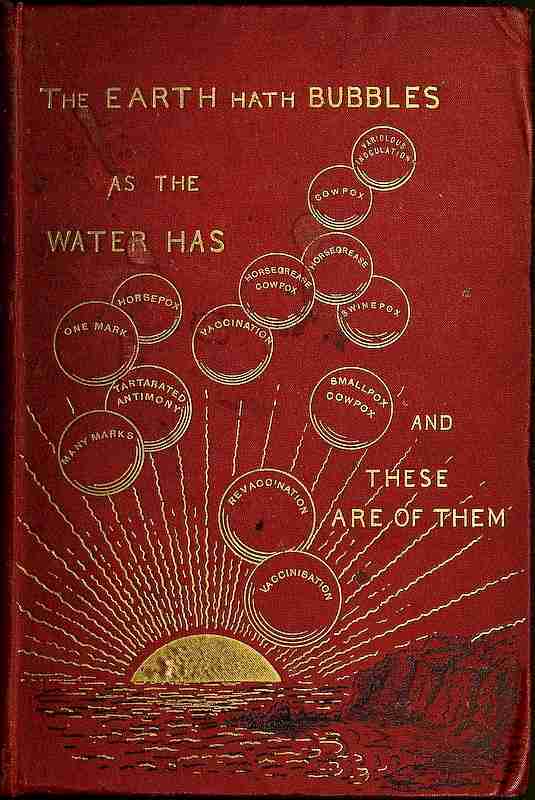
INTRODUCTION.
PREFATORY.
There are few matters among educated people upon which opinion is so absolute and so ill-informed as vaccination. They will tell you it has stopped smallpox and does no harm, and if you venture to question either assertion you are set down as an abettor of “those ignorant and fanatical anti-vaccinators.” If undeterred you inquire when smallpox was stopped, and which is the harmless variety of vaccination, you will probably be told that these are medical questions, whilst the facts are indisputable; the answer running in the line of Old Kaspar’s to Little Peterkin, inquisitive as to the good of Blenheim—
Why that I cannot tell, said he,
But ’twas a famous victory.
I am not complaining of this attitude of mind. We all accept more or less on bare authority. In the multiplicity and unsearchableness of knowledge, it is unavoidable. Some years ago a venerable friend urged me to write against vaccination, which, he said, was working endless mischief to the public health. He would have the book published, and provide whatever was requisite for my satisfaction. I pleaded prior engagements, and turned the conversation, thinking how sad it was that one so good, and, in other respects, so enlightened should be subject to so strange an illusion—I, then, taking vaccination on trust as one of the numerous blessings conferred upon mankind in the course of the present century.
I am therefore disposed to make large allowance for the credulous attitude of the public toward vaccination whilst at the same time insisting on its correction; and for this reason especially, that vaccination is no longer a matter of private concern. We are free to entertain what notions we please, but if we proceed to enforce them on unbelievers, we cannot complain if we are required to answer for our aggression or encounter rough usage. Enforced by the law of England, vaccination is related to the life and intelligence of every citizen, and it is consequently vain to claim for it exemption from vulgar discussion. Apart from its compulsory infliction, vaccination might be and remain an esoteric rite, the very mystery of mysteries; but with compulsion the privilege of sanctity is impossible.
VARIOLATION.
It has been said that beliefs and observances in themselves most irrational wear a different aspect when viewed in the light of their origin and history. It is so with vaccination. Had it come upon the world as we know it, with failure and disaster, equivocation and apology, rejection would have been inevitable; but when we turn to the past we discover that our damnosa hæreditas has a tradition that goes far to account for, if not to excuse, the folly which remains.
Vaccination was the successor of Inoculation (or, more precisely, Variolation), entering into a possession already acquired in the human mind.
It had been observed from of old that some forms of disease rarely recur in the same person in a lifetime; and thus when scarlet fever, or measles, or smallpox broke out in a family, it was considered prudent to let the disease have its course, and thereby obtain immunity from fear of future infection.
It was this confidence, that smallpox once undergone was finally disposed of, that was the justification of the practice of inoculating the disease when introduced from the East in the first quarter of last century. Inasmuch, it was argued, as none can have smallpox more than once, why not induce it artificially, and pass through the illness at a convenient season? But Nature, though compliant, does not always accept the course we ingeniously prescribe for her. Smallpox as naturally developed (so to speak) is a crisis of impurity in the blood, and if the requisite conditions are absent, it cannot be adequately excited. Hence variolation was an uncertain and hazardous operation. It took with some and was indistinguishable from an attack of ordinary smallpox; it took partially, or not at all with others; and the operation was frequently followed by malaise, disorders of the skin, and grave constitutional derangements. Nor were the variolated secure from smallpox. They occasionally had smallpox with their neighbours, and then it was said, “There must have been some mistake about the inoculation; for it is impossible that anyone can be successfully inoculated and have smallpox.” Further, the variolated, while labouring under the induced malady, conveyed the disease to their attendants and visitors; and thus smallpox was propagated by the means intended to avert it.
THE PRECURSOR OF VACCINATION.
At the close of last century, variolation had become the custom of the upper and middle classes of England. The trouble and the peril were disliked, but were accepted in the name of duty. The variolation of their children was an anxiety that weighed like lead on the hearts of affectionate parents; and glad and grateful they were when the operation was accomplished without serious mishap. Patients designed for variolation were dieted, purged, and bled; and smallpox from sufferers of sound constitution was diligently inquired for. Mild smallpox was in great demand and was propagated from arm to arm. When Dr. Dimsdale operated on the Empress Catharine he did not venture to convey smallpox direct to the imperial person. He looked out a case of “benign smallpox” with which he inoculated a strong young man, and from the young man the Empress. Unless we realise the inconveniences, the uncertainties, the disasters and the horrors of the practice of variolation, albeit minimised, excused and denied by its professors, we can never understand the enthusiasm with which vaccination was received as its substitute. The promise conveyed in vaccination was a relief inexpressible, bearing with it a show of reason that was well nigh irresistible. The argument ran thus: No one can have smallpox twice, and the mildest attack is as protective from subsequent attack as the severest. Therefore it is that in inoculation with smallpox we find security. But inoculation with smallpox is an uncertain operation with dangerous issues. Here, however, in cowpox is discovered a mild variety of smallpox, which may be inoculated with perfect ease, and with no possibility of harm. And inasmuch as the mildest smallpox is as preventive of future smallpox as the severest, it follows that this gentle cowpox must serve as a full equivalent for smallpox itself.
IMMEDIATE TRIUMPH OF VACCINATION.
It was in this plausible shape that vaccination had an immediate triumph. The way was made straight for it and every difficulty removed by the existing practice of variolation. Dr. W. B. Carpenter says that vaccination was more strenuously resisted at the beginning of the century than it is at this day. He is completely mistaken. Vaccination came upon a generation prepared for it—which saw in it a prescription in full accord with common-sense. The entire medical profession, with a few exceptions, the King, Queen and court, were converted straight off, and parliament and society followed suit. It was, I confess, a natural development of opinion; and we need have little doubt that had we lived in those days we should have found ourselves shouting with the genteel mob. The limited resistance offered to vaccination was not based on physiological or sanitary science: such science did not then exist. It was the resistance of variolators who were satisfied with the established practice and resented its disturbance; professing at the same time immeasurable horror at the profanation to humanity by infection with bovine disease. Whilst we have no reason to identify ourselves with that resistance, we have to recognise the service rendered by the variolators in observing the results of vaccination—the persistency with which they traced and exposed its failure to prevent smallpox and the injuries and deaths it caused. So far as the maintenance of variolous inoculation was concerned, they fought a losing battle; but they drove the vaccinators from post to post (cursed while they did so as malignant false witnesses possessed of the devil) and at last compelled the admission that their infallible preventive could not be guaranteed to prevent, but only to make smallpox milder—a safe assertion because unverifiable, as disputable as indisputable in particular instances.
JENNER’S PROCEDURE.
About the matter of this prophylactic there was from the first a curious confusion which continues to this day.
Jenner was a country doctor at Berkeley in Gloucestershire, a dairy country, where the maids believed that if they caught cowpox in milking they could never afterwards catch smallpox. Jenner when a young man was inclined to accept the dairymaids’ faith; but when he discussed it with his medical acquaintance, they ridiculed him. They said, “We know that such is the dairymaids’ faith, but we also know that it is untrue; for we know dairymaids who have had cowpox, and afterwards had smallpox notwithstanding their cowpox.” Jenner was convinced and said no more about cowpox.
To this point let me draw special attention. No man knew better than Jenner that cowpox as cowpox was no preventive of smallpox.
Toward middle-life he had what he conceived to be a happy thought. Cowpox as cowpox he had dismissed as impracticable; but there was a variety of cowpox which he resolved to recommend.
Cows in Gloucestershire were milked by men as well as by women; and men would sometimes milk cows with hands foul from dressing the heels of horses afflicted with what was called grease. With this grease they infected the cows, and the pox which followed was pronounced by Jenner to have all the virtue against smallpox which the dairymaids claimed for cowpox.
HORSEGREASE COWPOX.
According to Jenner, then, the dairymaids were right, and they were wrong. They were right when the pox they caught was derived from the horse through the cow; they were wrong when the pox they caught originated on the cow without the horse. He thus discriminated a double pox—cowpox of no efficacy against smallpox, and horsegrease cowpox of sure efficacy.
Further, in this connection, it is to be observed, that farriers believed that when they got poisoned in handling horses with greasy heels, they too, like the dairymaids, were safe from smallpox.
It is not therefore for cowpox, but for horsegrease cowpox that Jenner is answerable. In cowpox he had not, and could have no faith.
In 1798 Jenner published his famous Inquiry, a treatise much more spoken of than read, wherein he distinctly set forth the origin of his chosen prophylactic. It was not, I repeat, cowpox: it was horsegrease cowpox. He carefully discriminated it from spontaneous cowpox, which, he said, had no protective virtue, being attended with no inflammation and erysipelas, the essential sequences of inoculation with effective virus.
REJECTION OF JENNER’S PRESCRIPTION.
I have said that the world gave a cordial and unhesitating welcome to Jenner’s revelation, but the observation requires a startling qualification. Jenner’s revelation as conveyed in his Inquiry was summarily and ignominiously rejected—was absolutely rejected. I wish to emphasise this point. Jenner published his Inquiry in order to recommend horsegrease cowpox, and what I have to say is, that the public declined to have anything to do with horsegrease cowpox. The origin of cowpox in horsegrease was scouted as an intolerable origin. It was disgusting. Why a diseased secretion from horses’ heels should be more repulsive than a similar secretion from cows’ teats was not explained; but, as we all know, there is no accounting for tastes. Various attempts were made to verify Jenner’s prescription by inoculating cows with horsegrease, but they ended in failure—fortunately, it was said, in failure; for as Dr. Pearson (chief among primitive vaccinators) observed, “The very name of horsegrease was like to have damned the whole thing.” What did Jenner do under these circumstances? Did he confront the public and assert the efficacy of horsegrease cowpox? Not he. He wanted money. He saw how the wind was blowing. He said not another word about horsegrease cowpox; and as the public were eager at any price to escape from the nuisance of smallpox inoculation, and disposed to substitute cowpox as a harmless substitute, why then he resolved to go in for cowpox, and pose as its discoverer and promoter.
JENNER’S TRANSFORMATION.
I am not making what is called a constructive charge against Jenner, but simply setting forth plain, undeniable matter-of-fact. I ask any one in doubt as to what I say to read Jenner’s Inquiry, published in 1798, the prescription of which is horsegrease cowpox, and the condemnation of cowpox. Turn then to his petition for largess, addressed to the House of Commons in 1802, and what do we find? Not one word about horsegrease cowpox, but this audacious assertion:—
“That your Petitioner has discovered that a disease which occasionally exists in a particular form among cattle, known by name of Cowpox, admits of being inoculated on the human frame with the most perfect ease and safety, and is attended with the singularly beneficial effect of rendering through life the person so inoculated perfectly secure from the infection of Smallpox.”
Why, that was not Jenner’s discovery! It was the notion of the dairymaids, and, so far as concerned spontaneous cowpox, was known by Jenner to be untrue. Yet, strange to say, the claim was in a measure allowed by the House of Commons, and £10,000 awarded to the imposter, and subsequently £20,000 in 1807.
HORSEGREASE COWPOX KEPT OUT OF SIGHT.
As evidence of how completely Jenner’s prescription of horsegrease cowpox was put out of sight, I may refer to the treatise of Dr. Willan On Vaccine Inoculation, published in 1806, wherein all that was thought important concerning the new practice was set forth; and although Jenner was freely cited, yet neither horsegrease nor horsegrease cowpox was referred to from the first page to the last. Instead, cowpox, after the fancy of the dairymaids, was exalted as the true prophylactic, apparently without a suspicion of its questionable character.
As I have said, Jenner not only offered no resistance to this amazing transformation, but conformed to it, and assumed the issue as his own. Since the public preferred cowpox to horsegrease cowpox, he saw no reason why he should object, especially as the same foolish public lusted after some one to worship for their deliverance from the plague of variolation. The world resounded with praises of the immortal Jenner, the saviour of mankind from smallpox. Enveloped in the smoke of such incense, it is scarcely surprising that the idol came to believe that his worshippers knew him better than he did himself.
SPURIOUS COWPOX.
The promise of vaccination, its absolute security and harmlessness, was speedily belied. The vaccinated caught smallpox; they fell sick after the operation; they were afflicted with eruptions and swellings; they died. These mishaps were at first denied—stoutly denied; and when denial was no longer possible, it was attempted to explain them away. The cowpox used could not have been genuine cowpox, but spurious; and for awhile spurious cowpox did yeoman’s service in the way of apology; but by-and-by the excuse began to work more harm than good. Mishaps were so numerous that people became afraid of this omnipresent spurious cowpox, and to ask what it was, and how it could be avoided. How can there be spurious pox? Whoever heard of spurious disease? Milkmen vend spurious milk, grocers spurious sugar, smashers spurious coin; but surely cows are not to be numbered with such malefactors as producers of spurious pox! The thing was absurd on its face, and absurd it proved. When Jenner was under examination by a committee of the College of Physicians in 1806, he was pressed hard for a definition of spurious cowpox, when he “owned up.” He knew nothing of spurious cowpox. The words had been employed, not to describe any irregularity on the part of the cow, but certain irregularities in the action of cowpox on the part of the vaccinated: which was to say that when the vaccinated recovered creditably and did not catch smallpox, the cowpox was genuine; but when the sequences were otherwise, why then it was spurious! Ingenious and convenient, was it not?
HORSE VIRUS VINDICATED.
Reverting to Jenner’s suppression of the origin of cowpox in horsegrease, it may be suggested that he had changed his mind: but he had not changed his mind. As observed, various attempts were made to inoculate cows with horsegrease, and that these attempts were failures; but subsequent attempts were successful. Tanner, a veterinarian, of Rockhampton, Gloucestershire, succeeded to Jenner’s complete satisfaction. Dr. Loy of Whitby dispensed with the cow altogether, and inoculated with horsegrease, or horsepox, producing vesicles identical with those of cowpox. The great success, however, in this line was reserved for Sacco of Milan. From the hand of a coachman poisoned with horsegrease he inoculated nine children, and from the virus thus engendered operated on every side. Writing to Jenner in 1803, Sacco said—“It is now admitted and settled that grease is the cause of vaccine, and we cannot too soon alter the designation to equine.” De Carro of Vienna received this equine from Sacco, and used it so freely and successfully among the Viennese, that, in his own words, it became impossible to say which of the citizens were equinated and which vaccinated.
What did Jenner make of these confirmations? He was adjudged mistaken in asserting that the cowpox good against smallpox was derived from horsegrease. Did he appeal with triumph to the evidence of Sacco, and say, “You thought me wrong, but see, I was right!” Not he. He kept silence. He consented to be treated as in error. He stood by and allowed cowpox to be used in which he had no confidence whatever. Nay more. He consented to be rewarded and honoured as the discoverer of a pox (which he did not discover) in which he was without faith, and had at the outset of his career expressly rejected and condemned. He recognised that it was expedient that the connection between horsegrease and cowpox should be denied. He had his bill to settle with the English people, and it was not for him to make difficulties. When, however, he had obtained all he could expect from public favour, and had got clear of London and the oppression of its savants, why then he resumed the expression of his original opinion; and still further, like Sacco of Milan, he dispensed with the cow, and inoculated straight from the horse. He supplied the National Vaccine Establishment with horse virus; he sent it to Edinburgh; he distributed it among his medical acquaintances; he described it as “the true and genuine life-preserving fluid.” What more need I say? Such was Jenner; such were his tactics; and whoever assumes his defence will assume a task in which he is not to be envied.
WHICH SHALL IT BE?
Jenner died in 1823, and at that date three kinds of virus were in use; first, cowpox from horsegrease or horsepox; second, cowpox; third, horsepox. These of course were subject to inscrutable modification in transmission from arm to arm: it is the distinct sources we have to recognise. A patient intent on vaccination might have said to himself, Which shall it be? Shall I be cowpoxed? or, shall I be horsepoxed? or, shall I be horsepoxed cowpoxed? How such an inquirer would have been answered had he set his perplexity before his medical adviser, I can only conjecture. Probably he would have been rebuked for his intrusion into matters outside his province. The little girl who quenched the scepticism of her comrade with the dictum, “It is so, for ma says so; and if it isn’t so, it is so, if ma says so,” illustrates the manner of rebuff administered to those who pry into professional mysteries. It is for you to pay and for us to think is a formula by no means limited to ecclesiastics.
SMALLPOX COWPOX.
Jenner was pleased to describe cowpox as a mild form of smallpox; but for what reason, outside his pleasure, he did not explain. Nevertheless the suggestion has borne fruit. When virus has fallen short, it has been asked, Why, if cowpox be mild smallpox, should not cows be inoculated with smallpox, and a crop of virus be raised? Various such attempts have been made, in which Mr. Badcock of Brighton has been especially distinguished. Mr. John Simon, writing in 1857, said, “Mr. Badcock, from 1840 to the present time, has again and again derived fresh stocks of vaccine lymph from cows artificially infected by him; having vaccinated with such lymph more than 14,000 persons, and having forwarded supplies of it to more than 400 medical practitioners.” When it is remembered that virus for half a dozen or more vaccinations is taken from a single arm, and that this process of reproduction is repeated every week, some idea may be formed of the extent to which this smallpox cowpox has been diffused over the country.
The original assertion that vaccination conferred life-long immunity from smallpox was unwillingly abandoned under stress of experience, until no respectable practitioner pretended that the rite afforded more than a partial or temporary security. In promotion of smallpox cowpox, however, Jenner’s most extravagant claims were revived. In Mr. Simon’s words, for the recipient of smallpox cowpox, “Neither renewed vaccination, nor inoculation with smallpox, nor the closest contact and co-habitation with smallpox patients, will occasion him to betray any remnant of susceptibility to infection.” Untrue even of variolation, it is unnecessary to controvert such a figment: it suffices to place it on record.
The hypothesis was, that smallpox inoculated on the cow lost somewhat of its virulence; but if so, why should not such cowpox inoculated on man resume its virulence? We are apt to forget that the nature of things is not controlled by our wishes, and that our interest in the conversion of smallpox into cowpox, and its maintenance as cowpox, is no warrant for fulfilment. I may also remark that though smallpox cowpox has entered so largely into currency, there is no evidence to what extent it has displaced the preceding issues of horsegrease cowpox, cowpox and horsepox. So far as we know, they are all existent in the common blood, indistinguishable, the stronger surviving, the weaker dying out: nobody knows, nor can know.
CONDEMNATION OF SMALLPOX COWPOX.
That smallpox cowpox is in any sense cowpox is, however, widely disputed, much confidence being placed in the researches of the Lyons Commission in 1855, presided over by M. Chaveau. This Commission, says Dr. Charles Cameron, “proved incontestably that smallpox can no more be converted into cowpox by passing it through a cow than by stunting an oak it can be converted into a gooseberry bush.” Cowpox, it is held, is a disease of the cow, with no relation to smallpox. The vesicles of each may be apparently identical, as are the vesicles excited by the application of tartar emetic; but that is no proof of essential identity. According to Dr. George Wyld, “Smallpox inoculation of the heifer produces not vaccinia, but a modified smallpox, capable of spreading smallpox among human beings by infection;” and Dr. Cameron boldly attributes the recent increase of smallpox to the use of smallpox cowpox for vaccination.
Nor is Dr. Cameron singular in this opinion. Some time ago, the Galway Guardians ran short of virus for vaccination, when it was proposed to inoculate a calf with smallpox. As soon as the Local Government Board in Dublin became aware of the project, it was forbidden. Why? Here is the deliverance of the Secretary—“Because smallpox virus taken from the calf would communicate that disease to the human subject, and be thereby a fertile source of propagating the disease; and would, moreover, render the operator liable to prosecution under the Act prohibiting inoculation with smallpox.” Thus the virus current in England, and credited with miraculous virtue by Simon, is denounced as dangerous and its use unlawful in Ireland!
COWPOX REVIVED.
The constant disasters of vaccination, the certain and suspected communication of human diseases with the virus propagated from arm to arm, have induced a wide resort to cowpox under the designation of “animal vaccination,” in contempt of the fact that disease in cattle is as rife as among men, and inoculable. Still the dread of the invaccination of syphilis is so intense, and so justifiable, that other risks are encountered if that may be avoided.
This cowpox is commended as “pure lymph from the calf,” a sweet periphrase with a savour of Daphne and Chloe, of Flora and the country green—a periphrase used in craft or ignorance, “pure lymph” being as incapable of producing vaccinia as pure milk or pure saliva. The prescription takes us back to Jenner’s time and Jenner’s procedure. As has been said, the Gloucestershire dairymaids believed that after cowpox they were safe from smallpox, and that Jenner was much impressed with their belief until he discovered that it was untrue. Had he found it true, he might have advertised the prophylactic thirty years in advance of the publication of his Inquiry; but if anything was certain, this was certain, that cowpox did not avert smallpox. Satisfied that cowpox per se was of no avail against smallpox, he defined a variety of cowpox generated by the application of horsegrease, to which he was pleased to ascribe sovereign efficacy. Why, I ask, did he discriminate and prescribe that variety of cowpox if cowpox per se was effective? The question answers itself. I will not say the cowpoxers treat Jenner’s evidence with disrespect; for such is their ignorance, that I question if they are aware of its existence; moreover, that which is undesirable to know, is instinctively avoided and kept out of sight. They recommend their “lymph” as wonderfully mild, being attended with no erysipelas, the pest of arm-to-arm vaccination—a description that tallies exactly with Jenner’s of impotent cowpox. “The pustules,” says Jenner, “are of a much milder nature” than those of horsegrease cowpox. “No erysipelas attends them, and they are incapable of producing any specific effect on the human constitution.”
A COWPOX CHARLATAN.
Yet, incredible as it may appear, it is with the praise of this impotent cowpox, attended with no erysipelas, that the public have been deafened, and for which the most extravagant assertions are made. Dr. Martin, one of the chief producers and vendors of the article, appeared at the British Medical Association in 1881, saying, “I am called upon at times, at the very shortest notice, to vaccinate whole cities; and when I left America, I had just completed the vaccination of the city of New Haven. The custom is to send for me, or my son, wherever smallpox breaks out, with orders to vaccinate at once the entire population of the city, town, or neighbourhood. It is done immediately, the result being that an epidemic is completely stopped in a week.”
Thus spoke the charlatan, with the acquiescence of the medical assembly. When churchmen deplore the scepticism of the age, and the decay of faith, it is to be observed that the habit of mind is limited to certain modes of opinion, and that in general we are as credulous as ever. Human nature in its structure is curiously immutable. Wherein is the advantage to disbelieve in witchcraft and to believe that epidemics of smallpox can be stopped with cowpox?
A DECOROUS UNANIMITY.
Such are the leading varieties of virus used for vaccination—starting with Jenner’s horsegrease cowpox, then cowpox, then horsepox, then smallpox cowpox, and finishing with cowpox revived; each of them inscrutably modified in transit from child to child and from beast to beast. We are continually hearing of miracles wrought by vaccination in the past and present—especially the past, at home and abroad—especially abroad, the assumption being that vaccination is, and has been, everywhere the same. On the contrary, the condition precedent to serious consideration of any vaccine miracle is a definition of the variety of vaccination practised. It is, we admit, convenient for the administrators of the rite that it should pass for uniform, however multiform; for the practice has become a great and lucrative business—a world-wide poll-tax; and whatever the internal differences of the priesthood, it is their obvious interest to exhibit a decorous unanimity in presence of their customers. Hence the uneasiness recently excited by indiscreet advocates of “pure lymph from the calf” has been judiciously allayed, not by resistance, but by concession and damnation with faint praise; the commercial instinct dictating caution, for if the public did get behind the professional screen, and discovered the mysteries of pox, what might not befall the craft of vaccination!
JENNER’S SUCCESSIVE DISCLAIMERS.
The story of vaccination is a story of failures, and as each failure has become manifest, it has been more or less artfully apologised for.
Much is given to assurance. People like infallible prescriptions. They prefer an unequivocal lie to an equivocal answer. This adventurers understand, and discourse accordingly. Hence when Jenner solicited Parliament for largess, he did so in no doubtful terms. He boldly declared that cowpox was “inoculated on the human frame with the most perfect ease and safety,” and was “attended with the singularly beneficial effect of rendering through life the person so inoculated perfectly secure from the infection of smallpox.” Again he said, “The human frame, when once it has felt the influence of genuine cowpox, is never afterwards, at any period of its existence, assailable by smallpox.”
It is needless to point out that Jenner was without warrant for his assertions. His experience did not cover more than a few years; and he could not, therefore, know that his specific would secure its subjects from smallpox for life. He believed, or affected to believe, his own assurance, and assurance being infectious, it widely spread. The inoculation of cowpox became fashionable among busybodies, male and female. Ladies especially were numbered among Jenner’s favourites and experts, operating, as he described, “with a light hand.” Cobbett relates, “Gentlemen and ladies made the beastly commodity a pocket companion; and if a cottager’s child were seen by them on a common (in Hampshire at least), and did not quickly take to its heels, it was certain to carry off more or less of the disease of the cow.”
It so happened that prior to the introduction of vaccination, a marked decline in the prevalence of smallpox had set in, and for the continuance of this decline the vaccinators took credit. “See,” they cried, “see what we are doing!” But they failed to observe that the decline prevailed among millions who did not participate in the cowpox salvation. Soon, however, cases of smallpox among the vaccinated began to be reported. At first they were denied. They were impossible. When the evidence became too strong for contradiction, it was said, “There must have been some mistake about the vaccination; for it is incredible that any one can be properly vaccinated and have smallpox: the human frame, when once it has felt the influence of genuine cowpox, is never afterwards, at any period of its existence assailable by smallpox.” Either some carelessness on the part of the vaccinator, or some defect in the cowpox served for a while to reassure the faithful; but ultimately these reassurances utterly broke down. Persons vaccinated by Jenner himself caught smallpox and died of smallpox. Then said Jenner, “I never pretended that vaccination was more than equivalent to an attack of smallpox, and smallpox after smallpox is far from being a rare phenomenon; indeed, there are hundreds of cases on record, and inquiry is continually bringing fresh ones to light.” True; very true; but what then of the assurance and prediction under which £30,000 of the people’s money had been pocketed—“The human frame, when once it has felt the influence of genuine cowpox, is never afterwards, at any period of its existence, assailable by smallpox”? Nay, more; Jenner descended even lower. He not only likened vaccination to smallpox, but to variolation, that is to the former practice of inoculation with smallpox; and as, he said, variolation was well known to be no sure defence against smallpox, why should people be offended when smallpox in like manner occasionally followed vaccination? Why, indeed! but then the promise ran—“The human frame when once it has felt the influence of genuine cowpox, is never afterwards, at any period of its existence, assailable by smallpox.” In a letter to his friend Moore in 1810, Jenner said, “Cases of smallpox after inoculation are innumerable.” And again, “Thousands might be collected; for every parish in the kingdom can give its case.” And he asked another correspondent, Dunning, in 1805, “Is it possible that any one can be so absurd as to argue on the impossibility of smallpox after vaccination!” And this from Jenner, who had deceived the nation in 1802 with the assurance that, “inoculated cowpox was attended with the singularly beneficial effect of rendering through life the person so inoculated perfectly secure from the infection of smallpox”!
Such was Jenner; such his inconsistency; and such the admissions he was driven to make under stress of failures many and manifest.
SMALLPOX MADE MILDER.
As vaccination failed to afford the protection originally guaranteed, various explanations were devised to enable those who had talked too loftily to eat humble pie without painful observation. One of the commonest excuses was that if vaccination did not prevent smallpox it made it milder: and inasmuch as no one knew, or could know, how severe any attack of smallpox would have been without vaccination, it was an assertion as indisputable as the reverse—namely, that vaccination not only made smallpox severer, but frequently induced the disease. There are many assertions with which there is no reckoning, for it would require omniscience to check them. Let us beware of such assertions. Let us neither make them, nor suffer ourselves to be imposed upon by them.
PUNCTURES, ONE OR SEVERAL.
Another excuse was advanced in the report of the National Vaccine Establishment in 1814. It was said the failures in vaccination appeared to result from the practice Of making only one puncture for the insertion of virus. One puncture ineffective! Why, if one puncture were ineffective, how were the early miracles of vaccination to be accounted for, all of which had been effected by means of single punctures?
MR. RIGBY’S PROTEST.
There was in those days a surgeon of eminence in Norwich, Edward Rigby, and he at once entered his protest against the novel doctrine. Writing to the Medical and Physical Journal of August, 1814, he said, “No physiological reason is assigned for this, and I believe it would be difficult to prove that a single perfect vesicle, which goes through the usual stages and exhibits the characteristic appearances of this singular disease, can be less the effect of a constitutional affection than any given number would be.... It cannot surely be doubted that a single perfect vesicle affords as complete security against Variola as any indefinite number; and, if so, there would seem to be an obvious objection to unnecessarily multiplying the vesicles, which in all cases go through a high degree of inflammation, are often attended with painful tumefaction and even suppuration in the axilla, and, if exposed in the later stages to any act of violence, are apt to assume a very disagreeable ulceration, more especially as young children, now the principal subjects of vaccination, are most liable to suffer in this way.” Rigby had the better side of the argument. As he observed, no physiological reason was assigned for the recommendation of plural punctures; nor was any such reason ever assigned. It is the rationale of vaccination that a virus is injected into the system which begets a fever equivalent to an attack of smallpox; and as smallpox rarely recurs in a lifetime, it is hoped that Nature may graciously recognise the substitute for the reality. Organic poisons such as vaccine operate like fire or ferment. Quantity is of no account. So that the fever be kindled, excess is waste. A scratch at a dissection is as deadly as a gash. One bite of a mad dog is as likely to beget hydrophobia as a dozen. The sting of a cobra may be almost invisible, but the puncture is enough for death. Sir James Paget says of vaccine virus that “inserted once, in almost infinitely small quantity, yet by multiplying itself, or otherwise affecting all the blood, it alters it once for all.”
Such is the rationale of vaccination, and if I were a vaccinator, I should hold the position assumed by Rigby, and maintain that one puncture is as effective as a dozen, inasmuch as with one it is possible to excite that fever which is the essential of vaccination; adding, in Rigby’s words, that as one puncture is in all cases attended with a high degree of inflammation, and often with painful tumefaction, and even suppuration in the arm-pits, which in case of violence are apt to pass into very disagreeable ulceration, especially in young children, it is most undesirable to increase the number of such dangerous wounds.
MR. (MARKS) MARSON.
I do not know that the condemnation of single punctures at that time, seventy years ago, had much effect. Two punctures became common, chiefly to guard against the possible failure of one. It is of late years that the resort to many punctures has become fashionable. Mr. Robert Lowe, now Lord Sherbrooke, in the House of Commons in 1861 spoke of “the beautiful discovery which had been made, that the security of vaccination may be almost indefinitely increased by multiplying the number of punctures”! The chief author of this remarkable discovery was Mr. Marson, for many years surgeon of the Smallpox Hospital at Highgate. He estimated the efficacy of vaccination by marks, and made so much of marks that I usually think of him as Marks Marson. He said—“A good vaccination is when persons have been vaccinated in four or more places leaving good cicatrices. I define a good cicatrix in this way: a good vaccine cicatrix may be described as distinct, foveated, dotted, or indented, in some instances radiated, and having a well, or tolerably well, defined edge. An indifferent cicatrix is indistinct, smooth, without indentation, and with an irregular or ill-defined edge. When I find that a person has been vaccinated in at least four places, leaving good marks of the kind which I have described, that person invariably, or almost invariably, has smallpox in a very mild form.”
Reading a statement like this, we revert to the rationale of vaccination, and ask what can marks have to do with its efficacy? Remember, Marson offered no explanation of his statement. He was satisfied to say thus and thus have I observed, and you may take my word for it. But in science we take no man’s word. We must see, or, like Trelawney’s Cornishmen, we must know the reason why. Marson appeared before the House of Commons’ Vaccination Committee in 1871, and set forth his marks doctrine with all the qualifications and inconsistencies which characterise the victim of a fad in contact with facts which his fad fails to include or account for.
MR. WHEELER’S RESEARCHES.
Fatal cases of smallpox are confluent cases, and in confluent cases vaccination marks rarely show up so as to answer to Marson’s description of marks distinct, foveated, dotted, or indented, with a well, or tolerably well-defined edge. And in this matter our acute and industrious friend, Mr. Alexander Wheeler, has explored the records of the Smallpox Hospitals, and proved that vaccination marks many or vaccination marks few have no influence whatever on the character or issue of smallpox. As Mr. Wheeler shows, the classification of smallpox into discrete and confluent is the only clue to the right estimation of the fatality of the disease. Smallpox in the discrete form, that is, when the pustules are distinct and separate, is not dangerous when uncomplicated with other disease, the overwhelming majority of patients recovering, vaccinated or unvaccinated. The contest between life and death is waged among the confluent cases, where the pustules are so close that they run together; and it is on these confluent cases, and the conditions and antecedents of the sufferers, that attention should be concentrated. There is a third form of smallpox, the malignant, chiefly confined to persons of irregular life, which is almost invariably fatal, and, as vaccinators themselves allow, vaccination in malignant smallpox affords no odds to its victims.
MR. ROBINSON’S OPINION.
Nevertheless, as Mr. Enoch Robinson has pointed out, there is something to be said for what Marson called good vaccination marks. The bit of reality that constitutes the basis of the marks illusion is this, that a well-formed vaccine cicatrix represents a strong vitality with vigorous healing power; whilst an ill-formed cicatrix represents a contrary habit of body; and, pari passu, those who heal well under vaccination stand likely to make the best recoveries in the event of smallpox. Good marks are simply notes of good constitutions, and the rest follows. Aught beyond is mere medical rubbish, on a par with faith in omens and divination in tea-cups.
CRUELTY OF MARKING.
Vaccination, in whatever form, is bad, but this faith in marks aggravates its cruelty. Mr. Claremont, vaccinator for St. Pancras, operates on infants by the thousand, and inflicts on each four marks. At a recent inquest on an infant, the victim of his handiwork, I heard him say, “The mothers nearly always protest.” Of course they do. What kind of mothers would they be if they did not protest! Apart from the venom, the shock to an infant’s life from such wounds is very serious. Mr. Young was called the other day to see a dying infant vaccinated by this Claremont. Previous to vaccination it was perfectly healthy, but never afterwards. From the time of the operation it fell under a blight. “In its coffin,” said Mr. Young, “it lay like a child’s doll—the poor babe had wasted away.”
I was glad to see in the Times about a year ago a letter from Dr. Allnatt of Cheltenham protesting against the cruelty of vaccination as practised upon the children of the poor. He recalled the days when he was a pupil of Dr. Walker, in 1825-26, and his instructions were to dip the point of the lancet into the fresh lymph, and insert it tenderly without drawing blood, under the cutis of the forearm, and protect the wound with a slight compress. “But the case is altered now,” he says. “Some of the vaccinators use real instruments of torture. Ivory points are driven into the flesh, and wounds ensue which become erysipelatous, and in the delicate constitutions of weakly children fatal.”
The case is altered now, says Dr. Allnatt; but why is the case altered now? Why, because, under the old terms vaccination was more and more seen to be no defence against smallpox; and to preserve the rite, and the gains from the rite, the marks doctrine was invented, or, rather, revived, and hailed as a sort of revelation from heaven.
REVACCINATION INTRODUCED.
When vaccination was seen to be no preventive of smallpox, it was conjectured that it might require renewal, a suggestion which distressed Jenner exceedingly. It was calculated, he said, “to do unspeakable mischief,” depriving his discovery “of more than half its virtues.” But as experience continued to belie the claim made for vaccination as a permanent defence, it was natural that those interested in its performance should endeavour to retrieve its waning credit. Thus revaccination began to be practised. Between 1830 and 1835 there were 13,861 revaccinations effected in the army of Wurtemburg. Dr. Holland (subsequently Sir Henry) after recording the accumulating proofs of the futility of vaccination in 1839, recommended revaccination as a probable resource, and the recommendation gradually acquired authority. The London Medical Gazette in 1844 boldly proclaimed, “Revaccinate, revaccinate!” But so late as 1851 the National Vaccine Establishment protested against the innovation, saying, “The restriction of the protective power of vaccination to any age, or to any term of years, is an hypothesis contradicted by experience and wholly unsupported by analogy.” Whatever the experience, however, and whatever the analogy, there was the indisputable fact, that vaccination in most unimpeachable form did not avert smallpox, and that if the public faith and the public money were to be retained, some fresh artifice was essential. It was hard to surrender the original claim of the equivalence of vaccination to smallpox; but it needs must when the devil drives; and so it has come to be admitted that Jenner was mistaken, and the vaccine rite to be effectual must be renewed.
VACCINISATION.
Dr. Colin expresses what is now the common medical opinion in saying, “We must not stop at a single vaccination. We must establish the firm conviction in the public mind, that vaccine prophylaxy is only real and complete when periodically renewed;” and Dr. Warlomont, chief of Belgian vaccinators, goes yet further in advising and practising what he calls Vaccinisation; which is, that every subject of the rite be vaccinated again and again until vesicles cease to respond to the insertion of virus. Then, and then only, can the victim be guaranteed from smallpox! Such are the shifts to which vaccinators have been reduced. If their insurance were valid, the premium would exceed the principal, whilst there is no reason to believe the new security is a whit better than the old. In these frantic prescriptions we see the quackery in its death-throes.
ABSURDITY OF REVACCINATION.
As for revaccination keeping off smallpox, it is absurd, and ought to be known for absurd. The chief incidence of smallpox is among the young, in whom it cannot be pretended that the influence of primary vaccination is exhausted. The subjects of revaccination are passing, or have passed out of the smallpox age; and as the statistics of the army and navy prove, our soldiers and sailors are no more exempt from smallpox than the unrevaccinated civil population of corresponding years. In this matter, the old words stand true, Populus vult decipi; decipiatur.
THE REDUCTION OF SMALLPOX.
From whatever side regarded, the original and successive claims made for vaccination are seen to have broken down; but a practice endowed and enforced as a poll-tax for the benefit of the medical profession is not lightly surrendered. Instead a variety of defences, more or less ingenious, are thrown out.
I.—One of these is the reduction of smallpox. It is said, “Smallpox was once a common disease, and is now a comparatively rare one—How are we to account for this improvement otherwise than by the introduction of vaccination?”
The answer is, that smallpox was declining before vaccination was introduced, and that, too, in spite of the extensive culture of the disease by variolation; and the decline continued during the first part of the present century whilst as yet nine-tenths of the people were unvaccinated. Several diseases once common have abated or disappeared; and why should we attribute to an incommensurate cause a similar abatement in smallpox? Leprosy, once extensively prevalent in England, has disappeared. Why? It died out gradually; but suppose some rite, analogous to vaccination, had been brought into vogue contemporaneously with its decline, would not the rite have had the credit, and would not its practitioners have called the world to witness the success of their prescription?
HAS VACCINATION SAVED LIFE?
II.—In the same line of defence, we have the claim made for an extraordinary salvation of human life. Thus Sir Spencer Wells in a recent speech observed, “Jenner is immortal as a benefactor of mankind. It may not be generally known, but it is true, that Jenner has saved, is now saving, and will continue to save in all coming ages, more lives in one generation than were destroyed in all the wars of Napoleon.”
The answer to such a statement is to call for proof of the lives saved. There is no proof. At the close of last century, 20 per cent. of the mortality of Glasgow was due to smallpox. Smallpox abated, but did mortality abate? Not in the least. Dr. Robert Watt in 1813 recorded the fact with amazement over it. And what was true of Glasgow was true of other cities and other populations. There may be a cessation of smallpox, but (unless the result of sanitary improvement) the work of death is merely transferred to cognate agencies. There is no saving of life. What was a mystery to Watt is less of a mystery since the development of sanitary science. Zymotic disease in its various forms is a definite evolution from definite insanitary conditions. It is not affected by medical repression, nor by the spontaneous substitution of one variety of fever for another. In the words of Dr. Farr, “To save people from smallpox is not enough whilst exposed to other forms of disease. Thus in a garden where the flowers are neglected, to keep off thistle-down merely leaves the ground open to the world of surrounding weeds.” To lower the zymotic death-rate it is necessary to reduce the conditions in which zymotic disease is generated. Citing Dr. Farr once more, “To operate on mortality, protection against every one of the fatal zymotic diseases is required; otherwise the suppression of one disease-element opens the way for others.” Dr. Watt and Dr. Farr alike believed that vaccination stopped smallpox, and alike realised that the disappearance of smallpox was accompanied with no saving of life. Sir Spencer Wells is of a contrary opinion, which he shares with a number of people who prefer the free, play of the prejudiced imagination to the sobriety of exact information.
WHO ARE THE UNVACCINATED?
III.—Then we are asked to believe that though vaccination may not keep off smallpox, it makes it milder, and in proof we are entertained with low rates of mortality among the vaccinated and high rates among the unvaccinated.
We reply, to make a fair comparison between the vaccinated and the unvaccinated, it would be necessary to compare class with class, physique with physique, age with age. In other words, the subjects of smallpox should be constitutionally equal, their difference being limited to vaccination present or vaccination absent. So much is obvious.
But when or where has such comparison been even attempted? Nor would it be easily practicable: for the vaccinated comprise the best portion of the community, physically; but who are the unvaccinated? They are the waifs and strays of civilisation, the offspring of the miserable and the vagrant, who, without fixed domicile, escape the attention of the vaccination officer. These, whatever their ailment, whether measles, pneumonia, diarrhœa, would exhibit a higher rate of mortality than the vaccinated; but would it therefore be safe to argue that vaccination was not only good against smallpox, but against measles, pneumonia, and diarrhœa? Yet it is these, the lowest physically and most neglected of the population, who drift into smallpox hospitals, who are exhibited as fearful examples of the neglect of vaccination. It might be added, they are unbaptised as well as unvaccinated, and probably the one defect may be as prejudicial as the other.
UNVACCINATED DEATH-RATES.
Our contention does not end here. Such is the prejudice in favour of vaccination that a bad case of smallpox is assumed to be an unvaccinated case. Over and over again has it been proved that vaccinated patients dead of smallpox have been registered as unvaccinated, their death being taken as evidence of the absence of the saving rite. Again in severe smallpox, when vaccination marks are invisible, the sufferer is frequently set down as unvaccinated. Dr. Russell, of the Glasgow Hospital, relates that patients entered as unvaccinated, showed excellent marks when detained for convalescence. Had they died, they would have gone to swell the ranks of fearful examples.
It is thus that the high death-rates of the unvaccinated are accounted for, the framers of hospital reports appearing to vie with each other in extravagance. We are continually adjured in the newspapers to confess our folly and repent, because 40 or 60 or 80 per cent. of the unvaccinated have perished in this or that hospital because unvaccinated. To us such statistics have fraud written on their face, and the more they are sworn to, the more unscrupulous do their vendors reveal themselves. When all were unvaccinated last century, the hospital death-rate of smallpox ranged about 18 per cent. Now we are asked to believe that death-rate has doubled, trebled, quadrupled, and for no other reason apparently than to make for the glory of vaccination.
NURSES EXEMPT FROM SMALLPOX.
IV.—It is further said that nurses in smallpox hospitals never contract smallpox because they are revaccinated.
To establish this assertion, it would be necessary to prove that prior to the introduction of vaccination, or rather of revaccination, it was common for nurses to fall victims to the disease. The attempt is not made, and wisely, for failure would be conspicuous. Jenner never recommended vaccination as a protective for nurses. Their general immunity, along with that of physicians, is noted throughout our older medical literature; nor is the reason far to seek. Smallpox is predominantly an affection of the young, and it is no more surprising that a nurse should be proof against it than that she should be proof against measles, whooping cough, or scarlet fever. Nurses occasionally incur these maladies, and they occasionally incur smallpox.
If revaccination preserves nurses from smallpox, to which they are exposed in the intensest form, it should much more preserve soldiers, sailors, policemen and postmen, whose exposure is incomparably less intense; yet these servants of the state (as already observed) are as liable to smallpox as their unrevaccinated fellow citizens of correspondent ages.
To speak plainly, the selection of a vocation so arduous and repulsive, marks off a smallpox nurse as unimpressionable, and little apt to catch anything. Smallpox, too, is like tobacco: custom fortifies the constitution against its immediate effects. If the atmosphere of a smallpox hospital is endured for a fortnight, it is likely to continue endurable. On the other hand, if a volunteer sickens on probation, she is not reckoned among nurses. Lastly, many nurses have entered hospitals as patients, and have accepted service in default of other occupation. On these grounds, the nurse argument breaks down irretrievably. At first sight, it seems something, but on scrutiny it proves nothing.
POCK-MARKED FACES.
V.—Another favourite argument for vaccination is the disappearance of pock-marked faces. People say when they were young such faces were common, whilst now they are rare; and demand, What can have wrought the change if not vaccination?
A medical man at a public meeting tried to dispose of some statistics adverse to vaccination by saying that statistics could be made to prove anything; and presently went on to relate that when his mother was a girl every third person she met was pock-marked. She had told him so repeatedly, and there was no doubt about her accuracy. Thus statistics in general were untrustworthy, but his mother’s statistic was unquestionable.
We need not hesitate to allow that when smallpox was common and cultivated pock-marked faces were more numerous: but we must not forget that whether a patient is marked or not marked is very much a matter of treatment. Many at this day pass through smallpox, and severe smallpox, and escape unmarked, simply because those who have care of them observe certain precautions. It was different in former times. The treatment of smallpox was atrocious. The sick-room was made pestiferous by the exclusion of air and the maintenance of high temperature. The patient sweltered under bed-clothes. He was neither allowed to wash nor change his linen. He was drenched with physic and stimulants. In hospitals, patients were stuck two or three in a bed, and stewed together. If, under such circumstances, the sick were restored to life pock-marked, what wonder! Patients who were fortunate enough to be sufficiently let alone, stood the best chance of recovery.
Besides smallpox was not equally diffused. In some places it was endemic; in others it appeared at intervals; and in others it was hardly known. The smallpox death-rate of Glasgow was double that of London; and we may therefore infer that pock-marked faces were twice as numerous in Glasgow as in London. Hence when recollections are appealed to, they should be localised. What might be true of one population might be grossly untrue of another.
It has been observed that smallpox was falling off toward the close of last century, and the decline accelerated in the present century, irrespective of vaccination. An excellent illustration of this reduction of smallpox is furnished by the reports of the National Vaccine Establishment for 1822, 1825, and 1837, where the disappearance of pock-marked faces from London is triumphantly recorded and claimed as a result of vaccination. In 1831 Dr. Epps, director of the Royal Jennerian Society, made the like observation and the like claim, saying, “Seldom are persons now seen blind from smallpox. Seldom is the pitted and disfigured face now beheld;” adding, “but seldom do mankind inquire for the cause. It is vaccination. It is vaccination which preserves the soft and rounded cheek of innocence, and the still more captivating form of female loveliness.” Inasmuch as not ten per cent. of the population were vaccinated in 1831, the claim made for vaccination was absurd, whilst the disappearance of pock-marked faces was sufficiently explicable by the reduced prevalence of smallpox.
Where then is the argument for vaccination from the disappearance of pock-marked faces? When anyone under seventy proceeds to recite the legend, “There is no use in arguing against vaccination, for when I was young every third or fourth person was pock-marked,” etc., etc., the effect is droll. It shows how prone we are to fancy we have seen what we think we ought to have seen. Droller still it is when striplings of five-and-twenty and thirty profess the same experience—“When I was a lad,” and so forth and so forth. There is matter for reflection as well as for laughter in the hallucination.
Nevertheless, if pock-marked faces are not so common as they must have been a century ago, they are by no means rare; and if the argument for vaccination were valid, the pock-marked would be unvaccinated. But are they? Those who will take pains to inquire will find that almost invariably they have been vaccinated, and some of them repeatedly, the vaccination having as it were induced the smallpox.
VACCINIA A REAL DISEASE.
Thus far we have chiefly dealt with vaccination as if its fault were limited to failure to prevent smallpox; but vaccination is more than an ineffective incantation. It is the induction of an acute specific disease. The prime note of vaccination is erysipelas. “The cowpox inflammation,” said Jenner, “is always of the erysipelatous kind.” He held that cowpox unattended with erysipelas was “incapable of producing any specific effect on the human constitution.” If it is supposed that Jenner is antiquated, we may refer to a distinguished contemporary. Mr. John Simon replying to the question, “Whether properly performed vaccination is an absolutely inoffensive proceeding?” answers decisively, “Not at all; nor does it pretend to be so.” The rationale of vaccination is that it communicates a mild variety of smallpox, and that with a little of the devil we buy off the entire devil. Dr. Ballard, Medical Officer to the Local Government Board, in his treatise, Vaccination: its Value and Alleged Dangers, says, “Vaccination is not a thing to be trifled with, or to be made light of; it is not to be undertaken thoughtlessly, or without due consideration of the patient, his mode of life, and the circumstances of season and of place. Surgeon and patient should both carry in their minds the regulating thought, that the one is engaged in communicating, the other in receiving into his system, a real disease—as truly a disease as smallpox or measles; a disease which, mild and gentle as its progress may usually be, yet, nevertheless, now and then, like every other exanthematous malady, asserts its character by an unusual exhibition of virulence.”
VACCINAL FATALITIES.
Here we have Vaccinia defined as disease with precautions for its safe reception; yet withal it is allowed it may assert itself with virulence. But where do we find any precautions exercised in the vaccination of the poor?—that is to say, of the vast majority. Precautions are not only disregarded, they are unknown, they are impracticable. Infants of all sorts and conditions are operated on as recklessly as sheep are marked. Whether they live or die is matter of official indifference, whilst each is warrant for an official fee. Sir Joseph Pease, speaking in the House of Commons, said, “The President of the Local Government Board cannot deny that children die under the operation of the Vaccination Acts in a wholesale way.” Vaccination conveys an acute specific disease (having a definite course to run like smallpox or other fever) which, whether by careless treatment, or superinduced, or latent disease, is frequently attended with serious and fatal issues. Hence it is that vaccination is dreaded and detested by the poor on whom it is inflicted without parley or mitigation; in itself a bearer of illness, it is likewise a cruel aggravation of weakness and illness. When the poor complain that their children are injured or slain by vaccination, they are officially informed they are mistaken. Dr. Stevens, a well-known familiar of the vaccination office, says he has seen more vaccination than any man, and has yet to witness the least injury from the practice. Variolators used to say the same of their practice until vaccinators arose and convicted them of lying. Coroner Lankester held that vaccination was not a cause of death “recognised by law,” and was therefore an impossible cause. Such prevarication is mockery. True it is that, if a child dies of vaccination, it dies of erysipelas, or pyœmia, or diarrhœa, and it is easy enough to ignore the primary cause and assert the secondary; but I would ask, How else can death ensue from vaccination than by erysipelas, pyœmia, diarrhœa, or similar sequelæ? If vaccination kills a child, how otherwise could it kill? Even should death occur directly from surgical shock, it would be said, the child did not die of vaccination, but from lack of vigour to sustain a trivial operation. The Sangrado of the Stevens pattern is never without a shuffle.
VACCINIA MODIFIED IN ITS RECIPIENTS.
It is usual at coroners’ inquests on vaccination fatalities to produce children vaccinated at the same time from the same vaccinifer, and to assert that inasmuch as they have made good recoveries, it is impossible that the virus was at fault, and that something else than vaccination must have been the cause of death. The argument often impresses a jury, but it is grossly fallacious. Suppose a mad dog bit six men, and that five escaped injury beyond their wounds and fright, and that one died of rabies, would the escape of the five prove that the death of the sixth was unconnected with the dog? Or suppose an equal potion of gin were administered to six infants, one of whom died and five recovered, would the recovery of the five prove that gin did not kill the sixth? Mr. Stoker writes to the newspapers that he vaccinated twelve other persons with the virus he used for Miss Ellen Terry, and that as no untoward symptoms appeared in the twelve, therefore Miss Terry’s whitlow had no connection with her vaccination—and this in spite of the untoward symptoms falling due at the very time that vaccination accounted for them! Any reasons are good for those disposed to be convinced, and who have settled it in their minds that vaccination is invariably harmless.
No doubt there is virus used for vaccination that is virulent beyond other virus, as there is virus that is comparatively innocuous; but, as Dr. Mead observed more than a century ago, “It is more material into what kind of body smallpox is infused than out of what it is taken.” The same virus that one constitution may throw off with little effort, may induce disease and death in another. Dr. Joseph Jones, president of the Louisiana Board of Health, relates that “In many cases occurring in the Confederate Army, the deleterious effects of vaccination were clearly referable to the condition of the forces, and the constitution of the blood of the patients; for it was observed in a number of instances that the same lymph from a healthy infant inoculated upon different individuals produced different result’s corresponding to the state of the system; in those who were well fed and robust, producing no ill-effects, whilst in the soldiers who had been subjected to incessant fatigue, exposure, and poor diet, the gravest results followed.”
Some constitutions are peculiarly liable to injury from vaccine virus, just as some constitutions cannot endure drugs that others receive without inconvenience. Thus it is that fatalities from vaccination are frequent in certain families. Of these, neither the law nor medical men condescend to take account. Parents often plead in vain for exemption from the rite on the ground that they have already had children injured or slain by its performance; the brutal and unscientific argument running, “How can vaccination hurt your children when it does not hurt other people’s children?”