
CHAPTER VII.
OPERATIONS IN LONDON, 1800.
Dr. Pearson was the chief actor in the formation of—
The Institution
for the Inoculation of the Vaccine Pock,
Warwick Street, Charing Cross.
Founded 2nd December, 1799.
In April, 1801, the Institution was removed to a more commodious house, 5 Golden Square. It was the first establishment of the kind in the world. In the conspectus of the Institution it was stated—
Of above 4000 persons who have had the inoculated Cowpock one only has died. There is, however, good ground for believing that the proportional mortality will be even less than here stated.
Not a single well-attested instance has been produced among more than 2000 inoculated with Cowpock, and subsequently with Smallpox, of the Smallpox being taken, although many were exposed to the infectious effluvia of that disease. Traditionally the fact is established from time immemorial that after Cowpox there is no Smallpox.
It may be fairly affirmed, that the inoculated Cowpock is generally a much slighter disease than the inoculated Smallpox; and that the proportion of severe cases in the latter is to the former as at least ten to one.
It does not appear the genuine Vaccine Pock can be propagated like the Smallpox by effluvia from persons labouring under it. Hence if the Vaccine Inoculation should be universally instituted in place of the Smallpox, it is reasonable to conclude, that this most loathsome and fatal malady will be extinguished; and, like the Sweating-Sickness, the Plague, certain forms of leprosy, etc., be known in this country only by name.
It does not appear that the Vaccine Poison, like that of the Smallpox, can be conveyed so as to produce the disease indirectly from diseased persons, by adhering to clothes, furniture, bedding, letters, etc. Hence no danger of its propagation in these channels is to be apprehended from the universal practice of the inoculation of the Cowpock.
It has been found that a person, whose constitution has distinctly undergone the Vaccine Disease, is in future insusceptible of the same disorder. [Thus re-vaccination was treated as impossible.]
Experience shows, that there is no reason to apprehend the smallest chance of deformities of the skin from the Vaccine Inoculation.
The extensive practice of the Vaccine Inoculation in the present year, and the accounts of the disease in the casual way do not show that any other disease will be excited subsequently.
A further considerable public benefit expected is, that a stock of efficacious Vaccine Matter, free from contamination by the Smallpox, will by this Institution be preserved for the use of the public.
These statements are interesting as showing how early the rollicking tunes were set to which at this day we are expected to dance. The last paragraph is noteworthy as a confession under Pearson’s hand that vaccine poison had got confused with variolous, and that the mistake would henceforth be avoided. Jenner maliciously and persistently used this mishap, for which Woodville was responsible, to discredit Pearson and magnify his own pretensions; but, as Pearson observed, neither Jenner nor any one else knew that it was possible to have cowpox and smallpox simultaneously. The mistake was made, however; and, as is the function of mistakes, knowledge was enlarged. Pearson’s behaviour in the matter was as creditable to him as Jenner’s was otherwise.
The Vaccine Pock Institution was organised with a staff of physicians, surgeons, and apothecaries of the highest London respectability; and as it was desired to have the benefit of Jenner’s name (his active co-operation, as a resident in Gloucestershire, being out of the question) Pearson wrote to him—
London, 10th December, 1799.
We have made some progress in the institution of a charity for inoculating the Vaccine Pock. I do not know that I can confer any honour on you by proposing you (if I am able) to the directors of our establishment, nor do I well know what to propose to you. It occurs to me that it might not be disagreeable to you to be an extra corresponding physician.
No expense will be attached to your situation except a guinea a year as a subscriber; and indeed I think you ought to be exempt from that, as you cannot send any patients: but you may depute some proxy in town.
I confess I was surprised that you neither called nor sent for me for the last two months you were in town. However, if it was because you were too much occupied, I certainly excuse you.
The invitation was given stiffly, from duty more than inclination. Pearson knew very well why Jenner, furious with jealousy, had kept away from him; and he was thus answered—
Berkeley, 17th December, 1799.
Sir,—I received your letter of the 10th instant, and confess I felt surprised at the information it conveys.
It appears to me somewhat extraordinary that an institution formed upon so large a scale, and that has for its object the inoculation of the Cowpox, should have been set on foot and almost completely organised without my receiving the most distant intimation of it. The institution itself cannot, of course, but be highly flattering to me, as I am thereby convinced that the importance of the fact I imparted is acknowledged by men of the first abilities. But at the same time allow me to observe that if the Vaccine Inoculation, from unguarded conduct, should sink into disrepute (and you must admit, Sir, that in more than one instance has its reputation suffered) I alone must bear the odium. To you, or any other of the gentlemen whose names you mention as filling up the medical departments, it cannot possibly attach.
At the present crisis I feel so sensibly the importance of the business that I shall certainly take an early opportunity of being in London. For the present I must beg leave to decline the honour intended me.—I remain, Sir, your obedient Servant,
E. Jenner.[114]
Pearson’s reply to this absurd and thoroughly Jennerian letter does not appear. He might have thanked Jenner for having drawn his attention to cowpox, and have proceeded to point out that beyond that service he and his friends owed him nothing, nor in anywise admitted his guardianship. Their practice was at complete variance with his teaching. He had prescribed horsegrease cowpox in which they had no faith, having tried to produce it in vain. On the other hand, they were operating with cowpox per se, which he had condemned as useless, being attended with no erysipelas or constitutional effect; and that working with this condemned cowpox, they found themselves producing a much milder disease, and were under no necessity of following his advice and destroying the pustule formed at the point of inoculation with escharotics; adding, that if they had been bound to his horsegrease and caustics, they would have made no progress with the public whatever.
Vaccine Inoculation might be good for mankind, but it was to be something better for Edward Jenner. There was not the least reason, outside his jealousy and rapacity, why he should not have congratulated Pearson on his enterprise and promised his assistance. As to claiming the guardianship of Vaccine Inoculation, it was preposterous: it had passed wholly beyond his control. It was Pearson’s complaint that Jenner never did anything useful after the publication of The Inquiry. He left to others the discovery of virus, and the labour and responsibility of experimenting, and only appeared on the scene when there was some disaster whereat he could play the part of superior person, whilst insisting that all supposed improvements and successes should be assigned to his credit.
Jenner is all-in-all in the vaccinators’ hagiology, but he holds the place at the cost of justice to Pearson and Woodville. To prove that I am not making a fanciful assertion, let me cite unprejudiced contemporary evidence. Dr. Paterson of Montrose in a communication to the Medical and Physical Journal, dated 25th May, 1801, observed—
While we are irresistibly led to join the wondering, the grateful throng, in paying the just tribute of applause to Dr. Jenner, the immortal discoverer, we must, at the same time, confess how much we are indebted to the ingenious and benevolent Dr. Pearson for bringing, in such a handsome manner as he did, the business before the public; thereby exciting, all at once, a universal, an unparalleled quest of investigation, and furnishing, by innumerable and satisfactory experiments, a complete confirmation of the noble discovery.
Here, we may observe afresh, that Pearson did not confirm Jenner’s “noble discovery.” On the contrary, his use of cowpox was at distinct variance with Jenner’s prescription of horsegrease cowpox, and with his condemnation of cowpox. Jenner, as we shall see, followed Pearson: Pearson did nothing to confirm Jenner.
Woodville lent his powerful influence as head of the Smallpox Hospital to establish the New Inoculation. He put Jenner’s prescription to the test with perfect sincerity and admirable courage, suffering himself to be thrice inoculated with horsegrease in order to come at the truth;[115] and only resorted to cowpox when he found horsegrease cowpox unattainable. Mr. Anthony Highmore, surgeon, speaking over Woodville’s grave in 1805, exclaimed—
Who that have felt the benefits of Vaccination will not teach their children, and their children’s children, to bless the name of Woodville when they bless the name of Jenner.
Yet Pearson and Woodville, who made the New Inoculation practical and practicable, were pursued by Jenner with implacable animosity, stigmatising their mishaps and appropriating their apparent successes.
To publish a pamphlet for the detraction of Woodville, and if possible to upset Pearson’s Vaccine Pock Institution, Jenner left Berkeley for London on 28th January, 1800, taking Bath on his way, where also a Vaccine Pock Institution was in progress.
Early in 1800 appeared A Continuation of Facts and Observations relative to the Variolæ Vaccinæ—a quarto of 40 pages, Jenner’s third pamphlet. Like its predecessor, a trumpery collection of gossip, it was designed to manifest his advantage over Woodville, who had inadvertently confused cowpox with smallpox in his inoculations at the Hospital.
First, Jenner expressed satisfaction over the interest of Europe in Cowpox Inoculation—
I have the pleasure, too, of seeing that the feeble efforts of a few individuals to depreciate the new practice are sinking fast into contempt beneath the immense mass of evidence which has risen up in support of it.
He then went on to describe the accumulating mass of evidence—
Upwards of six thousand persons have now been inoculated with the virus of Cowpox, and the far greater part of them have since been inoculated with that of Smallpox, and exposed to its infection in every rational way that could be devised, without effect.
“True,” Pearson might have observed, “but who inoculated the vast majority of the six thousand? Nor were they inoculated with the horsegrease cowpox you prescribed, but with the cowpox you condemned.”
The introductory reference to Woodville revealed Jenner’s disposition and tactics—
It was very improbable that the investigation of a disease so analogous to the Smallpox should go forward without engaging the attention of the Physician of the Smallpox Hospital in London.
Accordingly, Dr. Woodville, who fills that department with so much respectability, took an early opportunity of instituting an inquiry into the nature of the Cowpox. This inquiry was begun in the early part of 1799, and in May, Dr. Woodville published the result, which differs essentially from mine in a point of much importance. It appears that three-fifths of the patients inoculated were affected with eruptions, for the most part so perfectly resembling the Smallpox, as not to be distinguished from them. On this subject it is necessary that I should make some comments.
Woodville, whose experiments were as a hundred to one of his patronising critic, and informed with purpose too, must have received this languid commendation of his country acquaintance with some surprise, if not with fierier sentiment. Jenner as an investigator was never of much account. Of what constitutes scientific demonstration, he had little perception. Incapable and indolent, he nevertheless was ambitious, and had the craft to appropriate the research of others, and with assurance so ineffable that even the plundered fell under the persuasion that what he took was somehow his own. For example, the occurrence of smallpox and cowpox simultaneously in Woodville’s practice, which he had not foreseen, nor could any foresee, he first used as a pretext for lofty reprehension toward Woodville, and then converted into evidence of his own prescience, saying—
In my first publication I expressed an opinion that the Smallpox and the Cowpox were the same disease under different modifications. In this opinion, Dr. Woodville has concurred. The axiom of the immortal Hunter, that two diseased actions cannot take place at the same time in one and the same part, will not be injured by the admission of this theory.
Mark the adroit oblivion and the adroit attachment. It was horsegrease that he assumed to be the origin of smallpox through cowpox; and the cowpox used by Woodville was Jenner’s condemned cowpox, underived from the horse; yet the inconvenient was passed over, and the convenient assumed!
Possibly cowpox and smallpox are forms of the same disease: possibly they are not: possibly all diseases are forms of one disease: possibly they are not: but whatever the fact, Jenner had not an iota of evidence to adduce for his conjecture that grease in horses, and pox from that grease in cows, was a modification of smallpox in men.
As we review these early days of the New Inoculation, nothing so stirs regret as what appears to have been the wilful shutting of men’s eyes to facts—to notorious facts. It was well known in Gloucestershire, that whilst the vulgar supposed that cowpox prevented smallpox, it did not do so. Indeed, it was under stress of this knowledge that Jenner rejected cowpox per se for horsegrease cowpox. In the Gloucester Journal of 9th May, 1799, Mr. C. Cooke wrote—
I not only very much doubt that the Cowpox is a permanent preventive of Smallpox, but I am confirmed in this opinion by occurrences in my own practice, by conversing with many medical men on the subject, and by Dr. Beddoes, who writes, “I have a case where the Smallpox was taken after the Cowpox had been twice gone through.”[116]
Yet in presence of such testimonies, which were neither examined nor exploded, Jenner prophesied in this strain—
Some there are who suppose the security from the Smallpox obtained through the Cowpox will be of a temporary nature. This supposition is refuted, not only by analogy with respect to diseases of a similar nature, but by incontrovertible facts, which appear in great numbers against it. A person had the Cowpox 53 years before the Smallpox was tried upon him, and as he completely resisted it, I conceive every reasonable mind must be satisfied that he was secure from the disease during the intervening time.
Such was the evidence that he thought should satisfy every reasonable mind! How did he know that the said person had cowpox 53 years before, or had the right sort of cowpox, and in the right way? Inoculation with smallpox was continually unsuccessful (without reference to cowpox as cause of failure) and especially among elderly folk. When, however, there is a disposition to believe, the most indifferent reasons serve for conviction.
Cowpox and Smallpox, said Jenner, were modifications of the same disease; and Smallpox, whether contracted or inoculated, was a well-known excitant of scrofula; and Jenner was inclined to consider it probable that “the general introduction of the Smallpox into Europe had been among the most conducive means in exciting that formidable foe to health.” Then, it might be said, Cowpox as a modification of Smallpox must be liable to the like objection. “Not at all!” protested the smooth-spoken adventurer. “The diseases are the same, but unlike in the excitation of scrofula”—
Having attentively watched the effects of the Cowpox in this respect, I am happy in being able to declare, that the disease does not appear to have the least tendency to produce this destructive malady.
Considering his limited experience, the asseveration as to the non-excitation of scrofula was sheer quackery, and of a piece with the wilder assurance that follows. In 1798 he had set forth cowpox as a useful alternative to smallpox for inoculation; but in 1800 the claim was thus magnified—
When scrutiny has taken place, not only among ourselves, but in the first professional circles in Europe, and when it has been uniformly found in such abundant instances—
That the Human Frame when once it has felt the influence of the genuine Cowpox is never afterwards, at any period of its existence, assailable by the Smallpox,
May I not with perfect confidence congratulate my country and society at large on their beholding in the mild form of the Cowpox, an antidote that is capable of extirpating from the earth a disease which is every hour devouring its victims; a disease that has ever been considered as the severest scourge of the human race!
It is unnecessary to discuss these wild words—it is sufficient to record them as evidence of what it was possible to assert in the year 1800—and assert, too, whilst as yet the Cowpox that was to work the miracle was one thing in the hands of Jenner, and another in those of Pearson and Woodville!
The pamphlet published, Jenner’s other business in London was to undermine the institution for Vaccine Pock Inoculation. He went about insinuating and protesting that its founders and officers neither knew what was true Variolæ Vaccinæ, nor how to use it; that not only were they ignorant, but perverse; and that the immeasurable blessing he had been the means of conveying to mankind would never be rightly enjoyed until there was an Institution with Edward Jenner for its guide and director.
In playing this game Jenner had facilities and advantages. No one, not Pearson himself, contested his position as advertiser of the New Inoculation, and to the public he was its representative. He had attempted nothing and had no mishaps to account for: these attached to Woodville and other credulous and active experimenters.
Moreover he had no awkward information to contend with in those he addressed—they listened, were informed, were convinced. Jenner’s conduct at this juncture, in relation to Pearson and Woodville, has been stigmatised as mean, thankless, despicable. These be hard words. His tactics were the common tactics of men in whom self-love is predominant, and we have not the strength for the use of the appropriate epithets with the frequency that experience requires.
The poor were the chief sufferers from smallpox, and under the name of the poor Jenner advanced his project. He drew up the following memorandum, which he submitted to the Earl of Egremont, and circulated privately—
PROPOSAL FOR A PUBLIC INSTITUTION FOR VACCINE INOCULATION.
Having now pursued the inquiry into the nature of the Cowpox to so great an extent as to be able positively to declare that those who have gone through this mild disease are rendered perfectly secure from the contagion of the Smallpox; and being convinced from numberless instances that the occupations of the mechanic or the labourer will meet with no interruption during its progress, and the infected and uninfected may mingle together in the most perfect safety, I conceive that an Institution for the Gratuitous Inoculation of the lower classes of society in the Metropolis would be attended with the most beneficial consequences, and that it might be so constituted as to diffuse its benefits throughout every part of the British Empire.
Edward Jenner.
London, 16th March, 1800.
Then followed a scheme of the Institution, including “a Physician to be appointed to superintend the medical department.”
Whether from Jenner’s practical inefficiency, or because the time was not ripe, or because those who were more actively interested in cowpox were satisfied with Pearson’s Institution, the project lay in abeyance till 1803. He took nothing ostensibly by his intrigue save the withdrawal of the names of the Duke of York and Lord Egremont from the patronage of the existing establishment.
Meanwhile Pearson continued to operate with unabated energy, and his Institution became a recognised centre of inquiry, advice, and supply. It was designed, as he wrote, “1st, to be useful to the poor; but it had other objects, to wit, 2ndly, to ascertain the laws of the new poison for the extinction of smallpox; and 3rdly, to serve as a public office for the supply of the world with virus until supplies should become unnecessary.” One of the most flattering applications was received by Pearson from the French Consulate on 5th April, 1800. In a reply, dated 12th May, signed by the staff of the Institution, it was said—
We are not surprised that you have not yet found the disease among the cows of France, it being on the whole a rare disease in England; nor are we surprised at your want of success with the matter sent to you, because from experience we know that it very frequently fails, unless used immediately from the subject.
Vaccine matter may be conveyed in various ways: we have sent it to you in three, namely, on threads, on lancets, and on glass.
If you try the matter sent on thirty patients immediately, we think you cannot fail to excite the disease in some of them, and then you will please to preserve the succession by inoculation as we do in England, having had no fresh matter from the cow since January and February of last year, 1799.
The Frenchmen failed again with this virus, but Dr. Woodville soon after went to Paris, and effected what was desired.
Cow-Pock Dispensaries were opened in various towns throughout England, Bath and Manchester perhaps having the lead; and an Address to the Poor was drawn up as a common form to be issued from such Dispensaries. In a copy of this Address, widely circulated in and around Manchester in 1800, we read—
The experience of several years has fully proved that inoculation for the Cowpox is a certain preservative against the Smallpox; and is, besides, so mild and safe a disorder, when compared with the inoculated Smallpox, that it has been generally introduced among the better informed and more wealthy inhabitants, both of this kingdom and of various parts of Europe.
Inoculation for the Cowpox has been practised for several years [less than three] with constant success, in various parts of the Kingdom.
It has never failed to prevent the infection of the natural Smallpox.
It may be communicated with safety to persons of every age and sex, and at all times and seasons of the year, with equal advantage.
It does not produce eruptions, which scar and disfigure the face; and it is seldom, if ever, attended with any other marks of the disease than what appear on the arms from inoculation.
So far from proving hurtful, delicate and sickly children are often improved in health by having passed through this complaint.
Scarcely any remedies or attendance are required for the Cowpox, nor is there any necessity for a course of physic before or after the inoculation.
The prejudices of the poor against inoculation for the Smallpox, by which thousands of lives have been annually saved,[117] have been often lamented; but if they suffer unjust prejudices to prevent their laying hold of the advantages now offered to them by the inoculation of the Cowpox, they will neglect the performance of a duty they owe to themselves, to their families, and to society at large. For surely it is little less than criminal to expose their helpless children to the attack of so terrible and fatal a malady as Smallpox when it may be readily avoided by the inoculation of so mild, simple, and safe a disease as that of the Cowpox.
N.B.—All poor persons, whose affection for their families leads them to embrace this favourable opportunity, may have their children inoculated for the Cowpox at the Hospital and Dispensaries every day in the week (Sunday excepted) throughout the year. No time ought to be lost by the poor in freeing their families from the apprehension of the Smallpox, which daily increases in frequency and malignity throughout this town.
This manifesto is an illustration of the unscrupulous and unwarrantable assertions with which the New Inoculation was introduced to the world. There is no question that many who were active in circulating these mendacities did so honestly, justified, as they thought, by medical authority. What is marvellous is the survival of the primitive fictions to the present day. It would seem that when the human mind acquires a certain set, something like a surgical operation is requisite to reverse it.
We shall now see how the New Inoculation obtained this sudden popularity—a popularity so sudden that opposition had not time to organise itself. There were protests, and some raillery. In the Gentleman’s Magazine for August, 1799, we find a correspondent saying—
There is a plan to mitigate Smallpox in the human species by passing it through a Cow. Now as everyone is not in possession of a Cow, I propose to pass it through animals that most people possess. I mean Cats; and I shall call it the Catpox. When my plan is matured, the ingenious shall hear further concerning it.
And Pearson writing in 1802, when the success of cowpox appeared secure, observed—
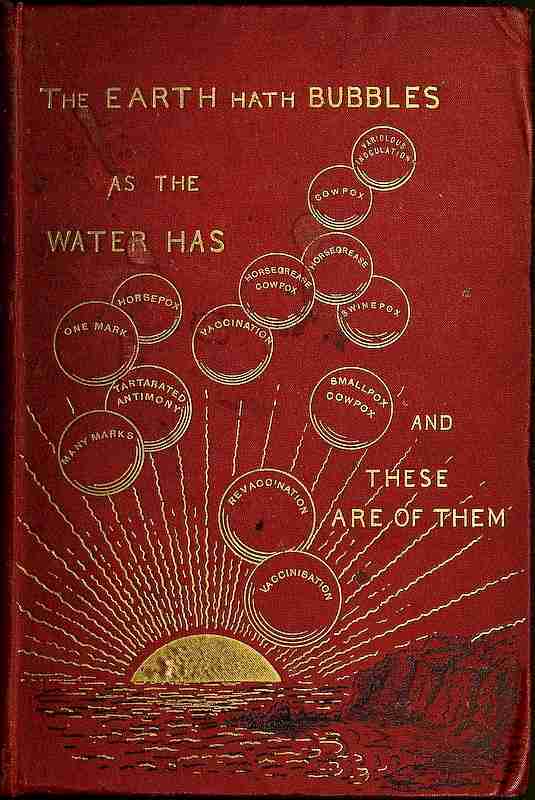
How the new practice was sneered at by some: how it was reprobated as a gross and mischievous imposition: how it was stigmatised with the appellation of the Gloucestershire bubble: and how the Inquirers were considered by many persons as fit candidates for a certain asylum: to say nothing of the villainous jests made on the occasion, are recent in our memory.[118]
FOOTNOTES:
[114] Baron’s Life of Jenner, vol. i. p. 360.
[115] Rees’s Cyclopædia, vol. 38. London, 1819. The writer of the article himself inoculated Woodville with the Grease.
[116] Mr. Cooke’s letter was reprinted in the Medical and Physical Journal, vol. i. p. 322. London, 1799.
[117] By and by controversy with the Smallpoxers waxed hot, and then the Cowpoxers averred that thousands of lives were annually lost by their practice.
[118] Examination of Report of Committee of House of Commons. London, 1802.