
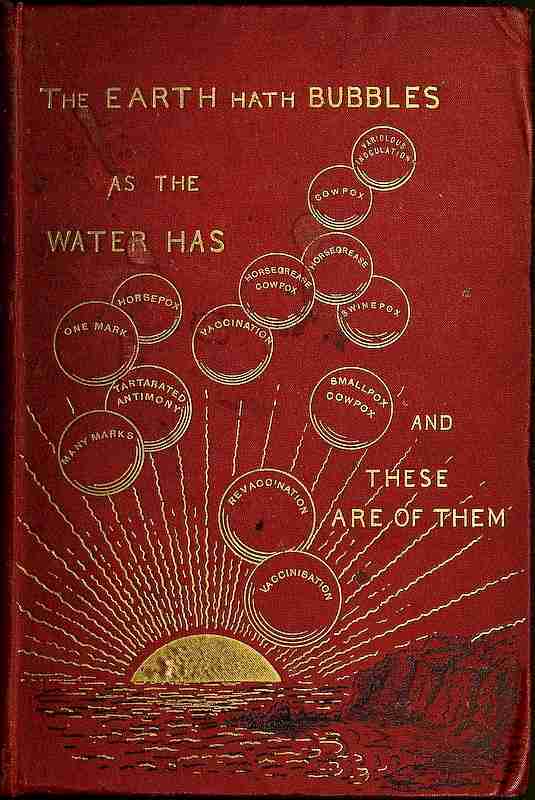
CHAPTER IX.
A DISHONOURABLE TRANSFORMATION.
Honour was abundant, but honour is windy fare, and Jenner had an eye for something more substantial. Among his papers we read—
While the vaccine discovery was progressive, the joy I felt at the prospect before me of being the instrument destined to take away from the world one of its greatest calamities, blended with the fond hope of enjoying independence and domestic peace and happiness, was often so excessive that, in pursuing my favourite subject among the meadows, I have sometimes found myself in a kind of reverie. It is pleasant to me to recollect that these reflections always ended in devout acknowledgments to that Being from whom this and all other mercies flow.[124]
But how was the fond hope of enjoying independence to be realised? The question was discussed by Jenner and his friends, and it was finally decided to apply to the House of Commons for a reward. But in order to go to Parliament it was necessary to have a good case, and Jenner’s case was open to various objections. The Inquiry, published in 1798, was by no means a manual of practice. Its prescription was Horsegrease Cowpox; but such Cowpox was neither producible nor accounted tolerable. Cowpox that did not originate in Horsegrease, Jenner had adjudged spurious; and yet such spurious Cowpox had been adopted by Pearson and Woodville, and under their influence had obtained extraordinary popularity. It was therefore by no means improbable that any claim for cash wherewith to enjoy independence might be seriously contested. In this strait, what was to be done? The question was a grave one, and called for a heroic solution. Resolved therefore, that Horsegrease Cowpox be dropped, and with it the use of escharotics for the subjugation of the pustules produced thereby. Absolute silence should thenceforth be his rule as to Horsegrease. So much for the negative position: the positive was more difficult. To claim Cowpox as his own, with the modes of its exhibition devised by Pearson, was an evolution full of hazard, but unless prepared to surrender “the fond hope of enjoying independence,” it must be effected. He had advantages. His name was associated with the new practice: even Pearson had done him homage: neither the medical profession nor the public were likely to study the Inquiry critically, or to trouble their heads over obscure details: Cowpox was to them Cowpox: he had the world’s ear; and opposition would be set down as the ordinary behaviour of envy toward success. Anyhow the transformation must be attempted: otherwise, farewell to dreams of financial independence.
To initiate this transformation, Jenner came to London, and in May, 1801, published a quarto pamphlet of twelve pages, entitled The Origin of the Vaccine Inoculation.
First it was necessary to represent that his investigations had extended over many years—a fact of which there was no sign in the Inquiry, the evidence indeed being distinctly otherwise; and thus he shaped his statement—
My inquiry into the nature of the Cowpox commenced upwards of twenty-five years ago. My attention to this singular disease was first excited by observing that among those whom in the country I was frequently called upon to inoculate, many resisted every effort to give them the Smallpox. These patients I found had undergone a disease they called the Cowpox, contracted by milking Cows affected with a peculiar eruption on their teats. On inquiry, it appeared it had been known among the dairies from time immemorial, and that a vague opinion prevailed that it was a preventive of the Smallpox. This opinion I found was comparatively new among them; for all the older farmers declared they had no such idea in their early days—a circumstance that seemed easily to be accounted for, from my knowing that the common people were very rarely inoculated for the Smallpox till that practice was rendered general by the improved method introduced by the Suttons: so that the working people in the dairies were seldom put to the test of the preventive powers of the Cowpox.
Jenner’s design in the foregoing statement was manifest. It was to minimise the faith of the country folk, and to represent that by his own perspicacity he had discovered the virtue of Cowpox through his failures to inoculate with Smallpox. The inquiries of Pearson and others, however, showed conclusively that in many parts of the south of England, in Ireland, and on the Continent it was believed that to have suffered from Cowpox was to be secure from Smallpox; and the belief was entertained altogether independently of failures to inoculate with Smallpox; just as a similar belief prevailed among farriers as to the prophylaxy of Horsegrease. The faith in Cowpox was neither vague, nor new, nor confined to Jenner’s neighbourhood; and his assertion to the contrary showed with what hardihood he had undertaken to construct a case in his own favour.
In opposition to the rural faith, medical men maintained that it was possible to have Smallpox after Cowpox; and surgeons averred that they had successfully inoculated many who had suffered Cowpox. Indeed it was indubitable professional testimony to this effect that compelled Jenner to forsake his first fancy for Cowpox, and to report the true specific as Horsegrease Cowpox. Having, however, to sacrifice that discovery, and revert to the Cowpox he had discredited, a fresh manœuvre was requisite; and thus was it performed—
In the course of the investigation I found that some of those who seemed to have undergone the Cowpox, nevertheless, on inoculation with the Smallpox, felt its influence just the same as if no disease had been communicated to them by the Cow. This occurrence led me to inquire among the medical practitioners in the country around me, who all agreed in this sentiment, that the Cowpox was not to be relied upon as a certain preventive of the Smallpox. This for a while damped, but did not extinguish my ardour; for as I proceeded I had the satisfaction to learn that the Cow was subject to some varieties of spontaneous eruptions upon her teats, that were all capable of communicating sores to the hands of the milkers, and that whatever sore was derived from the animal was called in the dairy the Cowpox. Thus I surmounted a great obstacle, and, in consequence, was led to form a distinction between these diseases, one of which only I have denominated the true, the others the spurious Cowpox, as they possess no specific power over the constitution.
Here we have the trick before us at the very point of transformation. He consulted with medical practitioners, “who all agreed that Cowpox was not to be relied upon as a certain preventive of Smallpox.” True. What did he do next? He discovered that what Cowpox did not prevent, the variety derived from Horsegrease did. Such was the original revelation of 1798. In 1801 we have a different story, and his quest a different issue. Not a word about the discovery of the sure preventive in Horsegrease Cowpox—not one word! Although his ardour was damped by the medical evidence against Cowpox, he yet prosecuted his inquiry; and to his satisfaction ascertained that what the milkers called Cowpox was not always Cowpox, but that any sores whatever derived from the Cow were so designated. He therefore was led to form a distinction between the diseases, and to denominate one as true and the others as spurious Cowpox.
Thus the Horse, the obnoxious Horse, was got rid of, and the Cow represented as of herself yielding pox, which pox was the Cowpox that Pearson and Woodville (in contempt of Jenner’s 1798 revelation) had brought into fashion; and which it had become all essential for Jenner to claim as his own in order to realise his “fond hope of enjoying independence.”
In this connection the question occurs, Why should “some varieties of spontaneous eruptions” have been designated spurious Cowpox? Such eruptions were not Cowpox in any sense. Why then spurious? That Cows communicated a variety of sores to their milkers, described by them in common as Cowpox, was an assertion for which Jenner never adduced any evidence; which, too, (as we shall see) at a later date he disowned as a misapprehension. Nevertheless spurious Cowpox got the New Inoculation over many difficulties. When Smallpox, or any notable mischief, followed Cowpox it was said, “Ah! the Cowpox must have been spurious; for Smallpox, or any harm, is impossible after true Cowpox.” People did not stay to inquire whether spurious Cowpox (that was to say, matter “from a variety of sores on the Cow,” according to Jenner’s second version) could be propagated from arm-to-arm, even if taken from the Cow by mistake. The illusory Variolous Test and the Spurious Cowpox Dodge worked marvellously for the public deception.
Another point Jenner tried to score at the cost of Pearson and Woodville. When they began to inoculate they found they had to ascertain at what period the virus should be taken from the Cow, and from the arms of the inoculated. Jenner afforded them no guidance. Writing to John Ring, 1st July, 1801, he confessed—
In the early part of my inoculations I had not learned to discriminate between the efficacy of the virus taken at an early and at a late period of the pustule.[125]
Where Jenner had not learned to discriminate, the line became clear in the course of general practice; and Pearson was especially explicit as to the right time for taking virus; but to make good his claim to national consideration, Jenner fancied it necessary to exhibit himself as complete master of the art of Cowpox Inoculation, owing nothing to others; and he therefore proceeded to appropriate the fruit of the common medical experience, assigning it to a season when he alone was in the field. Referring to his separation of true from spurious Cowpox, he thus prosecuted his raid—
This impediment to my progress was not long removed before another, of far greater magnitude in appearance, started up. There were not wanting instances to prove that when the true Cowpox broke out among the cattle at a dairy, the person who had milked an infected animal, and had thereby gone through the disease in common with others, was liable to receive the Smallpox afterwards. This, like the former obstacle, gave a painful check to my fond and aspiring hopes; but reflecting that the operations of Nature are generally uniform, and that it was not probable the human constitution (having undergone the Cowpox) should in some instances be perfectly shielded from the Smallpox, and in many others remain unprotected, I resumed my labours with redoubled ardour. The result was fortunate; for I now discovered that the virus of Cowpox was liable to undergo progressive changes from the same cause precisely as that of Smallpox, and that when it was applied to the human skin in its degenerated state, it would produce the ulcerated effects in as great a degree as when it was not decomposed, and sometimes far greater; but having lost its specific properties, it was incapable of producing that change upon the human frame which is requisite to render it insusceptible of the variolous contagion: so that it became evident a person might milk a Cow one day, and having caught the disease, be for ever secure; while another person, milking the same Cow the next day, might feel the influence of the virus in such a way as to produce a sore, or sores, and, in consequence of this, might experience an indisposition to a considerable extent; yet, as has been observed, the specific quality being lost, the constitution would receive no peculiar impression....
This observation will fully explain the source of those errors which have been committed by many inoculators of the Cowpox. Conceiving the whole process to be extremely simple, as not to admit of a mistake, they have been heedless about the state of the Vaccine Virus; and finding it limpid, as part of it will be, even in an advanced state of the pustule, they have felt an improper confidence, and sometimes mistaken a spurious pustule for that which possesses the perfect character.
No one apparently thought it worth while to expose the fictitious character of these statements, invented by Jenner to justify his pretensions and to baffle objections. Any careful reader of the Inquiry of 1798, and the Origin of Vaccine Inoculation of 1801, cannot fail to perceive the radical inconsistency of the earlier and later narratives, and how a few hasty experiments enveloped in unverifiable conjecture and gossip, came to be magnified into years of arduous research.
He wound up his statement with this flourish and prediction—
The distrust and scepticism which naturally arose in the minds of medical men, on my first announcing so unexpected a discovery, has now nearly disappeared. Many hundreds of them from actual experience, have given their attestations that the inoculated Cowpox proves a perfect security against the Smallpox; and I shall probably be within compass if I say thousands are ready to follow their example; for the scope that this Inoculation has now taken is immense. An hundred thousand persons, upon the smallest computation, have been inoculated in these realms. [May, 1801.] The numbers who have partaken of its benefits throughout Europe and other parts of the globe are incalculable; and it now becomes too manifest to admit of controversy, that the annihilation of the Smallpox, the most dreadful scourge of the human species, must be the final result of this practice.
For the end designed—to establish and exalt a claim with the purpose of exacting corresponding recompense, the Origin of the Vaccine Inoculation was an adroitly drawn document: its veracity is a different matter. A just man, not to say a generous, would have had some praise for Pearson, Woodville, and others to whom the extension of the New Inoculation was due; but Jenner was essentially a mean spirit; and for him to have stated his case truly would have been to jeopardise “the fond hope of enjoying independence.”