
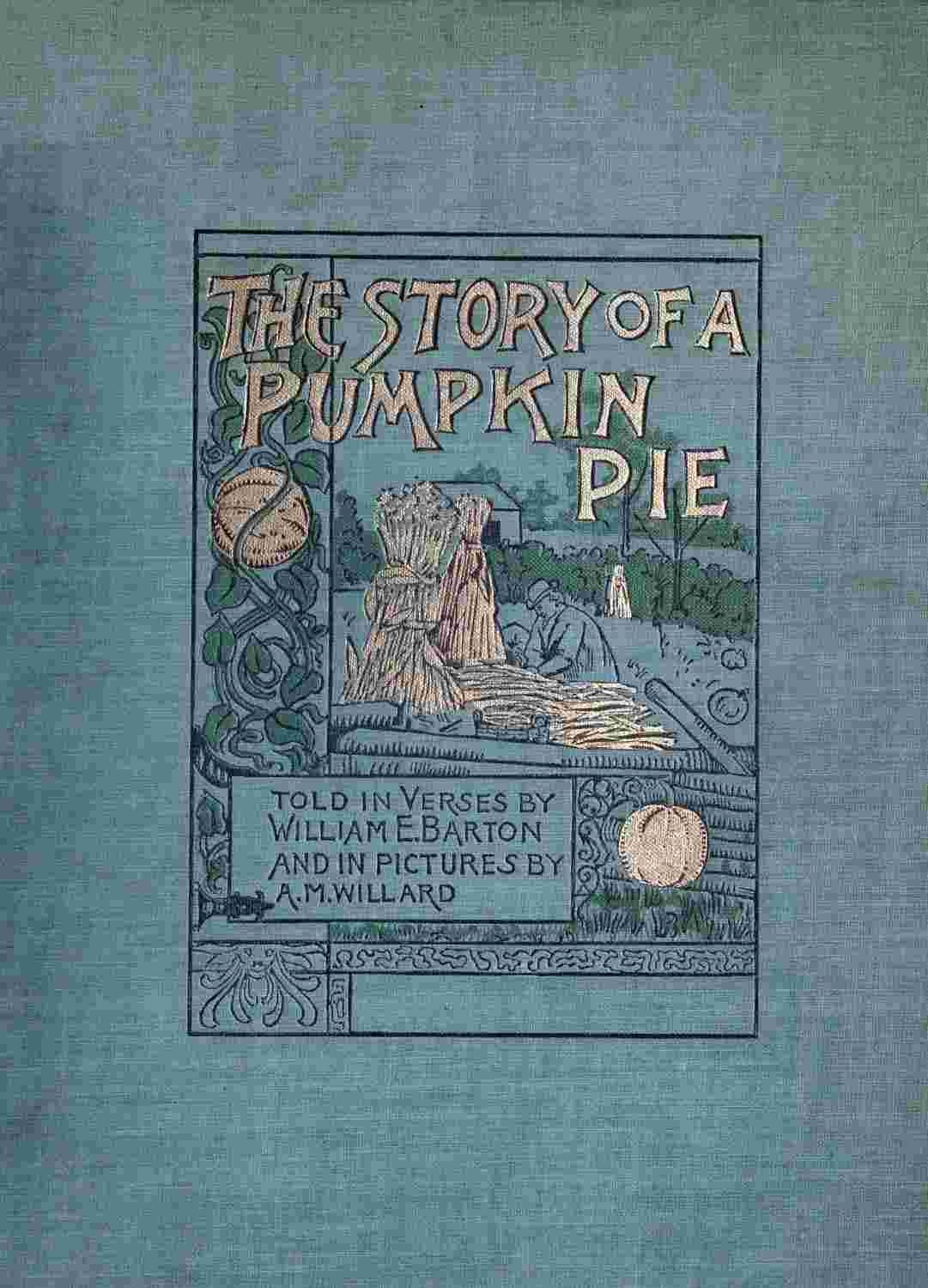
The Project Gutenberg eBook of The Story of a Pumpkin Pie
Title: The Story of a Pumpkin Pie
Author: William E. Barton
Illustrator: Archibald M. Willard
Release date: December 24, 2020 [eBook #64122]
Most recently updated: October 18, 2024
Language: English
Credits: Charlene Taylor, Chuck Greif and the Online Distributed Proofreading Team at https://www.pgdp.net (This file was produced from images generously made available by The Internet Archive/American Libraries.)
THE STORY OF A PUMPKIN PIE
THE STORY OF A
PUMPKIN
PIE
TOLD IN VERSES BY
WILLIAM E. BARTON
AND IN PICTURES BY
A.M. WILLARD.
BOSTON THE PILGRIM PRESS
CHICAGO
Copyright, 1898
By William E. Barton
PUBLISHER’S PREFACE
The author and artist of this book are so much better known in connection with other kinds of literary and artistic work, that a word concerning its origin will be in order. Just before Christmas, 1897, Mr. Willard, the artist, sent to his friend Dr. Barton twenty pencil sketches illustrating the evolution of a pumpkin pie. Dr. Barton wrote some verses to accompany them for his own children. They gave so much pleasure to his little people and to others, and were enjoyed by so many older people as well, that the author and artist have consented to give them to other children.
Dr. Barton is well known as the author of more pretentious works in theology, history, and fiction, and Mr. Willard is known as the painter of “Yankee Doodle,” the most famous patriotic picture painted in this country. His “Minute Men of the Revolution” is hardly less noted, and not less meritorious. His comical pictures also are widely known, with humor varying from the quiet Sunday smile that goes with “Pitching the Tune,” to the rollicking, boisterous laugh belonging to “The Drummer’s Latest Yarn.”
But Mr. Willard first became known to the public as a painter of children. His first pictures to attract attention of the public were a pair called “Pluck,” representing a homemade cart occupied by some little folks, and drawn by a dog in hot pursuit of a rabbit. These made their advent twenty odd years ago when the chromo was in its glory, and found their way into thousands of homes.
It is interesting to notice the recurrence of the theme in these pictures. There is still a dog, and the children must be a generation younger than those in “Pluck,” but they are the same sturdy, industrious, plucky little people.
Mr. Willard’s children are always wholesome and attractive. They are honest, happy, unspoiled little folks, full of fun and ingenuity, and good companions for boys and girls everywhere.
INTRODUCTION
And of Charlie and Fred. Just how and why
They labored with their sister Nell
And Towser helped, this book will tell.
Will know what they themselves should do.
If they will work, and wait, and try,
They, too, may have a pumpkin pie.
And grass grows green and flowers are bright,
There live our girl and jolly boys,
In all the farm home’s cares and joys.
Where cool the creek, though days are hot;
In health and happiness they dwell,
And what they do I now will tell.
I
The winter’s gone. It’s warm to-day!
Let’s gather sticks in the garden lot
And make a jolly fire. Why not?”
And Towser came to help them through.
They raked the sticks, the weeds they brought,
And every brier and twig they sought.
II
That we can work. Let’s plow the ground.
We’ll make a garden all our own,
And have a pumpkin in it grown.”
And started there to plow the lot.
Carl was a horse, the dog another;
The plowman was the younger brother.
III
Their plowing proved too much like work.
The plow was dull, the harness frail,
Their plowing seemed but doomed to fail.
Showed that he felt the heavy strain,
And when they looked across the patch,
Their furrow only seemed a scratch!
IV
With spade and hoe and great big spoon.
And Towser dug at a wee round hole,
Pretending that he smelt a mole.
Swift goes the day that pleasure brings.
And deep they dug the mellow soil,
And raked it smooth with patient toil.
V
It makes folks hungry, thus to play.
They ate their fill of bread and meat,
And mother smiled to see them eat.
Back to the garden did they run;
And Helen bore, as swift she ran,
Some pumpkin seeds in a small tin pan.
VI
And patience is as great an art
As farming is; but you must know
Without it pumpkins will not grow!
They thought they would not go again.
Busy with other kinds of play,
A week or more they stayed away.
VII
But day and night the wee vines grew.
Each day they helped their mother dear,
Each week some wonder did appear.
In two weeks more a green ball round,
That grew upon the pumpkin vine:
And Carl and Fred cried, “This is fine!”
VIII
And up the corn grew rank and high;
Beyond where they their seed had sown,
The cornfield stretched, a forest grown.
With bare brown feet and torn straw hat.
Between the corn-rows on the ground
Their pumpkin lay, large, green, and round.
IX
With books and lunch and noisy glee,
Went off to school, their tasks to learn,
And Towser waited their return.
They had but little time for play,
But drove the cows, the chickens fed,
Then supper ate and went to bed.
X
With frosts that unripe pumpkins kill.
They shivered in their beds so warm
Lest Jack Frost should their pumpkin harm.
Their pumpkin now was ripe indeed.
And on the next bright Saturday,
’Twas warm, and fine for work or play,
XI
Adown the field and toward the gate,
With Helen perched upon its crest,
And Towser doing quite his best!
More royally than Helen shone;
No steed more proud than Towser bore
A princess to the palace door.
XII
So Towser thought he had a right
To chase a neighbor’s cur away
Who came intruding that high day.
’Spite Carl’s rebuke and Helen’s fears.
Nell tugged the lines; the boys cried, “Whoa!”
But fiercely on did Towser go!
XIII
In telling dogs to bark and bite!
O Towser, thou didst little know
How great the wreck thy wrath would show!
Are small, but little childhood knows.
The children wept and scolded sore,
And Towser they would love no more!
XIV
If Helen’s head and Helen’s hat
Were badly damaged by the fall?
The pumpkin was not harmed at all!
It still will make a monstrous pie.
Your hat’s all right. ’Twas pretty old,
And mother, I am sure, won’t scold!”
XV
But these young folks knew what to do.
The saw and hammer quick they brought,
And all their skill and wisdom sought.
To mend it took till almost night.
The boys their anger soon forgot,
And Helen, too, the aching spot.
XVI
Harnessed and vowing to be good.
They rolled it in, and to the door
The pumpkin now with joy they bore!
Lest he should chase a dog again.
But never horse more faithful proved
Than Towser to the lads he loved.
XVII
With memories of a happy year.
The children to the woodshed went
And to the axe their backs they bent,
To make it into pumpkin pies;
Yet saved the seeds to plant next spring,
That these might other pumpkins bring.
XVIII
And seasoned it with sweet and spice,
And rolled the crust so crisp and thin
To bake the precious pumpkin in.
Until the oven claimed the pie,
And then with appetites most keen
They scraped the pan and licked it clean.
XIX
And at the church our children found.
They sat quite still, and did no wrong,
But, oh, that sermon seemed so long!
The words the governor had said,
And told the reasons why, thought he,
They all should very thankful be.
XX
And all the table had been cleared,
Father and mother said that they
Had had enough to eat that day.
We’re ready now for pumpkin pie!”
So mother cut them each a slice,
And, bless my heart, but it was nice!
CONCLUSION
Will know next spring just what to do.
For patience and hard work, you know,
Are needed to make pumpkins grow.
Some other things than pumpkin seed.
But patience seeds take long to grow,
And now’s the time of year to sow!
By spring, I think, you’ll know just how.
And all you learn, I’m glad to tell,
Is good for other things as well.
Mother will gladly do the rest.
And when Thanksgiving Day draws nigh
I hope you’ll get your pumpkin pie.