
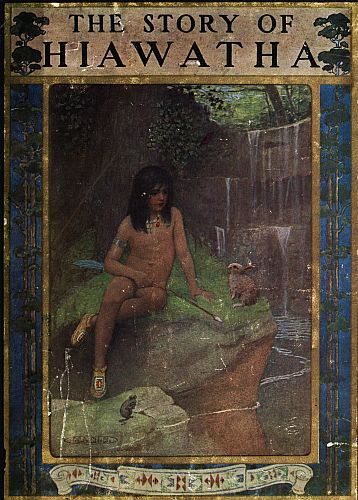
The Project Gutenberg eBook of The Story of Hiawatha, Adapted from Longfellow
Title: The Story of Hiawatha, Adapted from Longfellow
Author: Henry Wadsworth Longfellow
Winston Stokes
Illustrator: Maria Louise Kirk
Release date: April 9, 2010 [eBook #31926]
Most recently updated: January 6, 2021
Language: English
Credits: Produced by Emmy, Tor Martin Kristiansen and the Online
Distributed Proofreading Team at https://www.pgdp.net (This
file was produced from images generously made available
by The Internet Archive)
THE STORY OF HIAWATHA
THE STORY OF HIAWATHA
ADAPTED FROM
:LONGFELLOW:
BY
WINSTON STOKES
Illustrated by M · L · KIRK
NEW YORK
FREDERICK · A · STOKES COMPANY
PUBLISHERS
Frederick A. Stokes Company
All rights reserved
September, 1910
PREFACE
In this land of change it is important that we may learn a little of the childlike people who preceded us; who hunted, fished and worshipped long ago where we now make our homes and lead our lives. No other legends have so strange a charm, or such appealing local interest, as legends of the wildwood, and nowhere are these so well expressed as in Longfellow's poem of Hiawatha.
To furnish a simple medium through which both younger and older people of today may be brought closer, by Longfellow, to the mystery of the forest, this prose rendering of "Hiawatha" has been written. It follows closely the narrative of the poem, and in many places Longfellow's own words have been introduced into its pages, for the purpose of this volume is to awaken interest and pleasure in the poem itself.
CONTENTS
THE STORY OF HIAWATHA
| PAGE | ||
| Preface | vii | |
| CHAPTER | ||
| I. | The Peace-Pipe | 1 |
| II. | The Four Winds | 3 |
| III. | Hiawatha's Childhood | 11 |
| IV. | Hiawatha and Mudjekeewis | 15 |
| V. | Hiawatha's Fasting | 19 |
| VI. | Hiawatha's Friends | 23 |
| VII. | Hiawatha's Sailing | 27 |
| VIII. | Hiawatha's Fishing | 30 |
| IX. | Hiawatha and the Pearl-Feather | 34 |
| X. | Hiawatha's Wooing | 38 |
| XI. | Hiawatha's Wedding Feast | 43 |
| XII. | The Son of the Evening Star | 47 |
| XIII. | Blessing the Cornfields | 53 |
| XIV. | Picture Writing | 57 |
| XV. | Hiawatha's Lamentation | 60 |
| XVI. | Pau-Puk-Keewis | 65 |
| XVII. | The Hunting of Pau-Puk-Keewis | 70 |
| XVIII. | The Death of Kwasind | 76 |
| XIX. | The Ghosts | 80 |
| XX. | The Famine | 84 |
| XXI. | The White Man's Foot | 88 |
| XXII. | Hiawatha's Departure | 92 |
CONTENTS
THE SONG OF HIAWATHA
| PAGE | ||
| Introduction | 99 | |
| CANTO | ||
| I. | The Peace-Pipe | 105 |
| II. | The Four Winds | 111 |
| III. | Hiawatha's Childhood | 123 |
| IV. | Hiawatha and Mudjekeewis | 133 |
| V. | Hiawatha's Fasting | 144 |
| VI. | Hiawatha's Friends | 156 |
| VII. | Hiawatha's Sailing | 163 |
| VIII. | Hiawatha's Fishing | 168 |
| IX. | Hiawatha and the Pearl-Feather | 178 |
| X. | Hiawatha's Wooing | 189 |
| XI. | Hiawatha's Wedding Feast | 200 |
| XII. | The Son of the Evening Star | 210 |
| XIII. | Blessing the Cornfields | 225 |
| XIV. | Picture Writing | 234 |
| XV. | Hiawatha's Lamentation | 241 |
| XVI. | Pau-Puk-Keewis | 250 |
| XVII. | The Hunting of Pau-Puk-Keewis | 260 |
| XVIII. | The Death of Kwasind | 274 |
| XIX. | The Ghosts | 279 |
| XX. | The Famine | 288 |
| XXI. | The White Man's Foot | 295 |
| XXII. | Hiawatha's Departure | 304 |
ILLUSTRATIONS
| "Of All Beasts He Learned the Language" | Cover |
| "From the Full Moon Fell Nokomis" | Frontispiece |
| FACING PAGE | |
| "Dead He Lay There In the Sunset" | 22 |
| "Pleasant Was the Journey Homeward" | 42 |
| "Seven Long Days and Nights He Sat There" | 86 |
| "Give Me Of Your Roots, O Tamarack" | 164 |
| "Take My Bait, O King of Fishes" | 170 |
| He Began His Mystic Dances | 204 |
| "Held By Unseen Hands But Sinking" | 222 |
| "And Each Figure Had a Meaning" | 236 |
| "Hurled the Pine Cones Down Upon Him" | 278 |
| "Westward, Westward Hiawatha Sailed Into the Fiery Sunset" | 310 |
THE STORY OF HIAWATHA
I
THE PEACE-PIPE
Over the prairies, down the rivers, through the forests, from north and south and east and west, the red men hastened to approach the smoke-cloud. There were Delawares and Dacotahs and Choctaws and Comanches and Pawnees and Blackfeet and Shoshonies,—all the tribes of Indians in the world, and one and all they gathered at the Pipestone Quarry, where the Great Manito stood and waited for them. And the Great Manito saw that they glared at one another angrily, and he stretched his right hand over them and said:
"My children, I have given you a happy land, where you may fish and hunt. I have filled the rivers with the trout and sturgeon. There are wild fowl in the lakes and marshes; there are bears in the forest and bison on the prairie. Now listen to my warning, for I am weary of your endless quarrels: I will send a Prophet to you, who shall guide you and teach you and share your sufferings. Obey him, and all will be well with you. Disobey him, and you shall be scattered like the autumn leaves. Wash the war-paint and the bloodstains from your bodies; mould the red stone of the quarry into peace-pipes, and smoke with me the pipe of peace and brotherhood that shall last forever."
The tones of his deep voice died away, and the Indians broke their weapons and bathed in the sparkling river. They took the red stone of the quarry and made peace-pipes and gathered in a circle; and while they smoked the Great Manito grew taller and mightier and lighter until he drifted on the smoke high above the clouds into the heavens.
II
THE FOUR WINDS
Although Mudjekeewis was so strong that all his enemies were afraid of him, he did not love the war-path, for he alone remembered the warning of the great Manito; and as he wished to be a hero, and yet to do no harm to his fellow men, he decided to hunt and kill the great bear of the mountains, and to take the magic belt of shining shells called wampum that the great bear wore about his neck. Mudjekeewis told this to the Indians, and one and all they shouted: "Honor be to Mudjekeewis!"
For a weapon he took a huge war-club, made of rock and the trunk of a tough young pine, and all alone he went into the Northland to the home of Mishe Mokwa. Many days he hunted, for the great bear knew of his coming, and the monster's savage heart felt fear for the first time; but at last, after a long search, Mudjekeewis heard a sound like far-off thunder, that rose and fell and rose again until the echoes all around were rumbling, and he knew the sound to be the heavy breathing of the giant bear, who slept. Softly Mudjekeewis stole upon him.
The great bear was sprawled upon the mountain, so huge that his fore-quarters rose above the tallest boulders, and on his rough and wrinkled hide the belt of wampum shone like a string of jewels. Still he slept; and Mudjekeewis, almost frightened by the long red talons and the mighty arms and fore-paws of the monster, drew the shining wampum softly over the closed eyes and over the grim muzzle of the bear, whose heavy breathing was hot upon his hands.
Then Mudjekeewis gripped his club and swung it high above his head, shouting his war-cry in a terrible voice, and he struck the great bear on the forehead a blow that would have split the rocks on which the monster slept. The great bear rose and staggered forward, but his senses reeled and his legs trembled beneath him. Stunned, he sat upon his haunches, and from his mighty chest and throat came a little whimpering cry like the crying of a woman. Mudjekeewis laughed at the great bear, and raising his war-club once again, he broke the great bear's skull as ice is broken in winter. He put on the belt of wampum and returned to his own people, who were proud of him and cried out with one voice that the West-wind should be given him to rule. Thenceforth he was known as Kabeyun, father of the winds and ruler of the air.
Kabeyun had three sons, to whom he gave the three remaining winds of heaven. To Wabun he gave the steady East-wind, fresh and damp with the air of the ocean; to the lazy Shawondasee he gave the scented breezes of the south, and to the cruel Kabibonokka he gave the icy gusts and storm-blasts of the Northland.
Wabun, the young and beautiful, ruled the morning, and would fly from hill to hill and plain to plain awakening the world. When he came with the dew of early dawn upon his shoulders the wild fowl would splash amid the marshes and the lakes and rivers wrinkle into life. The squirrels would begin to chatter in the tree-tops, the moose would crash through the thicket, and the smoke would rise from a thousand wigwams.
And yet, although the birds never sang so gayly as when Wabun was in the air, and the flowers never smelled so sweet as when Wabun blew upon their petals, he was not happy, for he lived alone in heaven. But one morning, when he sprang from the cloud bank where he had lain through the night, and when he was passing over a yet unawakened village, Wabun saw a maiden picking rushes from the brink of a river, and as he passed above her she looked up with eyes as blue as two blue lakes. Every morning she waited for him by the river bank, and Wabun loved the beautiful maiden. So he came down to earth and he wooed her, wrapped her in his robe of crimson till he changed her to a star and he bore her high into the heavens. There they may be seen always together, Wabun and the pure, bright star he loves—the Star of Morning.
But his brother, the fierce and cruel Kabibonokka, lived among the eternal ice caves and the snowdrifts of the north. He would whisk away the leaves in autumn and send the sleet through the naked forest; he would drive the wild fowl swiftly to the south and rush through the woods after them, roaring and rattling the branches. He would bind the lakes and rivers in the keenest, hardest ice, and make them hum and sing beneath him as he whirled along beneath the stars, and he would cause great floes and icebergs to creak and groan and grind together in agony of cold.
Once Kabibonokka was rushing southward after the departing wild fowl, when he saw a figure on the frozen moorland. It was Shingebis, the diver, who had stayed in the country of the North-wind long after his tribe had gone away, and Shingebis was making ready to pass the winter there in spite of Kabibonokka and his gusty anger. He was dragging strings of fish to his winter lodge—enough to last him until spring should set the rivers free and fill the air once more with wild fowl and the waters with returning salmon.
What did Shingebis care for the anger of Kabibonokka? He had four great logs to burn as firewood (one for each moon of the winter), and he stretched himself before the blazing fire and ate and laughed and sang as merrily as if the sun were warm and bright without his cheery wigwam.
"Ho," cried Kabibonokka, "I will rush upon him! I will shake his lodge to pieces! I will scatter his bright fire and drive him far to the south!" And in the night Kabibonokka piled the snowdrifts high about the lodge of Shingebis, and shook the lodge-pole and wailed around the smoke-flue until the flames flared and the ashes were scattered on the floor. But Shingebis cared not at all. He merely turned the log until it burned more brightly, and laughed and sang as he had done before, only a little louder: "O Kabibonokka, you are but my fellow-mortal!"
"I will freeze him with my bitter breath!" roared Kabibonokka; "I will turn him to a block of ice," and he burst into the lodge of Shingebis. But although Shingebis knew by the sudden coldness on his back that Kabibonokka stood beside him, he did not even turn his head, but blew upon the embers, struck the coals and made the sparks flicker up the smoke-flue, while he laughed and sang over and over again: "O Kabibonokka, you are but my fellow-mortal!"
Drops of sweat trickled down Kabibonokka's forehead, and his limbs grew hot and moist and commenced to melt away. From his snow-sprinkled locks the water dripped as from the melting icicles in spring, and the steam rose from his shoulders. He rushed from the lodge and howled upon the moorland; for he could not bear the heat and the merry laughter and the singing of Shingebis, the diver.
"Come out and wrestle with me!" cried Kabibonokka. "Come and meet me face to face upon the moorland!" And he stamped upon the ice and made it thicker; breathed upon the snow and made it harder; raged upon the frozen marshes against Shingebis, and the warm, merry fire that had driven him away.
Then Shingebis, the diver, left his lodge and all the warmth and light that was in it, and he wrestled all night long on the marshes with Kabibonokka, until the North-wind's frozen grasp became more feeble and his strength was gone. And Kabibonokka rose from the fight and fled from Shingebis far away into the very heart of his frozen kingdom in the north.
Shawondasee, the lazy one, ruler of the South-wind, had his kingdom in the land of warmth and pleasure of the sunlit tropics. The smoke of his pipe would fill the air with a dreamy haze that caused the grapes and melons to swell into delicious ripeness. He breathed upon the fields until they yielded rich tobacco; he dropped soft and starry blossoms on the meadows and filled the shaded woods with the singing of a hundred different birds.
How the wild rose and the shy arbutus and the lily, sweet and languid, loved the idle Shawondasee! How the frost-weary and withered earth would melt and mellow at his sunny touch! Happy Shawondasee! In all his life he had a single sorrow—just one sleepy little sting of pain. He had seen a maiden clad in purest green, with hair as yellow as the bright breast of the oriole, and she stood and nodded at him from the prairie toward the north. But Shawondasee, although he loved the bright-haired maiden and longed for her until he filled the air with sighs of tenderness, was so lazy and listless that he never sought to win her love. Never did he rouse himself and tell her of his passion, but he stayed far to the southward, and murmured half asleep among the palm-trees as he dreamed of the bright maiden.
One morning, when he awoke and gazed as usual toward the north, he saw that the beautiful golden hair of the maiden had become as white as snow, and Shawondasee cried out in his sorrow: "Ah, my brother of the North-wind, you have robbed me of my treasure! You have stolen the bright-haired maiden, and have wooed her with your stories of the Northland!" and Shawondasee wandered through the air, sighing with passion until, lo and behold! the maiden disappeared.
Foolish Shawondasee! It was no maiden that you longed for. It was the prairie dandelion, and you puffed her away forever with your useless sighing.
III
HIAWATHA'S CHILDHOOD
In the full moon, long ago, the beautiful Nokomis was swinging in a swing of grape-vines and playing with her women, when one of them, who had always wished to do her harm, cut the swing and let Nokomis fall to earth. As she fell, she was so fair and bright that she seemed to be a star flashing downward through the air, and the Indians all cried out: "See, a star is dropping to the meadow!"
There on the meadow, among the blossoms and the grasses, a daughter was born to Nokomis, and she called her daughter Wenonah. And her daughter, who was born beneath the clear moon and the bright stars of heaven, grew into a maiden sweeter than the lilies of the prairie, lovelier than the moonlight and purer than the light of any star.
Wenonah was so beautiful that the West-wind, the mighty West-wind, Mudjekeewis, came and whispered tenderly into her ear until she loved him. But the West-wind did not love Wenonah long. He went away to his kingdom on the mountains, and after he had gone Wenonah had a son whom she named Hiawatha, the child of the West-wind. But Wenonah was so sad because the West-wind had deserted her that she died soon after Hiawatha was born, and the infant Hiawatha, without father or mother, was taken to Nokomis' wigwam, which stood beside a broad and shining lake called "The Big-Sea-Water."
There he lived and was nursed by his grandmother, Nokomis, who sang to him and rocked him in his cradle. When he cried Nokomis would say to him: "Hush, or the naked bear will get thee," and when he awoke in the night she taught him all about the stars, and showed him the spirits that we call the northern lights dance the Death-dance far in the north.
On the summer evenings, little Hiawatha would hear the pine-trees whisper to one another and the water lapping in the lake, and he would see the fire-flies twinkle in the twilight; and when he saw the moon and all the dark spots on it he asked Nokomis what they were, and she told him that a very angry warrior had once seized his grandmother and thrown her up into the sky at midnight, "right up to the moon," said Nokomis, "and that is her body that you see there."
When Hiawatha saw the rainbow, with the sun shining on it, he said: "What is that, Nokomis?" and Nokomis answered, saying: "That is the heaven of the flowers, where all the flowers that fade on the earth blossom once again." And when Hiawatha heard the owls hooting through the night he asked Nokomis: "What are those?" And Nokomis answered: "Those are the owls and the owlets, talking to each other in their native language."
Then Hiawatha learned the language of all the birds of the air, all about their nests, how they learned to fly and where they went in winter; and he learned so much that he could talk to them just as if he were a bird himself. He learned the language of all the beasts of the forest, and they told him all their secrets. The beavers showed him how they built their houses, the squirrels took him to the places where they hid their acorns, and the rabbits told him why they were so timid. Hiawatha talked with all the animals that he met, and he called them "Hiawatha's brothers."
Nokomis had a friend called Iagoo the Boaster, because he told so many stories about great deeds that he had never done, and this Iagoo once made a bow for Hiawatha, and said to him: "Take this bow, and go into the forest hunting. Kill a fine roebuck and bring us back his horns." So Hiawatha went into the forest all alone with his bow and arrows, and because he knew the language of the wild things he could tell what all the birds and animals were saying to him.
"Do not shoot us, Hiawatha!" said the robins; and the squirrels scrambled in fright up the trunks of the trees, coughing and chattering: "Do not shoot us, Hiawatha!" But for once Hiawatha did not care or even hear what the birds and beasts were saying to him.
At last he saw the tracks of the red deer, and he followed them to the river bank, where he hid among the bushes and waited until two antlers rose above the thicket and a fine buck stepped out into the path and snuffed the wind. Hiawatha's heart beat quickly and he rose to one knee and aimed his arrow. "Twang!" went the bowstring, and the buck leaped high into the air and fell down dead, with the arrow in his heart. Hiawatha dragged the buck that he had killed back to the wigwam of Nokomis, and Nokomis and Iagoo were much pleased. From the buck-skin they made a fine cloak for Hiawatha; they hung up the antlers in the wigwam, and invited everybody in the village to a feast of deer's flesh. And the Indians all came and feasted, and called Hiawatha "Strong Heart."
IV
HIAWATHA AND MUDJEKEEWIS
Hiawatha thought a great deal about his father, Mudjekeewis, and often plagued Nokomis with questions about him, until at last she told Hiawatha how his mother had loved Mudjekeewis, who left her to die of sorrow; and Hiawatha was so angry when he heard the story that his heart felt like a coal of fire. He said to Nokomis: "I will talk with Mudjekeewis, my father, and to find him I will go to the Land of the Sunset, where he has his kingdom."
So Hiawatha dressed himself for travel and armed himself with bow and a war-club, took his magic mittens and his magic moccasins, and set out all alone to travel to the kingdom of the West-wind. And although Nokomis called after him and begged him to turn back, he would not listen to her, but went away into the forest.
For days and days he traveled. He passed the Mississippi River; he crossed the prairies where the buffaloes were herding, and when he came to the Rocky Mountains, where the panther and the grizzly bear have their homes, he reached the Land of the Sunset, and the kingdom of the West-wind. There he found his father, Mudjekeewis.
When Hiawatha saw his father he was as nearly afraid as he had ever been in his life, for his father's cloudy hair tossed and waved in the air and flashed like the star we call the comet, trailing long streams of fire through the sky. But when Mudjekeewis saw what a strong and handsome man his son had grown to be, he was proud and happy; for he knew that Hiawatha had all of his own early strength and all the beauty of the dead Wenonah.
"Welcome, my son," said Mudjekeewis, "to the kingdom of the West-wind. I have waited for you many years, and have grown very lonely." And Mudjekeewis and Hiawatha talked long together; but all the while Hiawatha was thinking of his dead mother and the wrong that had been done to her, and he became more and more angry.
He hid his anger, however, and listened to what Mudjekeewis told him, and Mudjekeewis boasted of his own early bravery and of his body that was so tough that nobody could do him any harm. "Can nothing hurt you?" asked Hiawatha, and Mudjekeewis said: "Nothing but the black rock yonder." Then he smiled at Hiawatha and said: "Is there anything that can harm you, my son?" And Hiawatha, who did not wish Mudjekeewis to know that nothing in the world could do him injury, told him that only the bulrush had such power.
Then they talked about other things—of Hiawatha's brothers who ruled the winds, Wabun and Shawondasee and Kabibonokka, and about the beautiful Wenonah, Hiawatha's mother. And Hiawatha cried out then in fury: "Father though you be, you killed Wenonah!" And he struck with his magic mittens the black rock, broke it into pieces, and threw them at Mudjekeewis; but Mudjekeewis blew them back with his breath, and remembering what Hiawatha had said about the bulrushes he tore them up from the mud, roots and all, and used them as a whip to lash his son.
Thus began the fearful fight between Hiawatha and his father, Mudjekeewis. The eagle left his nest and circled in the air above them as they fought; the bulrush bent and waved like a tall tree in a storm, and great pieces of the black rock crashed upon the earth. Three days the fight continued, and Mudjekeewis was driven back—back to the end of the world, where the sun drops down into the empty places every evening.
"Stop!" cried Mudjekeewis, "stop, Hiawatha! You cannot kill me. I have put you to this trial to learn how brave you are. Now I will give you a great prize. Go back to your home and people, and kill all the monsters, and all the giants and the serpents, as I killed the great bear when I was young. And at last when Death draws near you, and his awful eyes glare on you from the darkness, I will give you a part of my kingdom and you shall be ruler of the North-west wind."
Then the battle ended long ago among the mountains; and if you do not believe this story, go there and see for yourself that the bulrush grows by the ponds and rivers, and that the pieces of the black rock are scattered all through the valleys, where they fell after Hiawatha had thrown them at his father.
Hiawatha started homeward, with all the anger taken from his heart. Only once upon his way he stopped and bought the heads of arrows from an old Arrow-maker who lived in the land of the Indians called Dacotahs. The old Arrow-maker had a daughter, whose laugh was as musical as the voice of the waterfall by which she lived, and Hiawatha named her by the name of the rushing waterfall—"Minnehaha"—Laughing Water. When he reached his native village, all he told to Nokomis was of the battle with his father. Of the arrows and the lovely maiden, Minnehaha, he did not say a word.
V
HIAWATHA'S FASTING
The next day, Hiawatha walked by the bank of the river, and saw the wild rice growing and the blueberries and the wild strawberries and the grape-vine that filled the air with pleasant odors; and he knew that when cold winter came, all this fruit would wither and the Indians would have no more of it to eat. Again he prayed to the Great Manito to tell him of some food that the Indians might enjoy in winter and summer, in autumn and in spring.
The third day that Hiawatha fasted, he was too weak to walk about the forest, and he sat by the shore of the lake and watched the yellow perch darting about in the sunny water. Far out in the middle of the lake he saw Nahma, the big sturgeon, leap into the air with a shower of spray and fall back into the water with a crash; and every now and then the pike would chase a school of minnows into the shallow water at the edges of the lake and dart among them like an arrow. And Hiawatha thought of how a hot summer might dry up the lakes and rivers and kill the fish, or drive them into such deep water that nobody could catch them; and he called out to the Great Manito, asking a third time for some food that the Indians could store away and use when there was no game in the forest, and no fruit on the river banks or in the fields, and no fish in any of the lakes and rivers.
On the fourth day that Hiawatha fasted, he was so weak from hunger that he could not even go out and sit beside the lake, but lay on his back in his wigwam and watched the rising sun burn away the mist, and he looked up into the blue sky, wondering if the Great Manito had heard his prayers and would tell him of this food that he wished so much to find. And just as the sun was sinking down behind the hills, Hiawatha saw a young man with golden hair coming through the forest toward his wigwam, and the young man wore a wonderful dress of the brightest green, with silky yellow fringes and gay tassels that waved behind him in the wind.
The young man walked right into Hiawatha's wigwam and said: "Hiawatha, my name is Mondamin, and I have been sent by the Great Manito to tell you that he has heard your prayers and will give you the food that you wish to find. But you must work hard and suffer a great deal before this food is given you, and you must now come out of your wigwam and wrestle with me in the forest."
Then Hiawatha rose from his bed of leaves and branches, but he was so weak that it was all he could do to follow Mondamin from the wigwam. He wrestled with Mondamin, and as soon as he touched him his strength began to return. They wrestled for a long time and at last Mondamin said: "It is enough. You have wrestled bravely, Hiawatha. To-morrow I will come again and wrestle with you." He vanished, and Hiawatha could not tell whether he had sunk into the ground or disappeared into the air.