
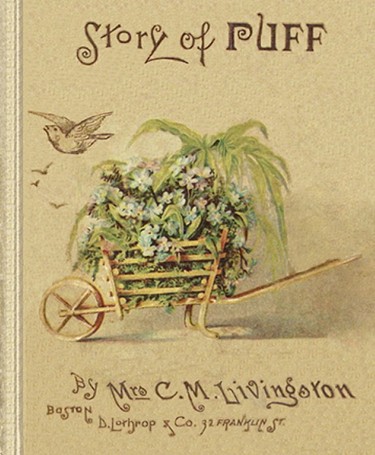
The Project Gutenberg eBook of The story of Puff
Title: The story of Puff
Author: Mrs. C. M. Livingston
Release date: December 3, 2025 [eBook #77391]
Language: English
Original publication: Boston: D. Lothrop and Company, 1883
Transcriber's note: Unusual and inconsistent spelling is as printed.
DODY.
THE STORY OF PUFF
BY
MRS. C. M. LIVINGSTON
BOSTON
D. LOTHROP AND COMPANY
FRANKLIN STREET
COPYRIGHT, 1883.
D. LOTHROP AND COMPANY.
CONTENTS.
ILLUSTRATIONS.
A little Girl came with a Basket
What a lovely Spot my Home was
They brought me fresh Chickweed
Making a Breakfast of Cherries
Dody cried as if her Heart would break
Dear Rose lay on a Bed of Flowers
Such a Chattering as they kept up
Everything looks fresh and clean
How dreary the pretty World began to look
STORY OF PUFF.
CHAPTER I.
I belong to the Canary family, and that is a very good
old family as everybody very well knows. The first that I can remember
of anything was the time that I was taken away from my mother and
brothers and sisters. A little girl came with a basket after me. She
had on a blue dress and a white sunbonnet, and her name was Rita. I was
frightened almost to death, and screamed with all my might when she
took hold of me; my mother screamed too, and spread out her wings and
scolded, but it did no good. I was hurried into the basket, the cover
shut down tight, and there I was in the dark. It was dreadful. I could
hardly breathe.
A LITTLE GIRL CAME WITH A BASKET.
When she got home, she took me out of the basket and put me in a small wire cage. I curled up in one corner, and did not dare to look about me for a long time. They brought me some supper, but I would not taste it. I was only just learning to feed myself; my dear mother used to feed me nice bits from her bill; my heart swelled right up in my throat. I could not have eaten if I had tried.
When it began to grow dark, I cried as hard as I could: we used to cuddle down under mother's wings and go to sleep; I thought my heart would break. Towards morning I tucked my bill in my neck, and snugged down in a heap with one foot under me and got a little sleep.
I was wakened next morning by the sun shining right into my cage. I was glad of it, for I had been quite cold. My feathers were not so very thick yet. Pretty soon two little girls, Rita and her sister Dody, came and talked to me. Dody was a little bit of a round-faced girl, with bright blue eyes and red cheeks.
I loved her right away. She said "Poor birdie!" and her voice was as sweet as my little sister's voice when she said "peep" to me in the mornings. They stood and looked at me a long time, and talked about me. "How bright his eyes are!" they said, and, "What funny little feet!" "How pretty he will be when he gets all his feathers." Then their mother called, "Children, come to breakfast," and they ran off.
I ate a very few seeds for my breakfast, and drank a little water. Then I tried to dress my feathers just as I had seen my dear mother do hers, but mine would not lie down smoothly. After breakfast they came back and talked to me again, but I never gave a single chirp in answer. It was a long, sad day, and I was glad when night came again.
Just as I was going to bed, Dody came to the cage with her hands full of little fixings. I wondered what she was going to do. I flew up on the top perch and watched her. She opened the door, and in one corner of my floor she put a piece of cotton, soft stuff like thistledown. Then she spread some pieces of white flannel on it, and covered it with a piece of pink stuff. Then what did she do but catch me and try to put me in the little bed she had made.
I tried my best to make her know that birds didn't sleep in beds, but she kept saying, "Poor Puffy was tired! Shall have a nice bed, so he shall."
So she put me on the soft little bed, and spread the blanket and the pink thing over me; then she took her hand off and I flew right back to my perch.
"Why, Puffy!" she said. "You musn't do so."
Then we had another hard time. Her little hand chased me about the cage till I was ready to drop, but she got me. She put me in the bed again and held me down. She tucked the blanket around me, and said:
"Dear Puff, it's a very cold night; little birdies will freeze if they don't cover up. Dody wants you to learn to sleep in a bed, just as she does. That's no way to rest; get way up on a perch, and stand on one foot, and stick your head in your feathers way behind you. I'll just tell you, Puffy, we ain't going to have any such uncomfortable works in this house. Now be still, and I'll sing you to sleep."
I wish I could tell you just how she looked while she sat there singing her sweet little hymn:
"Hush my dear, lie still and slumber,
Holy angels guard thy bed."
Her singing was so sweet, and she looked so loving! If anybody could make me sleep in a bed she could, but I wasn't going to do it not even for her. I thought I should smother, bundled up there, and I knew I was right, for my mother began to teach us to sleep on a perch. I kept still, though. It was no use to flutter; she only squeezed me the harder. Pretty soon she thought I was asleep. She softly raised her hand, and I popped up quick as wink and was back on my top perch in no time. Then poor Dody cried. I felt sorry for her, but I couldn't help it. Her mother came in then, and explained it all out nice to her and she felt better.
They all sat around then, looking at me and talking about me. They tried to find a name for me. One said "Billy," and another said "Dick." "Call him 'Goldy,' he is so yellow," Rita said. But their mother said, "Better call him Puff; he looks just like a little puff ball." They clapped their hands and cried out, "So we will; that's a sweet little name." I never forgot my name from that day to this. I couldn't, I heard it so much.
It was a pretty little home that I had come to. There was no fine furniture in it, but it was snug and warm, the fire was always bright and everybody looked sunshiny. Even when the wind blew and the snow flew, it always seemed as if the sun shone in that room. I think one reason was because everything went on smoothly, and there was a good deal of singing. Rita and Dody sang all their little songs, and evenings and Sundays their father and mother sang with them.
I never shall forget the day I began to sing myself. I didn't know I could. I remember the very first song—Rita and Dody were singing it. It was "Blooming May makes all gay."
It made the girls almost wild with joy when I piped out a few little notes, no louder than a katydid's. They said, "He's going to be a singer! Isn't that nice?"
And they ran and told their mother, and she came and stood looking at me a long time. But I didn't sing a word while she was there. Somehow I couldn't when they were all watching me so. They told all the neighbors, too, and when their father came from his work, they ran to meet him the first thing. I never could see why they made such an ado over it. I thought birds were made on purpose to sing, and of course they all did. But now that I come to think of it, my dear mother did not sing. My father did all the singing in our family. She chirped a little, but it was sweeter than any singing to me.
The cold winter went away and spring came. My cage was hung out of doors under the apple-tree every day now, and here was a beautiful new world, made of soft blue and pretty green and white blossoms. What a lovely spot my home was! A little brown house, with tall old trees around it, standing on a green hill sloping down on one side to a little brook that rattled and hurried over the stones. The trees were covered with pink and white blossoms, and the air was soft and sweet.
There was a wide porch where everybody came to get cool, so I had plenty of company. There were other birds, too, who came often to the apple-tree. I was afraid of them at first, but I soon got over that. One by the name of Jenny Wren, built a nest just in the corner, at the top of the porch. I enjoyed her society very much.
I grew very fast, and could sing almost as well as the birds that came in the trees and sang in the mornings. I began to be very happy, too, and to like my new home. Rita and Dody loved me so much, and I loved them. They always ran to me the first thing when they came from school. They brought me fresh chickweed and lumps of sugar, and sometimes a bit of orange or apple, and I ate it right from their fingers. It was good, too.
There is one thing that I never could understand, and that is why they do not give us oranges to eat all the time when we like them better and they are so much easier to eat than seeds. I do get very tired getting the shells off from my seeds. I would have much more time to sing, if I did not have to keep pecking away at those hard old things all the time. It is a very hard way to earn one's living, I think. And yet it is not so bad as it might be, for my friends in the apple-tree tell me that nobody brings them anything at all, that they pick up their eating just where they can. Sometimes they get plenty, and sometimes not. They eat bugs and worms and all such vile things. Pah! I am sure I should not like that. But then it must be nice to spread one's wings and fly away up into the blue, and sit and swing on a bough of a tall tree.
THEY EAT BUGS.
One morning the little girls brought me some news. They told me that a rich lady who lived down in the village, was going away with all her family for a month, and that she was going to pay them for taking care of her bird while she was gone.
"So you see you are going to have company, Puffy," Rita said. "I'm going to bring him home to-night, and you must be sure to have your feathers all smoothed down nicely, and your best manners on, for he's very stylish, Puffy, and he lives in a great, grand house ten times as big as ours."
That day seemed very long to me, and I dressed my feathers a great many times, and tried to look my best. I grew very restless as it drew near to four o'clock, and hopped up and down stairs till I was all tired out; for you must know my little house is three stories high. There is the first floor, then the first perch, where I stand to reach my seeds and water, and the second one where I sleep nights, and that makes three stories, besides the attic where my swing is.
ON THE BOUGH OF A TALL TREE.
Pretty soon I heard the gate click. I peeped through the leaves. Yes! There he was coming, sure enough—the grand company bird. My heart fluttered so I could hardly breathe, but I flew up-stairs with all speed, curled down on my feet, puffed out my feathers, and tried to look as if I didn't care.
"Here he is, Puff," Rita said, as she came up the steps of the porch with a pretty cage in her hand. "This is Fred, Puffy; why don't you make a bow to him?"
I straightened myself up then and looked at him, and he looked at me, but neither of us spoke. I forgot all about manners. Rita hung his cage very near mine, and went away, and we went on staring at each other. He was a handsome fellow, large, and yellow as buttercups. I thought he looked proud, he stood up so tall and stiff, and snapped his black eyes at me, just as if he were poking fun at something. Then he went up to his highest perch and sat and looked and looked.
I had always thought my cage was a cosey little home until his great gilt one was put by the side of it. Then I began to feel ashamed of my little house, so very small and plain. I remembered just then what Rita said about manners; so I chirped a few times to him in a friendly way, to let him know he was welcome. He never answered my chirps at all, but just kept on staring, and I could feel that he was looking me over from head to foot, as if he were measuring every feather I had on. Of course I could not make as good an appearance as he did; I hadn't had so much time to grow in.
All at once he jumped up on the highest perch he had and began to sing with all his might. He trilled and warbled and went up and down the scale, in and out and every way, and when he came to the high notes, he opened his mouth as wide as he could and screamed. He certainly had a very powerful voice, but not a sweet one. When he went up so high it was just yelling, and that's all you can call it.
When he had finished, he cocked his head on one side and looked at me out of the corner of his eye, as much as to say, "There! Did you ever hear anything like that?"
CHAPTER II.
I WENT on cracking seeds as if I didn't hear him, but
after he had performed two or three times like that, I thought I would
show him I could sing a little, too. I knew I could, for people often
stopped at the gate as they passed, and said to each other, "What a
sweet singer that bird is!"
I had heard the wild birds sing so much that I had caught many of their
airs; so while he was taking his supper, I tuned up. I did my very
best. I was surprised at myself.
Fred was surprised, too. He dropped the seed he was biting in two, and glared fiercely at me. Then his wings began to drop down, and he looked very mad. Then he spread his wings till he looked like a great bat, and flew at the side of his cage as if he would dash right through it, and fly at me. I sung away, and he chattered and scolded and tried his best to get out. I was glad he couldn't. I should not have liked him to come to my cage as mad as he was then.
When I got to the end of my song, I stopped and gave him a little piece of my mind. I don't know how I dared to speak so to a stranger, but I guess I was a little out of patience myself.
I think Fred was all worn out, for he went to bed soon after. I did not go to sleep right away, though I went to my chamber. Somehow I didn't feel so happy as I usually did. I knew I had not been polite or kind to Fred, and I had been jealous and vain. I did not sleep well. I had bad dreams. When I woke in the night, I was afraid. I heard cats walking round I thought. I thought I would try to be a very good little bird to-morrow.
When I woke again, the sun was shining, and Fred was already stirring. He seemed to have forgotten how cross he had been. He said "Good morning," and chirped away quite pleasantly.
After we had eaten breakfast, and taken a bath and dressed ourselves, we sung. We sung together, just as loud and high as we could yell. My throat was almost split, but I wasn't going to let him beat me. For the first few days we did not get along very well. Fred was very quick-tempered. He would spread his wings and open his mouth as if to swallow me, if I said the least thing to provoke him.
Some days we had very good times. Our cages hung so near that we could talk together all we pleased. Fred told me about his life when he was at home; how he hung between lace curtains in a pretty window of a large, fine house, and watched people pass all day long. And there were a great many visitors, and they all said, "What a beautiful bird!" and "What a wonderful singer!" And he had cake and candy, just as much as he wanted, and oranges and bananas, and they had a piano, and when they played, he sang with it, and people said it was as good as a concert. He said it was very dull in that little old brown house, and he wondered I didn't die.
And one day when he felt very good-natured, he told me that I was very handsome, and that I had a wonderful voice, and that I ought to be out in the world where people would admire me. He said, too, that it was a shame to give me nothing but seeds and water to eat; that they were mean, stingy people to treat me so. I did not like to hear him talk in that way about my dear Rita and Dody, who were always so kind to me. But when I came to think it over, it did seem as if I had been treated badly, and I felt cross when Dody filled my seed-cup. I wouldn't touch one for quite a while.
I sat and pouted half the morning, and Dody thought I was sick. She went and told her mother how I acted. Her mother was looking over lettuce for dinner; beautiful green leaves they were—oh! How I wanted to get my bill into it.
Her mother said, "Poor Puffy, he needs something fresh and green. Give him a leaf of lettuce."
So she did—a lovely curly, tender leaf. I was going at it at once, but I waited to see what Fred would do with his leaf. I was afraid he might laugh at me if I ate lettuce. But when I saw him eat his as if he liked it very much, I began on mine. It was so good. In a few days after that the cherries were ripe, and we each had a fresh one every morning. I felt ashamed of being so bad and talking as I had, when a great red juicy cherry was given me every day.
WHAT A LOVELY SPOT MY HOME WAS.
"I can tell you what it is," said Fred one morning, as he was nibbling a big cherry, "it must be a very nice thing to get just as many of these as you want. Think of our sleeping up in that big tree, all tucked in among the leaves, then in the morning making a breakfast of cherries, and away we'd go sailing off just where we please! No cage for us any more! See here, Puff," and Fred came to the side of his cage, and poked his head away out through the wires and spoke low, "let's you and me run away!"
MAKING A BREAKFAST OF CHERRIES.
The idea of such a thing almost took my breath away. I looked up in the blue sky. The white clouds were floating along softly. What if we could escape and fly away up, up, and stand on that soft cloud, and sail along, sail along, through the blue forever! It would be lovely. Just then Rita and Dody came to bring us chickweed, and we had not time to talk about it. But when the time came for our evening song, instead of singing a low, soft hymn, we talked again about running away. Fred talked so much and so fast, that before I knew it I had promised to try to escape. We made up our minds that we would go in the morning.
"The sooner we are off the better," Fred said, "for this is the grandest time in the year. Everything is ripe—cherries and berries, and we shall find hosts of friends as soon as we get out. I was talking with Mr. Wren only yesterday, and he promised to help us in any way he could."
We sat up very late that night laying our plans. We decided to slip out when the cage doors were opened to change the water in our bath-tubs.
"Be quick as a wink when the time comes," Fred said. "Whoever gets out first will wait on the top of that tall lilac for the other. Good-night! We must be off to sleep now, so as to be ready for morning. And don't you go and back out. Have some spirit about you; as if a creature with wings ought to live in a cage, like a poor little mean mouse!"
Then Fred stretched himself up tall, and looked very proud. He bounded into his swing in high spirits, and soon swung himself to sleep. But I couldn't sleep. It seemed dreadful to be going out into the great wide world all alone. Perhaps the cats would get us, or a bad boy shoot us. I could hear the dogs barking, and everything seemed dark and gloomy. I wished I hadn't promised to go. Dody told me once that God took care of little birds, but I couldn't feel sure about it that night. I started at every noise I heard. I was very unhappy.
It was a long night, but morning came at last. Dody was up bright and early. She brought Fred and me each a beautiful fresh clover blossom the first thing she did. Much as I loved clover, I couldn't bear to taste it, I felt so bad, thinking of what we meant to do. I couldn't eat much breakfast, for when I heard the little breakfast bell tinkle, I knew it would be time to start in a little while. I always had sung at prayers, but I couldn't that morning. Dody sat in her little rocking-chair and sung from her hymnbook as hard as she could. It was a sweet hymn, and a tune I liked. But I could not sing a note, and she kept looking at me as if she wanted to know why. Fred sang louder than anybody.
It was but a few minutes afterwards that the girls came to attend to us. They carried our cages out on the back porch, and brought the seed-box and fresh water. Rita tended to me that morning, and Dody took Fred. Dody turned her back just a minute to get the seeds. Fred's door was open a little bit, and he stood down close by it waiting his chance. He slipped out as swift as a butterfly! Dody gave a scream, but Fred spread his wings and went way, way up. How beautifully he soared along. I wished I was with him. I had no chance to get out myself, for Rita shut my door tight and went off trying to catch Fred.
FRED SPREAD HIS WINGS.
Everybody shouted and ran here and there. The neighbors all came over, and one said, "I see him!" and another cried, "There he is!" and at last somebody said, "Here he comes on top of the lilac. Hand me his cage and I'll get up on the fence and hold it towards him. Maybe he'll go in!"
Maybe he didn't! Naughty Fred flew up in the tip-top branch of the maple, and swung gayly back and forth, just as if he greatly enjoyed seeing a woman on the fence with a red face turned up to the sky, and an empty bird-cage in her hand. He only stayed a minute, then he flew far away and was never seen again.
Dody cried as if her heart would break. When I saw how badly everybody felt about Fred's getting away, I couldn't make up my mind to try to go that day. I couldn't go if I had tried, for Rita opened and shut my door in a flash when she waited upon me. I suppose Fred was vexed at me because I didn't come. Rita and Dody and their mother spent nearly all that day out doors looking for him, and they kept his cage hanging out for him a good many days, but he did not come.
DODY CRIED AS IF HER HEART WOULD BREAK.
I missed Fred very much, and felt discontented and unhappy. I did not enjoy life as I did before he came. I was all the time wishing and longing to be somewhere else, and to have things I had not. I did not sing any more. I moped. I thought if I could live in a big, handsome house, such as Fred told me about, and have a golden cage and all those new things to eat, and see people passing back and forth all day, then I should be happy. How could I be expected to content myself always in this back place, seeing nothing all day long but trees and birds and two or three people?
RITA.
Sometimes I thought about following Fred, but I felt a little afraid to go alone. I heard them say that perhaps the cats or dogs had killed him by this time: But I kept thinking of all he had told me, and I made up my mind at last that I would not be a prisoner any more. I would get out and see the world. So now I spent all my time in planning how it should be done. It would not be an easy thing to do. Rita and Dody were so very careful they never left my door open a second. You may wonder how it was that I could make up my mind to leave my dear friends, but when one begins to go wrong, I guess nothing is of any account but the thing they want to do. So night and day I thought and contrived how to escape.
One pleasant afternoon when the little girls got home from school, they came to pet me. They brought a great treat they thought. It was a piece of banana. I wanted to taste it and see what it was like, but I sat sulkily in one corner, and never touched it. They talked to me, but I wouldn't answer.
"Oh dear," said Dody, "he's sick, I know he is."
Her little hot face looked so tired after her long walk, I ought to have been ashamed of myself for acting so.
"Shut the windows and let him out for a little while," her mother said. "That will rest him."
So she took my cage into the dining-room, and opened the door. I flew right out and alighted on the window-sill. I went straight to the window, because, I knew something that I guess Dody had forgotten. There was a hole in one of the dining-room windows, just a little one, no bigger than Dody's hand.
"You stay here, Puffy," Dody said, "and I'll get you some nice cold water, and you'll feel better, birdie dear. I always do when I take a bath."
No sooner had she shut the door than I rushed up to the broken window, and out I went! I was free—free as the wind!
I waited just a minute on the rose bush, and peeped in to see Dody hunting under chairs and tables, and calling, "Where are you, Puffy!"
Then I said softly, "Good-by, dear Dody," and I spread my wings and away, away. I thought I never would stop till I got up into the beautiful blue and sat on one of those soft, white clouds.
CHAPTER III.
I DID stop, though, very soon, to rest me. I didn't
think when I saw the other birds skim through the air that flying would
tire me so. I kept going on toward the blue, but the white clouds
seemed just as far off as when I started.
I came to a lovely garden and stood on a honeysuckle vine a few minutes
to rest myself. The vine clambered over a porch, and I heard voices
talking and laughing. I was enjoying myself very much snuffing the
sweet air from the honeysuckle, when a hand came softly down over me
and drew me in through the vines.
It was so sudden I had no time to get away, and my heart fluttered with fear. The hand was soft and white, and I found when I dared to look up that the owner of it was a beautiful young lady. She was dressed in gauzy white stuff, and was such a pretty creature that I thought I should like to stay with her always.
"Do see what I have found," she said to another lady. "A darling little canary."
Then there gathered about me ever so many ladies dressed in silks and jewels. They talked to me and called me a beauty, and wondered if I could sing.
One lady called a girl, and said, "Angeline, go up in the attic and bring down that old bird-cage."
Then they put me in it and the lady said, "Hang it in the dining-room."
It was near a window that I was placed, and not long after I saw the pretty young lady who caught me, get in a carriage and go away.
I heard them say, "Better take your bird home with you."
But she said, "No, if nobody comes to claim him, he shall belong to Rose."
And who was Rose? I did not find out that night for I soon went to sleep, tired out with my journey. I had time in the morning to look about me before the rest got up. Here I was at last in a large fine house such as Fred told me about. I could see through into the parlor, and there were the lace curtains and pictures, and ever so many pretty things. It was better than being free to live in such a place. I was almost wild with joy. I sung at the top of my voice, and swelled out my feathers till I was three times as big as usual. I should never have any more trouble; everybody would praise me, and I should have everything I wanted. I thought there was only one thing lacking to make me perfectly happy. I wanted a big gold cage like Fred's.
While I was watching them set out the table in a scarlet and white cloth, and china and silver, just wonderful to see, a little girl danced into the room and came toward me.
"Good morning, little birdie," she said. "What's your name? My name's Rose."
Her voice was low and sweet, and she looked like one of the little pinkish-white roses that clamber over the porch at Dody's house. Her eyes were blue, like the sky, and her gold hair hung on her shoulders in pretty waves. I was glad I belonged to Rose. I was just thinking what a nice place I had come to, when I heard a great noise and a boy burst into the room with a whoop and a yell. I trembled when I saw him, for I had heard about boys. He was short and chubby, with very black eyes and hardly no hair on his head—I guess his feathers hadn't grown out.
"Hulloa!" he said. "Who's this?"
Then he poked his fingers through the wires and hooted at me, and kept me flurrying about from side to side, frightened almost to death.
Rose said, "Please, Rob, don't tease him. See, he's afraid, poor birdie!"
He paid no attention to her, though, and I was glad when the breakfast bell called him away. After breakfast both he and Rose went off to school.
It was pretty quiet all day. The dining-room was darkened to keep out the flies, and nobody brought me any nice little bit to eat. I had nothing but seeds and water. I missed my cuttle-bone and my chickweed. I began to be lonely, and to wish I could see Dody. Then I sat and thought just how the little room looked with the roses peeping in at the window. I could see my empty cage hanging there, and dear Dody sad and lonely. A little whisper from somewhere asked me whether I did right to run away, and if, after all, I was going to like my new home so very much better than the old. But I hushed it up with a very loud song.
In a few days something happened. Angeline cane walking in with a great beautiful gilt cage in her hand, larger and handsomer than Fred's even. She opened its door, then she opened my door and put the open doors close together. I stood and looked at it in great astonishment and delight.
Then Angeline said, "Why don't you go in, you little goose?"
I didn't like being called a goose, nor did I think it was a polite way to invite me. But I stepped in, and she shut the door and carried the old cage away. Then she took the new cage into the back parlor, and fastened it on a pretty gilt chain that hung down from the ceiling between the lace curtains of the window. There! Now I had everything just as I wanted it. Was it I, or somebody else, in that great bright cage among the lace curtains, looking out on the gay street? I danced up-stairs and down, and strutted about and tried to look like Fred. I nibbled the cuttle-bone, and took a seed and a drink of water, and tried to sing a little to express my feelings. But, somehow, it seemed as if my throat was all swelled up. I couldn't sound a note.
A DRINK OF WATER.
You would think that then, surely, I was perfectly happy, with everything so nice and a dear little mistress who loved me. But, oh, that boy! I knew as soon as I saw him that my troubles had begun. He seemed to have a great many names. Most of the time it was "Bob," but Rose called him "Rob." When he was going to bed his mother said, "Good-night, Robbie," and his father said "Robert!" when he was naughty, and that was most of the time. Saturdays he nearly tortured the life out of me. He would catch me, and squeeze me till I was almost choked. He would poke at my eyes, and open my mouth and try to get hold of my tongue. I tried to get away from him. If I could, I would have gone out of the window and left everything, and never have come back. Schools ought not to have Saturdays. Rose was in school all the week, and Saturdays she often went to visit her cousins, so nobody knew how the naughty boy tormented me.
I began to find out that Fred had told only the bright side of things. As the weeks passed away, I got tired of the life I led. It was fun at first to watch the people pass, but at last I got very tired watching them come and go, come and go all day long. Some of them looked cross, and some looked sad, and nobody looked very happy. It wasn't half so nice, after all, as hanging under the apple-tree and having calls from the other birds that flew about. Here no birds came to see me, except one ill-natured old sparrow, and he came to pick a quarrel with me. He would dart at my cage when the window was open, his mouth stretched and his eyes fierce as cat's eyes, I learned how to manage him after a while. I would just get back in the further corner of my cage, keep perfectly still, and look at him. So he got ashamed of himself and left me in peace. That was one of my troubles. I had others.
Some days I nearly starved. Everybody would go off and forget me. Not a drop of fresh water, not a seed in my cup, I thought many a day I should die before night. I would get so weak I couldn't sing, and I sat sad and cross and remembered how Rita and Dody never forgot me once. Rose would have seen to me if her mother had allowed her to, but I was left to the care of servants, and Rose went to school very early and did not know how badly I was treated. There were days, though, when I had everything and more too; sugar and orange and berries and cake. Then I often made myself sick. I would rather have had something steady, even if it was plain.
I was very lonely, too. Nobody seemed to have time to give me a kind word. Once when I had sung one of my best songs and did the high notes beautifully, a young man sitting in the room reading a newspaper, said, "What a horrid screecher that bird is. He ought to have his neck wrung!"
Think of that when I had been doing my best to please him! I didn't sing any more for a good many days. I just stood on my highest perch, and looked into the street to see if I couldn't see Rita and Dody coming to take me home. Day after day I tired myself all out watching, but they never came. It was dusty in that window, too. My eyes and nose were full of it. I thought of the pure air in my other home; how sweet the roses smelled in the porch; and Rita and Dody were there and I was not. Oh! If I had only been content in the dear little place. Now I never should see it again. They were better folks, too, in the little house. They never spoke angry words to each other. But in this house I heard a great many; besides there were no prayers and hymns there.
I had worse enemies, too, than Bob, I found out after awhile. One day, when Angeline took me into the kitchen to clean my cage, she left me standing on the kitchen table while she talked with another girl that put her head over the back fence. I was looking about the room, when to my horror I saw stretched out behind the stove a great long gray cat. I kept as still as a mouse—hardly breathed. It was dreadful! What if she should wake up? I had heard awful stories about cats.
I never took my eyes from her. Sure enough she did wake up just then. She stretched herself and washed her face, and then got up and walked about. I kept still. I didn't dare to scream as long as she had not seen me. All of a sudden she turned her head and saw me. Oh, what frightful big yellow eyes she had! She gave one great bound and sprang up on the table. Then I screamed loud and sharp, and Angeline rushed in, just as that dreadful monster had her paw raised all ready to strike at me.
Angeline took a broom and sent that cat out of the door pretty fast. Then she talked real nice to me, and comforted me, and I thought more of her than I ever did before.