
The Project Gutenberg eBook of The story of Robinson Crusoe in Latin
Title: The story of Robinson Crusoe in Latin
Adapted from Daniel Defoe's famous book [or rather, translated from J.H. Campe's "Robinson der Jüngere"] by G.F. Goffeaux. Edited, amended and rearranged by P.A. Barnett
Author: Joachim Heinrich Campe
Daniel Defoe
Editor: P. A. Barnett
Translator: François Joseph Goffaux
Release date: December 7, 2024 [eBook #74851]
Language: Latin
Original publication: London: Longmans, Green, and Co, 1907
Credits: Aurēliānus Agricola
Important note : If during the Middle Ages Latin evolved independently from its classical archetype, the humanists of the Renaissance strove to restore the original language by drawing from copies of the works of ancient authors. These copies being imperfect, the spelling of certain words was impaired with folk etymology and influenced by improper pronunciation, and the length of the vowels, despite its importance in the classical language, was and still is widely neglected. Only the rise of Indo-European studies, especially after 1850, helped restoring and gradually spread the original forms and sounds of the words. Older works, when they are republished, may also benefit from the most recent spelling, and as such show more useful to students who need to learn from the best standards, or just provide a more pleasurable reading experience to more advanced readers. Therefore, this work is offered to you in the original version, but also in a renewed version, with better spelling if applicable, and long vowels noted with macrons. On the other hand, although the spelling has been modified, vocabulary, grammar and syntax, fortunate or not, which belong to the author, were kept as they were out of respect for the original work.
Access to the original version Access to the new version
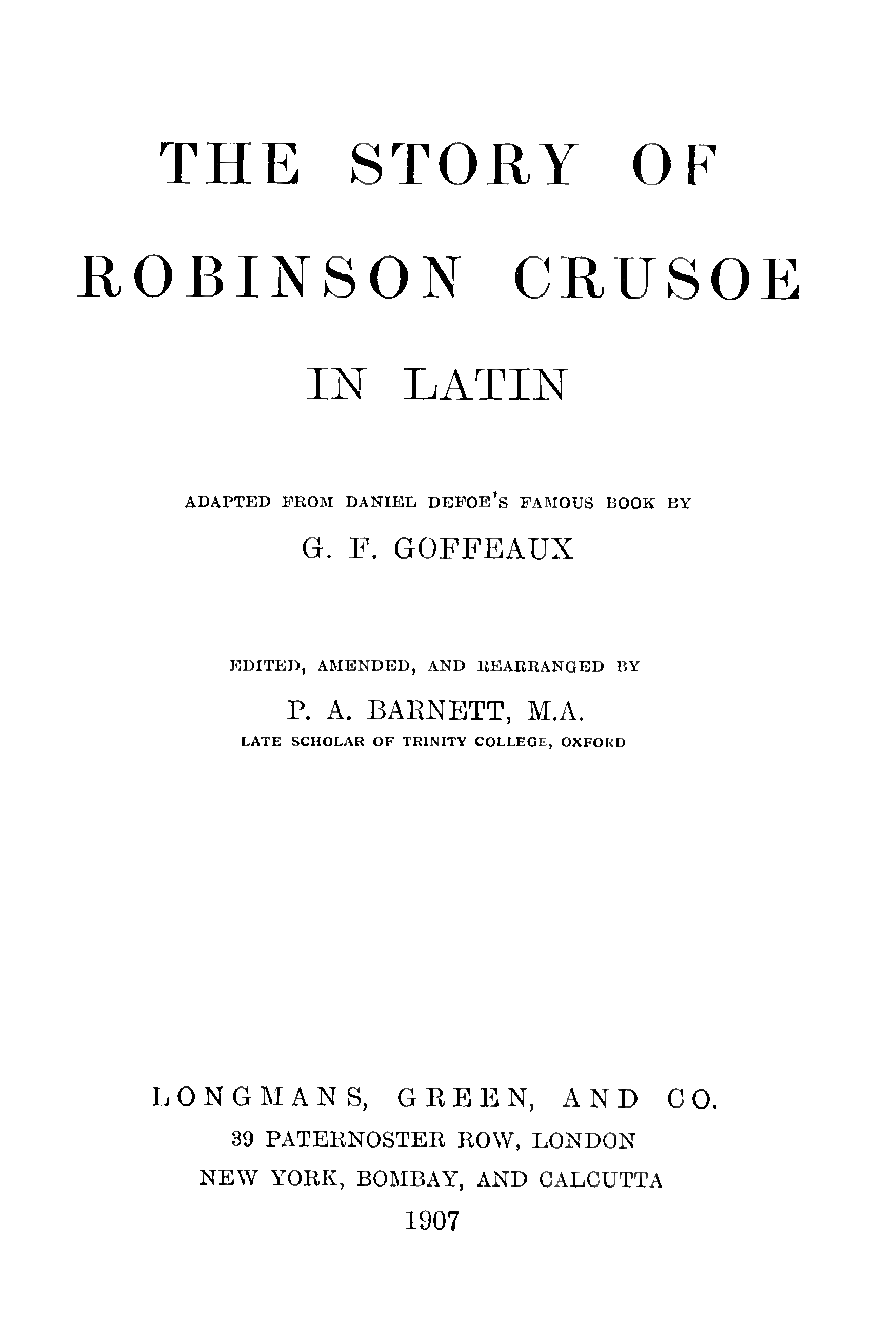
The Story of Robinson Crusoe in Latin
Adapted from Daniel Defoe’s famous book by
G. F. Goffeaux
Edited, amended, and rearranged by
P. A. Barnett, M.A.
Late scholar of Trinity College, Oxford
Lonmans, Green, and Co.
39 Paternoster Row, London
New York, Bombay, and Calcutta
1907
To
Rudyard Kipling
EPISTLE DEDICATORY AND EXPLANATORY
Dear Kipling,
The body, if not the soul, of this little book is due to the labours of an intelligent Frenchman who discovered sixty or seventy years ago that the degenerate practice of introducing young people to the Latin language by means of Cæsar, Cicero, and Vergil failed to engage their interest. The fact has since been rediscovered by persons so eminent, and has been proclaimed with such energy and unaffected ingenuousness, that I do not mind confessing that I have myself long had something more than a suspicion of it.
Goffeaux thought it worth while to write some of the adventures of Robinson Crusoe in Latin, in order that boys who already knew something of the original enchanting history might realise that it was possible to express in that language matters about which a reasonable being might reasonably be interested. His book had considerable vogue ; and after four or five editions had been printed in France, it was printed and reprinted in this country, with English notes.
When a copy of Goffeaux's book came into my way through the kind offices of a friend, I wondered whether it could have exhausted its usefulness in our grandfathers’ time ; whether our children might not get some profit out of it. My Frenchman has, in my hands, been cut down a good deal ; his Latin has been mended ; not less than half of his moral sentiments have been suppressed ; and the result is now offered to the boys and girls of England for what it is worth.
You are in the direct line of great story-tellers, of whom Defoe was greatest in his day ; and I have placed your name in front of my wares because I desire above all things to commend, and make easier to young people, the reading of Latin as literature. I do not call my Goffeaux by that sacred name ; but a healthy boy who is piqued into following Crusoe through a language which Cicero and Cæesar and Vergil (in spite of their imperfect education), would have understood, will the more readily believe that they themselves are better worth reading. And he will assuredly read them the more easily after reading Goffeaux.
I might have begged, I dare say in vain, for the patronage of the professed scholar. I should like to have it ; but I am more concerned to secure yours because whereas Latin literature will not live as an interest of youth — or of old age, for that matter — by reason of its philological or rhetorical or scientific interest, it will live because people love it.
It is unfortunate that Cæsar and Vergil and Cicero neglected to write Latin books for the use of English children. Yet, if we are to present such things in any form which young English people will willingly accept, we must temper the forbidding but necessary Grammar that hedges round the great masterpieces of those great writers with something not quite so austere, at all events superficially. Such fine scholars as Professor Sonnenschein and Mr. Godley have, indeed, led the way — I do not know how people ever got on without “ The New Orbilius ” and “ Ora Maritima ” — and I plead that, after them, Goffeaux may have his chance.
It is true that his style is not classical, nor could all the botching of an even learned editor make it so. It lacks periodic consecutiveness ; its constructions are mostly the simple ordinary constructions ; it does not affect the delicate shades that make native Latin so subtle an instrument of logic and narrative. But for these very reasons it is better fitted for the purpose proposed. And, at any rate, it contains a large vocabulary (a few words, to be sure, invented), which the intelligent boy and girl can pick up as they go along. They can avoid the “ more flagrant forms of guessing, ” against which an eminent friend of your own was solemnly warned, by an occasional use of the dictionary and a glance at the few appended notes.
I hope you will not think this an insufficient apology for my doubly presumptuous effort and dedication.
Very truly yours
P. A. Barnett
1st December, 1906