
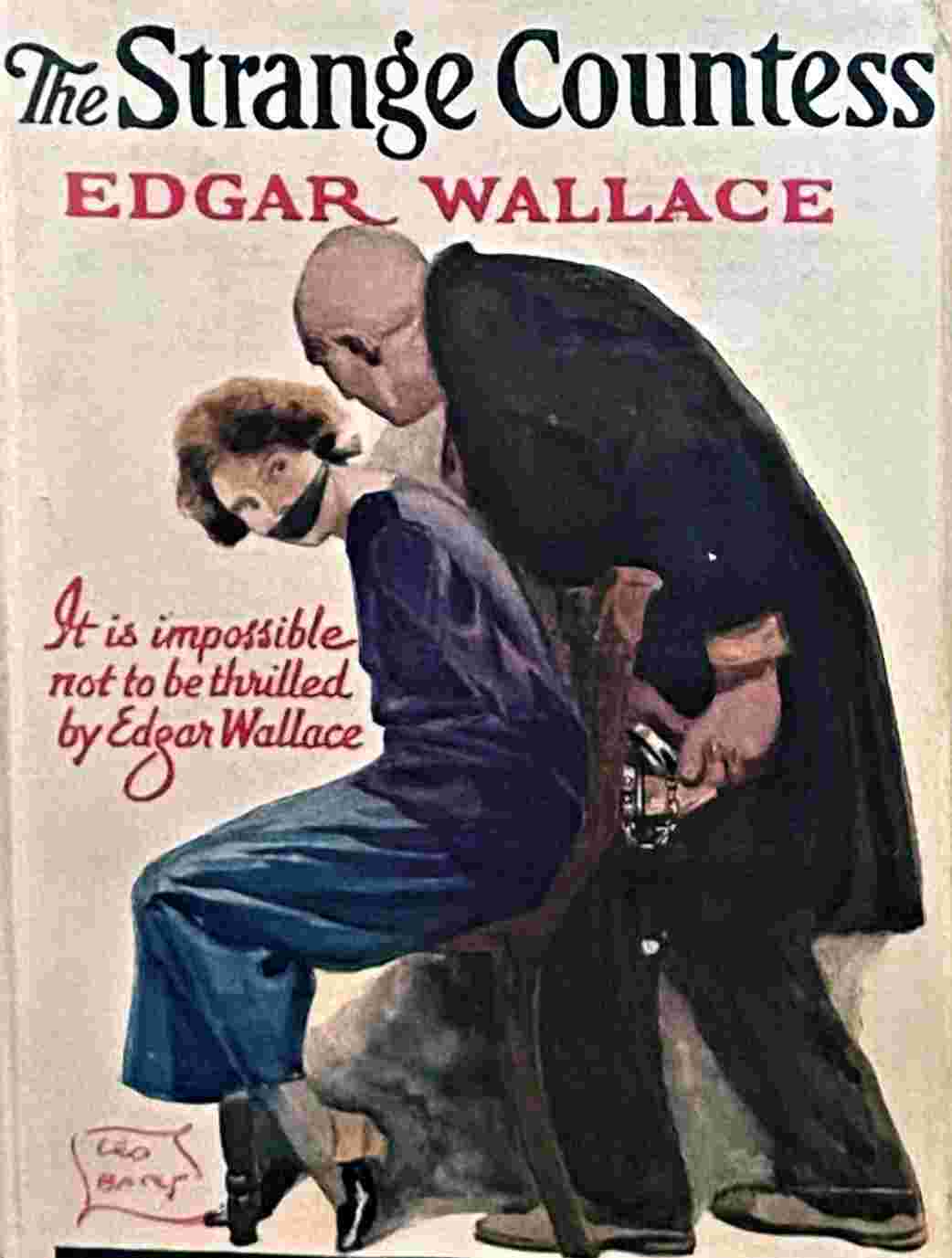
Chapter Seven
For a second she remained, paralyzed, and then, as the sound of his feet crossing the floor came to her, she screamed.
“What is it?”
She heard the creak and rumble of Lizzy’s bed, the scratch of a match, and saw the white gleam of the gas as it was lit. In another second Lizzy was in her room.
Lois was out of bed now and with trembling fingers was lighting her own lamp. Otherwise the room was empty.
“Somebody was here—a man,” she said shakily.
“You’ve been dreaming.”
“I was not dreaming. Listen!”
There was the thud of a closing door. Running to the window, Lois threw up the sash and leant out. She had time to see a man’s figure walking swiftly down Charlotte Street.
“There he is! Don’t you recognise him? It is Dorn!”
Lizzy craned farther out of the window and after a time came in with a scared face.
“I shouldn’t like to say it wasn’t,” she said cautiously. “Do you mean to say Dorn’s been here?”
Lois nodded. This shock, coming on top of the other, had almost unnerved her.
“But was he here—in this room?” Still Lizzy was not convinced, but one glance at the girl’s face told her that Lois had not been mistaken.
She hurried out into the kitchen, drew a glass of water. Lois drank the refreshingly cold liquid eagerly.
“Well, he’s got a nerve!” said Lizzy, sitting down on a chair and staring blankly at her companion. “What was he doing?”
“I don’t know. He was standing in front of the dressing-table. I only saw him for a second, and then this wretched light went out.”
“He’s got a nerve,” said Lizzy again. “There’s a limit to everything. Going into a young lady’s bedroom in the middle of the night to get an introduction seems to me to be ungentlemanly.”
Lois laughed weakly.
“He didn’t speak to you?”
She shook her head.
“Jack scuttled off like a rabbit, I suppose.”
Lizzy walked to the door and opened it, gazing reflectively at the stairs, as though she wished to visualise the undignified character of the visitor’s exit.
“He sends you chocolates overnight——”
Lois’ eyes strayed to the dressing-table, and she sprang to her feet with a cry.
“They’re gone!” she said, and the stenographer’s jaw dropped.
“Gone? Were they there?” She pointed.
“I put them on the dressing-table to remind me in the morning—at least, I think I did.”
A hurried search of the kitchen discovered no trace of the missing package.
“Perhaps he knew you wouldn’t like them and came to get them back?” was the inane suggestion that Lizzy offered.
“I don’t know—I don’t understand.”
At that moment a voice hailed them and Lizzy opened the door.
“Is anything wrong?”
It was old Mackenzie.
“That man never sleeps,” groaned Lizzy under her breath. “He ought to be a night watchman. No, everything’s all right, Mr. Mackenzie.”
“I heard somebody come down the stairs and go out a little time ago,” said the old man, “I thought maybe one of you was ill.”
“This is where our characters go west,” said Lizzy, and, in a louder voice: “No, Mr. Mackenzie, it was only me! I went down to make sure that Miss Reddle had closed the front door. Good-night.”
She came back, looking very thoughtful.
“ ‘Three o’clock in the morning’ is a pretty nifty fox-trot, but it is a bad time for young men to come sneaking round other people’s rooms. What are you going to do, Lois? Anyway, he’s saved you the postage on the chocolates. It seems to me to be the moment for tea.”
Any occasion was the moment for tea so far as Lizzy was concerned. She bustled off into the kitchen and came back in ten minutes with a hot decoction which was very gratifying to Lois, and, in spite of Lizzy’s making, unusually palatable.
“There are two things to do; one is to inform the police, and the other is to see Mr. Dorn, and I think I will take the latter course. Will you give me his address again?”
“You’re not going now?” said Lizzy, in a tone of horror.
“No, I’ll go before working hours.”
“He’ll be in bed. Maybe you’ll be able to get the chocolates back while he is sleeping,” suggested Lizzy. “As I remarked before, he’s got a nerve.”
Hiles Mansions was a magnificent block of flats near Albert Hall, but Mr. Dorn’s apartment was the least magnificent of any, for it was situated on the upper floor and consisted of two rooms, and a bath and a tiny hall. The elevator man was in his shirt-sleeves, polishing brasses at the early hour at which Lois made her call. But he showed no surprise at her enquiry.
“Top floor, miss. If you’ll step into the lift and excuse my shirt-sleeves, I’ll take you up.”
The elevator stopped at the sixth floor and the liftman pointed to a plain rosewood door, one of three on the landing. She hesitated, her finger on the bell-push, and then, mastering her courage, she pressed, expecting to be kept waiting for a long time, for if Mr. Dorn was really the night visitor, he would still be in bed. To her surprise, however, her finger was hardly off the bell-push before the door opened and Michael Dorn confronted her. He seemed to have been up for some time, for he was dressed and shaved, and there was no evidence in his eyes that he had spent a sleepless night.
“This is an unexpected pleasure, Miss Reddle,” he said. “Will you come in?”
The study into which she was ushered was larger than she had expected and the sloping roof gave it an odd but pleasant character. She saw at a glance that the furniture was old, and probably valuable. The writing-table, from which he had evidently just risen, for the morning newspaper lay open at the top, was undoubtedly Buhl, and the deep arm-chair before the fire was the only modern article in the room. Etchings covered the soberly painted walls, and in one alcove was a well-filled bookcase.
“Mr. Dorn, I have called on a very serious errand,” she said.
“I am sorry to hear that,” was his reply as he pushed a chair forward.
“I won’t sit down, thank you. Last night you sent me a box of chocolates. I can understand that your intentions were well meant, though I thought I had made it very clear that I do not wish to know you, or to improve an acquaintance which began only yesterday. I am very grateful to you for all you did,” she went on a little incoherently, “but——” she paused.
“But——?” he suggested.
“Your conduct is abominable!” she flamed. “The gift of chocolates was an impertinence, but to follow that up by breaking into my lodgings was criminal! I’ve come to tell you that, unless you cease your persecution, I shall complain to the police.”
He did not answer. Standing by the table, he fiddled with a long poignard which was evidently used as a letter-opener.
“You say I broke into your house—what makes you think that?”
“Because I recognised you,” she said emphatically. “You came and took away the box—though I could have saved you the trouble. I intended returning it in the morning.”
To her amazement, he did not deny his presence, but, on the contrary, gave confirmation of his action.
“If I had known you were going to return it this morning I should certainly not have called in the night,” he said with a calmness which took her breath away. “I have been guilty of conduct which may seem to you to be unpardonable, but for which there is a very simple explanation. Until a quarter to two this morning I had no idea that you had received the chocolates.”
He walked across the room to a cabinet, pulled open one drawer and took out the painted box.
“These are the chocolates, are they not?”
She was so taken back by his audacity that she could not speak. He put back the box carefully in the cabinet and closed the door.
“I underrated your intelligence, Miss Reddle,” he said. “I have done that all too frequently in my life—taken too light a view of woman’s genius.”
“I’m afraid I don’t understand you,” she said helplessly. “Only I want to tell you——”
“You want to tell me that if this act of mine is repeated, you will notify the police.” He took the words from her mouth. “And I think you would be wise. When do you take up your new position?”
“On Monday,” she was startled into telling him, but, recollecting that the object of her visit was not to furnish him with information about her movements, she walked to the door. “You don’t deny that you came into my room?”
He shook his head.
“No, why should I? You saw me. It was the flash of my lamp which woke you. I am very sorry. But for that stupid blunder you would not have known.”
She stared at him.
“You admit you were there?” she said, with growing wonder, as the nature of his offence began to take shape in her mind. “How could you, Mr. Dorn!”
“It is much easier for me to admit my fault than to lie about it,” he said coolly. “Even you must give me some credit for my frankness.”
He followed her out on to the landing and rang for the elevator.
“You must keep your door locked, Miss Reddle,” he said. “No matter where you are—even in the palatial establishment of the Countess of Moron—you must keep your door locked.”
He looked down the lift shaft and saw that the cage at the bottom was not moving. The elevator man was outside the building and had not heard the signal.
“I don’t think, if I were you, that I should write to your mother,” he said. “You may raise false hopes. At present she is well balanced. The knowledge that you are alive—and know—may cut the thread that has held her up all these years.”
“What do you know?” she gasped, gazing at him in terrified amazement.
Then came the whine of the ascending lift.
“I don’t think I should write if I were you,” he said, and with a smile handed the dazed girl into the elevator and waited until the clash of the lift-gate told him that she had reached the ground floor. Then he walked slowly back into his flat, closed the door behind him, and resumed his place at the table, but this time he did not read.
For half an hour he sat, his chin on his hand, and then, rising, he opened the door that led to the second room. A spare little man, with a dark and melancholy face, sat patiently on the edge of a chair, as he had sat ever since the ring at the door had announced the girl’s arrival. A beckoning jerk of Dorn’s chin brought the man to the study.
“Go along and pick up Chesney Praye. Find out what he was doing last night, and where he went. I think he was playing baccarat at the Limbo Club, and, if so, find out what he lost. That is all.”
Without a word the little man made for the door. His hand was on the latch when Dorn called him back.
“Call in at Scotland Yard and discover the owner of a blue Buick, No. XC2997. I pretty well know, but I should like a little moral support.”
When the door had closed behind his servitor Michael Dorn took several sheets of paper from the stationery rack and for half an hour was writing rapidly. When he had finished, he addressed an envelope, stamped the letter, and, going out to the landing, rang for the liftman and handed him the letter to post. Then he returned to his flat, and, taking off his collar and his tie, lay down on the bed for the sleep he so badly needed; for Michael Dorn had not closed his eyes for more than thirty-six hours.
Chapter Eight
All her life, Lois Reddle could never recall what happened that morning. She went about her work mechanically, like one in a dream; and that she did not commit the most appalling blunders was due to the natural orderliness of her mind. She went out with Lizzy to lunch at a neighbouring restaurant, and this was usually the meal of the day. But she could eat nothing, and her room-mate was genuinely alarmed.
“Was it fierce, dear?” asked Lizzy anxiously.
Lois roused herself from her thoughts with an effort.
“Was what fierce?” she asked.
“The fight you had with his nibs?”
At first Lois did not comprehend what the girl was talking about.
“Oh, you mean Mr. Dorn? No, it wasn’t fierce at all. It was a very—mild encounter.”
“Did you tell him about his nerve?” asked Lizzy.
“He seemed to know all about that!” said Lois with a smile.
“I’ll bet he was upset and asked for mercy. Did he go on his knees?”
She was anxious for details, but Lois shook her head.
“Nothing sensational happened. He was a little bit penitent, but only a little bit. I am scared.”
“Scared?” said Lizzy indignantly. “What have you got to be scared about? I’ll go and see him.”
“No, you’ll do nothing of the kind. He’s not likely to worry us again,” said Lois Reddle hastily.
“But what happened? Didn’t you ask him what he meant by it?” said her disappointed friend.
“Yes, I asked him something of the sort.” Lois was anxious to get off the subject, but Lizzy was insistent.
“Of course, if you were properly engaged and you were ill, and you’d had a tiff, it would have been all right his coming,” she began.
“We aren’t engaged, properly or improperly, and I am in disgustingly good health, and we haven’t had a tiff, so it wasn’t all right. He’ll not trouble us again, Lizzy.”
“I’ve been trying all morning to get a word with you,” said the disgruntled typist, “but you’ve been going about all blah and woozy, and naturally I thought you’d been raising hell—if you’ll excuse the unladylike expression—and that there had been an awful scene, but I did think you’d tell me when we came out to grub.”
But Lois was adamantine, and the meal passed in what was to Lizzy a wholly unsatisfactory discussion of her friend’s plans.
The one happy result of the morning’s interview was that, neither that day nor the next, did she so much as catch a glimpse of Michael Dorn and his long black car. But, as the days passed, this relief was not as pleasant as she had anticipated, and on the Saturday afternoon she found herself wishing that she had an excuse for meeting him.
What did he know about her mother? Had he known all the time, and was that the reason he was taking so great an interest in her? That he could have been associated, even remotely, with the case was impossible. His age, she guessed, was in the neighbourhood of thirty; possibly he was younger; and he must have been a child when Mary Pinder stood her trial.
Lois remembered with a start that her own name must be Pinder, though the question of names did not matter very much.
On the Monday morning she packed her two boxes, and, with Lizzy’s assistance, carried them down into the street to the waiting cab. Lizzy was inclined to be tearful. Old Mr. Mackenzie, in his black velvet coat, hovered anxiously in the background, though he did not emerge from the house which had been his voluntary prison for twenty-five years.
“What’s he shoving his nose in for?” demanded Lizzy viciously. “I’ll bet he’ll play ‘The Girl I Left Behind Me’ when you drive away!”
But it was to no such accompaniment that Lois left her old lodgings, and she came to the chaste atmosphere of Chester Square without any of the mishaps which Lizzy had so gloomily prophesied. The door was opened by a liveried footman, and she was apparently expected, for he led her up the broad, carpeted stairs to a wide and lofty room looking out on to the square.
Lady Moron was sitting at her small writing-table when the girl was announced, and rose magnificently to meet her. She was arrayed in a bright emerald velvet gown, which no other woman could have worn. On her ample bosom sparkled and flashed a great diamond plaque which was suspended from her neck by a chain of pearls. Her face was powdered dead white, against which her jet-black eyebrows seemed startlingly prominent. Lois noticed, now that she had time to inspect her new employer, that, though the blackness of her hair was natural, both eyebrows and eyelashes had been treated, and the scarlet lips were patently doctored.
“The maid will show you your room, Miss Reddle,” said the Countess in her deliberate way. “I hope you will be happy with us. We are extremely unpretentious people, and you will not be called upon to perform any duties that would be repugnant to a lady.”
Lois inclined her head slightly in acknowledgment of this promise, and a few minutes later was viewing her new bedroom with pleasant surprise. It was a big room at the top of the house, overlooking the square. There was here everything for comfort, and, for some reason which she could not define, she compared the furnishings of those she had seen of Mr. Michael Dorn’s and decided that they were in the same category of luxury.
She changed and came down to the drawing-room, which was also, she learnt, Lady Moron’s “work-room.” She opened the door and stopped. Two men were there; the first of these she recognised as the weak-kneed holder of the title. The second man was shorter and more sturdily built. His fleshy red face was eloquent of his love of good living, and when he smiled, as he did frequently, he showed two lines of large white teeth, that in some manner reminded the girl of a tiger’s, though there was certainly nothing tigerish about this gentleman, with his plump body and his curly red hair that ran back from a rather high forehead.
“Let me introduce Mr. Chesney Praye,” said her ladyship, and Lois found her hand engulfed in a large moist palm.
“Glad to meet you, Miss Reddle.” His voice was pleasantly husky. His keen eyes looked at her with undisguised admiration.
“You know Lord Moron?”
His lordship nodded and muttered something indistinguishable.
“Miss Reddle is my new secretary,” said her ladyship. She pronounced the four syllables of the word as though they were separated. “You may see a great deal of her, Chesney—Mr. Praye is my financial adviser.”
He certainly did not look like one who could offer any other advice than on the correct cut of a morning coat or the set of a cravat. He himself was perfectly dressed. Lois had often read the phrase “well-groomed” and now for the first time realised all that it signified, for Mr. Chesney Praye looked as though he had come from the hands of an ardent, hissing hostler, who had brushed and smoothed him until he was speckless and shining.
“A pretty nice pitch for you, this, Miss Reddle,” said Praye. “If you don’t get on with her ladyship, I’m a Dutchman! Ever been on the stage?”
“No, I haven’t,” she said, with a faint smile, as she recalled old Mackenzie’s warning.
“A pity. You ought to have done well on the stage,” he prattled on. “You’ve got the style and the figure and the voice and all that sort of thing. I’ve played for a few years in comedy—it’s a dog’s life for a man and not much better for a woman.”
He laughed uproariously, as though at some secret joke, and Lois was surprised that the majestic countess did not chide him for the free and easy attitude which seemed hardly compatible with that of a trusted financial adviser.
“I’d like to go on the stage.”
It was the silent Lord Moron, and his tone had a note of sulkiness which was surprising. It was as though he were a small boy asking for something which had already been refused.
The countess turned her dark, unfriendly eyes upon her son. “You will never go on the stage, Selwyn,” she said firmly. “Please get that nonsense out of your head.”
Lord Moron played with his watch-guard, and moved his feet uncomfortably. He was, she judged, between thirty and forty years of age, and she guessed he was not married, and had more than a suspicion that he was mentally deficient. She was to learn later that he was a weakling, entirely under the domination of his mother, a quiet and harmless man with simple, almost childish, tastes.
“Not for you, my boy,” said Mr. Chesney Praye, as he slapped the other on the shoulder, and Lord Moron winced at the vigour of this form of encouragement. “There is plenty of occupation for you, eh, countess?”
She did not answer him. She was standing by the long French windows looking down into the square, and now she turned and, fixing a pair of horn-rimmed lorgnettes, lifted them to her eyes.
“Who is that man?” she asked.
Chesney Praye looked past her, and Lois, who was watching at the time, saw his mouth twitch and the geniality fade from his face.
“Damn him!” he said under his breath, and the countess turned slowly and surveyed him with a stare.
“Who is he?” she asked.
“He’s the cleverest ‘busy’ in London—that’s who he is. Detective, I mean. I’d give a thousand for the privilege of going to his funeral. He’s got a grudge against me——”
He stopped, as though he realised he was saying too much. Lois looked over his shoulder at the man in the street. He was walking slowly on the opposite pavement.
It was Michael Dorn!
Chapter Nine
Lady Moron was talking.
“A detective? Really, I don’t see why you should be worried about detectives, Chesney. You are not, I hope, a member of the criminal classes?”
“Of course I’m not,” he said brusquely, almost rudely, “but I loathe this fellow. His name’s Dorn—Michael Dorn. He is the only private detective in England who is worth twopence. They call him into Scotland Yard for consultations; they think so much of him. He was the fellow that organised the raid on the Limbo Club, and he tried to get a conviction against me for being one of the proprietors, which of course I wasn’t.”
Michael Dorn had passed out of sight now, and the girl was thankful that their interest had been so concentrated upon his hateful presence that they had not noticed her; otherwise she must have betrayed her knowledge of the man.
A detective! At this moment Mr. Chesney Praye was amplifying his description.
“That fellow’s got the nerve of the devil,” he said, unconsciously echoing Elizabetta Smith. “He is utterly unscrupulous, and would ‘shop’ his own maiden aunt to get a conviction. He used to be a Deputy Commissioner of Police in India, but resigned to take up the case of an African millionaire who lost some documents and paid him a fortune for recovering them—at least, that’s the yarn I’ve heard.”
What did “shop” mean, she wondered, and guessed that it was synonymous with “betray.” And what sort of a man was this Mr. Chesney Praye that he could use these cant terms in the face of his noble employer? She had heard of men and women who occupied so well-established a position in the households of the great that they could grow familiar with the people they were paid to respect, and she supposed this was one such.
It was left to Lord Moron to protest.
“Don’t like ‘shop,’ old thing,” he quavered. “Sort of a low-down term to use before a young lady—what?”
Again those menacing eyes of his mother cowed him.
“It does not shock me, Selwyn, and I have no reason to suppose that my secretary will be shocked either.”
He wilted under the glance, muttered something incoherent and stole guiltily out of the room. Lois would gladly have followed, but there was no excuse. Instead, it was Mr. Chesney Praye who was dismissed.
“You must run along now, Chesney,” said the countess. “I want to have a little talk with Miss Reddle.”
Chesney, with his ever-ready grin, took a somewhat elaborate farewell of his hostess, bending to kiss her plump white hand that was so covered with jewels that Lois wondered whimsically whether he would cut his lip.
“You, young lady, I hope to meet again,” he said briskly, as he shook hands with unnecessary warmth, his bright eyes never leaving hers. “I might take her around a bit, don’t you think, countess? Is she from the country?”
“Miss Reddle has lived for some years in town,” said Lady Moron, and the reproof in her voice would have chilled most persons, but Chesney Praye was not the kind to be snubbed.
“Anyway, she hasn’t seen the sights I shall probably show her. Perhaps her ladyship will let you come and dine one night at the club. Do you dance?”
“If I’m allowed to choose my own partners, I dance rather well,” said Lois.
“Then you shall choose me,” said the thick-skinned young man, “for I’m a dandy hopper!”
It was some time after they were left alone before Lady Moron spoke. She stood, surveying the square below, her hands behind her, and Lois thought her ladyship must have forgotten that she was present, until the countess spoke, without turning her head.
“There will be nothing for you to do to-day. I’ve answered all my letters. We lunch at one-thirty, and you, of course, will invariably be at our table except when we have visitors. Dinner is at eight o’clock. You will be allowed to go out every other afternoon from five to ten, and such weekends as I am in the country will be your own. Thank you very much, Miss Reddle,” and with this dismissal Lois went directly up to her room, wondering how she would fill in her spare time between meals.
When Chesney Praye left the house in Chester Square he looked left and right, and presently saw what he sought. An idle man, standing at the corner of the street, his back towards the red-faced young man. Hesitating only a moment, he turned resolutely towards the seemingly unconscious Michael Dorn.
“Look here, Dorn!”
Dorn turned round slowly.
“Good morning, Mr. Praye,” he said, with a lift of his eyebrows, as though the man who confronted him was the last person in the world he expected to meet in that place at that time.
“What’s your idea in tailing me?”
Michael Dorn’s eyebrows met in seeming perplexity.
“ ‘Tailing’? Oh, you mean following you, I suppose? I haven’t quite got used to the argot of the London underworld. In India we call it——”
“Never mind what you call it in India,” said the other roughly. “What’s the great idea?”
Dorn looked at him with a thoughtful expression.
“Are you under the impression that I’m tailing you?”
“I’m not only under that impression—I know,” said the other, his face growing darker. “I spotted you this morning when I came out of my rooms in St. James’ Street, and thought you were there by accident. And one of your bloodhounds has been up to the Limbo Club, pumping the waiters. What’s the general scheme?”
“Curiosity,” murmured the other, “just idle curiosity. I’m thinking of writing a book on the bizarre criminal, and naturally you’d have a few pages all to yourself.”
Chesney Praye’s eyes were veritable slits as he tapped the other gently on the waistcoat.
“I’m going to give you a tip, Dorn,” he said. “Keep your finger out of my pie, or you’re going to get it burnt!”
“One good tip deserves another,” said Dorn. “And mine is, keep your finger off my waistcoat or you’ll be severely kicked!”
He said it in the most pleasant manner, but the furious man knew that he meant every word, and dropped his hand. Before he could master his wrath, Dorn went on:
“You’ve got a good job, Praye—don’t lose it. I understand that you’re financial adviser to a very noble lady—unprepossessing, but noble. If, by chance, I hear you’re advising her to put money in some of your wildcat schemes, or advising her to finance some of the little gambling houses which you have found so profitable in the past, I shall be coming right along after you with a real policeman.”
“You damned amateur!” spluttered the other.
“You have found the chink in my armour.” Dorn was coolness itself, and the shadow of laughter gleamed in his fine eyes. “I hate being called ‘amateur’! I have warned you.”
“You’re not in India now——” began Chesney, and recognised his mistake too late.
“I am not in India now, nor are you,” Dorn’s voice was gentle, almost silken. “Seven years ago I was in India—in Delhi—and there was a certain smart young Government official, also a financial adviser to some heads of departments, whose accounts went a little wonky. He was some twenty thousand pounds short. The money was never discovered. It was generally thought that the financial authority was more of a fool than a rogue, and, although he was dismissed from the public service, he was not prosecuted.”
Chesney Praye licked his dry lips.
“I, for my part, advised his prosecution,” Dorn went on. “In fact, I knew that the money was lying at a bank in Bombay, in the name of a lady friend. The Simla big-wigs were so scared of a scandal that the thief”—he paused and watched the other wince—“this thief was allowed to transfer his ill-gotten gains to Europe. And lo! I meet him again in the rôle of financial adviser!”
Chesney found his voice.
“There’s a law of libel in this country,” he said.
“There are several other laws, including the very excellent criminal law,” said Dorn. “And the statute of limitations does not apply to felonies. One loud squeal in an irresponsible newspaper, and they’d have to pinch you, whether the Government liked it or not.”
Chesney Praye looked first one way and then the other, and presently his eyes caught the detective’s. He was paler than he had been.
“I didn’t associate you with that business,” he said. “I knew I had an enemy somewhere in the background. It was you, was it?”
Dorn nodded.
“It was I—by the way, where is your dissolute friend, Dr. Tappatt, located? I thought he must have drunk himself to death, but I hear that he is in London—you introduced him to the countess a year ago. Did you tell her about his queer record? Or is he now her medical adviser? Or is he running one of the famous unregistered homes for mental cases? That man will hang sooner or later.”
Praye did not reply. His face was working nervously; for a second he had a mad impulse to strike at his tormentor, but thought better of it. It was in a calmer voice that he said:
“I don’t see why we should quarrel over what is past. You’re wrong when you think I made money out of that Delhi business, and I haven’t seen Tappatt for months. But I know I can’t convince you. Let’s bury the hatchet.”
Michael Dorn looked down at the extended hand, but made no effort to take it.
“If I bury any hatchet with you, Praye,” he said, “it will only put me to the expense of buying a new one. You go your way and let your way be as straight as possible. If you run foul of me, I’m going to hurt you, and I assure you I shall hurt you bad!”
He saw the flaming hate in the man’s eyes, and his own gaze did not waver. Suddenly Praye turned on his heels and walked away.
The detective waited until the man was out of sight, then strolled along the side-street, passed up the mews at the back of Chester Gardens, and made a careful examination of the back premises of No. 307. The stables and garages on the other side of the mews interested him considerably, and it was some time before he was clear of the mews, and met the silent little man whom he had sent out on an errand the morning Lois Reddle had visited his flat.
“Wills, there’s a garage to let in this mews. I have an idea that it belongs to her ladyship—her own cars are at the Belgrave Garage. Go along and see the agents, tell them you wish to rent the place and get the keys—to-night if possible—to-morrow certain.”
He handed a note he had made of the agent’s address to the other, and without a word the silent Wills strolled away. He never asked questions—which, to Michael Dorn, was his chief charm.
Michael came into Chester Square from the opposite end. He saw Lady Moron’s big Rolls standing at the doorway, and presently had the felicity of seeing her ladyship, accompanied by her son, enter the car and drive away. She was going shopping and would come back to lunch, he thought, and loafed along the side-walk, slackening his pace as he came opposite the house. There was no sign of the girl, but Michael Dorn was a very patient man. It was not Lois whom he expected or wished to see. The man for whom he was waiting came out ten minutes after Lady Moron’s car had turned from Chester Square. He was a tall, broad-shouldered man with a somewhat unpleasant face, whom Michael knew to be Lady Moron’s butler. Him he followed at a distance, and this time Michael made a very profitable trail.
Chapter Ten
The Countess of Moron, Lois discovered, had one amiable weakness; it was for jigsaw puzzles, which were made especially for her—pictures in greys and blues and elusive shades which would have driven an ordinary puzzle expert to despair. They were cut in tiny pieces, and her ladyship would spend hours before the big table in the library, putting them together. This she confessed at luncheon, and it was the first time that Lois had seen the human side of her employer. In the main the conversation was confined to the two women, Lord Moron being in the party, but not of it. When he spoke, as occasionally he did, his mother either ignored him or answered him in monosyllables. And apparently he was used to such treatment, which he did not seem to resent. The only servant present throughout the meal was the butler, Braime, for whom Lois conceived an instant dislike. He was a man with a forbidding face, sparing of speech, and though he was polite enough, there was something about his height and bulk which produced in the girl a sensation of uneasiness.
“You don’t like Braime, Miss Reddle?” asked the countess, when the man was momentarily absent from the room.
Lois marvelled at the intuition of her employer, and answered laughingly:
“I don’t know whether I like him or not.”
“He is a very satisfactory person,” said the countess in her majestic manner. “I like tall servants, and the fact that he is unpleasant looking is an advantage. None of my callers will try to steal him. In society one finds one’s best servants so frequently enticed away by people who pretend they are one’s friends.”
It was then that she told of her passion for jigsaw puzzles.
“Braime is very helpful and quite clever at that sort of thing, and I have frequently had to call on him for help.”
“Have you had him long?”
“Some six months. He was recommended to me by some people anxious to reform criminals,” was the startling thing she added.
Lois nearly jumped from her chair.
“You mean that he has been in prison?” she asked, bewildered.
Lady Moron inclined her head in a stately agreement.
“Yes, I believe he has been in prison for some foolish offence—stealing silver, I think. I have given him a new start, and the man is grateful.” When the butler returned, Lois gave him a more careful, if more furtive, scrutiny. Despite his powerful physique, he moved with a gentle, almost feline tread and his big clumsy hands manipulated the delicate china with a dexterity which was surprising.
Partly to her amusement, but more to her embarrassment, Lois found that a maid had been allocated to her—a fresh-faced country girl who had been recruited from her ladyship’s own village in Berkshire. For the Earls of Moron were wealthy landowners, and Moron House, near Newbury, was one of the show places of the county.
The maid had all the loquacity of her kind, and Lois had not been very long in her room before she learnt that her distrust of the butler was generally felt throughout the servants’ quarters.
“He’s always prying and spying, miss,” said the maid. “He’s just like a great cat, the way he walks; you can’t hear him until he’s behind you. And us servants are not good enough for him. He has all his meals in his pantry, and whenever we get a new servant here he watches her as if she was a mouse. I wonder her ladyship stands such an ugly, bad-tempered man about the house.”
“Is he very bad-tempered?” asked Lois.
“Well,” admitted the girl with reluctance, “I can’t exactly say that. But he looks bad-tempered,” she said triumphantly, “and you can always judge a man on his looks. Her ladyship took a lot of trouble about you, miss.”
“About me?” said Lois in surprise.
The girl nodded.
“She had these chairs put in for you and chose your bed, and—hullo, what’s this? Is this yours, miss?”
She had pulled open the empty drawer of a bureau, and now she held in her hand a large cabinet photograph. Lois took it from her; it was the picture of a young man; she judged him to be in the early twenties. He was singularly good-looking, and there was about the face something that was vaguely familiar.
“I don’t know how that got there,” said the chattering girl. “I cleared these drawers out myself yesterday. Her ladyship must have brought it up and left it.”
Lois saw, though it was only a bust photograph, that the young man wore the uniform of a Highland regiment, and she tried to recall the badge. As a child she had been interested in regimental insignia.
“He’s good-looking, isn’t he, miss?”
“Very good-looking,” said the girl. “I wonder who he is?”
“We’ve got lots of photographs in the house and nobody knows who they are. Her ladyship collects them,” said the girl.
“I will take it down to Lady Moron,” said Lois.
She found the countess sitting with her head in her hands before a half-completed puzzle picture.
“Where was that? In your room?”
Lady Moron took the photograph from her hand, looked at it disparagingly and dropped it into a table drawer.
“He was a boy I knew some many years ago,” she said, and did not trouble to discuss how the photograph had appeared in Lois’ room.
Lois went back to her own room. It was a sunny afternoon and rather warm. The long windows were open and one of these led on to a small stone balcony, one of the many which ornamented the front of the house. Across the window opening, however, was a light wooden gate which barred access to the inviting place.
“We’re not allowed to go out on the balconies in the daytime,” said the girl. “Her ladyship is very particular about that.”
“Does that apply to me?”
“Oh yes, miss,” said the girl. “Her ladyship doesn’t go out on to her own balcony, except in the evenings. Nobody is allowed out by day.”
Lois was wondering what induced the eccentric countess to prohibit a very pleasant lounging place during the day.
The afternoon post brought a number of letters, which, contrary to Lady Moron’s express principles, had to be answered that afternoon, and she was busy until an hour before dinner. And then the stately lady made a suggestion for which the girl was very grateful.
“If you have any girl friend you would like to ask to tea you may—any afternoon I am out. To-morrow will be a free evening for you. I shall be going out to dinner.”
That night, before she retired to her comfortable bed, she wrote a long letter to Lizzy Smith and posted it herself, and Lizzy’s reply was characteristically prompt. Lois was eating a solitary breakfast the next morning when a footman came in to say that she was wanted on the telephone. It was Lizzy.
“That you, kid? I’ll be coming along to-night. Are you sending the car, or am I taking the old No. 14? Don’t dress for me; I’m a plain woman without any side.”
“Don’t be silly, Lizzy. I shall be all alone and expecting you.”
“What sort of a crib is it?” asked Lizzy.
“Very nice, very nice, indeed,” said Lois, but without any enthusiasm. “Only there isn’t enough work to do.”
“ ‘Only’ is not the word you want, it’s ‘and,’ ” said Lizzy. “What is coming over you, Lois? Find me a job without work—here’s old Rattlebones!”—the latter in a lower tone told Lois that the girl was telephoning from the office and that the managing clerk had arrived.
Lady Moron and her son had gone out to dinner and a theatre party, and Lois was alone when the girl came.
“This is certainly great,” said Lizzy in a slow tone, as she looked round the resplendent dining-room. “That big chap’s the butler, I suppose? I can’t say that I like his face, but he can’t help that. How many courses do you have?” she asked, after the third course. “My doctor says I mustn’t take more than six.”
Following dinner the two girls went up to Lois’ room and Lizzy sat down to stare and admire.
“I always thought these sort of jobs didn’t exist outside of good books,” she said. “I mean the books they give you for Sunday School prizes. You’ve certainly rung the bell this time, Lois!”
“It seems too good to be true, doesn’t it?” laughed Lois.
“You haven’t seen him, I suppose?”
“You mean Mr. Dorn? Yes, I saw him this morning. He was walking up and down Chester Square. And Lizzy, he’s a detective.”
Lizzy’s eyes lit up.
“A real detective?” she said, in an awestricken tone. “And I thought he was the other way about—that he was one of the people detectives catch. What did he say, Lois?”
The girl shook her head.
“I didn’t speak to him. I only saw him through the window. Lizzy, I’m so worried and puzzled about it all—and he’s such a queer man! The things he could have said when I collided with his car!”
“I don’t know why you need be worried,” said the philosophical Lizzy. “Even detectives have their feelings. There was one married the other day—I saw a bit in the paper about it. And some of them are quite respectable men.” She looked up suddenly.
“What is it?” asked Lois.
“I thought I heard footsteps outside the door.”
Lois walked to the door and threw it open. The corridor was empty.
“What made you think there was somebody there?”
Lizzy shook her head.
“I don’t know,” she said vaguely, “only I’ve got sharp ears, and if they weren’t slippers moving on a carpet, I’ve never heard ’em!”
Lois closed the door and sat down on the bed.
“Lizzy, I’m going to tell you something,” she said, and the interest of Miss Elizabetta Smith quickened.
“Ah!” she said, drawing a long breath. “I knew you’d tell me sooner or later. But, my dear, it won’t be any news to me. He is one of the nicest men I’ve ever met——”
“What on earth are you talking about?” demanded Lois, aghast. “Are you thinking of that wretched Mr. Dorn?”
“Well, what else have you got to tell me?” demanded Lizzy indignantly; and Lois, in spite of the seriousness of the subject she was about to broach, fell into an uncontrollable fit of silent laughter.
“My dear, I can’t tell you now, not—not in this mood,” said Lois. “You poor little matchmaker! Mr. Dorn is probably married, with a large family. We won’t talk about him either.” Then, as a thought struck her: “Would you like to see this wicked city by night, with all its lights? I’ll show you.” She walked to the French windows and opened them. “This little balcony is forbidden territory by day, but it is rather wonderful now, isn’t it?”
She stepped out on to the balcony and, walking to the balustrade, rested her hand upon the broad parapet, looking down into the street, which seemed a terribly long way below. And even as she did so, she felt the balcony sag slowly beneath her.
She turned in a fright and leapt towards the window; but at that minute there was a loud crack, and the stone floor dropped suddenly beneath her.
Chapter Eleven
As she fell, Lois clutched wildly, and her fingers caught a projecting ridge of stone an inch wide; the jerk nearly pulled her arms from their sockets, but for the moment she hung.
She heard the frightened scream of Lizzy.
“Are you there? Oh, for God’s sake hold on, Lois! I’ll get them!”
And then, looking up, she saw the girl jerked violently backwards. She was falling; she could not hold on a second longer. There was a terrible, unendurable pain in her shoulders and her head was swimming.
And then, just as her fingers were slipping, a big hand grasped her wrist, and she felt herself drawn upwards until another hand caught her under the arm and pulled her into the room. She looked up into the unpleasant face of Braime, the butler.
He laid her on the bed, then, going to the window, knelt and peered down. The crash of falling masonry had attracted one of those small crowds which gather from nowhere at any hour of the day or night in London. Braime saw a policeman running across the street, and, rising, dusted his knees carefully, closed the window door and latched it. He said not a word to the girl, but went out of the room.
Lois, on the very verge of collapse, lay white of face, as pale as death. But her distress was as nothing to Lizzy Smith’s, who was paralysed by all the tragic happening, until the girl’s moan aroused her to action.
Lois came from semi-consciousness to a clearer understanding, with a sense that she had been drowned, then, as out of a haze, loomed the white-faced Lizzy with a water-jug in her hand.
“That was a close call!” breathed the girl.
Something in the words was reminiscent; Lois had heard them before. Then in a flash she remembered the motor-car which had nearly killed her and Michael Dorn’s words. She struggled up to a sitting position and found that the sensation of drowning was not altogether illusory, for Lizzy had been very lavish in her use of the water-jug.
She had hardly got to her feet when there was a tap at the door and the butler came in, followed by a policeman.
“The officer wishes to see the balcony,” said Braime, and opened the door for the policeman’s inspection.
With the aid of his lamp the officer made a cursory examination and brought his head back into the room. He looked strangely at Lois.
“You’ll never get nearer to trouble than that, miss,” he said. “There’s an old crack in the slab that you trod on, and the balustrade doesn’t support the flooring at all. I’d like to see some of the other balconies,” he said, and disappeared with the butler.
This was the second accident in a few days; her spine crept at the thought. What malign influence was following her? For the first time she wished she was returning to her humble little room in Charlotte Street, and she said good-bye to Lizzy with real reluctance.
The countess arrived home soon after the girl had gone, and came immediately up to Lois’ room as she was undressing.
“I knew that balcony was unsafe,” she said, “and I told that fool of a butler to keep the gate fixed. Where is the gate?”
“It was here this afternoon; I did not notice it before I went down to dinner, Lady Moron,” said Lois. “I thought it had been moved to allow the windows to be closed.”
The countess bit her red lip thoughtfully.
“There is more in this than I care to think about,” she said. “I hope you’re not going to have a sleepless night, Miss Reddle. I cannot tell you how distressed I am. How were you saved?”
Lois told her and Lady Moron nodded.
“Braime?” she said. “But what was he doing on the third floor at that time?”
She looked searchingly at the girl and then, without another word, went to her own room.
It was two o’clock in the morning before sleep came to Lois; and by that time her nerves were on edge, so that she started at every sound. Something was keeping her awake—something she was trying to remember. Some thought was working insistently at the back of her mind, demanding revelation. As she tossed from side to side, consciousness of this inhibited memory made her grow wider and wider awake. And then, as she came back to bed, after the second tramp to the washstand for a glass of water, it flashed upon her.
“Keep your door locked—even in the palatial home of the Countess of Moron!”
Michael Dorn’s warning! It was that. She went to the door and felt for the key. But there was none, nor was there any bolt. Turning on the light, she lifted one of the smaller arm-chairs, carried it to the door, and pushed the back beneath the handle. Then she went back to bed and was asleep in a few seconds.
She awoke the next morning to find the sun streaming past the edge of the blind. There was a gentle tap-tapping at the door. She jumped out of bed and pulled away the chair to admit the maid.
“Good morning, miss,” said the maid cheerfully, and was inclined to discuss the accident of the night before, but that Lois was most anxious to forget.
“Her ladyship’s very much upset. She hasn’t had any sleep all night, miss,” said Jean. “She asked me if I’d warned you about the balcony. Of course I told her I did, but only in the daytime—I didn’t know it was unsafe. I’ve only been here a fortnight. Her ladyship was in the country until then.”
She drew the blinds, and, crossing to the window, Lois looked out. The jagged edge of the broken balcony was there to remind her of her narrow escape and she shuddered as she recalled that dreadful moment when she had hung in space.
“It was the butler’s fault,” said Jean maliciously. “I shouldn’t be surprised if he got the sack.”
“If it hadn’t been for the butler I should have been killed.”
“If it hadn’t been for the butler, miss, you wouldn’t have been in danger,” said the girl, and there seemed some truth in her remark. “Her ladyship told me to move you to-day to his lordship’s room on the floor below.”
“But surely she’s not turning out Lord Moron?” asked Lois, aghast.
Apparently the household staff entertained towards his lordship something of the contempt which his mother displayed, in public and private.
“Oh, him!” said the girl with a shrug. “He doesn’t mind where he sleeps. He’d be just as happy in the garret. All he wants to do is to go on the stage and play with his silly old electricity! I wonder her ladyship allows him to go on in that childish way.”
So the Earl of Moron’s queer desire was public property, thought Lois. Apart from the shock of the news that he was being turned out of his apartment to make room for a secretary, Lois was not sorry that new accommodation was to be offered to her, and her pleasure was intensified after her interview with the countess.
Her ladyship, who had a predilection for strong colours, wore a gown of petunia that morning. Lois thought it made her look old. She made no reference to the accident, and for the first hour after breakfast they were engaged in letter-writing. Lady Moron had many correspondents, and there was the usual sprinkling of begging letters which had to be dealt with in the usual way. When Lois had finished her work and brought the last letter for her employer’s signature, the countess looked up.
“You are not suffering any ill effects from last night’s terrible experience?” she asked.
“No,” smiled Lois.
“I have told the maid to move you into Selwyn’s room. As a matter of fact, it is never used by him; he prefers his little study at the top of the house and sleeps there nine nights out of ten. You are not worried about what happened?”
Lois shook her head.
“Or nervous?”
The girl hesitated.
“I was a little nervous last night.”
“I thought you would be, and I have been considering what would be my best course to induce you to stay. I like you. And there is another reason; I want a woman in the house to whom I can talk confidentially.” She turned in her swivelled chair and looked up into Lois’ face. “I don’t want to be alone,” she said. “I am rather frightened of being alone.”
“Frightened, Lady Moron?”
Her ladyship nodded. There was certainly nothing in her voice to indicate her fear. She picked and chose her words with characteristic care. “I can’t explain why, but I am frightened—of certain people. If you care to remain with me, I will raise your salary, and I am quite willing that your friend should sleep in the house.”
“My friend?” asked the surprised Lois. “Do you mean Miss Smith?”
Again the countess nodded, her dark eyes never leaving the girl’s face.
Lois hesitated.
“That might be very—very awkward for you,” she said.
The countess waved a flashing hand.
“I have considered the matter in all its aspects, and if it is agreeable to you and your friend, I will have another bed put into your room. Perhaps you would like to see Miss Smith and discover her opinions on the subject? I will have the car ready for you in a quarter of an hour.”
Looking over the edge of the wire blinds, Lizzy Smith saw the glistening limousine pull up at the door, and Lois alight, and, defiant of all the rules of the establishment, she ran out of the office and came half-way down the stairs to meet the visitor.
In a few words Lois told her of Lady Moron’s proposal.
“Gee whiz!” said Lizzy, flabbergasted. “You don’t mean that?”
She gripped Lois by the arm and pulled her upstairs. “Come right along to the ’phone!” she hissed, “and tell her royal highness that I’ll be on the mat at six!”
Chapter Twelve
Lois did not go into the office; she left her friend on the threshold and went on to the appointment she sought. Leaving the car in Parliament Street, she walked down Whitehall to the Home Office building, and, filling in a blank, took her place in the waiting-room.
There was very little possibility, she told herself that the august Under-Secretary, with whom she craved an interview, would grant her that privilege, in spite of the pressing nature of the note which she had sent with the official form. She began to despair and was looking round at the waiting-room clock for the tenth time, when a messenger came for her.
“Miss Reddle?” he asked. “Will you follow me?”
Her heart beat a little faster as he knocked on an imposing door, and, opening it, announced her name. An elderly man, who was sitting at the far end of a big room, his back to an empty fireplace, an immense desk before him, half rose from his chair.
“Sit down, Miss Reddle,” he said, with official brusqueness. “I read your note, and I’m sorry to have kept you waiting. I had an important conference here.” And then, without further preliminary: “You say that Mrs. Pinder is your mother?”
“Yes, sir, I am certain of that.”
There was a big folder before him, and this he opened.
“The case is familiar to me,” said the Under-Secretary. “As a matter of fact, I was a junior engaged in the courts when she was tried, though not in the case. I don’t know what I can do for you. Her sentence has nearly expired, and if I were you I should wait until she comes out before you take any further steps. There are certain other people interested in the case, as you probably know, and that is the advice I have given to them.”
“But my mother was innocent,” said Lois, and he replied with an almost imperceptible shrug of his shoulders.
“Innocence has this much in common with guilt,” he said, “that after twenty years it is very difficult to prove or disprove. I followed the case very closely and it seemed to me that there were two essential pieces of evidence, one of which might have proved her guilt beyond doubt, and one her innocence. And these were not produced at the trial.”
“What were they?” asked Lois quickly.
“The first was the key to the box in which the jewellery and the cyanide were discovered. If that had been found in your mother’s possession any doubt in my mind would have been removed. That was the judge’s view also. The other is the letter the murdered woman—or rather,” he said hastily, “the woman who was found dead—would have written had it been a case of suicide. You know, of course, there was a pen and ink on the table and a pad of paper, but no letter was found. It was a new pad, purchased by the dead lady that morning, and one sheet had been torn away. The view of the defence was that, preparatory to committing suicide, she had written a letter, as people do in such circumstances. However, it was not found, although a very careful search was made.”
And then, abruptly, he began to question her about herself, her life. When she had told him the means by which she had identified herself with Lois Margeritta, Mrs. Pinder’s daughter, he agreed.
“I should think you were right there,” he said.
“Even Mr. Dorn thinks I am right,” she said with a half-smile.
“Dorn?” he said sharply. “You mean the Indian man, the police officer? Do you know him?”
“Not very well,” she said.
Could he be amongst the “other people interested in the case”? She dismissed the possibility as absurd.
He looked at her keenly.
“In what circumstances did you meet Dorn?” he asked, and Lois was very frank.
“Humph!” said the Under-Secretary. “Dorn isn’t that kind of man. I mean, he wouldn’t go chasing round after a girl if there wasn’t something else to it. He is a man of the highest integrity and honour,” he said emphatically; and for some extraordinary reason she was pleased to hear this tribute to the man who had so often annoyed her.
There was nothing more to be done, and when he rose to signify the end of the interview and shook her hand, he put into words her own thought.
“When your mother comes out of prison she will be able to give you a great deal more information than any of us possess. There is the question of your father, for example, who disappeared for a week or two before the crime and was never seen again. What happened to him? I remember there was a half-hearted attempt on the part of the prosecution to hold your mother responsible for his disappearance.”
“How horrible!” said Lois indignantly.
“Yes, I suppose it was horrible.”
From the Under-Secretary’s tone it seemed to Lois that he did not regard the matter quite in that light.
“In criminal cases, my dear young lady, the prosecution have to presume the most horrible things, and they’re usually right!”
There was very little profit for the girl from this interview, but at least she had the satisfaction of knowing that she had made a start. Somehow she had never thought very much about her father and his disappearance. That seemed so unimportant by the side of her mother’s suffering.
The letter and the key; these were two new points which she had never considered or known about before. She went back to Chester Square with a sense of accomplishment, and arrived in time to witness perhaps the strangest incident that mortal eye had seen.
As she opened the door of the drawing-room, she heard a shrill voice raised in anger, recognised it as Lord Moron’s, and would have drawn back, only her ladyship, who had seen her, called her into the room.
Moron was beside himself with rage. His sallow cheeks were pale, and, as he spluttered his annoyance, he stamped his foot in childish anger.
“I refuse, I absolutely refuse!” he almost screamed. “I appeal to Miss What’s-er-name. I appeal to you, miss. Is it right that a man in my position should do what any wretched boozing doctor tells him to do? Don’t think that I’m afraid of this horrible creature, because I’m not! I know the law, by gad!”
“Braime simply carried out his instructions,” said the countess in her deep, booming voice.
She was standing near her writing-table, slowly sharpening a pencil with a little knife, and did not look up from her task.
“I don’t mind giving up my room for a young lady,” said the Earl rapidly, “any gentleman would do the same. Besides, my study’s awfully jolly. But if I want to go out alone, I’ll go out alone, and I won’t have any beastly criminal butlers going with me—not if all the beastly doctors in the world order it. I’ve stood enough, my dear mother.”
He shook a trembling finger at the woman, who, seemingly oblivious to the scene, continued her pencil-sharpening.
“I’ve stood enough. You may marry this wretched Chesney Praye, the infernal blackguard! Ah, yes. I know all about that! I know a lot of things you don’t imagine I know! You may use my money as you jolly well please, you may——”
Lois saw Lady Moron’s hand go up and touch her son’s face with a caressing gesture.
“You’re a naughty boy,” she said, her thin lips curled in a smile.
And then, with a scream of pain, the man stepped backwards and put up his hand to his bleeding face.
Lois could not believe the evidence of her eyes. Yet there it was—a long, straight cut, and the little knife with which the woman was sharpening her pencil showed a tiny red stain.