
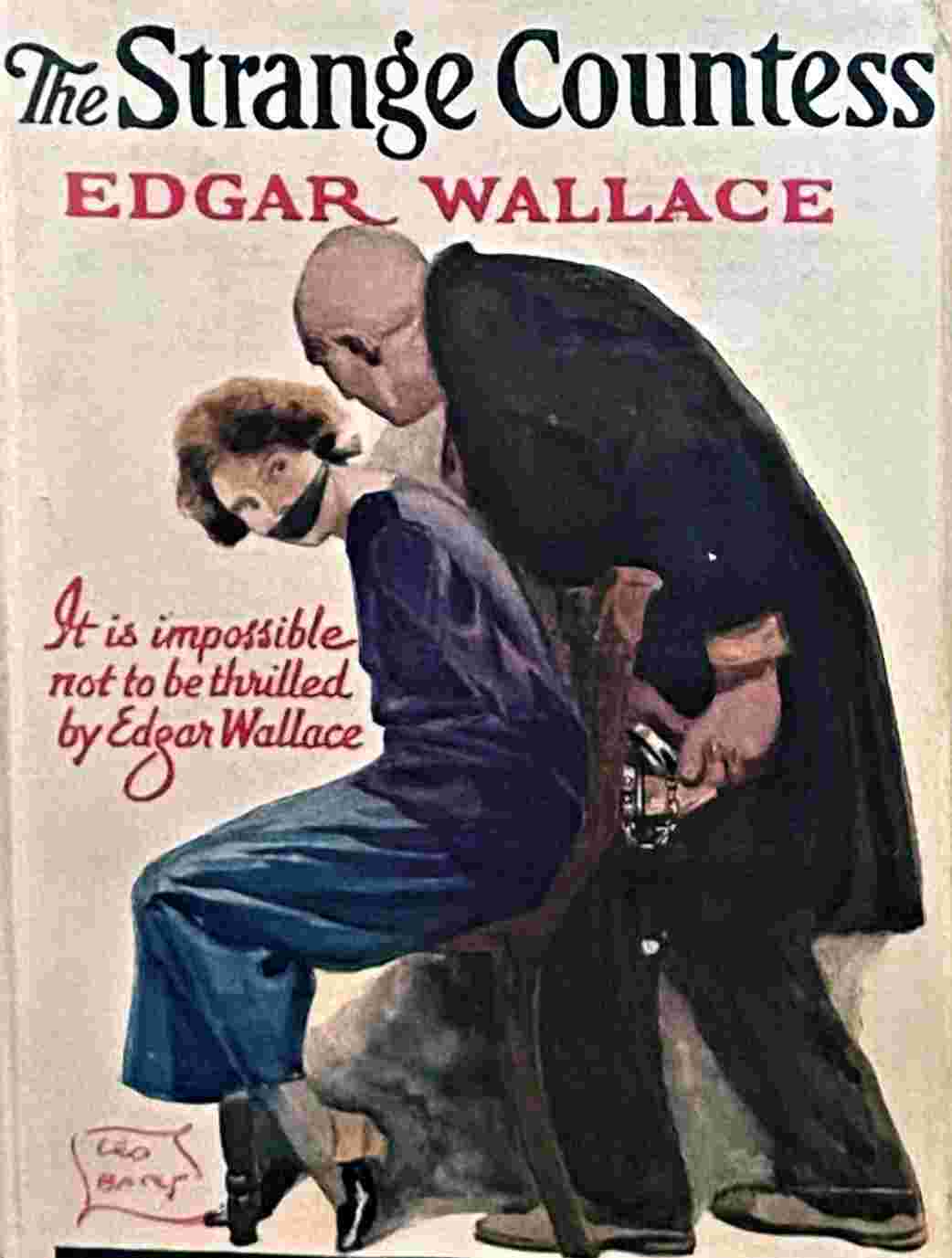
Chapter Thirteen
“You’re a very naughty boy,” said the countess, intent again upon her pencil-sharpening, “go back and play with your batteries!” and, with a gasp of fear, the man turned and ran blindly from the room, his face dabbled red.
There was a dead silence, and then the countess looked up.
“I suppose you think I’m very horrid? But Selwyn is difficult at times—shockingly difficult, and shockingly sulky. I must impose my will on him for his own good. And really, he isn’t hurt any more than he would have been if his razor had slipped.”
The cold-bloodedness of the thing left Lois breathless and shaken. She could hardly believe that she was not dreaming horribly.
“It was rather—drastic, wasn’t it?” she said, speaking with difficulty.
Again the dark eyes met hers.
“Drastic? Yes. Dr. Tappatt wishes me to be even more drastic. Did you speak to your friend?”
“Yes,” said Lois, almost grateful to be lifted out of the scene.
“And she will come? How dear of her! I told you I was afraid this morning, Miss Reddle. I don’t suppose you guessed why, even after Moron’s amazing exhibition of childish temper?”
Lois did not guess and was wisely silent. Her ladyship made no further reference to the scene. When Lord Moron came to lunch with his face conspicuously plastered, his mother did no more at the end of the meal than say:
“Please don’t come to dinner like that, Selwyn. One would imagine you had been in an earthquake.”
To which he answered, with a meek:
“Yes, madam.”
The change of rooms had been effected, and Lois was now in what might very well have been a small state apartment in one of the royal palaces. The new bed had been erected, and as the hour approached for Lizzy’s arrival, the uneasy qualms which Lois had been feeling all day began to dissipate. Though she had given strict injunctions as to the appearance her son should present at dinner, the countess herself dined out. She sent for Lois before she left the house.
“If you could amuse Selwyn, please do so. He is quite a good companion if you can reduce your mentality to the level of his. Possibly your friend will find him easier than you,” she added, and Lois would have been amused if she were not a little shocked.
Lizzy came promptly at six, bringing with her a battered black bag containing what she described as her “court dress and coronation robes” and the girl prepared her for a shock.
“You’re dining to-night with the Earl of Moron,” she said, and Lizzy collapsed into a chair.
“I can’t and I won’t,” she said energetically. “I knew there was going to be a catch in this!”
Lois soothed her fears, and, though she did not wish to follow the example of the servants and speak of his lordship in terms of disparagement, she sufficiently reassured her friend that Lizzy neither fainted nor flew when she was introduced to the vacuous, young-old man.
He was standing with his back to the empty fireplace in the drawing-room, a cigarette drooping from his lips, when Lois ushered her friend into his presence. He gave Lizzy a feeble handshake.
“Awfully glad to meet you. Nice weather we’re having,” he said, and to Lois: “Her ladyship’s gone, I suppose? That beastly bounder Praye called for her.”
Lois remembered the scene, of which she had been an unwilling witness, and Mr. Chesney Praye’s attitude towards the countess, which seemed inexplicable, was within her understanding. Chesney Praye was something more than a financial adviser. Apparently he had advised the lady in affairs of the heart only too well, though Lois found it rather difficult to imagine the masterful countess in a tender mood.
“Perfectly beastly bounder,” said his lordship with such energy that she realised that the spirit of revolt was not wholly crushed. “That wretched boozing doctor is bad, but Chesney Praye is worse! I call him a bird of prey—that’s not bad, what? Chesney, the bird of prey!”
He chuckled at his mild jest and visibly brightened under the influence of his own humour. This was the second reference that had been made to the mysterious doctor. Lois wondered if she would be called upon to meet him.
“Well, I’m glad she’s gone with her bird of prey. Let’s go along and have some grub.”
Lizzy’s jaw dropped at the sound of this familiar vulgarism; and that moment probably marked the beginning of an interest in the aristocracy which was fated to grow in intensity.
It was one of the most cheerful dinners that Lois remembered, and certainly for his lordship it was an hilarious feast, for he trotted out his joke about “bird of prey” some half a dozen times, and on each occasion with an increasing measure of amusement.
“I didn’t see the joke at first,” said Lizzy, wiping her eyes.
“His name’s Praye,” explained his lordship eagerly. “I call him the bird of prey—rather good, what? Let’s play draughts. I’m rather a dab at draughts.”
It was an opportunity to learn to know him better and Lois very skilfully drew him out. He had been to a public school—he thought it was Harrow; in fact, he was pretty sure it was Harrow—for two years, and then his mother had taken him away. He hated school life; it was rough. Since then he had practically not left his mother. He thought he was a member of one of the clubs, but he wasn’t quite sure which one; at any rate, he had never been there.
“You aren’t married?” asked Lois boldly.
The question afforded him a tremendous amount of enjoyment.
“Married—me? Good gracious, no! Who wants to marry a silly old johnny like me? Oh dear, no! There was a girl who wanted to marry me, I understand, when I was rather young, but her ladyship wouldn’t have her at any price.”
He had never occupied any responsible position. His mother managed his estate with the aid of bailiffs and lawyers; from time to time documents came to him for his signature; and he had been to the House of Lords once to take his seat.
“Never again—too silly,” he said. “They dress you up in red velvet and put crowns and things on your head!”
She discovered, to her surprise, that he had a hobby, and incidentally, his mother’s sneering remarks about his “batteries” were cleared up. He had a passion for electrical apparatus. His study, into which the girl had not been invited, was a litter of model dynamos, electric trains, and batteries.
“I’ve done one of the neatest little jobs for her ladyship in the library—ask her to show it to you.” His face went serious, “Perhaps you’d better not,” he said hastily.
Electrical work was not wholly an amusement to him. He claimed with pride to have fixed all the bells in the house, and later the girl learnt that this was true.
Whatever terrors the peerage had for Lizzy were quickly dissipated; towards the end of the evening she was hotly disputing the bona fides of a piece which had mysteriously appeared on his side of the chequer-board.
“Never had such a perfectly jolly evening in all my young life,” said his lordship. He had been glancing nervously at the clock for some time. “Now I think I’ll toddle, before the madam comes.”
He made one of his rapid exits, and the two girls came out into the hall. Braime was standing by the front door, staring through the glass panels into the street.
“Good-night, miss,” he said respectfully, and then continued his vigil.
“I don’t like that man,” said Lizzy, when they got to their room.
“Braime? I didn’t, but I owe him so much. If he had not been there last night——”
“How did he get there—that’s the question?” said Lizzy. “He must have been in the room when the balcony fell, for almost at once I felt somebody pulling me aside.”
“What do you think of Lord Moron?” asked Lois, anxious to turn the conversation to pleasanter channels.
“He’s wonderful,” said Lizzy dreamily. “From what I heard about him I thought he was dippy; but that boy’s got brains!”
Lois was in bed, and Lizzy, who was too intensely interested in her own views to be a quick-change artist, was in that condition of deshabille which made her least presentable, when there came a frantic tapping at the door.
“Who is that?” asked Lois.
“It’s me, young lady. Can I come in?”
It was Lord Moron’s voice.
Chapter Fourteen
“I’m afraid you can’t come in now. Is there anything you want?”
“Yes, I forgot something,” said the agitated voice.
“Can I get it for you?” asked Lois, now at the door.
“No, I’m afraid you can’t, it’s—er——”
His voice died down into a rumble of sound. Then!
“Never mind. I don’t suppose—I say, don’t be alarmed or anything of that sort—I mean, don’t mention to the madam anything that seems remarkable, will you?”
The girl shook her head in bewilderment.
“I don’t know what you mean. Is there something I can get for you?”
But he had evidently gone. Lizzy, who had a practical mind, suggested that the articles he required were false teeth.
“He’s got that kind of delicate mind that wouldn’t mention them to a lady,” she said.
But her companion did not accept that explanation.
Lizzy, who was not affected by the stateliness of the surroundings, was asleep almost as soon as she had finished talking. But Lois Reddle had never been more wide awake in her life. She heard the clock strike the quarter and the half and the hour. She turned from side to side and counted sheep and furnished houses and followed all the prescriptions for sleeplessness which had ever been offered. But at half-past one she was alert and wakeful. She heard the whine of a car as it stopped in front of the house. That was Lady Moron returning, she guessed.
The bed she occupied was a small four-poster. Perhaps it was this unusual factor which kept her awake. She stared up in the dark at the silken canopy above her head, wondering whether she would sleep more comfortably upon the big settee at the foot of the bed.
The deep breathing which came from Lizzy’s bed irritated her unreasonably. She rose, touched the pillow, and turned over again, and then——
“Did she know the photograph?”
She sat up with a jerk. It was the voice of Chesney Praye and had come from the canopy above her!
It was as though somebody was lying on the top and speaking, for the words were clear and distinct. It was the voice of the countess who answered him.
“No,” came the deep tones. “I put it in the drawer just before she arrived.”
A pause, and then presently he spoke again.
“You took a risk.”
She heard the deep laughter of Lady Moron.
“I’ve taken a greater one to-night, I think, Chesney.”
“My dear Leonora,” Chesney’s voice was pained, “surely you can trust me?”
“I have to,” the deliberate tone of her ladyship came down from the canopy, “and I think you will be wise not to play the fool. Selwyn is worrying me.”
“Selwyn!” contemptuously.
“Selwyn. He knows more than I gave him credit for. How did he know that we were to be married? He came out with it in his rage to-day. And how did he know that I’d been lending you money——”
“Come into the dining-room.”
There came the sound of a knock and then the voice of Braime spoke very faintly.
“I’ve set the table, my lady.”
After that Lois heard no more.
“Who was that? Was it somebody talking?” It was Lizzy who spoke. “Was it you, Lois? I heard somebody say they’d lent money.”
Lois was out of bed now, and had switched on the little lamp that stood on the table by the bedside. She looked up fearfully at the canopy. It had the heavy, respectable appearance which all such articles of furnishing have. Lois had a wild idea that a door had been left open, but the only door in the room was that which led to the corridor and it was locked, as she knew.
“What was it, Lois?” Lizzy was struggling into her dressing-gown.
“I don’t know. I heard somebody speaking. It seemed to be in the room.”
“It came from the direction of your bed,” said Lizzy. “Lord! This is a queer house. I don’t like it, Lois. I’d sooner have old Mackenzie and his fiddle any day or any night.”
Lois Reddle jumped on to the bed, lifted the table lamp and began an examination of the valance above. Presently she uttered an exclamation. In one corner, suspended by two wires, was a black, bell-shaped piece of ebonite, which at first she thought was a telephone receiver. Behind was a flat and circular box, and this was wired to the canopy.
“That is where the voice came from; it’s a loud-speaking telephone!”
She found the wire; it was cunningly hidden along the valance, descending one of the bed-posts, where it ran in a red flex to a wall-plug. The mystery was a mystery no longer, and now she understood the agitation of Lord Moron. She appreciated, too, his skill as an electrical engineer. He had been spying on his mother, if such a term applied to one who heard rather than saw. Somewhere in the house, probably in the drawing-room, was a concealed microphone, and too late that night he had remembered that he had not disconnected the instrument. Lady Moron was puzzled as to how her son knew so much. Lois could have told her.
“What a bird!” said Lizzy admiringly. “Fixed it all up himself! The boy’s got brains! What did you hear, Lois?”
But the girl was not inclined to be communicative. She pulled out the plug from the wall, sent her companion to bed, and followed her example.
Whose photograph was it that had been placed for her inspection? And what risk had Lady Moron taken? She remembered the picture of the handsome young officer who was “a boy I once knew” to her ladyship. And what risk had the woman run in leaving that under her secretary’s eyes. She got out of bed again and re-fixed the plug, feeling that she was being guilty of a despicable act. But something was happening which was so vital to her, that she could not afford to allow niceties of conduct to weigh against her need. No sound came from the microphone. But perhaps after supper they would return here. And, in any event, the weariness and monotony of waiting might induce the sleep which refused to come to her eyes.
Three o’clock struck, half-past three, four and half-past, and the chill of dawn began to show on the white blinds. Lois was not as far from sleep as she had been, and she was beginning to doze when a faint sound brought up her head from the pillow.
Click, click!
It was as though somebody was turning on the lights in the drawing-room. She waited tensely for the next sound. Presently there was an indistinguishable whisper, and then a voice spoke. Clearly the words came to her.
“Lois Reddle is very near to death!”
She knew the voice, in her imagination could almost see the speaker.
It was Michael Dorn.
Chapter Fifteen
In a second she had recovered, and had leapt out of bed. Better the known than the unknown. All fear had vanished; she would face Dorn and have the truth. Snatching up her dressing-gown, she went to the door, turned the key noiselessly and ran down the dark stairs.
The drawing-room faced her as she came on to the landing, and she did not hesitate, but flung open the door. The place was in darkness, and reaching out, she felt for the light switches and turned them. The room was empty; there was no sound save the musical ticking of a French clock on the mantelpiece, no sign of Michael Dorn or of his unknown companion. She gazed bewildered. Then she heard a noise behind her and spun round.
“What is it?”
It was the countess, who slept on the same floor as the girl.
“Turn on the landing lights,” said the woman calmly, and when she did so, Lois saw the older woman standing on the landing above, wrapped in a white ermine coat, as calm and imperturbable as ever.
“I thought I heard voices and came down.”
“In the drawing-room? Of course, it is under your bedroom!”
Lady Moron descended the stairs without haste and walked into the salon.
“You must have been mistaken, there’s nobody here,” she said. “I’m afraid your nerves are on edge. The opening of your door woke me. What did the noise sound like? The windows are fastened. None of the furniture has been moved.”
“I heard somebody speaking,” said Lois.
“Go to bed, my child.”
Her large hand patted the girl gently on the shoulder, and Lois went meekly up the stairs and into her room.
She came down to breakfast the next morning feeling a wreck, and Lizzy, warned by her friend, made no reference at the table to the voices of the night. She saw the girl off and came back to the dining-room. A footman was clearing the table under Braime’s watchful eye. When the man had gone:
“Her ladyship says you heard somebody speaking in the night, Miss Reddle?”
“I thought I did. Perhaps I was dreaming, or only imagined that I heard her ladyship in my sleep.”
“Lady Moron did not go into the drawing-room last night,” was the surprising reply.
Lois stared at the man, who went on:
“Her ladyship went into the library, but you would not hear her from your apartment.”
The library! That was where the microphone was fixed, and all the time she had been talking to Lady Moron on the landing Michael Dorn and his assistant had been on the floor below. The library was situated on the ground floor at the back of the house. She was thankful that she had not found him whilst that watchful woman was hovering in the background.
“I thought I heard you come out of your room, miss,” Braime continued; “in fact, I was on the point of coming downstairs when her ladyship came up. By the way, her ladyship will not be down until one o’clock, miss, she has two friends coming to lunch. She asked me if you would deal with any letters which are not marked personal.”
Lois was in the midst of this occupation when Lord Moron came into the drawing-room, a nervous and apprehensive man.
“ ’Morning, Miss Reddle,” he said, eyeing her keenly. “Well?”
“Not very well, thank you!” smiled Lois.
“Queer house this,” he mumbled. “All sorts of odd noises. These old places are like that, you know. Nothing disturbed you, I suppose? Nobody—er—talking in the street?”
“No, nothing disturbed me,” she said untruthfully, and he heaved a sigh of relief.
“Awfully glad. You don’t mind my going into your room to get the things I left behind, do you? I say, don’t mention this to her ladyship, will you, because she thinks I’m a careless devil and she’ll rag me most fearfully!”
Lois promised, and he hurried from the room. When she went up to prepare for luncheon, she examined the canopy and found, as she had expected, that the microphone and its attachments had been removed.
In other circumstances she might have been amused, but she was conscious that a terrible danger was hovering over her, and in some way that the menace was associated with the countess and her friend.
“Lois Reddle is near to death!” She shivered at the recollection.
Twice in a week she had escaped destruction by a hair’s breadth. Those were not accidents; she was sure now. But who could desire her harm? And what had the photograph of the young man in uniform to do with her?
On one point she was determined, and she had confided her intention to Lizzy that morning whilst they were dressing, before they came down to breakfast. She must leave this house and take the risk of unemployment for a while.
Lady Moron came into the drawing-room just before lunch, looked over the letters and signed such as required her signature, and then Lois broke the news. To her surprise the big woman was neither indignant nor entreating.
“When I saw you early this morning I was afraid this would happen,” she said. “And really I cannot blame you, Miss Reddle. You have had a most terrifying experience, though I believe that last night’s trouble was purely imaginary.”
Lois said nothing.
“When do you wish to go? As soon as possible, I gather from your hesitation. Very well, I am not blaming you. I feel partly to blame, and I will pay you a month’s salary and arrange for you to leave to-morrow.”
The two visitors were Chesney Praye and a man whom Lois had not seen before, though she had heard his lordship’s views on him. Later she felt she had no particular desire to meet him again. He was a bald man of fifty, with a face even redder than Mr. Praye’s, a big, bulbous nose, a loose mouth. She might, had she met him in the street and not in this chaste atmosphere, have analysed him as a typical drunkard. Nor would that description have been uncharitable. His frock coat was old and shone at the seams, and she observed that he had made only a half-hearted attempt to make his nails presentable.
“I want you to meet Dr. Tappatt.”
So this was the famous doctor. She was not impressed.
“Glad to meet you, young lady, very glad to meet you,” said the doctor with spurious heartiness. And with his words came the faint aroma of something that was not entirely whisky and not entirely cloves. “This is the young person your ladyship was speaking about? Hears voices, eh? Dear, dear, that’s a bad symptom,” he chuckled, “a very bad symptom. Eh, Chesney? We’ve had ’em for that! We’ve had ’em for that!”
Lois saw the butler fill this strange creature’s glass with wine, and when she looked again the glass was empty. Apparently Braime, if he did not already know the peculiarities of the guest, had been carefully coached, for, without asking, he had refilled the glass.
Lord Moron appeared at the lunch table, a sulky and silent young man, his face less extensively plastered.
“Had an accident, eh? Been in a railway smash?” demanded the doctor. “Your lordship should be more careful.”
“I haven’t been in a railway accident,” said Selwyn sulkily.
He evidently knew the doctor, and the girl had a feeling that he was afraid of him, for once or twice she saw him glancing furtively and a little fearfully in the direction of the untidy man.
“There’s another one who hears voices, eh? Your lordship hasn’t been followed by a dog—a nice black dog with a waggly tail, eh?”
“No, I haven’t,” almost shouted Lord Moron, going red and white. “I never said I had, did I? I’m perfectly—I know what I’m doing and all that sort of thing. You leave me alone, sir.”
It was in every way an uncomfortable meal for Lois Reddle. The glowering resentment of Moron, the calm indifference of his mother, the crude jocularity of Chesney Praye, and the presence of the doctor, who, when he was not drinking, was boasting of the wonderful cures he had effected in India, brought a sense of nightmare to the girl. Only once more did Dr. Tappatt turn his attention to Lois.
“What’s this I hear about your trying to throw yourself over the balcony? Come, come, young lady, that will never do!” He wagged his animal face at her, and the bloodshot eyes gleamed unpleasantly.
“Don’t be stupid.” It was Lady Moron who spoke. “The balcony gave way under Miss Reddle; there was no suggestion that she attempted to throw herself into the street.”
“A joke, a mere jest,” said the doctor unabashed, and pushed his glass towards the watchful Braime. “That’s a good wine of yours, your ladyship, a fine, full-bodied wine with a generous bouquet. Romanee-Conti, I think?”
“Clos de Vougeot,” corrected the countess.
“There is very little difference between the wines of Vougeot and Vosne,” said the connoisseur. “As a rule, I prefer the Conti, but your ladyship has converted me.”
The lunch did not end soon enough for Lois. When the countess had risen, she strolled to where her son was standing.
“When you come down to dinner to-night, be so good as to have the last of that ridiculous plaster taken from your face. I wish, at any rate, that you should look like a gentleman and not like a prize-fighter.” She mouthed the words deliberately. “Otherwise, perhaps I shall have to consult Dr. Tappatt.”
Lord Moron shrunk at the ominous words, and his muttered rejoinder did not reach Lois’ ears.
The suggestion that she should work in the library was one which Lois was glad to accept; for beyond a glimpse, she had never seen the room wherein the Countess of Moron spent so many hours with her jigsaw puzzles. And there was another reason; she must find the artfully concealed microphone which Lord Moron had installed.
It was a pleasant room, low-roofed and long, and ran from the wall of the reception-room at the front of the house to a small conservatory which hid the ugliness of the tiny courtyard at the back. Every wall was covered with bookshelves, and there were, in addition, more than a dozen big filing cabinets in which the countess had accumulated, and carefully docketed, the little souvenirs which had come to her in the course of her life; theatre programmes, newspaper cuttings, correspondence which most people would not have thought worth preserving. But Lady Moron was a methodical woman and had a horror of waste. This she told the girl when she introduced her to the room.
Left alone, Lois made a careful inspection of the library, without, however, discovering the hidden receiver or its wiring. She noticed that one section of the bookcase was covered by a strong door, covered with fine wire mesh, through which the titles could be seen; and studying these in the ample leisure she had, she was more than a little surprised at the precautions taken to prevent casual reading of this forbidden library. The books were of the most innocuous type, and she surmised that there had been a time when this section held literature less innocent.
She had finished her work and was browsing about the books, taking down one after the other and glancing at their contents, when Braime came in. One glance at the man told her that something unusual had happened. His face was twitching, and he was evidently labouring under the stress of great excitement which he had not succeeded wholly in suppressing.
“Will you go to the dining-room, miss? There’s a gentleman wishes to see you.”
“A gentleman? Who is it?”
“I don’t know his name,” said the man, “but if he’s not there, will you wait for him?”
“But who is it, Braime? Didn’t he give his name?”
“No, miss.” The hands clasped before him were trembling, his eyes held a strange light.
“In the dining-room?” she said as she went out.
“Yes, miss.”
To her surprise, when she looked round, she found he had not accompanied her. The dining-room was empty, except for Jean, her maid. The girl was engaged in dusting, and seemed surprised at the arrival of Lois.
“Braime told me a gentleman was waiting to see me?”
Jean shook her head.
“I don’t know anything about a gentleman, miss, but I do know one thing,” she said viciously. “He’s no gentleman. I caught him coming out of the countess’ room just now and I’m going to tell her ladyship. A sneaking, prying——”
“Please find out who it is wishes to see me,” said the puzzled girl. “Perhaps he is in the hall.”
Jean went out, but returned in a few minutes, shaking her head.
“Nobody is there, miss. Thomas, the footman, says that there have been no callers since Dr. Tappatt left. Mr. Praye is with her ladyship in the drawing-room.”
What did this mean? Lois frowned. Braime’s story was obviously an excuse to get her out of the room. She hurried back to the library. The door was closed and she threw it open.
“Braime——” she began, and then stopped and said no more.
The butler lay on his back in the middle of the floor, a silent, motionless figure, a look of agony on his white face, his lips distorted in a grimace of agony.
Chapter Sixteen
Her first impulse was to fly, her second, more merciful, was to run to his side, and, kneeling down, loosen his collar. Was he dead? There was no sign of life or sound of breath. The hands, upraised, as though to clutch an invisible enemy, were stiff and rigid.
She flew out of the door and called the maid.
“Telephone for a doctor, please. Braime is ill,” she said breathlessly, and rushed up the stairs.
Lady Moron was deep in conversation with her visitor, but at the sight of the girl she came hurriedly across the room.
“What is it?” she asked in a low voice.
“It’s Braime,” said Lois breathlessly. “I think he’s dead!”
The countess followed her down the stairs at a pace which Lois did not think was possible for so heavy a woman. For a moment she stood in the doorway, surveying the silent man.
“This is not for you to see,” she said gently, and, pushing the girl back into the passage, closed the door.
Presently she came out.
“I’m afraid he’s dead. Tell me what happened. Or first ring through to the Limbo Club for Dr. Tappatt.”
Lois told her that she had already given an order for a doctor to be called, and her instructions were fulfilled more efficiently than she had supposed. For Jean had rung the Virginia Hospital, which is within a hundred yards of Chester Square, and even while they were talking in the passage there came the clang of an ambulance bell, and the footman hurried to open the door.
The youthful house surgeon who had accompanied the ambulance made a brief examination of the prostrate figure and was obviously puzzled.
“Was this man subject to fits?” he asked.
“I am not aware that he was. He has been quite well since he has been in my employ,” said Lady Moron.
Lois, who had been attracted to the room, was looking down fearfully at the still figure.
“There is no wound of any kind that I can see,” said the doctor, peering through his spectacles. “I will have the attendants in and we’ll rush him to the hospital.”
He went back to the hall and signalled for his assistants, and a stretcher, withdrawn from the ambulance, was brought into the library.
And then, as they were about to lift the man on to the canvas, there came the sound of running footsteps in the hall and a man burst violently into the room. He was hot and hatless and stood breathing heavily in the doorway, looking from one to another. Presently his gaze fell upon Lois.
“Thank God!” he said shakily.
Then, with two strides, he was by the side of the prostrate figure.
“Are you a doctor?” began Lady Moron.
“My name is Michael Dorn—a name probably unknown to your ladyship,” said Dorn brusquely.
His keen eyes searched the room. Rising, he lifted a china bowl filled with roses, swept the flowers on to the floor, and dashed the water into the man’s face. Ripping off the collar of the man he knelt over Braime’s head and drew up the stiff arms, pressing them back again to the body. Lois watched him in bewilderment. He was applying the restorative methods which are used for people who are partially drowned.
“Are you a doctor?” asked the young surgeon, a little irritably.
“No,” said Michael, without ceasing his work.
“May I ask what you think you’re doing with this man?”
“Saving his life,” was the brief reply.
Lady Moron turned at that moment. She had heard the voice of her son in the hall, and, sweeping out of the room, she intercepted him.
“What do you want, Selwyn?” she asked coldly.
“Something’s happened in the library. They say old Braime’s got a fit or something—thought I might be useful.”
“Go back to your study, please, Selwyn,” said her ladyship. “I will not have you excited over these matters.”
“But dash it all——” began his lordship, but the look in his mother’s eyes silenced him, and he grumbled his way back to his den.
The countess waited until he was out of sight, and then came back to the little party that was watching Michael Dorn and his seemingly futile efforts. A few minutes passed, and then:
“I really think this man should be taken to the hospital, Mr.—er—Dorn.”
Lady Moron’s visitor had by now joined the group. Chesney Praye had witnessed the arrival of the detective and had thought it wise not to offer his advice. But now, morally strengthened by the presence of the countess, he added his voice to the argument.
“You’re probably killing that man, Dorn. Let him go to the hospital, where he’ll be properly attended to.”
Michael made no reply. The perspiration was pouring down his face; he stopped only to strip off his coat before he resumed his work.
“I hope you’re a better doctor than you are a detective,” said Chesney, nettled by Dorn’s attitude.
“In the present case, I am as good a doctor as you are an embezzler,” said Dorn, without turning his head. “And, in any circumstances, I am a better detective than you are a crook. He’s reviving.”
To Lois’ amazement, Braime’s eyelids were flickering. She saw the slow, unaided movement of his chest.
“I think he’ll do now,” said Dorn, getting up and wiping his forehead.
“Are you a detective?” It was the doctor who asked the question.
“Sort of a one,” said Michael with a smile. “I think you’d better get him into hospital as soon as you can, doctor. Please forgive me for butting in, but I have had a case like this before.”
“What is it?” demanded the puzzled medico, as the butler was lifted on to the stretcher and carried from the room. “I thought it was a stroke of some kind.”
“It was a stroke of a pretty bad kind,” said Michael grimly.
He did not attempt to follow the ambulance party, but, putting on his coat, he strolled round the room on what appeared to be a tour of inspection. He examined the ceiling, the floor, and ran his eye over the library table.
“He fell six feet from the table, didn’t he?” he mused. He pointed to the patch of water that had discoloured the carpet. “Do you mind telling me where his feet were? He had been moved when I came in.”
“Lady Moron would prefer to discuss that matter with the police when they arrive,” snapped Chesney Praye. “You’ve no right whatever to be here, you know that, Dorn.”
“Will somebody tell me where his feet were?”
It was Lois who pointed.
“He was lying across the room.”
“Of course—yes.” The puzzled Dorn stroked his chin. “You weren’t here when it happened, I suppose, Miss Reddle?”
“I forbid you to answer any questions,” said the countess in her most ponderous manner. “And I completely agree with Mr. Praye that this is not a matter for outsiders. Do you suggest the man was assaulted?”
“I suggest nothing,” said Dorn, and again his eyes sought Lois Reddle’s. “You have quite a lot of accidents in this house, don’t you, Miss Reddle?” he asked pleasantly. “If I were you, I think I’d go back to Charlotte Street; you’ll be safer. When I saw the ambulance at the door I must confess that I nearly died of heart failure. I thought you were the interesting subject.”
Her ladyship walked to the door and opened it a little wider.
“Will you please go, Mr. Dorn? Your presence is unwelcome, and your suggestion that any person in this house is in the slightest danger is most offensive to me”—she looked at Praye—“and to my friend.”
“Then your ladyship should change your friend,” said Dorn good-naturedly, “and, lest you should think that the fine feelings of Mr. Chesney Praye are lacerated by my suggestion, I will relieve your mind. There are only two things that annoy Chesney, and they are to lose money he has and to be thwarted in any attempt to get money which doesn’t belong to him. Can I speak with you alone, Miss Reddle?”
“I forbid——” began the countess.
“May I?”
Lois hesitated, nodded, and preceded him from the room.
It was in the hall, deserted even by the footman, that he spoke his mind.
“I confess I didn’t expect the succession of accidents which have followed one another at such close intervals since you have been in this house,” he said. “I only consented to your coming here at all because I thought that——”
“You consented?” Her eyes opened wide. She flushed with sudden anger. “Does it occur to you, Mr. Dorn, that I do not require your consent?”
“I’m sorry.” He was humility itself. “I am on the wrong track, but my nerves are a little jangled. What I wanted to say was that I ought to have known, after you received those poisoned chocolates——”
She went pale.
“Poisoned?” she whispered.
He nodded.
“Of course they were poisoned. Hydrocyanic acid. Why did you think I came into your room that night to get them away? I came with my heart in my mouth as I did a few minutes ago, expecting to find you dead.”
“Why are you so—so interested in me?” she asked, but he evaded the question.
“Will you leave this house to-day and go back to Charlotte Street?”
She shook her head.
“I can’t until to-morrow. I’ve promised Lady Moron that I would stay with her until then, and I’m sure, Mr. Dorn, that you’re mistaken. Who would send me poisoned chocolates?”
“Who would try to run you down with a car?” he countered. “Look at this.” He put his hand in his waistcoat pocket and took out a little roll of cloth. “Do you recognise this stuff?”
Her mouth opened in astonishment.
“Why, that is a piece of my skirt that was cut out when the car——”
“Exactly, and I found it hanging on the car. The people who garaged it were in such a hurry that they didn’t attempt to examine or to clean the machine.”
“But who—who is this enemy of mine?” she asked in a low voice.
He shook his head.
“Some day I will tell you his name. I think I have already told you too much, and made myself just a little bit too conspicuous. My only hope is that the knowledge that I am around will scare them. You can’t leave to-night?”
“No, it is impossible,” she said.
He nodded.
“All right.” He glanced past her to Lady Moron, who was standing at the door of the library, deeply engaged in conversation with Chesney Praye. Presently he caught the eye of the red-faced man. “I want you, Praye.”
He walked out of the house, waiting on the sidewalk for Chesney to join him.
“Now see here, Dorn——” began the other loudly.
“Lower your voice. I am not deaf. And, anyway, there’s no call for you to talk at all. Understand that. I’ve been to the India Office this morning, and sounded the Secretary. There will be no difficulty in getting a warrant for you in connection with that Delhi business if I take a little trouble. Let fact Number One sink into your mind. The second is this; if any harm comes to this girl Reddle—and I can trace your strong right hand in the matter—I’ll follow you through nine kinds of hell and catch you. Absorb that.” And with a nod, he turned and walked away, leaving the man speechless with rage and fear.
Chapter Seventeen
Lois thought it was kind of Lady Moron to give her the afternoon and evening to herself.
“My dear, I’ll be glad to get rid of you,” said her ladyship frankly. “That wretched man Dorn has quite upset me, and I’m not going to visit my resentment on you. Go away for a few hours and begin to forget that there is such a place as 307 Chester Square. And if you feel you’d like to go to a theatre later, please do so. I will leave instructions for the night footman to wait up for you. I have just heard from the hospital that Braime is quite conscious and perhaps he will give us an account of the mysterious happening. I’ve had the library searched, and I’ve not found anything to account for his extraordinary seizure. I doubt even whether the clever Mr. Dorn will be any more successful,” she added, without evidence of malice.
Lois was glad to get away, and her first thought was to acquaint her friend with what had happened. She made her way to Bedford Row, and as she reached that familiar thoroughfare, she saw the ancient Ford at the door and Mr. Shaddles pulling on his gloves preparatory to departure.
He lived in Hampstead, and was invariably the first and last user of the old machine. His glare was distinctly unfriendly as she mounted the steps.
“Well?” he asked. “You’ve come back, have you? Tired of your job, eh? I never thought you’d be much good as a private secretary.”
“I’m not tired of it, but I’m leaving,” she smiled.
“Young people must have change,” deplored Mr. Shaddles. “It is the cursed unrest of the age. How long were you with me?”
“Some years, Mr. Shaddles.”
“Two years, nine months, and seven days,” he said rapidly. “That seems like eternity, I suppose, young woman? To me it is”—he snapped his fingers—“yesterday! I brought you down from Leith, didn’t I? One of my clients mentioned you, and I gave you your chance, eh?”
“Yes,” she said, wondering why he had grown so unexpectedly reminiscent.
“Ah!” He looked up at the sky as though for inspiration, or applause—she wasn’t quite sure which. “You’ll want to come back to your old job, I suppose?” And without waiting for her reply, “Well, you can start to-morrow. I’ll give you three pounds a week, and you can start to-morrow morning at half-past eight.” He laid special emphasis on the last words.
“But, Mr. Shaddles,” said the dazed girl, “that is awfully kind of you—most kind. I’d love to come, but I can’t come to-morrow morning.”
“Half-past eight to-morrow morning,” he blinked at her. “Don’t keep me, I’m in a hurry.”
He went down the steps, mounted his car, and she stood watching him until he was one with the traffic in Theobalds Road.
So great was the shock of the lawyer’s generosity that this was the first news she told the sceptical Lizzy.
“There’s been something strange about him for the last two days,” decided that young lady. “Softening of the brain, I think. He didn’t mention about putting up my salary? Maybe he’s not so far gone as that. I shouldn’t take too much notice; he’ll probably change his mind to-morrow. Three pounds a week? He must be mad! I’ll bet he’ll come down to the office in the morning in his pyjamas, playing a cornet, and calling himself Julius Cæsar.”
The clerks had gone; Lizzy was alone in her office; she had stayed behind to type an interminable memorandum of association, which was never finished after Lois had told the story of what had happened at the house that day.
“I think Mike’s right,” said Lizzy, nodding vigorously. “That house is too full of tricks. I hate the idea of leaving Selwyn——”
“You mean Lord Moron?”
“He’s Selwyn to me,” said Lizzy calmly. “I’m going to the pictures with him to-morrow night. He’s a nice boy, that. What he wants is a mother’s care and he’s never had it.”
“And you’re going to be the mother?” Lois laughed, and then, seriously: “I can’t leave at once. You must please yourself what you do. I promised Lady Moron I would stay.”
Lizzy pulled a long face.
“I can’t desert you, but I’ll tell you straight, that I’d rather sleep on the top shelf of a mortuary than at Chester Square to-night. I’ll go with you, but I’m doing you a favour. Put it down in your book. As to old Shaddles he’ll be in charge of a keeper to-morrow. If anybody else but you had told me about that three pounds a week business, I’d have known they were lying. And now, what do you say to coming back to Charlotte Street and pretending we are poor again?”
To Lois there could have been no more attractive way of spending the evening. The old room with its shabby furniture, its faded chintzes, was home; and even the squalling of playing children in the street had a special charm which Lois had never observed before.
There was too a welcome awaiting them. Old Mackenzie saw them through the window of his room and came down to greet them in the passage. He was pathetically disappointed when he learnt they were not staying the night, but cheered up after Lizzy told him their plans.
“Let us ask him up to dinner,” said Lois, as she sat on the kitchen table, watching the girl manipulating the frying-pan.
Lizzy nodded. She was a thought distrait, and later Lois learnt the reason.
“If I’d had any sense, I’d have asked Selwyn to drop in, and he’d have come,” she said. “He’s democratic—one of the best mixers I’ve ever met. He told me last night, when you went out to get a handkerchief, that he felt thoroughly at home with me, and that I was the first girl he’d ever felt at home with all his life. That’s something for an earl to say, knowing that I’m a thirty-five bob a week key-shifter.”
Her voice trembled slightly and Lois regarded her with a new interest. She had been acquainted with Lizzy for many years and had never known her so emotional.
“He’s never had a mother’s care, that boy,” she said again, her voice shaking.
Lois charitably overlooked the fact that the boy in question was somewhere in the region of thirty-five.
“That woman hasn’t got any more sympathy with Selwyn than I’ve got with her. She’s got a heart like a bit of flint, she’s——”
“Mr. Mackenzie will be a poor substitute for your Selwyn, but shall we have him up?” asked Lois again.
“Yell for him,” was the terse reply.
In many ways Mr. Mackenzie was a more entertaining guest than Lizzy had hoped. In the first place he was very interested in her account of the Morons’ house and daily life, for it was Lizzy who spoke as an authority on the subject, appealing only occasionally to Lois for confirmation.
“Silk curtains? Really!” said Mr. Mackenzie, impressed.
“And satin ones,” said Lizzy recklessly. “At least, they look like satin. And silver mountings everywhere. And real marble walls in the bathroom. Am I right, Lois? And a silver fire-grate in the drawing-room.”
Old Mackenzie sighed.
“It must be very gran’ to live amidst such surroundings,” he said, “though I never envy any man or woman. And the countess is a charming lady?”
“I wouldn’t call her that,” said Lizzy. “She’s all right up to a point. She’s a bad mother but a good scout, if you understand me.”
“She has young children?” Mr. Mackenzie was interested.
“He is not exactly young,” Lizzy was careful to explain, “he’s a young man in what you might term the first prime of life. No, he’s not at school,” she snapped to the unfortunate question. “He’s a wonderful man. Selwyn wants to be an actor, and why his mother doesn’t let him go on the stage is a wonder to me.”
Again Mr. Mackenzie sighed.
“It is a bad life, the stage. I think I have told you young ladies before, all my sorrow and troubles come from my association with the stage.” And he went on disjointedly: “She was a bonny girl, with a beautiful figure and a face like a—a——”
“Angel?” suggested Lizzy, pausing with uplifted fork.
“ ‘Madonna’ was the word I wanted. To me it is still a matter of wonder that she ever looked at me, let alone accepted my humble suit. But at that time, of course, I was in a very good position. Some of my comic operas were being played. I had a considerable sum of money which, fortunately, I invested in house property, and she was a little—er—extravagant—yes, that’s the word, she was a little extravagant. It was perhaps my fault.”
There was a long silence while he ruminated, his chin bent on his chest, his eyes fixed upon the table-cloth.
“Yes, it was my fault. I told my dear friend Shaddles, when he suggested a divorce——”
“Shaddles?” squeaked Lizzy. “You don’t know that old—that gentleman, do you?”
Mackenzie looked at her in surprise.
“Why, Mr. Shaddles is my lawyer. That is how I came to have the good fortune to secure you as my tenants. You remember Mr. Shaddles recommended my little house?”
“Shaddles! Good Lord!” said Lizzy, pushing back her plate. “I don’t think I could ever have slept in my bed if I’d known!”
“He is a good man, a true man, and a friend,” said Mr. Mackenzie soberly.
“And he’s a mean old skinflint,” said Lizzy, despite Lois’ warning glance.
“He’s a wee bit near,” admitted Mr. Mackenzie. “But then, some lawyers get that way. His father was like that.”
“Did he ever have a father?” asked Lizzy, with assumed surprise.
“His father and his father’s father were the same way. But the Shaddles are great lawyers, and they’ve managed great estates. They’ve been lawyers to the Moron family for hundreds of years.”
“Do you know the Morons then?” asked Lois.
He hesitated.
“I cannot say that I know them. I know of them. The old earl, the father of the present boy, I have seen once. He lived abroad for many years, and was—weel, I’ll no’ call him bad, but he was a gay man by all accounts. And a scandalous liver. Willie, his son, was a fine boy, but he died. Selwyn, the younger son by the second wife, must be the lad to whom you’re referring.”
Even Lizzy was impressed by the old man’s knowledge of the Morons’ genealogical tree.
“It is a good thing for the family that they have this fine boy, Selwyn; though, if her ladyship had a daughter, she would succeed to the title, the Morons being one of those families where a woman succeeds failing a male heir.”
After dinner was cleared away he brought up his violin and played for half an hour; and Lizzy, whose respect for the musician seemed to have taken an upward curve, tolerated the performance with admirable fortitude.
The evening passed all too quickly, and at ten o’clock Lois looked at her watch and the two girls exchanged glances. Lizzy rose with a shiver.
“Back to the house of fate,” she said dramatically. “And thank heaven this is the last night we shall sleep there!”
She could not guess that neither Lois Reddle nor she would ever pass into that house of fate again!
Chapter Eighteen
At five o’clock that afternoon there was a great thudding of doors and snapping of keys in Telsbury Prison. The evening meal-hour was over. The last visit had been paid by the chief wardress. Laundries, cook-houses, and workshops had been locked up by the officers responsible, and the five halls, that ran, star-shaped, from the common centre, were deserted except for the wardress on duty at the desk, who was reading the letters which had come addressed to the prisoners and which would be delivered to them in the morning. She worked with the sure eye and hand of an expert, using her blue pencil to cover up such items of general news as convicts are not allowed to receive.
So engaged, she heard the burr of a “call,” and, looking round, saw that the red disc had fallen over one of the hundred apertures in the indicator. She put down her pencil, walked along the hall, and, stopping before a cell, inserted her key and pulled the door open.
The woman who rose from her bed did not wear the prison livery. Instead, she was dressed in a dark blue costume; her hat and coat lay on the bed and on top a pair of new gloves. In one corner of the cell was a small Gladstone bag and an umbrella.
“I am sorry to trouble you, madam,” said the prisoner nervously, “but I wondered if they had forgotten, if——” Her voice shook and she found it difficult to speak.
“They haven’t forgotten, Mrs. Pinder,” said the wardress calmly. “The officer should not have put the lock on you.” She pushed the door open wide. “If you feel lonely come out and sit with me.”
“Thank you,” said the woman gratefully, and the official saw that she was very near to tears. “Only the governor told me that he had telegraphed to my friends. There has been no reply?”
“There wouldn’t be,” said the tactful wardress. “They will be here very soon. Probably they think that you would prefer to wait.” She laughed. “Usually prisoners are discharged in the morning, but the Home Office allowed the governor to use his discretion in letting you out over-night. I don’t think I should worry, Mrs. Pinder.”
She waited at the door.
“Come out when you want,” she said good-humouredly. “There’s the whole hall to walk in and the lock is on, so you won’t be seen by any of the women.”
Mary Pinder came slowly into the wide hall and looked along the familiar vista of small black doors, tier upon tier, at the big window at the end of the hall through which the light of the evening sun was shining. For the first time in twenty years she was free of restraint, could walk without observation, and soon would pass through that steel-barred grille into God’s sweet air and into a world of free people.
She checked the sobbing sigh that came, and, her hands tightly clasped together, stood motionless, thinking. She dared not believe the story she had been told; dared not let her mind rest upon what happiness lay beyond the bars.
The wardress had gone back to the desk and her occupation, and the woman watched her wistfully. She was in contact with the world; had a husband perhaps, and children, outside these red walls. Mary Pinder had been cut off from life and human companionship for nearly twenty years. Outside the world rolled on; men had risen and fallen, there had been wars and periods of national rejoicing; but here, in this shadowy place, life had been grey, without relief, and even pain had become a monotony.
She walked timidly towards the officer and sat down in a chair near her. The wardress stopped her work to smile encouragingly, and then laid down her pencil again.
“I hope you’re going to forget this place, Mrs. Pinder?”
The other shook her head.
“I shouldn’t think it were possible—to forget,” she said. “It is life, most of the life I have known. I was eighteen when I came here first; twenty-three when I was transferred to Aylesbury, and thirty when I came back. I have little else to remember,” she said simply.
The woman looked at her curiously.
“You’re the only prisoner I’ve ever known that I had any faith in, Mrs. Pinder,” she said.
Mary Pinder leant forward eagerly.
“You believe that I was innocent?” And, when the woman nodded: “Thank you. I—I wish I had known that somebody believed that.”
“I wish I had told you,” said the wardress briefly. Then, as the sound of a turning key came to her: “Here comes somebody who thinks you were innocent, at any rate,” she said, and rose to meet the governor.
“All dressed and ready, eh?” said he cheerfully. “You’re a lucky woman! I wish to heaven I were free of this wretched place. But I am a prisoner here until I die!”
It was a stock joke of his and the woman smiled, as he took her arm and paced with her along the hall.
“Your friends will not be here until ten o’clock. I’ve just had a wire. They thought you’d rather leave after dark. Do you know where you’re going?”
“I haven’t any idea,” she said. “The address I gave you will always find me.” And then, in a changed tone: “Doctor, I wasn’t dreaming that you told me about—about——”
“That young lady who saw you? No, it is a most amazing coincidence. If I’d had any brains I should have known, the moment I saw how upset she was, that she was the girl with the branded arm.”
“My daughter!” she breathed. “Oh God, how wonderful! How wonderful!”
“They didn’t want to let you know. They were afraid of the effect it might have upon you. She’s a pretty girl.”
“She’s lovely,” breathed Mary Pinder. “She’s lovely! And does she know?”
He nodded.
“She knew that day she was in my room, when I told her about Lois Margeritta. If there’s any doubt about it the letter I had from the Under-Secretary should set your mind at rest. She went to see him with the idea of getting further particulars about the—about the crime you were charged with committing. Mrs. Pinder, will you tell me something?” He dropped her arm and faced her. “I am an old man and haven’t a very long time to live, and I’ve lost most of the little faith in human nature I ever possessed. Were you innocent?” He paused. “Were you innocent or guilty?”
“I was innocent.” She raised her eyes fearlessly to his. “What I have told you has been the truth. I went out to look for work, and when I came back I was arrested.”
“What about your husband? Where was he?”
She shook her head.
“He was dead,” she said simply. “I didn’t know then, but I have learnt since. Doctor, do you believe that?”
He nodded silently.
“You’ve been wonderful to me, sir,” she said in a low sweet voice. “I wish I could repay you for your kindness.”
“Well, you can,” he said in his gruff way. “When you get out into the world, you’re bound to meet some poor women who will suggest that you have your hair dyed red—don’t do it.”
He found an especial pleasure in the soft laughter that his jest evoked.
“And now you can come along and dine with my wife and me,” he said. “The only satisfaction I’ve ever got out of having a house within the prison walls.”
At five minutes past ten that night a small saloon motor-car drew up before the gates of Telsbury Prison and the driver got down and pulled the bell. He was challenged, as usual, from the wicket.
“I’ve called to take away Mrs. Pinder,” he said.
“You had better come in and see the governor.”
“I’d rather stay.” The driver lit a cigarette and paced to and fro to kill the time. But he had not long to wait; five minutes after, the little wicket-gate swung open and a woman stepped out.
“Is that Mrs. Pinder?” asked the man in a voice little above a whisper.
“Yes, it is I.”
“Let me take your bag.”
He opened the door of the car, pushed the bag inside and put out his hand to help her enter. Then, swinging into the driver’s seat, he closed both doors and sent the car spinning along the London road. In the shadow of the prison-gate the doctor watched the departure, and turned back with a sigh towards his office. Telsbury Prison had lost something of its interest with the passing of one whom the newspapers had described as “The Hereford Murderess.”
Chapter Nineteen
Lois Reddle was in no mood to return to Chester Square; but she was less willing to break faith with the woman whom she was beginning to dislike, and debated the question, she and Lizzy, on the Charlotte Street doorstep.
“Let’s stay,” urged Lizzy. “At any rate, don’t let’s go back yet. We shan’t see anything of Selwyn. Besides, remember what Mike said.”
“What Mike said means nothing to me—if by ‘Mike’ you mean Michael Dorn,” said Lois quietly. “We must go back, Lizzy—I’ve promised.”
Lizzy groaned.
“Oh, these honourable people—you make my head ache! Well, don’t let’s go back yet,” she urged. “The old lady said you could stay out to do a theatre. What’s the hurry?”
Again Lois hesitated.
“No, we’ll go back now,” she said firmly.
She looked across the road. An idler was standing with his back to the railings and she knew at once that it was not Dorn. No sooner had they moved towards Oxford Street than the lounger was galvanised to life and followed at a slow pace on their trail. Once Lois looked back; the man was following them.
“Let us turn round to the right,” she said. “I’m almost sure we are being followed.”
“We will keep to the main street,” said the intelligent Lizzy. “I prefer being followed that way.”
They reached Oxford Street, and crossed the road, the shadow coming after them at a respectful distance.
“Try Regent Street,” said Lizzy, “and when we get a little way down we’ll cross the road and come back on the other side. Then we’ll be sure.”
The movements of the man, when this manœuvre was completed, left no doubt. He, too, crossed the road and came back with them, and, when they boarded a westward bound ’bus, Lois saw him call a cab, which kept behind them all the way.
“If I thought it was Mike, I’d go back and give him a bit of my mind,” said Lizzy.
“It’s not he,” Lois assured her. “Mr. Dorn is not so tall and he’s smarter looking.”
They got out of the ’bus near Victoria, and, as they hurried across the road, Lois saw that the cab had stopped and the man was getting out. Surely enough, by the time they had plunged into silent Belgravia, he was on their heels. He never attempted to overtake them, showed not the slightest inclination to be any nearer to them than he was. If they dawdled, he slackened his pace; when they hurried, his stride lengthened. Then suddenly, ahead of them, Lois saw Michael Dorn. He stood squarely in the middle of the pavement and it was impossible to avoid him.
“I want a word with you, Miss Reddle,” he said. “You’re not going back to Lady Moron’s?”
“That is just what I am doing,” said Lois quietly.
“That is just what you’re not doing,” he said firmly. “Miss Reddle, I’ve rendered you many services. I would like you to do something for me in exchange.” He seemed momentarily at a loss for words. “And I have a personal interest. I don’t suppose you like me very much, and, anyway, that doesn’t count in the argument. But I like you.”
“Thank you,” she said.
“You can afford to be sarcastic—I do not complain of that; but I am telling you the plain, naked truth. I like you as any decent man would like a girl of your character and——”
“Sweetness,” suggested Lizzy, an interested audience.
“That is a very good word,” said Dorn with a faint smile. “But because of this personal interest and—liking—I realise I’m being very lame and unconvincing, but I’m rather a fool in my dealings with women—I want you to go back to Charlotte Street.”
Lois shook her head.
“I quite understand that you are disinterested,” she said.
“I’m not,” he interrupted. “I’m too interested in you to be disinterested.”
“Well, in spite of that, or because of that, I am staying with Lady Moron to-night. To-morrow we are leaving, Miss Smith and I, and are returning to Charlotte Street.”
“You are returning to Charlotte Street to-night,” he said, almost harshly, and she stiffened.
“What do you mean?” she demanded coldly.
“I mean just what I say. I will not have you stay in this devil house another night. Won’t you be persuaded, Miss Reddle?” he pleaded. “You don’t imagine for one moment that this is a caprice on my part? Or that I have any unreasoning prejudice against Lady Moron and her son? I beg of you not to go to that house to-night.”