
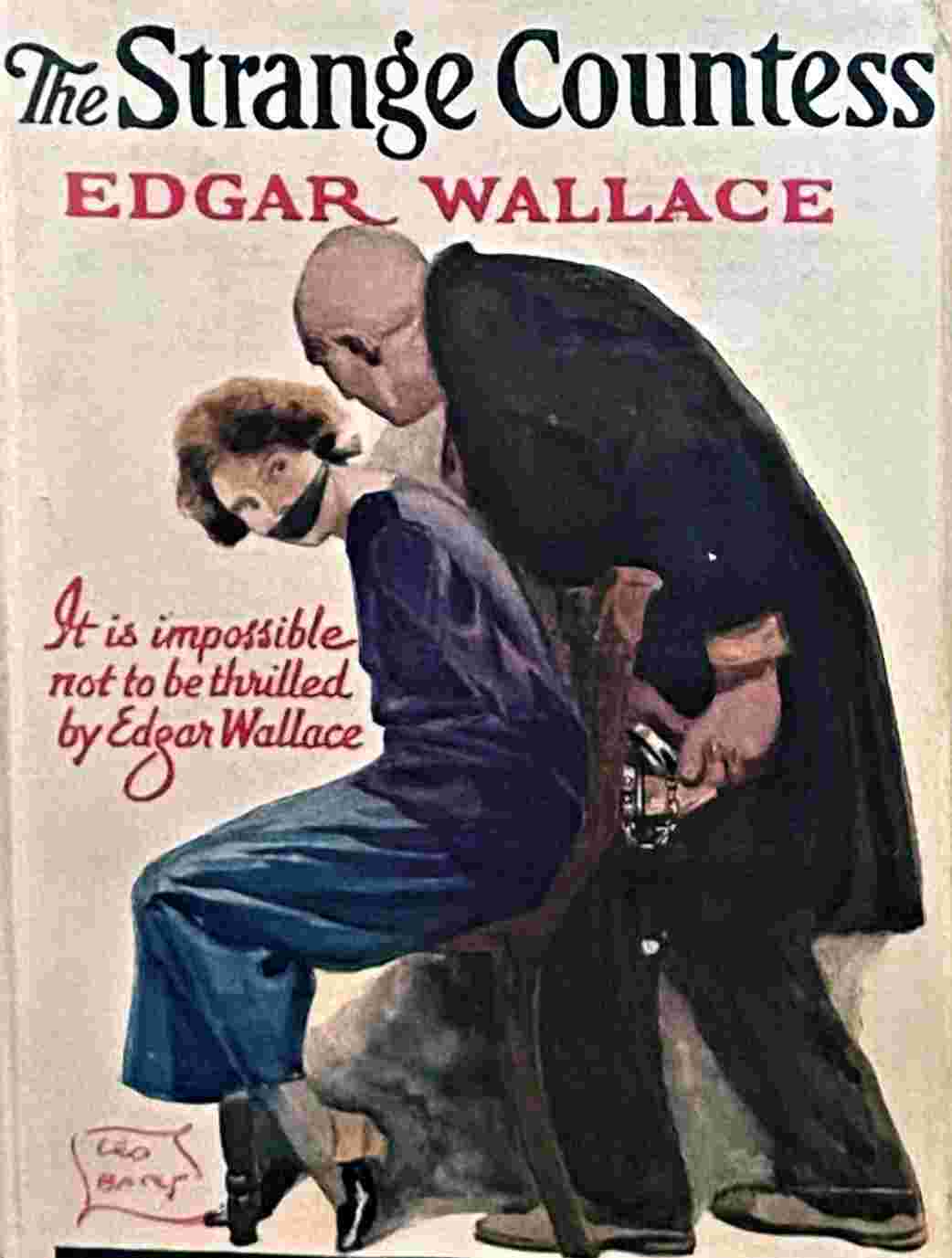
“Can you give me any reason?”
He shook his head.
“You must trust me, and believe that I have a very excellent reason, even though I can’t for the moment disclose it. That is, unless you see some reason yourself?”
“I don’t,” she said. “There have been a number of accidents; do you suggest Lady Moron is responsible?”
“I suggest nothing.”
“Then I’ll say good-night,” she said, and was passing on; but he barred her way, and at that moment he must have signalled to the dark figure in the background, for the tall man came forward.
“This is Sergeant Lighton, of the Criminal Investigation Department,” he said, and then indicated the girl: “This is Lois Reddle. I charge her with being concerned in the attempted murder of John Braime!”
The girl listened, thunderstruck, rooted to the spot.
“You charge me?” she said in horror. “But, Mr. Dorn——”
Michael Dorn made a signal, and the tall man caught Lois gently by the arm. Within half an hour of the prison gate opening for her mother, a cell door in a mundane police station closed upon her daughter.
Chapter Twenty
“And that’s that!” said Michael Dorn lugubriously, as he left the police station in company with the tall officer.
“Lighton, I’m going to catch a real thief now, if my theories are sound. And my main theory has something to do with an envelope which I begged from a clerk at the Home Office to-day, and which was posted to my address this afternoon.”
“Letter-box stealing?” asked the other, and Michael did not reply until he had secured the cab that was crawling on the other side of the street and they were seated.
“Let us say letter-delaying. I got on to this business owing to the fact that all the letters that came to me from my stationer and from a friend of mine in a Government office were unaccountably delayed twenty-four hours in the post. After giving the matter some thought I reached the conclusion that this coincidence was due to the fact that they were both enclosed in blue envelopes.”
“How is Braime?” asked the sergeant.
“Better,” was the reply. “I had a talk with him to-night—he’s had the shock of his life.” He chuckled softly, though his heart at that precise moment was aching for the dazed and indignant girl who was occupying the matron’s room, a large and airy cell, at the Chelsea police station.
The cab stopped before Hiles Mansions, and the lift-man took them up to Michael’s cosy flat. There were two or three letters waiting for him in his letter-box. He took them out and examined them. Then he went on to the landing and rang for the elevator.
“You brought these letters up?”
“Yes, sir.”
“What time did they arrive?”
“Half-past nine, sir,” said the man.
“There was a blue envelope posted to me this afternoon at three-thirty. It’s not here. How do you account for that?”
The liftman looked past him.
“I’m sure I can’t tell you, sir,” he said, studiously avoiding Michael’s eyes. “I bring the letters up as they come and put ’em in your box.”
“You’re on duty from nine at night until nine in the morning, aren’t you?” asked Dorn.
“Yes, sir.”
“You handle the morning and the night posts. Why is it that all letters enclosed in blue envelopes fail to reach me until twenty-four hours after they are due?”
“I can’t tell you that, sir.”
“Tell this gentleman. He’s a detective from Scotland Yard. And tell him without hokum, or you’ll sleep uncomfortably to-night, my friend.”
For a while the man blustered and protested and then suddenly collapsed.
“I’ve got a wife and four children,” he whined, “and there’s an Army pension I shall lose——”
“You’ll lose nothing if you tell me the truth. Who employed you to stop my letters?”
“A man, sir. I don’t know his name. If I die this minute, I don’t know his name! He gives me two pounds a week to hold up all the blue envelopes and the official ones. They’re not stolen, sir, they’re always put into the letter-box——”
“I know all about that,” interrupted Michael curtly. “You’re wasting your breath, man. Who is your employer?”
“I swear I don’t know him, sir. I met him at a public-house one night. He kidded me on to this job. I wish I’d never seen him.”
“Does he call for the letters?”
“Yes, sir, he called this morning after the post came in, but I didn’t give him the blue envelope because I hadn’t got it then. The postman overlooked it and came back a quarter of an hour later.”
“The blue envelope? Which blue envelope?” asked Michael quickly.
“It is downstairs, sir,” whimpered the unfaithful servant of Hiles Mansions.
“We’ll go down with you and get it.”
In the lobby below was a small cubby-hutch which served the porters as an office, and from beneath a stained blotting-pad he drew out two blue envelopes.
The first Michael recognised as that which he had written himself; the second he tore open and read, and the detective-sergeant saw his face change. Thrusting the letter into his pocket, he turned to the frightened servant.
“What else came for me to-day? Come, across with it, quick!”
Without a word the man put his hand into the pocket of a jacket that was hanging against the wall and took out a telegram, which had obviously been opened and reclosed. Michael read it in a fury of anger.
“Deal with this man,” he said and flew out of the hall, springing on the first empty taxi he saw.
A run of ten minutes brought him to his garage. Almost before the cab could turn round, the long black car was running out of London in defiance of all speed regulations.
Midnight was booming from Telsbury Parish Church when the car shot up to the entrance of the prison and Michael leapt out and pulled the bell.
“The governor’s in bed, sir.”
“I must see him at once. This is a matter of life and death. Take my card to him.” He thrust it through the bars of the grating and waited impatiently until he was admitted and conducted to the doctor’s house.
The governor, in pyjamas and dressing-gown, was waiting for him in his small study.
“Mrs. Pinder left at ten o’clock. Didn’t you send down for her?”
“No, sir, I knew nothing whatever about the release. The letter from the Home Office giving me the information had been held up. Ten o’clock? Who called for her?”
“I don’t know, I thought it was you. I saw the car and didn’t trouble to make enquiries.”
“Do you know which way they went?”
“They turned towards the London road. The car was a small saloon—a Buick, I think, with an enclosed drive. Hasn’t she turned up?”
Michael shook his head.
“No, she’s not in London.”
There was no time to be lost. He got into his machine and flew back along the London road. At the junction of the Telsbury by-road was a filling station, and he knew that an attendant slept upon the premises. It was some time before he could get an answer to his knocking, and then he was rewarded with valuable information.
“I saw the machine pass. It went south, towards Letchford.”
“It didn’t take the London road?”
“No, sir, it turned there.” He pointed. “I could see the rear light going up over the hill. It was just before I closed down for the night.”
Michael got back into his car, and, opening out, flew over the hill and covered the fifteen miles that separated Telsbury from Letchford in exactly fifteen minutes. Here again he was in luck. One of the town police had seen the machine; it had taken the westerly road. But thereafter his fortune failed him, for he came to a place where four roads met, and there was no trail that could help him determine which route the unknown driver had chosen. They were not bound for London at any rate. He tried one road without success; worked across country to intercept the second, but could meet nobody who had the slightest information to offer.
At four o’clock in the morning a weary man brought his machine to a standstill before the Chelsea police station and went slowly up the steps into the charge-room.
“Hullo, Mr. Dorn!” said the sergeant. “The superintendent’s been looking for you all night about that charge.”
“Well, what about it?” asked Michael drearily.
“There’s going to be the devil to pay. It appears that the countess says the girl wasn’t in the room when Braime was hurt. We’ve had a full statement from her in writing, and the superintendent says he’s got something to say to you that you won’t forget in a hurry!”
Dorn’s lip went back in an angry snarl.
“If he should say anything that’s worth remembering I’ll go out of business,” he said. “Anyway, you can release her. I’d like to offer my apologies.”
“Let her out!” laughed the sergeant. “You’re a bit late. She was released at one o’clock this morning.”
Dorn’s eyes narrowed.
“Released at one o’clock this morning?” he said softly. “Did she go away by herself?”
“No, sir, she did not. A gentleman called for her in a blue Buick.”
Michael Dorn staggered back; his face was drawn and haggard. Of a sudden he seemed to have grown old.
“The man who released that girl may be an accessory to murder!” he said. “Tell your superintendent that when you see him!”
And, turning on his heel, he left the charge-room.
The Public Prosecutor’s office opened at ten o’clock, and Michael Dorn was waiting for him, a dusty, unshaven, grimy figure, when that official arrived.
“Hullo, Dorn! What is wrong?” he asked, and, in as few words as possible, the detective explained the position.
The Prosecutor shook his head.
“We can do nothing. You haven’t the evidence we want, and no charge would lie. We’ve given you the freest hand, in view of all the remarkable circumstances of the case, but I cannot consent to a warrant for arrest until you bring me proof positive and undeniable.”
Michael Dorn bit his lip thoughtfully.
“In the old days, when they couldn’t get a man to tell the truth, what did they do with him, Sir Charles?”
“Well,” said the other drily, “they tried something with boiling oil in it! Those were the days when criminal investigation was a little easier than it is now.”
“No easier.” Michael shook his head. “I’m going to get the truth. I’m going to find out where they have taken these two women. And the rack and the thumbscrew will be babies’ toys compared with what I will use against them! I’ll have the truth if I have to pull Chesney Praye limb from limb!”
Chapter Twenty-one
Lois was wakened from an exhausted sleep by the opening of the cell door; she got up unsteadily, not quite knowing what she was doing, and followed the matron to the charge-room, dizzy with sleep, inert from the very shock of the charge levelled against her. She heard the desk-sergeant say something, and dimly heard the name of the countess. And then somebody shook hands with her; she thought it was the sergeant. And a young man, who had appeared and disappeared in her focus of vision and had not entered into recognition, took her arm and led her slowly into the dark street. He jerked open the door of a car, and, before she knew what was happening, had set the car in motion. She experienced a pleasant sensation of languor—her head drooped.
It was the bump of her forehead against the driver’s seat that wakened her. It was nearly daybreak.
“Where are we?” she asked.
She was uninterested in the identity of the driver, but, as he turned his head to answer her, she saw that it was the red-faced man, Chesney Praye.
“It’s all right, Miss Reddle,” he said, showing his big teeth in a grin; “I’m taking you down into the country.”
She frowned, trying to remember clearly the events of the night before. She was still dazed with sleep, then she recalled her arrest and became wide awake. Before she could ask any further questions, he was explaining over his shoulder.
“Her ladyship thought you’d better be kept out of the way of that sleuth for a day or two. He’s got a grudge against you, and he’s a vindictive beast.”
“Mr. Dorn?” she asked. “Why did he arrest me? I knew nothing whatever about Braime’s injury.”
“Of course you didn’t,” he said soothingly. “But that was his way of getting even.”
With whom he was getting even he did not explain, and even to the girl’s tired brain it seemed a little illogical to suggest that Michael Dorn had procured her arrest in order to get even either with Mr. Chesney Praye or the Countess of Moron.
They were passing across the wide slope of a hill. Beneath them she saw the glitter of a meandering river and the grey smoke rising from little cottages in the valley. The road was narrow and bumpy and was little more than a lane. She wondered why he came this way, for down the hill-side she saw a broader thoroughfare which seemed to be running more or less parallel with that they traversed.
“We are nearly there.”
They were reaching the mouth of the valley. The lane dipped unexpectedly into a thick plantation of young trees, turned abruptly at right angles over a cart track, and five minutes later she sighted a long discoloured wall, which enclosed a squat, low-roofed building. She saw that the other side of the house faced a road, and again she wondered why they had not reached their destination by a more comfortable route. Evidently she was expected, for the weather-beaten gate was pulled open and they passed into an untidy farmyard. Half a dozen chickens scattered at their approach; from a patched and broken pen came the grunt of a pig.
“Here we are.”
He stopped the car, and, jumping out into the litter, he jerked open the door and helped her to alight. The girl looked round in surprise. She saw a long, rambling farm-house, and of the windows that were in view, all except two had not been cleaned for years. To her left was a cavernous black barn, its doors hanging on broken hinges, and, she guessed, immovable. It was empty save for a rusted old plough and the wheelless body of a farm waggon. The place smelt of decay and she noted in that brief survey that at one end of the building the roof was nearly innocent of tiles.
“This is not on Lady Moron’s estate?” she asked.
“No, it is a little place that a friend of ours—hers I mean—has. You’ve met Dr. Tappatt?”
“Dr. Tappatt?” she frowned. Of course, it was the queer, uncleanly doctor, with the bulbous nose, who had lunched at Chester Square.
“Is he here?” she asked dismally. The last person in the world she wanted to spend a day with was the doctor.
“Yes, he’s here. He’s not a bad fellow; I knew him in India, and I think you’ll like him.”
They had evidently come in the back way of the farm, for the only visible door into the house was closed and bolted. He knocked for a little while before a woman’s harsh voice asked who was there, and in a little time there was a sound of rusted bolts being drawn and a tall, gaunt female showed in the doorway. She wore a soiled print dress; her face was sallow and grimy.
“Come in, mister,” she said, and they passed into a dark corridor.
The house smelt damp and sour, and the ancient carpet on the floor was too thin to deaden the hollow echoes of their footsteps.
“The doctor is here.” She wiped her hands mechanically upon her black apron, and showed them into a room leading off the passage.
It was a dingy apartment, as unsavoury as the house itself. Huddled in one corner of a horsehair sofa, before the ashes of a wood fire, a man was sleeping, wrapped in an old dressing-gown. The air was thick and redolent of stale smoke and whisky fumes, and the girl drew back in disgust.
Chesney went past her and shook the sleeping man.
“Here, wake up,” he said roughly. “There’s somebody to see you.”
Dr. Tappatt’s head jerked up. If he had been unpleasant at midday in Chester Square, he was repulsive now.
“Eh, what?” he grunted. He got up on to his feet and stretched himself. “I’m tired. I told you I should go to sleep. You said you’d be here before now. She’s sleeping. I’ll bet she’s got a more comfortable bed to-night than she’s had for twenty years.”
“Shut up, damn you!” said Chesney under his breath. “Here’s Miss Reddle.”
The doctor blinked at the girl.
“Hullo! Glad to see you, miss. Sorry for you to see me like this, but I’ve been up all night with—with a patient.” He boomed the last word as though by its very emphasis it would carry conviction.
“Now listen, Tappatt. There’s a warrant out for this lady, but we’ve succeeded in getting her away from the police, and she is to remain here for a few days until her ladyship can square matters.”
Lois gasped.
“A warrant out for me?” she said in amazement. “But you told me that Dorn had no right to arrest me!”
He smiled and signalled to her to keep silence.
“Has the woman got Miss Reddle’s room ready? She is very tired and wants to sleep.”
“Surely, surely,” mumbled the doctor. He held a bottle upside down over a glass, and a very small trickle of liquid came out, to his annoyance. “I must have a drink,” he grumbled. “This fever is playing Old Harry with me.”
“But, Mr. Praye,” said Lois, “I don’t quite understand the position. Why am I staying here? Where is this place?”
“Near Nottingham,” replied Praye. “And, for heaven’s sake, don’t stray out of the farm and lose yourself. You’ll be all right; you needn’t be here longer than a few days, and I assure you that there is no cause for worry.”
He looked at his watch and uttered an impatient exclamation.
“Is Miss Reddle’s room ready?” he asked sharply.
The doctor led the way out along the passage and up a narrow flight of stairs. On the top landing he unlocked a door and threw it open.
“Here it is.”
“But I’m not tired, Mr. Praye; in fact, I was never so wide awake, and I’d rather stay up, if I could have some tea?”
“You can have anything you like, my child,” said the doctor gallantly. “Where’s that woman? Hi, you!” he roared down the stairs. “Bring this lady up some tea, and bring it quick!”
Lois walked into the bedroom. It was poorly furnished but clean. She had the impression that every article of furniture had been newly placed.
“This was the room we got ready for the other,” began the doctor, “but when I heard the young lady was coming——”
Chesney Praye silenced him with a look.
The other? Twice he had made reference to another visitor who had already arrived.
“That door at the end leads to a bathroom,” said the doctor. “It is the snuggest little country lodging you could hope to find.”
He closed the door on her and softly turned the key. The two men went down the stairs together. When they were alone in the doctor’s room:
“Where’s Pinder?” asked Chesney Praye.
“She’s all right,” said the other carelessly.
“She’s nowhere near this girl?”
“No, she’s in the other wing. She’s easy. Twenty years of prison discipline behind her. She won’t kick!”
“What did you tell her?”
“The yarn you told me, that somebody wanted to get at her, and she had to lie here quietly for a day or two. That housekeeper of mine will look after her, believe me. She had charge of one of my homes in India.”
Chesney looked at his watch again.
“It is four miles to Whitcomb Aerodrome; you can drive me over.”
“Why don’t you take the car?”
“Because, you fool, I don’t want the car to be seen. Hurry up!”
In five minutes the doctor had harnessed a raw-boned pony to a dilapidated trap. The blue car had been driven into a shed and the door locked, and they were bowling down the road to Whitcomb as fast as the ancient animal could pull them. A quarter of a mile short of the aerodrome Chesney got down.
“Those two women are not to meet——”
“They’re not likely,” interrupted the other.
“And you’d better keep to the house.”
“What about money?” asked the doctor.
Chesney took a pad of notes from his pocket and passed two to the man.
“And try to cut out the booze for the next week. You’ve got a chance of making big money, Tappatt, but you’ve also got a chance of being pinched. If Dorn so much as smells the end of the trail, he’s sure to have you before you realise you’re suspected.”
Tappatt grinned.
“On what charge?” he asked. “They both came of their own free will, didn’t they? I don’t pretend they’re certified.”
“They may want to go away of their own free will,” said the other significantly.
He walked rapidly along the road through the big gates of the aerodrome and crossed the field towards a two-seater scout that had been drawn out of its hangar and was attended by three men.
“Good morning. I’m Mr. Stone,” he said. “Is this my machine?”
“Yes, sir. You’ve got a good morning for your trip.”
Praye looked at the frail machine dubiously.
“Will that make Paris in one trip?”
The aerodrome manager nodded.
“Two hours and fifty minutes,” he said. “Maybe shorter. You’ll have a following wind.”
He helped the passenger into a heavy leather coat. The pilot had already taken his place, and, when Praye had been strapped and gloved and received his final instructions, the propellers turned with a roar, and the machine, running lightly along the grass, swept up into the blue sky and was soon a speck of white above the eastern horizon.
Chapter Twenty-two
When Michael Dorn left the police station he hurried his car to Charlotte Street. At such an early hour of the morning there was no sign of life in this thoroughfare. He expected to be kept waiting before there came an answer to his knocking. But had he known something of old Mackenzie’s habits, he would not have been surprised at the promptitude with which his signal was answered.
The old man was in his dressing-gown and had not been half an hour in bed when Dorn arrived. He looked with mild suspicion at the visitor—a suspicion which was intensified when he learnt the object of his visit.
“Yes, sir, Miss Elizabetta Smith is in the house. Are you from the police?”
“Yes,” said Michael, without stretching the truth. “Can I speak to Miss Smith?”
“She came in late and very distressed. I understand that the good countess has promised to do all in her power to secure the release of my young friend, Miss Reddle. It is indeed an awful thing to have happened. Will you come in, sir?”
Michael followed him up the stairs to his little room and sat down whilst the musician went up to arouse Lizzy. She also had heard the knocking and was waiting in the doorway of her room when Mackenzie came up.
“Dorn, is it?” she said viciously. “I’ll come down and Dorn him! He’ll be ‘sunset’ by the time I’ve finished with him!”
She came into Michael’s presence a flaming virago.
“You’ve got a nerve!” she said. “After swearing away the life of poor Lois——”
Michael shook his head.
“She’s not here?” he interrupted with a touch of asperity.
“Here? Of course she’s not here! She’s in the police station, and how you could——”
“She’s not in the police station, she’s been released, and I want to find the man who released her.”
Something in his tone silenced the girl.
“Isn’t she with Lady Moron?” she asked.
“I am going to Chester Square, but I don’t expect to find Miss Reddle there. I locked her up to save her life—I suppose you realise that? There have been two attempts made to kill her, and I had information that the third would be more successful. I knew her mother was on the point of being released from prison—she was in fact released last night. It is vitally necessary that I should have Lois Reddle under my eye.”
Lizzy had collapsed into a chair.
“Her mother released from prison?” she said hollowly. “What are you talking about? Her mother’s dead. And killing? Who’s going to kill Lois? Why! It was an accident—the balcony.”
“It was no accident,” said Michael quietly. “The balcony has been unsafe for a year past and was condemned by the borough surveyor on the advice of a local builder who was brought in to repair the slab. Until Miss Reddle occupied that room in Chester Square the French windows leading to the balcony had been kept locked up.”
Lizzy gasped.
“But the servants——”
“The servants were all new. None of them had been longer in the house than a fortnight. Sergeant Braime came up from Newbury, and even he knew nothing.”
“Sergeant Braime?” she repeated, wide-eyed.
“Braime is an officer of the Criminal Investigation Department, who has been in the countess’ household for six months,” was the staggering reply. “Nobody was allowed to go on to the balcony. A gate was fixed to prevent the servants from forestalling the plan—it was removed the night Lois went to her room.”
“By whom?” asked Lizzy quietly.
Michael Dorn shrugged his shoulders.
“Who knows? I shall discover later.”
“Where is Lois now?”
“That is exactly what I want to know. I’m going to Chester Square right away. Will you come with me?”
She was out of the room in a flash.
“But, Mr. Dorn, this is a terrible thing you say; that any person should conspire against the life of that innocent lassie!” said old Mackenzie, horrified. “You will surely find Miss Reddle at the good countess’ home.”
“I hope so, but I very much doubt it, Mr. Mackenzie,” said Michael.
The old man’s lips were tremulous.
“Is there anything I can do? It is not my habit to leave the house, but I would even take that step——”
Michael shook his head.
“I am afraid you can do nothing, except in the unlikely event of Miss Reddle returning here. You will see that she does not go out again, and that she does not receive visitors in any circumstances. I very much doubt,” he smiled faintly, “whether you will be called upon to render this help. I can only wish to heaven that you will be!”
Lizzy was down in a very short time, dressed for the street, and, as they drove towards Chester Square, she told him the part she had played in securing Lois Reddle’s release.
“I went and found the countess; she was at a friend’s house, and told her about Lois. She was very much upset. I’d never seen her before to speak to, but she was quite decent to me.”
“Did she have anybody with her? Do you know Chesney Praye?”
Lizzy shook her head.
“No, I’ve heard of him from Lois, but I’ve never seen him.”
Michael described the man and again she shook her head.
“No, he was not there.”
“What did the countess do?”
“She telephoned to somebody and said she was sending a letter to the police officer in charge. She told me to go home to Charlotte Street and wait in patience until Lois came back.”
Michael nodded.
“You could rest in patience because she knew that Lois wasn’t going back to Chester Square!” he said grimly. “And if she hadn’t come back to Chester Square and you were there waiting for her, you would have wanted to know where she had been taken.”
The car drew up before 307, and Michael got out and pressed the bell. There was no reply. He rang again, and followed this up by knocking. Still there was no answer. Stepping out from under the porch he looked up at the windows, just as a sash was raised and a tousled head thrust forth. It was Lord Moron, and apparently he was sleeping on the floor which was usually given over to the household staff.
“Hullo! What’s the trouble, old thing?”
“Will you come down?” called Michael, and the head was withdrawn.
They waited for a longer time than it would have taken for him to reach the ground floor, before the door opened, and then the explanation for the delay was unnecessary, for with him the countess stood in the hall, wrapped in her cloak, a majestic and imposing figure.
Chapter Twenty-three
“What is the meaning of this?” she demanded.
“I’ve come for Lois Reddle,” said Dorn shortly.
“She is not here. I have put her beyond your vindictive reach.”
“Where is she?”
“I refuse to make any statement, after your disgraceful conduct last night in arresting this poor innocent child——”
“You can leave that out, Lady Moron,” said Michael savagely. “Nobody knows better than you why she was arrested. Where is she?”
“I’ve sent her away to friends of mine.”
“The address?”
The Countess of Moron smiled slowly.
“A very persistent young man,” she said, almost pleasantly. “Will you come into the library? I cannot speak in this draughty hall. Is that Miss Smith you have with you? She may come in too.”
“She’ll be safer outside,” said Michael coolly and passed into the hall.
All this time Selwyn had said nothing, but now he turned to his mother.
“Where is Miss Reddle? Perhaps your ladyship will tell me?”
“I shall tell you nothing,” was the cold reply. “You may go back to your room.”
“I’ll be blowed if I’ll go back to my room,” protested Lord Moron. “There’s something remarkably fishy here, and I want to know just what the deuce it is all about.”
It was a most heroic speech for him, and Michael, who knew all the courage that was required to oppose this woman, felt a little glow of admiration for the bullied man. Even the countess was taken aback.
“Why, Selwyn,” she said in a milder voice, “that is not the tone to adopt towards your mother!”
“I don’t care what it is or what it isn’t,” said Selwyn doggedly. “There’s something fishy—I’ve always said there was something fishy about—things. Now, where the deuce is Miss Reddle?”
“She is with some friends of ours in the country,” said her ladyship.
The reply seemed to exhaust his power of resistance.
“Very well,” he said meekly.
He looked through the open door at Lizzy, smiled and waved his hand at her, looked back at his mother, and then, visibly bracing himself for the effort, walked boldly down the steps in his pyjamas and attenuated dressing-gown to talk to the girl.
“Are you satisfied, Mr. Dorn?”
“No, I am far from satisfied, your ladyship,” said Michael, as he followed the woman into the library.
He noticed the dull patch on the carpet where the water had been thrown upon Braime, and saw her eyes also fixed upon the spot.
“And now, Mr. Dorn,” she said, almost amiably, “there is no reason why we should quarrel. What is this mystery that you are making about Miss Reddle? The poor girl was beside herself last night. It was an act of mercy to send her off into the country.”
“Who drove her?”
“My chauffeur.” His keen eyes were fixed upon her, but she did not falter.
“Not Mr. Chesney Praye by any chance?” he asked softly.
“Mr. Praye is in Paris. He has been there some days,” was the staggering reply. “You’ve found a mare’s nest. Really there is no mystery at all about anything that has happened to this young lady in my house. What reason in the world was there for me to engage her, except my desire to find a comfortable job for a very very nice girl?” And then: “Is Braime better?”
“Sergeant Braime is much better,” said Michael, and saw that he had got beneath her guard.
She cringed back as at a blow, and her voice had lost a little of its assurance when she faltered:
“Sergeant Braime? I am talking about my butler——”
“And I’m talking about Sergeant Braime of the Criminal Investigation Department, who has been in your service for six months.”
Her mouth was an O of amazement.
“But—but he was recommended to me by——”
“By a spurious Prisoners’ Aid Society,” said Michael. “The idea was that, if you believed that the man had a criminal record, he had a better chance of coming into your ladyship’s service.”
She had recovered herself in an instant.
“But why?” she drawled. “Why put a detective in my household? It is an abominable outrage and I shall report the matter to the Commissioner of Police immediately.”
He was looking round the room and his eyes rested upon that section of the bookshelves which was protected by the wire-covered door.
“You have a book there that I should like to see. I intended coming last night, only something prevented me.”
“A book?”
“A book called The Life of Washington—sounds a fairly innocuous title, doesn’t it?”
She walked to the bookcase, and, taking a key from the drawer of her desk, opened the wire net cover.
“There it is,” she said. “Read it and be improved.”
She turned to walk to the door and stood there watching him. And then he did the last thing she expected. From his pocket he took a thick red glove and drew it on his right hand. Reaching up, he seized the back of the book and jerked it loose. There was a click, a spark of blinding white light, but nothing else happened, and he laid the book with some difficulty on the table.
“A very good imitation,” he said quietly, “but it is less of a book than a steel box, and any person who attempts to pull it out automatically makes contact with a very powerful electric current. Where is the switch?”
She did not reply. Her face, under the powder, was drawn and haggard. Walking to the door, Michael searched for a while, then, stooping down, he turned over a big switch that was well concealed by a hanging portière.
“Have you the key of this box?”
“It is not locked,” she said, and, coming to his side, pressed a spring. The lid sprang open.
The “book” was, as he surmised, hollow. It was also empty.
“Is there a law against having a safe-box made like a book?” she asked, and her voice was almost sweet. “Does one get into very serious trouble for protecting one’s property from thieving butlers and—inquisitive amateur detectives?”
“There’s a law against murder,” said the other shortly. “If I had touched that book without rubber gloves, I should have been as near dead as makes no difference. It did not kill Braime, because he is constitutionally a giant.”
“I did not ask you to take down the book,” she said.
“Neither did you warn me,” Michael smiled crookedly. “Empty, eh? Of course, it would be. You suspected Braime, and left a little notebook around carelessly in your bedroom, in which you made reference to the Life of Washington. Braime saw it and fell into the trap. He came to the library, and would have been a dead man if I hadn’t applied first aid.”
There was a silence.
“Is that all?” asked Lady Moron.
“Not quite all. I want to know where is Miss Reddle?”
“And I’m afraid I cannot tell you. The truth is, when she was released last night, or in the early hours of this morning, she refused to come either here or to her house in—wherever her house may be. She said she wanted to go into the country——”
“And did Mrs. Pinder express a desire to go into the country?” he asked, his cold eyes fixed on hers.
“Mrs. Pinder? I do not know Mrs. Pinder.”
“Did Mrs. Pinder express a desire to go into the country?” he asked again. He raised a warning finger. “Madam, there is very considerable trouble coming to you, and to those who work with you.”
She shrugged her broad shoulders.
“If it takes any other form than an early morning call by a melodramatic detective I shall bear it with equanimity,” she said, and stalked through the doorway into the hall, Michael following.
As she stood aside for him to pass through the door, she saw the grotesque figure of Selwyn leaning over the side of the car—intently occupied—and her lips curled.
“My son has found his intellectual level,” she said, and called him by name.
To Michael’s surprise the young man merely turned his head and resumed his conversation with the girl.
“Selwyn!”
Even then he took his time.
“Good-bye, young lady. Don’t forget”—in a stage whisper—“pork sausages, not beef. Beef gives me indigestion.” And, waving her an airy farewell, he went back to the woman whose face was a thundercloud of wrath.
“It sounded almost as if you were making a date with that young man,” said Michael as they drove off.
“He’s coming to supper,” said Lizzy. “Was Lois there?”
“No, I didn’t expect she would be.”
Even the prospect of a tête-à-tête meal with a scion of the nobility was not sufficient to compensate for this news.
“But where is she, Mr. Dorn?”
“She’s somewhere. I don’t think she’ll come to any harm for a day or two.”
She looked at him quietly.
“You don’t think that.”
“Yes, I do,” he protested.
She did not take her eyes from him.
“You look nearly dead,” she said. “You’re pretty fond of her, aren’t you?”
He was startled by the question.
“Fond of Lois?” The question seemed in the nature of a revelation. “Fond of her—why—I suppose I am.”
At that moment Michael Dorn realised that he had something more than a professional interest in the girl he sought, and he was shocked at the discovery.
He dropped Lizzy Smith in Charlotte Street, and, declining her invitation to come in, drove home, and, leaving his car in the courtyard of Hiles Mansions, he dragged himself wearily up to his room. He was sleeping on the top of his bed when the silent Wills came in with a telegram in his hand, and, struggling up, he tore open the cover and read the message. It had been handed in at Paris at eight o’clock and ran:
Will you please inform me name of District Commissioner, Karrili, during period you were in Punjab.
It was signed “Chesney Praye, Grand Hotel.”
“An ‘I’m here’ enquiry,” said Michael, handing the telegram to Wills, “the idea being to establish the fact that he is in Paris at this moment. Get on the ’phone, Wills, to all the private hire aerodromes within a radius of a hundred miles of London, find out if anybody hired a private machine in the early hours of the morning to take him to Paris. Report to me later.”
Wills nodded and stole forth silently.
“To try that stuff on me!” said Michael wrathfully, as the door closed upon his man.
Chapter Twenty-four
It was three o’clock in the afternoon when Lois Reddle woke from a heavy sleep, feeling ravenously hungry. She got off the bed, and, putting on her shoes, walked to the window. The prospect was a dreary one. She saw the farmyard into which she had driven that morning, and recognised the slatternly woman who was feeding the chickens as the janitress who had opened the door. Beyond the discoloured wall was the slope of a treeless down, and, by getting close to the pane and looking sideways, she could see no more than a further fold of the hills, surmounted by a black copse.
She felt refreshed when she had bathed her face and hands, but the pangs of hunger had grown more poignant, and she went to the door and turned the handle. It did not budge; the door was locked. The window sash, she found, only opened a few inches, but it was sufficient to call to the woman in the yard, and presently she attracted her attention, for she waved her hand impatiently and went on feeding the chickens. Then, after a few minutes, she went out of the girl’s line of vision. It was some time before her heavy tread sounded on the stairs, and obviously the locked door was no accident, for, when the woman came in carrying a tray, the key was hanging from a chain fastened to her waist.
“Please do not lock the door again,” said Lois, as she surveyed the very plain fare with some appreciation.
“You get on with your eating and never mind about the door,” was the unexpected reply.
Lois was left in no doubt as to the woman’s hostility and wisely did not continue the argument. Then, to her amazement, as the woman went out of the room she turned the key again. Lois ran to the door and hammered on the panels.
“Unlock this door,” she said, but there was no reply save the sound of the dour attendant’s footsteps on the stairs, and the girl went slowly back to her meal to confront a new problem.
The appetite of youth was not to be denied, and when she had finished her meal some of her confidence and poise had returned. It was impossible that they could be keeping her prisoner; she scoffed at the idea. Possibly the locking of the door was the act of an over-zealous custodian who was to keep her safe from—she shook her head. Not from Michael Dorn. Whatever views the countess might have of him, however unforgivable had been his behaviour, he was not vindictive, nor would he pursue her in any spirit of revenge. That was the greatest impossibility of all.
She tried the door again; it was undoubtedly locked. And then, in a spirit of self-preservation, she attempted to open the window, and found that two slats of wood had been so screwed as to make it impossible for the sash to rise or fall more than a few inches. The other window had been similarly dealt with. She was examining this when she saw the doctor in the yard. He wore his rusty frock coat, but he was collarless, and on his head was an old golf cap.
Walking with unsteady steps to the gate through which she had come, and which was open, with some difficulty he closed it. She needed no special knowledge of human weakness to see that he had been drinking more than was good for him, for his gait was unsteady, and when, turning back to the house, he saw her, and yelled a greeting, it was interrupted by a hiccough.
“Had a good sleep, young friend?” he shouted. “Has that old hag brought your lunch?”
“Doctor”—she spoke through the slit of the sash—“can’t I come down? She has locked me in.”
“Locked you in?” The statement seemed to afford him some amusement, for he rocked with laughter. “Well, well, fancy locking you in! She must be afraid of you, my dear. Don’t you worry, you’re all right. I’ll look after you. You’ve heard no voices, have you? Seen nobody following you around, eh? You’ll be all right in a day or two.”
His words filled her with apprehension. Once before, at the luncheon where she had met him, he had spoken about mysterious voices and people following her. Did he think she was mad? She went cold at the thought. Going to the door, she waited for him to come up the stairs, but there was no sound from below, only a soft patter of feet, and presently something snuffled under the door and there was a low growl. The woman’s harsh voice called from the passage.
“Bati, Bati, hitherao! Come down, you black soor!”
She heard the animal running down the stairs, there was the sound of a smack and a sharp yelp. Later, she saw the dogs—there were two of them—in the yard. Great black beasts, bigger than Alsatians, but lacking their fineness. They were prowling about, nosing into stable refuse. One of them saw her, growled and showed his fangs, the bristles stiff, and she hastily drew out of sight. She knocked again on the door, stamped on the floor, but attracted no attention, and though she heard the doctor’s voice and called to him he ignored her. Her situation was a dangerous one, and she began to understand dimly the reason for Dorn’s drastic action.
Where she was she could not guess. So much of the country as she could see had no meaning for her; and, except that her window faced northward, she was unable to locate her position.
The woman brought her up some more tea in the afternoon—vile stuff beside which Lizzy Smith’s concoctions were veritable nectar.
“I insist that you leave this door open,” said the girl.
“They’d tear you to pieces if I did,” said the woman. “There is no holding them with strangers. Hark at Bati now!”
There was a snuffling and growling outside the door.
“Go away, you! Juldi!” she cried shrilly in her queer mixture of English and Hindustani.
The girl faced her.
“I am not afraid of dogs,” said Lois steadily, and walked to the door.
Before she was half-way the woman had overtaken her, and, catching her by the arm, had swung her round.
“You’ll stay where you are, and do as you’re told, or it will be worse for you,” she said threateningly.
“Where is the doctor? I wish to see him.”
“You can’t see any doctor. He’s gone down to the village to get a drink.”
She kicked away the dogs that strove to get through the half-open door, closed and locked it, and for half an hour Lois sat before her untasted meal, trying to think. The light was fading in the sky when there came the second dramatic interruption of that day.
Lois was standing by the window, looking into the dreary yard and thinking of Michael Dorn. He had certainly become a bright nucleus of hope. Michael Dorn would not fail her; wherever she was, he would follow. Why she should think this, she could not understand. Why he should give his time and his thoughts to her protection, was a mystery yet to be solved. But he was working for her—working for her now. It was a comforting thought; she almost forgot her fears.
Then from the yard below came the screaming voice of the gaunt woman.
“I told you to wash those dishes, didn’t I? Never mind what you’re doing; when I give you an order you carry it out, you old gaol-bird.”
“Why am I kept here?” Another voice spoke sweet and soft. Lois trembled at the sound. “He told me that——”
“Never mind what he told you,” shrilled the other. “Wash those dishes, and then you can scrub the floor; and if it is not done in half an hour I’ll put you in the cellar with the rats or give you to the dogs, and they’ll tear you to pieces! Hi, Bati! Mali!”
There was a harsh growl from the dogs and a clanking of chains.
“I refuse”—again the gentle voice—“I refuse!”
Crack!
“Refuse that! Give me any trouble and I’ll whip you till you bleed. Ah, you would, would you?”
There was the sound of a struggle and the horrified girl, craning her neck, saw a frail woman stumble and fall to the ground, saw the cruel whip rise and fall——
“Stop!” cried Lois hoarsely, and at that instant, as the old hag stooped over the stricken woman and jerked her out of view, the knees of Lois Reddle gave beneath her and she fell to the floor in a swoon.
Chapter Twenty-five
Lois came to consciousness almost at once, as she thought, though she had been lying on the floor for half an hour before she moved, and, sick and shaking, dragged herself with difficulty to the bed.
She felt ill and shaken and sat with her hands before her eyes trying to shut out that hideous scene. The raised whip——
She lay down on the bed, her face in the crook of her arm, trying to reconstruct from the confusion of her mind a sane and logical explanation, and always her thoughts flew back to Michael Dorn, with his saturnine face and his soul-searching eyes. Why he should weave in and out of her troubled thoughts, she could not fathom, except that she came back to that sure foundation of faith. Who was this other prisoner? What had the countess to do with this experience of hers? Was it true, as Michael Dorn had hinted, that the falling balcony and the motor-car incident were not accidents, but deliberate attempts to kill her?
When the woman brought her supper, Lois was outwardly calm, recognising the futility of questioning her. When she came up to clear away, she brought a small oil lamp and lit it. She pulled down the two ragged blinds before she left, and at the door paused for her good-night message.
“If you want anything, stamp on the floor,” she said. “If you take my tip you won’t send for the doctor, because he’s raving drunk; and don’t take any notice of that woman downstairs, she’s crazy!”
It was not a very cheering farewell. One thing was certain, she was free from interruption for the rest of the night; and she decided to put into operation the plan she had formed.
She had found in her little handbag a small nail file. The slats that prevented the windows opening had been screwed into the sash grooves, and Lois guessed that by breaking off the point of the file she would be able to improvise a screwdriver. The snapping of the file was an easy matter, but when she came to fit the jagged end in the screws, she found both the instrument and her strength insufficient for the purpose. She tried another screw with no better result, and finally gave up her task in despair. The windows could be broken, but they were scarcely a foot wide. And the dogs were below; she heard them growling as she worked.
There was nothing for her to do, nothing to read. She did not even know the time, for her watch had stopped, and she could only judge the hour by the light of the sky.
Pacing up and down the room, her hands behind her, she resolutely refused to be panic-stricken. The blind impulse of panic, which came to her again and again, had made her want to scream aloud. What was Lizzy doing now? And Michael Dorn? Always her thoughts came back to Michael Dorn.
“I wonder if I’m in love with him?” she said aloud, and smiled at the thought.
If she was, then he was the last person she had ever expected to love, and Lizzy would never believe that she had not been fond of him all the time. He would find her. She was sure of that. But suppose he did not? She drew a long sigh. Turning down the light and resting her elbows on the window-sill, she stared out into the darkness. The moon was rising somewhere on the other side of the house. She saw the ghostly light of it turn the dark downs to silver. Then she heard hurried steps in the hall below, and, going back to the table, turned up the light. The lock snapped back and the door was thrust open. It was the doctor, and he was not drunk. He was, in truth, haggardly, tremblingly sober.
“Come out of this!” he jerked, and dragged her from the room down the stairs into the hall. “Go up and put that light out,” he said to some one in the darkness, and the gaunt woman, appearing from nowhere, brushed past her and ran up the stairs.
“What do you want, doctor? Is anything——”
“Shut up!” he hissed. “Have you put that light out?”
“Yes,” said a sulky voice from the stairs. “What is there to be scared about? You’ve been drunk and dreaming.”
“I’ll smash your head if you talk to me like that!” said the man without heat. “I tell you I saw the car coming over the hill. It stopped in front of the house. Do you think I’m blind? You go up to my room and you can see the lights. He got out and came along the wall, then I lost sight of him.”
Lois’ heart so thumped and swelled that she almost choked.
“Where is he now?” asked the woman.
“Shut up.”
Again a dreadful, long silence, broken at last by the faint sound of the howling dogs.
“He’s at the back!”
The doctor still held Lois’ arm in his firm grip, and now he gently shook her.
“If you scream or shout, or do anything, I’ll cut your throat. I mean what I say—do you hear?”
“Why didn’t you leave her upstairs?” growled the woman.
“Because I wanted her here, where I could see her. Find my silk handkerchief; I left it in the study. And bring the irons, I’m not going to take any risks.”
The woman went into the room and came back. Suddenly Lois felt the handkerchief against her mouth.
“Don’t struggle; I’m not going to hurt you, unless you shout. Get the irons.”
“Here!” said the woman’s voice.
Lois felt her wrists gripped and dragged behind her. In another second she was handcuffed.
“Sit down there.” He pushed her into a chair, felt at the gag, and grunted his satisfaction.
“Listen! He’s knocking.”
Tap-tap-tap!
Silently the two stepped into the darkness of the front yard and the woman called.
“Who’s there?”
And then came a voice that made the girl half-rise from her chair.
“I want to see the master of this house,” said Michael Dorn.
Chapter Twenty-six
It was the worst kind of fortune that Michael Dorn received news of two early morning departures from aerodromes situated a hundred miles apart; and worse that he should have chosen the Cambridgeshire venue first. Here the telephone enquiries he made gave him little information, and it was not until he arrived at Morland that he found the early morning passenger was an undergraduate from Cambridge who had been summoned home through the serious illness of a sister and had left for Cornwall.
“I wasn’t in the office when you enquired,” said the aerodrome chief, “or I would have told you that.”
“It can’t be helped,” said Michael.
He went back to his car and studied the map. He was separated from Whitcomb by a hundred and seven miles of road, mainly indifferent; and, to add to his troubles, he had two bad punctures in the first twenty miles and went into Market Silby on a flat tyre. By the time the new tyre was purchased and fixed he had lost a good hour of daylight and had still the worst of the road to negotiate. And it was by no means certain, even when he reached his objective, that he would be any nearer to finding the girl.
During the period of waiting while the tyre was being fitted he studied the little time-table he had made that morning. The girl had been taken from the police station in the neighbourhood of two o’clock, he had discovered. She had left in the car for an unknown destination, and at eight o’clock—six hours later—Chesney Praye had wired him from Paris. Supposing he had flown from a private aerodrome near London, it would have taken him two hours to reach the French Capital, which meant that he must have departed somewhere about five o’clock.
Between two and five o’clock was the unknown quantity of distance. By accepting this period he had decided that Lois had been taken to a spot between an hour and a half and two hours distant from the metropolis. He also guessed the aeroplane theory was right, that the place of detention and the aerodrome were within twenty miles by car, and six or seven miles if the abductor drove or walked.
The Cambridge aerodrome was an ideal fulfilment of his calculations. So was Whitcomb, on the borders of Somerset. He came to the aerodrome in time to catch the manager just before he left for the night, showed his authority, which had a more official value than Lady Moron had imagined, and accompanied the manager to his office.
“The gentleman’s name was Stone. We had a telephone message late last night from London, asking us to have a machine waiting to take him to France, and he arrived on time.”
He described the traveller so faithfully that Michael could almost see Chesney Praye standing before him.
“That is the gentleman,” he said. “How did he get here?—Did he come here by car?”
The manager shook his head.
“No, he came up in a trap to the end of the field and walked the rest of the distance.”
“A horse-drawn trap? Who drove him?”
“That I cannot tell you. It was too far away to see. I know very few people here.”
Michael considered for a moment.
“Perhaps you will show me where the trap set down.” And, as a thought struck him: “Have you an Ordnance map of this district?”
This request the manager was able to satisfy. He could also show him on the plan the point at which the passenger had left the cart. Michael traced the road with the tip of his finger, and then began a wide sweep in search of houses.
“That’s Lord Kelver’s place. I do happen to know that, because I’ve been there. That’s the house of his bailiff.” When Michael touched another red square: “That’s the road to Ilfey Village. There is an inn there, the Red Lion, where he may have been putting up,” he suggested, but Michael rejected the likelihood of Chesney having stayed in the neighbourhood.
“What is this place?”
His finger paused, but the manager shook his head.
“I don’t remember it. Perhaps one of my mechanics will be able to tell us.”
He went out and came back with a workman who bent over the map.
“That is Gallows Farm,” he said. “It is an old place—been there for hundreds of years. I don’t know who has it now, but he isn’t a farmer—at least, I never saw any cattle coming out of his yard.”
There was a telephone on the table; Michael took it up and gave the number of the nearest police station. He introduced himself and then put his question and waited whilst the particulars were found.
“Gallows Farm was let twelve months ago to a Mr. ——” He gave a name which was unfamiliar to Dorn. “There’s nobody there except the gentleman and his housekeeper.”
This was not very informative, but Michael was not discouraged. Again he went over the map, and in the end concluded that Gallows Farm was the only house in the neighbourhood which was in any way under suspicion. He snatched a hasty meal in the aerodrome mess, and it was growing dark when he skirted the field and took the road along which the cart had come in the early morning. Presently, as he came over the crest of the hill, the farm showed dimly in the circle of his powerful headlamps. There were no lights or sign of life about the house. The long, white, ugly wall was surmounted by broken glass, and the gate, which opened on to the road, was securely fastened. There was no evidence of a bell-pull.
He went back to the car, and, finding an electric torch, continued his investigations. The farm building lay on the slope of the hill and he had to descend to get to the back of the premises. Here the gate was larger and more insecure, and his attempt to open it was followed by a furious barking and straining of chains. He listened, interested; the barking had a familiar sound. It was not the deep roar of the mastiff, or the half-frightened, half-angry discordance of the terrier; there was a howl in that note that he had heard before on dark nights as he had passed through sleeping Indian villages.
“If they’re not native dogs, I’ve never heard any,” he said softly, and continued his circuit.
From the declivity at the back of the house he could not see the top windows of the building, low as it was, and he turned to the front of the house and rapped on the heavy black wooden gate.
Somebody must have been aroused by the barking of the dogs, for almost immediately the sharp voice of a woman called:
“Who’s there?”
“I want to see the master of this house,” said Dorn.
“Well, you can’t see him, not at this time; he’s in bed.”
“Then let me see you. Open this gate,” said Michael.
There was an interval of silence, and then the woman said:
“Go away, or I’ll telephone for the police.”
That pause before she spoke betrayed the situation to the keen-witted man at the gate. There was somebody else behind that barrier, somebody who was prompting the woman in a whisper.
“Will you please tell your master, who is in bed, but not, I think, asleep, that unless you open the gate I’ll come over the top?”
This time the woman needed no prompting.
“If you dare, I’ll set my dogs on you!” she screamed.
He heard her footsteps running on the cobbled yard, and presently the throaty growl of the dogs as they came flying before her.
“Now will you go away?” shrieked the woman. “If they get out they’ll tear the heart out of you, ek dum!”
Michael Dorn uttered an involuntary exclamation. “Ek dum?” Who was this who used the Indian phrase?
“I think you’d better let me in, my sister,” he said, and he spoke in Hindustani.
There was no reply for a moment, and now he was sure somebody was whispering—whispering fiercely, urgently.
“I don’t know what you mean by your outlandish gibberish,” said the woman’s voice huskily. “You get away, mister, before you’re in trouble.”
Michael, thrusting his lamp in the direction of the gate-top, looked up at a row of rusty iron spikes. Should he take the risk? These people might be law-abiding, and it was not remarkable that the woman should have a few Indian phrases. She might have been a soldier’s wife who had lived in India and had acquired the habit of that pigeon talk.
“Won’t you be sensible and let me in? I only want to ask you a few questions.” And then, as an inspiration came to him: “I am from Mr. Chesney Praye.”
This time the silence was so long that he thought they had gone. Then the woman spoke.
“We don’t know Mr. Chesney Praye, and we’re going in.”
“We? Who’s your friend?” asked Michael, but there was no answer.
Presently the door was slammed ostentatiously. Behind the gates he could hear the growling and snuffling of the dogs, and when he put his toe cautiously under the space between earth and gate he heard the vicious snap of a jaw, and smiled in the darkness. Soon after, the man and woman at the upstairs window heard the whine of a motor and saw the two white beams of its head-lamps moving towards London.