
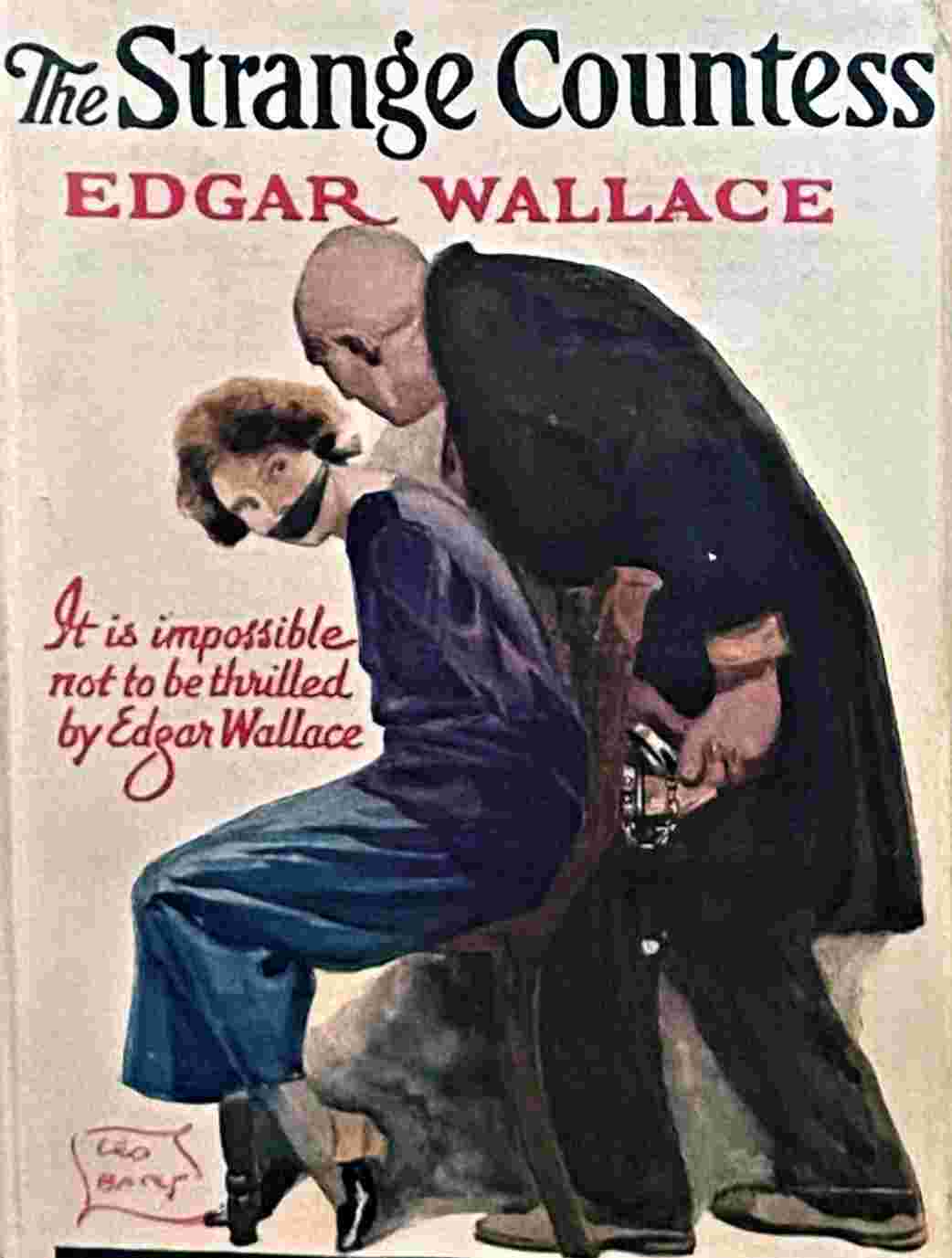
And Lois Reddle lay sobbing on her bed, and in her heart the despair of hopelessness.
Chapter Twenty-seven
Two hours after Michael Dorn had gone, Dr. Tappatt sat in his parlour, his elbows on his knees, his big face cupped in his hands. Beside him was a half-filled tumbler of whisky, and he was gazing into the fire, which was lit for him summer and winter since he had left India. There had been a time when his name had ranked high in the profession of medicine, but an unsavoury incident had driven him from Edinburgh, where, although he was young, he had established an excellent practice, and he found himself in India, with no other assets than his undoubted skill, the meagre remnants of his savings, and a taste for good wine. For a time he had been attached to the court of an Indian prince, and then, in an evil moment, he had conceived the idea of a mental home for wealthy Indians.
But for the growing craving for drink he might have retired after a few years, with sufficient to keep him for the rest of his life. But there was a kink somewhere in Dr. Tappatt’s nature and it showed itself only too clearly in his conduct of the home. He had to leave the North-West Provinces in a hurry and settle in Bengal, where there were queer stories about the home he founded there. There were applications at court by the relatives of patients who had been put away by interested people, and in the end his home was closed and he moved into the Punjab.
His brilliant brain had been sharpened by conflict with authority, and he had become something of a strategist, for strategy is the art of knowing your enemy’s mind.
Staring into the fire, he was studying the mentality of Captain Michael Dorn and he reached certain conclusions. The woman attendant had long since gone to bed, and was asleep when he shuffled down the passage and knocked at her door.
“Come out; I want to speak to you.”
He heard her grumbling, and went back to the study. Once in the period of waiting he looked at the telephone and reached out his hand half-way to take it. But he knew that the person he had in mind was not to be lightly disturbed again, and he had already made his report. No, his method was the best, he decided; and if he was mistaken in his estimate of Michael Dorn no harm would be done.
When the woman came blinking into the light, buttoning up her dress, he nodded to a chair and for half an hour they talked, the woman interpolating sour objections which he dismissed without ceremony.
“I haven’t had any sleep for two nights,” she complained, “and I don’t see why——”
“Are you expected to see anything?” he snarled. “You’re a listener—no more!”
She had served him for the greater part of twenty years and was afraid of no other person in the world. And from grumbling she came to whining, until he waved her out of the room.
At seven o’clock in the morning Dr. Tappatt, dressed in a thick woollen overcoat, for he felt the chill air of the morning, drew up the blinds and opened the windows of his parlour, having previously made a tour of inspection. Heaping two more logs on the fire, he gathered some scraps of meat and carried them out to the dogs, who greeted him with hoarse barks of welcome. He took his time, finding a malicious joy in his tardiness. Then, when he had toured the yard, he went round to the front of the house again, turned the key, unbolted the gate, and pulled it open. A man was standing squarely opposite the entrance, and the doctor started.
“Good morning, Dr. Tappatt,” said Michael Dorn. “I had an idea I should see you if I came early enough.”
“Good gracious!” said Tappatt, in feigned surprise. “This is an unexpected pleasure, Captain Dorn!”
“I am glad you think so. Did Miss Reddle sleep well?”
The doctor’s brows furrowed.
“Miss Reddle? I can’t remember—oh, yes, of course, it was that delightful young lady I met at the Countess of Moron’s house. What a queer question to ask me!”
There was a silence.
“You haven’t invited me in. You’ve lost your old Anglo-Indian sense of hospitality,” bantered Michael.
Tappatt stood in the doorway, his hands in his pockets, his inflamed face thrust forward.
“I don’t remember that we were especially good friends, Dorn,” he said. “I seem to remember certain unpleasant encounters——?”
“Nevertheless—you are going to invite me inside, or else——”
“Or else?” repeated the doctor.
“Or else I shall invite myself. I have a particular wish to look round your little place.”
Tappatt’s big mouth twisted in a smile.
“With or without a search warrant?” he asked politely.
“Without, for the moment. You and I are two old law-breakers, Tappatt; we have never been great sticklers for formality.”
By this time he had walked through the gate, and, curiously enough, he did not seem to expect the dogs. Tappatt noticed this and grew even more alert. He had matched his brain against this sometime chief of police, and so far the honours were with him, he felt.
“I can’t resist you, Dorn,” he said, and waved his hand to the open door of the house. “Step right in.”
Michael did not require a second invitation. He strolled carelessly into the house, and turned to the study as though he had been there before. Following him, the doctor closed the door.
“Now, what do you want?”
“I wish to search these premises—I am seeking a lady named Pinder and her daughter, Lois Margeritta Reddle, whom I believe are forcibly detained here.”
Tappatt shook his head.
“I’m afraid you’re on a wild goose chase. Neither of these ladies are inmates of my house. In fact, I have no patients just now——”
“Nor yet a licence to take patients,” added Michael. “I took the trouble to look up the records—they are available even in the middle of the night—fearing that short-memoried authority had overlooked your many grievous faults; I was happy that the official mind has showed commendable discretion.”
“I haven’t applied for a licence,” said Tappatt shortly. Any question regarding his profession touched him on the raw. “I don’t see why I should allow you to make a search,” he went on. “You have no more authority to act as a detective than I have to run a mental home. You can start here—look under the table or under the sofa,” he grew heavily sarcastic, “I may have some unfortunate person concealed there!”
Dorn walked from the room, along the passage, and stopped at the door at the foot of the stairs, turning the handle.
“My housekeeper’s room.”
“Where is she?” asked Michael.
“She’s in the kitchen.”
Michael passed into the room, pulled up the blinds and again looked round. Though he did not show by any sign his state of mind he was neither uneasy nor unalarmed at the readiness with which permission had been given to him to make the search. Rather were matters working out according to his expectations.
“There are two rooms upstairs; would you like to see them?”
Dorn nodded and followed on the man’s heels to the landing.
“This is a ward I should use if I had luck enough to get a patient.” He threw open the door of what had been Lois’ room. It was empty; the bed was stripped of all its clothes and the blankets were neatly folded at the foot. Michael walked into the room, inspected the little bathroom, tried the windows, and came out without a word. Most women use a distinctive perfume. He had noted that Lois was faintly fragrant of lavender—the room had that scent too.
The room opposite was even less completely furnished, and it was also tenantless. He knew that there was no space between the ceiling and the roof to conceal any but a willing fugitive, and satisfied himself with the briefest of scrutinies.
The other wing of the house was scarcely habitable; in some places the sky showed through the gaps in the roof, and all the upper floors were rotten with storm-water and would hardly bear the weight of a child.
“Where does that lead?” asked Michael when he came out from the inspection of the lower floor of the old wing. He pointed to a flight of steps that terminated in a door.
“It is a cellar of some kind; you can go in,” said the other carelessly.
Michael pushed the door open and stepped into a little apartment. A certain amount of light and air was admitted through a small grating that had been let into the wall, but there was little of either. Other light or ventilation there was none, except for the spy-hole in the door. He flashed his lamp around, saw an old bed in one corner and a washstand. He walked to the bed, turned over the folded blankets, and then came into the daylight.
“Quite an airy apartment,” he said drily. “Is this for a patient too?”
“There is many a poor fellow sleeping out at night who would be glad of that room,” said Dr. Tappatt virtuously, and Michael showed his teeth for a moment in an unpleasant smile.
“Ever been in prison, Tappatt? I don’t think you have, have you?” he asked, as he ascended the steps again.
Nobody knew better than Michael Dorn that the doctor had escaped conviction, but it was his way of giving a warning.
“I have not had that distinction.”
“Yet,” finished Dorn. “The cells of Dartmoor are much more wholesome than this black hole of yours—as you will find. Plenty of fresh air, immense quantities of light—and the food is good.”
Tappatt licked his lips but made no answer.
“What is in here?” He stopped before a locked shed.
“A motor-car belonging to a friend of mine. Do you want to see it?”
“A blue Buick, by any chance?”
“Yes, I think it is a Buick.”
“Left here the night before last, I think?”
Tappatt smiled and shook his head.
“It has been here a week. There are times when you are just a little too clever.”
“Let me see it,” said Michael.
The doctor went back to the house for keys, whilst Michael made a rapid inspection of the remaining buildings. The two dogs broke into a fury at his approach, straining at their chains until it seemed that they must choke or the leashes break. Then the doctor returned and found Dorn contemplating the back gate with absorbed interest; the ground was hard and showed no footmark—even the car had left no tracks.
“Here is a key.”
“I don’t think I want to see the car,” said Dorn slowly. “I know it rather well and the owner more than a little.” He looked round. “I don’t see your housekeeper anywhere.”
“I expect she’s gone into the village to do her marketing,” said the other.
Slowly Michael took a gold case from his pocket, selected a cigarette and lit it, throwing the match towards the dogs, an act which angered them to madness.
“You want to be careful of those dogs,” warned the doctor. “They’re not the kind to monkey with. I don’t know what they would do to you, even if I were with you.”
“They want to be careful of me,” said Dorn. “I had the death of more pariahs on my soul than any other police official in India during the term I was serving.”
“They would get you before you got them,” said the doctor angrily.
Michael Dorn smiled, and stretched out his hand stiffly before him.
“Do you see that?” he asked. “Watch!”
Where it came from, how it got there, Tappatt could not for the life of him tell; but though the hand apparently had not moved it was holding a short-barrelled Browning of heavy calibre.
“Where on earth did that come from?” he gasped. “You had it there all the time——”
“No, it came out of my pocket,” laughed Michael. Again he was engaged in one of his subtle acts of intimidation.
“I’ll swear that it didn’t.”
“Watch!”
Again the hand was held stiffly. An imperceptible movement, whether up or down or backward Tappatt could not say, and the hand was empty.
“It is a trick,” said Dorn carelessly. “And if you speak dog language you might explain to these hounds of yours that I am a man to leave severely alone. By-the-way, dog patrols have always been a specialty of yours? Wasn’t the trouble in Bengal over a patient who had been worried to death? Refresh my memory.”
The doctor swallowed something, and then Dorn asked:
“Why are these dogs chained up?”
“I keep them chained.”
“They weren’t chained last night. You knew I was in the neighbourhood, and that doesn’t seem to be the time to put them on the leash. Yet at four o’clock this morning they were fast. Why did you tie them up, doctor?”
Their eyes met.
“Shall I tell you why?”
Tappatt was silent; the detective had returned at four o’clock in the morning; he had just missed the little procession that had crossed the fields!
“Shall I tell you why?” Dorn asked again.
“You’re in an informative mood,” sneered Tappatt.
“Very. You tied them up because you took those two women out of the house last night, out through this yard, and you could only do that when you had put the dogs on the chain. Correct me if I’m wrong. They went out this way and they will come back this way.”
Dr. Tappatt’s jaw dropped; this was a turn to his disadvantage with a vengeance. He had expected Dorn to be satisfied with his search and to leave some time during the day. His plan was not working as he had expected.
“You can invite me to breakfast; I shall stay until they return.”
“I swear to you that I know nothing whatever about any women,” protested Tappatt violently. “You’re making a mistake, Dorn! Anyway, you’ve no right here—you know that!”
Michael shook his head.
“I never make mistakes,” he said arrogantly, “and I have every right to be here. It is the first duty of a citizen to frustrate any wrong-doing, and the first duty of a host to ask his guest if he is hungry. Now you can invite me to breakfast. And over that pleasant meal I will tell you something which will interest and amuse you.”
The baffled man looked first one way and then the other. He was trapped; his ruse had not only failed, but had rebounded against himself. Dorn, out of the corner of his eye, saw the quick rise and fall of his chest, and knew something of the panic in him.
“You can’t stay here. I don’t want you!” exploded Tappatt angrily. “That story about women being in my house is all moonshine and you know it. I’ll give you one minute to clear out! You can’t bluff me!”
Michael Dorn laughed softly.
“What will happen if I don’t clear out? Will you send for the police? There is the opportunity to get back on the cruel police commissioner who shut down your little home in the Provinces and might have got you five long weary years in Delhi prison if the official mind had only moved a little quicker. Send for the police, my good man; it will be a grand advertisement for you.”
Dr. Tappatt had no intention of sending for the police; the force was not a popular constituent of public life with him. From the height of his intellect he looked down upon all other professions and callings than his own.
“All right,” he growled, “come in. And as for the women, you’ll find you were mistaken.”
“Don’t let us discuss them,” said Michael with an airy gesture of his hand.
Chapter Twenty-eight
He could almost afford to feel jubilant at the contemplation of his partial success, only he was a man who never counted eggs as chickens; nor did he underrate the resourcefulness of the man he was dealing with.
The doctor was thinking rapidly, and a stiff glass of whisky helped further to clear a mind which was only normal when it was stimulated. Dorn was there to stay; such subterfuges as came into his mind to rid himself of the unwelcome visitor, he rejected.
“Tell me where the coffee is and I will make it myself,” said Dorn. “Please forgive me if I’m a little suspicious, but doctors have an uncanny knowledge of the properties of certain drugs, and I should hate to feel myself going to sleep for no other reason than that you had found an opportunity for doctoring my drink.”
He went into the kitchen, kindled the fire and put on the kettle. In one of the cupboards he found a tin of biscuits and a can of preserved milk—there were the elements of safe refreshment here. He knew his doctor very well—he had set a train of thought in motion. Would he take the obvious step, or go outside the detective’s plan?
The doctor crouched before the fire in his study, his mind working in all directions. It was a curious fact that, until Dorn’s jesting remark, he had not thought of drugs. He heard Michael whistling softly to himself, and, rising noiselessly, crossed to his desk and searched among the bottles that were arrayed on various shelves and in divers pigeonholes, and presently found what he sought.
He slipped a grey pellet from the phial, dropping it into the palm of his hand, and, replacing the bottle, pulled down the desk cover. There might be no opportunity. Against that, every man as self-assured as Dorn was left himself open at one point.
Wedging the pellet between the second and third fingers of his left hand, he came back to the fire, and was there when Michael Dorn came in later with coffee, cups, and saucers on a tray, the biscuits under his arm.
“I’ve been thinking that perhaps, after reflection, you will tell me what time you expect our friends to return?” he asked. “Or, failing that, would you tell me what is the signal you are to give to signify that the coast is clear?”
“You’re mad to make such suggestions,” said Tappatt gruffly. “I thought you weren’t going to talk about the women. They are not here.”
“Somebody has got to talk about them,” murmured Michael apologetically. “Have some coffee? It is infinitely better than that yellow stuff you’ve got on the mantelpiece, and costs about one twentieth the price.”
He poured out a cup and pushed it towards his companion, but the doctor did not so much as turn his head.
Michael sipped luxuriously at the hot comforting fluid, his eyes fixed upon Tappatt’s moody face. Suddenly the doctor lifted his head as though he had heard something.
“There is somebody coming now,” he said, and the detective walked to the door and listened.
When he turned the doctor was in his old posture.
“You’re getting jumpy—it is the whisky, my friend,” he said.
He refilled his cup, stirred it vigorously, and dropped in a liberal supply of condensed milk.
“What is this interesting thing you were going to tell me?” asked Tappatt, still staring into the fire.
“It concerns you. There is a movement to get you brought before the General Medical Council for that Indian trouble, which means, I suppose, that you will be struck off the medical register.”
This was news to the doctor, and he sprang to his feet.
“That is a lie!” he said loudly.
Suddenly Michael bent his head.
“What was that?” he asked.
Tappatt looked round.
“I didn’t hear anything.”
But the detective motioned him to silence. He rose, picked up his coffee, and walked to the door, listening.
“Stay here,” he said and disappeared from view.
He was back again in a minute, but remained standing by the door, sipping at his cup, and the doctor affected to be amused.
“You’ve got nerves, man,” he said. “If you’d trusted me enough to leave your cup behind I’d have given you something to cure you!”
“So I suppose,” said Michael, setting down the vessel nearly empty. “I hate showing discourtesy to a host, but I have made a practice all my life of pouring out my own drinks when I’m in dubious company, and hanging on to them until I’m finished.”
The doctor glanced at the cup and his face cleared. It had been so absurdly easy, though the danger was by no means over.
“What I like about you, Dorn, is that you’re a gentleman. I’m not paying you a compliment. I’m merely stating a fact. I’ve had to do with a few police officers who have been the scum of the gutter, and the contrast is refreshing. You were kidding about striking me off the register, weren’t you?”
Michael shook his head.
“I never kid. I am the man who intends making a personal application at the next meeting of the Council,” he said. “You can be sure that I shall be able to lay before them sufficient proof to make your position in England a pretty uncomfortable one.”
Tappatt forced a smile.
“In that case,” he said, rising, “I’d better do what I can to get on the right side of you. If you will come with me, I will show you something you’ve overlooked.”
He smiled in the other’s face, and Michael followed him down the passage into the yard.
“You were rather unkind about the airiness of this admirable place of detention,” said Tappatt. He stood on the top of the steps which led to the underground room. “Did it occur to you that it might be just a little more airy than you had imagined? Come!”
He ran down the steps, pushed open the heavy door, and went into the cellar chamber.
“You did not see the trap-door in the corner of the room, did you?”
Michael pushed past him and strode across the brick floor. He had taken three steps when the door shut. The key squeaked as it turned and there came to him the sound of Tappatt’s mocking laughter.…
“That is a trick of mine—now show me your trick with the gun!” laughed the doctor.
A splinter of wood leapt from the door; there was the sound of a muffled explosion and Tappatt scrambled up the steps, laughing hysterically.
He ran back to the room. Michael’s cup stood on the table, and he spooned a quantity of the lukewarm liquid and tasted it, smacking his lips.
“Brain against brain. I think I’ve scored the final point!” he said with satisfaction. It had been so crudely simple. What would happen after, he did not stop to consider.
For Dr. Tappatt the game was almost finished. His employer had been more than generous—a large sum was due for his latest services, and the whole world was open to him. For two years he had served his friend faithfully and well. It had been an unromantic service, a service that kept him well within the boundaries of the law. The doctor had a very clear viewpoint. He knew that the end of this adventure meant the worst kind of trouble, and one more offence against the law would make little difference if he faced a jury. He was determined to avoid juries. The detention of Michael Dorn gave him a breathing space—a respite. The machinery of the law moved slowly, and nowadays a man who took forethought might go from one end of Europe to the other between sunrise and sunrise.
Half an hour passed, an hour. He looked at his watch for the twentieth time, and, pulling open a drawer of his desk, he took out a pair of handcuffs, humming a tune as he worked the hinges.
Returning to the cellar room, he knocked loudly on the door and called the prisoner by name. There was no reply, and he unlocked the door and peeped cautiously inward. The slit afforded him a view of the bed. Michael Dorn was lying face downward, his head on his arm and motionless.
Without hesitation, the doctor went into the room, and, turning the inert figure on its back, began a quick search. There was no pistol in the hip pocket; he found that in a specially constructed pouch inside the coat. Dorn’s eyelids flickered as the doctor made the search, and there came from the lips an unintelligible mutter of sound.
“You are not so talkative now, my friend,” said Tappatt pleasantly.
He took some papers from the detective’s pocket and these he transferred to his own. Watch and chain he left; but anything that might be used as a weapon, even the little penknife, he took away. When he had finished he fastened the handcuffs and gazed upon his finished work with a smile of satisfaction. Returning to the house, he found the tin of biscuits, and, filling a ewer full of water from the yard pump, he brought them back to the prison. These he placed near the bed.
“Michael Dorn, you were easy,” he said, addressing the unconscious figure. “Much easier because you have no official standing, and have few friends who will worry about you, or notify the police of your disappearance. And if they are notified, where are they to search? Tell me that, Michael Dorn!”
He locked the door and, passing through the gate at the front of the house, he made a reconnaissance. There was just a chance that the man had left his motor car near by, and a standing machine might attract the attention of the constabulary. There was even a possibility that he had not come alone. But, though the doctor walked a mile in either direction, there was no sign of a car, and he returned to the house, tired but triumphant. Never again would the thought of Captain Michael Dorn come like a shadow over his pleasant dreams of the future.
Chapter Twenty-nine
Dear Miss Smith,—I have been trying to get into communication with a Mr. John Wills, who is an assistant of mine, and possibly I have succeeded. But in case, by any mischance, my messages have failed to reach him, I should esteem it as a great favour if you would find him and hand him the enclosed, which is a duplicate of the instructions already posted. I think I have located Miss Reddle, and hope to have good news for you to-morrow. But I am dealing with a man for whose genius I have a profound respect. Miss Reddle is at Gallows Farm, near Whitcomb in Somerset, and, if you do not hear from me by telegram in the course of the day, it is extremely likely that I shall also be there—against my will. I have calculated every contingency; foreseen, I think, most of the possibilities, but there is always a big chance that I may not be as clever as I think I am! Will you therefore remain all day at Charlotte Street? I suggest that you should ask your employer, Mr. Shaddles, to let you off for the day, and, if necessary, show him this letter. He may remember me by name; I met him many years ago.
Yours very truly,
Michael Dorn.
The words, “If necessary, show him this letter,” were heavily underlined.
The letter had come by special delivery, a red express label on the face, and the postmark was a town in Somersetshire. Lizzy Smith read it three times, once to master the calligraphy, once to understand it, and once out of sheer enjoyment, for she felt more important with each reading; though it struck her as humorous that Michael Dorn should, in his most extravagant mood, imagine that her flinty-faced employer would grant her leave of absence on the strength of a meeting which he must long since have forgotten and would most certainly disclaim.
The news was too vital to be kept to herself, and she took the letter down to old Mr. Mackenzie, and found him engaged in fitting a new string to his violin.
“Wore it out last night, I should think,” said Lizzy, not unkindly. “I heard you tuning and tuning.”
“Tuning!” said old Mackenzie in surprise. “I was no’ tuning, young lady. Perhaps, to the ear of one who is not acquainted with the peculiar qualities of classical music, it may have sounded that way. I was playing the aria from Samson and Delilah. ’Tis a bonny piece.”
He pulled on his spectacles from his forehead, and took the letter from her hand.
“You would like me to read this?” he asked, and when she nodded, he followed the quaint crabbed writing line by line. “It seems very good news,” he said. “Will Miss Reddle be back to-night?”
Lizzy sighed impatiently. It was the sort of question he would ask.
“How do I know whether she’ll be back to-night?” She was annoyed that he was not as impressed as she had expected. “She may not be back at all! Don’t you understand anything you can’t play on your fiddle, Mr. Mackenzie? She may be in the power of this Gallows man! The whole thing now depends on me. Mike understands human nature, and when he got into trouble naturally his mind flew to Elizabetta Smith. That man has got experience.”
“Naturally,” murmured Mr. Mackenzie.
“Now the thing is,” considered Lizzy, her face wearing a frown of profoundest thought, “shall I try to find this fellow Wills first, or shall I go to the office?”
“You might telephone to Mr. Dorn’s flat,” suggested the old man helpfully, and Lizzy was irritated that that simple solution had not occurred to her.
On her way to the office she stopped at the first telephone booth and called Michael’s number, and after a long wait was told there was no answer. The news pleased her rather than otherwise, for the responsibility, vague as it was, gave her a pleasing sense that she was intimately associated with great happenings, though she looked forward with trepidation to her meeting with old Shaddles. That he would grant her the day was a forlorn hope. Much more likely he would point his skinny finger to the door and order her from his room. Nevertheless, though she sacrificed her livelihood, she was determined to be on hand in case her services were required—though what she could do, and in what capacity she could act, she did not trouble to consider.
Before she reached the office she had created three alternative excuses, none of which unfortunately had any relation to the other. Happily she was only called upon to produce two.
Mr. Shaddles had arrived before her; he was invariably the first-comer and generally the last leaver. Without taking off her hat, she knocked at the glass panel, and when his gruff “Come in!” reached her she all but abandoned the interview. He scowled at her as she came in, noted her coat and her hat.
“Well, what is the matter? Why aren’t you at your work? You’re five minutes late as it is!” he demanded.
Lizzy rested her hand lightly on his desk, and in her most genteel voice began:
“Mr. Shaddles, I’m sorry to ask you, but, owing to a family bereavement, I should like the day off.”
“Who’s dead?” he growled.
“An aunt,” she said, and added: “On my mother’s side.”
“Aunts are nothing,” said the old man, and waved her to the door. “Uncles are nothing either. Can’t spare you. What do you want to go to funerals for?”
“Well, the real truth is,” said the disconcerted Lizzy, and produced the letter, “I’ve had this!”
He took the message with apparent reluctance and read it through with typical care. He sat for a long time, and she thought he was searching for misspelt words—a horrible practice of his.
“There is nothing about your aunt in this,” snarled Mr. Shaddles.
“Mr. Dorn has been more than an aunt to me,” said Lizzy with dignity. “It is my pet name for him. And if he’s not dead, he may very well be.”
He looked out of the window, scratched his rough chin angrily, then glared round at her.
“You can have the day,” he said, and she nearly dropped with amazement.
Murmuring her incoherent thanks, she was making for the door.
“Wait.”
He put his hand in his pocket, laid a note-case on the table, and took out three bank-notes.
“You may not want these,” he said; “I cannot conceive that you will, but you may. I shall require you to give me a very full account of any expenses you incur. If you need a car, hire one from the Bluelight Company—they are clients of ours, and they allow me a rebate.”
Like a woman in a dream, Lizzy staggered out the office. Each note was for £20. She had no idea there was so much money in the world.
She did not answer the clerk whom she passed on the stairs, and had not wholly recovered by the time she reached Hiles Mansions. Mr. Dorn was not in, the liftman told her unnecessarily; and Mr. Wills had not called since the previous day. Lizzy went out into the Brompton Road, called a taxicab magnificently, and, reaching Charlotte Street, discovered she had only sufficient loose cash to pay the fare.
Such a tremendous happening could not be reserved to herself, and she took Mr. Mackenzie into her confidence.
“Shaddles is a grand man,” said Mackenzie soberly, “a big-hearted fellow.”
Lizzy shook her head.
“I don’t know whether I shall get into trouble with the police for taking this money from the poor old man,” she said. “He has been strange for a long time: I’ve seen this coming on for days. When he raised Lois Reddle’s salary to three pounds a week I knew something else would happen.” She looked at the three notes in awe. “They get like that when they’re about ninety,” she said. And then a great inspiration came to her—so daring, so tremendous, that it left her gasping.
Borrowing some loose change from the old man, she dashed down to the telephone box from which she had called Hiles Mansions and gave Lady Moron’s number. The footman who answered her told her that her ladyship was in bed.
“Oh, pray don’t trouble,” said Lizzy in an exaggerated tone. “Will you ask his lordship to hop along?”
“To what, madam?”
“To speak to me,” corrected Lizzy.
“What name shall I give him?”
“Tell him the Lady Elizabetta,” said Lizzy, and lolled languidly against the cork-lined ’phone box as she would have lolled had she been a person of title.
She had to wait for some time before his lordship, who was sound asleep at that hour, could be aroused and sufficiently interested in the caller to come down to the drawing-room, where there was a telephone extension.
“Hullo?” he asked feebly. “Good morning and all that! Sorry I didn’t catch your name.”
“It’s Miss Smith,” said Lizzy in a hushed voice, and she heard Selwyn gasp.
“Really? Not really? I say, there’s been an awful bother here! Everything’s at sixes and sevens, and all that sort of thing. That beastly bounder, Chesney Praye—you remember the fellow—bird of prey, what?” (Even Lizzy could not laugh at that hour in the morning.) “Well, he’s in the library with her ladyship!”
“Listen—Selwyn!” She had to summon all her courage to voice this familiarity. “Can you see me? You know where I live—you were coming to dinner to-night; but I want you to come before. There’s something I want to see you about, something—well, I can’t describe it.”
“Certainly,” he interrupted. “I’ll come right along. I’m supposed to go to the South Kensington Museum to see some models, but—— All right, colonel, thank you very much for calling!”
The tone was louder and more formal. Lizzy, not unused to such innocent acts of deception, guessed that a servant or his mother had come into the drawing-room.
She went back to her lodging with a feeling of exaltation. Not only had she secured the aid of a member of the aristocracy, but she had also, with great daring, and exercising a woman’s privilege, addressed him by a name which, to say the least, was intimate. She confided to Mr. Mackenzie, with an air of nonchalance, that she was expecting Lord Moron to call upon her, and he was impressed to a gratifying extent.
“I told him to drop in—I know him rather well.” Lizzy flicked a speck of dust from her skirt with a fine air.
“Is that so?” he asked, looking at her in wonder. “Well now, I never thought that one of the Morons would ever do me the honour of entering my house! They’re a fine family, a handsome family. I remember the old earl: he frequently came to the theatre, though not, I fear, in the most presentable condition.”
Miss Lizzy Smith was not interested in the old earl. She was, however, immensely absorbed in the new one; and when Lord Moron’s taxicab pulled up at the side-walk she was at the door to admit him.
“I say, what an awfully jolly kitchen!” he said, looking round at a room of which even Lizzy was not particularly proud.
“I wouldn’t have asked your lordship here——” she began.
“I say, don’t give us any of that ‘lordship’ stuff,” he pleaded. “I’m Selwyn to my friends. That’s a wonderful frying-pan: did you make it?”
Lizzy disclaimed responsibility. But he had his views, apparently, upon culinary apparatus, had invented an electric chafing-dish, and had plans for a coke oven. Until then she had not known that coke was ever cooked.
“I’ve often thought I’d like to run away from this awful ‘my-lording’ and do some work. I’ve got a bit of money of my own that even her ladyship can’t touch—and you can bet your life that it’s pretty well tied up, old thing, if she and the bird of prey can’t get their hooks into it!”
He was delightfully, restfully vulgar, and Lizzy who only knew this much about electricity, that lamps light up when you turn a switch, without exactly understanding why, could have listened for hours to schemes which might even have interested an engineer. But she had the letter to discuss.
He read it through, and, by stopping at every other line and asking for explanations, understood the gist of it. She had noticed before how, on really important matters, Selwyn had quite intelligent views; and that he was no fool she discovered later in the day, when he confided to her that he had countered his mother’s veiled threats of getting him certified as mentally incompetent to deal with his estate, by making a visit to three Harley Street alienists in consultation, and procuring from them a most flattering tribute to his mentality.
“I don’t know what it’s all about,” he said, as he handed the letter back. And then, answering her pained look: “Yes, I understand the letter, but I mean all these accidents and things—old Braime dropping dead, or something, in the library. Madam is my mother, and I suppose I ought not to loathe her. But she’s fearfully devilish, Miss Smith, fearfully devilish!”
He fingered the red seam on his cheek tenderly.
“You can never be sure what she’s up to, and since that bounder Praye and that awful boozy doctor have been around the house she’s been queerer than ever. Do you know what she told me once? She said that if she thought she’d be any happier by me being dead I’d be dead to-morrow—those were her very words! Dead to-morrow, dear old Lizzy! Isn’t it positively fearful?”
“What a lady!” said Lizzy. “You’ve heard nothing at the house about this business—I mean Gallows Farm?”
He shook his head.
“They never talk in front of me. But something’s happening: I’m sure of that! That chap Chesney has been in with her ladyship since eight o’clock this morning—they told you she was in bed—well, she wasn’t: she was in the library. And the telephone seems to have been ringing all night. I say, what do you think of that detective johnny putting the young lady in gaol? A bit thick, what? I meant to have a few words with him the other morning.”
“He did it for a very good reason,” said Lizzy mysteriously. “I can’t tell you everything, Selwyn; one day you will know the truth, but at the present moment I’m not at liberty to talk.”
“Nobody seems to be at liberty to tell me anything,” said the dismal man. “But what’s the idea of that letter? Somebody’s got her in that place with a fearful name!” He slapped his side. “Tappatt—the chap who worries the wine! You know this fellow—the perfectly horrible doctor! I’ll bet he’s the perfectly awful villain of the piece! He hasn’t been near the house for days, and he had been sleuthing round Chester Square a lot lately. And”—he slapped his knee again—“and there was a trunk call came through from the country last night! I was in the hall when the bell rang, and I’m sure he was the johnny who called. He asked for her ladyship. Gallows Farm: that’s the place he lives!”
Suddenly he jumped up, his eyes bright with excitement.
“She’s there—I’ll bet a million pounds to a strawberry ice! Gallows Farm, Somerset.” He tapped his forehead. “I signed a paper about that, I’ll swear! It is one of the job lots her ladyship bought two or three years ago, or one of her bailiffs bought. She is always buying old properties and selling ’em at a profit. And I know old stick-in-the-mud has got a home somewhere—Tappatt, I mean—because her ladyship said she’d send me there if I wasn’t jolly careful. That rosy-nosed hound has got Miss Reddle!”
They looked at one another in silence.
“You’re a detective, Selwyn!” she breathed ecstatically, and he pulled at his moustache.
“I’m pretty smart at some things—what about a rescue?” said his lordship suddenly.
“A what?” Lizzy’s heart beat faster.
“A rescue,” he nodded. “What about hopping down into Somerset, seeing old stick-in-the-mud, and saying: ‘Look here, old top, this sort of thing can’t be tolerated in civilised society. Hand over Miss Reddle or you’ll get into serious trouble’?”
Lizzy’s enthusiasm died down.
“I don’t think that would make much difference to him,” she said. “And it would be unnecessary, Selwyn; if Michael Dorn is there she will be released this afternoon.”
Selwyn was disappointed.
“Besides,” Lizzy went on, “what would her ladyship say if you were away all day?”
“Blow her ladyship!” He snapped his fingers. “I’ve had enough of her ladyship—I have really. I’ve made up my mind that I’m through with Chester Square, and I’ve got my eye on a dinky little flat in Knightsbridge,” he said rapidly. “I feel it is time I asserted myself. My idea is to live incognito. I’m going to call myself Mr. Smith——”
“Indeed?” said Lizzy coldly.
“It’s a pretty good name. Anyway, Brown is as good.” He amended his plans in some haste. “Now what about a little bit of lunch somewhere?”
An hour later Lizzy went dizzily into the great dining-room of the Ritz-Carlton, and Lady Moron, entertaining a guest at a corner table, looked at her through her lorgnettes and shrugged her large shoulders.
“Selwyn is sowing his wild oats rather late in life,” she said, and Chesney Praye, who had returned from Paris that morning, was mildly amused.
Chapter Thirty
Though she could remember one or two uncomfortable days in her life, Lois Reddle could not recall one that bore any comparison with the twenty hours that followed her departure from Gallows Farm. She had been awakened by the woman at some unknown hour in the middle of the night, ordered to dress and come downstairs. The first order was easy to obey, for she had not taken off her clothes. When she came down into the passage she found the doctor waiting for her. He was wearing his heaviest overcoat, and carried a thick stick, and was testing a flash-lamp as she joined him.
“Where are you taking me?” she asked, as he led her across the yard to the accompaniment of the savage chorus of the dogs.
“You’ll find out in good time,” was the unpromising reply. “I don’t want you to ask questions or to speak until I tell you. After you leave this house you are to be silent—understand that?”
They mounted the gentle slope of the downs and presently descended into a valley on the other side. Although the moon was obscured, there was sufficient light to enable her to pick her way across the rough ground and to dispense with the arm he offered her. Once they made a wide detour to avoid a marshy patch, and once he had to help her through a fence of hawthorn. Ahead of them was a dark line of trees, which was on the estate. He told her there were twelve hundred acres of land attached to the farm, only a small portion of which had been sub-let, and none of which was under cultivation.
“It is poor land, anyway—most of this downland is. That is Gallows Wood,” he said, indicating the trees ahead. “The farm takes its name from the wood. There used to be a gallows on the crest of the hill years ago. Not scared, are you?”
He chuckled when she answered “No.”
After a while they struck a rough track which led into the heart of the copse, and now for the first time he produced the flash-lamp; a necessary precaution, for the path was overgrown and difficult to follow. Although her voice was steady and her attitude one of sublime confidence, Lois was inwardly quaking. There was something very ominous in this move. Yet it was not the fear of what would happen in the wood that frightened her. She guessed that the doctor was moving her from the farm because he expected the return of Michael Dorn. She dreaded only this; that Michael would search the house and be satisfied that she was not there. Would the doctor move the grey-haired woman too, she wondered? After ten minutes’ walk he stopped, and she thought he had lost the way, until the light of his lamp revealed a small stone cottage, standing back from the path and almost hidden by trees and undergrowth. This, then, was the new prison, she thought.
“Hold this light,” he ordered, and she obeyed, whilst he tried key after key in the lock.
After a while the door swung open and he went in, turning his head to see that she was coming after. The floor was thick with dust; the only furniture in the room into which he invited her was an old backless chair. On one of the walls was a yellow almanac for the year 1913, and probably the house had not been occupied since then.
“You’ll stay here and keep quiet. There will be light in a few hours. If you want anything, ask Mrs. Rooks—she will be here presently.”
He went out, but did not lock the door; she found afterwards that it was lacking in this appendage. Followed half an hour’s wait, and then she heard footsteps in the hall, heard another door open, and a mutter of conversation. Something dropped with a thud on the passage, and for a second Lois’ heart came into her mouth. But it seemed that Mrs. Rooks, who, she guessed, was the sallow-faced woman, had come heavily laden, for the sound of her complaining reached the girl. Evidently she had brought the provisions necessary for the party—the weight of them was not very promising, and Tappatt was seemingly prepared for a long stay.
“Nearly broke my back,” she grumbled. “Why couldn’t she carry it, doctor?”
Lois crept nearer to the door and listened, hoping to hear something that would confirm her theory that she was being hidden because the doctor expected a return visit from Michael Dorn.
“Get a chair from the other room,” she heard him growl. “What are you making all this fuss about? It is no worse for you than for me. This isn’t the first time you’ve sat up all night, is it?”
“I don’t see why you should take all this trouble,” grumbled the woman. “He’ll not come back again, and, if he did, what’s to stop him coming into the wood?”
“He will come back—you need have no doubt about that. I know the man. And you can make your mind easy about his finding them. He isn’t likely to search every copse in the neighbourhood.”
A few minutes later the front door slammed as he went out, and she heard the woman grumbling to herself. She was sitting within a few feet of the door, and could hear every sound and move in the bare room. To open the window might be possible, but to do so without her hearing was a hopeless impossibility.
Soon after daybreak Mrs. Rooks took her into the kitchen, and, passing the room which held the second prisoner, Lois saw that there was a key in that door. If the conditions were the same in the other prison room it was as impossible for the unknown woman to escape. Who was she, she wondered? Some poor creature, perhaps, who had been entrusted by her friends to the tender mercy of Dr. Tappatt. Her heart ached for the woman, and in her pity she forgot her own danger and discomfort.
Throughout the long and weary day that followed she saw no sign of any human being. The wood was situate on a private estate, and the overgrown condition of the path had told her that it was not frequented even by those who had authority to cross the land. From the windows she could see only the trunks of beeches and the green tracery of leaves. The oppressive loneliness told even upon the uncommunicative Mrs. Rooks, who must have been unused to a solitary life, for that afternoon she came into the room where Lois was sitting. Lois had opportunity for studying her. She must have been in the region of fifty, a harsh, sour-faced woman, with a grievance against the world and its people.
“It’s so pesky quiet that I should go off my head if I was here long,” she complained.
Lois wondered if she could make the woman talk about other things than the loneliness of the wood.
“Have you been in England a long time?” she asked.
Mrs. Rooks had to master her natural repugnance to gossip before she spoke.
“Only two years. We were in India before then. I don’t know what that has got to do with you, anyway.”
“I heard you call your dogs by Indian names. ‘Mali’ means money, doesn’t it?”
“Don’t you ask questions, young lady,” said the woman. “You behave yourself, and you won’t be badly treated. Act the fool, and you’ll——” She nodded significantly. “Of course ‘Mali’ means money. Do you mallum the bat?”
Lois shook her head smilingly. She guessed that she was being asked if she spoke or understood Hindustani.
“Why am I kept here—can you tell me that?”
“Because you’re not right in your head.” The reply would have driven Lois to a fury, but she had already guessed the excuse that would be made for her detention. “You’ve been hearing things and seeing things. An’ people who hear things, voices an’ all that, are batty.”
Lois laughed quietly.
“You know that I am not mad, Mrs. Rooks.”
“Nobody thinks they are mad,” said Mrs. Rooks alarmingly. “That’s one of the symptoms. The minute a person thinks she’s sane, she’s mad! The doctor knows: he’s the cleverest man in the world.”
She glanced back at the open door. Lois heard a steady echo of footsteps, as though somebody was pacing the floor.
“Who is in the other room?” she asked, without expecting any very satisfactory reply.
“A woman—she’s nutty.”
“I thought I saw her the other evening,” said the girl with affected carelessness. “Weren’t you—talking to her in the yard?”
The woman’s shrewd eyes looked her up and down.
“You saw me quieting her with the whip. She gets fresh sometimes—most of ’em do. You will too.” Lois shuddered at this ominous prophecy. “Bless you, they don’t mind a licking! Lunatics ain’t human beings anyway, they’re just animals, the doctor says, and you’ve got to treat ’em like animals. That’s the only kind of treatment they understand.”
Lois tried to veil her horror and disgust and felt that she had not wholly succeeded.
“I hope you will not treat me like an animal,” she said, and Mrs. Rooks sniffed.
“If you behave yourself, you’ll be treated well. All nutty people have a good time if they don’t get fresh and obstrepulous. That’s the doctor’s way.”
It was clear to Lois that, whatever faults this woman might have, however brutal she might be, she had accepted without any question any diagnosis that the doctor might make. To Mrs. Rooks she was crazy, just as was the other woman. And if she became “obstrepulous” she would be served in the same way.
“Why did you call her a gaolbird?”
Again that shrewd, suspicious scrutiny.
“I call her lots of things,” said Mrs. Rooks indifferently. “If you hadn’t been spying you wouldn’t have heard. Names don’t hurt anybody. They’re better than the whip anyway—did you know that man that came last night?”
“Mr. Dorn?”
“Yes, who is he?”
“He’s a police officer,” said Lois.
The effect of the words upon the woman was unexpected. Her sallow skin became a pasty white.
“A detective!”
Lois nodded, and Mrs. Rooks’ face cleared.
“That’s part of your crazy ideas,” she said calmly. “He is a man the doctor owes money to. I know, because the doctor told me. The doctor’s been in difficulties, and he’s not the kind of man who’d have any trouble with the police. They told a lot of lies about him in India, but he’s a good man, the best man in the world.”
And then a thought struck Lois, and she asked:
“What is supposed to be my delusion?”
Mrs. Rooks shot a cunning glance at the girl.
“I’m surprised at you asking that, young lady! You think you’re somebody who you’re not!”
Lois frowned.
“You mean I am under the impression that I am somebody important?”
Mrs. Rooks nodded.
“Yes—you think you’re the Countess of Moron!” she said.
Chapter Thirty-one
Lois could hardly believe her ears.
“Me?” she said in amazement. “I think I am the Countess of Moron? How absurd! I think nothing of the kind!”
“Yes, you do,” nodded Mrs. Rooks. “The doctor said you think you’re the countess. You tried to murder Lady Moron because you wanted the title!”
The suggestion was so ludicrous that Lois laughed.
“How ridiculous! Such an idea has never entered my head. Lady Moron! Why, I am a secretary—where did you hear this?”
“The doctor told me,” said the woman stubbornly. “He never tells lies—except to people he owes money to, but that’s natural, ain’t it?”
She went out of the room soon after and was gone for half an hour, apparently attending to the needs of the other prisoner, for when she came back she had something to say about discontented people.
“She’s had all she wants to eat and all she wants to drink and still she’s not satisfied. That shows she’s mad. I never knew a crazy woman that was satisfied.”
Lois thought it was a weakness, not entirely confined to the crazy.
“When are we leaving here?”
“I don’t know—to-night I guess,” said the other, vaguely. “Anyway, the doctor will be here to take my place and I’ll get some sleep. I’m nearly dead.”
Mrs. Rooks was not disposed for further conversation and as the day progressed she grew more taciturn and irritable. When night fell, she seemed to be spending her time either at the door of the cottage or outside. Lois heard her walking under her window, talking to herself. She was dozing in her chair when she heard the doctor’s voice and was instantly wide awake.
“You take the other, I’ll bring this one along. You can leave all the truck here. We may want to come back. I don’t think it is likely, but we may.”
The room was in darkness when he came stamping in and flashed his lamp upon her.
“You’ve had an uncomfortable day, but you’ve got your friend to blame,” he said. “You’ll be able to sleep to-night in your own bed, which is more than he will do!”
She did not answer him; the reference to Michael’s bed was too cryptic to follow.
“Clever fellow, Dorn, eh? Brilliant detective? He’s got all his wits about him, don’t you think?”
Still she did not answer.
“Oh yes, he’s clever,” said Tappatt. He was in a cheerful, almost a rollicking mood, and she guessed with a sinking heart that if Michael Dorn had come back, he had been outwitted. “Look at this.” He flashed his lamp on an object which lay in his palm. It was a heavy-calibred automatic pistol and she uttered an “Oh!” of surprise.
“Don’t worry. I’m not going to kill you, my girl. We don’t kill people, we cure ’em! That is what they are here for.”
As he patted her shoulder, she shrank back from him.
“No, I wanted to show you that, because it is Dorn’s. I took it away from him as easily as you might take money from a child. I just took it out of his pocket and he said nothing! And he’s clever.”
“Is he dead?” she asked, and the question tickled him.
“No, he’s not dead,” he said jovially. “Nothing so dramatic. I don’t kill people, I tell you. I cure ’em! He’s cured! The mania for investigation has been entirely eradicated!”
Mrs. Rooks and her prisoner had, by this time, left the house. Lois heard them swishing through the undergrowth and saw a momentary flicker of light through the window, as the old woman sought for the path.
“We’ll give them a start,” said the doctor, “and then we’ll follow them. Rooks is slow; getting old, I guess.”
“Who is the other woman?”
“A patient of mine,” said the doctor casually. “She’s got some strange delusions.”
“Why did you tell Mrs. Rooks that I was mad?”
“Because you are,” was the calm reply. “I have diagnosed you as suffering from delusions, with suicidal tendencies. And my diagnosis has never been questioned, my dear. And now, if you’re ready——?”
“Why do you say that I think I’m the Countess of Moron?”
“Because you do! I’ve put that in my case book and case books are evidence!”
And he roared with laughter as if he had made a good joke.
They returned to the other cottage, and even in her weariness Lois looked forward to the walk across the fields, for her legs were cramped and she ached in every limb. As they mounted the last gentle slope, the long wall of Gallows Farm came into view. The gate was open and they passed through. Half-way across the yard he caught her arm and they stopped. She heard the rattle of the chained dogs and wondered if he was about to warn her again of the dangers that attended an escape. Instead:
“There’s a nice little place down there,” he pointed into the darkness—“a room that has been described as airy, though it is a little below the level of the ground. I must show it to you some day—it has an interesting story.”
“Are you going to put me there?” she asked, her courage almost failing her.
“You? My dear, you’re the last person in the world I should put there.” Again the hateful encouragement of his caressing hand. “Go ahead, your own handsome apartment is ready for you.”
He took up the lamp that was waiting in the passage and showed her to the landing. Glancing at the room opposite, she saw that a new staple had been fixed in the doorway and guessed that the other woman was now her neighbour. Tappatt followed the direction of her eyes.
“You’ll have company,” he said. “The old home is filling up rapidly! All you require in any mental establishment is a start. Satisfied clients are the best advertisements!”
“Where is Mr. Dorn?” she asked as he was leaving the room.
“He has gone back to London with a flea in his ear. That fellow won’t bother me again in a hurry.”
“Do you ever speak the truth?”
For some reason the question infuriated him and his manner changed in an instant.
“I’ll tell you the truth one of these days, my young lady, and it won’t be pleasant to hear!” he stormed.
With that he slammed the door and turned the key on her.
Chapter Thirty-two
Earlier that day somebody else had asked for the truth. As a rule, Mr. Chesney Praye had little use for that quality, but, as he explained to the Countess over their protracted meal, he wanted to know “exactly where he was.” He knew a lot, more than she guessed, for he was a keen man with an instinct for hidden facts. He was also a professional opportunist, as she was to learn.
“You’re going to marry me, Leonora, as soon as this business is cleared up. But before we go any further, I want all your cards on the table. And first I want to know what I have been doing. Blind obedience is all right in a soldier, but I’m not a soldier. I’ve muddied my hands pretty badly over this business and I can see myself getting five years’ imprisonment if Dorn ever gets on to my trail. But there is a lot that you haven’t told me and I’d rather like to know where I stand.”
The Countess took the cigarette from her mouth, blew a cloud of smoke, following it with her eyes until it dissipated, and then, slowly extinguishing the cigarette in the ash-tray, she made her revelation and Mr. Chesney Praye listened without interruption for half an hour. And all that he heard he sorted for his own advantage.
She paused only once, and that was when she saw her son, piloting the girl into the palm court.
“She’s prettier than I thought,” she said, “a chorus-girl’s prettiness, but——”
“Never mind about her,” said Chesney impatiently. “What happened after——”
The Countess told him, concealing nothing, and when she had finished, he sat back in his chair, hot and limp.
“My God!” he breathed. “You—you are wonderful! And that’s the ‘why’ of Gallows Farm, eh? I confess I was puzzled.”
“That is the why of Gallows Farm,” said Lady Moron, lighting another cigarette.
Chesney Praye left the hotel alone; the Countess was going down to her place in the country, and, when she invited him to accompany her, he had invented an appointment on the spur of the moment, for Chesney was a quick thinker, and on the occasion of which Michael Dorn never grew weary of reminding him, he owed his immunity from arrest to this quality.
He glanced up at the street-clock. There was time to carry out one essential part of his scheme and, if his plan was not entirely worked out when he picked up a taxi, it was complete in all details when he reached St. Paul’s Churchyard.
From the top of a plebeian ’bus Lord Moron and his companion saw the cab flash past.
“My stepfather!” groaned his lordship. “You wouldn’t think a horrible, common bounder like that would attract a woman like her ladyship, Elizabeth?”
But Lizzy pressed her lips tightly together and expressed no opinion, other than the noncommittal one that “likes attract like,” which may or not have been as complimentary as she intended.
There was no telegram for her in Charlotte Street when they arrived.
“And there won’t be,” said Lord Moron with satisfaction. “I’ll bet you any amount of money that the purply doctor has got away with it. Mind you, Elizabeth, I know him! He’s had his skinny legs under my mahogany, and whatever you may say about me, I’m a judge of character.”
“I think you’re clever,” admitted Lizzy, “and I’ve always said so. What is your mother going to say about us going to lunch at that posh restaurant?”
Lord Moron expressed his complete indifference.
“From to-day I am on my own; I can’t start too soon,” he said. “Her ladyship doesn’t mind being seen in public with that perfectly impossible Chesney Praye—the bird of prey, as I sometimes call him——” he waited for applause, but received no more than an approving smile,—“and if she doesn’t mind, I don’t see how she can object to me going to lunch with one of the—at any rate, a very nice girl,” he added lamely, and Elizabeth raised her eyes in the shy, wistful way she had seen in the best films.
At eight o’clock the post office was closed. Moron went down to the nearest branch office and enquired for a telegram, but none had been received; nor were they able to get into communication with Mr. Wills.
On his way back to the house, Selwyn telephoned the Bluelight Garage, in accordance with instructions, and they were flying along the broad expanse of the Great West Road, when a faster car overtook and passed them and Selwyn involuntarily shrank back to cover.
“Who was it?” asked Lizzy, who had not seen the occupant.
Lord Moron raised his fingers to his lips, though the possibility of being overheard was negligible. It was not until the overtaking car was a steady speck in a revolving cloud of dust that he turned dramatically to her and whispered:
“Chesney—Chesney Praye. He’s going down too! I knew he was in it. A bounder like that would be in anything dirty!”
“Did he see us?”
Selwyn shook his head.
“No. He was driving; but he was grinning like an ape. That shows!”
At Maidenhead they passed the car standing outside an hotel.