
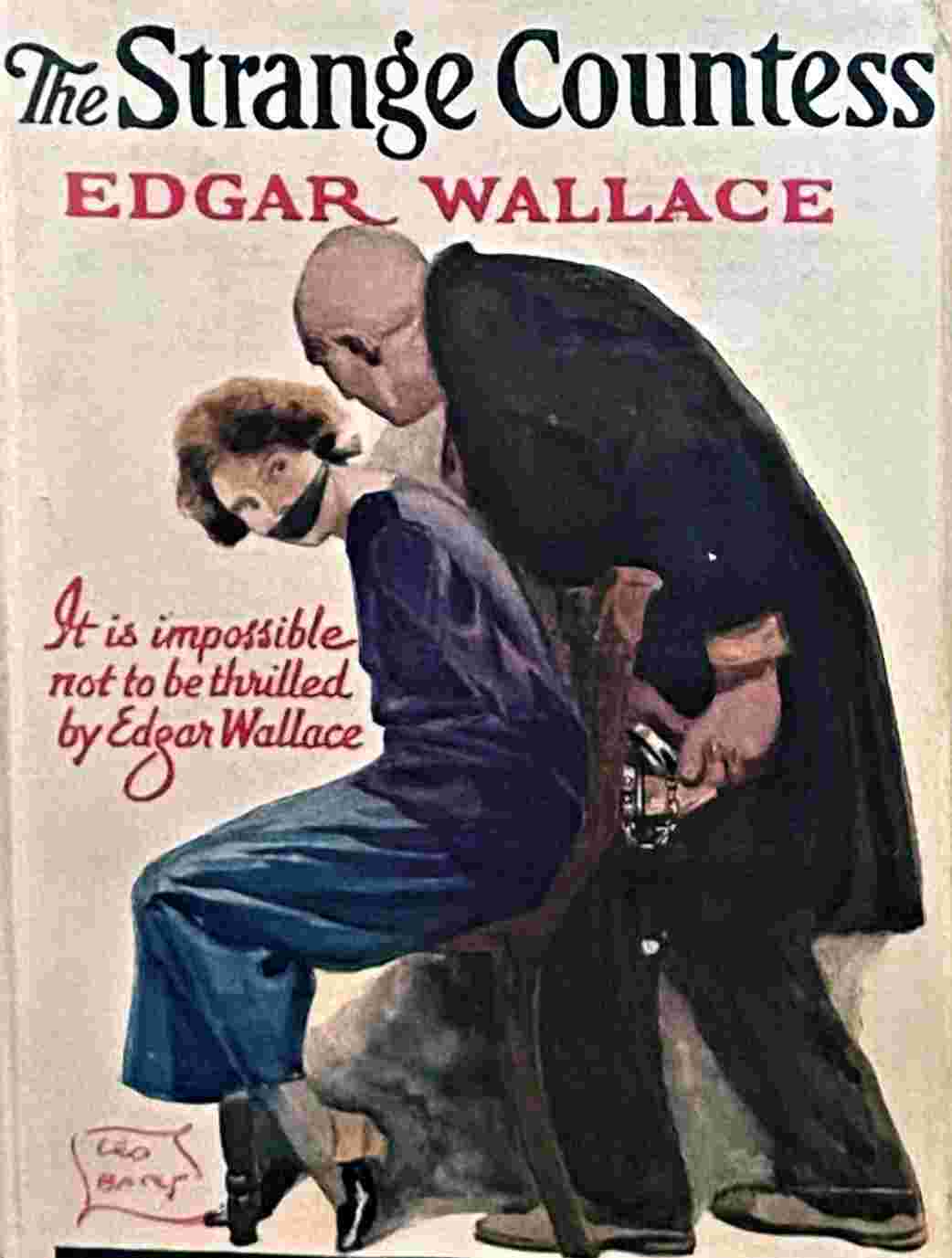
The Project Gutenberg eBook of The strange countess
Title: The strange countess
Author: Edgar Wallace
Release date: April 14, 2025 [eBook #75858]
Language: English
Original publication: United States: Small, Maynard & Company, 1926
Credits: An anonymous Project Gutenberg volunteer
The
Strange Countess
BY
EDGAR WALLACE
BOSTON
SMALL, MAYNARD & COMPANY
PUBLISHERS
[COPYRIGHT]
Copyright, 1926
By SMALL, MAYNARD & COMPANY
(INCORPORATED)
[DEDICATION]
To
D. C. THOMSON
WITH THE AUTHOR’S HAPPIEST MEMORIES
OF A LONG BUSINESS ASSOCIATION
CONTENTS
The Strange Countess
Chapter One
Lois Margeritta Reddle sat on the edge of her bed, a thick and heavy cup of pallid tea in one hand, a letter in the other. The tea was too sweet, the bread was cut generously even as it was buttered economically, but she was so completely absorbed in the letter that she forgot the weakness of Lizzy Smith as a caterer.
The note was headed with a gilt crest and the paper was thick and slightly perfumed.
307 Chester Square, S.W.
The Countess of Moron is pleased to learn that Miss Reddle will take up her duties as resident secretary on Monday, the 17th. Miss Reddle is assured of a comfortable position, with ample opportunities for recreation.
The door was thrust open and the red and shining face of Lizzy was thrust in.
“Bathroom’s empty,” she said briefly. “Better take your own soap—you can see through the bit that’s left. There’s one dry towel and one half-dry. What’s the letter?”
“It is from my countess—I start on Monday.”
Lizzy pulled a wry face.
“Sleep in, of course? That means I’ve got to get somebody to share these digs. Last girl who slept here snored. I will say one thing about you, Lois, you don’t snore.”
Lois’ eyes twinkled, the sensitive mouth curved for a second in the ghost of a smile.
“Well, you can’t say that I haven’t looked after you,” said Lizzy with satisfaction. “I’m the best manager you’ve ever roomed with, I’ll bet. I’ve done the shopping and cooked and everything—you’ll admit that?”
Lois slipped her arm round the girl and kissed her homely face.
“You’ve been a darling,” she said, “and in many ways I’m sorry I’m going. But, Lizzy, I’ve tried hard to move on all my life. From the National School in Leeds to that little cash desk at Roopers, and from Roopers to the Drug Stores, and then to the great lawyers——”
“Great!” exclaimed the scornful Lizzy. “Old Shaddles great! Why, the mean old devil wouldn’t give me a half-crown raise at Christmas, and I’ve been punching the alphabet five years for him! Kid, you’ll marry into society. That countess is a she-dragon, but she’s rich, and you’re sure to meet swells—go and have your annual while I fry the eggs. Is it going to rain?”
Lois was rubbing her white, rounded arm, gingerly passing her palm over the pink, star-shaped scar just above her elbow. It was Lizzy’s faith that whenever the scar irritated, rain was in the offing.
“You’ll have to have that electrocuted, or whatever the word is,” said the snub-nosed girl when the other shook her head. “Sleeves are about as fashionable nowadays as crinolines.”
From the bathroom Lois heard her companion bustling about the little kitchen, and, mingled with the splutter and crackle of frying eggs, came shrilly the sound of the newest fox-trot as Lizzy whistled it unerringly.
They had shared the third floor in Charlotte Street since the day she had come to London. Lois was an orphan; she could not remember her father, who had died when she was little more than a baby, and only dimly recalled the pleasant, matronly woman who had fussed over her in the rough and humble days of her early schooling. She had passed to the care of a vague aunt who was interested in nothing except the many diseases from which she imagined she suffered. And then the aunt had died, despite her arrays of medicine bottles, or possibly because of them, and Lois had gone into her first lodging.
“Anyway, the countess will like your classy talk,” said Lizzy, as the radiant girl came into the kitchen. She had evidently been thinking over the new appointment.
“I don’t believe I talk classily!” said Lois good-humouredly.
Lizzy turned out the eggs from the frying-pan with a dexterous flick.
“I’ll bet that’s what got him,” she said significantly, and the girl flushed.
“I wish you wouldn’t talk about this wretched young man as though he were a god,” she said shortly.
Nothing squashed Lizzy Smith. She wiped her moist forehead with the back of her hand, pitched the frying-pan into the sink and sat down in one concerted motion.
“He’s not common, like some of these pickers-up,” she said reminiscently, “he’s class, if you like! He thanked me like a lady, and never said a word that couldn’t have been printed on the front page of the Baptist Herald. When I turned up without you, he was disappointed. And mind you, it was no compliment to me when he looked down his nose and said: ‘Didn’t you bring her?’ ”
“These eggs are burnt,” said Lois.
“And a gentleman,” continued the steadfast Lizzy. “Got his own car. And the hours he spends walking up and down Bedford Row just, so to speak, to get a glimpse of you, would melt a heart of stone.”
“Mine is brass,” said Lois with a smile. “And really, Elizabetta, you’re ridiculous.”
“You’re the first person that’s called me Elizabetta since I was christened,” remarked the stenographer calmly, “but even that doesn’t change the subject so far as I am concerned. Mr. Dorn——”
“This tea tastes like logwood,” interrupted the girl maliciously, and Lizzy was sufficiently human to be pained.
“Did you hear old Mackenzie last night?” she asked, and when Lois shook her head: “He was playing that dreamy bit from the Tales of Hoggenheim—Hoffmann is it? All these Jewish names are the same to me. I can’t understand a Scotsman playing on a fiddle; I thought they only played bagpipes.”
“He plays beautifully,” said Lois. “Sometimes, but only rarely, the music comes into my dreams.”
Lizzy snorted.
“The middle of the night’s no time to play anything,” she said emphatically. “He may be our landlord, but we’re entitled to sleep. And he’s crazy, anyway.”
“It is a nice kind of craziness,” soothed Lois, “and he’s a dear old man.”
Lizzy sniffed.
“There’s a time for everything,” she said vaguely, and, getting up, took a third cup and saucer from the dresser, banged it on the table, filled it with tea and splashed milk recklessly into the dark brown liquid.
“It’s your turn to take it down to him,” she said, “and you might drop a hint to him that the only kind of foreign music I like is ‘Night Time in Italy.’ ”
It was their practice every morning to take a cup of tea down to the old man who occupied the floor below, and who, in addition to being their landlord, had been a very good friend to the two girls. The rent they paid, remembering the central position which the house occupied and the popularity of this quarter of London with foreigners who were willing to pay almost any figure for accommodation in the Italian quarter, was microscopic.
Lois carried the cup down the stairs and knocked at one of the two doors on the next landing. There was the sound of shuffling feet on the bare floor, the door opened, and Rab Mackenzie beamed benevolently over his horn-rimmed spectacles at the fair apparition.
“Thank you, thank you very much, Miss Reddle,” he said eagerly, as he took the cup from her hand. “Will you no’ walk round? I’ve got my old fiddle back. Did I disturb you last night?”
“No, I’m sorry I didn’t hear you,” said Lois, as he put the cup on the well-scrubbed top of the bare table.
The room, scrupulously clean, and furnished only with essentials, was an appropriate setting for the little old man in his baggy trousers, his scarlet slippers and black velvet coat. The clean-shaven face was lined and furrowed, but the pale blue eyes that showed beneath the shaggy eyebrows were alive.
He took up the violin which lay on the sideboard with a gentle, tender touch.
“Music is a grand profession,” he said, “if you can give your time to it. But the stage is damnable! Never go on the stage, young lady. Keep you on the right side of the footlights. Those stage people are queer, insincere folk.” He nodded emphatically and went on: “I used to sit down in the deep orchestra well and watch her little toes twisting. She was a bonny girl. Not much older than you, and haughty, like stage folks are. And how I got up my courage to ask her to wed me I never understood.” He sighed heavily. “Ah, well! I’d rather live in a fool’s paradise than no paradise at all, and for two years——”
He shook his head.
“She was a bonny girl, but she had the criminal mind. Some lassies are like that. They’ve just no conscience and no remorse. And if you’ve no conscience and no remorse and no sense of values, why, there’s nothing you wouldn’t do from murder downwards.”
It was not the first time Lois had heard these rambling and disjointed references to a mysterious woman, these admonitions to avoid the stage, but it was the first time that he had made a reference to the criminal mind.
“Women are funny creatures, Mr. Mackenzie,” she said, humouring him.
He nodded.
“Aye, they are,” he said simply. “But, generally speaking, they’re superior to most men. I thank ye for the tea, Miss Reddle.”
She went upstairs to find Lizzy struggling into her coat.
“Well, did he warn you off the boards?” asked Miss Smith, as she strolled to the little mirror and dabbed her nose untidily with powder. “I’ll bet he did! I told him yesterday that I was going into a beauty chorus, and he nearly had a fit.”
“You shouldn’t tease the poor old man,” said Lois.
“He ought to have more sense,” said Lizzy scornfully. “Beauty chorus! Hasn’t he got eyes?”
Chapter Two
They went off to the office together, walking through the Bloomsbury squares, and only once did Lois look round apprehensively for her unwelcome cavalier. Happily he was not in sight.
“About that scar on your arm,” said Lizzy, when they were crossing Theobalds Road. “I know a perfectly posh place in South Moulton Street where they take away scars. I thought of going there to have a face treatment. The managing clerk suggested it—Lois, that fellow is getting so fresh he ought to be kept on ice. And him forty-eight with a grown-up family!”
Two hours later, Mr. Oliver Shaddles picked up some documents from the table, read through with quick and skilful eyes, rubbed the grey stubble on his unshaven chin irritably, and glared out upon Bedford Row.
He turned towards the little bell-push on his table, hesitated a second, then pressed it.
“Miss Reddle!” he snapped to the clerk who answered his summons with haste.
Again he examined the sheet of foolscap, and was still reading when the door opened and Lois Reddle came in.
Lois was a little above medium height, and by reason of her slimness seemed taller than she was. She was dressed in the severe black which the firm of Shaddles & Soan imposed upon all their feminine employees. Mr. Shaddles had reached the age, if he had ever been at any other, when beauty had no significance. That Lois Reddle had a certain ethereal loveliness which was all her own might be true, but to the lawyer she was a girl clerk who received thirty-five well-grudged shillings every week of her life, minus the cost of her insurance.
“You go down to Telsbury.”
He had a minatory manner, and invariably prefaced his remarks with the accusative pronoun. “You’ll get there in an hour and a half. Take those two affidavits to the woman Desmond, and get her to sign the transfer form. The car’s there——”
“I think Mr. Dorling had it——” she began.
“The car’s there,” he said obstinately. “You’ll have a dry trip, and you ought to be thankful for the opportunity of a breath of fresh air. Here, take this,” as she was going out with the foolscap. It was a little slip of paper. “It is the Home Office order—use your senses, girl! How do you think you’ll get into the gaol without that? And tell that woman Desmond—— Anyway, off you go.”
Lois went out and closed the door behind her. The four faded, middle-aged clerks, sitting at their high desks, did not so much as look up, but the snub-nosed girl with the oily face, who had been pounding a typewriter, perked her head round.
“You’re going to Telsbury, by the so-called car?” she asked. “I thought he’d send you. That old devil’s so mean that he wouldn’t pay his fare to heaven! The juggernaut will kill somebody one of these days,” she added darkly, “you mark my words!”
Attached to the firm of Shaddles & Soan was a dilapidated motor-car that had seen its best time in pre-war days. It was housed in a near-by garage which, being a property under Mr. Shaddles’ direction as trustee, exacted no rent for the care of the machine, which he had bought for a negligible sum at the sale of a bankrupt’s effects. It was a Ford, and every member of the staff was supposed to be able to drive it. It carried Mr. Shaddles to the Courts of Justice, it took his clerks on errands, and it figured prominently in all bills of cost. It was, in many ways, a very paying scheme.
“Ain’t you glad you’re going?” asked Lizzy enviously. “Lord! If I could get out of this dusty hole! Maybe you’ll meet your fate?”
Lois frowned.
“My what?”
“Your fate,” said Elizabetta, unabashed. “I spotted him out of the window this morning—that fellow is certainly potty about you!”
A cold light of disfavour was in the eyes of Lois, but Lizzy was not easily squashed. “There’s nothing in that,” she said. “Why, there used to be a young man who waited for me for hours—in the rain too. It turned out that he wasn’t right in his head, either.”
Lois laughed softly as she wrapped a gaily coloured scarf about her throat and pulled on her gloves. Suddenly her smile vanished.
“I hate Telsbury; I hate all prisons. They give me the creeps. I am glad I’m leaving Mr. Shaddles.”
“Don’t call him ‘Mister,’ ” said the other. “It is paying him a compliment.”
The car stood at the door, as Mr. Shaddles had suggested, an ancient and ugly machine. The day was fair and warm, and once clear of the London traffic the sun shone brightly and she shook off the depression which had lain upon her like a cloud all that morning. As she sent the car spinning out of Bedford Row she glanced round instinctively for some sign of the man to whom Lizzy had made so unflattering a reference, and whose constant and unswerving devotion was one of the principal embarrassments of her life. But he was nowhere in sight, and he passed out of her mind, as, clear of London, she turned from the main road and slowed her car along one of the twisting lanes that ran parallel with the post route and gave one who loved the country and the green hedgerows a more entranced vision than the high road would have given her.
Seven miles short of Telsbury she brought the car back to the main thoroughfare, and spun, at a speed which she uneasily recognised as excessive, on to the tarred highway. Even as she came clear of the high hedges she heard the warning croak of a motor-horn, and jammed on her brakes. The little machine skidded out into the road. Too late, she released the brakes and thrust frantically at the accelerator. She saw the bonnet of a long, black car coming straight towards her, felt rather than heard the exclamation of its driver.
“Crash!”
In that second she recognised the driver.
“Say it!”
The girl, gripping the steering wheel of her ancient Ford, stared defiantly across a broken windscreen, but Michael Dorn did not accept the challenge. Instead, he put his gear into reverse, preparatory to withdrawing his running-board from the affectionate embrace of the other guard. He did this with a manner of gentle forbearance which was almost offensive.
“Say it!” she said. “Say something violent or vulgar! It is far better to have things out than to let bad words go jumping around inside!”
Grey eyes need black lashes to be seen at best advantage, he thought; and she had one of those thinnish noses that he admired in women. He rather liked her chin, and, since it was raised aggressively, he had a fair view of a perfect throat. It struck him as being extremely perfect in spite of the red and yellow and green silk scarf that was lightly knotted about. She was neatly if poorly dressed.
“Nothing jumps around inside me except my heart,” he said, “and, at the moment, that is slipping back from my mouth. I don’t like your necktie.”
She looked down at the offending garment and frowned.
“You have no right to run into me because you disapprove of my scarf,” she said coldly. “Will you please disengage your strange machine from mine? I hope you are insured.”
He jerked his car back, there was a sound of ripping tin, a crack and a shiver of glass, and he was free. Then:
“You came out of a side road at forty miles an hour—you’d have turned over certain, only I was there to catch you,” he said half-apologetically. “I hope you aren’t hurt?”
She shook her head.
“I am not,” she said, “but I think my employer will be when he sees the wreckage. Anyway, your end is served, Mr. Dorn, you have made my acquaintance.”
He started and went a shade red.
“You don’t imagine that I manœuvred this collision with the idea of getting an introduction, do you?” he almost gasped, and was thunderstruck when the girl with the grave eyes nodded.
“You have been following me for months,” she said quietly. “You even took the trouble to make up to a girl in Mr. Shaddles’ office in order to arrange a meeting. I have seen you shadowing me on my way home—once you took the same ’bus—and on the only occasion I have been to a dance this year I found you in the vestibule.”
Michael Dorn fiddled with the steering wheel, momentarily speechless. She was serious now, all the banter and quiet merriment in her voice had passed. Those wonderful eyes of hers were regarding him with a certain gentle reproach that was hard to endure.
“Well, the truth is——” he began lamely, and found himself at a loss for words.
She waited for him to finish his sentence, and then:
“The truth is——” A faint smile trembled at the corner of her red mouth. “The truth is, Mr. Dorn, that it isn’t a very terrible offence for any nice man to wish to meet any girl—that I recognise. And it would be stupid in me if I pretended that I am very much annoyed. But as I told your ambassador, Miss Lizzy Smith——”
He blinked rapidly.
“I really do not wish to know you, and I have no doubt that she has conveyed that intelligence to you. Therefore your position is a little—what shall I say?”
“Offensive is the word you’re wanting,” he said coolly. “I’ll admit that it bears that construction.”
He got down slowly, walked to the side of her car, and stood, his hands resting on the arm of the seat.
“I want you to believe, Miss Reddle!” he said earnestly, “that nothing is farther from my wish than to annoy you. If I hadn’t been a clumsy fool you would never have known that I was——”
He stopped, at a loss for a word. It was she who supplied it, and in spite of his seriousness he laughed.
“ ‘Dogging’ is an ugly word. I’m trying to think of something prettier,” he said.
She liked the ghost of a smile that shone in his blue eyes, and had they parted then, without another word, she might have thought more kindly of him. But:
“Where are you off to, on this bright autumn day?” he asked, and she stiffened.
“Will you start my car, please?” she said with dignity.
He cranked up the engine and stood aside. She could not resist the temptation:
“If you follow me now you’ll have a shock,” she said. “I am going to Telsbury Prison.”
The effect on the man was startling; he stared in amazement and fear. His jaw dropped, and into his eyes came a queer look of wonder.
“Where are you going?” he asked huskily, as though he doubted the evidence of his ears.
“I am going to Telsbury Prison—please.”
She waved him out of her way. The car with the broken wind-screen went noisily along the broad high road, leaving the man to stare. And then:
“Good God!” said Michael Dorn.
Chapter Three
The grim entrance of Telsbury Convict Establishment is mercifully hidden behind a screen of thick-growing pines. Its red walls have mellowed with age, and but for the high tower in the centre of the prison a traveller would pass it unnoticed. Hiding all the heartache that has made the word “Dartmoor” synonymous with sorrow, Telsbury has missed the fame of its fellow-prison.
Lois had already made two visits to the prison on her employer’s business. A client of the firm had prosecuted a woman who had been engaged in systematic fraud, and she had been sent down for five years. It had been necessary to secure her signature to certain deeds transferring back to their lawful owner stocks which had been fraudulently converted.
Stopping her car broadside on to the high black gates, she descended and pulled a bell. Almost immediately a grating was slipped back and two watchful eyes surveyed her. Though the gatekeeper recognised her, it was not until she had shown him the Home Office order which she carried that he turned the key in the lock and admitted her to a bare stone room, furnished with a desk, a stool, two chairs, and a table.
The warder read the order again and pressed a bell. He, his two reliefs, and the governor were the only men who came within those walls, and his sphere of operations was restricted to the room and the archway, barred with steel railings, which cut the courtyard off from the rest of the prison.
“Getting tired of coming here, miss?” he asked with a smile.
“Prisons make me very tired and very sick at heart,” said the girl.
He nodded.
“There are six hundred women inside here who are more tired and more sick than you will ever be, I hope, miss,” he said conventionally. “Not that I ever see any of them. I open the gate to the prison van and never catch a sight of them again, not even when they go out.”
There was a snap of a lock, and a young wardress in neat blue uniform came in and greeted Lois with a cheery nod. The girl was conducted through a small steel gate, across a wide parade ground, empty at that moment, through another door and along a passage into the governor’s small office.
“Good morning, doctor,” she said. “I’ve come to see Mrs. Desmond,” and displayed her papers before the grey-haired governor.
“She’ll be in her cell now,” he said. “Come along, Miss Reddle, I’ll take you there myself.”
At the end of the passage was another door, which led into a large hall, on either side of which was a steel alleyway, reached by broad stairs in the centre of the hall. Lois looked up, saw the netting above her head and shivered. It was placed there, she knew, to prevent these unhappy women from dashing themselves to death from the top landings.
“Here we are,” said the governor, and opened the cell door with his pass-key.
For five minutes she was engaged with the sulky woman, who had a whining grievance against everybody except herself; and at last, with a heartfelt sigh of relief, she came out through the door and joined the governor. As he locked the cell, she said:
“Thank heaven I shan’t come here any more.”
“Giving up being a lawyer?” he asked good-humouredly. “Well, I never thought it was much of a profession for a girl.”
“You give my intelligence too great credit,” she smiled. “I am a very commonplace clerk and have no other knowledge of the law than that stamps must be put on certain documents and in certain places!”
They did not go back the way they had come, but went out through the hall into the parade ground. So perfect was the organisation that in the brief space she had been in the cell the yard was filled with grey figures parading in circles.
“Exercise hour,” said the governor. “I thought you’d like to see them.”
The girl’s heart was filled with pity and an unreasoning resentment against the law which had taken these women and made them into so many meaningless ciphers. With their print dresses and white mob caps, there was something very ugly, very sordid about them, something which clutched at the girl’s heart and filled her with a vague fear. There were women of all ages, old and young, some mere girls, some grown ancient in sin, and each bore on her face the indefinable stamp of abnormality. There were fierce faces, cunning faces, weak, pathetic faces that turned to her as the ghastly circle shuffled on its way; faded eyes that stared stupidly, dark eyes that gleamed with malignant envy, careless eyes that did not trouble to investigate her further than by a casual glance. Shambling, shuffling women, who seemed after a while to be unreal.
The circle had nearly passed in hideous completeness when Lois saw a tall figure that seemed to stand out from that ground of horror. Her back was straight, her chin uplifted, her calm eyes looked straight ahead. She might have been forty, or fifty. The delicately moulded features were unlined, but the hair was white. There was something divinely serene in her carriage.
“What is that woman doing here?” said Lois, before she realised that she had asked a question which no visitor must put to a prison official.
Dr. Stannard did not answer her. He was watching the figure as it came abreast. For a second the woman’s eyes rested gravely upon the girl. Only for a second—just that period of time that a well-bred woman would look at the face of another—and then she had passed.
The girl heaved a sigh.
“I’m sorry I asked,” she said, as she walked by the governor’s side through the grille to his office.
“Other people have asked that,” said the governor, “and haven’t been satisfied. It is against the prison rules to identify any convict, as you know. But, curiously enough——” He was looking round for something, and presently he found it, a stout calf-bound book that had been opened and laid face downwards on a filing cabinet.
Without a word he handed it to her, and she looked at the title. She was sufficiently acquainted with law books to recognise it as one of that variety. It was labelled Fawley’s Criminal Cases.
“Mary Pinder,” he said briefly, and she saw that the book was open at the page which was headed by that name. “It is rather curious, I was reading up the case just before you came in. I was looking up the essential details to see whether my memory was at fault. I don’t mind telling you”—he dropped his voice as though in fear of an eavesdropper—“that I share your wonder!”
She looked at the title: “Mary Pinder—Murder,” and gasped.
“A murderess?” she asked incredulously.
The doctor nodded.
“But that is impossible!”
“Read the case,” said the other, and she took up the book and read:
Mary Pinder—Murder. Convicted at Hereford Assizes. Sentenced to death; commuted to penal servitude for life. This is a typical case of a murder for gain. Pinder lived in lodgings with a young man, who was reputedly her husband, and who disappeared before the crime occurred. It is believed that he left her penniless. Her landlady, Mrs. Curtain, was a wealthy widow, somewhat eccentric, believed to be on the border line of insanity. She kept large sums of money in the house and a quantity of antique jewellery. After her husband had left her Pinder advertised for a temporary situation, and a lady, calling at the house in answer to the advertisement, found the front door unfastened, and, after repeated knocking, receiving no answer, walked in. Seeing one of the room doors open, she looked in and found, to her horror, Mrs. Curtain lying on the floor, apparently in a fit. She immediately went in search of a policeman, who, arriving at the house, found the woman was dead. The drawers of an old secretaire were open and their contents thrown on the floor, including a piece of jewellery. Suspicion being aroused, the room of the lodger, who had been seen leaving the house just before the discovery, was searched in her absence. A small bottle containing cyanide of potassium, together with many pieces of jewellery, was found in a locked box, and she was arrested. The defence was that the deceased had frequently threatened to commit suicide, and that there was no evidence to prove the purchase of the poison, which was in an unlabelled bottle. Pinder refused to give information about herself or her husband; no marriage certificate was discovered; and she was tried before Darson J. and convicted. It is believed that Pinder, being in urgent need of money, was seized with the sudden temptation and, dropping cyanide in the woman’s tea, afterwards ransacked her secretaire. The case presents no unusual features, except the refusal of the prisoner to plead.
Twice Lois read the account and shook her head.
“I can’t believe it! It is incredible—impossible!” she said. “She was imprisoned for life—but surely she should be out by now? Isn’t there a remission of sentence for good conduct?”
The governor shook his head.
“Unfortunately she made two attempts to escape, and lost all her marks. It is a great pity, because she’s a fairly rich woman. An uncle of hers, who only learnt of her conviction after she had been five years in gaol, left her a very considerable fortune. She never told us who she was—he visited her here a few weeks before his death—and we’re just as wise as ever we were, except that we know that he was a relation of her mother.”
Lois took up the book again and stared at the printed page.
“A murderess—that wonderful woman!”
He nodded.
“Yes. Remarkable. Yet the most innocent-looking people commit bad offences. I have been here twenty years and lost most of my illusions.”
“If they thought she was a murderess, why didn’t they——”
She could not bring herself to say “hang her.” The governor looked at her curiously.
“Ha—h’m—well, there was a reason, a very excellent reason.”
Lois was puzzled for a moment, and then suddenly the explanation came to her.
“Yes, the baby was born in this very prison—the prettiest little baby girl I’ve ever seen—a perfect child. I hated the time when she had to be taken away. Poor little soul!”
“She didn’t know, perhaps doesn’t know now,” said Lois, her eyes filling with tears.
“No, I suppose not. She was adopted by a woman who was a neighbour and always believed in Mrs. Pinder’s innocence. No, when I said ‘poor little soul,’ I was thinking of the fool of a nurse who let the child burn its arm against the top of a hot water bottle. A pretty bad burn. I remember it because it left a scar on the baby’s forearm—the stopper of the water bottle had a star.”
Lois Reddle clutched the edge of the table and her face went suddenly white. The doctor was putting away the book and his back was towards her. With an effort she gained control of her voice.
“Do—do you remember the name by which the baby was christened?” she asked in a low voice.
“Yes,” he said instantly, “an unusual name, and I always remember it. Lois Margeritta!”
Chapter Four
Lois Margeritta! Her own name! And the star-shaped burn on her arm!
Her head was in a whirl; the room seemed to be spinning round drunkenly and it needed all her strength of mind to keep her from crying out.
But it was true. That dignified, stately woman who had marched so calmly in the circle of pain was her mother! Incredible, impossible though it seemed, she knew this was the truth. Her mother!
Obeying a blind impulse, she darted to the door, flung it open, and was half-way along the stone passage before the startled governor had overtaken her.
“Whatever is the matter with you, girl?” he demanded, half astonished and half angry. “Are you ill?”
“Let me go, let me go!” she muttered incoherently. “I must go to her!”
And then she came back to sanity with a gasp, and allowed herself to be led back to the governor’s room.
“You sit down there while I give you a slight sedative,” said the doctor, as he closed the door with a bang which echoed along the hollow passage.
He opened the medicine chest, deftly mixed the contents of three bottles and added water from a carafe on his table.
“Drink this,” he said.
The girl raised the glass to her lips with fingers that shook, and the governor, hearing the glass rattle against her teeth, smiled.
“I think I’m a little mad,” she said.
“You’re a little hysterical,” said the practical doctor, “and it is my fault for letting you see these people. We’ve broken all the rules by talking about them.”
“I’m dreadfully sorry,” she muttered, as she put the glass on the table. “I—I—it was so dreadful!”
“Of course it was,” he said. “And I was several kinds of an old fool to talk about it.”
“Will you tell me one thing, doctor, please? What—what became of the child?”
The doctor was obviously loth to discuss the matter any further.
“I believe she died,” he said briefly. “She was taken away by some excellent people, but they failed to rear her. That is the story I have. As a matter of fact it was published in the newspapers—there was a great deal of interest in the case—that the child had died in prison, but that was not the case. She was a healthy little creature when she left here. And now, young lady, I am going to turn you out.”
He rang for the wardress, who conducted her to the gatekeeper’s lodge, and in another second Lois was standing outside the black door, behind which was—who?
She was mad to have made such a fool of herself. There was so much more she wanted to know, so many opportunities which might have been hers to see the beautiful woman who was—her mother? Her heart raced at the thought. It couldn’t be! Her mother was dead; that stout, homely body who had been a mother to her. It was a coincidence. There must be other children in the world called “Lois Margeritta” than she, and it was possible that some had been branded in babyhood.
She shook her head; it was impossible, it was beyond all the bounds of probability that there could be two Lois Margerittas with a star-shaped burn on the left arm.
Climbing painfully into the car, her knees giving under her, her trembling hands manipulated the gears. The car wobbled painfully, and, as she came slowly out on to the little road that runs by the prison, she was conscious of a weakness which almost terrified her. She stopped the car a few inches from the kerb, and at that moment she heard a quick step, and, turning her head, saw the man with whose machine she had collided earlier in the afternoon. There was a look of deep concern on his saturnine face.
“Anything wrong?” he asked sharply.
“No—nothing,” she said unsteadily.
He stood surveying her with a critical and speculative eye.
“You nearly drove into that lamp-post. Aren’t you feeling well?”
“Not—not very,” she said.
In another second he had swung himself into the car by her side, and she made room for him behind the steering wheel.
“I’ll take you down to the Lion Hotel and get them to send up for my car.”
She was dimly aware that the long machine with the damaged mudguard was parked by the side of the prison wall.
“I shall be quite all right——” she protested.
“Nevertheless, I will drive you back to town,” he said, and she made no further demur.
He stopped outside the Lion Hotel long enough to communicate with a little man who seemed to be expecting him; then turned the damaged nose of the Ford towards London; and she was intensely grateful to him that he made no attempt to improve his opportunity, for the rest of the journey was carried out in almost complete silence. From time to time he glanced at her, and once he looked at the crumpled papers which she held tightly gripped in her little hand, the documents which Mr. Shaddles’ client had signed, and which were now in a more ruffled condition than most legal documents are supposed to be.
“179 Bedford Row, I think it is?” he said, as they crossed the traffic of Holborn, and she had recovered sufficient of her spirits to answer:
“I think you should know.”
One side of his mouth went up in a smile.
“I’m pretty well acquainted with this neighbourhood,” he said coolly. And then, as the car came to a standstill behind a big Rolls that stood before the doorway of 179:
“You’ve been awfully kind to me, Mr. Dorn,” she said. “I am very grateful to you indeed.”
“What worried you?” he asked. “At the prison, I mean?”
She shook her head.
“Nothing—only it is a rather dreadful shock, seeing so many women.”
His eyes narrowed.
“You saw the women, did you? Pretty queer lot, eh?”
She shivered.
“Do you know the prison? Have you been inside, I mean?” she asked.
“Yes, I’ve been inside once or twice,” he answered.
Glancing up at the window behind which was her office, she caught a glimpse of a short, tilted nose and a pair of wide open eyes, and, in spite of herself, laughed helplessly.
“Good-bye, Mr. Dorn.”
She held out her hand and he took it.
“I’m afraid I’ve been an awful nuisance to you. Will you be able to get your car sent up to town, or must you go down to Telsbury for it?”
“Don’t bother about my car; it is here,” he said, and nodded to the end of the road. To her amazement she saw his black machine come slowly to the side-walk and stop.
She was about to say something, but changed her mind, and, running up the steps, disappeared through the dark portals, the man watching her until she was out of sight.
Chapter Five
The clerks had gone, only Lizzy Smith remained. That young lady came flying to greet her, all of a twitter with excitement.
“Oh, you artful one! You picked him up, did you? Haven’t you got a nerve to come back with him? Suppose old Shaddles had seen you! What have you done to the juggernaut? All the mudguard’s bent. Lois, the countess is here! She’s in with old Shaddles, and she’s got the Queen of Sheba skinned to death! I’ll bet that chinchilla coat she’s got cost a thousand if it cost a tenner. And me wearing dyed fox, and glad to get it! Not that I’m struck on chinchilla—it doesn’t suit my complexion, anyway——. And isn’t Mike lovely?”
“Mike?” said Lois, puzzled.
“Didn’t he tell you his name was Mike?” asked Lizzy contemptuously. “Of course it is! Michael Dorn. You don’t mean to tell me that you’ve been joy-riding with him all these hours and never called him ‘Mike’ once?”
Lois hung up her coat and hat, and sat down wearily. Miss Smith regarded her with a gathering frown.
“You’re not looking very bright, old dear,” she said. “What’s wrong?”
“The prison upset me,” said Lois. “How long has the countess been here?”
“You haven’t had a row with him, have you?”
“With him—whom? Oh, the man, you mean, Lizzy?”
“Of course I mean the man! Who else was there to row with? You can’t start any backchat with a pre-war Ford.”
Happily Lois was saved the embarrassment of an answer, for at that moment a buzzer sounded and Lizzy darted into Shaddles’ office, to return with an uplifted and bending finger.
“The countess wants to see you!” she hissed fiercely, “and the thing attached to her is her little boy—the earl!”
Lois went into the room and closed the door behind her. Mr. Shaddles glared up from his table as she handed him the crumpled documents.
“What’s happened to these?” he asked.
“We had an accident with the car,” said Lois, a little incoherently. She was not a fluent liar.
“ ‘We’? Who are ‘we’?”
“I mean, I ran into another car,” said the girl in some confusion.
Mr. Shaddles smoothed out the rumpled paper, glanced at the signature, and then:
“This is the girl, your ladyship.”
For the first time Lois was conscious of the woman’s presence. “Majestic” was a word which fitly described the Countess of Moron. She was tall and stoutly made. The long chinchilla cloak which covered her dress from head to heel was open to show the rich velvet brocade dress, but for the moment Lois had no eyes for the woman’s apparel, or her looped pearls, or the jewels which glittered from ears and fingers. It was the face that held her. Big, dominating, in some indefinable way menacing. Black eyebrows that met above a masterful nose; a pair of eyes of so dark a brown that they seemed black. They were what are called full eyes; the vulgar would describe them as bulging. They were hard and bright and stared unwinkingly at the girl. The mouth was big, the lips thin, and the chin full and powerful. Lois found herself trying to guess her age. Whether it was due to artifice or not, her hair was a jet black, untouched by a vestige of grey; and later she was to learn this was natural.
“You are Miss Reddle?” said the countess. Her voice was almost as deep as a man’s, and she had a slow, deliberate enunciation which was a little disconcerting.
Lois had the feeling that she was in a witness-box, under cross-examination.
“Yes, madam, I am Lois Reddle,” she said.
For a moment the countess said nothing; then she turned to her companion.
“This is Miss Lois Reddle, Selwyn,” she said.
He was a thin, bent man, with a weak face almost innocent of chin, and a drooping yellow moustache, the twirling of which seemed to occupy most of his spare time.
“May I introduce my son, the Earl of Moron?” said her ladyship, and Lois bowed.
“Glad to meet you,” murmured the earl mechanically. “Rather nice weather we’re having, what?”
Having made this speech, he seemed to have exhausted his vocabulary, for he was silent during the remainder of the interview.
Lady Moron withdrew her scrutiny and turned her eyes slowly to the lawyer.
“She seems entirely satisfactory, Shaddles,” she said.
Shaddles pursed his lips.
“Yes, she’s a very good girl,” he said, “quite reliable.”
He glanced disparagingly at the crumpled documents on his blotting-pad.
“Quite reliable. I’ve no doubt that Miss Reddle, in her anxiety to get back to interview your ladyship, has slightly damaged my car; that will be a matter for adjustment between your ladyship and myself.”
He had glanced out of the window and had taken in with an assessor’s eye the amount of the damage. Lady Moron looked at him for a time.
“She had no idea I was here, Shaddles. And of course I shall not be responsible for any damage to your car.”
He squirmed in his seat.
“And, personally, I should doubt if the car has any value. At any rate, in my eyes it has none. Come, Selwyn.”
For a moment Lois had the illusion that the young man was holding on to his mother’s skirt, and she had an insane desire to laugh, as her ladyship went forth majestically, followed by what Lizzy had described, not unfaithfully, as “the thing attached to the Countess.”
Shaddles bustled through the outer office, opened the door for them, and went down to see her ladyship into her car before he returned.
“Now, what the devil do you mean by smashing up my car?” he grated. “And look at the condition of these documents. Is that the sort of thing that can go before a Master in Chambers? Pah!”
Before she could reply:
“Whatever are the cost of the repairs I shall send the bill to you, and I shall expect you to act in an honourable manner, for I’m not sure that you are not liable in law. You will have a good salary and you owe your position entirely to the fact that I happen to be her ladyship’s solicitor.”
“If there is any damage, I will pay for it, Mr. Shaddles,” said the girl, and was glad to make her escape.
Lizzy Smith did not find her a very communicative companion, and she was responsible for most of the conversation on the way back to their lodgings. Lois was glad when her companion left her that night to join a girl friend who had two tickets for a theatre. She wanted to be alone, she wanted to think out this most terrifying problem of hers. There were other problems too, for suddenly she remembered the look of utter horror and amazement that had come to Michael Dorn’s face when she told him she was going to the prison. Did he know, and was he dogging her footsteps for any other than the obvious reason—the young man’s desire to get acquainted with the girl who had taken his fancy? That seemed impossible.
She was glad she was taking up a new post. She would have leisure, in the service of Lady Moron, and opportunities, perhaps, for meeting people who would be helpful to her in the conduct of her investigations.
A thought occurred to her as she was sitting before her untasted supper, and, getting up, she put on her hat and went eastwards to Fleet Street. She had been to the Daily Megaphone before to make searches on behalf of Mr. Shaddles, but now she found that the offices, which are usually open to the public, were closed. She sent up a note from the jealously guarded lobby of the editorial offices, and to her joy her request was granted, and a messenger conducted her to the file room.
Taking down one of the many big black volumes which filled the shelves on one side of the room and opening it at the date she had remembered, the messenger left her; and for two hours she studied the details of what she would ordinarily have dismissed as a sordid and wicked crime. She was half-way through the account of the trial when she saw a name that made her gasp. It was the name of a witness who had been called by the defence—Mrs. Amelia Reddle!
Then it was true! This was the kindly neighbour, about whom the prison governor had spoken. It was her mother, that tall, lovely woman who paced the prison flags with such unconcern. “A kind neighbour took the child”—Mrs. Reddle was the kind neighbour, and had brought her up in ignorance of her origin.
The printed page swam before her eyes as she sat, her hands tightly clasped, her mind confounded by the confirmation of this tremendous discovery.
Her mother was innocent. It was something more than a natural revolt against the thought that in her veins ran the blood of a murderess; it was a conviction, an inspiration, the faith which is knowledge.
She went back to her lodgings, calm and determined. She would prove her mother’s innocence, devoting her life to that object.
Chapter Six
Charlotte Street was deserted when she turned the corner. Passing a small closed coupé that stood by the side-walk, she was half-way up the street, and was turning to cross, when she saw the car coming towards her at full speed, and stopped in the roadway to let it pass. Its headlights were burning very dimly, she noticed—in the idle way of one whose mind was fully occupied elsewhere. The car came on, gaining momentum, and then, when it was a dozen yards away, it swerved suddenly towards her.
Her first impulse was to step back, but an instinct beyond understanding made her leap ahead. If the driver had corrected his swerve she could not have escaped death. That spring saved her; the edge of the mudguard grazed her dress and some small and jagged projection ripped a two-inch strip from her skirt as neatly as though it had been cut by scissors. In another second the car had passed, speeding towards Fitzroy Square, its rear light dark, its number invisible.
For a second the girl stood, bereft of breath, trembling in every limb; and then somebody darted out of the doorway of her house and came towards her, and before she saw his face she knew him.
“Close call that,” drawled Michael Dorn.
“What happened?” she asked. “They must have lost control, I think.”
“Yes, they must have lost control,” he said quietly. “You didn’t see the number, I suppose?”
She shook her head. In her then state of nerves the question irritated her.
“Of course I did not see the number. Do you want me, Mr. Dorn?”
“I came to see how you were after your unpleasant experience.”
She faced him squarely.
“What do you mean? What unpleasant experience?” she asked.
“I was referring to the little accident for which I was partly responsible,” he answered coolly. “I regard any road collision as unpleasant. But possibly you’re a more hardened motorist than I am.”
She shook her head.
“You don’t mean that at all. You mean—you mean—what happened at the prison.”
He bent down towards her.
“What did happen at the prison?” he asked in a low voice.
“If you don’t know, I can’t tell you,” she said, and, turning abruptly from him, went into the house and closed the door almost in his face.
Before she had reached her room she regretted her act of rudeness. It was too late now; she would not go back and apologise, even if she could bring herself to such an act.
An alarmed Lizzy was waiting for her.
“Do you know it is nearly twelve o’clock? I thought you were going to bed early?” she said.
“I’ve been to Fleet Street, looking up a case for—for Mr. Shaddles, and look at my dress—a car ripped it.”
Lizzy’s nose wrinkled.
“If it’s true that you’ve been working overtime for that old skinflint—and it probably isn’t—you’ve got something the matter with your head,” she said, “and you ought to see a doctor. I’m disappointed with you.”
“Why?” asked the girl, as she tossed her hat on to the bed and stooped to a further examination of her torn skirt.
“Well, I thought you’d been out to see a Certain Person. Then, on the other hand, I couldn’t understand, if you were with him, how he could have sent you this.”
On the table, standing amidst its loosened wrappings, was a beautiful round box, the satin cover of which was painted with a floral design.
“It was a bit of cheek on my part, taking it out of the paper,” admitted Lizzy, “but I haven’t touched a single choc.”
“Chocolates?” said Lois incredulously, and lifted the cover, displaying the most gorgeous selection of confectionery that had ever come her way.
On the top was a small card with a line of writing: “From an Admirer.”
She frowned.
“From an Admirer,” nodded Lizzy. “No name? Now, I wonder who it can be?”
Her smirk of amazement was too extravagant to leave any doubt in Lois’ mind.
“Did he bring it?” she asked.
“He? You mean Mike? Why, of course he brought it! At least, I suppose so. It was here when I came in. How many other admirers have you got, Lois?”
The girl replaced the lid with a vicious jab.
“I hate that man,” she said vehemently, “and if he doesn’t leave me in peace I shall complain to the police. It isn’t enough to find him sitting on the doorstep——”
“Was he here?” gasped Lizzy.
“Of course he was here! You knew he was here,” said Lois unjustly. “Lizzy, you’re helping and abetting him, and I wish you wouldn’t.”
“Me?” said the indignant Lizzy. “Abetting? I like that! You take him out driving all the afternoon and talk about me ‘abetting’! Why, I haven’t seen the bird to speak to for a month!”
“Where does he live?” demanded Lois.
“How the blazes do I know?” stormed Lizzy. And then, more soberly: “Yes I do. He lives in Hiles Mansions.”
“Then this goes back to Hiles Mansions to-morrow morning,” said Lois with determination. “And with it a polite note asking him to refrain from his attentions, which are getting a little objectionable.”
Lizzy shrugged her thin shoulders.
“I don’t know what you expect,” she said, in despair. “A good-looker, with a nice car, and a perfect gentleman.”
“He may be all these things and still be objectionable to me,” said Lois shortly, and to her surprise the ungainly Lizzy put her arm around her with an affectionate hug and laughed.
“I won’t quarrel with you the last few nights you are here. And another thing, Lois; I’m not going to take another mate. Your room will be waiting for you when you get tired of the aristocracy.”
One big room in the suite had been divided by a wooden partition. There was a doorless opening that communicated between the two cubicles, over which a curtain was hung. And after Lois had made a parcel of the confectionery and had addressed it to her “admirer,” she carried the package into her bedroom and put it on her dressing-table. She must not forget to return that gift, even though she could ill afford the postage.
They chatted across the partition (which did not reach to the ceiling) for some time, and presently Lois slipped into her bed feeling unutterably tired.
“Good-night,” she called.
“Hark at old Mac!”
From below stole the sad wail of old Mackenzie’s fiddle. Softly it rose and fell, and to one of the audience at least the sound was infinitely sweet and soothing.
“He used to be an orchestra leader—what’s the word? Conductor,” said Lizzy. “I wish he’d keep his moonlight sonatas until I was out of the house.”
“I like it,” said Lois.
In truth the sad melody attuned to her own troubled heart.
“It gives me the hump,” grunted Lizzy, as she jerked off her stockings and examined her toes critically. “After you’ve gone I’m going to ask him to give up his midnight folly.”
“He has very little amusement,” protested Lois.
“Why doesn’t he go out and get it? The old niggard never leaves the house. He’s got plenty of money. He owns this property.”
Lois was listening. The old man was playing the Intermezzo from Cavalleria Rusticana, and, hackneyed as the melody was, it sounded to the girl as though it expressed all the sorrows, all the fears, all the inarticulate protests of her own soul.
“Music’s all right in its place,” said Lizzy, “if it’s the right kind. What’s the matter with ‘Maggie! Yes, Ma?’ I bought a copy of it cheap a week ago and gave it to him and he’s not played it once!”
Presently there was silence on the other side of the partition. The music had ceased. Lois, turning over, fell into a troubled sleep. She dreamt she was in Telsbury Prison; it was she, among the colourless women, who was walking that dreary circle. Somebody stood watching her where she had stood by the doctor’s side; a great, fleshy-nosed woman whose hard black eyes smiled sneeringly as she passed. In the centre of the circle was the little old man, Mackenzie, his fiddle cuddled under his chin, and he was playing a vulgar tune she had heard Lizzy whistle.
Suddenly she woke with a start.
A light had flashed on her face—somebody was in the room. She could hear their soft movements, and then came to her ears the rustle of paper. It was Lizzy, of course. Lizzy frequently came in the middle of the night, when her cough was troublesome, for the voice lozenges which Lois kept in the drawer of her dressing-table. Without a word she stretched out her hand and switched on the little hand-lamp which was one of her luxuries.
As she turned the switch, she remembered drowsily that the battery had nearly run out. There was a flicker of white light, that died down to yellow, and then to darkness. But in that second of time she had seen the figure of a man standing by the dressing-table, and recognised him before she saw the startled face of Michael Dorn!