
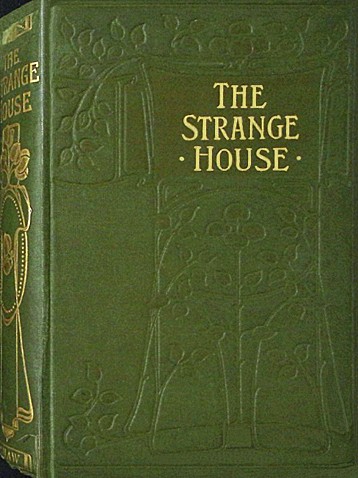
The Project Gutenberg eBook of The strange house
Title: The strange house
or, A moment's mistake
Author: Catharine Shaw
Release date: August 29, 2025 [eBook #76759]
Language: English
Original publication: London: John F. Shaw and Co, 1891
Transcriber's note: Unusual and inconsistent spelling is as printed.
"Whatever is the matter?"
THE STRANGE HOUSE;
OR,
A MOMENT'S MISTAKE.
BY
CATHARINE SHAW
AUTHOR OF "DICKIE'S SECRET," "THE GABLED FARM," "ALICK'S HERO,"
"NOBODY'S NEIGHBOUR," "SOMEBODY'S DARLING," ETC.
New Edition.
LONDON:
JOHN F. SHAW AND CO.
48, PATERNOSTER ROW, E.C.
CONTENTS
————
CHAPTER
II. POVERTY KNOCKS AT THE DOOR
III. LOVE DOES NOT FLY OUT OF THE WINDOW
XXXV. OUTSIDE THE GREAT NORTHERN
XLVII. THE STRANGE HOUSE AGAIN
THE STRANGE HOUSE.
————
CHAPTER I.
NEXT DOOR.
"HARK! What's that, Ned?"
"Nothing!"
"It isn't nothing! Do hush, Ned; there is something wrong outside!"
It was a still night at the end of September, unusually mild for the time of year, and the boys were just in bed, having left their window thrown wide-open, so that every noise in the road came up distinctly.
Conway, having just laid his head on his pillow, heard some one say in a clear, abrupt undertone—
"I've got you!" followed by a scuffle, in which, now that Ned was quiet, holding his breath too, there were words exchanged of angry expostulation.
The boys were out of bed in a trice, and were leaning out of the window breathlessly.
"Let go, I say," said the second voice angrily.
"Not I! I've got you, now! I've been watching you for this half-hour."
"Let go, I say! What do you want with me? I'm in my own garden, I tell you."
"A likely story," answered the gruffer voice, which the boys took to be a policeman's. "And if you stir till I can get help, you'll feel my truncheon."
"I say," said Conway, "don't you think we ought to go down, Ned?"
He was getting into his garments in breathless haste, followed by Ned. And just as they rushed down-stairs, two or three heads were put out at various doors, and their mother asked—
"Whatever is the matter?"
The boys did not wait to explain much, but called out, "There's something going on in the next garden; tell father to come," and rushed off.
"What is it, mother?" asked Mollie, peeping from her room.
Mrs. Shaddock shivered, her teeth chattering with nervousness. "I don't know," she answered, "only I heard a noise in the road."
"Why have the boys gone down?" asked Mollie. "And oh, here's father going too!"
Meanwhile the boys had reached the garden, and had sprung over the hedge which separated them from their neighbour's grass-plot, and were already standing by the policeman, who was grimly holding on to a crouching figure under the front hedge.
As the policeman's lantern was turned on the boys' faces, the imprisoned man looked up and exclaimed—
"Speak for me, young sirs; you know me, don't you? These young gentlemen live next door to me, and they know I live here!"
"I don't believe you," said the policeman; "you're here for no good, that I do know. Get up and come along with me."
"I'm not going to," said the man stoutly. "I live here. And if I like to be in my garden at this time of night, I shall please myself."
"We'll go and rouse the house and see if you belong there. Who else lives here?" asked the constable suspiciously.
"No one else," said the man, springing to his feet, and releasing himself, though he did not attempt to move away. "I live alone, and it's no business of any one's if I do. What sort of a policeman can you be not to know me who has lived here for this past year, and worked in my garden day and night?"
"Yes, it 'is' our neighbour," broke in Conway, while Mr. Shaddock, who had now come out, assured the officer of the law that this was the case.
"Well, I'm new on this beat," said the man, letting go unwillingly. "But when I see a feller poking along by a hedge, and hiding down beneath it when he hears a footstep, I sez to myself, 'He ain't up to no good.' And no more he isn't, be he neighbour or no neighbour to respectable folks!"
He stood aside angrily, while the man, with curt thanks to his releasers, strode up the garden path and let himself into the house with a latch-key.
"Rum," remarked the policeman; "for when I first took hold of him, I could swear I saw a light in the bottom room. And how should it go out and all be black and dark now, I should like to know?"
He moved off, shaking his head, while Mr. Shaddock and his sons made their way back to their home.
On the doorstep stood Mrs. Shaddock and her eldest daughter, Mollie, who had been looking on in great excitement, fearing, or perhaps hoping, that a veritable thief had been caught.
The disturbed household gathered in the deserted dining-room, a motley group in their quickly-donned costumes.
Ned could not help laughing as he pulled Mollie's long hair, and asked her if she were sure her head was not chopped off?
"After that tug, I 'am,'" she answered. "But, father, what did he say? We could not hear."
"Yes," said Mrs. Shaddock, "do tell us."
"I've nothing to tell," answered her husband. "Our strange neighbour, it seems, was meandering about outside, and a new policeman took him up in mistake for a thief; that's all!"
"All!" echoed Mrs. Shaddock. "Suppose you had been taken up when you were smoking a cigar."
"Well, he wasn't smoking," said Conway; "he was hiding apparently. Besides, he says there is no one living in the house with him, and yet the 'Bobby' saw a light put out."
Mrs. Shaddock turned white. "'I' saw a light put out," she said, "just after your father went out. We were standing on the doorstep when a light was slowly moved a few yards, and then it went out."
"That can't be, my dear, if nobody besides lives there," said Mr. Shaddock.
"It is very queer though," she said, turning to Mollie, "for we both thought it was strange the person did not come to the door."
"What a good thing it is we had been up so late!" said Ned, yawning. "If we had not been at that concert, this would not have happened!"
Conway laughed. "Or we should have slept through it," he said.
"I feel scared," remarked Mollie. "I wonder if Daisy is awake?"
"There is nothing to be scared at," said Ned, "and father is next door to you. Anyway, I love excitements. We will watch the Strange House, Conway, and see what comes of this."
"Yes," assented his brother, "if it is worth while. That feller next door has told a lie, anyway!"
"Oh, that's nothing," said Ned carelessly. "It's more than that, I think. I shall keep my eyes open."
"And I shall shut mine," said Conway, "if they aren't shut already!"
CHAPTER II.
POVERTY KNOCKS AT THE DOOR.
"HOW does it look, Phyllis?"
The child glanced up from her lessons, and stretched out her hand across the table for a fine piece of cambric which her mother was holding out to her.
She took it under the lamp, and examined it critically.
"I've seen you do it better, mother."
"I was afraid so," answered Mrs. Ashlyn slowly. "I can do no more work by candlelight."
"Mother!" exclaimed the child, with an accent of dismay.
"I have feared it for a long time," she said, passing her hand over her eyes, and leaning back in her chair rather wearily.
Phyllis looked in her face consideringly, and then her eyes met a pair of dark ones opposite—those of a young man seated with a pile of books before him, in the study of which he had been buried, till interrupted by the serious nature of the conversation between his two companions.
For that it was a serious conversation both knew.
Mrs. Ashlyn was a widow with very limited means, and had been accustomed to eke out her income by fine needlework for a large baby-linen warehouse in the neighbouring town.
If this source of income should fail, what would become of them? So thought the three seated in that cosy little room.
From outside came the subdued roar of the sea, as its ceaseless waves broke on the beach near; while inside the clock ticked on audibly, and the lamp shone on Phyllis's shining hair and on Otto's curly head, both bent over their respective books, though their thoughts were busy elsewhere.
Otto, the son of an old friend, had lived with Mrs. Ashlyn for three years, while preparing for his medical examinations, and had become, as Phyllis expressed it, "quite one of the family." But at any rate, he shared all their interests, and, so far as he understood them, sympathized in their cares.
What would happen now, if one of the chief sources of income should be permanently dried up?
The meditations of the three were broken in upon by a light step coming swiftly up the little garden path, and by the turning of the handle of the front door.
"There's Gertrude!" exclaimed Phyllis rather unnecessarily, for both her companions knew that quite well.
Mrs. Ashlyn rose, folded her work carefully into a spotless handkerchief, and placed it in a dainty, covered basket which stood at her side. Then she looked up with a smile as the door opened to admit a girl of about twenty-two, who came in with a bright look and manner that seemed like a May breeze.
"You look like news!" said Phyllis. "Are they going to keep you on?"
"No," answered Gertrude.
Mrs. Ashlyn's eyes were fixed on her face inquiringly, with an anxiety in her answer which the others understood, if Gertrude did not.
"No," pursued Gertrude, "they are not. They want to make other arrangements. So now there is nothing to be done but to look out for something else!"
"That is not so easy," said Mrs. Ashlyn. "Camptown is not so very large, and the schools there are limited in number. But I dare say we shall find something in time."
"Of course we shall," said Gertrude heartily. "Why, mother, do you not 'know' that all our ways are in our Father's hands?"
Mrs. Ashlyn was leaving the room, and received her daughter's kiss with a sweet, patient smile, the patience of which was not noticed by her child so much as its sweetness.
"Mother! I had something to ask you. Now Phyllis is so 'competent' and—well—everything, would you spare me if I heard of a situation near London—at Hampstead?"
"Have you?" asked her mother, starting. And she was not the only one in that room who started too.
"Yes, Miss Timely told me of one—"
"I will think of it," said Mrs. Ashlyn quietly.
And then the door closed and the three young people were left alone.
Gertrude looked after her mother with a puzzled look. Then she said to Phyllis—
"Is mother not well?"
But Phyllis did not answer at once, so Otto said quietly—
"Her eyes have troubled her again to-night, and I think she has gone to bathe them."
"You speak in a different tone from what you do generally, Otto," she said, going to his side. "Has anything happened while I have been gone?"
"Nothing but what I said—nothing fresh," he added in a quick undertone. "But I think it has come over your mother more than ever before—what I have long foreseen—that the work which she does so beautifully is injuring her sight, and that she will soon be unable to do it."
"Otto!"
There was a pause. The young man was gathering his books together, as if he had finished.
"Have you done?" asked Phyllis, surprised.
"For to-night," he answered. "I am going for a walk along the beach."
CHAPTER III.
LOVE DOES NOT FLY OUT OF THE WINDOW.
OTTO let himself out into the darkness, leaving the two girls looking at each other.
"He said he had heaps to do!" exclaimed Phyllis.
"He has altered his mind. But what is this, about mother's eyes?"
Phyllis explained, and then Gertrude ran up-stairs to find her mother.
The rooms were all dark, but as she peeped into her mother's, across the strip of moonlight was a kneeling figure.
The figure rose on hearing her step, and her mother came to her side and drew her to the window. Neither spoke for a moment, then Gertrude said gently—
"Your eyes may be better again, mother!"
"I hardly expect that my dear, but—"
"You have seen a way?"
"Yes; 'I will never leave thee nor forsake thee.'"
"That is the best help there can be."
Again they stood in silence, watching the bright rippling sea, sparkling like diamonds in the moonlight.
"What is this situation you have heard of, my dear?"
"It is near Hampstead; Miss Timely knows the people well, and says I should be very comfortable. There are four boys and two girls—"
"Boys?" asked Mrs. Ashlyn.
"Oh, not all for me to teach! One little boy, I think, and the two girls."
"When do they want you?"
"Directly. But, mother, the salary is good, much better than what Miss Timely gave me. And then you will not have my board, you know!"
"Your board!" said her mother fondly. "But, Gertrude, how shall I part with you, and how shall you bear to go?"
"That I do not know," she answered, in a tone that had a sort of huskiness in it. "But sometimes I have wished for a change—"
"Have you, dear?"
"Yes," answered Gertrude slowly, her voice growing clear and calm again, "yes, I have. I thought it would be good for us all. I shall come back again, God willing. But—if you do not mind, I should like to go."
Mrs. Ashlyn was very thoughtful for a few moments, still with her arm round her daughter's waist, and still looking out on the sea.
She opened her mouth to speak, but the question got no farther than her lips.
Perhaps Gertrude did not desire to prolong the interview. At any rate she drew herself away gently, and said in a would-be sprightly tone—
"I must write about this at once, mother, and then set to about some adornments! What a good thing it is you have made me keep my clothes in such good order!"
"I never thought it would be for this," said her mother ruefully.
"Ah! We do not know what good things are in store for us, by and by, mother. Let us trust on; we have been cared for hitherto."
Mrs. Ashlyn followed her down-stairs, and superintended the letter to a certain Mrs. Shaddock, living in a certain road near Hampstead; which letter got written and posted before they went to bed.
"I'll run over and put it in the box," said Gertrude, throwing a light shawl over her head. "Mother, I shall not be able to be so primitive at Hampstead!"
"No, my dear. You will miss the freedom."
"I shall miss a great many things," she answered soberly.
Meanwhile Otto had made his way from the houses of the little village, and had found a sheltered nook among the rocks where he could be alone, and yet could see the sea and the moon.
But though his eyes were fixed upon it, his thoughts were elsewhere.
He felt conscious of having received a blow. He was unwilling to acknowledge it to himself, and yet he felt it was there.
He had been sure two years ago that he had buried something—a very dear hope—safely and securely in the depths of his heart, never again to rise, he had assured himself. And yet—yet the imprisoned hope was not dead! It had burst its chains, and was there by his side, with more life than ever!
When he had first come to Lanriffe, the pretty little fishing village near to the larger town of Camptown, and had settled down in Mrs. Ashlyn's happy little cottage, he had found out after a few months that there was one in that cottage who had become worth all the world to him.
Then had come thoughts of prudence and necessity—his unfinished studies, his uncertain future, his poverty, everything.
He had had a sore struggle, but he had considered he had conquered.
"As sisters henceforth," he had assured himself. And till to-night he had believed it true.
Now she was going away! Uncertain?—Nonsense, of course she would go!
All his patience and self-control were cast to the winds. He bent his head to the blast, and felt as if there were nothing in the world of any use now! Gertrude was going away!
CHAPTER IV.
GONE.
THE answer from Mrs. Shaddock had come. Gertrude was to go as soon as she could arrange to set off, and Mrs. Ashlyn and the two girls were very busy during the days which elapsed, stitching and planning and packing.
When they were together, all tried to face the impending parting with as much cheerfulness as possible. But the nearer it got, the worse it seemed.
Otto, after that one lonely walk on the shore, buried himself in his studies with more diligence than ever, seldom looking up to joke with Phyllis or fall into one of those talks with Gertrude that had been such a happiness to him before.
The last day seemed a very long one. In the afternoon, when they were up-stairs putting the final things into the box, the door opened and a sweet face peeped in.
"Rose!" exclaimed Phyllis.
Any one could see that the lady whom Phyllis addressed was her own sister, but the sad eyes and ethereal mournful look did not match Phyllis's bright face at all.
"My dearest!" said Rose's mother, rising. "Have you come home?"
"Yes, we came last night. To-day I have done nothing but set my house in order."
She sighed heavily, as she put her bonnet on the bed and turned to smooth her hair at the glass, which reflected back a singularly lovely young face set in wavy hair, which at thirty was already almost white. She smoothed it back with careless grace, and turned to her mother with a faint smile, saying, "I have come to tea!"
"I am so glad," said Gertrude. "It would have seemed worse to go without seeing you, Rose."
"I need not ask?" said Mrs. Ashlyn, tenderly. "You have had no tidings?"
"None," answered Rose, sadly. "We spent all our holiday in searching, and could gain not the slightest clue."
When they went down-stairs, Otto sat in the window still buried in his books. But on their entrance, he closed them and rose to greet the new-comer, glancing in her face inquiringly, as the others had done, knowing that the answer was to be read plainly enough without any words.
Rose and her husband had passed through a terrible sorrow—one so dreadful that life had seemed a blank to them from the moment, two years ago, when they had become childless!
No little grave belonged to the sorrowful parents; no last days of love and tenderness could be remembered; no little clothes in which their darling had died were left for that broken-hearted mother. Their child had been snatched from them, and had left no mark behind.
The young mother, when lodging for a few weeks at the seaside, had suddenly been called away to attend her husband, who was dangerously ill.
The landlady, who had only one boy, offered in the kindest way to take charge of their four-year-old darling. And in an agony of doubt, torn between love for husband and child, Rose left the child in her charge, and set off on her long journey to Scotland.
While she was there, she received one letter from the landlady to say all was going well. And then a week elapsed and no further tidings came.
She wrote to inquire, and on receiving no answer, she left her convalescent husband and hurried south.
When she arrived at the lodgings, all things were as she had left them a fortnight before, but the house was empty!
No landlady, no boy, no child!
The neighbours said she had hurriedly set out ten days ago, saying the little visitor was ill and must be taken to his mother. And this was all any one knew. They had taken tickets to London, and there all trace of them ceased.
That was Rose's story: no wonder that Otto looked in her face to see if in their weary search any hope had crept in.
No earthly hope had entered, but in that depth of desolation, when their hearts had been almost broken, the One who healeth the broken in heart had drawn near to them to bind up their wounds.
"He belonged to Jesus," Rose had said to her mother; "he loved Jesus, even though he was so little. By and by we shall meet again, either here or in heaven, and I can trust Him!"
Oh, the depth which that loving heart had reached before she could say, "I can trust Him!"
Otto knew all the story. Besides, Rose's husband was Otto's own brother.
So they sat down to tea, and Rose put away her own sorrows while she entered into all the interests at the cottage.
At last it was time to go, and Otto offered to accompany his sister-in-law home.
"To-night?" she asked, surprised. "I can easily go back in the omnibus, Otto, and you would rather not be away this last night?"
"I shall come with you," he answered; "there will be all too much time for good-byes even then. Goodbyes are wretched things."
His eyes met Gertrude's, and then looked away again. "Shall you be up when I come home?" he asked.
"That depends on what time that will be," she answered, smiling a very little.
"Then I will come in time to see you," he said.
CHAPTER V.
MOLLIE'S WELCOME.
THE train was speeding towards London, bearing Gertrude to her new home.
The partings had all been said. Oh, the terrible wrench it was to leave her mother, to know that henceforth she must be left to Phyllis's care and thoughtfulness!
Then Phyllis! How her large eyes had filled with tears, and how sober her sweet face had looked as she realized for the first time her responsibilities as sole home-daughter!
And then the third parting had perhaps been the worst of all, because the feeling on both sides had not been able to be expressed.
"Will you think of me and trust me, Gertrude?" was all that Otto's dry lips had been able to falter.
And Gertrude had put her hand in his, and had answered a very quiet, "Yes, Otto," as their eyes met.
Now, seated in the train, she felt as if she would like to have been able to live the last twelve hours over again.
Towards afternoon a cab drove up to that certain road near Hampstead where the Shaddocks lived, and Gertrude and her two modest boxes were deposited within the hall of her new home.
"Good afternoon, Miss Ashlyn," said a tall, pleasant-looking girl of about thirteen, coming out of the dining-room, where she had been waiting on purpose to receive her governess. "Mother is out just now, but told me to make you welcome."
"Thank you," said Gertrude. "Are you Mollie?"
"Yes. Will you like to remove your things, or will you have some tea first?"
The prospect of a cup of tea after her long journey looked very inviting, and gave Gertrude a pleasant impression of her new surroundings that such a thing should have been thought of.
"Stay!" said Mollie, ere she could reply. "I will have it brought to your room; you will feel more at home so."
"She won't!" said Ned, peeping in at the door and hearing his sister's remark. "People don't get at home in their bedrooms! Besides, I want to see Miss Ashlyn, and if you shut her up there, I shan't."
Mollie tossed her head at this advice. While Ned came forward on Gertrude's holding out her hand, with an awkward attempt to be at his ease.
"I shall soon be at home, I dare say," said Gertrude, as brightly as she could, though her heart felt like a lump of lead, and she would like to have hidden her face and had a good cry.
"Come up-stairs, Miss Ashlyn," said Mollie then, "and do not mind Ned. He is always rude."
The matter-of-fact tone of this revelation was very astonishing, but Mollie left no time for Ned's rejoinder, as she tripped on before, having taken up Gertrude's umbrella and waterproof in her hand.
"This is your room," she said, when they had gained the top floor. "You will find a nice view from the windows, which 'I' think compensates for the stairs!"
"Beautiful!" said Gertrude.
"Susan will bring up your boxes in a moment. Oh! Here she is with your tea. We shall have high-tea at seven o'clock. When you are ready, if you will ring, Susan will tell me, and I will come up to show you the way down."
"Thank you, Mollie," said Gertrude gratefully. "You seem to have thought of everything!"
The girl looked rather astonished, but answered, abruptly, "Oh, that is nothing. I hope your tea will be good."
She left the room, and Gertrude laid her bonnet down and threw off her jacket, just as two maids came to her door with her boxes.
They were soon uncorded, the servants glancing at her a little curiously, though not unkindly. And then the door was shut and she was alone.
She looked round; her room was large and well-furnished, with a somewhat low ceiling, but the window was wide and low too, giving an impression of space and expanse very cheering to the country girl, who had dreaded brick walls and endless roofs.
No walls or roofs, at least near ones, obtruded themselves on her view. Before her stretched the gardens of neighbouring houses, and beyond these were a few more distant streets of villas, shut in finally by green hills and fields, with Highgate spire in the distance.
Then she turned her attention to her tea. On the dainty tray was a pretty tea-set with a plate of sandwiches and some cake for her refreshment.
So she sat down to partake of it, leaving her boxes and all else till she should have tasted that fragrant cup which had been prepared.
Greatly revived, and feeling that the world looked decidedly less dark than it had done a quarter of an hour ago, she rose and prepared to unpack her boxes, having gathered that this was what Mollie expected her to do.
The things which had taken so long to work at and pack at home, took but little time to take out of the box and arrange neatly in the wardrobe. All was done very quickly, and then she stood ready to begin her new life.
"This is the last time I shall be mistress of my own time," she said to herself with a little smile on her lips. "How strange it will seem!"
Then she knelt down by the bed, and asked that she might be blessed in this home and be made a blessing.
Then she rang her bell, as directed, and waited Mollie's appearance with beating heart.
CHAPTER VI.
ALL SIX!
MOLLIE looked round on her governess's room with approving eyes.
"You have found out where to put your things," she remarked. "Do you like your room?"
"Very much indeed, thank you."
"We have only had one governess before," said Mollie, "but the boys go to school now, all but Randall, and he's spoilt." She laughed lightly as she led the way down-stairs once more.
"Will you make acquaintance with the schoolroom first, Miss Ashlyn?"
"Anywhere you like, dear."
"Then here it is," she said, pausing on the landing of the first floor. "That is mother's room, that is mine and Daisy's; there is the spare room, and this is our own special study, where we 'grind,' and play, and practise."
The view from the window looking towards the front, though different from her room up-stairs, Gertrude considered very good "for London," for it was over the well-kept grounds of a gentleman's house, which was nearly hidden in the autumn-tinted trees.
But only a glance did she give at that, for at the table sat her pupils, who would henceforth be everything to her.
Daisy was a plain little girl with a dark, sober face, who looked up quietly and even calmly into her face, murmuring, "Good afternoon, Miss Ashlyn."
So different was the child from bright, energetic Mollie, that Gertrude almost felt abashed by her reception. She shook her little hand, however, and looked round at the other occupants of the room.
Ned, whose acquaintance she had already made, sat perched on the end of the sofa, swinging his legs backwards and forwards.
"I'm not one of 'em," he announced with a wink at the others, at which Randall winked back and gave a giggle.
"I know that," answered Gertrude pleasantly, "so now I must put names to these two. This is Randall, I am sure, by what I have heard; and this must be Hugh."
She bent towards the boy—rather taller than Randall, but not so robust—and looked into his face.
Did something in him remind her for an instant of that little nephew who had gone out of their life so mysteriously? For a moment she felt as if she were speaking to him. Then her eyes nearly filled with tears, and very tenderly she said, "I hope Hugh and I shall be friends."
The child, for he was about nine years old, looked up with great astonishment. While Randall burst out—"He's a cry-baby; you won't care for him."
"Shall I not?" answered Gertrude. "We shall see."
"Oh, fie!" said Daisy, colouring. "You should not tell tales out of school."
"We haven't begun yet," said Randall, nodding.
"Why, there's mother; she's coming in."
He ran to the window to make sure, and then bounded down the stairs.
"What are you playing at?" asked Gertrude, turning to Daisy and Hugh.
"A word game," said Daisy, rather curtly.
"Would you care to join?" asked Mollie. "But I do not think it is worth while, for mother is come in, and she will want to see you, she said."
"I will look on then," answered Gertrude.
She stood by the table watching the game till Randall came tearing back to say that Mrs. Shaddock was in the drawing-room, and would Miss Ashlyn go there to her.
She found Mrs. Shaddock a woman evidently accustomed to society, apparently with but little in common with the life which Gertrude had left—a life full of Sunday-school work, Church interests, and desires after pleasing God above everything else.
"I am sure you will satisfy me," Mrs. Shaddock concluded, after they had talked for half an hour; "so do not be discouraged if you find things difficult at first."
She rose as she said these words, and Gertrude found herself dismissed, with all the load of her six charges on her hands.
"I am out a great deal," Mrs. Shaddock had said, "and I require a governess who will act in my absence as if she were an elder daughter."
She went up-stairs pondering deeply. So she was expected to "manage" the whole six! What if they should prove too much for her?
Then she remembered a promise which she had often "tried and proved."
"'As thy days so shall thy strength be.'"
So she entered the study with a peaceful face.
"Here is Conway," said Mollie, looking up. "Now you have seen all of us! And, Miss Ashlyn, Conway said he had something to tell us, when you came up. Do you know we have a Strange House next door?"