
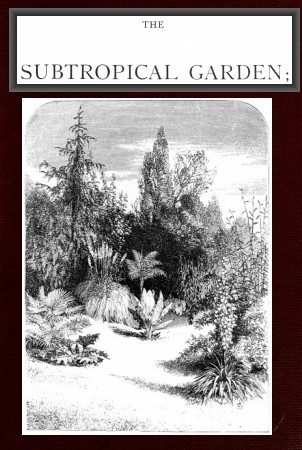
The Project Gutenberg eBook of The Subtropical Garden; or, beauty of form in the flower garden.
Title: The Subtropical Garden; or, beauty of form in the flower garden.
Author: W. Robinson
Release date: October 17, 2015 [eBook #50243]
Most recently updated: October 22, 2024
Language: English
Credits: Produced by Shaun Pinder, Chuck Greif and the Online
Distributed Proofreading Team at http://www.pgdp.net (This
file was produced from images generously made available
by The Internet Archive)
|
List of Illustrations (etext transcriber's note) |
THE SUBTROPICAL GARDEN.
Works by the same Author.
/\/\/\/\/\/\/\/\/\/\
ALPINE FLOWERS FOR ENGLISH GARDENS. With 70 Illustrations.
THE WILD GARDEN, or our Groves and Shrubberies made beautiful by the naturalisation of hardy exotic plants. With Frontispiece.
MUSHROOM CULTURE: its Extension and Improvement. With Illustrations.
Nearly Ready.
HARDY FLOWERS; or, HERBACEOUS, BULBOUS, AND ALPINE PLANTS. This will be the most comprehensive and practically instructive book ever published on these plants. With Frontispiece.
A CATALOGUE OF CULTIVATED HARDY PERENNIALS, BULBS, ANNUALS, etc., including also all British Plants. Prepared for the purpose of facilitating exchanges, &c., and enumerating nearly 10,000 hardy exotic and British plants.
THE
SUBTROPICAL GARDEN;
OR,
BEAUTY OF FORM IN THE
FLOWER GARDEN.
BY W. ROBINSON, F.L.S.,
AUTHOR OF ‘ALPINE FLOWERS,’ ‘THE WILD GARDEN,’ ‘HARDY FLOWERS,’ ETC.
WITH ILLUSTRATIONS.
LONDON:
JOHN MURRAY, ALBEMARLE STREET.
1871.
The right of Translation is reserved.
LONDON:
PRINTED BY WILLIAM CLOWES AND SONS, STAMFORD STREET
AND CHARING CROSS.
PREFACE.
THIS book is written with a view to assist the newly-awakened taste for something more than mere colour in the flower-garden, by enumerating, describing, indicating the best positions for, and giving the culture of, all our materials for what is called “subtropical gardening.” This not very happy, not very descriptive name, is adopted from its popularity only; fortunately for our gardens numbers of subjects not from subtropical climes may be employed with great advantage. Subtropical gardening means the culture of plants with large and graceful or remarkable foliage or habit, and the association of them with the usually low-growing and brilliant flowering-plants now so common in our gardens, and which frequently eradicate every trace of beauty of form therein, making the flower-garden a thing of large masses of colour only.
The guiding aim in this book has been the selection of really suitable subjects, and the rejection of many that have been recommended and tried for this purpose. This point is more important than at first sight would appear, for in most of the literature hitherto devoted to the subject plants entirely unsuitable are named. Thus we find such things as Alnus glandulosa aurea and Ulmus campestris aurea (a form of the common elm) enumerated among subtropical plants by one author. Manifestly if these are admissible almost every species of plant is equally so. These belong to a class of variegated hardy subjects that have been in our gardens for ages, and have nothing whatever to do with subtropical gardening. Two other classes have also purposely been omitted: very tender stove-plants, many of which have been tried in vain in the Paris and London Parks, and such things as Echeveria secunda, which though belonging to a type frequently enumerated among subtropical plants, are, more properly, subjects of the bedding class. But if I have excluded many that I know to be unsuitable, every type of the vegetation of northern and temperate countries has been searched for valuable kinds; and as no tropical or subtropical subject that is really effective has been omitted, the result is the most complete selection that is possible from the plants now in cultivation.
No pains have been spared to show by the aid of illustrations the beauty of form displayed by the various types of plants herein enumerated. For some of the illustrations I have to thank MM. Vilmorin and Andrieux, the well-known Parisian firm; for others, the proprietors of the ‘Field;’ while the rest are from the graceful pencil of Mr. Alfred Dawson, and engraved by Mr. Whymper and Mr. W. Hooper. I felt that engravings would be of more than their usual value in this book, inasmuch as they place the best attainable result before the reader’s eye, thus enabling him to arrange his materials more efficiently. A small portion of the matter of this book originally appeared in my book on the gardens of Paris, in which it will not again be printed. For the extensive list of the varieties of Canna I am indebted to M. Chatè’s “Le Canna.” Most of the subjects have been described from personal knowledge of them, both in London and Paris gardens.
W. R.
April 3, 1871.
CONTENTS.
| PART I. | |
|---|---|
| PAGE | |
| INTRODUCTION AND GENERAL CONSIDERATIONS | 1 |
| PART II. | |
| DESCRIPTION, ARRANGEMENT, CULTURE, ETC., OF SUITABLE SPECIES, HARDY AND TENDER, ALPHABETICALLY ARRANGED | 43 |
| PART III. | |
| SELECTIONS OF PLANTS FOR VARIOUS PURPOSES | 221 |
LIST OF ILLUSTRATIONS.
Separate plates to face the pages given.
| PAGE | |
| Frontispiece—Hardy and tender Plants in the Subtropical Garden. | |
| Cannas in a London park | 13 |
| Anemone japonica alba | 17 |
| Group and single specimens of plants isolated on the grass | 23 |
| Portion of plan showing Yuccas, etc. | 25 |
| Formal arrangements in London parks | 26 |
| Tree Ferns and other Stove Plants | 28 |
| Ailantus and Cannas | 30 |
| Young Conifers, etc. | 32 |
| Gourds | 34 |
| Section of raised bed at Battersea | 40 |
| Acanthus latifolius | 47 |
| Aralia canescens | 58 |
| Aralia japonica | 60 |
| Aralia papyrifera | 61 |
| Asplenium Nidus-avis | 70 |
| Bambusa aurea | 72 |
| Bambusa falcata | 74 |
| Berberis nepalensis | 79 |
| Blechnum brasiliense | 80 |
| Bocconia cordata | 81 |
| Buphthalmum speciosum | 83 |
| Caladium esculentum | 84 |
| Colocasia odorata | 85 |
| Canna | 86 |
| Carlina acaulis | 110 |
| Caryota sobolifera | 111 |
| Centaurea babylonica | 112 |
| Chamædorea | 114 |
| Chamærops excelsa | 116 |
| Cycas | 120 |
| Tree Fern | 123 |
| Dimorphanthus mandschuricus | 124 |
| Erianthus Ravennæ | 132 |
| Ferula communis | 136 |
| Ficus elastica | 139 |
| Gynerium argenteum | 142 |
| Gunnera scabra | 144 |
| Heracleum | 147 |
| Malva crispa | 153 |
| Melianthus major | 155 |
| Monstera deliciosa | 156 |
| Montagnæa heracleifolia | 157 |
| Morina longifolia | 158 |
| Mulgedium alpinum | 159 |
| Musa Ensete | 160 |
| Nicotiana Tabacum | 163 |
| Onopordum Acanthium | 164 |
| Poa fertilis | 174 |
| Rheum Emodi | 178 |
| Rhus glabra laciniata | 180 |
| Seaforthia elegans | 185 |
| Solanum robustum | 190 |
| Solanum Warscewiczii | 195 |
| Uhdea bipinnatifida | 205 |
| Wigandia macrophylla | 208 |
| Yucca filamentosa | 212 |
| Yucca pendula | 214 |
| Yucca filamentosa variegata | 217 |
PART I.
INTRODUCTION AND GENERAL CONSIDERATIONS.
SUBTROPICAL GARDENING.
INTRODUCTION AND GENERAL CONSIDERATIONS.
The system of garden-decoration popularly known as “Subtropical,” and which simply means the use in gardens of plants having large and handsome leaves, noble habit, or graceful port, has taught us the value of grace and verdure amid masses of low, brilliant, and unrelieved flowers, and has reminded us how far we have diverged from Nature’s ways of displaying the beauty of vegetation, our love for rude colour having led us to ignore the exquisite and inexhaustible way in which plants are naturally arranged. In a wild state brilliant blossoms are usually relieved by a setting of abundant green; and even where mountain and meadow plants of one kind produce a wide blaze of colour at one season, there is intermingled a spray of pointed grass and other leaves, which tone down the mass and quite separate it from anything shown by what is called the “bedding system” in gardens. When we come to examine the most charming examples of our own indigenous or any other wild vegetation, we find that their attraction mainly depends on flower and fern, trailer, shrub, and tree, sheltering, supporting, relieving and beautifying each other, so that the whole array has an indefinite tone, and the mind is satisfied with the refreshing mystery of the arrangement.
We may be pleased by the wide spread of purple on a heath or mountain, but when we go near and examine it in detail, we find that its most exquisite aspect is seen in places where the long moss cushions itself beside the ling, and the fronds of the Polypody peer forth around little masses of heather. Everywhere we see Nature judicious in the arrangement of her highest effects, setting them in clouds of verdant leafage, so that monotony is rarely produced—a state of things which it is highly desirable to attain as far as possible in the garden.
We cannot attempt to reproduce this literally—nor would it be wise or convenient to do so—but assuredly herein will be found the chief source of true beauty and interest in our gardens as well as in those of Nature; and the more we keep this fact before our eyes, the nearer will be our approach to truth and success.
Nature in puris naturalibus we cannot have in our gardens, but Nature’s laws should not be violated; and few human beings have contravened them more than our flower-gardeners during the past twenty years. We should compose from Nature, as landscape artists do. We may have in our gardens—and without making wildernesses of them either—all the shade, the relief, the grace, the beauty, and nearly all the irregularity of Nature.
Subtropical gardening has shown us that one of the greatest mistakes ever made in the flower-garden was the adoption of a few varieties of plants for culture on a vast scale, to the exclusion of interest and variety, and, too often, of beauty or taste. We have seen how well the pointed, tapering leaves of the Cannas carry the eye upwards; how refreshing it is to cool the eyes in the deep green of those thoroughly tropical Castor-oil plants, with their gigantic leaves; how grand the Wigandia, with its wrought-iron texture and massive outline, looks, after we have surveyed brilliant hues and richly-painted leaves; how greatly the sweeping palm-leaves beautify the British flower-garden; and, in a word, the system has shown us the difference between the gardening that interests and delights all beholders, as well as the mere horticulturist, and that which is too often offensive to the eye of taste, and pernicious to every true interest of what Bacon calls the “purest of humane pleasures.”
But are we to adopt this system in its purity? as shown, for example, by Mr. Gibson when superintendent of Battersea Park. Certainly not. It is evident, that to accommodate it to private gardens an expense and a revolution of appliances would be necessary, which are in nearly all cases quite impossible, and if possible, hardly desirable. We can, however, introduce into our gardens most of its better features; we can vary their contents, and render them more interesting by a better and nobler system. The use of all plants without any particular and striking habit, or foliage, or other desirable peculiarity, merely because they are natives of very hot countries, should be tabooed at once, as tending to make much work, and to return—a lot of weeds; for “weediness” is all that I can ascribe to many Solanums and stove plants, of no real merit, which have been employed under this name. Selection of the most beautiful and useful from the great mass of plants known to science is one of the most important of the horticulturist’s duties, and in no branch must he exercise it more thoroughly than in this. Some of the plants used are indispensable—the different kinds of Ricinus, Cannas in great variety, Polymnia, Colocasia, Uhdea, Wigandia, Ferdinanda, Palms, Yuccas, Dracænas, and fine-leaved plants of coriaceous texture generally. A few specimens of these may be accommodated in many gardens; they will embellish the houses in winter, and, transferred to the open garden in summer, will lend interest to it when we are tired of the houses. Some Palms, like Seaforthia, may be used with the best effect for the winter decoration of the conservatory, and be placed out with a good result, and without danger, in summer. Many fine kinds of Dracænas, Yuccas, Agaves, etc., which have been seen to some perfection at our shows of late, are eminently adapted for standing out in summer, and are in fact benefited by it. Among the noblest ornaments of a good conservatory are the Norfolk Island and other tender Araucarias; and these may be placed out for the summer, much to their advantage, because the rains will thoroughly clean and freshen them for winter storing. So with some Cycads and other plants of distinct habit—the very things best fitted to add to the attractions of the flower-garden. Thus we may, in all but the smallest gardens, enjoy all the benefits of what is called Subtropical Gardening, without creating any special arrangements for it.
But what of those who have no conservatory, no hothouses, no means for preserving large tender plants in winter? They too may enjoy the beauty which plants of fine form afford. A better effect than any yet seen in an English garden from tender plants may be obtained by planting hardy ones only! There is the Pampas grass, which when well grown is unsurpassed by anything that requires protection. There are the Yuccas, noble and graceful in outline, and thoroughly hardy, and which, if planted well, are not to be surpassed, if equalled, by anything of like habit we can preserve indoors. There are the Arundos, conspicua and Donax, things that well repay for liberal planting; and there are fine hardy herbaceous plants like Crambe cordifolia, Rheum Emodi, Ferulas, and various graceful umbelliferous plants that will furnish effects equal to any we can produce by using the tenderest exotics. The Acanthuses too, when well grown, are very suitable for this use. Then we have a hardy Palm, that has preserved its health and greenness in sheltered positions, where its leaves could not be torn to shreds by storms, through all our recent hard winters.
And when we have obtained these, and many like subjects, we may associate them with not a few things of much beauty among trees and shrubs—with elegant tapering young pines, many of which, like Cupressus nutkaensis and the true Thuja gigantea, have branchlets as graceful as a Selaginella; not of necessity bringing the larger things into close or awkward association with the humbler and dwarfer subjects, but sufficiently so to carry the eye from the minute and pretty to the higher and more dignified forms of vegetation. By a judicious selection from the vast number of hardy plants now obtainable in this country, and by associating with them, where it is convenient, house plants that may be placed out for the summer, we may arrange and enjoy charms in the flower-garden to which we are as yet strangers, simply because we have not sufficiently selected from and utilized the vast amount of vegetable beauty at our disposal.
In dealing with the tenderer subjects, we must choose such as will make a healthy growth in sheltered places in the warmer parts of England and Ireland at all events. There is some reason to believe that not a few of the best will be found to flourish much further north than is generally supposed. In all parts the kinds with permanent foliage, such as the New Zealand flax and the hardier Dracænas, will be found as effective as around London and Paris; and to such the northern gardener should turn his attention as much as possible. Even if it were possible to cultivate the softer-growing kinds, like the Ferdinandas, to the same perfection in all parts as in the south of England, it would by no means be everywhere desirable, and especially where expense is a consideration, as these kinds are not capable of being used indoors in winter. The many fine permanent-leaved subjects that stand out in summer without the least injury, and may be transferred to the conservatory in autumn, there to produce as fine an effect all through the cold months as they do in the flower-garden in summer, are the best for those with limited means.
But of infinitely greater importance are the hardy plants; for however few can indulge in the luxury of rich displays of tender plants, or however rare the spots in which they may be ventured out with confidence, all may enjoy those that are hardy, and that too with infinitely less trouble than is required by the tender ones. Those noble masses of fine foliage displayed to us by tender plants have done much towards correcting a false taste. What I wish to impress upon the reader is, that in whatever part of these islands he may live, he need not despair of producing sufficient similar effect to vary his flower-garden or pleasure-ground beautifully by the use of hardy plants alone; and that the noble lines of a well-grown Yucca recurva, or the finely chiselled yet fern-like spray of a graceful young conifer, will aid him as much in this direction as anything that requires either tropical or subtropical temperature.
Since writing the preceding remarks I have visited America, and when on my way home landed at Queenstown with a view of seeing a few places in the south of Ireland, and among others Fota Island, the residence of Mr. Smith Barry, where I found a capital illustration of what may be easily effected with hardy plants alone. Here an island is planted with a hardy bamboo (Bambusa falcata), which thrives so freely as to form great tufts from 16 ft. to 20 ft. high. The result is that the scene reminds one of a bit of the vegetation of the uplands of Java, or that of the bamboo country in China. The thermometer fell last December (1870) seventeen degrees below freezing point, so that they suffered somewhat, but their general effect was not much marred. Accompanying these, and also on the margins of the water, were huge masses of Pampas grass yet in their beauty of bloom, and many great tufts of the tropical-looking New Zealand flax, with here and there a group of Yuccas. The vegetation of the islands and of the margins of the water was composed almost solely of these, and the effect quite unlike anything usually seen in the open air in this country. Nothing in such arrangements as those at Battersea Park equals it, because all the subjects were quite hardy, and as much at home as if in their native wilds. Remember, in addition, that no trouble was required after they were planted, and that the beauty of the scene was very striking a few days before Christmas, long after the ornaments of the ordinary flower-garden had perished. The whole neighbourhood of the island was quite tropical in aspect; and, as behind the silvery plumes of the Pampas grass and the slender wands of the bamboo the exquisitely graceful heads of the Monterey and other cypresses and various pines towered high in the air, it was one of the most charming scenes I have yet enjoyed in the pleasure-grounds of the British Isles. And this, which was simply the result of judiciously planting three or four kinds of hardy plants, will serve to suggest how many other beautiful aspects of vegetation we may create by utilising the rich stores within our reach.
We will next speak of arrangement and sundry other matters of some importance in connection with this subject. The radical fault of the “Subtropical Garden,” as hitherto seen, is its lumpish monotony and the almost total neglect of graceful combinations. It is fully shown in the London parks every year, so that many people will have seen it for themselves. The subjects are not used to contrast with or relieve others of less attractive port and brilliant colour, but are generally set down in large masses. Here you meet a troop of Cannas, numbering 500, in one long formal bed—next you arrive at a circle of Aralias, or an oval of Ficus, in which a couple of hundred plants are so densely packed that their tops form a dead level. Isolated from everything else as a rule these masses fail to throw any natural grace into the garden, but, on the other hand, go a long way towards spoiling the character of the subjects of which they are composed. For it is manifest that you get a far superior effect from a group of such a plant as the Gunnera, the Polymnia, or the Castor-oil plant, properly associated with other subjects of entirely diverse character, than you can when the lines or masses of such as these become so large and so estranged from their surroundings that there is no relieving point within reach of the eye. A single specimen or small group of a fine Canna forms one of the most graceful objects the eye can see. Plant a rood of it, and it soon becomes as attractive as so much maize or wheat. No doubt an occasional mass of Cannas, etc., might prove effective—in a distant prospect especially—but the thing is repeated ad nauseam.
The fact is, we do not want purely “Subtropical gardens,” or “Leaf gardens,” or “Colour gardens,” but such gardens as, by happy combinations of the materials at our disposal, shall go far to satisfy those in whom true taste has been awakened—and, indeed, all classes. For it is quite a mistake to assume that because people, ignorant of the inexhaustible stores of the vegetable kingdom, admire the showy glares of colour now so often seen in our gardens, they are incapable of enjoying scenes displaying some traces of natural beauty and variety.
The fine-leaved plants have not yet been associated immediately with the flowers; hence the chief fault. Till they are so treated we can hardly see the great use of such in ornamental gardening. Why not take some of the handsomest plants of the medium-sized kinds, place them in the centre of a bed, and then surround them with the gaily-flowering subjects? The Castor-oil plants would not do so well for this, because they are rampant growers in fair seasons, but the Yuccas, Cannas, Wigandias, and small neat Palms and Cycads would suit exactly. Avoid huge, unmeaning masses, and associate more intimately the fine-leaved plants with the brilliant flowers. A quiet mass of green might be desirable in some positions, but even that could be varied most effectively as regards form. The combinations of this kind that may be made are innumerable, and there is no reason why our beds should not be as graceful as bouquets well and simply made.
However, it is not only by making combinations of the subtropical plants with the gay-flowering ones now seen in our flower-gardens that a beautiful effect may be obtained, but also with those of a somewhat different type. Take, for instance, the stately hollyhock, sometimes grown in such formal plantations as to lose some of its charms, and usually stiff and poor below the flowers. It is easy to imagine how much better a group of these would appear if seen surrounded by a graceful ring of Cannas, or any other tall and vigorous subjects, than they have ever yet appeared in our gardens.
Consider, again, the Lilies, from the superb, tall, and double varieties of the brilliant Tiger lily to the fair White lily or the popular L. auratum. Why, a few isolated heads of Fortune’s Tiger lily, rising like candelabra above a group of Cannas, would form one of the most brilliant pictures ever seen in a garden. Then, to descend from a very tall to a very dwarf lily, the large and white trumpet-like flowers of L. longiflorum would look superb, emerging from the outer margin of a mass of
subtropical plants, relieved by the rich green within; and anybody, with even a slight knowledge of the lily family, may imagine many other combinations equally beautiful and new. The bulbs would of course require planting in the autumn, and might be left in their places for several years at a time, whereas the subtropical plants might be those that require planting every year; but as the effect is obtained by using comparatively few lilies, the spaces between them would be so large, as to leave plenty of room to plant the others. However, it is worth bearing in mind, that most of the Cannas, by far the finest group of “Subtropical” plants for the British Isles, remain through the winter in beds in the open air protected by litter: hence, permanent combinations of Lilies and Cannas are perfectly practicable.
Then, again, we have those brilliant and graceful hosts of Gladioli, that do not show their full beauty in the florist’s stand or in his formal bed, but when they spring here and there, in an isolated manner, from rich foliage, entirely unlike their own pointed sword-like blades. Next may be named the flame-flowered Tritoma, itself almost subtropical in foliage when well grown. Any of the Tritomas furnish a splendid effect grouped near or closely associated with subtropical plants. The lavishly blooming and tropical-looking Dahlia is a host in itself, varying so much as it does from the most gorgeous to the most delicate hues, and differing greatly too in the size of the flowers, from those of the pretty fancy Dahlias to the largest exhibition kinds. Combinations of Dahlias with Cannas and other free-growing subtropical plants have a most satisfactory effect; and where beds or groups are formed of hardy subjects (Acanthuses and the like), in quiet half-shady spots, some of the more beautiful spotted and white varieties of our own stately and graceful Foxglove would be charmingly effective. In similar positions a great Mullein (Verbascum) here and there would also suit; while such bold herbaceous genera as Iris, Aster (the tall perennial kinds), the perennial Lupin, Baptisias, Thermopsis, Delphiniums, tall Veronicas, Aconites, tall Campanulas, Papaver bracteatum, Achillea filipendula, Eupatoriums, tall Phloxes, Vernonias, Leptandra, etc., might be used effectively in various positions, associated with groups of hardy subjects. For those put out in early summer, summer and autumn-flowering things should be chosen.
The tall and graceful Sparaxis pulcherrima would look exquisite leaning forth from masses of rich foliage about a yard high; the common and the double perennial Sunflower (Helianthus multiflorus, fl. pl.) would serve in rougher parts, where admired; in sheltered dells the large and hardy varieties of Crinum capense would look very tropical and beautiful if planted in rich moist ground; and the Fuchsia would afford very efficient aid in mild districts, where it is little injured in winter, and where, consequently, tall specimens flower throughout the summer months; and lastly, the many varied and magnificent varieties of herbaceous Peony, raised during recent years, would prove admirable as isolated specimens on the grass near groups of fine-foliaged plants. Then again we have the fine Japan Anemones, white and rose, the showy and vigorous Rudbeckias, the sweet and large annual Datura ceratocaula, the profusely-flowering Statice latifolia, the Gaillardias, the Peas (everlasting and otherwise), the ever-welcome African Lily (Calla), the handsome Loosestrife (Lythrum roseum superbum), and the still handsomer French Willow, and not a few other things which need not be enumerated here, inasmuch as it is hoped enough has been said to show our great and unused resources for adding real grace and interest to our gardens. This phase of the subject—the association of tall or bold flowers with foliage-plants—is so important, that I have bestowed some pains in selecting the many and various subjects useful for it from almost every class of plants; and they will be found in a list at the end of the alphabetical arrangement.
Many charming results may be obtained by carpeting the ground beneath masses of tender subtropical plants with quick-growing ornamental annuals and bedding plants, which will bloom before the larger subjects have put forth their strength and beauty of leaf. If all interested in flower-gardening had an opportunity of seeing the charming effects produced by judiciously intermingling fine-leaved plants with brilliant flowers, there would be an immediate revolution in our flower-gardening, and verdant grace and beauty of form would be introduced, and all the brilliancy of colour that could be desired might be seen at the same time. Here is a bed of Erythrinas not yet in flower: but what affords that brilliant and singular mass of colour beneath them? Simply a mixture of the lighter varieties of Lobelia speciosa with variously coloured and brilliant Portulacas. The beautiful surfacings that may thus be made with annual, biennial, or ordinary bedding plants, from Mignonette to Petunias and Nierembergias, are almost innumerable.
Reflect for a moment how consistent is all this with the best gardening and the purest taste. The bare earth is covered quickly with these free-growing dwarfs; there is an immediate and a charming contrast between the dwarf-flowering and the fine-foliaged plants; and should the last at any time put their heads too high for the more valuable things above them, they can be cut in for a second bloom. In the case of using foliage-plants that are eventually to cover the bed completely, annuals may be sown, and they in many cases will pass out of bloom and may be cleared away just as the large leaves begin to cover the ground. Where this is not the case, but the larger plants are placed thin enough to always allow of the lower ones being seen, two or even more kinds of dwarf plants may be employed, so that the one may succeed the other, and that there may be a mingling of bloom. It may be thought that this kind of mixture would interfere with what is called the unity of effect that we attempt to attain in our flower-gardens. This need not be so by any means; the system could be used effectively in the most formal of gardens.
One of the most useful and natural ways of diversifying a garden, and one that we rarely or never take advantage of, consists in placing really distinct and handsome plants alone upon the grass, to break the monotony of clump margins and of everything else. To follow this plan is necessary wherever great variety and the highest beauty are desired in the ornamental garden. Plants may be
placed singly or in open groups near the margins of a bold clump of shrubs or in the open grass; and the system is applicable to all kinds of hardy ornamental subjects, from trees downwards, though in our case the want is for the fine-leaved plants and the more distinct hardy subjects. Nothing, for instance, can look better than a well-developed tuft of the broad-leaved Acanthus latifolius, springing from the turf not far from the margin of a pleasure-ground walk; and the same is true of the Yuccas, Tritomas, and other things of like character and hardiness. We may make attractive groups of one family, as the hardiest Yuccas; or splendid groups of one species like the Pampas grass—not by any means repeating the individual, for there are about twenty varieties of this plant known on the Continent, and from these half a dozen really distinct and charming kinds might be selected to form a group. The same applies to the Tritomas, which we usually manage to drill into straight lines; in an isolated group in a verdant glade they are seen for the first time to best advantage: and what might not be done with these and the like by making mixed groups, or letting each plant stand distinct upon the grass, perfectly isolated in its beauty!
Let us again try to illustrate the idea simply. Take an important spot in a pleasure-ground—a sweep of grass in face of a shrubbery—and see what can be done with it by means of these isolated plants. If, instead of leaving it in the bald state in which it is often found, we place distinct things isolated here and there upon the grass, the margin of shrubbery will be quite softened, and a new and charming feature added to the garden. If one who knew many plants were arranging them in this way, and had a large stock to select from, he might produce numberless fine effects. In the case of the smaller things, such as the Yucca and variegated Arundo, groups of four or five good plants should be used to form one mass, and everything should be perfectly distinct and isolated, so that a person could freely move about amongst the plants without touching them. In addition to such arrangements, two or three individuals of a species might be placed here and there upon the grass with the best effect. For example, there is at present in our nurseries a great Japanese Polygonum (P. Sieboldi), which has never as yet been used with much effect in the garden. If anybody will select some open grassy spot in a pleasure-garden, or grassy glade near a wood—some spot considered unworthy of attention as regards ornamenting it—and plant a group of three plants of this Polygonum, leaving fifteen feet or so between the stools, a distinct aspect of vegetation will be the result. The plant is herbaceous, and will spring up every year to a height of from six feet to eight feet if planted well; it has a graceful arching habit in the upper branches, and is covered with a profusion of small bunches of pale flowers in autumn. It is needless to multiply examples; the plan is capable of infinite variation, and on that account alone should be welcome to all true gardeners.