
The Project Gutenberg eBook of The Surprising Adventures of Sir Toady Lion with Those of General Napoleon Smith
Title: The Surprising Adventures of Sir Toady Lion with Those of General Napoleon Smith
Author: S. R. Crockett
Illustrator: Gordon Browne
Release date: April 1, 2012 [eBook #39340]
Most recently updated: March 6, 2015
Language: English
Credits: Produced by David Edwards, Matthew Wheaton and the Online
Distributed Proofreading Team at http://www.pgdp.net (This
file was produced from images generously made available
by The Internet Archive)
Sir Toady Lion
"AS THE HIGHLANDERS HAD CLUNG TO THE CAVALRY STIRRUPS AT BALACLAVA." Page 257.
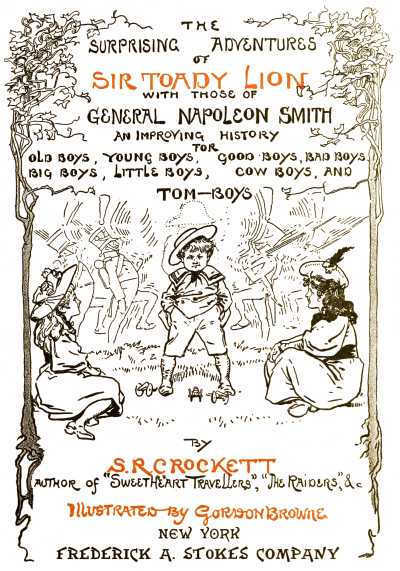
THE SURPRISING ADVENTURES OF SIR TOADY LION WITH THOSE OF GENERAL NAPOLEON SMITH
AN IMPROVING HISTORY
FOR
OLD BOYS, YOUNG BOYS, GOOD BOYS, BAD BOYS,
BIG BOYS, LITTLE BOYS, COW BOYS, AND
TOM-BOYS
BY
S. R. CROCKETT
author of "Sweetheart Travellers", "The Raiders", &c.
ILLUSTRATED BY GORDON BROWNE
NEW YORK
FREDERICK A. STOKES COMPANY
Copyright, 1897
by
Frederick A. Stokes
Company
Too Good Boys
Not Allowed
To Read This Book
By Order
Field Marshal Napoleon Smith
| CHAP. | PAGE. | |
| I. | Prissy, Hugh John, and Sir Toady Lion, | 1 |
| II. | The Gospel of Dasht-Mean, | 10 |
| III. | How Hugh John Became General Napoleon, | 18 |
| IV. | Castle Perilous, | 25 |
| V. | The Declaration of War, | 30 |
| VI. | First Blood, | 35 |
| VII. | The Poor Wounded Hussar, | 42 |
| VIII. | The Familiar Spirit, | 46 |
| IX. | Put to the Question, | 52 |
| X. | A Scouting Adventure, | 60 |
| XI. | Enemy's Country, | 67 |
| XII. | Mobilisation, | 73 |
| XIII. | The Army of Windy Standard, | 83 |
| XIV. | The Battle of the Black Sheds, | 89 |
| XV. | Toady Lion Plays a First Lone Hand, | 95 |
| XVI. | The Smoutchy Boys, | 101 |
| XVII. | Before the Inquisition, | 107 |
| XVIII. | The Castle Dungeon, | 114 |
| XIX. | The Drop of Water, | 122 |
| XX. | The Secret Passage, | 128 |
| XXI. | The Return from the Bastile, | 137 |
| XXII. | Mutiny in the Camp, | 147 |
| XXIII. | Cissy Carter, Boys' Girl, | 154 |
| XXIV. | Charity Begins at Home—and Ends There, | 162 |
| XXV. | Love's (Very) Young Dream, | 174 |
| XXVI. | An Imperial Birthday, | 185 |
| XXVII. | The Bantam Chickens, | 192 |
| XXVIII. | The Gipsy Camp, | 199 |
| XXIX. | Toady Lion's Little Ways, | 206 |
| XXX. | Saint Prissy, Peacemaker, | 211 |
| XXXI. | Prissy's Picnic, | 220 |
| XXXII. | Plan of Campaign, | 237 |
| XXXIII. | Toady Lion's Second Lone Hand, | 244 |
| XXXIV. | The Crowning Mercy, | 258 |
| XXXV. | Prissy's Compromise, | 269 |
| XXXVI. | Hugh John's Way-Going, | 280 |
| XXXVII. | The Good Conduct Prize, | 287 |
| XXXVIII. | Hugh John's Blighted Heart, | 294 |
| XXXIX. | "Girls are Funny Things," | 308 |
| PAGE. | |
| "As the Highlanders had Clung to the Cavalry Stirrups at Balaclava," | Frontispiece |
| Sir Toady Lion, | Titlepage |
| Hugh John had a Sister, | 1 |
| The Highway lies Deserted, | 10 |
| Mr. Dick Turpin, Late of York and Tyburn, | 12 |
| He Stood on the Roadside, | 18 |
| It Could not Have Been Better Done for a Field-Marshal, | 22 |
| Castle Perilous, | 25 |
| At the End of the Stepping-Stones, | 30 |
| Janet Sheepshanks Awaited this Sorry Procession with a grim Tightening of the Lips, | 32 |
| "I Couldn't Help Getting Beaten," | 35 |
| Success Often Bred Envy, | 42 |
| Sambo, | 46 |
| A Fearful Black Countenance Nodded at Him, | 52 |
| Hugh John Took his way Down the Avenue, | 60 |
| "Wait Till the Next Time," | 63 |
| He was Obliged to Climb a Tree, | 67 |
| Hugh John Tugged Her Hair, | 73 |
| Deposited General-Field-Marshal Smith in the Horse-Pond, | 76 |
| Generals of Division, Equal in Rank, | 79 |
| The Army was Finally Mustered, | 83 |
| The Black Sheds, | 89 |
| The Battle of the Black Sheds, | 93 |
| Cautiously he Returned Through the Hedge, | 95 |
| "Oh, the Bonnie Laddie!" | 98 |
| "Surrender!" cried Nipper Donnan, | 101 |
| The Head Smoutchy, | 104 |
| "Got You at Last!" | 107 |
| "Will ye Say Now that the Castle is Your Father's?" | 112 |
| "But I Won't Cry—Even to Myself," | 114 |
| He Bent the Weight of his Body This way and That, | 117 |
| The Pining Captive, | 122 |
| The Secret Passage, | 128 |
| He Saw a Stretch of Rippled River, | 134 |
| He Floundered Through, | 137 |
| "I Create you General of the Comm'sariat," | 143 |
| "Don't you Speak Against my Father," | 147 |
| Sammy Carter Mutinous, | 149 |
| "One, Two, Three—and a Tiger," | 154 |
| "Look at Him, Madam," said Mrs. Baker, | 157 |
| Toady Lion sat Plump Down, | 162 |
| "Let me Look at Him," She Said, | 165 |
| Love's Young Dream, | 174 |
| "Hit Hard, Brave Soldier," | 177 |
| "Wasn't it Splendid?" | 182 |
| Toady Lion Preferred to Sleep in the Most Curious Positions, | 185 |
| Bantam Chickens, | 192 |
| The Gipsies' Wood, | 199 |
| She Carried a Back Load of Tinware, | 202 |
| The Oldest Implements Invented for the Purpose, | 206 |
| She Went on Her Way, | 211 |
| "Oh, Please Don't, Sir!" | 218 |
| Welcomed by the Enemy, | 220 |
| The Return of the Two Swift Footmen, | 223 |
| Hydraulic Pressure, | 225 |
| The Plan of Campaign, | 237 |
| Trotting Steadily Through the Town, | 244 |
| The Bounding Brothers, | 258 |
| The Living Chain, | 263 |
| Sixpence for Admission, | 269 |
| "Then," said Prissy, "I think it can be Managed," | 274 |
| Toady Lion Stood Looking on, | 280 |
| A Slim Bundle of Limp Woe, | 284 |
| The Good Conduct Prize, | 287 |
| "Smell That," | 292 |
| A Blighted Being, | 294 |
| He Sprang Over the Stile, | 308 |
| "It Looks Like Half of a Sixpence which Somebody has Stepped upon. How Quaint!" | 312 |
| As if Her Heart were Light Within Her, | 314 |
Sir Toady Lion.
CHAPTER I.
PRISSY, HUGH JOHN, AND SIR TOADY LION.
IT is always difficult to be great, but it is specially difficult when greatness is thrust upon one, as it were, along with the additional burden of a distinguished historical name. This was the case with General Napoleon Smith. Yet when this story opens he was not a general. That came later, along with the cares of empire and the management of great campaigns.
But already in secret he was Napoleon Smith, though his nurse sometimes still referred to him as Johnnie, and his father—but stay. I will reveal to you the secret of our soldier's life right at the start. Though a Napoleon, our hero was no Buonaparte. No, his name was Smith—plain Smith; his father was the owner of four large farms and a good many smaller ones, near that celebrated Border which separates the two hostile countries of England and Scotland. Neighbours referred to the General's father easily as "Picton Smith of Windy Standard," from the soughing, mist-nursing mountain of heather and fir-trees which gave its name to the estate, and to the large farm he had cultivated himself ever since the death of his wife, chiefly as a means of distracting his mind, and keeping at a distance loneliness and sad thoughts.
Hugh John Smith had never mentioned the fact of his Imperial descent to his father, but in a moment of confidence he had told his old nurse, who smiled with a world-weary wisdom, which betrayed her knowledge of the secrets of courts—and said that doubtless it was so. He had also a brother and sister, but they were not, at that time, of the race of the Corporal of Ajaccio. On the contrary, Arthur George, the younger, aged five, was an engine-driver. There was yet another who rode in a mail-cart, and puckered up his face upon being addressed in a strange foreign language, as "Was-it-then? A darling—goo-goo—then it was!" This creature, however, was not owned as a brother by Hugh John and Arthur George, and indeed may at this point be dismissed from the story. The former went so far as stoutly to deny his brother's sex, in the face of such proofs as were daily afforded by Baby's tendency to slap his sister's face wherever they met, and also to seize things and throw them on the floor for the pleasure of seeing them break. Arthur George, however, had secret hopes that Baby would even yet turn out a satisfactory boy whenever he saw him killing flies on the window, and on these occasions hounded him on to yet deadlier exertions. But he dared not mention his anticipations to his soldier brother, that haughty scion of an Imperial race. For reasons afterwards to be given, Arthur George was usually known as Toady Lion.
Then Hugh John had a sister. Her name was Priscilla. Priscilla was distinguished also, though not in a military sense. She was literary, and wrote books "on the sly," as Hugh John said. He considered this secrecy the only respectable part of a very shady business. Specially he objected to being made to serve as the hero of Priscilla's tales, and went so far as to promise to "thump" his sister if he caught her introducing him as of any military rank under that of either general or colour-sergeant.
"Look here, Pris," he said on one occasion, "if you put me into your beastly girl books all about dolls and love and trumpery, I'll bat you over the head with a wicket!"
"Hum—I dare say, if you could catch me," said Priscilla, with her nose very much in the air.
"Catch you! I'll catch and bat you now if you say much."
"Much, much! Can't, can't! There! 'Fraid cat! Um-m-um!"
"By Jove, then, I just will!"
It is sad to be obliged to state here, in the very beginning of these veracious chronicles, that at this time Prissy and Napoleon Smith were by no means model children, though Prissy afterwards marvellously improved. Even their best friends admitted as much, and as for their enemies—well, their old gardener's remarks when they chased each other over his newly planted beds would be out of place even in a military periodical, and might be the means of preventing a book with Mr. Gordon Browne's nice pictures from being included in some well-conducted Sunday-school libraries.
General Napoleon Smith could not catch Priscilla (as, indeed, he well knew before he started), especially when she picked up her skirts and went right at hedges and ditches like a young colt. Napoleon looked upon this trait in Prissy's character as degrading and unsportsmanlike in the extreme. He regarded long skirts, streaming hair, and flapping, aggravating pinafores as the natural handicap of girls in the race of life, and as particularly useful when they "cheeked" their brothers. It was therefore wicked to neutralise these equalising disadvantages by strings tied round above the knees, or by the still more scientific device of a sash suspended from the belt before, passed between Prissy's legs, and attached to the belt behind.
But, then, as Napoleon admitted even at ten years of age, girls are capable of anything; and to his dying day he has never had any reason to change his opinion—at least, so far as he has yet got.
"All right, then, I will listen to your old stuff if you will say you are sorry, and promise to be my horse, and let me lick you for an hour afterwards—besides giving me a penny."
It was thus that Priscilla, to whom in after times great lights of criticism listened with approval, was compelled to stoop to artifice and bribery in order to secure and hold her first audience. Whereupon the authoress took paper from her pocket, and as she did so, held the manuscript with its back to Napoleon Smith, in order to conceal the suspicious shortness of the lines. But that great soldier instantly detected the subterfuge.
"It's a penny more for listening to poetry!" he said, with sudden alacrity.
"I know it is," replied Prissy sadly, "but you might be nice about it just this once. I'm dreadfully, dreadfully poor this week, Hugh John!"
"So am I," retorted Napoleon Smith sternly; "if I wasn't, do you think I would listen at all to your beastly old poetry? Drive on!"
Thus encouraged, Priscilla meekly began—
And my love is a knight;
He girds him in a coat of mail,
When he goes forth to fight."
"That's not quite so bad as usual," said Napoleon condescendingly, toying meanwhile with the lash of an old dog-whip he had just "boned" out of the harness-room. Priscilla beamed gratefully upon her critic, and proceeded—
"Who rides whom?" cried Napoleon. "Didn't the fool ride a horse?"
"It means himself," said Priscilla meekly.
"Then why doesn't it say so?" cried the critic triumphantly, tapping his boot with the "boned" dog-whip just like any ordinary lord of creation in presence of his inferiors.
"It's poetry," explained Priscilla timidly.
"It's silly!" retorted Napoleon, judicially and finally.
Priscilla resumed her reading in a lower and more hurried tone. She knew that she was skating over thin ice.
Upon a stealthy steed."
"You mean 'stately,' you know," interrupted Napoleon—somewhat rudely, Priscilla thought. Yet he was quite within his rights, for Priscilla had not yet learned that a critic always knows what you mean to say much better than you do yourself.
"No, I don't mean 'stately,'" said Priscilla, "I mean 'stealthy,' the way a horse goes on sand. You go and gallop on the sea-shore and you'll find out."
I've listened quite a pennyworth now."
Upon a stealthy steed,
And when he sails upon the sea,
He plays upon a reed!"
"Great soft he was," cried Napoleon Smith; "and if ever I hear you say that I did such a thing——"
Priscilla hurried on more quickly than ever.
The deeds that he hath done:
When he hath slain his enemies,
Then he comes back alone."
"That's better!" said Napoleon, nodding encouragement. "At any rate it isn't long. Now, give me my penny."
"Shan't," said Priscilla, the pride of successful achievement swelling in her breast; "besides, it isn't Saturday yet, and you've only listened to three verses anyway. You will have to listen to ever so much more than that before you get a penny."
"Hugh John! Priscilla!" came a voice from a distance.
The great soldier Napoleon Smith instantly effected a retreat in masterly fashion behind a gooseberry bush.
"There's Jane calling us," said Priscilla; "she wants us to go in and be washed for dinner."
"Course she does," sneered Napoleon; "think she's out screeching like that for fun? Well, let her. I am not going in to be towelled till I'm all over red and scurfy, and get no end of soap in my eyes."
"But Jane wants you; she'll be so cross if you don't come."
"I don't care for Jane," said Napoleon Smith with dignity, but all the same making himself as small as possible behind his gooseberry bush.
"But if you don't come in, Jane will tell father——"
"I don't care for father—" the prone but gallant General was proceeding to declare in the face of Priscilla's horrified protestations that he mustn't speak so, when a slow heavy step was heard on the other side of the hedge, and a deep voice uttered the single syllable, "John!"
"Yes, father," a meek young man standing up behind the gooseberry bush instantly replied: he was trying to brush himself as clean as circumstances would permit. "Yes, father; were you calling me, father?"
Incredible as it seems, the meek and apologetic words were those of that bold enemy of tyrants, General Napoleon Smith.
Priscilla smiled at the General as he emerged from the hands of Jane, "red and scurfy," just as he had said. She smiled meaningly and aggravatingly, so that Napoleon was reduced to shaking his clenched fist covertly at her.
"Wait till I get you out," he said, using the phrase time-honoured by such occasions.
Priscilla Smith only smiled more meaningly still. "First catch your hare!" she said under her breath.
Napoleon Smith stalked in to lunch, the children's dinner at the house of Windy Standard, with an expression of fixed and Byronic gloom on his face, which was only lightened by the sight of his favourite pigeon-pie (with a lovely crust) standing on the side-board.
"Say grace, Hugh John," commanded his father.
And General Napoleon Smith said grace with all the sweet innocence of a budding angel singing in the cherub choir, aiming at the same time a kick at his sister underneath the table, which overturned a footstool and damaged the leg of a chair.
CHAPTER II
THE GOSPEL OF DASHT-MEAN.
IT was on the day preceding a great review near the Border town of Edam, that Hugh John Picton Smith first became a soldier and a Napoleon. His father's house was connected by a short avenue with a great main road along which king and beggar had for a thousand years gone posting to town. Now the once celebrated highway lies deserted, for along the heights to the east run certain bars of metal, shining and parallel, over which rush all who can pay the cost of a third-class ticket—a roar like thunder preceding them, white steam and sulphurous reek wreathing after them. The great highway beneath is abandoned to the harmless impecunious bicyclist, and on the North Road the sweeping cloud dust has it all its own way.
But Hugh John loved the great thoroughfare, deserted though it was. To his mind there could be no loneliness upon its eye-taking stretches, for who knew but out of the dust there might come with a clatter Mr. Dick Turpin, late of York and Tyburn; Robert the Bruce, charging south into England with his Galloway garrons, to obtain some fresh English beef wherewithal to feed his scurvy Scots; or (best of all) his Majesty King George's mail-coach Highflyer, the picture of which, coloured and blazoned, hung in his father's workroom.
People told him that all these great folks were long since dead. But Hugh John knew better than to believe any "rot" grown-ups might choose to palm off on him. What did grown-ups know anyway? They were rich, of course. Unlimited shillings were at their command; and as for pennies—well, all the pennies in the world lived in their breeches' pockets. But what use did they make of these god-like gifts? Did you ever meet them at the tuck-shop down in the town buying fourteen cheese-cakes for a shilling, as any sensible person would? Did they play with "real-real trains," drawn by locomotives of shining brass? No! they preferred either one lump of sugar or none at all in their tea. This showed how much they knew about what was good for them.
So if such persons informed him that Robert the Bruce had been dead some time, or showed him the rope with which Turpin was hung, coiled on a pedestal in a horrid dull museum (free on Saturdays, 10 to 4), Hugh John Picton looked and nodded, for he was an intelligent boy. If you didn't nod sometimes as if you were taking it all in, they would explain it all over again to you—with abominable dates and additional particulars, which they would even ask you afterwards if you remembered.
"MR. DICK TURPIN, LATE OF YORK AND TYBURN."
For many years Hugh John had gone every day down to the porter's lodge at the end of the avenue, and though old Betty the rheumaticky warder was not allowed to let him out, he stared happily enough through the bars. It was a white gate of strong wood, lovely to swing on if you happened to be there when it was opened for a carriageful of calling-folk in the afternoon, or for Hugh John's father when he went out a-riding.
But you had to hide pretty quick behind the laurels, and rush out in that strictly limited period before old Betty found her key, and yet after the tail of Agincourt, his father's great grey horse, had switched round the corner. If you were the least late, Betty would get ahead of you, and the gates of Paradise would be shut. If you were a moment too soon, it was just as bad—or even worse. For then the voice of "He-whom-it-was-decidedly-most-healthy-to-obey" would sound up the road, commanding instant return to the Sandheap or the High Garden.
So on these occasions Hugh John mostly brought Sir Toady Lion with him—otherwise Arthur George the Sturdy, and at yet other times variously denominated Prince Murat, the Old Guard, the mob that was scattered with the whiff of grapeshot, and (generally) the whole Grand Army of the First Empire. Toady Lion (his own first effort at the name of his favourite hero Richard Cœur-de-Lion) had his orders, and with guile and blandishments held Betty in check till the last frisk of Agincourt's tail had disappeared round the corner. Then Hugh John developed his plans of assault, and was soon swinging on the gate.
"Out of the way with you, Betty," he would cry, "or you will get hurt—sure."
For the white gate shut of itself, and you had only to push it open, jump on, check it at the proper place on the return journey, and with your foot shove off again to have scores and scores of lovely swings. Then Betty would go up the avenue and shout for her husband, who was the aforesaid crusty old gardener. She would have laid down her life for Toady Lion, but by no means even a part of it for Hugh John, which was unfair. Old Betty had once been upset by the slam of the gate on a windy day, and so was easily intimidated by the shouts of the horseman and the appalling motion of his white five-barred charger.
Such bliss, however, was transient, and might have to be expiated in various ways—at best with a slap from the hand of Betty (which was as good as nothing at all), at worst, by a visit to father's workroom—which could not be thought upon without a certain sense of solemnity, as if Sunday had turned up once too often in the middle of the week.
But upon this great day of which I have to tell, Hugh John had been honourably digging all the morning in the sand-hole. He had on his red coat, which was his most secret pride, and he was devising a still more elaborate system of fortification. Bastion and trench, scarp and counter-scarp, lunette and ravelenta (a good word), Hugh John had made them all, and he was now besieging his own creation with the latest thing in artillery, calling "Boom!" when he fired off his cannon, and "Bang-whack!" as often as the projectile hit the wall and brought down a foot of the noble fortification, lately so laboriously constructed and so tenderly patted into shape.
Suddenly there came a sound which always made the heart of Hugh John beat in his side. It was the low thrilling reverberation of the drum. He had only time to dash for his cap, which he had filled with sand and old nails in order to "be a bomb-shell"; empty it, put it on his head, gird on his London sword-with-the-gold-hilt, and fly.
As he ran down the avenue the shrill fifes kept stinging his ears and making him feel as if needles were running up and down his back. It was at this point that Hugh John had a great struggle with himself. Priscilla and Toady Lion were playing at "House" and "Tea-parties" under the weeping elm on the front lawn. It was a debasing taste, certainly, but after all blood was thicker than water. And—well, he could not bear that they should miss the soldiers. But then, on the other hand, if he went back the troops might be past before he reached the gate, and Betty, he knew well, would not let him out to run after them, and the park wall was high.
In this desperate strait Hugh John called all the resources of religion to his aid.
"It would," he said, "be dasht-mean to go off without telling them."
Hugh John did not know exactly what "dasht-mean" meant. But he had heard his cousin Fred (who was grown up, had been a year at school, and wore a tall hat on Sundays) tell how all the fellows said that it was better to die-and-rot than to be "dasht-mean"; and also how those who in spite of warnings proved themselves "dasht-mean" were sent to a place called Coventry—which from all accounts seemed to be a "dasht-mean" locality.
So Hugh John resolved that he would never get sent there, and whenever a little thing tugged down in his stomach and told him "not to," Hugh John said, "Hang it! I won't be dasht-mean."—And wasn't.
Grown-ups call these things conscience and religion; but this is how it felt to Hugh John, and it answered just as well—or even better.
So when the stinging surge of distant pipes sent the wild blood coursing through his veins, and he felt his face grow cold and prickly all over, Napoleon Smith started to run down the avenue. He could not help it. He must see the soldiers or die. But all the same Tug-tug went the little string remorselessly in his stomach.
"I must see them. I must—I must!" he cried, arguing with himself and trying to drown the inner voice.
"Tug-tug-tug!" went the string, worse than that which he once put round his toe and hung out of the window, for Tom Cannon the under-keeper to wake him with at five in the morning to go rabbit-ferreting.
Hugh John turned towards the house and the weeping elm.
"It's a blooming shame," he said, "and they won't care anyway. But I can't be dasht-mean!"
And so he ran with all his might back to the weeping elm, and with a warning cry set Prissy and Sir Toady Lion on the alert. Then with anxious tumultuous heart, and legs almost as invisible as the twinkling spokes of a bicycle, so quickly did they pass one another, Hugh John fairly flung himself in the direction of the White Gate.