
Awaiting a piteous death. And the handmaids huddled in fear
Round Aiêtes’ daughter apart shrilled lamentation drear.
And as when, of their mother forsaken, fledglings shrilly cheep,
Which have fallen to earth from a cleft in a sheer scaur’s precipice-steep,
Or as when ’twixt the low-browed banks of Pactolus’ fair-flowing stream {1300}
The swans are upraising their song, and the meadow of dewy gleam
Murmureth round, and murmur the river’s ripples fair;
So the handmaidens bowing low in the dust their golden hair,
All through the night were uplifting their pitiful wail of despair.
And now out of life had they slidden, had vanished from human ken,
And the name and the fame of them never more had been heard among men,
Those noblest of heroes!—their task unaccomplished had ended then:
Howbeit the Heroine-nymphs had pity of them as they pined
In helpless despair, the Warders of Libya, they that did find
Athênê, what time from the head of her father, in battle-gear {1310}
All flashing, she sprang, and the new-born bathed they in Trito’s mere.
The noon of the day it was, and the sun upon Libya-land
Burned with his fiercest beams: by Aison’s son did they stand,
And the mantle-shroud from his head with soft light touch drew they.
But the hero, downward drooping his eyes, thence turned them away,
For awe of the shapes divine: but with gentle words of cheer
With open face did they speak unto him in his ’wildered fear:
‘Ill-starred one, wherefore so grievously smitten art thou with despair?
We know how ye fared for the Golden Fleece: of your toils we be ware,
Even all the strength-overmastering labours on land that ye proved, {1320}
And all ye endured on the face of the watery deep as ye roved.
The Solitary Ones of the land, the Heroines, are we,
Warders and daughters of Libya, which speak which our voices to thee.
Up then: let thy spirit not thus to affliction of misery yield,
And uprouse thy comrades, so soon as the steeds of the car swift-wheeled
Of Poseidon, by Amphitritê loosed from the yoke, run free.
Unto your mother the nursing-debt then render ye
For all her travail, when long she bare you her womb within.
So haply again unto hallowed Achaia-land shall ye win.’
So spake they, and vanished, there as they stood, in the selfsame place {1330}
Where murmured their voices close in his ear: and with startled gaze
Staring around, on the earth sat Jason, and cried in amaze:
‘Be gracious, ye glorious Goddesses, lone in the desert which dwell!
Yet what this word of our home-coming meaneth I wot not well.
I will gather my comrades, and tell them, and learn what token is this
Of escape:—in the multitude of counsellors safety there is.’
Then he leapt to his feet, and he shouted afar o’er the desolate shore,
All dust-begrimed, as a lion that seeking his mate doth roar
Up and down through the forest-gloom: deep glens through many a hill
Far off at the sound of his voice’s thunder shuddering thrill, {1340}
And tremble the oxen that roam the meads with exceeding fear,
And the herders of kine: but never a whit dismaying to hear
Was the hero’s cry to his friends when the voice of his shouting they heard.
And they gathered with down-drooped eyes to his side, and they sat at his word
Sore troubled anigh where lay the ship; and the women withal
With the heroes mingled sat; and he spake, and he told them all:
‘Hearken, O friends, for in this mine affliction Goddesses three,
In vesture of goatskins girded about, from neck unto knee
Overdrooping their shoulders and waists, as maidens of earth to behold,
Stood over mine head full nigh, and they drew my mantle’s fold {1350}
Away from mine head with fingers light, and they bade me arise
From my couch of despair, bade rouse you up in the selfsame wise.
And they bade us to render our mother the nursing-debt again—
Seeing that long in her womb she bare us with travail-pain—
Whensoever the steeds of the swift-wheeled car of the Lord of the Sea
Amphitritê should loose from the yoke. Howbeit it is not in me
To divine what their prophecy meaneth. They named them, that stranger-band,
Heroines, daughters of Libya, and Warders of the Land.
Yea, whatsoever toils we endured in our journeying
By land or by sea, said they, they were ware of everything. {1360}
No longer thereafter I saw them in place, but there came between
A mist or a cloud—they appeared, and lo! they were no more seen.’
He spake, and they marvelled all such tale to hear him tell.
Then to the Minyan men a most strange wonder befell:
For out of the sea to the land did a horse gigantic bound
With golden mane far-streaming that tossed his shoulders around.
And with one swift stamp he shook from his shoulders the briny spray,
And onward he galloped with feet like the blast of the wind: straightway
Unto the throng of his comrades did Peleus rejoicing say:
‘The steed of the car of the Lord of the Sea!—unyoked hath he been {1370}
Even but now by the hands of his dear-loved wife, I ween.
And our mother—none other is this, I divine, than the good ship there,
Argo; for verily us within her womb she bare
With grievous anguish of travail groaning unceasingly.
Her therefore with stalwart strength and with tireless shoulders we
Will uplift, and afar o’er the wastes of the sandy land from the shore
Will we bear her, where yonder steed hath with swift feet sped before.
For he will not, he, sink into the earth, but his hoof-prints shall go
Pointing the way for us inland afar from the sea, I trow.’
So did he speak: of his keen-witted counsel were all they fain. {1380}
Lo, this is the song of the Muses, and I but sing their strain,
The Pierides’ servant; and this true tale in mine ears hath been told
That ye, O mightiest far of the sons of the kings of old,
By your manhood and might o’er the sands of Libya’s desert drear
Bare high over earth your galley and all her voyaging-gear,
On your shoulders laid, yea, bare her through long days two and ten,
And nights as many. That cup of affliction and travail then,
What tongue could tell it, which these in their toil filled up full-brim?
Of a truth of the blood of the Deathless they were, such labour grim
Did they take on them, onward driven and on by Necessity’s goad, {1390}
Till afar mid the ripples of Trito’s mere how triumphantly strode,
How gladly adown from their stalwart shoulders they set their load!
Then rushing, like unto hounds in the wild hunt’s frenzy-burst,
Sought they a spring, for that now was there added parching thirst
Unto all their affliction and manifold anguish; nor toiled they in vain
Wandering there; for lo, they came to the sacred plain
Where but yesterday Ladon the Serpent of Libya in Atlas’ garden
Kept watch o’er the Apples of Gold; and the Nymphs around their warden,
The Hesperides, rested never, chanting their lovely song.
But now by the arrows of Herakles stricken he lay along {1400}
By the trunk of the apple-tree: only the tip of his tail had strength
To quiver yet, but adown from his head, through all the length
Of his dark chine, lifeless he lay. Where the arrows had left in his blood
The bitter gall of the Hydra of Lerna, a swarming brood
Of flies o’er the venom-festering wounds of him crawled and clung.
And thereby the Hesperides over their golden heads had flung
Their white arms, shrilling their wail. And the wanderers suddenly drew
Anear, and to dust and to earth straightway, when the hero-crew
Came hastily on, did they turn even there. But Orpheus was ware
Of the portent divine, and he stood, and he spake to the Nymphs in prayer: {1410}
‘Divine Ones, lovely and kindly, O Queens, be gracious ye,
Whether amongst the Heavenly Goddesses numbered ye be,
Or the Earthly, or whether they name you the Lone Ones, Nymphs divine,
Come, O ye Nymphs, come, daughters of Ocean’s sacred line!
Appear ye in manifest form to our longing eyes, and show
Some spring gushing forth from the rock, some sacred upwelling flow
From the bosom of Earth, O shapes divine, that the thirst which doth burn
Our tongues without cease may be quenched; and if ever again we return
Unto Achaia-land in our weariful voyaging,
Then, as to the chiefest in heaven, to you which have done this thing {1420}
Gifts and libations and feasts with grateful love will we bring.’
So spake he, praying with earnest voice; and they from anear
Pitied their pain. And first did they cause green grass to appear
From the earth, and above the grass rose saplings tall, and these
Thereafter in fulness of bloom grew up into fair young trees:
Tall-standing and straight, high up from the face of the earth they towered.
In a poplar was Hesperê veiled, Erythêis an elm embowered,
And Aiglê a sacred willow. And out of the stems of them, lo!
Appeared they, and like as before they had been, so again did they show,
A marvel exceeding great: and Aiglê silence brake, {1430}
And with gentle words in their longing ears she answered and spake:
‘Of a surety for blessing to you and deliverance out of your toil,
Hitherward came but now one ruthless and shameless, to spoil
Our guardian serpent of life; and the Goddesses’ apples of gold
He plucked, and he bare them away, and he left us sorrowful-souled.
For there came yestreen a man most fell in wanton despite,
Grim-shapen, whose eyes ’neath his scowling brows flashed terrible light,
A pitiless man: in a monster lion’s fell untanned,
Raw hide, was he clad, with a stubborn olive-wood staff in his hand,
And a bow, with the arrows whereof he shot yon dragon dead. {1440}
And he came, he also, as one that afoot overland hath sped,
Thirst-parched: and questing for water with diligent haste he sought
Through all this place—but, I ween, he was like to behold it not!
Howbeit a certain rock by the mere Tritonian stood:
This, or of his own device, or a God wrought so on his mood,
Did he smite with his foot, and forth did the water in full burst flow.
Then down to the earth on his hands and his breast he bowed him low;
And out of the rifted rock an unspeakable draught he swilled,
Till his mighty maw, down-stooped like a beast of the field, he had filled.’
So spake she; and they right glad thence hasted, until they came {1450}
To the place where Aiglê had told of the spring; and they found the same.
And as when earth-burrowing ants swarm round their narrow pit,
All hurrying to and fro, or when clustering flies, that have lit
Where lieth a drop of the honey sweet, a tiny gout,
Insatiate-eager are thronging, so in a huddled rout
The Minyans round that rock-spring crowded on every side.
And with wet lips thus in his gladness hero to hero cried:
‘O strange!—how hath Herakles saved his companions forspent with stress
Of thirst, though afar he were! Would God that he yet might bless
The eyes of us finding him faring on through the wilderness!’ {1460}
Then shouted in answer they which were ready-dight for the deed.
And they parted, and this way and that way questing the lost did they speed.
For the tracks of the hero by winds of the night had been wholly effaced,
As they drifted the sand. And away did Boreas’ two sons haste,
Putting trust in their wings; and Euphêmus trusting his feet flying fast,
And Lynkeus the piercing glance of his eyes afar to cast:
And Kanthus, the fifth of the searchers, darted away with the rest,
Whom the doom of the Gods and his manfulness drave to essay that quest,
That of Herakles’ mouth for certain tidings he so might inquire
Where he left Polyphemus, Eilatus’ son; for with earnest desire {1470}
Was he fain to ask of the hero concerning his lost friend’s fate:—
But he mid the Mysians had builded a city glorious and great;
Then yearning for home came o’er him, and seeking Argo he passed
Far over the mainland, until he came to the land at the last
Of the sea-board Chalybans: there ’neath the mastering doom did he fall,
And there up-piled is his grave-mound under a poplar tall
Facing the sea. But Lynkeus deemed that he spied that day
Over measureless spaces of land lone-faring and far away
Herakles—saw him as one that hath seen or hath thought he hath seen
The moon, when the month is young, through mist-veils floating between. {1480}
To his comrades returned he, and told them that quester thereafter should see
The hero no more as he journeyed. In like wise came those three,
Even Euphêmus the swift of foot, and the scions twain
Of the Thracian Wind of the North, having toiled and striven in vain.
But, Kanthus, in Libya thee did the fell Fates bring to thine end.
Upon pasturing flocks didst thou light; and the shepherd, that wont to tend
Those sheep, in defending them smote thee, when thou thereof wast fain
To take for thy comrades’ need, and there of his hand was thou slain
By the cast of a stone; for in sooth no weakling there kept ward,
Kaphaurus, the grandson of Phœbus, Lykoreia’s Lord, {1490}
And of fair Akakallis the princess, whom Minos drave from her home
In Libya to dwell, when the fruit of a God was found in her womb,
His daughter she; and a glorious son unto Phœbus she bare,
Amphithemis namèd, and Garamas—twofold the names of him were.
And a Nymph, the Lady of Trito’s Lake, did Amphithemis wed;
And Nasamon’s might and Kaphaurus the strong she bare to his bed,
Even him which smote down Kanthus, defending his sheep as he fought.
Yet from the chieftains’ avenging hands escaped he not,
When they learned what deed he had done; and the Minyans sought their dead,
And they took up the corse, and they laid him to rest in the strait earth-bed, {1500}
Mourning, and took thereafter the slayer’s sheep for a prey.
There also Mopsus, Ampykus’ son, in the selfsame day
Did a pitiless fate cut off. Stern doom might he nowise shun
By his prophecy-lore, forasmuch as avoidance of death is there none.
For a dread snake lay mid the sand from the mid-noon sun to hide,
Too sluggish to strike of his will at such as would turn aside;
Nor yet would he dart full face upon one that in fear shrank back.
Yet into whomso but once he should spit his venom black,
Of all that on life-sustaining earth draw living breath,
Not a cubit’s length should be left of his path to the mansion of Death, {1510}
No, not though the Healer God—if this I may say, nor sin—
Should medicine him, if only his teeth should have grazed but the skin.
For when over Libya flying godlike Perseus came—
Who is also Eurymedon; so did his mother name his name—
As unto the king the Gorgon’s head new-severed he bore,
Whatsoever to earth dropped down of the dark-red gouts of gore,
All quickened, and serpents thereof of the selfsame brood did there spring.
Now Mopsus pressed on the ridge of the spine of the deadly thing,
Setting his left foot-sole thereupon; and the beast in his pain
Writhed round it: the flesh ’twixt ankle and calf in his fangs hath he ta’en, {1520}
And he tare it, the while Medea and all her handmaids fled
In affright. Howbeit the seer was handling, nothing adread,
The bleeding wound; for the pain not grievously vexed his soul.
Ah wretch!—for already a numbness of deadly slumber stole
Unstringing his sinews: a thick mist flooded his eyes all round.
Straightway his burdened limbs all helplessly sank to the ground,
And chill did he grow. And his comrades, and Aison’s son, amazed
At the strokes fast-falling of doom, on the dead man thronging gazed.
Yet not for a little space, albeit but newly dead,
Might he lie in the sun, for that fast through his flesh ’gan corruption to spread {1530}
From the venom: the very hair from the skin like slime was cast.
Therefore they straightway delved them a deep trench, labouring fast
With mattocks of brass; and in mourning thereafter their hair did they rend,
Both they and the maidens, bewailing the dead man’s pitiful end.
Round the hero meetly entombed then thrice in their warrior-gear
Marched they, and over his grave the earth-mound high did they rear.
But when now they were gone aboard of the ship, and the South-wind blew
Over the sea, they must needs make guess of the strait wherethrough
They should win forth out of Tritônis’ mere; neither any device
Long had they, but all day long were they drifting in aimless wise. {1540}
And as writheth a serpent along his crooked path, when beat
The rays of the sun on the land, and scorch him with fiercest heat,
And with hissing to this side and that side he turneth his head, and his eyne,
Like unto sparks that leap from the furnace, glitter and shine
For his fury, until to his lair through a cleft of the rock he may creep;
So Argo, seeking a mouth of the mere, a fairway deep,
Long time tacked to and fro. Then Orpheus suddenly spake,
That Apollo’s massy tripod forth of the ship they should take,
And propitiate the Gods of the land therewith for their home-going’s sake.
So went they, and set Apollo’s goodly gift on the shore. {1550}
Then stood before them one, the form of a youth who bore,
Even Triton the Wide-dominioned. From earth he uplifted a clod,
And he held it forth for his Stranger’s Gift; and spake the God:
‘Receive it, my friends: no gift exceeding goodly to see
Here have I now to give unto them which seek unto me.
But and if ye inquire touching this sea’s paths—as many a time
Is the need of men whose journeyings pass through an alien clime—
I will tell you, seeing Poseidon hath made me to understand
This sea, for that he is my father, and I am the king of the land
By the sea—if perchance to your ears from afar Eurypylus’ name, {1560}
Son of the Land of the Beasts of Ravin, from Libya came.’
He spake, and Euphêmus outstretched his hands right joyfully
That gift of the clod to receive, and answering thus spake he:
‘If thou peradventure of Atthis and Minos’ sea dost know,
O hero, to us who inquire the truth unfailing show.
For not of our will have we hitherward come, but the tempests’ might
Hath hurled us afar, on the borders of this your land to light:
And our galley, shoulder-uplifted, a weary burden, I wis,
Through the desert we bare to the waves of thy mere. But we know not this,
Whereby we shall sail thereout to win unto Pelops’ land.’ {1570}
He spake, and afar that other pointed, outstretching his hand
To the sea, and the mouth of the deep-channelled mere, and he spake the word:
‘Lo, yonder lieth the path to the sea, where the deeps unstirred
Darkest are gleaming: on either hand roll breakers white
Green-glimmering under their shivering crests, and on forthright
Through the lane of the breakers a straight path lieth to win from the mere.
And yon sea misty in distance beyond Crete stretcheth clear
To the sacred land of Pelops. But rightward still steer ye,
When forth of the mere ye have thrust, and ye ride on the swell of the sea.
And so long speed ye onward your course, close-hugging the land, {1580}
Till ye come to an inland-trending gulf; and then shall ye stand
Boldly across to the ness where endeth the sweep of the shore
Beyond. Therefrom shall your course be perplexity-troubled no more.
Now pass on your way rejoicing: let no man grieve the while
That your limbs must labour, while yet ye have strength of your youth for toil.’
With kindly counsel he spake; and they hied them aboard once more,
With intent to get them forth of the mere by toil of the oar.
On sped they with eager purpose: and now did Triton take
On his shoulder the mighty tripod; and now did he enter the lake,
And they saw:—but thereafter did no man mark how he vanished from sight {1590}
With the tripod, anigh though he were. Then each man’s heart grew light,
For that now for their helping had met them one of the Gods ever-blest.
And they cried unto Aison’s son to take of their sheep the best,
And to sacrifice to the God, and to chant the hymn of praise.
Then straightway he chose it in haste, and the victim on high did he raise,
And slew it there on the stern, and the sacrifice-prayer he cried:
‘Thou God, who hast manifested thyself on the mere’s lone side,—
Whether Triton the great sea-marvel thou be, or whether thy name
Be Phorkys or Nereus mid Sea-nymphs of Nereus’ loins which came,—
Be gracious thou, and vouchsafe heart-gladdening home-return.’ {1600}
So praying he severed the throat of the victim, and down from the stern
Mid the waves did he cast it. Out of the deep yet again did he rise:
In his own true form as a God was he manifest unto their eyes.
And as when one traineth a fleet-foot steed for the broad race-course,
Grasping the flowing mane of the hest-obeying horse,
Running lightly beside him, while high he is arching his neck in his pride,
And followeth on, and the gleaming bit, as from side to side
He rolleth it ’twixt his champing jaws, is clashing and ringing;
Even so with his hand to the keel of hollow Argo clinging,
Seaward he thrust her; and all his form, from the stately crown {1610}
Of his head, over back and waist and navel, thus far down
Was his wondrous shape even such as the Gods ever-blessèd are.
But down from his loins the tail of a sea-beast lengthened far
Forking to this side and that, and he lashed the face of the tide
With his spines, which parted below into fins outcurving wide
In fashion like to the horns of the moon when the month is new.
Onward he drave her, till sped from the thrust of his hand she flew
To the sea: then sank he mid fathomless depths, and the heroes all
Shouted, whose eyes beheld that awesome marvel befall.
There is the haven of Argo, and there are the signs of her stay: {1620}
There stand to Poseidon and Triton altars unto this day;
Forasmuch as for that day tarried they there. But with sail outspread
At the dawning again before the West-wind’s breath they fled.
And ever they kept the while that desert land to the right.
On the morning thereafter the ness they beheld, and the long sea-bight
Inland-trending beyond that seaward-jutting ness.
Then straightway the West-wind failed them, but blew the breath no less
Of the cloudless South; and their hearts rejoiced, in the sail as it sighed.
And the sun went down, and uprose the star of the folding-tide,
Which bringeth from labour rest unto ploughmen toil-fordone. {1630}
Even then, when the wind died down as the darkling night drew on,
Furled they the idle sail, and the mast exceeding tall
They lowered, and now to the toil of the polished oar did they fall
All through the night and the day, and, when failed the light of the day,
Through the night thereafter, till rugged Karpathos far away
Welcomed them: thence did they shape their course unto where rose high
Crete above all the rest of the isles in the sea which lie.
There Talos, the man of brass, from the stubborn scaur as he tore
Rock-shards, withstood them from making the hawsers fast to the shore,
When came to the roadstead of Dirkê’s haven the sea-worn ones. {1640}
Now he was the last of the brazen stock of the Ash-tree’s sons:
In the days of the Sons of the Gods none other on earth abode.
Him on Europa to guard her island Kronion bestowed;
And thrice round Crete each day with his brazen feet he strode.
Now in all the rest of his body and limbs was he fashioned of brass
Which might not be broken: howbeit a blood-red vein there was
By his ankle beneath the sinew, and guarded therewithin
Were the issues of life and of death by nought save a film of skin.
And the men were with travail outworn, yet aloof from the land drew they
Their ship with the backward sweep of the oars, in exceeding dismay. {1650}
To the outsea now from Crete had they turned them in plight forlorn,
Tormented with thirst, and by all their travail-pain outworn;
But, even as they turned them, Medea spake to the hero-crew:
‘Hear me: alone, I ween, can I for your helping subdue
Yon man, whosoever he be, though fashioned of brass all through
Be his body, except he have life everlasting added thereto.
But consent ye to keep hereby your galley beyond the flight
Of his stones, till he yield unto me his overmastered might.’
Then backed they the galley, beyond the cast of his arm, to rest
On the oars; and they waited to see what counsel, of all unguessed, {1660}
She would bring to pass. Then on either side of her cheeks did she hold
For a veil before her face her purple mantle’s fold.
Then up to the deck she went, and her hand did Aison’s son
Grasp in his own, and from thwart to thwart so led her on.
And the spell-chant raised she: the Fates with singing invoked she there,
Devourers of souls, swift hounds of Hades, through all the air
Which be hovering ever, and swoop on the doomed the living among.
Bowing the knee unto these three times she invoked them with song,
And thrice with prayer; and with soul unto mischief shapen she cast
The glance of the evil eye upon Talos, his vision to blast. {1670}
And her teeth gnashed fury accursèd upon him, the arms of her waved
Beckonings of doom, as of one that in frenzy of hatred raved.
Zeus Father, awe as a wind on my spirit bloweth chill,
Seeing how by disease not alone, nor by wounds, the doom of ill
Meeteth us, yea, how one from afar shall work our bane!
Even as he, though brazen, yielded yet to be slain
By the might of Medea the sorceress. Then, as he heaved on high
The massy rocks to withstand them from coming the haven anigh,
On a spur of the crag did he graze his heel, and the ichor-flood
Like melting lead gushed forth: nor long thereafter he stood {1680}
Towering up on the rock out-jutting that frowned o’er the brine.
But, even as high on the mountain side a giant pine,—
Which the woodmen have left, when adown from the forest at even they hie,
With the keen axe half hewn through,—as the winds of the night pass by,
Shivereth first in the blast, and swayeth; but, snapt ere long
At the stump, down falleth; so he on his feet all tireless-strong
For a little space yet stood, yet swayed he to and fro.
Thereafter all strengthless fell with a mighty crash their foe.
For that night there on the shore of Crete did the heroes lie;
But thereafter, so soon as the glow of the dawn overflushed the sky, {1690}
A fane to Athênê Minôïs builded they thereby.
Then water they drew them, and hied them aboard, that with oars swift-sped
Before all else they might pass beyond Salmônê’s Head.
But even as they ran over Crete’s wide sea, all suddenly came
A horror of darkness on them, which the Pall of Blackness they name,
The Night of Destruction. No stars shone through it, no faint ray gleamed
Of the moon: black chaos from heaven descended, or haply upstreamed
Darkness that might be felt from the depths of the nethermost hell.
And whether through Hades they drifted, or heaved on the waters’ swell,
Nowise they knew; but unto the sea in helpless despair {1700}
They committed their home-return, to bear as it would. But in prayer
Cried Jason with mighty voice, and to Phœbus his hands did he raise,
Calling on him to save them, the while the tears ran down his face
In his trouble. To Pytho and Amyklae promised he once and again
Offerings unnumbered to bear, and gifts to Ortygia’s fane.
And thou, O Lêto’s son, wast swift to hear: from on high
Unto Melas’ rocks thou descendedst, amidst of the sea which lie.
Twin peaks hath the isle: upon one thereof didst thou dart, and stand
Uplifting on high thy golden bow in a God’s right hand.
Flashed round thee on every side the bow’s bright splendour-sheen. {1710}
Then of the voyagers’ eyes was a little island seen
Of the Sporades, overagainst Hippuris’ tiny isle.
There cast they anchor, and waited: and soon Dawn’s rosy smile
Flushed up through the sky. In a tree-shadowed dell to Apollo they made
A goodly hallowed place, and an altar mid twilight of shade.
And the Splendour-god, because of the splendour that far-seen flamed,
Phœbus they called; and Anaphê, ‘Isle of Revealing,’ they named
That rock, for that Phœbus revealed it to men bewildered sore.
And they sacrificed whatso men might provide on a desolate shore
For the sacrifice: but when, for that wine they had none, they shed {1720}
Water over the brands on the altar glowing red,
Medea’s Phaeacian maidens beholding them could not refrain
The laughter their bosoms within any more; for that oxen slain
For the sacrifice in Alcinoüs’ halls had they seen full oft.
But the heroes with mirthful hearts cast back their railing, and scoffed
With gibing words: and so, like the flame’s light-flickering play,
Flashed taunts ’twixt these and contention of jesting. And unto this day,
From the old song-sport of the heroes, in that isle women fling
Even such light scoffs at the men when gifts of atonement they bring
To Apollo the Splendour-god, unto Anaphê’s Warder-king. {1730}
But when thence they had loosed the hawsers, when summer-winds blew light,
Then did Euphêmus call to remembrance a dream of the night,
In his awe of the glorious son of Maia. For lo, him thought
That the god-given clod in his palm close unto his breast he had caught.
And therefrom like a suckling babe white streams of milk it drew,
Till the clod, for all that so little it were, to a woman grew
Like to a virgin. In love’s embrace, by desire overborne,
Did he lie with the damsel: yet even as a maiden for ruth did he mourn
To have humbled her whom the very milk of his breast had fed.
But she with unangry words spake comfort to him, and she said: {1740}
‘Offspring of Triton am I, and the nurse of thy children to be:
No maid, dear friend; for that Triton and Libya gave birth unto me.
But me to the maidens the Daughters of Nereus do thou restore
To dwell in the sea nigh Anaphê’s isle. I shall rise once more
To the light of the sun, for thy children’s children a home prepared.’
Now his heart called this to remembrance; and all that dream he declared
Unto Aison’s son: then he mused in his soul on a prophecy
Of the Smiter from Far, and he uttered his thought, and thus spake he:
‘O strange!—of a surety a weird of glorious renown is thine!
For the Gods shall make this clod, when thou castest it into the brine, {1750}
An island, wherein thy children’s children hereafter shall live.
For this was the stranger’s-gift which Triton did freely give
To thine hand on the Libyan shore. Of the Gods that abide for aye
None other was he who gave, when he met thee there in the way.’
He spake, and Euphêmus set not at nought that answering word;
But his heart for the Aisonid’s oracle-promise was gladness-stirred;
And he cast ’mid the surges the clod. Thence rose up an isle from the sea,
Kallistê, the sacred nurse of Euphêmus’ children to be,
Which in Sintian Lemnos wont to dwell in the ancient days,
And from Lemnos were driven forth by men of Tyrrhenian race; {1760}
And to Sparta as suppliants came they: from Sparta fared they on,
Until they were led of Thôras, Autesion’s mighty son,
To Kallistê: then changed they its name, and Thôra the isle did they call
From their chief:—but after Euphêmus’ days did this befall.
Thence parting, unhindered o’er long sea-rollers untold did they fare
Till they stayed on Aigina’s beach; and in innocent rivalry there
Hero with hero contended, the while the water they drew,
Who first should draw it, and who to the ship win first of the crew.
For their need, and withal the fresh strong breeze, bade hasten away.
Wherefore it cometh that yet do the youths of the Myrmidons lay {1770}
On their shoulders the jars full-brimmed, and burdened so do they speed
With light-running feet o’er the race-course striving for victory’s meed.
Be gracious, O blest generation of chieftains!—may these lays ring
Year after year in the ears of men ever sweeter to sing!
For now at the last am I come to the glorious ending of all,
To the bourne of your travail: for struggle nor strife did thereafter befall
Unto you, as homeward-bound from Aigina did Argo flee,
Neither tempest of winds brake forth; but over a peaceful sea
By the land of Kekrops, by Aulis coasting, and under the lee
Of Eubœa, by cities Opuntian of Lokrian men did ye fleet, {1780}
Till with rapture of welcome on Pagasae’s strand ye set your feet.
[The End]
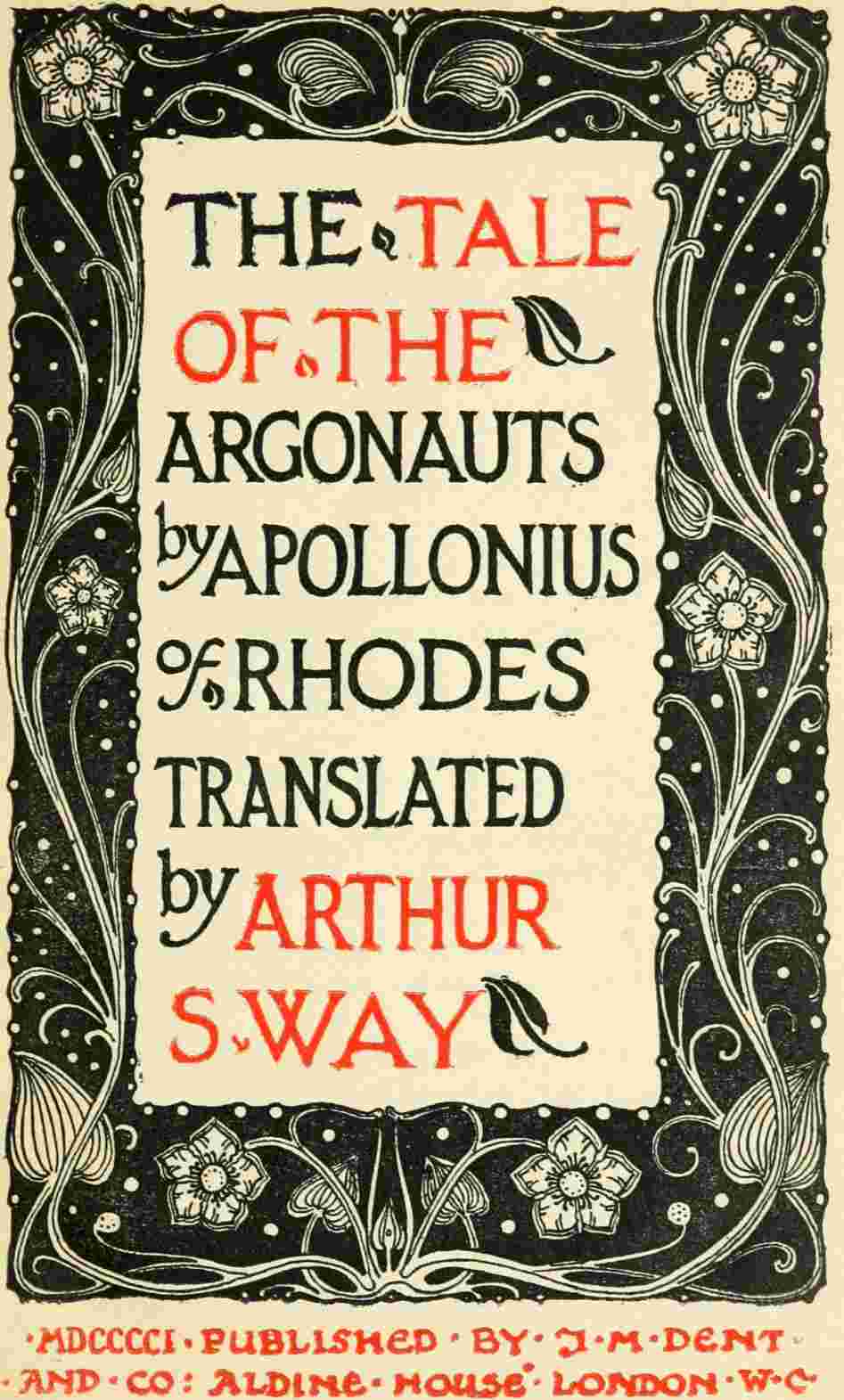
EDITOR’S NOTE
This rendering of the ‘Argonautica,’ now first published, has been translated from the original Greek by Arthur S. Way, M.A., the gifted translator of ‘Homer’s Iliad and Odyssey,’ ‘the Tragedies of Euripides,’ and ‘the Epodes of Horace.’ In the accompanying ‘Epilogue’ the translator summarises the literary history of the poem, and indicates its place in Greek literature. The earlier English versions of the poem are the verse renderings by Fawkes and Green (1780), and Preston (1803). These translations are in the style of Pope; Preston’s effort is the better; it is in three volumes, the second and third containing elaborate introductions and notes. The two poetical versions have been long out of print, and are now very rare. There is also an English prose rendering by Coleridge (Bohn, 1889).
As in the case of Chapman’s ‘Iliads,’ the Publishers have thought it well to allow the type to run into the margin, so as to avoid the turning of the lines.
The General Editor desires to thank Mr. Way for generously placing this new version of the old poem at his disposal for inclusion in the present series; he feels sure that many readers will appreciate this new-old treasure from ‘the realms of gold.’
I. G.
Shakespeare’s Day, 1901.
THE TRANSLATOR’S EPILOGUE
The historian, if asked to name the country and the period in which literary men—not popular novelists, but men whose incentive to labour is the love of literature, science, research—were in the most enviable position, would go very far back from the present time, and point to Egypt as the country, and the three centuries before Christ as the period. ‘The history of literature,’ it has been said, ‘is hardly anything but a martyrology, as though there were a conspiracy of ingratitude among men:’ but the respect, honour and support accorded to literary genius under the Ptolemies form a striking contrast to its fate in other lands and epochs.
When, on the death of Alexander the Great, in 323 B.C., his vast empire was divided amongst his generals, one of them, Ptolemy Soter, became king of Egypt. Once established in his kingdom, he soon proved that he was very much more than a mere soldier. He was a man of brains, with a taste for literature, and a love for those who pursued it. His successors were worthy of him: the Ptolemies created an era in the history of literature; they made learning the fashion, and scholars, poets and men of science honourable.
Ptolemy I. (Soter) built at Alexandria a magnificent palace of learning, the Museum. This ‘Temple of the Muses’ was such in a very literal sense, and so was very much more than a museum in the restricted sense now commonly understood. It was a Residential Royal Academy of Literature, the Resident Fellows of which were literary men. The first great annexe to the Museum was a Library, which the king spared no expense to make complete, and thus he attracted scholars from all Greek-speaking countries. His successor further enlarged the library, and added galleries of pictures and statues, and commenced a natural history museum. So it went on: Ptolemy after Ptolemy added to the completeness and magnificence of the now world-famous library, and amassed wealth of art-treasures and curiosities from all parts of the world. The foundation was richly endowed, so that the poets, scholars and scientists who dwelt there lived without a care, in sheltered comfort (Timon the Phliasian satirically called it ‘the coop’), with every advantage for the prosecution of their labours, and (after the days of Ptolemy V. 204-181 B.C.) the prospect of a pension. There was a hall where they all dined, the king himself being sometimes of the company. Through generation after generation this institution was the hobby of the kings of Egypt, some of whom were themselves proud to be of the brotherhood of authors, and who vied with each other in fostering genius, talent and plodding industry, with a splendour, lavishness and zeal unapproached in any other age or country. It was Ptolemy II. (Philadelphus) under whose auspices was produced the great translation of the Hebrew Bible into Greek, known as the Septuagint, from which the authors of the New Testament quote. When Egypt passed under the dominion of Rome, the Museum and its endowments did not suffer. Livy speaks of it as a noble monument of the wealth of the Egyptian kings; and Ammianus Marcellinus says that till the time of Aurelian (A.D. 270-275), the Museum ‘continued to be the habitation of scholars.’ The College, or Royal Society of Literature, so nobly housed, was under the government of a President, nominated first by the Ptolemies, afterwards by the Roman Emperors.
Of course, patronage cannot create genius, though it can provide conditions favourable to its development; and but few men of genius appeared during this long period of the establishment and endowment of literature. But the general level of culture was raised, and the amount of literary work done was immense. A great deal of learned labour was expended upon the interpretation of Homer. ‘It may indeed be said,’ remarks Prof. Mahaffy, ‘that all philology among the Greeks, all textual and grammatical criticism, arose from the desire to purify and to understand the text of Homer, and then of other old poets.’ At the same time, however, while nothing was more meritorious than the rôle of the commentator on Homer, nothing was less so than any attempt to imitate him, or to revive, in any shape or form, epic poetry. It was settled as an axiom beyond controversy that the age of great sustained poems was past, that the age of literary gem-work, of perfect finish in minute details, ‘of art for art’s sake,’ had come to stay. So poets were to restrict themselves to ‘short swallow-flights of song,’ fables, hymns to various deities and sacred places, elegies, epigrams, the one thing needful being that every line should be a model of polished brilliance, and that each poem should be a mine of learned allusion. Of this literary faith and practice the great champion and exponent was Callimachus.[1] He was, in the days of Ptolemy Philadelphus (285-247 B.C.), President of the Museum, and, in Prof. Murray’s words, ‘was perhaps the most influential personality in literature between Plato and Cicero.’ Philologist, archaeologist, historian, dramatist, poet, critic—there was scarcely a department of literature in which he did not, in the view of his contemporaries, excel; and his industry was enormous. As an example of the scale on which he worked, it is sufficient to mention just one of his many productions—an Encyclopædia of Literature, biographical, bibliographical and critical, in one hundred and twenty books. The prestige of his official position, coupled with his exact interpretation of the demands and capacities of his age, made him the autocrat of letters. He carved with incisive criticism, and lashed with merciless ridicule, the Thebaid, an epic written by Antimachus of Colophon in imitation of Homer, a work which the Emperor Hadrian, long afterwards, pronounced superior to Homer’s—from which fact we learn more perhaps of Hadrian than of the Thebaid. We can faintly imagine, then, with what scornful indignation Callimachus heard that a pupil of his own, a young inmate of the Museum, who owed all his literary culture to its head, had revolted from the cardinal principles of the one literary faith, had actually written an epic!
Apollonius, son of Illeus (or Silleus), born, about 270 B.C., at Naucratis (or, according to other accounts, at Alexandria), was kindled by his studies in Homer to attempt a theme never yet worthily sung—the story of the Quest of the Golden Fleece by heroes who were the fathers of those whose exploits Homer sang. He can hardly have been ignorant of his master’s views on the subject of modern epics; but he may well have felt some confidence that he could do that which would prove them wrong, and may have given Callimachus credit for magnanimity enough to confess himself mistaken when confronted with the actual achievement of that which he had pronounced impossible.
He completed his task, and gave a public reading of his epic, probably in the lecture-hall of the Museum. Its reception was a bitter disappointment for him. The audience took its cue from the all-powerful President; and before the storm of impatient interruptions, angry disapproval and contemptuous laughter the poor lad—he was not twenty—broke down, ‘flushing crimson with mortification,’ as the old Greek biographer graphically records. He recognised only too clearly who had taken the lead in crushing him, and tried to retaliate in satirical verse and stinging epigram. But it is given to few to be as effective with this weapon as Dryden or Byron, and Apollonius found that his enemy’s artillery, discharged as it was from the vantage-ground of social influence and official authority, overmatched his own. Callimachus was not ashamed to put forth all his strength against his young and friendless opponent; and his bitter satire, The Ibis,[2] seems to have displayed no little ability and power of invective. It long survived the occasion for which it was written, and must have been, in its kind, of some merit, since, personal and local though it was, its celebrity lasted till the Augustan age of Rome. Ovid took it as his model in his satirical poem of the same name.
The young poet found literary life in Alexandria made impossible for him, and (invited perhaps by sympathisers) he sailed thence to Rhodes. He there produced a revised version of his epic, and was comforted by the applause with which the Rhodians received it. Honoured by all, and presented with the freedom of the city, he gratefully took for his country the land where he was appreciated, and was proud to be known as ‘Apollonius of Rhodes.’ He lived there many years, a renowned poet, and a popular professor of rhetoric. Meanwhile at Alexandria his old enemy died: the old literary cliques were no more: the fame of the prophet who had been without honour in his own country had recrossed the sea: men longed to atone for the neglect which was a discredit to themselves; and Apollonius was given to understand that a warm welcome was prepared for him in the land of his birth. The temptation to triumph on the scene of his humiliation was irresistible. He returned to Egypt: he read his poem to enthusiastic audiences: the opportune death of Eratosthenes, who had succeeded Callimachus as President and Chief Librarian, created a vacancy for which Apollonius was acclaimed the only possible successor. So, installed as the head of the culture and learning of the Greek world, he lived days of peaceful industry and satisfied ambition, till, full of years and honours, he passed away, and, as though to symbolise forgiveness and oblivion of old feuds, was buried beside his old master, Callimachus.
Like all the Alexandrian scholars, he was busy with his pen to the last. His most important works, besides the ‘Tale of the Argonauts,’ were the ‘Foundations,’ poems embodying the stories or legends of the origin or foundation of famous cities, such as Rhodes, Cnidus, Alexandria. But of them all only nine and a half lines survive, and it is on the Argonautica that his fame must rest. The poem is, like the epics of Vergil, Tasso, Tennyson, the work of a student, and not, like those of Homer, the work of a man who had been a part of the life he described. Apollonius connected the Argonauts with all the legends or myths belonging to the places they might be supposed to have visited, gathering materials for this part of his work from the rich libraries in which he wrote. Hence we find traces of his having more matter than he quite knew what to do with; and his digressions on the origins of cities, names, rites, and so forth, are occasionally such as the average reader will skip. Still, all together, they do not occupy proportionally as much space as the similarly little-read Catalogue of the Ships in the Iliad.
There can be no doubt that the Argonautica was for the ancients the one great epic between Homer and Vergil. Even contemporaries wrote commentaries on it. It was popular among the Romans. P. T. Varro earned fame by his translation of it, and Val. Flaccus wrote a Latin Argonautica, which was but a free translation of the Greek original. But his noblest eulogy will be found in the pages of Vergil, who drew no small part of his inspiration from him, transferring to his Æneid at least a score of episodes, similes, or picturesque touches.
On the other hand, Apollonius is very far from being an imitator of Homer. He is, indeed, considering the atmosphere in which his genius was trained, amazingly original; and it is not the least proof of his genius that he recognised that his strength lay in the very things which were either neglected, or lightly touched on, by Homer. The elaborate picturesqueness and unfailing verve with which he describes the coasting voyages, the weird desolation of the Libyan sands, the gauntlet-fight, the battle with the giants, the passage of the Clashing Crags, and that of the Wandering Rocks, the ploughing with the brazen bulls, and many other such incidents, are examples of work of which Homer gives but slight and occasional examples: while the great and crowning achievement of the poem, the story of Medea’s passion, with its fierce fervour, its thrilling pathos, its lovely tenderness and virginal purity, its strangely modern introspectiveness and analysis of motives, is absolutely without parallel, not in Homer alone, but in any Greek poet whose works have come down to us. Even Vergil, with all his human sympathy, with all the advantage of having such a model before him, cannot rise to the same height: the love of Dido is a pale reflex of that of Medea. It is curious, too, to note that, even in the minor matter of similes, Apollonius remains original. In only one (Bk. II. 541-548, where he somewhat expands Homer’s thought) can he be charged with imitation.
The argument has been well summed up by Prof. R. Ellis:—‘For Apollonius the problem was how to write an epic which should be modelled on the Homeric epics, yet be so completely different as to suggest, not resemblance, but contrast. We think no one who has read even a hundred lines of the poem can fail to be struck by this. It is in fact the reason why it is a success. The Argonautica could not have been written without the Iliad and Odyssey, but it is in no sense an echo of either. Nay, we believe that a minute examination of Apollonius’ language and rhythm would show that he placed himself under the most rigid laws of intentional dissimilarity. Not that this is more than one element of his success. His genius is quite as real an element; and no one will deny this who has studied the successive phases of Medea’s passion in Book III. If, indeed, greatness could be tested by the extent of influence after death, the poem of Apollonius can rank only with the best works of Greek literature.’