
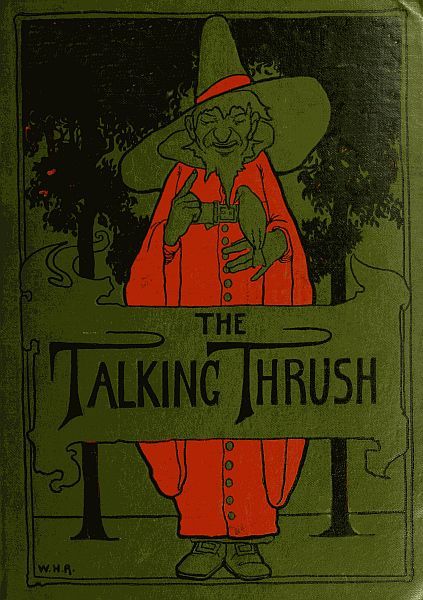
The Project Gutenberg eBook of The Talking Thrush, and Other Tales from India
Title: The Talking Thrush, and Other Tales from India
Author: William Crooke
W. H. D. Rouse
Illustrator: W. Heath Robinson
Release date: December 9, 2009 [eBook #30635]
Language: English
Credits: Produced by Chris Curnow, Emmy and the Online Distributed
Proofreading Team at http://www.pgdp.net (This file was
produced from images generously made available by The
Internet Archive)
Transcriber's Note:
Varied accenting was retained. This hyphenation was so varied that images of the original "Notes" pages were included in the this version. You may see these images by clicking on the pages numbers.
The Talking Thrush
And Other Tales from India
The Talking Thrush
And Other Tales from India
Collected by W·CROOKE
And Retold by
W·H·DROUSE
Illustrated by W·H·Robinson.
London: J. M. Dent & Sons Ltd.
1922
| First Published | October 1899 |
| Reprinted | July 1902; October 1922 |
All rights reserved
PRINTED IN GREAT BRITAIN
Preface
The present selection is confined to the Beast Stories, which are particularly interesting as being mostly indigenous and little affected by so-called Aryan influence. Most of them are new, or have been published only in the North Indian Notes and Queries (referred to as N.I.N.Q.).
the source of each tale, and a few
obvious parallels, or references
to the literature
of the subject.
Contents
| PAGE | |
| The Talking Thrush | 1 |
| The Rabbit and the Monkey | 8 |
| The Sparrow's Revenge | 16 |
| The Judgment of the Jackal | 21 |
| How the Mouse got into his Hole | 25 |
| King Solomon and the Owl | 30 |
| The Camel's Neck | 33 |
| The Quail and the Fowler | 36 |
| The King of the Kites | 39 |
| The Jackal and the Camel | 43 |
| The Wise Old Shepherd | 47 |
| Beware of Bad Company | 53 |
| The Foolish Wolf | 55 |
| Reflected Glory | 58 |
| The Cat and the Sparrows | 61 |
| The Foolish Fish | 65 |
| The Clever Goat | 72 |
| A Crow is a Crow for Ever | 76 |
| The Grateful Goat | 81 |
| The Cunning Jackal; or, The Biter Bit | 85 |
| The Farmer's Ass | 89 |
| The Parrot Judge | 93 |
| The Frog and the Snake | 97 |
| Little Miss Mouse and her Friends | 101 |
| The Jackal that Lost his Tail | 105 |
| The Wily Tortoise | 110 |
| The King of the Mice | 112 |
| The Valiant Blackbird | 117 |
| The Goat and the Hog | 123 |
| The Parrot and the Parson | 127 |
| The Lion and the Hare | 130 |
| The Monkey's Bargains | 132 |
| The Monkey's Rebuke | 139 |
| The Bull and the Bullfinch | 145 |
| The Swan and the Crow | 150 |
| Pride shall have a Fall | 156 |
| The Kid and the Tiger | 160 |
| The Stag, the Crow, and the Jackal | 166 |
| The Monkey and the Crows | 170 |
| The Swan and the Paddy-bird | 173 |
| What is a Man? | 176 |
| The Wound and the Scar | 182 |
| The Cat and the Parrot | 186 |
| NOTES | 195 |
List of Illustrations
| "A Crow is a Crow for Ever" | Frontispiece |
| PAGE | |
| Title-page | v |
| Preface: Headpiece | vii |
| Contents: Headpiece | ix |
| " Tailpiece | xi |
| The Talking Thrush: | |
| Initial | 1 |
| The Rabbit and the Monkey: | |
| Initial | 8 |
| Man with Bamboo Pole | 9 |
| "Sit in front of that Man" | 11 |
| Tailpiece | 15 |
| The Sparrow's Revenge: | |
| "Up jumped the Boy, and out he ran" | 19 |
| The Judgment of the Jackal: | |
| Initial | 21 |
| "The Merchant was much dismayed" | 22 |
| "And away they went" | 23 |
| How the Mouse got into his Hole: | |
| Initial | 25 |
| King Solomon and the Owl: | |
| Initial | 30 |
| Tailpiece | 32 |
| The Camel's Neck: | |
| Headpiece | 33 |
| The Quail and the Fowler: | |
| Headpiece | 36 |
| Tailpiece | 38 |
| The King of the Kites: | |
| Initial | 39 |
| "The Frog turned up his flat nose" | 41 |
| The Jackal and the Camel: | |
| Tailpiece | 46 |
| The Wise Old Shepherd: | |
| Initial | 47 |
| The Fifth Shepherd | 51 |
| Tailpiece | 52 |
| Beware of Bad Company: | |
| Initial | 53 |
| The Cat and the Sparrows: | |
| Initial | 61 |
| "Just at that moment up came a Cat" | 63 |
| Tailpiece | 64 |
| The Foolish Fish: | |
| Initial | 65 |
| Tailpiece | 71 |
| The Clever Goat: | |
| Tailpiece | 75 |
| A Crow is a Crow for Ever: | |
| "And took him home to the Palace" | 77 |
| Tailpiece | 80 |
| The Grateful Goat: | |
| Initial | 81 |
| Tailpiece | 84 |
| The Cunning Jackal: | |
| Initial | 85 |
| The Farmer's Ass: | |
| "He shaved off every scrap of hair from his head" | 89 |
| "It was not easy to get their hair back again" | 92 |
| Tailpiece | 92 |
| The Parrot Judge: | |
| The Parrot in Court | 95 |
| Tailpiece | 96 |
| The Frog and the Snake: | |
| Tailpiece | 98 |
| "He saw a Frog swimming on the top of the water" | 99 |
| Little Miss Mouse and her Friends: | |
| Tailpiece | 104 |
| The Jackal that Lost his Tail: | |
| "Suddenly cut off the Jackal's tail" | 106 |
| Tailpiece | 109 |
| The Wily Tortoise: | |
| Initial | 110 |
| Tailpiece | 111 |
| The Valiant Blackbird: | |
| "He sent a Fowler to catch him" | 117 |
| Tailpiece | 122 |
| The Goat and the Hog: | |
| A Demon | 123 |
| Tailpiece | 126 |
| The Parrot and the Parson: | |
| Initial | 127 |
| Tailpiece | 129 |
| The Lion and the Hare: | |
| Initial | 130 |
| Tailpiece | 131 |
| The Monkey's Bargains: | |
| Initial | 132 |
| The Monkey's Rebuke: | |
| "Oft had this Monkey seen the Milkman pour water into the Milk-cans" | 140 |
| "Then after a while he came to a Pond" | 141 |
| Tailpiece | 144 |
| The Bull and the Bullfinch: | |
| Initial | 145 |
| Tailpiece | 149 |
| The Swan and the Crow: | |
| Initial | 150 |
| "Hm, hm," said the Judge, looking at the Crow | 153 |
| Tailpiece | 155 |
| Pride shall have a Fall: | |
| Initial | 156 |
| Tailpiece | 159 |
| The Kid and the Tiger: | |
| Initial | 160 |
| The Stag, the Crow, and the Jackal: | |
| Initial | 166 |
| Tailpiece | 169 |
| The Monkey and the Crows: | |
| "O Monkey, what a fool you must be!" | 171 |
| Tailpiece | 172 |
| The Swan and the Paddy-bird: | |
| Initial | 173 |
| Tailpiece | 175 |
| What is a Man: | |
| "He espied an Elephant" | 178 |
| "I am a Man," said the other | 180 |
| The Wound and the Scar: | |
| Initial | 182 |
| Tailpiece | 185 |
| The Cat and the Parrot: | |
| "The Cat said to the Parrot, Come, friend" | 187 |
| "An old woman happened to be near" | 191 |
| Finis | 218 |
The Talking Thrush
Now this Thrush had a clever head; so she thought something more might be done with cotton besides lining a nest. In her flights abroad she used often to pass by the door of a Cotton-carder. The Cotton-carder had a thing like a bow, made of a piece of wood, and a thong of leather tying the ends together into a curve. He used to take the cotton, and pile it in a heap; then he took the carding-bow, and twang-twang-twanged it among the heap of cotton, so that the fibres or threads of it became disentangled. Then he rolled it up into oblong balls, and sold it to other people, who made it into thread.
The Thrush often watched the Cotton-carder at work. Every day after dinner, she went to the cotton tree, and plucked out a fluff of cotton in her beak and hid it away. She went on doing this till at last she had quite a little heap of cotton all of her own. At least, it was not really her own, because she stole it; but then you cannot get policemen to take up a Thrush for stealing, and as men catch Thrushes and put them in a cage all for nothing, it is only fair the birds should have their turn.
When the heap of cotton was big enough, our Thrush flew to the house of the Cotton-carder, and sat down in front of him.
"Good day, Man," said the Thrush.
"Good day, Birdie," said the Cotton-carder. The Thrush was not a bit afraid, because she knew he was a kind man, who never caught little birds to put them in a cage. He liked better to hear them singing free in the woods.
"Man," said the Thrush, "I have a heap of beautiful cotton, and I'll tell you what. You shall have half of it, if you will card the rest and make it up into balls for me."
"That I will," said the man; "where is it?"
"If you will come with me," said the Thrush, "I'll show you."
So the Thrush flew in front, and the man followed after, and they came to the place where the hoard of cotton was hidden away. The man took the cotton home, and carded it, and made it into balls. Half of the cotton he took for his trouble, and the rest he gave back to the Thrush. He was so honest that he did not cheat even a bird, although he could easily have done so. For birds cannot count: and if you find a nest full of eggs, and take one or two, the mother-bird will never miss them; but if you take all, the bird is unhappy.
Not far away from the Carder lived a Spinner. This man used to put a ball of cotton on a stick, and then he pulled out a bit of the cotton without breaking it, and tied it to another little stick with a weight on it. Then he twisted the weight, and set it a-spinning; and as it span, he held the cotton ball in one hand, and pulled out the cotton with the other, working it between finger and thumb to keep it fine. Thus the spindle went on spinning, and the cotton went on twisting, until it was twisted into thread. That is why the man was called a Spinner. It looks very easy to do, when you can do it; but it is really very hard to do well.
To this Spinner the Thrush came, and after bidding him good day, said she—
"Mr. Spinner, I have some balls of cotton all ready to spin into thread. Will you spin one half of them into thread for me, if I give you the other half?"
"That I will," said Mr. Spinner; and away they went to find the cotton balls, Thrush first and Spinner following.
In a very few days the Spinner had spun all the cotton into the finest thread. Then he took a pair of scales, and weighed it into two equal parts (he was an honest man, too): half he kept for himself, and the other half he gave to the Thrush.
The next thing this clever Thrush did was to fly to the house of a Weaver. The Weaver used to buy thread, and fasten a number of threads to a wooden frame, called a loom, which was made of two upright posts, with another bar fastened across the top. The threads were hung to the cross-bar, and a little stone was tied to the bottom of each, to keep it steady. Then the Weaver wound some more thread around a long stick called a shuttle; and the shuttle he pushed in front of one thread and behind the next, until it had gone right across the whole of the threads, in and out. Then he pushed it back in the same way, and after a bit, the upright threads and the cross-threads were woven together and made a piece of cloth.
The Thrush flew down to the Weaver, and they made the same bargain as before. The Weaver wove all the thread into pieces of cloth, and half he kept for himself, but the other half he returned to the Thrush.
So now the Thrush had some beautiful cloth, and I dare say you wonder what she wanted it for. As you have not been inquisitive, I will tell you: she wanted clothes to dress herself. The Thrush had noticed that men and women walking about wore clothes, and being an ambitious Thrush, and eager to rise in the world, she felt it would not be proper to go about without any clothes on. So she now went to a Tailor, and said to him—
"Good Mr. Tailor, I have some pieces of very fine cloth, and I should be much obliged if you would make a part of it into clothes for me. You shall have one half of the cloth for your trouble."
The Tailor was very glad of this job, as times were slack. So he took the cloth, and at once set to work. Half of it he made into a beautiful dress for the Thrush, with a skirt and jacket, and sleeves in the latest fashion; and as there was a little cloth left over, and he was an honest Tailor, he made her also a pretty little hat to put on her head.
Then the Thrush was indeed delighted, and felt there was little more to desire in the world. She put on her skirt, and her jacket with fashionable sleeves, and the little hat, and looked at her image in a river, and was mightily pleased with herself. Now she became so vain that nothing would do, but she must show herself to the King.
So she flew and flew, and away she flew, until she came to the King's palace. Into the King's palace she flew, and into the great hall where the King sat and the Queen and all the courtiers. There was a peg high up on the wall, and the Thrush perched on this peg, and began to sing.
"Oh, look there!" cried the Queen, who was the first to see this wonderful sight—"see, a Thrush in a jacket and skirt and a pretty hat!"
Everybody looked at the Thrush singing on her peg, and clapped their hands.
"Come here, Birdie," said the King, "and show the Queen your pretty clothes."
The Thrush felt highly flattered, and flew down upon the table, and took off her jacket to show the Queen. Then she flew back to her peg, and watched to see what would happen.
The Queen turned over the jacket in her hand, and laughed. Then she folded it up, and put it in her pocket.
"Give me my jacket!" twittered the Thrush. "I shall catch cold, and besides, it is not proper for a lady to be seen without a jacket."
Then they all laughed, and the King said, "Come here, Mistress Thrush, and you shall have your jacket."
Down flew the Thrush upon the table again; but the King caught her, and held her fast.
"Let me go!" squeaked the Thrush, struggling to get free.
But the King would not let her go. I am afraid that although he was a King, he was not so honest as the Carder or the Spinner, and cared less for his word than the Weaver and the Tailor.
"Greedy King," said the Thrush, "to covet my little jacket!"
"I covet more than your jacket," said the King; "I covet you, and I am going to chop you up into little bits."
Then he began to chop her up into bits. As she was being chopped up, the Thrush said, "The King snips and cuts like a Tailor, but he is not so honest!"
When the King had finished chopping her up, he began to wash the pieces. And each piece, as he washed it, called out, "The King scours and scrubs like a washerwoman, but he is not so honest!"
Then the King put the pieces of the Thrush into a frying-pan with oil, and began to fry them. But the pieces went on calling out, "The King is like a cook, frying and sputtering, but he is not so honest!"
When she was fried, the King ate her up. From within the body of the King still the Thrush kept calling out, "I am inside the King! It is just like the inside of any other man, only not so honest!"
The King became like a walking musical-box, and he did not like it at all, but it was his own fault. Wherever he went, everybody heard the Thrush crying out from inside the King, "Just like any other man, only not so honest!" Everybody that heard this began to despise the King.
At last the King could stand it no longer. He sent for his doctor, and said, "Doctor, you must cut this talking bird out of me."
"Your majesty will die, if I do," said the Doctor.
"I shall die if you don't," answered the King, "for I cannot endure being made a fool of."