
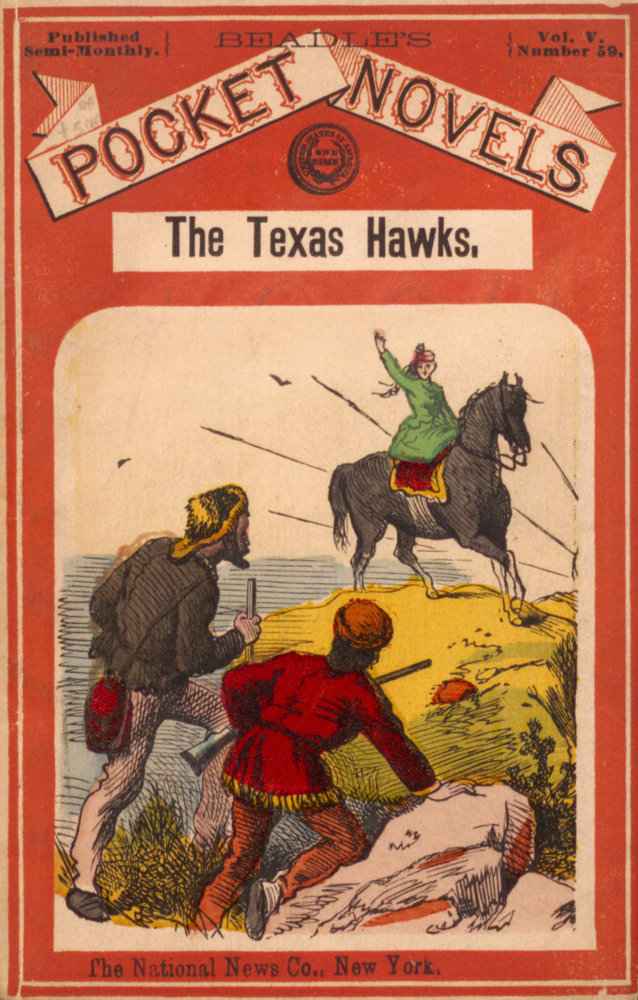
Campbell uttered a furious curse as he noted this, but then a gleam lighted up his countenance. The fugitive was heading directly for the timber point where he had lost sight of her and Fred Hawksley, a week previously.
Now, should she disappear as strangely as then, he would know that she was concealed somewhere in the baranca, and it would go hard but that he unearthed the mystery. With these thoughts, Ned urged his beast forward, at its best pace.
As the woman neared the timber point, she turned her head and glanced back over her shoulder. Campbell almost fancied that he could detect her scornful, taunting laugh as she waved a hand toward him, then bending forward, disappeared around the clump of trees.
“Now I will know—if she is gone, then I have her foul. I’ll solve the mystery of Fred’s disappearance, and that too before this day’s sun sets!” he muttered, as his spurs rankled the big horse’s sides.
In a few moments he also rounded the point of trees, and abruptly pulled up his horse, with a low cry. As he suspected, the prairie was open and untenanted. The strange rider had disappeared.
But then as he glanced downward at the tracks of the spotted mustang, Campbell saw that they turned abruptly to the right, running close to the underbrush, instead of heading for the baranca. For a moment the young hunter was disconcerted.
CHAPTER VII.
ON GUARD.
Ned Campbell sat his horse with an air of irresolution. For a moment he appeared at a loss what course to pursue.
He glanced quickly around him. The black column of smoke had disappeared. Evidently Zeb Ruel had regained the other party.
Ned was in a quandary whether to hasten to join them, to search for Fannie, or to follow up the faint clue that lay before him, which might lead to the discovery of his lost friend and almost brother, Fred Hawksley. With an effort he decided.
“It is what Fannie would wish, did she know it,” he muttered, as he shook the reins free. “There are better eyes than mine at work over yonder, and I could do no particular good. She would tell me to hunt for poor Fred.”
Campbell was following the trail of the spotted mustang, bending low in his saddle, for the ground was rapidly becoming more hard as he advanced, and the small hoofs had not cut deeply into the turf. Though keen-eyed, the young hunter soon found that he must dismount, or run the risk of losing the trail altogether.
Like a well-trained dog, the big bay horse followed him at a little distance. Step by step Ned picked up the trail, that gradually grew fainter and more indistinct.
Its course led along nearly equidistant from the motte and the baranca, yet heading so that, if maintained, the baranca would be headed. Yet Ned knew that this could not have been done, in the short time that he was hidden from view. He knew that the trail either entered the wood or else the baranca.
If the former, he must find it; if the latter, a few minutes’ delay would matter little, as the rider could not possibly leave it without his knowledge, for both ends were within his range of vision. Reasoning thus, Campbell kept on for over half a mile, more than once losing the trail, only to find it again the next moment.
But now he lost it altogether. A strip of flinty ground led from the baranca clear to the timber’s edge. At the edge of this strip, all traces ended.
One glance decided this, and then Campbell skirted the further side, until at the underbrush. He saw that a horse could not have forced a passage into the timber without leaving unmistakable traces of so doing. A grim smile lighted up his countenance. He knew now that the baranca contained his quarry.
“So much settled,” he muttered, triumphantly. “I don’t think the time is lost, for now I will have only one side to watch. Come, Miss, madam, whichever you may be. I think you will find it harder to pull the wool over my eyes now than last week. It’s you and I for it now, and the smartest brain wins.”
Signing for his horse to follow him, Campbell looked to his rifle, and glided toward the edge of the baranca. He paused upon the edge, and while closely scrutinizing much of its bottom as possible from his position, he meditated deeply.
“It’s plain,” he muttered, finally, “she took the piebald with her, else I must have seen its tracks. There are places where a horse can be concealed down there, but not many. Now shall I go down and hunt her out? No—were it only for myself, I would, and take the chances of her picking me off with that rifle of hers. But then! Fred. I won’t lose the game now by carelessness or foolishness. She must come out some time. I can stand it as long as she can. But first, for a good stand. Ha! I have it—the pile of rocks. She must be this side of that, for a goat could scarcely clamber over it. That will do. Then I’ll only have one way to look.”
Ned only hesitated for a moment, then narrowly examined the side of the baranca. As another proof that his suspicions were well founded, he soon discovered a path, narrow and steep, yet amply wide enough to permit a sure-footed horse to ascend or descend without much difficulty, leading down to the bottom of the ravine. His keen eye could detect the signs of hoofs having pressed its surface, though how recently could only be surmised.
“It leads in the right direction, too—that is, toward the pile of rocks. Somewhere near that I believe lies the secret. If so, the game’s mine.”
The young hunter had decided upon his course. Craft and cunning must be his aid now. The stakes played for were far too important to be lost by a rash or premature move.
Motioning his horse to remain stationary, Ned hastened to the timber and soon secured several small leafy branches, and a handful of dried grass. Holding these, he glided cautiously along the escarpment, his eyes closely scanning every foot of the bottom.
He neared the rocky barricade without discovering any thing that could possibly afford concealment for a horse, and then crouching down, he narrowly examined the pile. It will be remembered that he, in company with the other young hunters, had searched the opposite side of the barricade, on the night Fred Hawksley disappeared.
Campbell saw numerous crevices and small cavities, but none nearly large enough to admit the passage of a horse, yet, knowing that upon this point rested his last chance, he set about his work. First he started the big horse out, a few yards from the escarpment, beyond sight from the ravine, yet so that a single leap would carry him ready to mount. Then with strips cut from his hunting-shirt, he carefully bound the twigs and dried grass upon his head and shoulders, in such a manner that his vision was unobstructed, while concealing his form. This arranged to his satisfaction, he lay down upon the ground, with eyes riveted upon the rocky pile, his weapons ready for use.
Ned was a true hunter. More than once he had lain in wait for game almost without stirring a muscle, for half a day. And now this quality stood him in good stead; only this time his game was human.
For two hours he lay motionless, patiently watching, only shifting his gaze occasionally up the baranca, to make sure that his quarry was not escaping him in that direction. As he cautiously turned his head toward the barricade, after one of these glances, a glow of light filled his eyes, and he started convulsively.
He saw that his surmises were well founded. Before him stood the woman—the strange rider whom he firmly believed to be a decoy for some deep and subtle purpose.
Campbell could plainly distinguish her features, together with the upper portion of her form as she stood behind a bowlder, her face uplifted toward his position. Even in that brief glance he was forcibly impressed with her beauty.
He had time but for the one glance, for then the vision disappeared like magic. How, was plain. He could still see the dark niche that her form had filled, and he knew that this must be the entrance to some underground retreat that had, most probably, been washed out by the surgings of the water that frequently filled the baranca to its brim, in the rainy seasons.
His resolution was taken in a moment. He forgot his usual prudence, in the thought that the solution of his friend’s strange disappearance lay within his grasp. He did not give a thought to the danger he might be running, nor of the force he might encounter in his search for the strange woman.
“Run to earth at last!” he muttered as he looked to the caps of his revolvers. “You shall not escape me this time. I’ll know where Fred is if I have to force the words from your lips.”
Campbell critically scanned the side of the baranca beneath him. It was precipitous, and yet he did not like to lose the time for going up to the path. So lowering himself by the hands, he dropped lightly to the rocky ground beneath, accomplishing the feat in safety.
Drawing a revolver, he cautiously moved the rocky pile, his eyes riveted upon the opening in which he had beheld the strange woman. As he peered into the dark hole, for the first time a doubt as to the prudence of his course struck him, and he hesitated, in doubt whether it would not be wise to signal to his friends, knowing that the smoke column would quickly bring some of them to his side.
Better for him had he followed this plan, but with the game so close at hand, he could not bring himself to wait. Perhaps, after all, she was alone.
Forcing himself to believe this, Campbell placed a hand upon the bowlder, and lightly vaulted into the crevice. All before him seemed dark and black, and he paused for a moment to accustom his eyes to the change.
At that juncture a slight rustling sound met his ear, and quick as thought, he threw forward his left arm, at the same time raising his pistol. The action was purely instinctive, for he could see nothing, but it probably saved his life.
A crushing blow from some unseen weapon fell upon his fore-arm, hurling it helpless to his side, then all was a blank. The same blow had fallen, though with broken force, full upon his forehead, felling him senseless to the rocks.
The sight of this strange woman had set Campbell’s brain on fire, and he acted without the slightest precaution or forethought. Had he but reflected for a moment, he must have known that she had noticed him, recognizing the presence of an enemy, even through the disguising grass and twigs. What else could have caused her sudden retreat? But Ned was too greatly excited to notice this, and he suffered the consequences.
How long he remained insensible he never knew, but it must have been for some time, for, when he awoke, a scene something similar to that which met the wounded outlaw’s astonished gaze greeted his vision. The experience of the two men had been almost exactly similar. Both had narrowly escaped death at the hands of the same being—the old man, Albert Mestayer.
But Ned was more fortunate, in that he found his hurts carefully dressed. This was the first point that he noticed on returning to consciousness. The next was, that a thong or cord of some kind held his feet firmly to the rude but comfortable pallet upon which he lay.
“Father, he has awakened,” uttered a low, soft voice from close to his head, and Campbell heard a faint rustle there.
The voice thrilled through his brain like liquid music. Never before had he heard tones so sweet or melodious. In wonder at it, he forgot his hurts, his perilous situation—every thing but the voice.
A light step echoed through the rock-bound chamber, and a tall form came and stood over him, with folded arms, gazing down upon his countenance with vividly-glowing eyes. It was the man who had called himself Albert Mestayer, but Ned could not remember having ever met him before.
“You are right, Lola. Go, now. I wish to be alone with this man for a time.”
A light, graceful form glided past him and paused within range of Campbell’s vision, her eyes resting softly upon his face. A light of pity seemed to beam from their liquid depths as she uttered:
“You will not—not harm him, father?”
“Go—it is not your place to question me. You forget yourself, child,” sternly replied Mestayer, his brow contracting.
With another glance at the bewildered hunter, Lola disappeared from view. Then the eyes of the two men met fully, and Campbell read in those of the tall man a depth of hatred that for a moment chilled his blood. But then his courage returned, and he was once more himself, cool and collected.
“Well, sir, will you tell me what this treatment means, if, as I suppose, you are the one who struck me in the dark?”
“And may I ask why you were prowling round my home with drawn revolver?” retorted Mestayer.
“I was seeking for a friend, and had reason to believe that he was detained here by force,” boldly added Campbell, closely eying the old man; but the sneering smile didn’t change in the least.
“Who do you allude to?”
“Fred Hawksley. He followed your—that woman here, a week ago, and has not been seen or heard of since.”
“How do you know that he came here?”
“I was with the party that followed him and her. We saw by the trail that he came here.”
“I thought as much. Well, there is no need of keeping the truth from you, for I don’t think you will ever betray me—for a very good reason. He did come here—in much the same manner that you did. But he is not here now,” and the old man laughed diabolically.
“You did not murder him?” faltered Campbell.
“Never mind. You had far better be thinking of your own self. It may be beyond your power to do so ere long.”
“Threatened men live long. But tell me: where is Fannie Hawksley?” suddenly added the young hunter.
This random shaft told. Mestayer started and seemed confused. Campbell saw that his sudden suspicion was correct.
“How did you find—what do you know about that? But bah! I’m a fool. It’s only guess-work. You are nobody’s fool, my friend. I give you credit for that. But first—before I answer you, what is she to you that you take such an interest in her?”
“She is my promised wife.”
“Was, you mean. I am glad to see that I was not misinformed. Prepare yourself, my poor friend, for some affecting news,” he added, mockingly. “Your true love is no more. However, you have one consolation. You will not be long separated from her.”
“Bah! I know you are lying—I can see it in your eyes,” scornfully retorted the young hunter.
Mestayer started and his face flushed darkly, his eyes blazing with anger. His clenched fist uprose as if to deal a crushing blow upon the pale but undaunted face of the hunter, when a lithe form sprung forward and caught his arm. It was Lola.
“Father—think what you do! Strike a bound and helpless man—for shame!”
With an effort that seemed wondrous in a man so old, he hurled the maiden across the chamber, with a bitter curse.
For a moment Campbell thought he meant to slay her, but then with an effort, Mestayer calmed his passion, saying in a stern tone:
“Go, now, and see that you keep your station. No more eavesdropping, or it will be the worse for you. Stay—I forgot. Remain here and keep guard over this man, until I return. It is time James was going.”
Lola returned and sunk down beside the couch where lay the young hunter. His gaze followed her motions and then their eyes met; but only for a moment. Then Lola’s eyes drooped, a burning blush suffusing her rich complexion. Very different was her appearance then from what it had been when confronting James Mestayer, under somewhat similar circumstances.
In point of fact she was in greater peril at that moment than Campbell himself. The face of the handsome hunter had made a deep impression upon her heart, and for the first time in her life, Lola began to realize the meaning of the term, love.
CHAPTER VIII.
AT BAY.
When he left Ned Campbell, Albert Mestayer entered the first chamber or cell, where we a week previously to this date, found him bending over the wounded leader of the Night Hawks. Here that worthy, now recognized as a nephew of the old man, was idly lolling upon a pallet of skins, his wounds almost entirely cured.
He raised himself to a sitting posture as the old man entered, casting at him a quick, inquiring glance. Evidently the doughty leader of the Night Hawks regarded his newly-found relative with considerable respect.
“Well?” he added, as the old man approached.
“It is well, so far, but we must work to keep it so. This young fellow tracked us home, and his are not the sharpest eyes on the border. Hawksley is out with the settlers. They may find this place at any hour, and then, though I could make a good fight first, my revenge would be cut short by death. You know my reasons for acting thus, because I have told you my story. Well, the time has come for you to play your part. I need your help now, because I can not leave Lola here alone. Are you ready to keep your oath?”
“Yes. Tell me what I am to do, and I will not fail for lack of trying,” was the prompt reply.
“Good! I like to hear men answer like that. But now listen. You remember what I told you about the Kiowa chief, Chigilli?”
“Yes.”
“Well, you must go from here, to him, as speedily as possible. Tell him that the time has come when he can strike the blow. Tell him that his white father asks the aid of his strong arm. Or stay—I can do better than that. See—Chigilli gave this to me. It is his totem; this border is made from sacred wampum. Give this to him and bid him follow you. Lead him and his band here. When you come I will have all in readiness for the blow. You shall have Mary Colton—though she is one of the accursed, I spare her life, because I know that as your slave, her life will be worse than death.”
“You are complimentary,” muttered the outlaw, in a slightly bitter tone.
“I speak the truth. But let that pass. You must go now. You have not forgotten any of my instructions? You remember the rendezvous?”
“I forget nothing. But how am I to go? On your horse?”
“No. I may have use for him. But our young friend left his horse staked out upon the prairie above. Take it—that will be the easiest way to dispose of it, to keep it from telling troublesome tales. Ride out from the baranca until you strike ground that will take and hold a trail, then round the head of the ravine. After that do not spare the brute. Horse-flesh is cheap, and Chigilli will furnish you with a remount.”
“But why—”
“For this reason. If this Ned Campbell is missed—which of course will be the case—search will be made for him. His horse’s trail will be struck here. As it leads, so will they follow, and play into our hands by meeting you half-way. In that case, you know what to do. The Kiowas are eager for scalps. Let them take all they can—only tell Chigilli that he must bring me Hawksley a prisoner. You understand?”
“Yes.”
“Good. Now go and ride for life. By nightfall you can reach the rendezvous—by day-dawn you should be well on your road back here.”
But few more words were spoken, and James Mestayer left the strange retreat, and, after first cautiously scouring the surrounding prairie, dragged himself over the escarpment. After some little trouble, he secured the suspicious horse, and literally obeying the old man’s instructions, soon rounded the baranca’s head, then galloping swiftly away toward the west.
Hour after hour throughout that long day, he urged on the big horse, plying the spurs heavily and mercilessly, with only a few brief intervals for breathing his steed. Nowhere in the world are such reckless riders as in the Texan prairies, or among the cattle-districts of Kansas. Nowhere is so little regard paid to the life of a horse.
I know of one instance where a young man, naturally generous, affectionate and kind-hearted, on a two days’ trip rode three ponies until they dropped dead under the saddle. And this with no more urgent cause than that he was eager to meet with his relatives after a nine months’ sojourn herding cattle in lower Kansas. In forty hours—two days and one night—he rode three hundred and seventy-odd miles.
As the sun set, Mestayer caught sight of the hill-range in which he knew the Kiowa chief was awaiting a message from the old man, his “white father.” With bloody heel he urged on the heavily-laboring horse, though the blood-stained froth that dropped in flakes from its mouth, told plainly that the creature’s race was well-nigh run.
While yet the western sky was flecked with crimson, the end came, finding Mestayer prepared for it. Well knowing the symptoms, he was ready for the fall, and when the big bay fell forward heavily, the blood bursting from his nostrils, Mestayer alighted nimbly upon his feet, and without a second glance at the poor brute, he started forward with long, swinging strides that spoke well for his powers as a pedestrian.
The dark, broken hill-range was near, and at a glance the outlaw recognized the landmarks given him by his uncle, and he knew that his course had been shaped aright. Raising a hand to his mouth, he uttered a long-drawn, vibrating cry—the shrill view-hallo of the Kiowas. A few moments later there came to his ears a similar cry, only more perfectly modulated, and then a single horseman rode forth from a rocky defile that partially intersected the hills.
Despite his assurance that Chigilli was friendly, Mestayer twitched his revolver around more convenient to his hand, loosening it in the sheath. More than once he had experienced the treacherous nature of Indians, and the Kiowas were notorious for their proficiency in that respect.
The savage drew rein close beside the outlaw, and a brief but keen scrutiny followed, as though each was mentally measuring the other. Mestayer was somewhat surprised at the appearance of Chigilli. Naturally, one takes it for granted that a famous warrior must be an important person in looks as well as reality. Instead, the Kiowa chief was small—almost a dwarf, in fact; of slight, ill-shaped figure, old and wrinkled, with only one eye. But that burned brightly, and the numerous scars, together with the broad saber-slash that had destroyed his left eye, together with a portion of his nose, testified plainly that he had borne his part in more than one desperate affray.
“Who are you that sounds the Kiowa cry, yet wear the skin of a pale-face?” demanded Chigilli, in slightly accented English, his half-breed mother having taught him her father’s tongue.
For answer Mestayer produced the slip of wampum-enriched deer-skin, and handed it to the chief. Chigilli’s stern countenance instantly relaxed, and he henceforth treated the outlaw with the greatest deference and courtesy. Mestayer quickly made known the purport of his visit, and delivered, word for word, his uncle’s message.
Chigilli seemed a little vexed, but soon explained the cause. While waiting for the message from his white father, which was longer in coming than he had expected, his band had become separated, by far the larger portion being then in pursuit of a drove of buffaloes that had passed by on the run, the day before. Fearing to lose such an opportunity for securing a supply of meat for his lodges in winter, he had dispatched all but twenty of his men after the herd.
Mestayer was positive. There must be no delay; such as could not be avoided were they to send a runner to recall the hunters. He must return at once, whether Chigilli kept his pledge or not.
This decided the chief, and half an hour later he led the twenty warriors out from the rocky defile. Behind him, upon the broad, smooth surface of a rock, were depicted sundry rude signs and symbols, drawn with a finger-point covered with dampened powder. These were directions for the guidance of the buffalo-hunters, bidding them hasten after.
Mestayer found that he would not be able to regain the baranca retreat by daybreak, for the east was showing light streaks when there remained still a dozen or more miles to be covered. Then came an interruption, before another mile was traversed.
Events had occurred much as the old man, Albert Mestayer, had foreseen. Zeb Ruel had rejoined the other party of trail-hunters, informing them of where and how he had left Ned Campbell. In due course of time the young man was missed, searched for, and the trail found. They followed it after the outlaws had taken it up, round the baranca, and out into the prairie. As night fell they went into camp, when they were joined by others of the settlers who had turned out to take part in the hunt.
It may be as well to state here the cause of the smoke-signal having been made. Following the trail of the men on foot, the party had been considerably delayed by Hawksley’s having a fit of apoplexy, in consequence of his deep emotions. As soon as his senses returned, he urged them to lose no time, but to keep on the trail, and when his strength returned, he would follow on after them. They did so, the trail ending at last in their finding the senseless body of a white man, whom they naturally took to be the abductor of Fannie. For this reason they sent up the smoke. Noticing the signal, Hawksley managed to mount his horse and ride to the spot. His disappointment at seeing a stranger was great, and brought on another and more severe fit. While it lasted, and while the attention of all was directed toward him, the outlaw breathed his last. This was the state of affairs when Zeb Ruel came in and told his story. After some discussion, it was decided to go back and take up Ned Campbell’s trail, in hopes that, should he capture the strange rider, the mystery might be elucidated.
This party it was that now confronted the Kiowas, under guidance of the ex-captain of Night Hawks. Mestayer was by no means pleased at the meeting, for he saw that the settlers were nearly equal in numbers to the Kiowas, and he also knew that they were much better armed, each man bearing a rifle and at least one revolver, more generally two of these terrible weapons.
As the Kiowas were nominally at peace with the whites, a collision might and probably would have been avoided, only for one thing. Jack Colton was among the trail-hunters, and he recognized the would-be murderer of his brother.
With a wild cry he plunged spurs rowel-deep into his horse’s flanks and sprung forward, leveling his rifle as he did so. It cracked—one of the savages riding close behind Mestayer, uttered a shrill death-yell, and fell to the ground, dead.
That put an end to all doubt. Sounding his war-cry, Chigilli led the charge, and the next moment the two bodies were mingled together. For several minutes the conflict raged with deadly ferocity, but the superior weapons of the settlers quickly turned the tide in their favor.
Jack Colton had singled out the outlaw guide, and nothing loth, Mestayer gratified his desire, though still feeling the effects of his wounds. Their horses came violently together just as their pistols spoke for the first time.
Rearing, Colton’s horse received the bullet between its eyes and fell, hurling Colton violently to the ground, where he lay, stunned for the moment. Mestayer discharged a second shot at him, but with unsteady aim, and a slight flesh wound was the only result; then he was forced to turn his attention to other foemen.
Chigilli gave the signal to retreat, seeing that he was over-matched. The hills were near at hand, and for them their horses’ heads were turned, in full flight.
So sudden was this movement that the settlers did not comprehend its meaning until the Kiowas had gained full two-score yards the start. But then they dashed on in hot pursuit.
No man living understands better how to extract every ounce of service from a mustang than does a Kiowa, and though riding by far the most jaded horses, they slowly increased their vantage-ground, aided by the fact that the settlers devoted much of their care to pistol practice; at best but an uncertain art while riding a galloping horse.
They realized their error and strove to remedy it, but too late. The Kiowas had gained too many yards to be overtaken, and the cunning Chigilli well knew what he was about. He was rushing for a point from which his force could easily hold the settlers in check, or at least inflict fearful slaughter in case they should try a desperate charge first.
Zeb Ruel divined their purpose first, and kept the settlers from going too far. He knew a plan worth two of that, and as the Kiowas disappeared in a narrow, defile-like cleft, the settlers drew rein.
“Quick—Fenton, you an’ Morley come ’th me,” he cried, eagerly. “Rest o’ you stay here an’ keep the imps back ef they try to run out. We’ll fix ’em—hurry.”
As he spoke he turned his horse’s head to one side and dashed rapidly up to the hill’s base, here steep and rugged. Though not exactly comprehending his purpose, the two men designated by name followed him without hesitation.
Dismounting they clambered rapidly up the hill, soon gaining the top. An exultant shout broke from Ruel’s lips as he saw that he was in time. If indeed the Kiowas contemplated escape by such means, they would find their path a gantlet of death.
The defile alluded to ended in a steep hill, up which a horse could climb, though with difficulty. This once surmounted, a broad, gentle slope led down to the prairie beyond. Ruel’s position commanded this ascent, and was within easy pistol range.
“Good! we’ve got ’em in a hole, now!” he chuckled, breathing hard with fatigue. “We kin make things hot for ’em, I reckon!”
But, though he suspected it not, he was even then, in a measure, being outwitted. Chigilli had no intention of fleeing further. With his men dismounted and well covered, he felt able to beat back the settlers should they attack him, until help should arrive, and not a score seconds before Ruel reached his station, a Kiowa crossed the ridge, sent to hurry up the other band!
CHAPTER IX.
A STRANGE PROPOSAL.
The hours dragged by drearily enough with Ned Campbell, though for a part of the time he had the beautiful Lola for a guard. But after the first flush of surprise, Ned gave her little attention. His mind was filled with thoughts of his lost love, Fannie Hawksley, whom the old man, his captor, declared was dead. Though the young hunter tried to believe this a falsehood, his success was only partial. At times he would believe that Fannie was indeed dead—murdered—and in the agony of his soul he would groan aloud, almost praying for death that he might be reunited to her, in spirit if not in life.
Campbell was aroused from one of these fits of gloomy despondency by a low, taunting laugh sounding from close beside him, and hastily glancing up, he perceived that the old man had taken Lola’s position. The almost diabolical expression of triumph that rested upon his face, startled the young hunter, and he resolved to give his enemy no more such gleeful moments.
“Who are you that my misery should give you so much pleasure?” he demanded, with ill-concealed curiosity.
“I promised to tell you—and this is as good a time as any to keep my word,” slowly replied the old man, sinking down upon the rude stool that had been so recently occupied by a much more agreeable figure. “You may or you may not remember something of the matter, when I tell you that my name is Albert Mestayer.”
As he spoke, his gaze was riveted firmly upon the young man’s countenance. Though expressing curiosity, there was no change to indicate that Campbell had ever heard of the name before.
“I see you do not know—I might have known that they would never have told you. It is well. You will not be so prejudiced, and will be more likely to do me justice. Now listen well, and you will see why I hate your family and that of Hawksley.
“We three were close neighbors living then in the southern part of Illinois. Almost from childhood we had been play-mates and bosom friends. And such we might have remained to this day, only for the treachery of one—of Christopher Hawksley, the brother of Archibald.
“We three men married, but he—Chris—was single. Though living with his brother, he was quite as much at home while at your father’s house, or at mine. Indeed the gossips began to whisper that he was more so, and to point the finger of scorn at me.
“For a time I closed my ears to these rumors, but at my heart there gnawed a horrible fear that what I dreaded was but too well founded. He and she had long been intimate, and at one time were reported betrothed, but then a coldness came between them, and she accepted me. You see, young man, I am frank with you,” and Mestayer smiled bitterly. “I mean to tell you all—both for and against myself.
“I spoke to her of the rumors, but she was of a quick, passionate temper, and for the first time since marriage we had hot and angry words together. She refused to answer me, saying that I insulted her by the suspicion. While still angry, I met Christopher Hawksley and forbid him ever entering my house, or addressing my wife at any time or place where they might chance to meet.
“He seemed surprised—I thought then that he looked guilty, and I could scarcely keep my hands from his throat. But I did, and went home with a heart still more bitter and wicked.
“Three days after this, as I returned from the field somewhat earlier than usual, I saw Hawksley parting from my wife at the door. They seemed frightened and confused at my appearance, and I dare say they had cause.
“The next I remember is finding myself standing over his quivering and senseless body, my hands covered with blood, my wife crying for me to have mercy—not to stain my soul with murder. I had not killed because I had no weapons with me, I suppose. But I had beaten him almost to death with my naked fists.
“Well, the word soon spread that I had brutally murdered the man, and the excitement was great. Hawksley was one of those general favorites, half-fool, half-rogue, who spent his money with a lavish hand, making friends with everybody, while I, naturally reserved, had become morose and unsociable since these sickening rumors began to meet my ear. So you see it took very little to get up a hue and cry against me.
“Arch. Hawksley came and removed his brother. That night, though the doctors pronounced Chris. in no immediate danger, a mob, led by those who had once been my dearest friends—your father and Arch. Hawksley—came and took me from my bed, dragging me out-doors amid curses and threats, some even beating me with clubs and their fists as I was hauled helplessly along over the rough ground, half naked, only in my night-clothes.
“Well, you can guess the rest. The favorite punishment of western mobs, when they do not wish to quite murder, was given me. I was tarred and feathered! And for what? I have told you. You can judge whether I deserved it or not. And, mind you, your father and Archibald Hawksley were the leaders in the movement. By their orders the others acted. Do you wonder that I promised never to forgive them?
“After this, they set me free. Half mad I plunged into the swampy woods, where I lay until morning. By that time I had in a manner regained my coolness, and had decided upon my course of action. I knew that I had one true friend near me, and to his hut I hastened. This was a middle-aged negro. I had won him from his master half a dozen years before, on a Mississippi steamboat, playing cards. It was the planter’s last stake, and I could not refuse. When I gave Sam his choice, he elected to go with me. At the end of my trip I gave him his freedom, and he now lived on a piece of my land.
“He removed the tar, and tenderly nursed me through a long and severe illness, brought on by exposure and excitement. During all this he had kept my existence a secret, and all believed that I had thrown myself in the river to hide my shame. Sam also kept close watch upon my house, and when he considered me strong enough, he told me what he had learned.
“My wife took my death very easily, it seemed. Chris. Hawksley had been seen visiting her. That was enough. I swore then that I would have a deep and bitter revenge—that I would devote my entire life to that end.
“Sam was true to me, body and soul. What I said was law. He aided me in my scheme, by procuring me weapons, clothes and such articles as I needed. Then I watched my chance. It soon came.
“Sam brought me the word. Christopher Hawksley was at my house. I hastened there, cool and calm as I am now, though I had resolved that they both should die that night.
“I kept my oath. They were together in my wife’s room. They never left it alive. I shot him, and entered the room. The woman who had been my wife, fell upon her knees and begged for mercy, swearing that she was innocent. But I knew that she lied. I had seen too much.
“I raised my hand and struck her. She fell forward bathed in blood. I did not know that I had a knife in my hand, until I saw that.
“His death only inspired me with a ferocious joy. I gloried in my act of vengeance. But when I saw her lying there, gasping out her life, I changed. I had loved her so tenderly and true, until she fell from me. I had idolized her almost. And yet—I had killed her!”
The old man choked and paused. Campbell, pale and horror-stricken, did not speak. Then Mestayer, with an effort, resumed, his head bowed upon his hands, his voice sounding like that of one talking in a dream.
“How long I remained there I do not know, but it must have been for hours. The alarm was given by some one who had heard the shot and investigated it. The neighbors came and found me sitting there, her head upon my breast, her form clasped tight to my heart. Despite this they knew that I was the murderer. My revolver lay there, with one chamber discharged, as the blue gas around the tube showed, recently. My knife—with initials carved upon the horn handle—was beside me, covered with blood.
“They say that I acted like a madman when they tried to remove her body. But numbers prevailed, and I was bound. The next I remember I was in the county jail, tried and condemned to death. But trusty Sam didn’t fail me.
“He set me free—I have not patience now to tell all that he had to do, but he was at work for three nights before I was set free. Then, just as I mounted the horse he had brought for my use, we were discovered. Sam struck the horse a heavy blow that maddened it, and I was saved, though I tried to turn and aid him.
“Yes, he—the simple, unlearned negro—he saved me, at the cost of his own life. He was shot, but he kept the guards engaged until I was beyond their reach. Thus I lost my only friend.
“I had only one thing to live for—revenge. I swore to devote my life to that one end—and I have not yet forgotten my oath. For a time I kept in hiding, but then I set to work. You are the first one that knows for a certainty how your father died. I shot him.”
Campbell uttered a hoarse cry, and strove to arise, his eyes blazing with horror and vengeance. But the strong cords restrained his fury.
“And why—what had he done to you?”
“I have told you. Besides, I swore that I would destroy the entire race of the Hawksleys and Campbells. Boy, my wife was your father’s sister.”
Campbell listened in astonishment. Until now he had believed his father had been an only child. But there was something in the old man’s tones that told him he was speaking the truth.
“I am telling you the truth, though you seem to doubt it. But that matters little. I need only tell you a little more. After I killed your father, I had to hide again. I fled to New Orleans. While there, I met a Spanish creole and married her. Had she lived, I might have reformed, for I loved her with all my hot, fiery nature. But she died, leaving me one babe—you have seen her here—Lola.
“For a time I lived in retirement, caring only for my child, teaching her, as she grew older, to hate all mankind but her father. I succeeded, as I thought. Then I left her at school, and set forth to strike another blow. I found my enemies gone, they had removed, and I feared to inquire of those who could have told me where, lest I should be recognized.
“For years I hunted you—you and the Hawksleys. I did not find you until this spring. By chance I found this retreat, and fitted it up for use. Then I brought Lola here. You remember the excitement that she caused, as the strange rider—a better name would have been decoy, for that was her duty. I first gained her good views of those I hated—just how does not matter now.
“Her first success was in luring Fred Hawksley here. Then I stole away his sister—your betrothed, as you say. You came next. After you will come your sister Mary Colton. Then the rest of the Hawksleys. Before forty-eight hours roll by, all of those included in my vow of vengeance will be dead—dead, do you hear?” hissed Westmayer, in a low, malignant tone of voice.
“But Fannie—you have not—”
“It matters little to you whether she be dead or not. If not, she will be, soon. So will you. But I need the fresh air. I leave you to think of what I have told you, and to compose your mind for what is to come. If you sleep, pleasant dreams—ha! ha!” and laughing malignantly, the monomaniac left the chamber.
The conflicting emotions that racked Campbell’s mind on hearing this strange disclosure, can scarcely be imagined—most certainly not described. Besides clearing up the mystery that had enshrouded his father’s murder, it also revealed to him the full peril that threatened his own as well as the lives of his friends.
So deeply buried was he in thought that he did not hear the soft footfall nor the faint rustle as Lola seated herself beside him. Her large, dark eyes were filled with a gentle light foreign to her fiery, passionate nature, and her cheek glowed with the swift flow of blood.
As Campbell, aroused by that strange consciousness one feels when being fixedly gazed upon, raised his eyes, his face darkened with a frown. In a harsh tone he uttered:
“Well, I am waiting—proceed. Of course you come here to tell me some frightful story of how I have wronged you, possibly through my great-grandchildren, or something of that sort, and that you have sworn deadly vengeance against me and mine. Proceed—but for pity’s sake, cut it short.”
“You wrong me, Mr. Campbell,” and Lola’s voice sounded low and soft. “I am no enemy of yours—I would be your friend, if you would permit.”
“My friend—and his daughter?”
“I often think that I am not his daughter—that he is mad—a monomaniac, who does not know what he does or says. I overheard what he told you, for I feared that he meant to kill you, and I resolved to prevent that, if it cost my own life. It is the same story, almost word for word, that he has told me scores of times. But—whether that is true or not—I am not your enemy, since seeing you. Before, I hated you, because he taught me to do so. He made me believe that all men were evil, treacherous beings, but—I don’t think you are,” and Lola drooped her eyes before the steady gaze of the young hunter.
“What is your object in telling me this?” he asked, slowly.
“To prove to you that I am a friend, not an enemy, as you seemed to regard me.”
“Will you prove this? You can, if you wish. Will you do it?” added Campbell, with ill-suppressed eagerness.
“How can I?” softly, with a quick glance at him.
“Easily. Unloosen these cords, restore my weapons, and I will believe that you are a true, earnest friend.”
“So that you might kill my father?”
“No. I would not harm him unless he first attacked me. Then I would defend myself.”
“He would kill me!”
“With me you would be safe. I will take you to any point you wish, or, if you would rather, my mother will welcome you to her home.”
Their gaze met, but only for a moment, then the eyes of the strange girl sunk, and a low sigh fluttered her lips. The face of the young hunter, though open and earnest, had not told her the tale she wished and hoped to hear.
“You asked my father about your friends. He gave you to understand that they were dead. One of them still lives.”