
“Never mind. Don’t exult too soon. You had a brother?”
“Yes—Thomas. He died—was killed in California.”
“What was your father’s and your mother’s names?”
“James and Lucinda.”
“You had an uncle who married a sister to your mother?”
“Yes—father’s brother Albert. And you—you are the man!” eagerly cried the outlaw.
“Yes, I am Albert Mestayer, your father’s brother. In your face I saw what James was when young. That was what stayed my hand. I believed that you was my nephew, either James or Thomas, though I had not seen either for near twenty years. Then you can guess—but no, you were too young then, and I made James promise never to tell you the black story,” muttered the old man, half to himself.
The outlaw, Mestayer, as we must now call him—gazed keenly and curiously at this strangely found relation. He scarce knew what to think. Until now, he believed him dead, for that was what they—himself and brother—had been taught to think.
“Never mind. We will talk matters over after awhile, when you are stronger. If what I have heard of you is correct, you may be of service to me. But now, let me look to your hurts, and you can tell me how you received the first.”
As the old man’s nimble fingers bound up the wounds, Mestayer told the events of that night, so far as he knew them, concealing nothing. He did not fear his uncle would shrink from the crime.
CHAPTER V.
THE MAIDEN’S PERIL.
Over a week had passed by since the night on which this story opened, a week during which much had been done though little effected. Early in the day following the house-burning, a heavy shower fell that effectually obliterated all trails left by the fleeing Night Hawks and also destroyed Campbell’s hopes of discovering his lost friend with the aid of hounds.
Through that long week he had scarce rested an hour at a time, spurred on by the pleadings of Fred’s sister, Fannie Hawksley. He searched every rod of the baranca, in company with Ruel and several other of the lost man’s comrades, but without finding the slightest trace or clue. They clambered over the rocky barricade, little suspecting the secrets it concealed, or that the old man and his peerless daughter were silently laughing at them for their mole-like blindness.
Thoroughly convinced that their friend had not entered the baranca at all, the young hunters returned to the level prairie. There a surprise awaited them.
Beyond the baranca, a mile distant, they caught sight of a horse feeding upon the juicy grass. One glance sufficed. It was the big yellow horse Mott, on which Fred Hawksley had set forth in pursuit of the strange woman. The animal was alone, saddled and bridled. Nothing could be seen of his master.
The prairie around was closely scrutinized. One thing was plain; the horse had not crossed the baranca, nor been nearer to it than when found, since daylight, else the rain-moistened turf would have betrayed the fact. Following its trail, they found where it had stood for some time tied to the hanging limb of a tree, in a hollow hidden from the baranca, a mile or more distant. But nowhere could they find the imprints of human feet.
All was done that human ingenuity could devise, but at the end of the week, all was wrapt in darkness. Nothing was learned regarding the young man’s fate, nor, during that time, had any thing been heard of the strange woman rider. Both had seemingly disappeared together, without leaving any trace.
The agonized grief of the bereaved family had settled down to a more quiet, though not less acute sorrow. The everyday duties of life must be performed, though the heart be breaking.
It was nightfall when a single horseman drew rein before the dwelling of Archibald Hawksley, dismounting, and, with plump saddle-bags thrown over his arm, approached the front door with that assured freedom so characteristic of the West. There, hospitality is a matter of course. If sunset catches a traveler near a house, that, for the time being, is his home. He is welcomed, given the best the place affords, then sent on his way rejoicing. An experienced traveler never offers money in return; ’tis a poor reward for hospitality to insult a host.
The traveler in question bore evidence of having ridden many a mile, in the sand and dust that covered his garments, and his heavy horse-hide boots. There was a peculiar air about him that told a settler his occupation. Every thing, from the heavy, “black-snake” whip down, stamped him a drover.
Archibald Hawksley, a tall, stalwart man, bearing his years well, warmly greeted the stranger. Five minutes later, the drover was comfortably seated, pipe in mouth, awaiting the evening meal that Fanny was overseeing.
“Stranger in these parts, I reckon,” quoth Hawksley, also “blowing a cloud,” falling insensibly into the peculiar dialect of the parts, though a well-educated man.
“Yas—this is my fust trip this fur out, though I’ve traded over the line fer some y’ars. Met a feller in Naketosh” (Natchitoches) “last trip—fergit his name now, but reckon it don’t matter much—who told me thar was a chaince fer right smart tradin’ up this a-way; so here I be, ready fer business. I’ve got the money, you fellers hev got the spar’ horses an’ cattle, so I guess we kin come to tarms.”
A man is never so grief-stricken as to entirely neglect his personal interests, and Hawksley was soon deep in “business talk” with Mark Haley, as the trader gave his name. There was little difficulty in coming to terms, for the trader offered good prices, seeming strangely liberal, for a drover.
During supper, Fannie several times caught his gaze resting fixedly upon her face, and felt a strange, ill-defined uneasiness that she could not entirely banish. And yet this close scrutiny might well be pardoned, for the maiden was very pleasing to look upon, and the drover seemed just in the prime of life, when one’s fancy is most quickly caught by a fresh, lovely face.
Fannie Hawksley was more than ordinarily beautiful—indeed the family were noted for their good-looks, and she was the bright star of all. Under the medium hight, small and light as a fairy, her form was well developed and true-proportioned. Rich brown hair, a clear, fresh complexion, and melting hazel eyes—little wonder that Mark Haley gazed admiringly at her.
After supper was dispatched, the men stepped outside, and, with lighted pipes, continued their bartering. Haley’s eyes often wandered toward the house, seemingly admiring its structure, a two-story building being something of a novelty at that time, so far on the frontier.
That evening Ned Campbell called, as usual since Fred’s disappearance, to report progress. It was the same story of baffled search. Nothing had been learned regarding the missing man.
Mark Haley seemed deeply interested in the story, but could offer no suggestion that had not already been tried. Hawksley sunk into a troubled reverie, and then abruptly retired, first showing Haley his room.
An hour later Ned Campbell took his departure, sad and heart-sick. For several months he had been Fannie’s accepted suitor, but never until this night had she set the time for their wedding.
“Ned,” she had said, looking up into his bold, handsome face, as his arms tightly encircled her lithe, rounded form, “I can not marry until Fred returns home, or—or is found. If alive, bring him here; if dead, bring me proof, and I will be yours. In this horrible uncertainty, I can think of nothing else. It is killing mother and father. Bring him back to us, and I am yours.”
“If man can do it, Fannie, I will. But there seems little hope. Think what we have done—how we have searched. But, God helping me, I will find him. If only for your sake, I will not rest until I do. Good-by, darling. I will not come any more until I can bring you tidings, either good or bad. It only makes the work harder. Seeing your grief unnerves me. Good-by; pray for my success, and hope for the best, darling.”
“God bless you, Ned,” she answered, her bright eyes dimmed with tears. “You deserve a better girl than I am, but I will make you happy if I can.”
Campbell dared not reply in words, but their lips met in a long, clinging kiss of pure and holy love, then he tore himself away, and mounting his horse, galloped furiously away toward his own home.
Mechanically, Fannie closed and secured the door and windows, then covered up the embers in the fire-place with ashes, and taking a candle, slowly ascended the stairs to her chamber. Though she knew it not, eager eyes were fixed upon her form until the door closed behind her—eyes that burned with an evil glow—the eyes of Mark Haley, the drover.
The building was quiet and still. All seemed buried in profound slumber; but there was one pair of eyes that thought not of closing; one brain that was busy concocting a piece of diabolical treachery.
Nearly two hours passed by after Mark Haley watched Fannie Hawksley to her chamber, before he made a move. Then, with moccasins upon his feet, instead of the heavy boots, he noiselessly emerged from his room, having in one hand a small bull’s-eye lantern, the slide only partially turned. In the other he held a small patch of what looked like soiled paper or cloth, and a coil of stout string. The bushy black beard seemed one-sided, as though it was false, and had become slightly disarranged.
In the darkness, but partially dispelled by the tiny ray of light, his eyes burned and glowed with a phosphorescent luster that marks the orbs of cruel, treacherous creatures, whether human or quadruped. Pausing, he bent his ear and listened intently.
The house was still as death. Evidently the inmates were all peacefully slumbering, for a time happily forgetful of their great loss.
Haley smiled viciously, showing the white teeth through the bushy mask of hair. He chuckled, low and exultantly. Thus far, his plans had worked admirably. The settler had not suspected him for other than he seemed.
“It works like a charm—had I ordered all things, they could not have turned out better to my mind,” he muttered, as his ear was bent close to the door of Fannie’s chamber. “She sleeps—I can hear her breathing regularly. If I can only reach her before she awakes. A cry from her lips would fetch that man upon me, and I do not wish to kill him—not yet; a different death than a quick one by a bullet awaits him. A thousand times I could have done that—but my revenge is better, much better.”
These last words were hissed forth with a venom indescribable. Though he knew it not, Archibald Hawksley was entertaining his most deadly enemy.
Gently Haley lifted the simple latch, and his eyes snapped exultantly as he found the door yield to his pressure. Deeply troubled, Fannie had neglected securing it before retiring, and now she lay at the mercy of this demon in disguise.
Closing the dark-lantern, Haley stealthily entered the chamber, closing the door behind him. That would be another barrier for sound to pass through, in case Fannie should take the alarm too soon for his purpose.
The maiden still slept peacefully, breathing soft and regularly. The bed was dimly revealed by the moonlight that filtered through the window shade, and the cat-like eyes of the intruder could just discern the outlines of the maiden’s head and shoulder against the snowy pillow.
The light was sufficient for his purpose, and he gently placed the lantern upon the floor, crouching low down upon hands and knees. Thus, unless Fannie should raise up alarmed, he was hidden from her sight.
Stealthily, noiselessly, like a serpent of evil, the masked fiend crept toward the bedside, with ready implements that had been provided before entering the house. Fannie breathed on, soft and low, as he noiselessly arose and stood beside her.
A ray of moonlight fell upon her countenance, a soft luster-like halo encircled her head, a pearly tear glistened upon her cheek, but that fiend felt no pity—only a ferocious joy that he had thus far succeeded in his designs. The rich brown hair loosened from its fastenings, covered her neck and gently-heaving bosom as with a vail, while one hand seemed pressed above her heart to still its throbbings.
Only for a moment did Haley permit himself to gaze upon the picture of peaceful innocence, then he acted. One hand hovered over the maiden’s throat, while the other, holding the prepared plaster, clapped it adroitly over her mouth.
The maiden, thus rudely awakened, looked at the intruder with horror-distended eyes, but the cry she strove to utter, died away in her throat. The plaster closed her lips effectually, and the brawny hand tightly clutched her throat. Mark Haley was complete master of the situation.
“Lie still—act wisely and obey, or it will be the worse for you. I do not wish to harm you—will not unless you force me to do so. Remember this—if the house is aroused, it will be too late to save you. I will kill you first. You hear? I am not a man to idly threaten what I will not perform.”
Fannie, half strangled, asked the question with her eyes—“What do you mean to do with me?” Haley seemed to read her meaning, for he replied:
“I do not intend to harm you, at least not now. But you must go with me. Remember, at the first attempt to alarm your father, I send this knife home to your heart,” and as he hissed the words, Haley held a broad, keen blade before the maiden’s eyes. “I tell you this as a warning. You will heed it if you have any love for life. But now listen. I said you must go with me. I mean it, and the ride will be long. As the night is chilly you will need wraps. Promise me not to attempt to remove this plaster, and I will free your hands so that you can slip on your clothes. Refuse, and I take you as you are, in night-dress alone. Quick—decide. I have no time to waste. If you promise, close your eyes.”
Fannie read stern determination in her captor’s eyes, and making the best of affairs, signed her assent as indicated. Haley laughed.
“Good! I thought that would touch you. Remember—you may arouse your father, but he will only find your dead body, and I can escape through the window. Here—now put them on quickly.”
As he spoke, the villain handed Fannie her garments, and tremblingly she donned them, though the brute stood over her with uplifted knife. Haley thrust her shoes into the pockets of his great-coat.
“They would make too much noise. You can put them on when we are safe outside. But wrap a blanket round you, or you might catch cold in the night air. You see how very careful I am of your health? Like a father—ha! ha!” and again his disagreeable chuckle jarred upon her ears.
Scarcely waiting for Fannie to secure her dress, Haley seized her arms and bound them firmly with the string he had provided, then served her ankles the same way. On second thoughts, seeing how trembling and unnerved the maiden appeared, he resolved to carry her, instead of trusting her to walk out of the dwelling.
With knife clenched between his teeth, Haley picked the maiden up in his strong arms and rested her over his shoulder, her arms pinned beneath her. Then he picked up the dark-lantern and stepped out upon the landing.
All was still below, save the monotonous ticking of the clock. The settler slept on, all unconscious of this deadly blow that was being dealt him.
Opening the slide to throw a faint light before him, Haley began descending the stairs. Twice he paused and listened breathlessly as a stair creaked beneath his foot, but fortune favored him, and he gained the outer door in safety.
While he was undoing bolts and bars, Fannie moved restlessly upon his shoulder. Clutching her tightly he hissed a horrible threat in her ear. With a gasping gurgle, she resigned all hope of being rescued. She dared not give the alarm. She felt that instant death would follow, and, even in this great peril, life seemed very sweet to her.
Stepping outside, Haley gently closed the door behind him, then with a chuckle of fiendish triumph, he glided rapidly away from the house, toward the stable. Pausing outside, he deposited the maiden upon the ground, then clutched his knife firmly.
Only one obstacle now intervened between him and absolute victory, and he had strong hopes that he might avoid this. As the settler showed him the horses he wished to dispose of, Haley noticed a huge dog—an almost full-blooded mastiff—and learned that to his care was confided the stock at night. A sight rope held him to his post, but not strong enough to restrain him should an intruder approach. It was merely to keep his duty before him.
Haley, professing great love for dogs, had fondled and caressed the mastiff, with this end in view, and now hoped that he would be allowed to take his own horse without being molested. As he approached the entrance, a deep, warning growl told him that the dog was on guard. Softly whistling, though with ready knife, he stepped within. That the mastiff recognized him was plain, but he resolutely barred the way, growling deeply.
A curse gritted through Haley’s teeth, as he saw that only over the dead body of this faithful custodian could he hope to secure his horse. Bending down he caressed the dog, then, like lightning the heavy knife was brought round, sinking to the very hilt in the dog’s side. A half-stifled snarl and the huge brute leaped at the man’s throat, bearing him to the ground like a child.
In this moment Haley showed his desperate courage. Not a sound escaped his lips, though the great jaws closed upon his throat. He jerked the knife from its sheath of flesh and plunged it again and again into the quivering body.
But this was needless. The dog was already dead. His leap had been merely convulsive, and the jaws barely closed upon Haley’s throat. The teeth did not raze the skin.
Flinging the body from him, Haley arose and brushed the blood from his face, then quickly saddled and bridled his horse. Leading him forth, he once more picked up Fannie, mounting with the agility of youth.
Even now he did not forget his prudence, but rode slowly away, readjusting the bushy beard upon his face. Though late, he might meet with some person and this would aid in directing the search that he knew would follow with the morning.
“Now, my dear,” he uttered, as he carefully removed the plaster from the maiden’s lips, “I do this in pure kindness of heart, and I hope for your sake that you will not abuse my confidence. It’s not likely we will meet with any of your friends, but if we do and you should cry out, that cry will be your last. You understand?”
“Where are you taking me? Why have you done this? What have I ever done to you that you treat me so?” faltered Fannie.
“Nothing—but your father has—much. Never mind now. It will be explained to you in due time. Until then, keep still. It will be better for you,” was the brutal reply.
Fannie dared not disobey this command, and relapsed into silence. But with each passing moment her natural self-possession grew stronger, and she began to take note of the direction in which she was being taken. Haley made no attempt to prevent this. He seemed to feel that Fannie was too entirely in his power to make this knowledge dangerous to his plans.
Now that she was more herself, the maiden regretted not having given the alarm, while help was near, and inwardly resolved that should another opportunity offer, to embrace it at all hazards.
For over an hour Haley galloped steadily on, and Fannie felt her heart sink as she realized that they were now far beyond all habitations of her friends, with nothing but the vast, almost limitless prairie stretching out before them. Where was she being taken? What had fate in store for her?
Her eyes were closed, her head drooping in despair, when, with a low, fierce curse, Mark Haley suddenly drew rein. With hope thrilling her heart, Fannie eagerly raised her head and gazed around.
“Utter a whisper and I’ll murder you!” hissed the abductor, venomously.
Fannie saw the reason he had uttered this caution. Before them, blocking the very path they had been pursuing, she could just distinguish the forms of three men. Though their features were indistinct, the dress bespoke them white men.
She saw in them a last hope. The threats of Mark Haley were forgotten or disregarded. In a clear, imploring voice she cried out:
“Help—for the love of God, save me!”
With a snarling curse Haley lifted his clenched fist and drove it forcibly full between her eyes. With a convulsive shudder, Fannie’s head drooped and she lay a lifeless weight upon his arm.
“Hellow! what’s the meanin’ o’ all this, anyhow?” gruffly demanded one of the three men, stepping forward, his rifle muzzle in advance. “What ye got thar, mister?”
“None of your business. Attend to your own affairs and don’t meddle with mine,” boldly replied Haley.
“Eh? Jes’ lis’en, boys. Don’t he crow loud? Reckon you don’t know—why, hellow! Is’t you, Cap?” and the man lowered his weapon, his face expressing great surprise.
“I don’t know you—stand aside or I’ll give you cause to regret interfering with matters that don’t concern you,” snarled Haley, his revolver coming to a level.
“You will, eh? Is that the way you treat old pards, Jap Morton?” and the rifle was quickly raised to a level.
Would the man dare fire? In that dead, uncertain light, death to the maiden must almost assuredly follow.
“Curse you for a meddling rascal!” hissed Mark Haley, and his pistol spoke sharp and clear.
Like an echo the rifle responded. Then came a shrill cry—a heavy groan and dull fall; then more shots, a confused trampling—then all was still.
CHAPTER VI.
THE LOST TRAIL.
With the dawn of day, Archibald Hawksley emerged from the house, and set about his morning duties. Though he noticed the door was unbarred, he thought Fanny had forgot to secure it.
But he was not long deceived. As he entered the stable, a cry of rage and surprise burst from his lips. Before him lay the stiff and mangled body of his faithful mastiff.
One glance round the interior told him the stranger’s horse was missing, though all the others were safe. Scarcely knowing what to think, he rushed toward the house, where he was met by his wife, pale and agitated.
“Father, where is Fannie?”
Pale and stern, with blazing eyes, the settler dashed up the stairs and burst open the door of the room assigned to their late guest. It was empty. The bed had not been pressed that night. With a groan of heartfelt despair, he sunk into a chair. Though he knew not the cause of its being dealt him, he realized the full force of the blow.
“Father, where is Fannie?” repeated the pale and trembling wife, creeping to his side.
The voice and soft touch roused the stricken settler. In a moment he was himself again. With a desperate effort he regained his usual coolness, and set about the task that lay before him.
“God only knows, but I will find her. That man—that devil must have stole her. Fool that I was, to let his lying tongue so blind me! But he shall pay for it, by my hopes of heaven! I swear that I will have his heart’s blood for this!”
“Oh! Fannie—my child, my poor child!” gasped the bereaved mother, for the first time realizing the full weight of this new blow.
“Peace, Esther,” coldly added Hawksley, though the unnatural glitter in his eyes, and the feverish flush upon his face told how severe must be the effort at composure. “Weeping and wailing will do no good here. We must work. Do you go down and send the children round to the neighbors with the tidings. Bid them come here at once, ready for work. I will take his trail, and you can send them after me as they come in. I will leave plenty of signs so that they can easily overtake me. Be sure and send to Campbell’s for Ned. Go now—there is no time to lose. I must look first if he left any clue.”
Mrs. Hawksley, her terror and despair momentarily stilled by the stern and peremptory words of her husband, hastened down-stairs to dispatch the children, as directed, for assistance. Hawksley, cool and collected, began slowly searching the two chambers, in hope of finding some clue to the real object of the abductor.
This second blow, following so closely upon the disappearance of his only grown son, instead of crushing him to the earth, seemed to call forth all his energies, and to fit him for the difficult task that lay before him. Nothing was forgotten or overlooked.
He was disappointed in his search, for nothing was found that could assist him in the quest. Then descending the stairs, he bade his wife fill his saddle-bags with food, his canteen with strong coffee, while he made ready his horse. Ten minutes later he was in the saddle, renewing his instructions regarding his neighbors when they should arrive.
He rode out from the yard, and making a broad circuit, quickly struck the trail. There could be no mistaking this, for it lay plainly imprinted upon the dew-moistened ground. Dismounting, he closely examined each of the four hoof-prints, registering them indelibly upon his memory.
“I’ll not forget,” he muttered, swinging himself once more into the saddle. “Large hoofs, shod in front; a triangular chip broken from the inside edge of the off hind foot. Now it only remains to follow the trail to its end. Sooner or later we must meet, and then, Mark Haley—if that be your name—beware! As God hears me, I will kill you without mercy! And if—if harm has come to my poor child, I’ll torture you so that the most devilish red-skin would blush for shame at his ignorance!”
Bending low in the saddle, Hawksley rode on at a rapid gallop, his keen eye, sharpened by a knowledge of his child’s peril, picking up the trail unerringly. Straight as the flight of a crow, for miles, led the trace.
Hawksley’s brow darkened as he noted this. The abductor seemed striking for the broad, unsettled prairie. Could it be that he was one of those fiendish renegades who found a refuge among the Kiowas? He could think of no other solution for the abductor taking such a course.
“Never mind—’twill only be the easier to trail him, if he keeps away from the settled track. Ha! what is that?”
Checking his horse he bent down and picked up a circular patch of cloth, covered with some sticky substance. A groan broke from his lips as he divined the use it had been put to. One mystery was cleared up: that why Fannie had not given the alarm while being taken from her home.
“Curse him!” hissed Hawksley, hurling the bit of plaster away. “Curse my blindness in not seeing through his mask. Poor Fred’s fate should have taught me more caution. But never mind—my time will come.”
The settler, with flashing eyes and close-set teeth, continued his course, picking up the trail with tolerable ease for one so little versed in the art as he was. He knew, by the position of the hoof-prints—they being planted one in a place, from eight to ten feet apart—that at this point Mark Haley had been advancing rapidly, at a gallop. In trotting, there would be two hoof-prints close together, one almost obliterated by the other, or, just the same as made while in a walk, save of larger stride.
Hawksley, by this fact, could guess pretty closely at the speed maintained by the abductor, and though he knew that his own progress was much slower, still he did not despair of overtaking the man. Doubly loaded, the fugitive must pause soon, if only to rest his horse.
The sun was two hours high, when a sight met the father’s eye that caused a cold thrill to pervade his veins. For a moment he reeled in his saddle, and almost fell to the ground, but then, with pale face and starting eyeballs, he plunged spurs deep into his horse’s flanks, and dashed madly forward.
A score or more dark, slowly-circling forms were hovering over the prairie directly before him, in close proximity to where the trail must lead, unless it swerved abruptly to one side or the other. The shadowy shapes were those of vultures, buzzards, crows—those filthy yet useful scavengers of the prairies.
They told the experienced settler a significant tale. They told him that death was before him, along the trail. That they were collecting round a horrible feast that had been prepared for them.
In his agony of fear, Hawksley believed that he was about to behold the dead and mangled remains of his child. Fearing this, with mad shouts he dashed forward, brandishing his arms wildly.
The filthy birds heard him and in silence widened their circles, rising higher and higher, joined by others that rose heavily from the ground seemingly loth to quit the spot. A brace of coyotes slunk away, howling lugubriously, with drooping tail and snarling teeth.
A heart-sickening sight lay before him, as he mechanically wrenched his horse to a standstill. A groan of agonized apprehension broke from his pallid lips as he reeled rather than sprung from his saddle.
One glance was all that he could give—then he sunk to the ground, bowing his head upon his knees, shuddering convulsively, like one suddenly stricken with a chill. The horrible truth seemed plain to him—he believed that before him lay strewn the remains of Fannie, his child.
The greensward was trampled and torn, stained here and there with crimson blotches that showed where veins had been drained of their life-blood. Around were scattered white and gleaming bones, already dismembered and clean-picked by the teeth of coyotes and beaks of birds. Tattered and torn, he saw a bright, particolored patchwork quilt that he knew had covered his daughter’s bed. Further to one side was a fragment of her dress, also blood-stained.
Hawksley remained thus, bowed down in mute agony, until the quickly repeating thud of horses’ hoofs approaching in rapid gallop roused him. Then he clutched his rifle and glared around, his bloodshot eyes blazing with vengeance.
“Hold! Hawksley—don’t fire—we’re friends,” cried a loud, clear voice that he recognized through the blind passion that possessed him.
Slowly he lowered his rifle, passing a hand across his eyes, as though something obstructed his vision. He did not return the salutation, nor speak a word as the two young men rode up, but silently pointed a finger toward the ghastly relics that strewed the sward.
“My God! what is this?” gasped Ned Campbell, reeling in his saddle, shrinking back as a horrible fear struck to his heart.
Zeb Ruel—his companion—did not speak, but dismounted and slowly approached the spot. Leaning upon his rifle Hawksley closely watched his movements, a convulsive tremor agitating his frame as Ruel coolly picked up one of the gnawed and disfigured skulls, turning it about and viewing it from different sides.
With a grunt he tossed the fragment aside, then looked around for the other—as one glance was enough to decide that at least two persons had met their death at this point. His actions were vastly different here, for this skull was smaller and more delicately shaped, such as one would naturally supposed a woman’s to be.
Tremblingly the two men watched their companion. Upon him their hopes depended. He was by far the most acute and experienced of the trio, and besides was not so deeply interested as they. Hence his judgment was the more apt to be reliable.
Zeb Ruel did not touch this skull. The two watchers thought he seemed afraid to, and their hearts sunk still lower.
Whistling softly he strode slowly around the stained and trampled spot. He examined the blanket, then the fragment of Fannie’s dress. There were other pieces of cloth, evidently from garments worn by a man. Several large buttons, and the texture of the cloth proved that.
Abruptly pausing he poked at some object with the butt of his rifle. Whatever it was seemed wound round a fragment of bone. Stooping, he gingerly freed it with his fingers, then held it aloft, critically eying it.
Campbell and Hawksley both uttered little cries. They could see that it was a mass of hair, though the dust that covered it, disguised the color.
Shaking it gently, Ruel examined it closely. A long whistle, expressive of surprise, broke from his lips.
“What is it, Ruel?” faltered Hawksley.
“See! a skelp—no, by thunder! it’s a false b’ard!” was the astonished reply.
“Let me see,” and Hawksley snatched the article from Zeb’s hands. “Yes—it is his! He—Mark Haley wore this, and I—cursed fool that I am!—I thought it natural! Then it is true, as I feared—they are both dead! Fannie, my darling child—oh God!” and sinking to the ground, the stricken father burst into tears.
“Don’t bother him, Ned,” hastily muttered Ruel, as Campbell sprung from his horse. “It’ll be the savin’ o’ him—them tears. He’d go plum crazy else—an’ no wonder, nuther. First Fred, now the gal.”
“Then you think—” faltered Campbell, chokingly.
“But we don’t know,” was the hasty reply, for Ruel knew in what relation the young couple stood to each other, and dreaded the result. “An’ I never give up hope while thar’s a chance left. She may be rubbed out; I don’t say she isn’t. But why—who by? Surely the fellow wasn’t cussed fool enough to kill her an’ then hisself? You see some one must ’a’ helped—an’ that’s jest what we must look for now. You must help—you’re good on the trail—an’ it’ll keep you from gittin’ as he is. Go that way—I’ll go this. Look cluss round the aidges o’ the trampled spot. Mebbe we kin find sunkthin’ to pay us.”
Separating, the two young men crouched low down, carefully and thoroughly scrutinizing every inch of the ground for several yards beyond the edge of the torn and trampled spot. Their search was successful, for at almost the same moment, a cry announced some discovery.
“What is it, Ned?” muttered Ruel, springing to his friend’s side.
“Prints of a horse’s hoofs at full gallop. See—they toe away, and—look! See the blood-spots!”
“Sure enough—plenty, too. But now the question is—was thar anybody on him? Right here he looks as if he was runnin’ loose-like. But let that rest fer a bit, an’ come over an’ look at my find. I want your ’pinion on it. Them pesky wolves hes ’most blotted it out.”
“It’s the print of a man wearing a boot,” muttered Campbell, after a close scrutiny. “He is leaving this place—on a run. See how the toes cut in?”
“Right—but—”
“With boots on, you say?” interrupted Hawksley, who had risen unobserved.
“Yes, and large ones too.”
“Then he did not make them, for he left his boots at the house, with his empty saddle-bags.”
“Likely he took moccasins out o’ the bags, so’s to step easy,” suggested Ruel.
“Hark! some one is coming.”
“Two, rather, from the sound. Yes—see; it’s Fenton an’ Morley. Jest in time, boys,” he added, as the two men rode up to the spot. “We want you, with Hawksley here, to take an’ foller up this trail, while Ned an’ I look to t’other ’ne. Grupp the feller alive, mind ye. Whoever he is, he kin tell all what happened here last night. Think you kin foller it, Morley?”
“Ef any man kin, I kin,” quietly replied the little, weasen-featured hunter, throwing his bridle-rein to Fenton.
“If you git him, send up a smoke o’ wet grass. We’ll see it, an’ we’ll do the same if we git sure news fust.”
But little more was said. Hawksley had by this time entirely regained his composure, and, though he firmly believed that his child was dead, he resolved to bear up until he had drank deeply of revenge. He, together with Fenton and Morley, set forward upon the trail, the old hunter tracing it up with the certainty of a blood-hound.
Campbell rode his horse, leading that of Ruel, who preferred walking at present, though the trail was plain enough to be followed from the saddle. He was trying to decide whether the madly-fleeing horse was ridden, or not; a difficult task at the best, unless by long trailing.
“It’s the crittur that is hurt,” muttered Zeb, after a while, “an’ that too in the head or neck. ’Ca’se why? You see the drops o’ blood is mostly scattered in a line, an’ on some o’ them is scattered dust an’ dirt. Then ag’in, you see them on the side, cl’ar o’ the trail; see—here’s one. Now thar—thar’s two on t’other side. He does that by shaking his head. Ef he was hurt in the side, it’d be one-sided—the blood, I mean. Hold—stop!”
Campbell abruptly pulled up, and Ruel closely scrutinized the ground for a minute in silence. Then he arose and leaped into the saddle. He had decided that the horse was ridden.
“You kin see it from here,” he added, in answer to Ned’s inquiring looks. “See—it looks like the hoss had stumbled, then stopped half-way, in a heap. The ground is smooth, he didn’t stumble because he was growing fainty, for see—thar go his tracks es reg’lar es ever. Whoever rid him, was in a powerful hurry. You see he jerked the reins an’ stuck spurs in the brute so hard that it made him change his step. That’s what made the blurr thar. Onless the hoss had been ridden, thar’d jist bin one stumble, then the same clean step as afore.
“Now look well to your weepons,” he added, as he set forward at a hard gallop. “Thar’s a man ahead o’ us, an’ he was mixed up in the scenes back thar. Whoever he is we must take him; but don’t do no more’n cripple the cuss.”
“We’re not far from the river, now.”
“No. The varmint is makin’ straight for it. The fool—a hoss thet hes lost a bushel o’ blood like this ’ne hes, hain’t got no call tryin’ to cross the ford now. I only hope he won’t drownd the man, too.”
As Campbell said, they were near the river that was spoken of in our first chapter, as flowing close to the hunters’ bivouac. The ford was almost directly opposite the camp, and the trail was running in a bee-line for it.
“I knowed it—see, the tracks lead down into the water,” muttered Zeb, his keen eyes searching the further banks. “Mebbe he crossed, but I reckon he had to swim for it. Over we go—it’s the quickest way.”
The horses took willingly to the water, and though at one time they were forced to swim desperately in the raging current, their strong limbs prevailed and the two hunters were soon in safety at the other shore. Zeb Ruel leaped into the shallow water, tossing his reins to Campbell, saying: “Hold them, Ned. Mebbe I kin tell if he crossed clean over. I marked his tracks.”
But the soft mud was so deeply cut and scarred by different hoof-prints that he could not tell with certainty. Then the two men began closely scrutinizing the ground between the river and the timber.
For full half an hour they searched without success. It was evident that the horse had not crossed, and Paul was inclined to believe that the rider had been swept off into the deep water below, when, hampered by his wounded steed, his death would almost inevitably follow.
“Ha! look yonder!” cried Campbell, directing his companion’s attention over the river to a tall column of dense black smoke.
“It’s the boys—they’ve found somethin’ on the other trail. We’d better go back.”
As he uttered these words, the tall hunter suddenly paused, and bent his ear to the ground for a moment. Then rising he glided swiftly toward the arch-like opening between the two timber islands; reaching this he beckoned vehemently for Campbell to follow.
“Look yonder!” he hissed, grasping Ned’s arm with convulsive force, his other hand outstretched toward the open prairie.
“The woman—that strange rider—the one that decoyed Fred Hawksley from us!” gasped Campbell, in wonderment.
“It’s her—shure! Kin you take her? Your critter’s fresh. Ketch her an’ you kin tell whar Fred’s gone to.”
“I’ll do it or kill my horse. Stand aside, Ruel,” excitedly muttered Campbell.
“Easy—she’s comin’ closter. Look to your girth—see that it don’t fail ye now. Ef you cain’t do better, drop ’ither her or her critter. Ha! she has caught sight o’ you. Durn it! why didn’t we hide closter!”
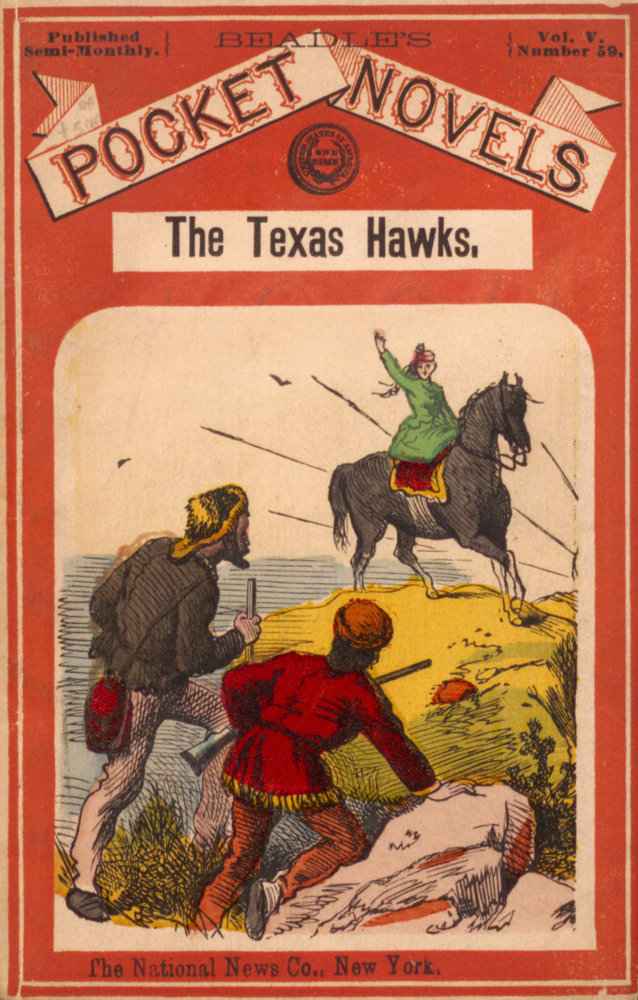
It was true. Upon a ridge scarcely a mile distant was the strange woman, riding the spotted mustang that had served her so well when Fred Hawksley was in pursuit. The sun shining clearly, had outlined the two hunters clearly against the open background, and she had evidently caught sight of them, for she drew rein, gazing in their direction with one hand shading her eyes.
As Campbell leaped upon his big bay horse, she wheeled the mustang and dashed back over the swell like an arrow. Touching his mettled horse, fairly warmed to his work by the morning’s ride, Ned sped swiftly over the rolling prairie, almost in the same tracks that he had made a week before, when pursuing the same creature. Would this chase end as disastrously? His brow darkened and his teeth gritted fiercely as he resolved to give the race a different termination.
A fierce joy filled the young ranger’s heart as the woman rider again appeared in sight, for he could see that already he had lessened the interval between them. Both animals evidently were fresh, and it was to be a test of their superiority—a war of races.
As they topped the next swell, Campbell’s face changed, He it was that was losing ground now. The spotted mustang stretched out like a grayhound, was running with the speed and evenness of an arrow’s flight. Bending forward, the strange rider seemed urging him on at top speed.
Campbell’s spurs dripped well with blood, and his voice added its persuasion, but in vain. Slowly, surely the spotted mustang was drawing away from the big horse.