
The Project Gutenberg eBook of The Three Mulla-mulgars
Title: The Three Mulla-mulgars
Author: Walter De la Mare
Illustrator: Dorothy Pulis Lathrop
Release date: May 31, 2010 [eBook #32620]
Language: English
Credits: Produced by Suzanne Shell and the Online Distributed
Proofreading Team at http://www.pgdp.net (This file was
produced from images generously made available by The
Internet Archive/American Libraries.)
CONTENTS
| Chapter I | 11 |
| Chapter II | 26 |
| Chapter III | 40 |
| Chapter IV | 51 |
| Chapter V | 62 |
| Chapter VI | 74 |
| Chapter VII | 87 |
| Chapter VIII | 97 |
| Chapter IX | 106 |
| Chapter X | 119 |
| Chapter XI | 187 |
| Chapter XII | 148 |
| Chapter XIII | 155 |
| Chapter XIV | 168 |
| Chapter XV | 179 |
| Chapter XVI | 191 |
| Chapter XVII | 200 |
| Chapter XVIII | 211 |
| Chapter XIX | 222 |
| Chapter XX | 232 |
| Chapter XXI | 241 |
| Chapter XXII | 251 |
| Chapter XIII | 261 |
THE THREE
MULLA-MULGARS
THE THREE
MULLA-MULGARS
BY
ILLUSTRATED BY
COPYRIGHT, 1919, BY
ALFRED A. KNOPF, Inc.
Published, December, 1919
Second Printing, February, 1925
PRINTED IN THE UNITED STATES OF AMERICA
ILLUSTRATIONS
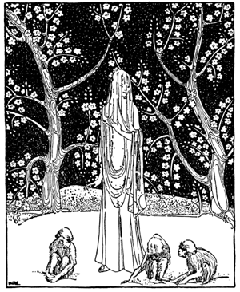
| "Oh, but if I might but hold it in my hand one moment, I think I should never even sigh again!" | Frontispiece |
| "The Queen of the Mountains is in the Forest—with fingers of frost" | 42 |
| The Wonderstone | 75 |
| Nod was never left alone | 80 |
| He jumped, he reared, he kicked, he plunged, he wriggled, he whinnied | 90 |
| Nod danced the Jaqquas' war-dance, ... stooping and crooked, "wriggle and stamp" | 129 |
| He felt a sudden darkness above his head, and a cold terror crept over his skin | 132 |
| With sticks and staves and flaring torches they turned on the fierce birds that came sweeping and swirling out of the dark | 189 |
| "What is it, brother? Why do you crouch and stare?" | 218 |
| "For there stood as if frozen in the moonlight the monstrous silver-haired Meermuts of Mulgarmeerez, guarding the enchanted orchards of Tishnar" | 224 |
| They feasted on fruits they never before had tasted nor knew to grow on earth | 232 |
| A Mulgar of a presence and a strangeness, who was without doubt of the Kingdom of Assasimmon | 274 |
THE THREE MULLA-MULGARS
CHAPTER I
On the borders of the Forest of Munza-mulgar lived once an old grey fruit-monkey of the name of Mutt-matutta. She had three sons, the eldest Thumma, the next Thimbulla, and the youngest, who was a Nizza-neela, Ummanodda. And they called each other for short, Thumb, Thimble, and Nod. The rickety, tumble-down old wooden hut in which they lived had been built 319 Munza years before by a traveller, a Portugall or Portingal, lost in the forest 22,997 leagues from home. After he was dead, there came scrambling along on his fours one peaceful evening a Mulgar (or, as we say in English, a monkey) named Zebbah. At first sight of the hut he held his head on one side awhile, and stood quite still, listening, his broad-nosed face lit up in the blaze of the setting sun. He then hobbled a little nearer, and peeped into the hut. Whereupon he hobbled away a little, but soon came back and peeped again. At last he ventured near, and, pushing back the tangle of creepers and matted grasses, groped through the door and went in. And there, in a dark corner, lay the Portingal's little heap of bones.
The hut was dry as tinder. It had in it a broken fire-stone, a kind of chest or cupboard, a table, and a stool, both rough and insect-bitten, but still strong. Zebbah sniffed and grunted, and pushed and peered about. And he found all manner of strange and precious stuff half buried in the hut—pots for Subbub; pestles and basins for Manaka-cake, etc.; three bags of great beads, clear, blue, and emerald; an old rusty musket; nine ephelantoes' tusks; a bag of Margarita stones; and many other things, besides cloth and spider-silk and dried-up fruits and fishes. He made his dwelling there, and died there. This Mulgar, Zebbah, was Mutta-matutta's great-great-great-grandfather. Dead and gone were all.
Now, one day when Mutta-matutta was young, and her father had gone into the forest for Sudd-fruit, there came limping along a most singular Mulgar towards the house. He was bent and shrunken, shivering and coughing, but he walked as men walk, his nut-shaped head bending up out of a big red jacket. His shoulder and the top of his head were worn bare by the rubbing of the bundle he carried. And behind him came stumbling along another Mulgar, his servant, with a few rags tied round his body, who could not at first speak, his tongue was so much swollen from his having bitten in the dark a poison-spider in his nuts. The name of his master was Seelem; his own name was Glint. This Seelem fell very sick. Mutta-matutta nursed him night and day, with the sourest monkey-physic. He was pulled crooked with pain and the shivers, or rain-fever. The tips of the hairs on his head had in his wanderings turned snow-white. But he bore his pain and his sickness (and his physic) without one groan of complaint.
And Glint, who fetched water and gathered sticks and nuts, and helped Mutta-matutta, told her that his master, Seelem, was a Mulla-mulgar—that is, a Mulgar of the Blood Royal—and own brother to Assasimmon, Prince of the Valleys of Tishnar.
He told her, also, that his master had wearied of Assasimmon's valley-palace, his fine food and dishes, his music of shells and strings, his countless Mulgar-slaves, beasts, and groves and gardens; and that, having chosen three servants, Jacca, Glutt, and himself, he had left his brother's valleys, to discover what lay beyond the Arakkaboa Mountains. But Jacca had perished of frost-bite on the southern slopes of the Peak of Tishnar, and Glutt had been eaten by the Minimuls.
He was very silent and gloomy, this Mulla-mulgar, Seelem, but glad to rest his bruised and weary bones in the hut. And when Mutta-matutta's father died from sleeping in the moon-mist at Sudd-ripening, Seelem untied his travelling bundle and made his home in the hut. Mutta-matutta was a lonely and rather sad Mulgar, so at this she rejoiced, for she had grown from fearing to love the royal old wanderer. And she helped him to put away all that was in his bundles into the Portingal's chest—three shirts of cotton; two red jackets, like his own, with metal hooks; a sheep's-coat, with ivory buttons and pocket-flaps; three skin shoes (for one had been lost out of his bundle in the forest); a cap of Mamasul skin (very precious); besides knives, fire-strikers, a hollow cup of ivory, magic physic-powder, two combs of Impaleena-horn, a green serpent-skin for sweetening water, etc., and, beyond and above all, the milk-white Wonderstone of Tishnar.
Here they lived, Seelem and Mutta (as he called her), in the Portingal's old hut, for thirteen years. And Mutta was happy with Seelem and her three sons, Thumb, Thimble, and Nod. They had a water-spring, honey-boxes or baskets for the bees in the Ollaconda-trees, a shed or huddle of green branches, for Glint, and a big patch of Ummuz-cane. Nod slept in a kind of hole or burrow in the roof, with a tiny peeping-hole, from which he used to scare the birds from his father's Ummuz.
Mutta wished only that Seelem was not quite so grim and broody; that the Munza-mulgars (forest-monkeys) would not come stealing her Subbub and honey; and that the Portingal's hut stood quite out of the silvery moon-mist that rose from the swamp; for she suffered (as do most fruit-monkeys) from the bones-ache. Seelem was gentle and easy in his own moody way with Mutta and his three sons, but, most of all, he cheered his heart with tiny Nod, the Nizza-neela. Sometimes all day long this old travel-worn Mulla-mulgar never uttered a sound, save at evening, when he sang or droned his evening hymn to Tishnar.[1] He kept a thick stick, which he called his Guzza, to punish his three sons when they were idle and sullen, or gluttonous, or with Munza tricks pestered their mother. And he never favoured Nod beyond the others more than all good fathers favour the youngest, the littlest, and the gaysomest of their children.
One of the first things that Nod remembered was Glint's tumbling from the great Ukka-tree, which he had climbed at ripening-time, bough up to bough from the bottom, cracking shells and eating all the way, until, forgetting how heavy he had become, he swung his fat body on to a slender and withered branch, and fell all a-topple from top to bottom on to the back of his thick skull. Beneath this same dark-leaved tree Seelem buried his servant, together with a pot of subbub, seven loaves or cakes, and a long stick of Ummuz-cane. But Mutta-matutta after his death would never touch an Ukka-nut again.
Seelem taught his sons how to make fire, what nuts and roots and fruits and grasses were wholesome for eating; what herbs and bark and pith for physic; what reeds and barks for cloth. He taught them how to take honey without being stung; how to count; how to find their way by the chief and brightest among the stars; to cut cudgels, to build leaf-huts and huddles against heat or rain. He taught them, too, the common tongue of the Forest-monkeys—that is the language of nearly all the Mulgars that live in the forests of Munza—Jacquet-mulgars, Mullabruks, purple-faced and saffron-headed Mulgars, Skeetoes, tuft-waving Manquabees, Fly-catchers and Squirrel-tails, and many more than I can mention. Seelem taught them also a little of the languages of the dreaded Gunga-mulgars, of the Collobs, and the Babbabōōmas. But the Minimul-mulgars' and the Oomgars' or man-monkeys' languages (white, black, or yellow) he could not teach, because he did not know them. When, however, they were alone together they spoke the secret language of the Mulla-mulgars dwelling north of the Arakkaboas—that is, Mulgar-royal. This language in some ways resembles that of the Portugalls, in some that of the Oggewibbies, and, here and there—but in very little—Garniereze. Seelem, of course, taught his sons, and especially Thumb, many other things besides—more, certainly, than would contain itself in a little book like this. But, above all, he taught them to walk upright, never to taste blood, and never, unless in danger or despair, to climb trees or to grow a tail.
But now, after all these thirteen years of absence from Assasimmon's palace in the beautiful Valleys of Tishnar, Seelem began to desire more and more to see again his home and his brother, with whom as a child he had walked in scarlet and Mamasul, and drunk his syrup from an ivory cup. He grew more gloomy and morose than ever, squatted alone, his eyes fixed mournfully in the air. And Mutta would whisper to Nod: "Sst, zun nizza-neela, tus-weeta zan nuome."
The more cunning of the Forest-mulgars at first had come in troops to Seelem, laden with gifts of nuts and fruits, because they were afraid of him. But he would sit in his red jacket and merely stare at them as if they were no better than flies. And at last they began in revenge to do him as much mischief as their wits could contrive, until he grew utterly weary of their scuffling and quarrelling, their thumbs and colours, fleas and tails. At last he could hear himself no longer, and one morning, in the first haze of sunrise over the sleeping forest, he called Mutta and his three sons to where he sat in the shadow of Glint's great budding Ukka-tree. And he told them he was going on a long journey—"beyond and beyond, forest and river, forest swamp and river, the mountains of Arakkaboa, leagues, leagues away"—to seek again the Valleys of Tishnar. "And I will come back," he said, leaning his hand upon the ground and blinking at Nod, "with slaves and scarlet and food-baskets and Zevveras, and bring you all there with me. But first I must go alone and find the way through dangers thick as flies, O Mulla-mulgars. Wait here and guard your old mother, Mutta-matutta, my sons, her Ummuz and ukkas. And grow strong, O tailless ones, till I return. Zu zoubé seese muglareen, een suang no nouano zupbf!" And that was all he said.
But Mutta-matutta, though she could not hide her grief at his going, helped him in every way she could to be quickly gone. He seemed beside himself, this white, old, crooked Mulla-mulgar. His eyes blazed; he went muttering; he'd throw up his hands and snuff and snuff, as if the very wind bore Tishnar on its wings. And even at night he'd rise up in the darkness and open the door and listen as if out of the immeasurable and solitudinous forests he heard voices calling him from far away. At length, in his last shirt (which had been carefully kept these thirteen years, with a dead kingfisher and a bag of civet, to keep off the cockroaches); in his finest red jacket and his cap of Mamasul-skin; with a great bundle of Manaka-cake and Ummuz-cane, knife and fire-striker and physic, and the old Portingal's rusty musket on his shoulder, he was ready to be off. In the early morning he came stooping under the little hut-door. He looked at his hut and his water-spring, at his bees and canes; he looked at his three sons, and at old Mutta-matutta, with a great frown, and trembled. And Mutta could not bear to say good-bye; she lifted her crooked hands above her old head, the tears running down her cheeks, and she went and hid herself in the hut till he was gone. But his three sons went a little way with him.
Thumb and Thimble hopped along with his heavy bundle on a stick between them to the branching of the Mulgar-track, which here runs nearly two paces wide into the gloom of Munza-mulgar; while Nod sat on Seelem's shoulder, sucking a stick of Ummuz-cane, and clutching the long, cold, rusty barrel of his musket. The trees of the forest lifted their branches in a trembling haze of heat, hung with grey thorny ropes, and vines and trailing creepers of Cullum and Samarak, vivid with leaves, and with large cuplike waxen flowers, moon-white, amber, mauve, and scarlet. Butterflies like blots and splashes of flame, wee Tominiscoes, ruby and emerald and amethyst, shimmered and spangled and sipped and hovered. And a thin, twangling, immeasurable murmur like the strings of Nōōmanossi's harp rose from the tiny millions that made their nests and mounds and burrows in the forest.
Seelem took his sons one by one by the shoulders, and looked into their eyes, and touched noses. And they lifted their hands in salutation, and watched him till he was gone from sight. But though his grey face was all wizened up with trouble and wet with tears, he never so much as once looked behind him, lest his sons should cry after him, or he turn back. So, presently, after they all three lifted their hands once more, as if his Meermut[2] might still haunt near; and then they went home to their mother.
But the rains came; he did not return. The long days strode softly by, the chatter and screams of Munza at dawn, the long-drawn, moaning shout of Mullabruk to Mullabruk as darkness deepened. Nod would sometimes venture a little way into the forest, hoping to hear the gongs that his father had told him the close-shorn slaves of Assasimmon tie with leopard-thongs about their Zevveras' necks. He would sit in the gigantic shadows of evening, watching the fireflies, and saying to himself: "Sst, Nod, see what they say—to-morrow!" But the morrow never came that brought him back his father.
Mutta-matutta cared and cooked for them. She made a great store of Manaka-cake, packed for coolness all neatly in plantain-leaves; Nano-cheese, and two or three big pots of Subbub. She kept them clean and combed; plastered and physicked them; taught them to cook, and many things else, until, as one by one they grew up, they knew all that she could teach them, except the wisdom to use what they had learnt. She would often, too, in the first hush of night, tell them stories of their father, and of her own father, back even to Zebbah, and the Portingal dangling with his bunch of wild-cats' tails in the corner.
But as the years wasted away, she grew thin and mournful, and fell ill of pining and grief and age, and even had at last to keep to her bed of moss and cotton in the hut.
Her sons worked hard for her, pushing into the forest and across the narrow swamp in search of fruits to tempt her appetite. Nod heaped up fresh leaves for her bed, and sang in his shrill, quavering voice every evening Tishnar's hymn to his poor old mother. He baked her sweet potatoes and Nanoes wrapped in leaves, and would dance round, "wriggle and stamp—wriggle and stamp," as Seelem had told him dance the Oomgar-nuggas, to try to make her cheerful. But by-and-by she began to languish, her teeth chattering, her eyes burning, unable to eat.... And one still afternoon, when only Nod was near (his brothers, tired of the heat and buzzing in the green hut, having gone to gather nuts and sticks in the forest), as Mutta-matutta sat dozing and muttering in her corner, came the voice of Tishnar, calling in the hush of evening: and she knew she must die.
Nod crept close to her, thinking at first the strange voice singing was the sound of Seelem's Zevveras' distant gongs, and he held the hard thin hand between his. When Thumb and Thimble returned with their bags and faggots of smoulder-wood, she called them all three, and told them she too must go away now, perhaps even, if only in Meermut, to find their father. And she besought them to be always true and faithful one to another, and to be brave. "Five fingers serve one hand, my good men," she said. "And oh, remember this always: that you are all three Mulla-mulgars, sons of Seelem, whose home is far from here—Mulla-mulgars who never do walk flambo—that is, on all fours—never taste blood, and never, unless in danger and despair, climb trees or grow a tail."
It was hot and gloomy in the tangled little hut, lit only by the violet of the dying afterglow. And when she had rested a little while to recover her breath, she told them that Seelem, the night before he left them, had said that, should he perish on his journey and not return, in seven Munza years they were, as best they could, bravely to follow after him. In time they would perhaps reach the Valleys of Tishnar, and their uncle, Prince Assasimmon, would welcome them.
"His country lies beyond and beyond," she said, "forest and river, forest, swamp and river, the Mountains of Arakkaboa—leagues, leagues away."
And, as she paused, a feeble wind sighed through the open window, stirring the dangling bones of the Portingal, so that, with their faint clicking, they too, seemed to echo, "leagues, leagues away."
"It will be a long and dreary journey, my sons. But the Prince Assasimmon, Mulla-mulla of the Mulgars, is great and powerful, and has for hut a palace of ivory and Azmamogreel, with scarlet and Mamasul, slaves and peacocks, and beasts uncountable; and leagues of Ukka and Barbary-nuts; and boundless fields of Ummuz, and orchards of fruit, and bowers of flowers and pleasure. And his, too, is the Rose of all the Mulgars." And as he listened Thimble shuffled from foot to foot, his heart uneasy, to hear her cry so hollowly the beauty of that Rose. And at her bidding, out of the cupboard they took the civeted bundles of all the stuff and little Mulgar treasures she had been hoarding up all these years for them against this last day.
She gave Thumb and Thimble each a red Oomgar's jacket with curved metal hooks, and to Nod the little coat of mountain-sheep's wool, with its nine ivory buttons. She divided and shared everything between them—their father's knives and cudgels, the beads blue and emerald, the Margarita stones. The Portingal's rusty hatchet, burned with a cross on its stock, she gave to Thumb; a little fat black greasy book of sorcery, made of Exxswixxia leaves, to Thimble; and to Nod, last of all, picking it out of the stitched serpent-skin lining of her great wool cap, she gave the Wonderstone.
"I give this to Nod," she said to his brothers, "because he is a Nizza-neela, and has magic in him. Come close, my sons, Thumb and Thimble, and see. His winking [or left][3] eye has green within the hazel; his thumbs grow lean and long; he still keeps two milk-teeth; and bears the Nizza-neela tuft betwixt his ears." With her hot skinny fingers she stroked softly back his hair, and showed his brothers the little velvety patch, or tuft, or badge, or crest, on the top of his head, above the parting. "O Mulla-mulgars, how I begged your father to take this Wonderstone with him on his journey! but he would not. He said, 'Keep it, and let my sons, if need be, carry it after me to the kingdom of my brother. He will know by this one thing that they are indeed my sons, Mulla-mulgars, Princes of Tishnar, sibbetha eena manga Môh!'"
"Never, little Nod," said his old dying mother—"never lose, nor give away, nor sport with, nor even lend this Wonderstone; and if in your long journey you are in danger of the Third Sleep,[4] or lost, or in great fear, spit with your spittle on the stone, and rub softly three times with your left thumb, Samaweeza: Tishnar will hear you; help will come."
Then, with her small, clumsy fingers, she tied up the sleeping milk-white Wonderstone in the hem of his woolly sheep's coat, and lay back in her bed, too feeble to speak again. Thumb, Thimble, and Nod sat all three, each with his little heap of house-stuff before him, which it seemed hateful now to have, staring through the doorway. In the purple gloom the fireflies were mazily flickering. Night was still, like a simmering pot, with heat. And out of the swamp they heard the Ooboë calling to its mate, singing marvellous sweet and clear in the darkness above its woven nest; while over their heads the tiny Nikka-nakkas, or mouse-owls, sat purring in the thatch. And Nod said: "Listen, Mutta, listen; how the Ooboë's telling secrets!" And she smiled with tight-shut lids, wagging her wizened head.
And in the deepest dead of night, when Thimble sat sleeping, his long arms thrown out over the Portingal's rough table, and Thumb crouching at the door, Nod heard in the silence a very faint sigh. He crept to his mother's bed. She softly raised her hand to him, and her eyes closed.
So her three sons dug her a deep grave beside Glint's, under the Ukka-tree, as she had bidden them. And many of the Forest-mulgars, specially those of her own kind and kindred, came down solemnly out of the forest towards evening of that day, and keened or droned for Mutta-matutta, squatting together at some little distance from the Portingal's hut. Beyond their counting (though that is not a hard matter) was the number of the years she and her father and her father's father, back even to Zebbah, had lived in the hut. But they did not come near, because they feared the Portingal's yellow bones hung up in the corner.
FOOTNOTES:
[1] Tishnar is a very ancient word in Munza, and means that which cannot be thought about in words, or told, or expressed. So all the wonderful, secret, and quiet world beyond the Mulgars' lives is Tishnar—wind and stars, too, the sea and the endless unknown. But here it is only the Beautiful One of the Mountains that is meant. So beautiful is she that a Mulgar who dreams even of one of her Maidens, and wakes still in the presence of his dream, can no longer be happy in the company of his kind. He hides himself away in some old hole or rocky fastness, lightless, matted, and uncombed, and so thins and pines, or becomes a Wanderer or Môh-mulgar. But it is rare for this to be, for very few Mulgars dream beyond the mere forest, as it were; and fewer still keep the memories of their dreams when the livelong vision of Munza returns to their waking eyes. The Valleys of Tishnar lie on either flank of the Mountains of Arakkaboa, though she herself wanders only in the stillness of the mountain snows. She is shown veiled on the rude pots of Assasimmon and in Mulgar scratch-work, with one slim-fingered hand clasping her robe of palest purple, her head bent a little, as if hearkening to her thoughts; and she is shod with sandals of silver. Of these things the wandering Oomgar-nuggas, or black men, tell. From Tishnar, too, comes the Last Sleep—the sleep of all the World. The last sleep just of their own life only is N[=o=o]manossi—darkness, change, and the unreturning. And Immanâla is she who preys across these shadows, in this valley. So, too, the Mulgars say, "N[=o=o]ma, N[=o=o]ma," when they mean shadow, as "In the sun paces a leopard's N[=o=o]ma at her side." Meermut, which means in part also shadow, is the shadow, as it were, of lesser light lost in Tishnar's radiance, just as moonlight may cast a shadow of a pine-tree across a smouldering fire. There is, too, a faint wind that breathes in the first twilight and starshine of Munza called the Wind of Tishnar. It was, I think, the faint murmur of this wind that echoed in the ear of Mutta-matutta as she lay dying, for in dying one hears, it is said, what in life would carry no more tidings to the mind than light brings to the hand. Nod's bells that he heard, and thought were his father's, must have been the Zevveras' bells of Tishnar's Water-middens, all wandering Meermuts. These Water-middens, or Water-maidens, are like the beauty of the moonlight. The countless voices of fountain, torrent, and cataract are theirs. They, with other of Tishnar's Maidens, come riding on their belled Zevveras, and a strange silence falls where their little invisible horses are tethered; while, perhaps, the Maidens sit feasting in a dell, grey with moonbeams and ghostly flowers. Even the sullen Mullabruk learns somehow of their presence, and turns aside on his fours from the silvery mist of their glades and green alleys, just as in the same wise a cold air seems to curdle his skin when some haunting N[=o=o]ma passes by. All the inward shadows of the creatures of Munza-mulgar are N[=o=o]manossi's; all their phantoms, spirits, or Meermuts are Tishnar's. And so there is a never-ending changeableness and strife in their short lives. The leopard (or Roses, as they call her, for the beauty of her clear black spots) is Meermut to her cubs, N[=o=o]ma to the dodging Skeetoes she lies in wait for, stretched along a bough. Her beauty is Tishnar's; the savagery of her claws is Nōōmanossi's. So Munza's children are dark or bright, lovely or estranging, according as Meermut or Nōōma prevails in their natures. And thus, too, they choose the habitation of their bodies. Yet because dark is but day gone, and cruelty unkindness, therefore even the heart-shattering Nōōmanossi, even Immanâla herself, is only absent Tishnar. But there, as everyone can see, I am only chattering about what I cannot understand.
[2] "Meermut" is shadow, phantom, spectre, or even the pictured remembrance of anything in the mind.
[3] On the right or cudgel side, the Mulgars say, sits Bravery; on the winking, woman, or left side, Craft.
[4] First Sleep is night-sleep; Second Sleep is swoon-sleep; Third Sleep is death, or Nōōmanossi. So, too, the Mulgars say, the first is "Little-go," the second is "Great-go," and the third is "Come-no-more"; as if their bodies were a lodging, and sleep a kind of out-of-doors.
CHAPTER II
At first the three brothers lived so forlorn and solitary together they could scarcely eat. Everything they saw or handled told them only over and over again that their mother was dead. But there was work to be done, and brave hearts must take courage, else sorrow and trouble would be nothing but evil. This, too, was no time for sitting idle and doleful. For a little before the gathering of the rains there began to seem a strangeness in the air. After the great heat had flown up a tempest of wind and lightning of such a brightness that Nod, peering out of his little tangled window-hole, could see beneath the gleaming rods of rain and the huge, bowed, groaning trees no less than three leopards crouching for shelter beneath the Portingal's sturdy little hut. He could hear them, too, in the pauses of the tempest, mewling, spitting, and swearing, and the lash of their angry tails against the wall of the hut. After the tempest, it fell cold and very still, with sometimes a moaning in the air. Strange weather was in the sky at rise and set of sun. And the three brothers, looking out, and seeing the numberless flights of birds winging with cries all in one direction, and hearing this moaning, hardly knew what to be doing. They went out every day to gather great bundles of wood and as many nuts and fruits and roots as they could carry. And they found everywhere wise creatures doing the same—I mean, of course, collecting food—for none beside the Minimuls, the Gungas, and the Mulla-mulgars have fire-sticks, and most of them fear even the sight and smell of flames.
And Nod, having his mother's quick hand, made a great store of Manaka-cake and Sudd-bread. He dried some fruits, pulped others. And some he poured with honey or Ummuz-juice into the Portingal's little earthen pots, many of which were still unbroken, while he who had first used them was but a bony shadow-trap in the corner. And Nod and Thumb made two great gourds of Subbub, very sweet and potent, so that, because of the sweet smell of it, the four-clawed Weddervols came barking about their hut all night. But the Manga-cheese their mother had made melted in the heat of the great fires they burned, and most of it ran down out of the cupboard. They filled the wood-hole with firewood, and stacked it outside, above Nod's shoulder, all against the hut.
And it was about the nineteenth week after Mutta's death that Thumb, as he came stooping to the door one night, saw fires of Tishnar on the ground. Over the swamp stood a shaving of moon, clear as a bow of silver. And all about, on every twig, on every thorn, and leaf, and pebble; all along the nine-foot grasses, on every cushion and touch of bark, even on the walls of their hut, lay this spangling fiery meal of Tishnar—frost. He called his brothers. Their breath stood round them like smoke. They stared and snuffed, they coughed in the cold air. Never, since birds wore feathers—never had hoar-frost glittered on Munza-mulgar before.
These Mullas danced; they crouched down in the dreadful cold, thinking to warm their hands at these uncountable fires. And, lo and behold! in a little while, looking at one another, each was a Mulgar, white and sparkling too. Their very hairs, down-arm and up-arm, every tuft stood stiff and white with frost. Like millers they stood, all blazing in the night.
And that was the beginning of Witzaweelwūlla (the White Winter). For it was only three days after Tishnar's fires were kindled that Nod first saw snow. Now one, two, three, a scatter of flakes, just a few. "Feathers," thought Nod.
But faster, faster; twirling, rustling, hovering. "Butterflies," thought Nod.
And then it seemed the sky, the air, was all aflock. He ran out snuffing and frightened. He clapped his hands; he leapt and frisked and shouted. And there, coming up out of the swamp, were his brothers, laden with rushes, and as woolly with snow as sheep. Because it looked so white and crisp and beautiful Nod even brought out a pot and filled it with snow to cook for their supper. But there, when he lifted the lid, was only a little steaming water.
By-and-by they began to wonder and to fear no more. How glad they were of all the wood they had brought in, and of their great cupboardful of victuals! They made themselves long poles, and would go leaping about to keep themselves warm. They built such roaring fires on the hearth they squatted round that the sparks flew up like fireflies under the black, starry sky. Snug in their hut, the brothers would sit of an evening on their three stools, with their smoking bowls between their legs. And they would open their great mouths and drone and sing the songs their father had taught them, beating to the notes with their flat feet on the earth floor. But, nevertheless, they pined for the cold and the snow to be over and gone, so that they might start on their journey! Every morning broke bleak and sparkling. Often of a night new snow came, till they walked between low white walls on their little path to the forest. But in spite of the cold which made them ache and shiver, and their toes and fingers burn and itch, they went out searching for frozen nuts and fruits every morning, and still fetched in faggots.
Often while they squatted, toasting themselves round their fire, Nod would look up, blinking his eyes, to see the faces of the Forest-mulgars peeping in at the window, envying the Mullas their warmth, though afraid of their fire, and calling softly one to another: "Ho, ho! look at the Mulla-sluggas [lazy princes] sitting round their fire!" And Thumb and Thimble would grin and softly scratch their hairy knees. Thumb, indeed, made up a Mulgar drone, which he used to buzz to himself when the Munza-mulgars came miching and mocking and peeping. (But it was a bad and dull drone, and I will not make it worse by turning it into my poor English from Mulgar-royal.)
Nod often sat watching the Forest-mulgars frisking in the forest, though every morning the light shone through on many perched frozen in the boughs. The Mullabruks and Manquabees made huddles in the snow. But the tiny Squirrel-tails, with their dark, grave, beautiful eyes and silken amber coats, still roosted high where the frost-wind stirred in the dark. Sometimes on a crusted branch of snow Nod would see five—seven—nine of these tiny, frost-powdered Mulgars cuddling together in a row, poor little frozen and empty boxes, their gay lives fled away. And when his brothers were gathering sticks in the forest, he would smuggle out for them two or three handfuls of nuts and pieces of cake and Sudd-bread. All the crusts and husks and morsels he kept in a shallow grass-basket, which his mother had plaited, to feed these pillowy Squirrel-tails, the lean Skeetoes, and the spindle-legged flycatchers.
Birds of all colours and many other odd little beasts came in the snow to Nod to be fed. He summoned them with the clapping of two sticks of ivory together, till his brothers began to wonder how it was their victuals were dwindling so fast. But once, when Thumb and Thimble were away in the forest with their jumping-poles, and he had ventured out on this errand with his basket full of scraps, he forgot to put up the door behind him. When he returned, skipping as fast as his fours would carry him, wild pigs and long-snouted Brackanolls, Weddervols, and hungry birds had come in and eaten more than half their store. The last of their mother's treasured cheese was gone, and all their Ummuz-cane. That night Thumb and Thimble went very sulky to bed. And for the next few days all three brothers sallied out together, with their poles, searching and grubbing after every scrap of victuals they could find with which to fill their larder again.
Some time after this, so hard and sharp grew the cold that Thumb and Thimble were minded to put on their red metal-hooked jackets when they went out stick-gathering. They took their knives and nut-sacks over their shoulders, and muffled and bunched themselves up close, with cotton-leaves wound round their stomachs, and their skin caps pulled low over their round frost-enticing ears. And they told Nod to cook them a smoking hot supper against the dark, for now the snow was so deep it was a hard matter to find and carry sticks, and they meant to look for more before matters worsened yet. So Nod at once set to his cookery.
He made up a great fire on the hearthstone. But in spite of its flames, so louring with gathering snow-clouds was the day that he had to keep the door down to give him clearer light; and, though he kept scuttling about, driving out the thieving Brackanolls and Peekodillies that came nosing into the hut, and scaring away the famished birds that kept hopping in through the window-hole, even then he could not keep himself warm. So at last he went to the lower cupboard, under the dangling Portingal, and took out his sheepskin coat. He put away the dried kingfisher which his mother had wrapped in the fleece to keep it sweet, and buttoned the ivory buttons, and skipped about nimbly over his cooking in that. Then he heaped more wood on—logs and brush and smoulder-wood—higher and higher, till the flames leapt red, gold, and lichen-green out of the chimney-hole. Then he said to himself, flinging yet another armful on: "Now Nod will go down and get some ice to melt for water to make Sudd-bread." So he went down to the water-spring.
And he stood watching the Mulgars frisking at the edge of the forest, vain that they should see him with his pole and basket, standing in his sheep's jacket. He broke up some ice and put in into his basket. Then he plodded over to his mother's grave and cleared away the hardened snow that had fallen during the night on her little heap of stones. "Kara, kara Mutta, Mutta-matutta," he whispered, laying his bony cheek on the stones—"dearest Mutta!" And while he stood there thinking of his mother, and of how he would go and bring down a pot of honeycomb for her death-shadow; and then of his father; and then of the strange journey they were all going to set out on when Tishnar returned to her mountains; and then of his Wonderstone; and then of Assasimmon, Prince of the Valleys, his peacocks and Ummuz-cane, and Ummuz-cane, and Ummuz-cane—while he was thus softly thinking of all these happy things, he suddenly saw the gigantic Ukka-tree above him, lit up marvellously red, and glowing as if with the setting of the sun. He shut his eyes with dread, for he saw all the forest monkeys lit up too, stock-still, staring, staring; and he heard a curious crackle and whs-s-s-ss.
Nod turned his little head and looked back over his shoulder. And against the snowy gloom of the forest he saw not only sparks, but flames, wagging up out of the chimney-hole. The door of the hut was like the frame of a furnace. And a trembling fear came over him, so that for a moment he could neither breathe nor move. Then, throwing down his basket of ice, and calling softly, "Mutta, O Mutta!" he scrambled over the snow as fast as he could and rushed into the hut. But he was too late; before he could jump, spluttering and choking, out of the door again, with just an armful of anything he could see, its walls were ablaze. Dry and tangled, its roof burnt like straw—a huge red fire pouring out smoke and flame, hissing, gushing, crackling, bubbling, roaring. And presently after, while Nod ran snapping his fingers, dancing with horror in the snow, and calling shriller and shriller,